INTRODUCTION
Study of Schiff base ligand is an excellent chelation ligand which can exhibit variety in the structure of their metal complexes. Transition metal complexes of N and O chelation centre have attracted considerable attention because of their interesting physicochemical properties and pronounced biological activities. Schiff bases and their metal complexes have used as hypertensive,
hypothermic, anticancer2-4, antifungal, antibacterial
& antitubercular reagents5-8. Transition metal
www.orientjchem.org Est. 1984
An International Open Free Access, Peer Reviewed Research Journal CODEN: OJCHEG
2012, Vol. 28, No. (4): Pg. 1849-1853
Synthesis and Structural Aspect of Some
Transition Metal Complexes with Schiff Base
Ligand Derived from 2, 6 Diethyl 4-pyrone
B.K. RAI*, PREM PRAKASH
1, PREMLATA
2and RANJANA
3*Department of Chemistry, L. N. T. College, Muzaffarpur, B.R.A. Bihar University, Muzaffarpur, India.
1Assistant Manager, Quality and Product Division, A.C.C. Cement, Thane, Mumbai, India.
2Department of Chemistry, Central Hindu School, Gorakhpur, India.
3Research Scholar, B.R.A. Bihar University, Muzaffarpur, India.
*Corresponding author E-mail: [email protected]
(Received: August 15, 2012; Accepted: October 07, 2012)
ABSTRACT
A series of transition metal complexes of Co(II), Ni(II) and Cu(II) having the general composition [M(DEPS)2X2]; where, M = Co(II), Ni(II) and Cu(II), DEPS = 2, 6 Diethyl 4-pyrone semicarbazone, X = Cl-, Br-, I- and NO
3
- have been prepared. The prepared complexes were
characterized by elemental analyses, molar conductance, magnetic susceptibility measurements, IR and electronic spectral studies. From the perusal of IR spectral data, it is proposed that the Schiff base DEPS behaves as a bidentate ligand and coordination proposes through azomethine N and carbonyl oxygen atom of semicarbazone moiety. The remaining positions of metal ions are satisfied by negative ions, such as Cl-, Br-, I- and NO
3
-. Electronic, spectral data and magnetic
susceptibility measurement indicate octahedral geometry around central metal ion.
Key words : DEPS/ Schiff base/ Co(II), Ni(II) and Cu(II) complexes.
complexes are of great significance on account of their unique coordination and structural properties
and their utilities as bio-inorganic models9-13. In
catalytic and biocidal activities of Schiff base compounds are enhanced by coordination with transition metal ions. Keeping the above facts in mind and in continuation of our earlier recent
research works14-19 in this field, we now report the
synthesis and characterization of coordination compound of Co(II), Ni(II) and Cu(II) with 2, 6-diethyl 4-pyrone semicarbazone.
EXPERIMENTAL
All the chemicals used were of analytical grade. The complexes were analysed for metal
contents by standard procedures20. IR spectra of
ligand and their complexes were recorded on Perkin-Elmer 577 using KBr disc. The electronic spectral data were recorded on a Cary 2390 spectrophotometer. Magnetic susceptibility values were measured by Gouy method using
Hg[Co(NCS)4] as a calibrant. The molar conductance
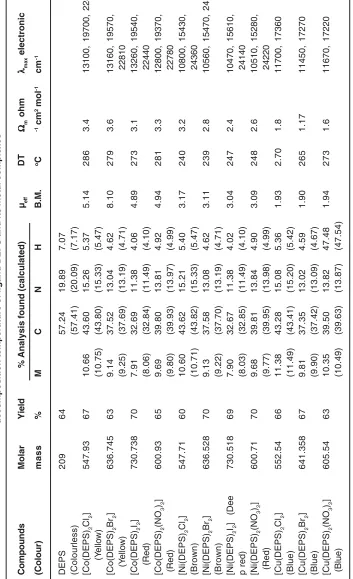
measurements were done on systronics conductivity meter model 303 using DMF as the solvent. Analytical data, electronic spectral data, molar conductance value, magnetic susceptibility value, decomposition temperature and molecular formula of the ligand as well as their complexes are recorded in Table-1 and the salient features of IR bands are recorded in Table-2.
Preparation of the ligand
Ethanolic solution of 2, 6-diethyl 4-pyrone (0.01M) was treated with semicarbazide hydrochloride (0.01 M) dissolved in ethanolic solution of sodium acetate in tetrahydrofuran. The resulting mixtures were heated on water bath for 4 h with frequent stirring. The precipitate was filtered, washed with ether. The residue was washed with
water and recrystallized with DMF. m.p- 126±1oC.
Yield 60-65%.
Preparation of the complexes
The complexes of Cobalt(II), Nickel(II) and Copper(II) have been prepared by reacting an ethanolic solution of the ligand 2-6-diethyl 4-pyrone semicarbazone (DEPS) with ethanolic solution of the corresponding metal halide/ nitrate/ perchlorate in the molar ratio 2:1. The procedure carried out in each case was of similar nature with a slight variation of timing of reflux. The complexes obtained in each case were washed with ethanol to remove
any excess of the ligand. Finally, complexes were washed with anhydrous diethyl ether and dried in air oven. Yield 70-75%.
RESULTS AND DISCUSSION I.R.Spectra
IR spectrum of the ligand DEPS exhibits a
medium broad band at 3220 cm 1 assigned14,15 to
nN—H. In the spectra of the complexes this band
appears without any change, indicating that either primary amino or secondary amino groups has not taken part in the coordination with metal ion.
IR spectrum of the ligand exhibits a sharp
strong band at 1740 cm-1 assigned21 to n
C=O. In the
spectra of the complexes, this band is shifted to
higher frequency region and appear at 1770 cm-1
with slightly reduced intensity. The shift of the band and change in intensity suggest coordination through carbonyl oxygen of semicarbazone moiety. The linkage with oxygen atom is further supported by the appearance of a new band in the far ir region
at 540-510 cm-1 in the complexes assignable19 to
nM–O. The IR spectrum of the ligand exhibits a band
at 1500 cm-1 assigned22 to n
C=N. In the spectra of the
complexes this band shows red shift with slightly reduced intensity. The shift of the band and change in intensity proposes coordination of azomethine N with metal ion. The linkage with nitrogen atom is further supported by the appearance of a band in
the far ir region at 395-370 cm-1 assigned19 to n
M–N. The evidence of metal halogen is confirmed by the low molar conductance of the complexes in the
range 1.6-3.6 ohm-1 cm2 mol-1. This statement is
further confirmed by the appearance of a band in
far ir region at 320-275 cm-1 which assigned19 to n
M–
X. Nitrate complexes show characteristic medium
intensity bands at 1375 and 1245 cm 1 with a
separation of about 130 cm 1 due to monodentately
coordinated nitrate23 group.
The electronic spectral and magnetic susceptibility value tentatively proposes octahedral geometry of Co(II), Ni(II) and Cu(II) complexes.
Conductivity measurement
Molar conductance values of the complexes of Cobalt(II), Nickel(II) and Copper(II)
T a b le 1: Anal ytical, colour , mol. wt.,
magnetic susceptibility v
alues,
conductivity measurement and
decomposition temperature of ligand DEPS and its metal complexes
Compounds
Molar
Yield
%
Analysis found (calculated)
µeff DT ΩΩΩΩΩm ohm λλλλλmax electronic (Colour) mass % M C N H B.M. oC -1 cm 2 mol
-1 cm -1 DEPS 2 0 9 6 4 57.24 19.89 7.07 (Colourless) (57.41) (20.09) (7.17) [Co(DEPS) 2 Cl 2 ] 547.93 6 7 10.66 43.60 15.26 5.37 5.14 2 8 6 3 .4
13100, 19700, 22840
(Y ello w) (10.75) (43.80) (15.33) (5.47) [Co(DEPS) 2 Br 2 ] 636.745 6 3 9.14 37.52 13.04 4.62 8.10 2 7 9 3 .6 13160, 19570, ( Y ello w ) (9.25) (37.69) (13.19) (4.71) 22810 [Co(DEPS) 2 I2 ] 730.738 7 0 7.91 32.69 11.38 4.06 4.89 2 7 3 3 .1 13260, 19540, (Red) (8.06) (32.84) (11.49) (4.10) 22440 [Co(DEPS) 2 (NO 3 )2 ] 600.93 6 5 9.69 39.80 13.81 4.92 4.94 2 8 1 3 .3 12800, 19370, (Red) (9.80) (39.93) (13.97) (4.99) 22780 [Ni(DEPS) 2 Cl 2 ] 547.71 6 0 10.60 43.62 15.21 5.40 3.17 2 4 0 3 .2 10800, 15430, (Brown) (10.71) (43.82) (15.33) (5.47) 24360 [Ni(DEPS) 2 Br 2 ] 636.528 7 0 9.13 37.58 13.08 4.62 3.11 2 3 9 2 .8
10560, 15470, 24100
(Brown) (9.22) (37.70) (13.19) (4.71) [Ni(DEPS) 2 I2
] (Dee
730.518 6 9 7.90 32.67 11.38 4.02 3.04 2 4 7 2 .4 10470, 15610, p red) (8.03) (32.85) (11.49) (4.10) 24140 [Ni(DEPS) 2 (NO 3 )2 ] 600.71 7 0 9.68 39.81 13.84 4.90 3.09 2 4 8 2 .6 10510, 15280, (Red) (9.77) (39.95) (13.98) (4.99) 24220 [Cu(DEPS) 2 Cl 2 ] 552.54 6 6 11.38 43.28 15.08 5.36 1.93 2.70 1 .8 11700, 17360 (Blue) (11.49) (43.41) (15.20) (5.42) [Cu(DEPS) 2 Br 2 ] 641.358 6 7 9.81 37.35 13.02 4.59 1.90 2 6 5 1.17 11450, 17270 (Blue) (9.90) (37.42) (13.09) (4.67) [Cu(DEPS) 2 (NO 3 )2 ] 605.54 6 3 10.35 39.50 13.82 47.48 1.94 2 7 3 1 .6 11670, 17220 (Blue) (10.49) (39.63) (13.87) (47.54)
DT = Decomposition
T
emeper
Table 2: Salient features of IR spectral bands of ligand DEPS and its metal complexes Compounds νννννN–H νννννC = O νννννC = N νννννM – O νννννM – N νννννM – X
DEPS 3260 s,b 1740 s,b 1500 s,b
[Co(DEPS)2Cl2] 3260 s,b 1765 m,b 1480 m,b 540 m 395 m 310 m
[Co(DEPS)2Br2] 3260 s,b 1770 m,b 1475 m,b 535 m 390 m 285 m
[Co(DEPS)2I2] 3260 s,b 1770 m,b 1475 m,b 535 m 385 m 275 m
[Co(DEPS)2(NO3)2] 3260 s,b 1760 m,b 1475 m,b 535 m 390 m
[Ni(DEPS)2Cl2] 3260 s,b 1760 m,b 1480 m,b 525 m 395 m 320 m
[Ni(DEPS)2Br2] 3260 s,b 1765 m,b 1480 m,b 520 m 390 m 290 m
[Ni(DEPS)2I2] 3260 s,b 1765 m,b 1480 m,b 520 m 395 m 280 m
[Ni(DEPS)2(NO3)2] 3260 s,b 1765 m,b 1480 m,b 525 m 370 m
[Cu(DEPS)2Cl2] 3260 s,b 1765 m,b 1475 m,b 510 m 395 m 320 m
[Cu(DEPS)2Br2] 3260 s,b 1770 m,b 1475 m,b 510 m 390 m 290 m
[Cu(DEPS)2(NO3)2] 3260 s,b 1765 m,b 1475 m,b 515 m 380 m
m = medium, s = strong, b = broad
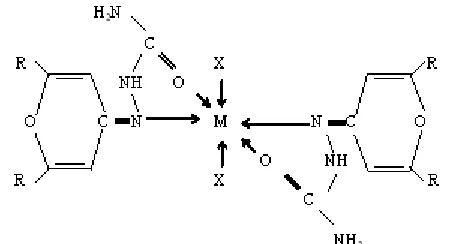
Fig.1: [M(DEPS)2X2]; M = Co(II), Ni(II) and Cu(II); X = Cl-, Br-, I-, NO 3
- and ClO 4
-; R = Eethyl
DMF indicating their nonelectrolytic22 nature. The
values of conductance also support the structure assigned on the basis of elemental analysis, IR spectra and magnetic susceptibility values.
CONCLUSIONS
Thus on the basis of the above studies it is concluded that the complexes possess the octahedral geometry around the central metal ion as shown in Fig.1.
REFERENCES
1. Sharda L. N. and Ganorkar M. C., Indian J.
Chem., 27: 617 (1988).
2. Margalioth E. J., Schenker J. G. and Chevion
M., Cancer, 52: 868 (1983).
3. Toyota E., Chinen C., Sekizaki H., Itoh K. and
Tanizawa K., Chemical and Pharmaceutical Bulletin, 44(5): 1104 (1996).
4. Theophanides T. and Anastassopoulou J.,
Crit Rev. Oncol Hematol, 42: 57 (2002).
Indian J. Chem., Sect A, 37: 747 (1998).
6. Jadegoud Y., Ijare O. B., Mallikarjuna N. N.,
Angadi S. D. and Mruthyunjaya B. H. M., J. Indian Chem. Soc., 79: 921 (2002).
7. Valli G., Sivakolunthu S., Thirunalaikumar M.,
Muthusubrmanian S., Sivasubramanina S., J. Indian Chem. Soc., 79: 79 (2002).
8. S. Santhi and C.G. Radhakrishnan
Namboori., Orient J. Chem., 27(3):
1203-1208 (2011).
9. R. Moubarake Li. R., Murray B. and Brooke
K. S., J. Chem. Soc., Dalton Trans, 6014 (2008).
10. Chandra S. and Gupta K., Trans. Met. Chem.,
27: 196 (2002).
11. Chandra S., Jain D., Sarkar A. and Chandra
R., Spectrochim Acta., Part A, Molecular and Biological Spectroscopy, 60: 2411 (2004).
12. Firdaus F., Fatima K., Khan S. N., Khan A. U.
and Shakir M., Trans. Met. Chem., 33: 467 (2008).
13. Kaden T. A., Toptes Curr. Chem., 121, 1984,
54; Bernhardt P. V. and Lawrance, Coord. Chem. Rev., 194: 297 (1990).
14. Y. Jubaira Beevi, G. Rajendran and Yohannan
Panicker, Orient J. Chem., 27(1): 329-332
(2011).
15. Rai B. K. and Kumari Rachana, Asian J.
Chem., 23: 4625 (2011).
16. Rai B. K., Sinha Puja, Vidyarthi S. N. and
Singh Vineeta, Asian J. Chem., 23: 4629 (2011).
17. Rai B. K. and Kumar Bimal, Asian J. Chem.,
23: 4635 (2011).
18. Rai B. K., Singh Vineeta, Vidyarthi S. N. and
Sinha Puja, Asian J. Chem., 23: 4638 (2011).
19. Rai B. K. and Anand Puja, Orient J. Chem.,
28: 525 (2012).
20. Vogel; A.I., A Textbook of quantitative
chemical Analysis, Revised by Mendham, J. Denny R.C., Barnes J. D. and Thomas M.,
Pearson Education, 7th Edn; London, (2008).
21. Silverstein, R.M. and Webster F. X,
Spectrometric Identification of Organic
Compounds, 6th Edn., John Wiley and Sons,
2008, 109. William Kemp, “Organic
Spectroscopy”, 3rd ed., Palgrave, New York,
2008; Ferraro J. R., “Low Frequency Vibration of Inorganic and Coordination Compound”, Plenum Press, New York.
22. Agarwal R. K., Agarwal Himanshu and
Chakraborti, Synth. React. Inorg. Metal Org. Chem., 25: 679 (1995).
23. Addition C. C., Logan N., Wallwork S.C. and
Barner D. C., Quart. Rev., (1971).
24. Boghaei; D.A. and Zadegan; N. Lashani,