Centre
of
Excellence
for
Nuclear
Materials
Workshop
Materials
Innovation
for
Nuclear Optimized
Systems
December 5-7, 2012, CEA – INSTN Saclay, France
Jean HENRY et al.
CEA (France)
Irradiation Resistance in a Fusion Environment: a
Challenge for Structural Materials
Workshop
organized
by:
Christophe
GALLÉ,
CEA/MINOS,
Saclay
–
[email protected]
Workshop
Materials
Innovation
for
Nuclear
Optimized
Systems
December 5-7, 2012, CEA – INSTN Saclay, France
Irradiation Resistance in a Fusion Environment: a Challenge for
Structural Materials
Jean HENRY
1, Jean-Louis BOUTARD
21CEA/DEN-DMN, Service de Recherche Métallurgiques Appliquées, SRMA (Saclay, France) 2
CEA, Cabinet du Haut-Commissaire (Saclay, France)
The safe and reliable operation of future fusion power plants will require structural materials able to withstand highly demanding operating conditions. Indeed the materials of the First Wall, Tritium Breeding Blankets or Divertor, will be subjected to intense fluxes of high energy neutrons, up to high total doses and in a wide range of in-service temperatures. In this presentation, we will discuss the irradiation behavior of candidate steels for fusion application.
In the absence of an irradiation facility with a prototypical neutron flux, irradiation effects in these materials, such as the 9Cr tempered martensitic steel Eurofer, were up to now assessed based in particular on experiments using fission reactors. This approach has some relevance since both experimental data and Molecular Dynamics simulations indicate that the primary displacement damage in iron is very similar after irradiation by fission or 14 MeV neutrons. Furthermore damage rates in fusion devices will be very close to values typical of fast reactors such as BOR60.
Like other 9Cr martensitic steels, Eurofer steel exhibits negligible swelling and very moderate hardening and embrittlement at irradiation temperatures above approximately 380-400°C. However results of irradiation experiments performed at 325°C up to about 80 dpa in BOR60 [1] showed an important increase of the yield stress in irradiated Eurofer and a significant degradation of the impact properties (large shift of the Ductile-to-Brittle Transition Temperature and decrease of the upper shelf energy). TEM and SANS investigations revealed that these modifications of the mechanical properties are due to the irradiation-induced formation of a high density of small dislocation loops and to alpha/alpha’ unmixing.
In fusion irradiation conditions, significant amounts of helium and hydrogen will be produced in the materials in addition to displacement damage. Implantation experiments using a cyclotron have revealed that helium can induce a drastic embrittlement of 9Cr martensitic steels, with the occurrence of intergranular fracture [2, 3]. This fracture behavior is consistent with the results of electronic structure calculations which indicate that helium severely decreases grain boundary cohesion in iron. Likewise, measurements of tensile and impact properties after irradiation of 9Cr martensitic steels in a spallation environment show a degree of embrittlement significantly greater than that expected after irradiation in fission conditions, which is attributed in particular to the high helium content in the irradiated specimens [3]. Furthermore, results of dual (Fe+He) and triple (Fe+He+H) ion beam irradiations indicate that the high swelling resistance of Ferritic/Martensitic steels might not be maintained in a fusion irradiation environment.
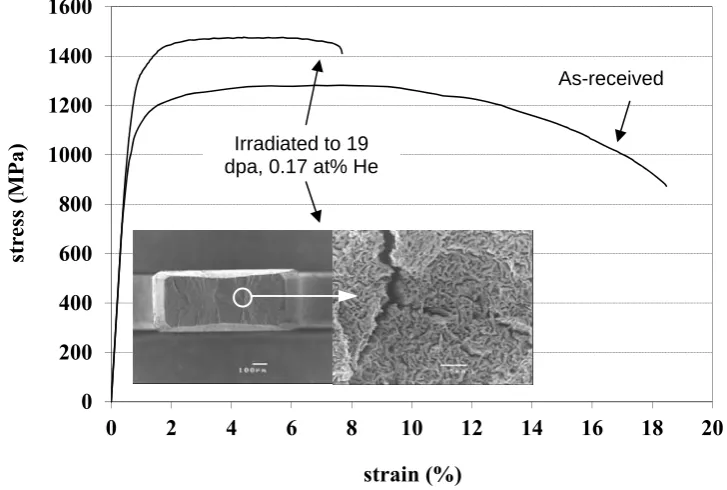
By contrast, Oxide Dispersion Strengthened (ODS) FM steels are promising materials for fusion application. In addition to lower irradiation-induced hardening at low temperature than FM steels [1], ODS displayed a better mechanical behavior after irradiation in spallation conditions [4]. Figure 1 shows an example of tensile curves measured on MA957 ODS irradiated in the SINQ spallation target. Irradiated MA957 retained significant ductility whereas FM steels subjected to identical irradiation conditions exhibited a brittle intergranular fracture mode. The high density of nanoclusters in ODS FM steels are believed to act as effective sinks for point defects as well as trapping sites for helium and hydrogen, which is confirmed by microstructural observations [5].
EPJ Web of Conferences 51, 04006 (2013) DOI: 10.1051/epjconf/20135104006
© Owned by the authors, published by EDP Sciences, 2013
Workshop
Materials
Innovation
for
Nuclear
Optimized
Systems
December 5-7, 2012, CEA – INSTN Saclay, France
0 200 400 600 800 1000 1200 1400 1600
0 2 4 6 8 10 12 14 16 18 20
st
re
ss (
M
Pa
)
strain (%)
Fig. 1: Engineering tensile curve measured at room temperature and SEM micrographs showing the ductile fracture surface of MA957 ODS after irradiation at 360°C to 19 dpa in the
SINQ spallation target. The accumulated He content in the irradiated specimen is about 0.17 at%. These data demonstrate the good mechanical behavior of MA957 following irradiation in
an environment with high He/dpa ratio [4].
Finally it must be emphasized that the above mentioned data were not obtained in a fusion representative environment. Hence modeling of irradiation effects, which has made great progress in recent years as demonstrated by other presentations in this workshop, will be a necessary tool to extrapolate the experimental results to the real case and to optimize the experimental program to be conducted in a future intense 14 MeV neutrons source such as IFMIF.
References
[1] J. Henry, X. Averty, A. Alamo. J. Nucl. Mater. 417 (2011) 99.
[2] R. Schäublin, J. Henry, Y. Dai. Comptes Rendus Physique, 9 (2008) 389.
[3] Y. Dai, J. Henry, Z. Tong, X. Averty, J. Malaplate, B. Long.J. Nucl. Mater 415 (2011), 306. [4] J. Henry, X. Averty, Y. Dai, J.P. Pizzanelli, J.J. Espinas. J. Nucl. Mater 386–388 (2009) 345. [5] L. Hsiung, M. Fluss, S. Tumey, B. Choi, Y. Serruys, F. Willaime, A. Kimura. Phys. Rev. B 82
(2010) 184103.
Irradiated to 19 dpa, 0.17 at% He
Irradiation resistance in a fusion
environment: a challenge for
structural materials.
MINOS Workshop, Materials Innovation for Nuclear Optimized Systems
structural materials.
J. Henry
1
, J-L. Boutard
2
1
CEA/DEN, SRMA, CEA Saclay
MATERIALS FOR THE FIRST WALL: IRRADIATION
CONDITIONS
Dual coolant blanket module
P. Norajitra, KIT
First Wall
Dose (dpa) Temperature appmHe/dpa
ITER
Austenitic steel
<3 dpa
<300
oC
~15
DEMO
EUROFER
50-80 dpa
300-550
oC
~12
OUTLINE
Irradiation effects in candidate materials assessed using fission reactors. Is it
relevant?
9Cr martensitic steels
Main reasons for their selection (irradiation behaviour at T>400°C)
Behaviour (tensile/impact) after high dose irradiation at T<400°C (fast reactor)
Behaviour (tensile/impact) after high dose irradiation at T<400°C (fast reactor)
Does Helium matter?
ODS FM steels: promising candidates for fusion application?
ARE FISSION REACTORS RELEVANT TO STUDY
IRRADIATION EFFECTS IN A FUSION ENVIRONMENT?
DAMAGE RECOVERY STAGES AFTER 14 MEV AND
FISSION NEUTRON IRRADIATION AT 20K
R
e
s
is
ti
v
it
y
T
n n n n n
14 MeV and Fission Neutrons:
Same Surviving Defects
M. Matsui et al. J. Nucl. Mater. 155-157 (1988) 1284
T
T
R
e
s
is
ti
v
it
y
(
ρ
)
-d
ρ
/d
T
recovery stages
FM STEELS: IRRADIATION BEHAVIOUR AT T>400°C
100 200
300 F17Cr SLF17Cr ST
M12Cr (HT9) SL M12Cr (HT9) ST
M9Cr (EM10) SL M9Cr (EM10) ST
D
B
T
T
(°
C
)
17%Cr
12%Cr
Dose: 70 - 110 dpa - Phenix irradiation
J.L. Séran et al. J. Nucl. Mater. 212-215 (1994) 588-593.
-100 0
400 450 500 550 600
D
B
T
T
(°
C
)
IRRADIATION TEMPERATURE (°C)
12%Cr
9%Cr
600
700
800
900
1000
Y
S
(
M
P
a
)
12
14
16
18
20
T
o
ta
l
E
lo
n
g
a
ti
o
n
(
%
)
9Cr1Mo (EM10) & 9Cr1MoVNb (T91)
EUROFER & RAFM
BOR60
9Cr TEMPERED MARTENSITIC STEELS: HARDENING
AND TOTAL ELONGATION /DOSE (T
IRR
: 325°C)
0
100
200
300
400
500
0
20
40
60
80
100
dpa
∆∆∆∆
Y
S
(
M
P
a
)
0
2
4
6
8
10
T
o
ta
l
E
lo
n
g
a
ti
o
n
(
%
)
9Cr1Mo & 9Cr1MoVNb
EUROFER & RAFM
EUROFER IRRADIATED TO 78 DPA @ 325°C
MICROSTRUCTURE (TEM)
SANS with
Magnetic Contrast
q
r
θ
I
nuclear
I
nuclear
+ I
magn.
H
EUROFER IRRADIATED TO 78 DPA @ 325°C
MICROSTRUCTURE (SANS)
A
magn
nucl
=
ρ
∆
ρ
∆
+
ρ
∆
=
⊥
2
2
.
2
)
I(q
)
I(q
Sample
)
,
(
)
I(q
)
I(q
||
f
.
2
F
q
R
magnetic
1
10
Eurofer 97
⊥
to H
unirradiated
⊥
to H
Eurofer 97 // to H
unirradiated // to H
i
n
c
m
-1
a)
R
m(nm)
N (m
-3)
A ratio
1.4
4 10
232.0
±
0.2
α
’
EUROFER IRRADIATED TO 78 DPA @ 325°C
MICROSTRUCTURE (SANS)
Euforer irradiated (fission spectrum) in the lower
0.01 0.1
0.2 0.4 0.6 0.8 1 1.2 1.4 1.6 1.8
d
Σ
/d
Ω
i
n
c
m
q in nm
-1Euforer irradiated (fission spectrum) in the lower
range of foreseen operating temperatures (<
380°C):
High hardening and large DBTT shift
formation of a high density of small
DOES HELIUM MATTER?
∼ 11
appm He/dpa
9CR MARTENSITIC STEELS: EMBRITTLEMENT DUE
TO IMPLANTED HELIUM
0 200 400 600 800 1000 1200 1400 1600
0 2 4 6 8 10
σσσσ ( M P a ) εεεε (%) T
imp= 250 °C
T
imp= 550 °C Unimplanted
Tensile tests tests @ RT on samples implanted with 0,5 % at He @ 250 & 550°C
Implanted He may induce (depending on
concentration/implantation temperature)
drastic embrittlement with occurrence of
intergranular fracture mode
Hardening (point defect clusters/He
bubbles)
Strong decrease of GB cohesion due to
helium (C.C. Fu SRMP)
0 100 200 300 400 500 600 700 800 900
0 0,01 0,02 0,03 0,04 0,05 0,06
Opening displacement (mm)
L o a d ( N ) 400°C 250°C 0 100 200 300 400 500 600 700 800 900
0 0,01 0,02 0,03 0,04 0,05 0,06
Opening displacement (mm)
L o a d ( N ) 0 100 200 300 400 500 600 700 800 900
0 0,01 0,02 0,03 0,04 0,05 0,06
Opening displacement (mm)
L o a d ( N ) 400°C 250°C
Bending tests @ RT on mini-Charpy samples implanted with 0,25 % (0.125) at He @
250 & 400°C ImplantedZone
800
1000
1200
1400
1600
st
re
ss
(
M
P
a
)
10.7 dpa160°CHe : 850 15.2 dpa
230°C
He : 1305 19.6 dpa
295°C
He : 1740
19.9 dpa
290°C
He : 1825
19.6 dpa
9CR-1MO (T91) FM STEEL: TENSILE PROPERTIES
FOLLOWING IRRADIATION IN SPALLATION CONDITIONS
0
200
400
600
800
0
2
4
6
8
10
12
14
16
18
20
strain (%)
st
re
ss
(
M
P
a
)
unirradiated 7.2 dpa115°C
He : 565
The specimens irradiated to
the highest doses (and He
content) exhibited very high
hardening and fully brittle,
intergranular fracture
ODS FM STEELS: PROMISING MATERIALS FOR
FUSION APPLICATION?
OSD MA957 : 14Cr-1Ti-0.3Mo-0.25Y2O3
400 500 600 700 800 9Cr1Mo 9Cr1MoVNb F82H JLF-1 EUROFER 9Cr2WTaV ODS-MA957 In c re a s e o f Y ie ld S tr e s s ( M P a
) 9Cr1MoVNb
9Cr1Mo
RAFM-steels
ODS-MA957
BOR 60
Mechanically Alloyed ODS F/M alloys such as MA957
contain high number densities of “nanoclusters” which
could
act
as
recombination
sites
for
point
defects/trapping sites for helium.
Miller et al., J. Nucl. Mater. 329-333 (2004) 338
0 100 200 300
0 10 20 30 40 50
In c re a s e o f Y ie ld S tr e s s ( M P a )
Displacement damage (dpa)
ODS-MA957
T
test = Tirrad = 300-325°C
MA957 ODS: TENSILE PROPERTIES FOLLOWING
IRRADIATION IN SPALLATION CONDITIONS
800
1000
1200
1400
1600
st
re
ss
(
M
P
a
)
Irradiated to 19 dpa
(~ 300°C), 0.17 at% He
As received
MA957