SPECIAL FEATURES OF PHOTOGRAPHIC DOCUMETATIO FOR PATIETS WITH COMPLETE DETURES.
Mariana Dimova1∗∗∗∗, Hrizdana Hadjieva2, Elena Hadjieva3
1 Department of Prosthodontics- Faculty of Dental Medicine, Medical University –
Sofia and Department of Prosthodontics - Faculty of Dental Medicine, Medical University – Varna, Bulgaria
2
Department of Prosthodontics- Faculty of Dental Medicine, Medical University – Sofia, Bulgaria
3
General Practitioner
*Corresponding Author
Mariana Jordanova Dimova, D.D.S., Assoc. Prof.
Department of Prosthodontics- Faculty of Dental Medicine, Medical University – Sofia Sv. Sv. G. Sofijski – Boul. 1, floor. 8, 1431 Sofia, Bulgaria
Telephone No: +359888872509 E- mail: [email protected]
Summary
Along with the development of photography and technologies, photo documentation in dental practice is getting more and more important for documentation, discussion, saving and exchange of information.
There is great amount of articles in the literature presenting and documenting different clinical cases especially those with esthetic treatment with ceramic, metal-ceramic or composite prostheses because of the good abilities and high resolution of dental photography.
The aim of the authors is to suggest an approach for documentation of clinical findings, cast situation models, x-ray examination, and the old and new treatment in completely edentulous patients.
The objects of our observation are 42 patients (26 women and 16 men) aged from 45 to 81 years. All patients are totally edentulous and are subjected to complete denture treatment. Patients’ agreement is achieved for photo documentation of treatment process’ stages.
The individual characteristics and treatment stages in every dental treatment could be documented and saved in database for educational and evidential purposes. The loss of teeth doesn’t make the photo documentation easier or uninteresting but acquires skill, preparation and conformity of its special features.
Introduction
Before working out the treatment plan for complete dentures the prosthodontist should observe, estimate, evaluate, summarize and save the information gathered from the clinical examination, the x-ray examinations and situation cast models for an analysis of the case.
The detailed clinical examination of edentulous jaws at the first appointment and the information transfer to the patients’ individual record 1, 2, 3, 4, 5, 6 allows to identify and record the anatomical characteristics, intermaxillary correlations (due to the old prostheses) as well as the following components: tongue’s features (impressions, changes in the epithelium, plaque, size, mobility, and neoplastic changes), lips’ peculiarities (herpes, rhagades and others), the tonus of cheeks and lips.
It should be stressed upon the fact that the clinical findings described in patient’s record do not evoke identical understanding of the status 7, 8 in different clinicians, who read the document. The subjective character of perception depends on the level of theoretical and practical education, the individual clinical experience and postgraduate qualification of the clinician.
Detailed observation of the old treatment (if there was any) possesses also an important diagnostic value (9, 10). The inspection and evaluation of old dentures in respect to the prosthetic margins, retention, stability, occlusal height and articulation helps to estimate and make indirect conclusions for the chewing ability and effectiveness and gives trends for subsequent investigation and treatment planning. In this sense the information gathered from the old denture treatment gives additional characteristics to the whole “picture” and should be saved in the patients’ personal record during the whole treatment and after that.
The situation casts of both jaws (2, 5) has the advantage of presenting a 3D- prosthetic area, but this kind of documentation doesn’t have informative value regarding color and texture of the mucosa (inflammation, hyperkeratosis, desquamation etc.) .
Another important documental and diagnostic means, which gives more information to the whole edentulous clinical case is the radiological investigation (11, 12), It is found quite often impacted teeth, parts of roots, cysts and other problems in the jaw bones.
Therefore the information gathered from the above mentioned diagnostic methods should be visualized, summarized and saved throughout the treatment which becomes possible with the help of photo documentation13, 14, 15, 16, 17. According to Krieger G. D.18 the dentists should be taught that “a single picture is more informative than a thousand of words”. T. Hedge 16 points out that the postgraduate educational programs in some dental schools include preparing and presenting of a complete treatment plan of a case, including at least 16 photos.
In this work the authors share their experience in photo documenting a great number of edentulous patients and points out the characteristic features of that process as well as a protocol for arranging a case of treatment with full dentures.
The photo documentation has been carried out with the help of a digital camera Nikon Coolpix 4500 4 MPx-CCD sensor, max image size: 2272x1704 pixels, TIFF-RGB or JPEG formatting. A ring light is used - SL-1 Macro cool light. The “white balance” has been set up. For the intraoral pictures a set of mirrors are used, contrast plates and retractors (Nichrominox - France). For the photo documentation of upper and lower prosthetic area middle or big occlusal mirrors are used. For left and right occlusal shots there have been used big or middle lateral mirrors.
The suggested from the authors’ protocol for photo documentation of the prosthetic treatment of edentulous patients includes:
I. Photo documentation before the beginning of treatment:
• Extraoral pictures in full face and in half face (side view) of the patient without his old dentures (Fig. 1, 2) at physiological rest and with the dentures (if there are any) in central occlusion.
• Extraoral pictures in full face with the old dentures (if there are any)-smile
• Intraoral pictures of prosthetic area on upper jaw (Fig. 5, 6, 7, 8) and lower jaw (Fig. 9, 10, 11) - “occlusal view”.
• Focusing on special characteristics or peculiarities of prosthetic area and the adjacent tissues. (Fig. 12, 13, 14, 15, 16).
• Extraoral pictures of old dentures (Fig. 20).
II. Photo documentation of situational cast models of upper and lower jaw- an “occlusal” view (Fig. 18, 19) and a picture of the panoramic x-ray examination (Fig. 17)
III. Photo documentation afterfinishing the prosthetic treatment:
• Extraoral (not in the mouth) pictures of the new pair of dentures (Fig. 21)
• Intraoral pictures with the new dentures in central occlusion-frontal and side view (Fig. 22, 23).
• Extraoral pictures in full face and in half face (sidevew) of the patient with the new dentures in central occlusion (Fig. 3, 4).
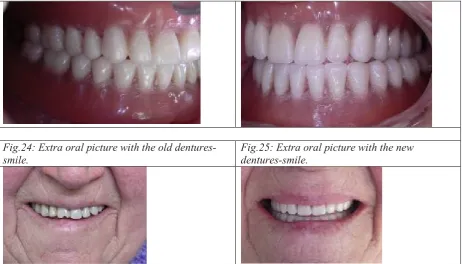
• Extraoral picture with the old and new dentures-smile (24, 25).
Fig. 1, 2: Extraoral pictures in full face and in half face (side view) of the patient without dentures.
Fig.5: Picture of upper jaw – occlusal view of the prosthetic area.
Fig.6: Picture of upper jaw-incorrect positioned frame: missing part of right tuber maxillae and hamulus maxillae.
Fig.7: A picture of upper jaw –sidelong view. A part of the palate’s vault and of the “A”-line are not seen, but the frenuli buccales, frenulum labiale and the retention of the left tuber maxillae are well seen.
Fig.8: A picture of upper jaw-a second to third stage of prosthetic stomatitis, lots of micro ulcerations and hematomas and exostosis in region 15.
Fig.9: A Picture of a lower jaw-occlusal view to the prosthetic area.
Fig.11: Pictures of lower jaw- the retractors are hiding part of the vestibulum.
Fig.12: Focusing on special characteristics of the prosthetic tissues-papillomatosis.
Fig.13: Changes in the soft oral tissues-hemangioma of the cheek.
Fig.14: Changes in the soft oral tissues-papilloma of the tongue.
Fig.17: A panoramic x-ray graph
Fig.18: A situation model of upper jaw- an occlusal view.
Fig.19: A situation model of lower jaw- an occlusal view.
Fig.20, 21: Picture of the old and the new dentures.
Fig.24: Extra oral picture with the old dentures-smile.
Fig.25: Extra oral picture with the new dentures-smile.
Extraoral pictures are made on dark colored background and at approximately equal distance between the patient and the camera and between the patient and the background.
An assistance of a helping stuff - a nurse, or assistant, was used while making the intraoral pictures and regarding the following characteristics of shooting: The patient was asked to hold the retractor (or retractors), while the nurse puts and holds the intraoral mirror and blows across it with a stream of air.
For the lower jaw occlusal view shot, the patient was asked to hold his tongue towards the throat additionally pushing it back with the mirror.
By photo documenting the occlusion with the prostheses in mouth the axis of objective should lay parallel to the occlusal plane for making the best and exact shot. When photo documenting the buccal right and left shots in occlusion the lateral mirror retracts the side objected to shooting. Those side pictures are shots in the mirror with the opposite side retracted.
Results and discussion
The extraoral photo documentation is not difficult and could be done easily from every photographer following the protocol sequence (Fig.1-6).
The intraoral photo documentation is not only connected with certain technical equipment and a trained assisting stuff but with good knowledge of prosthetic area anatomy too.
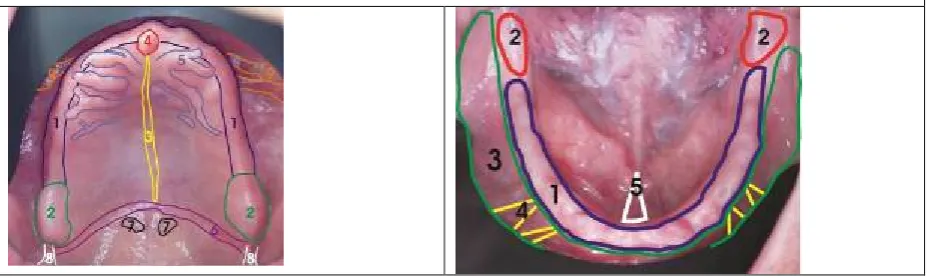
Fig. 26 and 27 show the schematic examples of the prosthetic bearing tissues with all the desired elements of the prosthetic area which have to be included in the photographic frame and in the impression and cast too.
Fig. 26: Schematic example of the elements of the prosthetic area of upper jaw: 1. crista alveolaris maxillae; 2. tuberi maxillae; 3. raphe mediana; 4. papilla incisivаe; 5. rugae palatinae; 6. “А” line;
Fig. 27: Schematic example of the elements of the prosthetic area of lower jaw: 1. crista alveolaris mandibulae; 2. trigonum retromolare; 3. vestibulum oris; 4. frenuli buccales; 5. frenulum lingue, frenulum labiale, regio sublingualis.
For the upper jaw these elements are: crista alveolaris maxillae and tuberi maxillae; raphe mediana (torus palatinus); papilla incisive; rugae palatinae; the zone of “А” line, foveae palatinae and plicae pterygomandibulare (hamuli maxillae). By photo documentation of the lower jaw the following elements should be reflected: crista alveolaris mandibulae; trigonum retromolare; vestibulum oris; frenuli buccales; frenulum lingue, frenulum labiale and regio sublingualis.
The photo documentation of edentulous patients could be considered as an easy work to do because of the fact that the patient has no teeth. This is but on the face of it and according to the authors, the totally edentulous patients are the most unfavorable group for colleagues with insufficient experience in intraoral photo documentation to begin with. That is because of the following (age determined) characteristics:
I. Local aspect characteristics:
• By elderly people the elasticity of tissues is quite reduced (low production of collagen and elastine). The perioral and face muscles’ tonus is also reduced which leads to sagging of the cheeks and lips and thus covering the alveolar ridges and causing additional effort to retract those soft tissues. The shortened length of the muscles’ fibers and sheaves makes difficult the wide opening of mouth in most patients and some of them look like they have microstomia. Hypovitaminosis, candidosis, angulus infectiosus oris, which are quite often seen among edentulous people, produce additional difficulties causing pain, rhagades and bleeding of the lips during their retraction for photo documentation.
• Patients who had not wear prostheses for a long time have their tongue usually enlarged by hypertrophy and with hypertonic activity. If in such case the patient has short frenulum lingue the retracting back of the tongue is not enough for a good picture. The resolution is to ask the patient to swallow and to stay with open mouth and the tongue put back and down. It is possible in the shot to present part of the tongue, which is hiding parts the lingual slopes of the lower jaw. It is recommended in such cases to use mirrors with lingual curve.
II. General aspect characteristics.
• Totally edentulous patients often are with lowered acoustic abilities or pressbyaccusis. That forces the dentist to repeat several times the explanations and directions of what they have to do before the photo documentation which lengthens the procedure in time.
• Usually old people get tired easily and when the photographing process gets longer the muscles tiredness cause tremor, which damages the possibility of getting a good focused picture. In other cases old patients’ general diseases as cardiovascular, respiratory, neurological, psychological and others, demands a quick and dynamic protocol. On the other hand in most cases there are no changes in the anatomy of the prosthetic area so it is not necessary to make pictures in the middle stages of the treatment as it is with the fixed prosthodontics’ patients. This allows us to suggest the photographic protocol only in two parts: photo documentation of patient at the first appointment before beginning the treatment, and documentation at the end of treatment. Exception of that could be done in cases with oral mucosa inflammation or preprosthetic surgery corrections. It is recommended to make an additional photo registration of treated areas.
• Sometimes local and general characteristic could interrupt and postpone photo documentation.
• The upper listed old age characteristics should not unmotivate the dentists for photo documentation of edentulous patients. There are also factors which facilitate this procedure and one of them is the low production of saliva (hypo salivation), which minimizes the need of constant evacuation of saliva.
• Another favorable factor is the availability of spare time of the patients, most of which are in pension and even are satisfied of the additional attention during the photo documentation.
• Patients readily sign the information agreement for photo documentation and collaborate through it. These additional interrelations between the patients and the clinician who direct the photo documentation has a good psycho-prophylactic effect and leads to a positive attitude of patients to the prosthodontic treatment.
Conclusions
The photographic diagnosis is as important as any other diagnostic method. As a mode of documenting information, photo documentation gives the greatest abundance of information. While at observation appointment some characteristics of totally edentulous prosthetic area can be missed the rational of photo documentation is that its information can be repeatedly reviewed after the patient leaves the clinic.
The clinical significance of photo documentation of edentulous patients consists of the following:
1. The ability of dental clinicians to distinguish and identify the anatomic parameters and characteristic of prosthetic area, to recognize and concentrate on specific findings which influence the diagnostics and future treatment plan are trained by the photographic protocol.
3. The data transfer between the clinics and the technical laboratories by means of photo documentation (including casts and written directions) improves the collaboration and create optimal prerequisite for successful treatment with full dentures.
4. The photo documentation allows creating a database of clinical cases with diagnostic, prognostic and evidence value. The comparative characteristics between the old and new prostheses give visualization of the success or failure of treatment.
The prosthetic treatment of a totally edentulous patient is a challenge for the clinicians and photo documentation of such cases is an indication for the professional level and qualification of practitioner. The protocol suggested for photo documentation of edentulous patients is suitable for presenting and discussing of a clinical case during educational seminars for students, postgraduates and colleagues.
References
1. Geering H, Kundert M. Total- und Hybridprothetik. Farbatlanten der Zahnmedizin, Georg Thieme Verlag Stuttgart New York; 1986. p. 7-16
2. Golgstein R, M Lancaster. Survey of patient attitudes toward esthetic procedures. J. P.D. 1984; 52: 775
3. Hupfauf L, Gernet W, Horn R, Jüde H, Kobes L, Landt H, et al. Totalprothesen. Praxis der Zahnheilkunde. Urban & Schwarzenberg; 1987. 2: p. 3-11
4. Winkler S. Essentials of Complete Denture Prosthodontics. Philadelphia W. B. Saunders; 1979. p. 88-141
5. Zarb G, Bolender C, Hickey J., Carlsson G. Boucher`s Prosthodontic Treatment for Edentulous Patients. St. Louis CV Mosby; 1999. p. 10
6. Angulo F. Panoramic radiograph in edentulous and partially edentulous patients. Acta Odontol. Venez. 1989; 27, 2-3: 60-67
7. Block N. Mental pictures and cognitive science. The Philosophical Review. XCII, 4, 1983; 21-24
8. Schneider F, Fink G. Funktionelle MRT in Psychiatrie und Neurologie Springer
Berlin – Heidelberg; 2007. p. 236-239
9. Alexander L. Effects of complete dentures on facial esthetics. J.P.D. 1964; 14, 2: 231-255
10.Brisman A. Esthetics: A comparison of dentist`s concepts. J. Am. Dent. Assoc. 1980, 100: 345
11.Keur, J., P. Campbell, J. Mc Carthy: Radiological findings in 1135 edentulous patients, J. Oral Rehab., 1987,14, 183-91
12.Mohamed S, Hamouda A, El-Gheriani W. Panoramic radiographic findings of edentulous patients prior to full denture. Ainshams Dental Journal 2005; VIII, 2: 255-259
13.Bengel W. Mastering Digital Dental Photography. Quintessence Publishing 2002; 249
14.Bang W. European mastering digital dental photography. Qintessence publishing, New Malden, Surrey, UK; 2006. P. 56-60