Centre
of
Excellence
for
Nuclear
Materials
Workshop
Materials
Innovation
for
Nuclear Optimized
Systems
December 5-7, 2012, CEA – INSTN Saclay, France
Bo SUNDMAN et al.
KTH (Sweden) and CEA-INSTN (France)
The Use of Computational Thermodynamics to Predict
Properties of Multicomponent Materials for Nuclear
Applications
Workshop
organized
by:
Christophe
GALLÉ,
CEA/MINOS,
Saclay
–
[email protected]
Constantin
MEIS,
CEA/INSTN,
Saclay
–
[email protected]
Workshop
Materials
Innovation
for
Nuclear
Optimized
Systems
December 5-7, 2012, CEA – INSTN Saclay, France
The Use of Computational Thermodynamics to Predict Properties of
Multicomponent Materials for Nuclear Applications
Bo SUNDMAN
1, Christine GUÉNEAU
21KTH (Stockholm, Sweden), ISNTN (Saclay, France)
2
CEA-DEN-DPC, Service de la Corrosion et du Comportement des Matériaux dans leur Environnement, SCCME (Saclay, France)
Computational Thermodynamics is based on physically realistic models to describe metallic and oxide crystalline phases as well as the liquid and the gas in a consistent manner [1]. The models are used to assess experimental and theoretical data for many different materials and several thermodynamic databases has been developed for steels, ceramics, semiconductor materials as well as materials for nuclear applications.
Within CEA a long term work is ongoing to develop a database for the properties of nuclear fuels and structural materials [2].
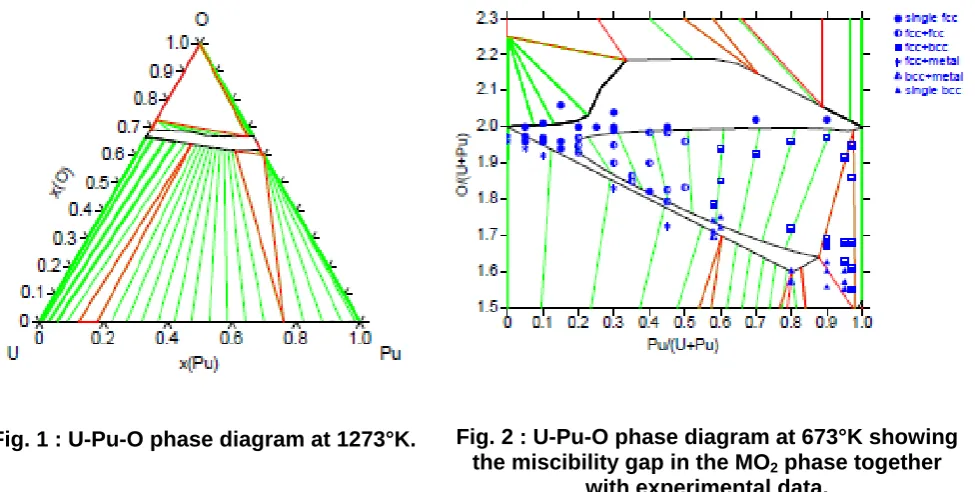
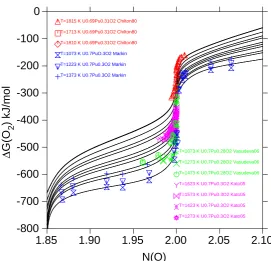
An overview of the modeling technique will be given and several examples of the application of the database to different problems, both for traditional phase diagram calculations and its use in simulating phase transformations. The following diagrams (Fig. 1, Fig. 2 and Fig.3) show calculations in the U-Pu-O system.
Fig. 1 : U-Pu-O phase diagram at 1273°K. Fig. 2 : U-Pu-O phase diagram at 673°K showing
the miscibility gap in the MO2 phase together
with experimental data. EPJ Web of Conferences 51, 01006 (2013)
DOI: 10.1051/epjconf/20135101006
© Owned by the authors, published by EDP Sciences, 2013
-800 -700 -600 -500 -400 -300 -200 -100 0 Δ G(O 2 ) kJ/mol
1.85 1.90 1.95 2.00 2.05 2.10
N(O) T=1815 K U0.69Pu0.31O2 Chilton80
T=1713 K U0.69Pu0.31O2 Chilton80
T=1810 K U0.69Pu0.31O2 Chilton80
T=1073 K U0.7PuO.3O2 Markin
T=1223 K U0.7Pu0.3O2 Markin
T=1373 K U0.7Pu0.3O2 Markin
T=1073 K U0.7Pu0.28O2 Vasudeva06
T=1273 K U0.7Pu0.28O2 Vasudeva06
T=1473 K U0.7Pu0.28O2 Vasudeva06
T=1623 K U0.7Pu0.3O2 Kato05
T=1573 K U0.7Pu0.3O2 Kato05
T=1423 K U0.7Pu0.3O2 Kato05
T=1273 K U0.7Pu0.3O2 Kato05
Fig. 3 : Oxygen chemical potentials at different temperatures and varying oxygen content for systems with Pu/u ratios around 0.3, together with experimantal data.
References
[1] H. Lukas, S. Fries, B. Sundman, Computational Thermodynamics. Cambridge University Press (2007).
[2] C. Guéneau, N. Dupin, B. Sundman, C. Martial, J.-C. Dumas, S. Gossé, S. Chatain, F. De Bruycker, D. Manar, R.J.M. Konings, Thermodynamic modeling of advanced oxide and carbide nuclear fuels: description of the U-Pu-O-C systems. J. Nucl Mater. 419 (2011) 145
Workshop
Materials
Innovation
for
Nuclear
Optimized
Systems
The use of Computational Thermodynamics to
predict properties of multicomponent materials
for nuclear applications
Bo Sundman and Christine Gu´eneau
INSTN and DEN/DANS/DPC/SCCME, CEA Saclay
Abstract
Computational Thermodynamics is based on physically realistic models to describe metallic and oxide crystalline phases as well as the liquid and gas in a consistent manner. The models are used to assess experimental and theoretical data for many different
materials and several thermodynamic databases has been
developed for steels, ceramics, semiconductor materials as well as materials for nuclear applications.
Within CEA a long term work is ongoing to develop a database for the properties of nuclear fuels and structural materials.
An overview of the modelling technique will be given and several examples of the application of the database to different problems.
Outline
◮ Thermodynamics
Outline
◮ Thermodynamics
◮ Computational Thermodynamics (CT, Calphad)
◮ models,
Outline
◮ Thermodynamics
◮ Computational Thermodynamics (CT, Calphad)
◮ models, ◮ software
Outline
◮ Thermodynamics
◮ Computational Thermodynamics (CT, Calphad)
◮ models, ◮ software
◮ assessments and databases
Outline
◮ Thermodynamics
◮ Computational Thermodynamics (CT, Calphad)
◮ models, ◮ software
◮ assessments and databases
◮ The fuelbase database.
Outline
◮ Thermodynamics
◮ Computational Thermodynamics (CT, Calphad)
◮ models, ◮ software
◮ assessments and databases
◮ The fuelbase database.
◮ Modelling oxides.
Outline
◮ Thermodynamics
◮ Computational Thermodynamics (CT, Calphad)
◮ models, ◮ software
◮ assessments and databases
◮ The fuelbase database.
◮ Modelling oxides.
◮ Summary and conclusions
Outline
◮ Thermodynamics
◮ Computational Thermodynamics (CT, Calphad)
◮ models, ◮ software
◮ assessments and databases
◮ The fuelbase database.
◮ Modelling oxides.
◮ Summary and conclusions
Literature:
◮ Nigel Saunders and Peter Miodownik, Calphad, Pergamon
Materials Series, Vol 1 (1998)
◮ Mats Hillert: Phase Equilibria, Phase Diagrams and Phase
Transformations, 2nd edition, Cambridge (2008).
◮ Leo Lukas, Suzana Fries and Bo Sundman,Computational
Thermodynamics, Cambridge (2007).
Classical Thermodynamics
Thermodynamics is a phenomenological theory describing the
relation between some observable properties like temperature, T,
pressure, P, heat Q, etc.
Classical Thermodynamics
Thermodynamics is a phenomenological theory describing the
relation between some observable properties like temperature, T,
pressure, P, heat Q, etc.
It is founded on two simple laws for macroscopic systems:
1. Energy cannot be destroyed or created,
Classical Thermodynamics
Thermodynamics is a phenomenological theory describing the
relation between some observable properties like temperature, T,
pressure, P, heat Q, etc.
It is founded on two simple laws for macroscopic systems:
1. Energy cannot be destroyed or created,
2. Heat never flows spontaneously from a cold body to a hot
body
Classical Thermodynamics
Thermodynamics is a phenomenological theory describing the
relation between some observable properties like temperature, T,
pressure, P, heat Q, etc.
It is founded on two simple laws for macroscopic systems:
1. Energy cannot be destroyed or created,
2. Heat never flows spontaneously from a cold body to a hot
body
These laws, and some trivial mathematics, makes it possible to
define a number of additional properties like internal energy, U,
entropy, S, Gibbs energy, G etc. These are not observables but can
be used to derive strict mathematical relations between many properties.
Properties derived from the Gibbs energy
S = −
∂G
∂T
P,Ni
H = G −TS V =
∂G
∂P
T,Ni
µi =
∂G
∂Ni
T,P,Nj6=i
Properties derived from the Gibbs energy
S = −
∂G
∂T
P,Ni
H = G −TS V =
∂G
∂P
T,Ni
µi =
∂G
∂Ni
T,P,Nj6=i
CP = −T
∂2G
∂T2
P,Ni
α = 1
V
∂2G
∂P∂T
Ni
κ = −1
V
∂2G
∂P2
T,Ni
Computational Thermodynamics: Central part of science
Computational Thermodynamics: Models 1
The Gibbs energy has been selected for modelling materials properties using the Calphad method. The main reason is that
most experimental data is known at constant T andP.
Computational Thermodynamics: Models 1
The Gibbs energy has been selected for modelling materials properties using the Calphad method. The main reason is that
most experimental data is known at constant T andP.
T andP are intensive properties and simple polynomials can be
used to describe theT and P dependence, but for very high
pressures special models are needed.
Computational Thermodynamics: Models 1
The Gibbs energy has been selected for modelling materials properties using the Calphad method. The main reason is that
most experimental data is known at constant T andP.
T andP are intensive properties and simple polynomials can be
used to describe theT and P dependence, but for very high
pressures special models are needed.
Modelling the composition dependence is the more complicated. There are two reasons for this:
◮ the amount of a component, Ni is an extensive property,
Computational Thermodynamics: Models 1
The Gibbs energy has been selected for modelling materials properties using the Calphad method. The main reason is that
most experimental data is known at constant T andP.
T andP are intensive properties and simple polynomials can be
used to describe theT and P dependence, but for very high
pressures special models are needed.
Modelling the composition dependence is the more complicated. There are two reasons for this:
◮ the amount of a component, Ni is an extensive property,
◮ the configurational entropy is very important.
Computational Thermodynamics: Models 1
The Gibbs energy has been selected for modelling materials properties using the Calphad method. The main reason is that
most experimental data is known at constant T andP.
T andP are intensive properties and simple polynomials can be
used to describe theT and P dependence, but for very high
pressures special models are needed.
Modelling the composition dependence is the more complicated. There are two reasons for this:
◮ the amount of a component, Ni is an extensive property,
◮ the configurational entropy is very important.
For the configurational entropy one must take into account the formation of molecules in a gas phase, crystalline sites in solids, charge transfer between elements, clusters etc. In many cases it is necessary to introduce more constituents of the phases than just the components.
Computational Thermodynamics: Models 2
Most materials consists of several crystalline phases with different structure and properties. The material often interact with other phases like gas and liquids.
The Gibbs energy is an extensive property and it is possible to model each phase separately:
G = X α
ℵαGα
m(T,P,yi)
whereℵαis the number of moles andGα
m is the molar Gibbs energy
of of the phase α.
Computational Thermodynamics: Models 2
Most materials consists of several crystalline phases with different structure and properties. The material often interact with other phases like gas and liquids.
The Gibbs energy is an extensive property and it is possible to model each phase separately:
G = X α
ℵαGα
m(T,P,yi)
whereℵαis the number of moles andGα
m is the molar Gibbs energy
of of the phase α.The molar Gibbs energy is written as a function
of the constituent fractions, yi, to model the configuration of the
phase. In this way each phase can be modelled independently.
Computational Thermodynamics: Models 2
Most materials consists of several crystalline phases with different structure and properties. The material often interact with other phases like gas and liquids.
The Gibbs energy is an extensive property and it is possible to model each phase separately:
G = X α
ℵαGα
m(T,P,yi)
whereℵαis the number of moles andGα
m is the molar Gibbs energy
of of the phase α.The molar Gibbs energy is written as a function
of the constituent fractions, yi, to model the configuration of the
phase. In this way each phase can be modelled independently. The equilibrium is found by minimizing the total Gibbs energy for the given set of external conditions.
Computational Thermodynamics: Models 3
In a gas phase the molecules like H2, H2O, O2 etc. are the
constituents. The mole fraction of component i in the gas is
xigas =
P
jbijyjgas P
k P
jbkjyjgas
where bij is the stoichiometric ratio of component i in j.
Computational Thermodynamics: Models 3
In a gas phase the molecules like H2, H2O, O2 etc. are the
constituents. The mole fraction of component i in the gas is
xigas =
P
jbijyjgas P
k P
jbkjyjgas
where bij is the stoichiometric ratio of component i in j.
In a crystalline phase one may have several sublattices with are preferred by different elements.
xα
i = P
sasPjbijyj(s),α P
sasPk P
jbkjyj(s),α
where as is the number of sites on sublattices, bij is the
stoichiometric factor and yi(s) is the fraction of constituent i on
sublattice s.
Computational Thermodynamics: Models 4
The figures below represent three crystalline structures, B1, D8b
and D03 which require sublattices to be modelled.
The Compound Energy Formalism (CEF) assumes random mixing of the constituents on each sublattice which gives the
configurational entropy as
cfgS
m = X
s
as X
i
yi(s)ln(yi(s))
Computational Thermodynamics: Models 5
The end member is an important concept in CEF defining one specific constituent in each sublattice. This defines a compound and the surface of reference for the phase:
srfG
m= X
I Y
iI
yi(s) ◦G
I
where I has one constituent i in each subalttice s and ◦G
I is the
Gibbs energy of formation of this compound from the reference
states of the elements, depending only on T andP.
Computational Thermodynamics: Models 5
The end member is an important concept in CEF defining one specific constituent in each sublattice. This defines a compound and the surface of reference for the phase:
srfG
m= X
I Y
iI
yi(s) ◦G
I
where I has one constituent i in each subalttice s and ◦G
I is the
Gibbs energy of formation of this compound from the reference
states of the elements, depending only on T andP.
In order to represent the interaction energy between the constituents in sublatticies there is an excess Gibbs energy:
EG m=
X
J Y
jJ
yj(s)LJ
where J has one or more constituents in each sublattice andLJ
describe the properties of real phases.
Computational Thermodynamics: Software 1
There are several commercial software for equilibrium calculations and they offer slightly different ways to control a system. The
simplest way is to specify T,P and the amount of all components.
Computational Thermodynamics: Software 1
There are several commercial software for equilibrium calculations and they offer slightly different ways to control a system. The
simplest way is to specify T,P and the amount of all components.
But a user may prefer to specify the chemical potential, µi of a
component i or its activity or one or more of the stable phases or
maybe even the composition of a specific phase.
Computational Thermodynamics: Software 1
There are several commercial software for equilibrium calculations and they offer slightly different ways to control a system. The
simplest way is to specify T,P and the amount of all components.
But a user may prefer to specify the chemical potential, µi of a
component i or its activity or one or more of the stable phases or
maybe even the composition of a specific phase.
By varying one of the conditions one can calculate how the system
varies with this and that is known as aproperty diagram.
Oxygen potentials in UO2
-25 -20 -15 -10 -5 0 log10(pO 2 ) bar
1.8 1.9 2.0 2.1 2.2 O/U T=2700 K T=2600 K T=2500 K T=2400 K T=2300 K T=2250 K T=2200 K T=2100 K T=2000 K T=1950 K T=1900 K T=1800 K T=1700 K T=1600 K T=1500 K T=1400 K T=1300 K T=1200 K T=1100 K T=1000 K T=900 K T=800 K
Computational Thermodynamics: Software 1
There are several commercial software for equilibrium calculations and they offer slightly different ways to control a system. The
simplest way is to specify T,P and the amount of all components.
But a user may prefer to specify the chemical potential, µi of a
component i or its activity or one or more of the stable phases or
maybe even the composition of a specific phase.
By varying one of the conditions one can calculate how the system
varies with this and that is known as aproperty diagram.
Oxygen potentials in UO2
-25 -20 -15 -10 -5 0 log10(pO 2 ) bar
1.8 1.9 2.0 2.1 2.2 O/U T=2700 K T=2600 K T=2500 K T=2400 K T=2300 K T=2250 K T=2200 K T=2100 K T=2000 K T=1950 K T=1900 K T=1800 K T=1700 K T=1600 K T=1500 K T=1400 K T=1300 K T=1200 K T=1100 K T=1000 K T=900 K T=800 K
The heat capacity of UO2
Computational Thermodynamics: Software 1
There are several commercial software for equilibrium calculations and they offer slightly different ways to control a system. The
simplest way is to specify T,P and the amount of all components.
But a user may prefer to specify the chemical potential, µi of a
component i or its activity or one or more of the stable phases or
maybe even the composition of a specific phase.
By varying one of the conditions one can calculate how the system
varies with this and that is known as aproperty diagram.
Oxygen potentials in UO2
-25 -20 -15 -10 -5 0 log10(pO 2 ) bar
1.8 1.9 2.0 2.1 2.2 O/U T=2700 K T=2600 K T=2500 K T=2400 K T=2300 K T=2250 K T=2200 K T=2100 K T=2000 K T=1950 K T=1900 K T=1800 K T=1700 K T=1600 K T=1500 K T=1400 K T=1300 K T=1200 K T=1100 K T=1000 K T=900 K T=800 K
The heat capacity of UO2 Phase fractions in MOX
0 0.5 1.0 1.5 2.0 2.5 3.0
Amount of phase
0 500 1000 1500 2000 2500 3000 3500
T/K
Computational Thermodynamics: Software 2
When two or more conditions are allowed to vary the software will
calculate a phase diagramwhere the lines separate regions with
different sets of stable phases.
0 500 1000 1500 2000 2500 3000 3500 T/K
0 0.2 0.4 0.6 0.8 1.0 Mole fraction O
liquid C1
hcp bcc
O-Zr phase diagram
1.5 1.6 1.7 1.8 1.9 2.0 2.1 2.2 2.3 O/(U+Pu)
0 0.10.20.30.40.50.60.70.80.91.0 Pu/(U+Pu) single fcc fcc+fcc fcc+bcc fcc+metal bcc+metal single bcc
Isothermal section of O-Pu-U Isopleth of C-O-Pu-U
The leftmost diagram is the O-Zr phase diagram, the middle diagram is an isothermal section at 473 K of the O-Pu-U phase diagram and the rightmost an isopleth section of the C-O-Pu-U system.
Computational Thermodynamics: Software 3
The diagrams below show the modelled Gibbs energy functions for two phases in a binary system at 3 different temperatures.
-7 -6 -5 -4 -3 -2 -1 0 1 2
Gibbs energy J/mol
0 0.2 0.4 0.6 0.8 1.0 Mole fraction Cu
fcc liquid -3 -2 -1 0 1 2 3
Gibbs energy kJ/mol
0 0.2 0.4 0.6 0.8 1.0 Mole fraction Cu
fcc liquid -1.0 -0.5 0 0.5 1.0 1.5 2.0
Gibbs energy kJ/mol
0 0.2 0.4 0.6 0.8 1.0 Mole fraction Cu
liquid
fcc
Computational Thermodynamics: Software 3
The diagrams below show the modelled Gibbs energy functions for two phases in a binary system at 3 different temperatures.
-7 -6 -5 -4 -3 -2 -1 0 1 2
Gibbs energy J/mol
0 0.2 0.4 0.6 0.8 1.0 Mole fraction Cu
fcc liquid -3 -2 -1 0 1 2 3
Gibbs energy kJ/mol
0 0.2 0.4 0.6 0.8 1.0 Mole fraction Cu
fcc liquid -1.0 -0.5 0 0.5 1.0 1.5 2.0
Gibbs energy kJ/mol
0 0.2 0.4 0.6 0.8 1.0 Mole fraction Cu
liquid
fcc
The equilibrium state for any temperature and composition is the lowest Gibbs energy.
Computational Thermodynamics: Software 3
The diagrams below show the modelled Gibbs energy functions for two phases in a binary system at 3 different temperatures.
-7 -6 -5 -4 -3 -2 -1 0 1 2
Gibbs energy J/mol
0 0.2 0.4 0.6 0.8 1.0 Mole fraction Cu
fcc liquid -3 -2 -1 0 1 2 3
Gibbs energy kJ/mol
0 0.2 0.4 0.6 0.8 1.0 Mole fraction Cu
fcc liquid -1.0 -0.5 0 0.5 1.0 1.5 2.0
Gibbs energy kJ/mol
0 0.2 0.4 0.6 0.8 1.0 Mole fraction Cu
liquid
fcc
The equilibrium state for any temperature and composition is the lowest Gibbs energy.The end points to a tangent to a Gibbs energy curve gives the chemical potential of the components,
µi =
∂G
∂Ni
T,P,Nj6=i
Computational Thermodynamics: Software 3
The diagrams below show the modelled Gibbs energy functions for two phases in a binary system at 3 different temperatures.
-7 -6 -5 -4 -3 -2 -1 0 1 2
Gibbs energy J/mol
0 0.2 0.4 0.6 0.8 1.0 Mole fraction Cu
fcc liquid -3 -2 -1 0 1 2 3
Gibbs energy kJ/mol
0 0.2 0.4 0.6 0.8 1.0 Mole fraction Cu
fcc liquid -1.0 -0.5 0 0.5 1.0 1.5 2.0
Gibbs energy kJ/mol
0 0.2 0.4 0.6 0.8 1.0 Mole fraction Cu
liquid
fcc
The equilibrium state for any temperature and composition is the lowest Gibbs energy.The end points to a tangent to a Gibbs energy curve gives the chemical potential of the components,
µi =
∂G
∂Ni
T,P,Nj6=i
As the Gibbs energy curves are modelled outside the stable range of the phases it is possible to calculate metastable states.
Computational Thermodynamics: Software 3
The diagrams below show the modelled Gibbs energy functions for two phases in a binary system at 3 different temperatures.
-7 -6 -5 -4 -3 -2 -1 0 1 2
Gibbs energy J/mol
0 0.2 0.4 0.6 0.8 1.0 Mole fraction Cu
fcc liquid -3 -2 -1 0 1 2 3
Gibbs energy kJ/mol
0 0.2 0.4 0.6 0.8 1.0 Mole fraction Cu
fcc liquid -1.0 -0.5 0 0.5 1.0 1.5 2.0
Gibbs energy kJ/mol
0 0.2 0.4 0.6 0.8 1.0 Mole fraction Cu
liquid
fcc
In two-phase regions the common tangentsto the Gibbs energy
curves gives the most stable state.
The vertical dashed lines indicate the compositions of the phases for the common tangents.
Computational Thermodynamics: Software 3
The diagrams below show the modelled Gibbs energy functions for two phases in a binary system at 3 different temperatures.
-7 -6 -5 -4 -3 -2 -1 0 1 2
Gibbs energy J/mol
0 0.2 0.4 0.6 0.8 1.0 Mole fraction Cu
fcc liquid -3 -2 -1 0 1 2 3
Gibbs energy kJ/mol
0 0.2 0.4 0.6 0.8 1.0 Mole fraction Cu
fcc liquid -1.0 -0.5 0 0.5 1.0 1.5 2.0
Gibbs energy kJ/mol
0 0.2 0.4 0.6 0.8 1.0 Mole fraction Cu
liquid fcc 600 700 800 900 1000 1100 1200 1300 1400 T/K
0 0.2 0.4 0.6 0.8 1.0 Mole fraction Cu
liquid fcc fcc 600 700 800 900 1000 1100 1200 1300 1400 T/K
0 0.2 0.4 0.6 0.8 1.0 Mole fraction Cu
liquid fcc fcc 600 700 800 900 1000 1100 1200 1300 1400 T/K
0 0.2 0.4 0.6 0.8 1.0 Mole fraction Cu
liquid
fcc
fcc
The solubility lines in the phase diagram are obtained by joining the points of the common tangents at varying temperatures.
Computational Thermodynamics: Databases 1
In a CT database is stored:
◮ the model descriptions for each assessed phase,
Computational Thermodynamics: Databases 1
In a CT database is stored:
◮ the model descriptions for each assessed phase,
◮ the end member energies, ◦G
I,
Computational Thermodynamics: Databases 1
In a CT database is stored:
◮ the model descriptions for each assessed phase,
◮ the end member energies, ◦G
I,
◮ the interaction energies, L
J.
Computational Thermodynamics: Databases 1
In a CT database is stored:
◮ the model descriptions for each assessed phase,
◮ the end member energies, ◦G
I,
◮ the interaction energies, L
J.
◮ additional data like magnetic parameters etc.
Computational Thermodynamics: Databases 1
In a CT database is stored:
◮ the model descriptions for each assessed phase,
◮ the end member energies, ◦G
I,
◮ the interaction energies, L
J.
◮ additional data like magnetic parameters etc.
All these model parameters must be assessed, normally using experimental data, in binary and ternary systems.
Computational Thermodynamics: Databases 1
In a CT database is stored:
◮ the model descriptions for each assessed phase,
◮ the end member energies, ◦G
I,
◮ the interaction energies, L
J.
◮ additional data like magnetic parameters etc.
All these model parameters must be assessed, normally using experimental data, in binary and ternary systems.
Assessments are tideous and difficult tasks and requires great skill of the person doing the assessment, or his advisor.
Computational Thermodynamics: Databases 1
In a CT database is stored:
◮ the model descriptions for each assessed phase,
◮ the end member energies, ◦G
I,
◮ the interaction energies, L
J.
◮ additional data like magnetic parameters etc.
All these model parameters must be assessed, normally using experimental data, in binary and ternary systems.
Assessments are tideous and difficult tasks and requires great skill of the person doing the assessment, or his advisor.
By combining several binary and ternary assessments one can construct multicomponent databases. Normally adjustments are needed to obtain correct multicomponent extrapolations.
Computational Thermodynamics: Databases 1
In a CT database is stored:
◮ the model descriptions for each assessed phase,
◮ the end member energies, ◦G
I,
◮ the interaction energies, L
J.
◮ additional data like magnetic parameters etc.
All these model parameters must be assessed, normally using experimental data, in binary and ternary systems.
Assessments are tideous and difficult tasks and requires great skill of the person doing the assessment, or his advisor.
By combining several binary and ternary assessments one can construct multicomponent databases. Normally adjustments are needed to obtain correct multicomponent extrapolations. Some model parameters, like the description of pure elements, must not be changed because that would make it impossible to combine assessments.
Computational Thermodynamics: Assessment 1
Computational Thermodynamics: Assessment 2
All kinds of data that can be calculated from the Gibbs energy of the system can, and must, be used to fit the model parameters.
-25 -20 -15 -10 -5 0 log10(pO 2 ) bar
1.8 1.9 2.0 2.1 2.2 O/U T=2700 K T=2600 K T=2500 K T=2400 K T=2300 K T=2250 K T=2200 K T=2100 K T=2000 K T=1950 K T=1900 K T=1800 K T=1700 K T=1600 K T=1500 K T=1400 K T=1300 K T=1200 K T=1100 K T=1000 K T=900 K T=800 K
Computational Thermodynamics: Assessment 2
All kinds of data that can be calculated from the Gibbs energy of the system can, and must, be used to fit the model parameters.
-25 -20 -15 -10 -5 0 log10(pO 2 ) bar
1.8 1.9 2.0 2.1 2.2 O/U T=2700 K T=2600 K T=2500 K T=2400 K T=2300 K T=2250 K T=2200 K T=2100 K T=2000 K T=1950 K T=1900 K T=1800 K T=1700 K T=1600 K T=1500 K T=1400 K T=1300 K T=1200 K T=1100 K T=1000 K T=900 K T=800 K
At CEA there is an ongoing project to develop the fuelbase
database for nuclear fuels, fission products, and structural materials.
Computational Thermodynamics: Assessment 2
All kinds of data that can be calculated from the Gibbs energy of the system can, and must, be used to fit the model parameters.
-25 -20 -15 -10 -5 0 log10(pO 2 ) bar
1.8 1.9 2.0 2.1 2.2 O/U T=2700 K T=2600 K T=2500 K T=2400 K T=2300 K T=2250 K T=2200 K T=2100 K T=2000 K T=1950 K T=1900 K T=1800 K T=1700 K T=1600 K T=1500 K T=1400 K T=1300 K T=1200 K T=1100 K T=1000 K T=900 K T=800 K
At CEA there is an ongoing project to develop the fuelbase
database for nuclear fuels, fission products, and structural materials.
In recent assessments results from DFT calculations have been included for the formation of defects and metastable compounds.
Diagrams calculated from fuelbase
400 600 800 1000 1200 1400 1600 1800 2000 2200 T/K0 0.2 0.4 0.6 0.8 1.0 Mole fraction Cr liquid fcc bcc σ bcc+bcc#2 Cr-Fe 1400 1600 1800 2000 2200 2400 2600 2800 3000 3200 T/K
0 0.2 0.4 0.6 0.8 1.0 Mole fraction SiO2
liquid CaO-SiO2 500 1000 1500 2000 2500 3000 3500 4000 4500 T/K
0 0.2 0.4 0.6 0.8 1.0 Mole fraction O
gas liquid UO2 U3O8+gas UO3+gas bcc+UO2 ortho+UO2 O-U 500 1000 1500 2000 2500 3000 3500 4000 4500 T/K
10-1010-910-810-710-610-510-410-310-210-1100
Activity O gas liquid UO2 U3O8 UO3 U4O9 O-U 0 0.1 0.2 0.3 0.4 0.5 0.6 0.7 0.8 0.9 1.0
Mole fraction Ni
0 0.2 0.4 0.6 0.8 1.0 Mole fraction Cr
Fe
T=1073 K
fcc
bcc sigma bcc
Cr-Fe-Ni at 1073 K
0 0.1 0.2 0.3 0.4 0.5 0.6 0.7 0.8 0.9 1.0
Mole fraction SiO2
0 0.2 0.4 0.6 0.8 1.0 Mole fraction A12O3
CaO
T=1673 K
liquid liquid
Al2O3-CaO-SiO2at
1673 K 0 0.1 0.2 0.3 0.4 0.5 0.6 0.7 0.8 0.9 1.0
Mole fraction O
0 0.2 0.4 0.6 0.8 1.0
Mole fraction Am T=1273 K
liquid+M2O3 gas+C1
Isothermal section of Am-O-Pu at 1273 K
Modelling ionic systems 1
The difficulty with modelling oxides is the charge transfer. Normally each oxygen atom will take two electrons from the metallic atoms, some with multiple valencies, and a separate charge balance is needed for the equilibrium.
Modelling ionic systems 1
The difficulty with modelling oxides is the charge transfer. Normally each oxygen atom will take two electrons from the metallic atoms, some with multiple valencies, and a separate charge balance is needed for the equilibrium.
In crystalline phases vacancies are often needed to describe defects or deviations from stoichiometry.
A simple case is wustite (periclas, halite) with a B1 structure modelled as
(Fe+2, Fe+3, Va)
1(O−2)1
0 0.1
0.2 0.3
0.4 0.5
0.6 0.7
0.8 0.9
1.0
y(Fe+3)
0 0.2 0.4 0.6 0.8 1.0
y(Va)
Fe+2:O-2
Fe+3:O-2
Va:O-2
Modelling ionic systems 2
The C1 structure, CaF2, is the same
structure as MO2 in nuclear fuels
modelled with several metallic valencies and defects on the oxygen sublattice and interstitial oxygen. The shaded plane is the neutral combination of defects.
The end members can be drawn in different ways, either varying occupancy of the oxygen sublattices at constant valency of U (top square prism) or varying U valencies at constant occupancy of the oxygen sublattices
(bottom triangular prism). 3VV 5VV
4VV 4OV
5OV 4OO
5OO 4VO
5VO
Modelling ionic systems 2
The C1 structure, CaF2, is the same
structure as MO2 in nuclear fuels
modelled with several metallic valencies and defects on the oxygen sublattice and interstitial oxygen. The shaded plane is the neutral combination of defects.
The end members can be drawn in different ways, either varying occupancy of the oxygen sublattices at constant valency of U (top square prism) or varying U valencies at constant occupancy of the oxygen sublattices
(bottom triangular prism). 3VV 5VV
4VV 4OV
5OV 4OO
5OO 4VO
5VO
For the U-Pu-O system the model is:
(U+3, U+4, U+5, Pu+3, Pu+4)
1(O−2, Va)2(O−2, Va)1
Modelling ionic systems 2
Most of the end members of the UO2 model have a net charge and
cannot be measured or even calculated by DFT. But one can make neutral combinations related to the formation of compounds.
The reaction for electronic defects is
2U+4=U+3+U+5
and expressed by the difference of 3 end members
◦G3
:O:V+ ◦G5:O:V−2 ◦G4:O:V 30V-1 5OV+1
4OV
Modelling ionic systems 2
Most of the end members of the UO2 model have a net charge and
cannot be measured or even calculated by DFT. But one can make neutral combinations related to the formation of compounds.
The reaction for electronic defects is
2U+4=U+3+U+5
and expressed by the difference of 3 end members
◦G3
:O:V+ ◦G5:O:V−2 ◦G4:O:V 30V-1 5OV+1
4OV
The Frenkel defects forming interstitial oxygen is given by
◦G4:O:O+ ◦G4:V:O−2 ◦G4:O:V
4VV+4 4VO+2
4OV 4OO-2
Summary
Calculations using a thermodynamic databases must be combined with other information and models in order to describe the real behaviour of a material.
Summary
Calculations using a thermodynamic databases must be combined with other information and models in order to describe the real behaviour of a material.
◮ Thermodynamics models can take some defects into account,
like vacancies, interstitials, anti-site atoms etc.
Summary
Calculations using a thermodynamic databases must be combined with other information and models in order to describe the real behaviour of a material.
◮ Thermodynamics models can take some defects into account,
like vacancies, interstitials, anti-site atoms etc.
◮ It is also possible to include kinetic data like mobilities in the
databases but that require additional assessment work.
Summary
Calculations using a thermodynamic databases must be combined with other information and models in order to describe the real behaviour of a material.
◮ Thermodynamics models can take some defects into account,
like vacancies, interstitials, anti-site atoms etc.
◮ It is also possible to include kinetic data like mobilities in the
databases but that require additional assessment work.
◮ The thermodynamic models can be extrapolated to
metastable states and calculate the driving forces for preciptitation of new phases.
Summary
Calculations using a thermodynamic databases must be combined with other information and models in order to describe the real behaviour of a material.
◮ Thermodynamics models can take some defects into account,
like vacancies, interstitials, anti-site atoms etc.
◮ It is also possible to include kinetic data like mobilities in the
databases but that require additional assessment work.
◮ The thermodynamic models can be extrapolated to
metastable states and calculate the driving forces for preciptitation of new phases.
◮ Thermodynamics provide information on the gradients in
chemical potential driving the diffusion in phase transformations.
Summary
Calculations using a thermodynamic databases must be combined with other information and models in order to describe the real behaviour of a material.
◮ Thermodynamics models can take some defects into account,
like vacancies, interstitials, anti-site atoms etc.
◮ It is also possible to include kinetic data like mobilities in the
databases but that require additional assessment work.
◮ The thermodynamic models can be extrapolated to
metastable states and calculate the driving forces for preciptitation of new phases.
◮ Thermodynamics provide information on the gradients in
chemical potential driving the diffusion in phase transformations.
◮ The thermodynamic factor, the matrix with the second
derivatives of the Gibbs energy, is needed to evaluate diffusion coefficients.
Conclusions
There are many factors which must be modelled and determined experimentally in order to understand the behaviour of
multicomponent materials.
Conclusions
There are many factors which must be modelled and determined experimentally in order to understand the behaviour of
multicomponent materials.
With an assessed thermodynamic database it is easy to calculate the set of stable set of phases, their amount and composition and the chemical potentials of the components for the varying external conditions.
Conclusions
There are many factors which must be modelled and determined experimentally in order to understand the behaviour of
multicomponent materials.
With an assessed thermodynamic database it is easy to calculate the set of stable set of phases, their amount and composition and the chemical potentials of the components for the varying external conditions.
This is a great help to select critical experimental work and to use in software for simulation of phase transformations.
Thanks
for listening