The Teacher Assistant Programme
Across The UAE: Empower To Include
Eman Gaad, British University in Dubai, UAE
ABSTRACT
This paper presents the findings of a government-funded research project that was aimed at providing well-trained teacher assistants to enable inclusion of learners with intellectual disabilities in 21 Emirati government schools across the United Arab Emirates. The project is a first in the country and attracted media attention because of its dual benefit in not only supporting the national trend of the inclusion of learners with disabilities in mainstream schools, but also enabling empowerment of young Emirati women who did not make it to higher education for some reason or another but are keen to join the work force.
The main research question was, “what is the impact of the programme on the lives of those Emirati women who became teacher assistants and on the education process in the school where they were trained?” Mixed methods were applied to achieve the aims of the project. Provisional results showed that having a well-trained teacher assistant in class, alongside the class teacher in Emirati mainstream schools, supports and empowers young learners with intellectual disabilities and contributes to an effective and long-lasting inclusive education. In relation to the Emirati trainees, the programme was effective and it supported such young women to secure a place in the work force as well as equipped them with new skills that they found useful for their own self-development and their respective communities across the UAE. The project was funded by the Emirates Foundation for the UAE Down Syndrome Association in collaboration with the British University in Dubai and the Ministry of Education in the UAE.
Keywords: Teachers Assistants; Inclusive Education; Female Empowerment; Down Syndrome; UAE
INTRODUCTION
il is considered the main source of income for the United Arab Emirates (UAE). The discovery of oil was very effective in leading to major development in all aspects of life in the UAE such as economy, health, social affairs and educational fields (Gaad, 2010). Although the UAE is a small country, it has achieved great development in various fields of life which has made the UAE a pivotal country in the region (Abdalla, 2011). At present, the UAE’s education system comprises two separate sectors - the public sector, in which this study was conducted, and the private sector. The public sector is funded by the government and only educates Emirati children. This rule is the result of the Ministry of Education’s decision to enroll only nationals in national schools (Gaad, 2006). The private sector caters for the ever-increasing number of expatriate children. Emirati children have the choice of which sector they are educated in; however, expatriates do not and they have no alternative but to attend private schools. Schools in both sectors are governed by the Ministry of Education, yet it would appear that schools in the private sector have greater autonomy than their public sector counterparts (Spencer, 2010). It is worth mentioning that all mainstream public education is conducted in single gender classes (Gaad, 2001) and all primary government education is governed and delivered by female staff, including teachers, management and administrative staff.
regular classroom settings was on the top of the agenda of reformers and innovators. This was natural as the UAE proceeded with the ratification of the UN Convention on the Rights of Persons with Disabilities in March 2010, following the Federal Law No. 29/2006 and its amendment through Law No. 14/2009 (Ministry of Social Affairs, 2006).
Several federal and local initiatives have been proposed to support the inclusion trend, and most noticeable was the ‘Schools For All initiative’ by the Ministry of Education in 2010 where selected schools across the UAE were allocated pilot-inclusive education. It was noticed, however, that the idea of having a teacher assistant or learning support aide was not incorporated in each inclusive class; instead, special needs coordinators who were trained in each school opted for a special educator who would advise and support all teachers in the school rather than having an allocated teacher assistant in each inclusive classroom. Literature in the field shows that there is a professional need for assistant teachers as trained personnel in order for the inclusion process to take place effectively. Therefore, investing in well-trained teacher assistants to support teachers and schools is inevitable to enable inclusion special needs learners in mainstream schools. Given the above and the fact that learners with intellectual disabilities are more vulnerable to be last on the list for inclusion into mainstream schools (Gaad, 2010), it was important to support the inclusion process in the country through training assistant teachers to serve in inclusive classrooms, particularly, and, more urgently, to support the inclusion of learners with intellectual disabilities in a nation with a higher-than-average rate of live births of individuals with Down Syndrome. The latter is deemed as the leading cause for intellectual disabilities.
In a mainstream school, special provision can be made for a child by providing extra adult support. “Mainstream schools have long been expected to make provision for those pupils who have some special needs…through the provision of extra support” (Everard et al., 2004). The amount of extra support allocated to a child varies according to factors such as perceived need and the school’s budget. The way in which this support is delivered is also subject to variation. Support can take the form of either ‘pull-in’ support, whereby an extra member of staff works with the child in their mainstream classroom, or ‘pull-out’ support which can also be referred to as withdrawal. During pull-out or withdrawal support, the child leaves the mainstream classroom in order to attend an alternative setting where the support is provided. This pull-out support is usually delivered by a special educator who is qualified to help meet the child’s needs, but the child could also be supported by a Learning Support Assistant. On occasions, schools will employ such assistants because they are a cheaper financial alternative to a special educator, yet still provide the required “support” for the child (Spencer, 2010). Since recent research in the UAE indicates that teachers are more reluctant to include learners with disabilities into mainstream schools because of fear of them not coping with the heavy inflexible curriculum (Gaad, 2010), the idea of training female teacher assistants to be placed in inclusive schools across the country was developed particularly to support those learners who may be at risk of not being included or to be the last on the list due to their intellectual disabilities and complex needs.
Teacher Assistant Project: A Brief Background
The schools in each Emirate were selected as nominated by the Local Educational authorities. A course to train assistant teachers was designed and advertisements were made through newspapers to recruit female Emiratis (as all primary government schools are feminized). A selection process took place according to the following simple criteria:
UAE Nationals from the seven Emirates equally
Willing to help and support learners with disabilities, especially intellectual disabilities
Willing to participate in a five-month training course (some parts are online and some are face-to-face) Willing to be interviewed by schools and, if accepted, work for one academic year in the local selected
government school
Believes in all the global values on inclusion of people with disabilities in education and life
Following the course, it was expected that female non-working Emiratis who are looking for sustainable jobs would acquire knowledge and skills that empower them as productive members in the UAE society. A Memorandum of Understanding between the UAE Down Syndrome Association and the British University in Dubai was signed to secure commitment to the delivery of the course. The Course was designed and delivered by a world-renowned scholar in the field of special and inclusive studies with a specialism in Down Syndrome.
At the end of the training course targeted participants were expected to:
Gain knowledge on the types of disabilities with focus on intellectual disabilities (the UAE has one of highest rates of Down syndrome in the world)
Learn skills to support learners with intellectual disabilities in government inclusive classrooms
Work with class teachers to draw up an individualised educational and social plan to include learners with disabilities
Successfully pass and complete the course Apply what they have learned in the field of work
Work as teacher assistant trainees in selected schools from September 2012 – March 2013
The project was proposed for funding by the leading Non-Government Organization that cares for people with Down Syndrome - the UAE Down Syndrome Association (UAEDSA). It was proposed in collaboration with one of the leading research-based universities in the area of special and inclusive education - the British University in Dubai - and the funds were granted by the Emirates Foundation, an Abu Dhabi federal body that supports and funds research in the area of social development.
The UAEDSA itself began in 2004 as a small group of families having a member with Down Syndrome for one year, under the umbrella of Dubai Ladies Club. H. H. Sheikh Manal Bint Mohd, Dubai Ladies’ Club President, recognised the hard work and community support provided by the Down Syndrome Group and she honoured the group with her patronage, which gave them immense support. The UAE Down Syndrome was officially turned into an association in September 2006 by the Ministry of Social Affairs (MOSA). The Association now has over 500 family members, comprising more than 17 nationalities with children from just a few months old to 40+ years of age.
METHODOLOGY, ETHICS & LIMITATION
Interviews were the main qualititative tool used to collect data. By interviewing the participants (the trainee teacher assistants) and the teachers in schools, the researcher could ensure that the participants understood the questions and had the opportunity to confirm their answers. As Bell (2005, p. 157) asserts, “a skillful interviewer can follow up ideas, probe responses, and investigate…feelings, which the questionnaire can never do.”
research-based evidence in the inclusion process in terms of academic and social achievement of the included learners. Course validated assignments that included fieldwork related to working with a teacher in a local school were also analysed. Interim reports by student team leaders also gave additional evidence, which is in addition to notes from the exit (end of pilot project) evaluation that included observations and interviews with participants and their supervisors. This study was conducted with rigor and intent to maximize useful outcomes for the field of inclusive education.
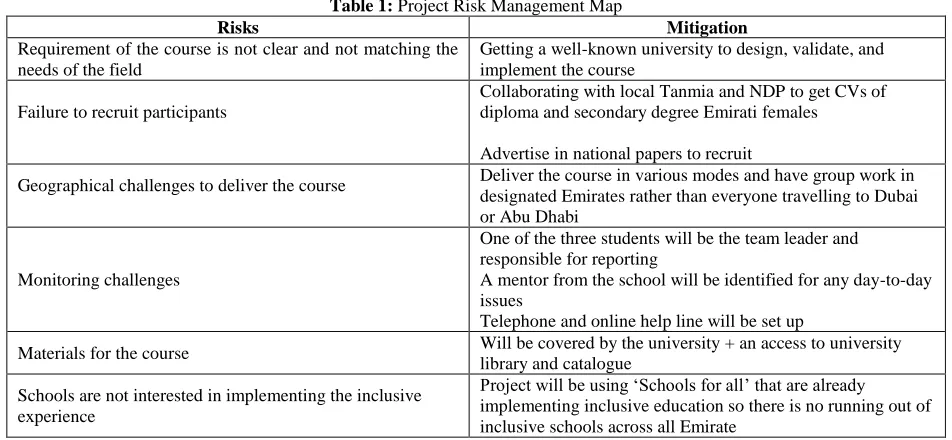
Project implementation was monitored across one academic year and recommendations were made for future practice. Table 1 details the risks and limitations the researcher examined before conducting the research:
Table 1: Project Risk Management Map
Risks Mitigation
Requirement of the course is not clear and not matching the needs of the field
Getting a well-known university to design, validate, and implement the course
Failure to recruit participants
Collaborating with local Tanmia and NDP to get CVs of diploma and secondary degree Emirati females
Advertise in national papers to recruit
Geographical challenges to deliver the course Deliver the course in various modes and have group work in designated Emirates rather than everyone travelling to Dubai or Abu Dhabi
Monitoring challenges
One of the three students will be the team leader and responsible for reporting
A mentor from the school will be identified for any day-to-day issues
Telephone and online help line will be set up
Materials for the course Will be covered by the university + an access to university library and catalogue
Schools are not interested in implementing the inclusive experience
Project will be using ‘Schools for all’ that are already implementing inclusive education so there is no running out of inclusive schools across all Emirate
Table 2 consists of the phases of the project with dates:
Table 2: Phases Of The Research Project
Phase Duration
From To
Signing MoUs between BUiD + UAEDSA and MOE and UAEDSA 01-11-2011 30-11-2011
Designing the course 1/11/-2011 15-12-2011
Advertising for recruitment of candidates + selection process+ signature
of agreement with candidates 15/12/2011 15-01-2012
Selection of schools following nomination of MoE 15-01-2012 30-01-2012
Delivering the theory course elements 01-02-2012 30-06-2012
Summer readings and theoretical assignments 01-07-2012 31-08-2012 Delivering the practicum course elements 15-09-2012 31-12-2012 Working on assignments + preparing for Exam 01-01-2013 01-02-2013
Examination and final results announced 02-02-2013 28-02-2013
Writing up the final report of the project 01-03-2013 30-04-2013
FINDINGS
A total of 24 trainees completed the entire course with only one who stepped off for one month due to mitigating issues. The following are some of the quotes from the trainees when asked about the impact of the programme on their lives:
Nora, aged 42 and a mother of two, said, “I never thought I could be working one day. I finished high school, got married, had children and never had a chance to be in the workforce. I used to be jealous of those working women; now I am going to be one of them”.
Ahlam is 38 and unmarried. She claims that the programme changed her life and gave her “a purpose to have every day”. She wanted to be “a productive member of her community after years of ‘staring at the ceiling’”.
Others expressed their initial anxiety at first as they had not been in formal education for years, but joining the programme was worth the effort.
The project also enjoyed extensive media coverage and the following are some of the quotes:
Zahra, 35, said she will be working at the primary school for Boys in Dubai. “I have bonded with my student Abdullah, 11”, she said. “He is in grade 4. Helping him makes me very happy.” (Gulf News, 1/2/2103)
Sina Al Kulaib, 40, is training at the Dubai Modern Education School with 12-year-old Alia. “This is the kind of job I have always wanted to do,” she said. (Gulf News 1/2/2103)
Rihab Hashim Al Hashimi, 29, from Shurooq Kindergarten, is training to look after Shamma, six, who has Down Syndrome. She also helps with Rashid, six, who has autism. “I hope to join full-time soon,” she said. (Gulf News 1/2/2103)
A teacher who supervised the trainees expressed her gratitude to have ‘helping hands’ while another welcomed the ‘extra support to facilitate’ inclusion. At the same time, a school head teacher echoed that and was excited that the country is ‘finally doing something about inclusion and they are finally investing in someone to become an assistant teacher’.
CONCLUSION
This research was conducted with the aim of determining the impact that the teacher assistant programme had on the lives of Emirati female teacher assistant trainees in terms of empowerment. It is clear that from the way the participants viewed and experienced supporting children with special needs, they found the programme to be helpful, life changing, and, indeed, empowering. With regard to inclusion, since the late 90’s, a wider view of inclusive education has begun to see its way into more countries in the region (Gaad, 2010). Recently, ministries of education in most Arab states began adopting policies and guidelines for implementing inclusive education. Gaad (2004) claims that the country in which this study was conducted - the UAE - was just “catching up.” Therefore, a follow-up study is recommended to examine the impact of the programme on learners with special needs themselves in the Emirati schools, providing a clear definition of who has special educational needs in this setting. This is in addition to the impact on the inclusion process that the country is adopting at present. It is clear that Learning Support Rooms, which for many years have been used as safety nets (Spencer, 2010), are now not the only option to educate a child with special needs in a mainstream school. The government sector has attempted to bridge the gap and hopefully, with the assistance of the teacher assistants, a move in the right direction is in place. One could argue that this humble piece of research is a good starting step to see the effect of the programme on its participants considering this is something new in a relatively young country that is newly adopting inclusion of all learners in regular settings and looks at training teacher assistants to support the cause.
AUTHOR INFORMATION
Professor Eman Gaad is the Dean of the Faculty of Education and a Professor of Special and Inclusive Education at British University in Dubai. Professor Gaad led the university’s special and inclusive Masters programme for many years and currently leads the Doctorate Programme. She co-founded one of the largest NGOs in the UAE - UAEDSA - and is one of the governors of the regionally outstanding Dubai College as well as on the Board of Directors of several non-profit organizations in the UAE and the region. She is a UNESCO Consultant and has advised policy and decision-makers as a senior consultant for both governments of Dubai and Abu Dhabi on disability related issues. She is also a winner of HH Princess Haya Award for Special Education as best distinguished individual research in 2012 and, in the same year, was awarded the Global Leadership in Education Award from the Asian Leadership Award Board. She has established herself as a world class researcher, advocate, international social development consultant and expert, certified assessor, and professional social trainer.
REFERENCES
1. Abdalla, K. (2011). Current Status of Gifted and Talented Learners in Cycle 2 Government Schools in Abu Dhabi Emirate: an Analytical Study. Unpublished MEd dissertation, British University in Dubai, Awarded June 2012.
2. Bell, J. (2005). Doing Your Research Project (4th Edn). Berkshire: Open University Press.
3. Bradshaw, K., Tennant, L., & Lydiatt, S. (2004). Special Education in the United Arab Emirates: Anxieties, Attitudes and Aspirations. International Journal of Special Education, vol. 19(1), pp. 49-55.
4. D’Souza, C. (2013). 24 Emirati women to help as teaching assistants. Gulf News, February 1, 2014. 5. Everard, K. B., Morris, G., & Wilson, I. (2004). Effective school management. (4th Edition). London: Paul
Chapman Publishing.
6. Gaad, E. (2001). Educating children with Down Syndrome in the United Arab Emirates. British Journal of Special Education, Vol. 28(4), pp. 195-203.
7. Gaad, E. (2004). Including students with Exceptional Learning needs in regular schools in the United Arab Emirates. The International Journal of Diversity in organisations, communities and nations, Vol. 4. 8. Gaad, E. (2006). Crossing the Barriers: Culturally diverse teachers teaching in Culturally diverse mixed
abilities classrooms in the United Arab Emirates. The International Journal of Diversity in organisations, communities and nations, Vol. 5, (2005/2006).
9. Gaad, E., Arif, M., and Scott, F. (2006). Systems analysis of the UAE education system. International Journal of Educational Management, Vol. 20, No. 4. (2006), pp. 291-303.
10. Gaad, E. (2010). Inclusive Education in the Middle East. UK: Routleadge.
11. Ministry of Social Affairs. (2006). UAE Federal Law No. 29 of the Year 2006 on the Rights of People with Special Needs. UAE: Ministry of Social Affairs Publication.