When 1
st
And 3
rd
Converge:
A Border Region Framework
Leebrian Gaskins, Texas A&M International University, USA Nacasius U. Ujah, Texas A&M International University, USA
Jaime Ortiz, Texas A&M International University, USA
ABSTRACT
The U.S.-Mexico border region is unique in its social, legal, economic, political, and technological dynamics. Therefore, professionals moving from the interior of the U.S. or Mexico (or from other countries) into the borderland region experience cross-cultural adjustment issues similar to those of expatriates. A quasi-expatriating model that takes into consideration the domestic adjustment and international expatriate adjustment literature addresses the unique adjustment dimensions that professional individuals experience in the US-Mexico border region.
Keywords: U.S.; Mexico; Border Adjustment; Degree of Adjustment; Work Role Transition; Quasi-Expatriation; SLEPT
INTRODUCTION
ymmetric acculturation of people from a part of a country to another part is easy when compared to the adjustments of people to border areas of countries. An emergent and eminence situation is that of the United States and Mexico as it offers unique social, legal, economic, political, and technological (SLEPT) dynamic. Hence, the region is considered more dissimilar to the rest of the U.S. and Mexico (Alvarez, 1995). Because of its proximity to and influence from Mexico and the United States, professionals moving to this borderland region experience cross-cultural adjustment issues similar to those of expatriates. This paper reviews the uniqueness existing on the US-Mexico border and how a person moving to this region from either country would experience expatriation melancholy. It also outlines the existing literature on international and domestic adjustment. Finally, this paper introduces a framework of analysis based on domestic and international cross-cultural adjustment research to study the US-Mexico border culture.
BACKGROUND
The US-Mexico border
Acculturation into the status environment in the border areas offers unique SLEPT conditions emerging from the intersection of two or more border areas. For the United States and Mexico border regions, from observation, border population carry traits of both countries, yet distinctively unique in its own. These SLEPT conditions represent the dynamics of the adjoining states at play in a border region. Unlike other borderlands in the world, the US-Mexico border is one where first-world meets third-world. The Border States in both countries is arguably a representative of countries in other continents country national boundary and border influx movements. The region was and is indelibly shaped by its unique history and disparities of the two nation-states (Heyman, 1994). Given the SLEPT issues surrounding the region, more citizens from the US and Mexico migrate to the border region for employment in fields such as government and international business. Also, significant differentiation from its component nations entice people to move to the border region from the US or Mexico and find quite different cultural drivers.
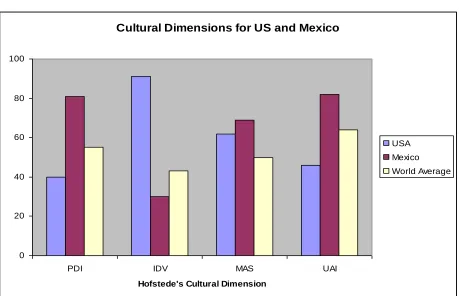
Figure 1
Hofstede (2001) maintains that the cultural dimensions between the US and Mexico are quite asymmetric. He suggest five dimensions about a country and its culture. These dimensions are power distance (PDI), individualism (IDV), masculinity (MAS), uncertainty avoidance (UAI), and long term orientation (LTO). In his model, the first four elements are ranked for both the US and Mexico. Within these four elements, only masculinity which is the distribution of roles between genders of a society is close in comparison. Where the United States score is 61 and Mexico‟s score is 69 as evident in figure 1.
In the US, individualism ranks considerately higher than that of Mexico (US: 91, Mexico: 30, World Average: 55). In Hofstede‟s model, this is the highest ranking among categories for the US. Which equates to a more self-reliant populate and relatively loose bonds with others. The opposite is true about Mexico which has a low individualism ranking. Generally, a culture with this ranking would be more collective with a strong commitment to the “group.” Relationships and actions that foster relationship building such as loyalty would be paramount.
The highest ranking for Mexico found in Hofstede‟s model is uncertainty avoidance (México: 82, US: 46, World Average: 64). Such a high ranking would equate to a society with a low tolerance for uncertainty. Society tries to implement strict laws and rules to avoid the unexpected. Given Hofstede‟s findings, Mexican society would tend be less likely to embrace change and very risk-adverse. In contrast, the US ranking is almost half that of Mexico. US society would, given their score, tend to have fewer rules and controls on outcomes. Such a society would have high tolerance to risk and embrace changes with little friction.
Also, Mexico ranks high in power distance (Mexico: 81, US: 40, World Average: 55). Power distance, according to Hofstede, this equates to the level of inequality of wealth and power in the society and between its members, the „haves‟ versus the „have-nots‟. The US ranked at least half that of Mexico in the measure. This denotes more cooperation between individuals and organization of different power levels, hence shared governance. While Mexico scores double that of the US, it is important to note that this measure reflects the “culturally accepted” rather than the actual power difference. It would be unfair to say there is more or double the amount of
Cultural Dimensions for US and Mexico
0 20 40 60 80 100
PDI IDV MAS UAI
Hofstede's Cultural Dimension
USA
Mexico
economic or social inequality in Mexcio as compared to the US. Also, it would be equally without basis to postulate that the US is more cooperative across social or economic strata. As noted by Hofstede, countries with strong religions such as Catholicism generally have high uncertainty avoidance and power distance ranking.
International Adjustment
As the world becomes more global, more attention and research has been given to study the adjustment process of expatriates. More than ever, international experience has become an important part of professional portfolios. However, what does define a successful international experience? When professionals leave a familiar cultural and social surrounding, some may not perform well in the new environment with different norms and mores (Ryan & Twibell, 2000). Failure to adapt to the new environment has high financial and psychological implications. Inclusive to the already known costs is employee turnover (Tziner and Birati, 1996) .
Some common themes or dimensions evolve after reviewing the literature on international adjustment. These themes: organizational process for selection, pre-departure training, previous cultural experience, individual skills for adjustment/adaption, and non-work related factors have been studied extensively by scholars like (Miles et al: 1978; Mendenhall and Oddou: 1981; Black 1988; Mendenhall et al: 1987; Boyacigiller 1990). Pre-departure factors like process for selection, pre-departure training, and previous cultural experience are foundation and toolset taken by expatriates to the host country. The post-departure factors of individual skills for adjustment or adaptation and non-work related skills become relevant as well for successful acculturation.
First, the organization selects the candidate for the assignment. Candidate selection, while more evidence suggests otherwise, is primarily based on technical competence (Black, Hal, and Mark, 1992). Even though this attribute may be important for work success of a candidate, there are many more skills needed for the candidate to be successful in a foreign environment (Church, 1982). The literature reviewed does not reveal enough research on how and why candidates are selected outside of pure technical ability.
Once the candidate has been selected by the organization, what occurs next? One may assume that the organization evaluates the candidate‟s non-technical abilities to adapt in the new environment (individual skills for adjustment/adaptation) and provides resources to assist in the adjustment process (training). While this would be perceived the best course of action, it is rarely done. According to Kealey and Protheroe (1996) studies show deficiencies in addressing the effectiveness of cross-cultural training.
It is understandable that previous success in an environment would lend itself to future success in the same environment. This measure of success may be seen in the work environment, especially if the candidate is competent, but not necessarily in the overall measure of cross-cultural adjustment (Black, 1988). However, empirical evidence supports that a candidate needs accurate prior cultural experience or exposure for adjustment (Church, 1982). The candidate must go from being a tourist to someone who can function within the culture inside and outside the workplace.
Empirical research in the area of individual skills needed for effectiveness and success in cross-cultural environments is vast (Van Oudenhoven and Van der Zee, 2002), (Tung, 1998), and (Ryan and Twibell, 2000). Most of this research focuses on two main themes: intrapersonal and interpersonal skills. An intrapersonal skill set relates to the emotional health of an individual. Aspects such as emotional stability, effective stress management, and open-mindedness to new situations are all part of the intrapersonal skill set. In contrast, an interpersonal skill set looks at constructs such as cultural empathy, flexibility, social initiative, and savvyness. These skills allow a candidate to build and foster interpersonal relationships with host nationals and correctly perceive and evaluate the new environment. It would seem natural and logical that these two skill sets would make a candidate more successful. Indeed, an emotionally-stable, stress-free, technically competent person should naturally succeed. The existing literature offers guarded confirmation on how these variables interact on the success of expatriate adjustment.
known in the literature as cultural distance. Empirical studies show that the more culturally distant or different a host culture is to one‟s own, the more difficult the adjustment process. The adjustment period is also the most difficult in the first two years of an assignment (Torbion, 1982). Another important adjustment relates to the family of the expatriated professional. Spouses and family of the candidate may not have the above-mentioned skills to adjust to the host culture. The success or lack thereof for the family can affect work success of the candidate (Caligiuri et al, 1998).
Domestic Adjustment
Ashford and Taylor (1990) maintain that the literature on domestic adjustment generally examines four areas of research: i) organizational socialization, ii) career transitions and sense-making, iii) work role transition, and iv) relocation issues. Along these lines, Black et al (1991) maintain that domestic adjustment focuses on the organizational socialization context rather than the environmental and cross-cultural ones. Hence, organizational socialization to a new employee is an important factor in their adjustment. On the other hand, Nicholson (1984) focuses on the roles placed on the employee by the organization and how the employee works to derive meaning. According to Fisher (1986), organizational socialization and employees‟ response to it can be categorized in three stages : anticipatory socialization, encounter stage, and role management.
In the anticipatory socialization stage, individuals make anticipatory adjustments to the organization‟s culture via choice of the organization and formulation of expectations required by the organization. The encounter stage is denoted by the beginning of individuals‟ mastery of work tasks and inter-work relationships (Fisher, 1986). During this stage, expectations are confirmed and low role ambiguity develops. Lastly, in role management stage the individual naturally moves incrementally towards becoming a fully accepted member of the organization .
Domestic adjustments typically do not involve significant changes to the non-working environment. A professional moving from Dallas to Washington D.C. would find culture, customs, language, and political contexts very familiar. While domestic adjustment literature share similar contexts to those found in international adjustment, it is quite possible that the variables involved may be unique and relationally different (Black et al, 1991).
Louis (1980) considers that in career-transition and sense-making, one transitions roles within or between organizations. In his model, the important aspect is how one makes sense of the new experience. An individual looks for information to explain the unexpected. When an individual moves to new and/or unfamiliar role, there are aspects that cause confusion. In this confusion, one tries to make sense of the situation based on prior experiences, new information gleamed from contextual clues, and input from associates.
Since relocation literatures discusses also a number of topics similar to the international adjustment literature. Therefore, the greater disruption to existing routines, the greater the uncertainty and longer time needed for uncertainty reduction. Aspects such as conflicts and differences, ambiguity or what is required and expected, and novelty or newness coupled with work environment may negatively impact adjustment (Brett, 1982).
THEORETICAL FRAMEWORK
An adjustment model for US and Mexican citizens migrating to the border region compels to make reference to both domestic and international adjustment models. A citizen moving to the border region would experience domestic adjustment issues such as relocation and change in work roles. These domestic changes would be complemented by the international aspect of the borderland region. Also, it may be that a person moving to this region would have significant contact with people and cultures of the other country.
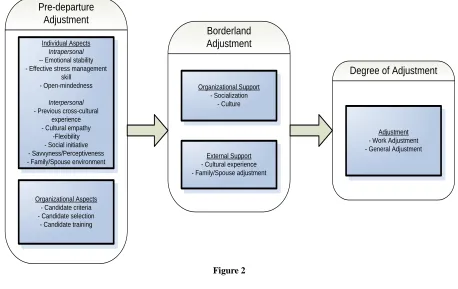
Figure 2 suggests an integrated model for adjustment. It presents a more tailored theoretical framework to the area of borderland movement or quasi-expatriation than the domestic or international expatriate being provided.
Figure 2
Pre-departure Adjustment
Similar to anyone taking a trip, planning is the first step of the journey before the first mile is driven. A person must plan and prepare items to increase the chances of success in the foreign environment. In the pre-departure adjustment, planning and preparation by both the individual and the organization is paramount. Two overarching dimensions are examined in pre-departure adjustment: individual and organizational aspect.
In both the domestic and international adjustment literature, individual personality skills are considered an “in-country” or “in-residence” construct. The above model argues that this should be a pre-departure construct. It is important to the success of a candidate to have certain pre-existing personality characteristics before leaving for the quasi-expatriation experience. It is unlikely that these skills can be taught or learned while in the stress of a foreign environment. Primarily, the individual must possess certain skills outside of their technical abilities to perform a particular job. Professionals who emigrate to any foreign county have certain personality qualities that assist in adjustment (Van Oudenhoven and Van der Zee, 2002). Variables of the individual aspect can be further reduced to intrapersonal and interpersonal.
The intrapersonal dimension of individual pre-departure adjustment focuses on skills and behaviors relates to emotional stability. It relates to the emotional health of a candidate and how they maintain that health. Key questions in testing this dimension would be the following: Does the candidate have effective stress management techniques? Are they relatively open-minded? How does the candidate rank on uncertainty avoidance? Preliminary thoughts based on the literature would suggest positive correlation between intrapersonal dimension variables and degree of adjustment (e.g. an emotional healthy individual with minimum uncertainty avoidance would tend to be more success at adjustment).
Adjustment - Work Adjustment - General Adjustment
Degree of Adjustment
Individual Aspects
Intrapersonal
-- Emotional stability - Effective stress management
skill - Open-mindedness
Interpersonal
- Previous cross-cultural experience - Cultural empathy
-Flexibility - Social initiative - Savvyness/Perceptiveness - Family/Spouse environment
Organizational Aspects - Candidate criteria - Candidate selection
- Candidate training
Pre-departure Adjustment
Organizational Support - Socialization
- Culture
External Support - Cultural experience - Family/Spouse adjustment
The interpersonal dimension examines constructs such as cultural empathy, flexibility, social initiative, and savvyness. It is necessary that a candidate has had a previously positive cross-cultural experience. More importantly, it would probably be preferable that the candidate have not previous cross-cultural experience rather than a negative one. This experience would manifest itself as a cultural empathy toward others. In relation to open-mindedness in the intrapersonal dimension the candidate must possess some degree of flexibility in the interpersonal dimension to adapt to situations. To attain interpersonal success and support, social initiative would prove important. Does the candidate initiate social contact with others? Not only is social contact and flexibility important, but it is also necessary to understand a degree of savvyness or perceptiveness. Can the candidate determine the actors and their roles in the foreign environment?
Lastly, as part of the interpersonal dimension, the family/spouse environment should be examined. Most candidates will not live entirely at work nor will their spouse or children. It is important to examine the adjustment dynamic of the familiar relationships to determine if the members have successful skills for adjustment. Caligiuri (1998) suggests that success or lack thereof for the family can affect work success of the candidate.
The organizational aspect is critical in the preparation of quasi-expatriation adjustment. Variables of this construct are candidate criteria, selection, and training. Most organizations rely solely on the technical competence of a candidate. While more research is needed, it would seem logical that the organization should invest time and energy to assess candidates beyond technical ability. What criteria should a candidate possess to be considered for relocation to the border region? What is and how thorough is the selection process? After the selection, what training and how much and content of is offered to the candidate with their family?
An interesting exemption to this lack of vetting and training is the US Customs and Border Patrol (US-CBP). Leamon (1999) noted that,
Potential candidates undergo tests for logical reasoning and ability to learn languages. Furthermore, the US-CBP tests candidates for physical and emotion health. For example drug test, structured interview about various stressful job related situations) and performs a comprehensive background investigation. Additionally, the US-CBP applies a five-step process to screen potential candidates for a wide range of counterproductive behaviors. This later process focuses on the potential candidate’s conscientiousness, emotional maturity, initiative, integrity/honestly, judgment, sensitivity to other’s needs (empathy), and attitude toward use of force. Lastly, the potential candidate is given a 19-week course to provide technical training (i.e. law enforcement, Spanish, border operations, firearms, driving, and physical training).The testing by the US-CBP parallels the organizational aspect dimension in candidate criteria, selection, and training.
Borderland Adjustment
Once the candidate is located in the border region, what aspects become important to their adjustment and success? The borderland adjustment in this model looks at two dimensions: organizational support and individual support. As part of organizational support, it is important how an organization socializes and supports its quasi-expatriated employee. This contributes an important part in the employee‟s adjustment and success. According to literatures, a person in an unfamiliar environment looks for information to reduce uncertainty. The organization provides a basis and primary source of this information. According to Feldman (1976) and subsequently by Fisher (1986), during the first stages of work-role transition, the employee formulates expectations required by the organization and begins to master work tasks and develop inter-work relationships. Finally, the employee moves toward becoming a fully accepted member of the organization.
to existing routines for family members, for example, new language, different social structures, the greater the uncertainty and longer time needed for uncertainty reduction. As also noted in the literature, success adjustment of the individual is correlated to that of the family.
Degree of Adjustment
As noted in Black (1988), the construct of adjustment is considered multifaceted. Adjustment tends to follow a “U-curve”. In the beginning, there is some novelty and excitement with the foreign experience. After some length of stay, professionals coping with adjustments and adaptation tend to experience varying degrees of cultural shock. Next, the adjustment phase begins leading finally into mastery. In figure 2, the degree of adjustment can be examined in two dimensions: work and general. Work adjustment measures level of adjustment to the foreign work environment. Organizational pre-departure factors such as candidate criteria and selection along with borderland organizational adjustment factors such as socialization would be correlated to work adjustment. Measures of this construct could include such items as organizational commitment, job satisfaction, intent to leave, and turnover.
In contrast, general adjustment examines how well the individual adjusts to the environment mostly outside of work adjustment. The employee‟s pre-departure individual skills and the borderland external support would probably be more correlated to the general adjustment measure. The end result is that work and general adjustment success would not be isolated constructs as suggested in the literature.
CONCLUSIONS
The US-Mexico border region offers unique social, legal, economic, political, and technological dynamics. Professionals moving to this borderland region summarily experience cross-cultural adjustment issues similar to those of expatriates. The proposed model for quasi-expatriation addresses the unique adjustment dimensions a professional would experience based on domestic adjustment and international expatriate adjustment theories. One might expect a degree of generality for quasi-expatriates in any world border region. Nevertheless, the US-Mexico border quasi-expatriation is indeed unique and depends upon several relational factors on the two countries. There is, for instance, a great distance in the aspects of individualism, power distance, and uncertainty avoidance. This distance in ranking shows a significant cultural difference between both countries.
Like most border regions, the US-Mexico border area suffers from having the right pool of professionals. Given the social, legal, economic, political, and technological issues surrounding the region, the lure of professionals are most daunting. Moreover, a preliminary testament of top managers in the regions affirms that professionals have a two year window, referring to the time it will take for some expatriates to leave or stay. Therefore, a better selection, preparation, and adjustment of quasi-expatriating employees to the border region are a must. The lack of adjustment and ensuing turnover for employees recruited from outside the region to work on organizations such as maquiladoras or export assembly plants, schools, universities, or government agencies has severe financial consequences.
Future research along this framework could come in two ways. First is to quantitatively testing the components of the models at the three sections of the framework: Pre-Departure Adjustment, Borderland Adjustment, and Degree of Adjustment. The challenge to undertaking an empirical analysis of such would be the indicators a researcher can use as proxy for the three sections, the choice of statistical tool to use, and most importantly the availability of categorical and numerical data from organizations around. Second is to compare data on work retention, work transition, and work relocation of two or more organization. This would be a comparison of an inland US company, border region US company, and inland Mexico company if possible.
AUTHOR INFORMATION
Leebrian Gaskins: A doctoral student with a major in International Business and a concentration in Management Information Systems at the Texas A&M International University. As an Information Systems administrator, Mr. Gaskins managed a work force of more than forty personnel‟s with experience in client service relations, instructional technologies, and computing services.
Nacasius U. Ujah: A doctoral student majoring in International Business and a concentration in Finance at the Texas A&M International University.
Jaime Ortiz: Is the Associate VP for International Programs and an Associate Professor at the A. R. Sanchez Jr. School of Business respectively at Texas A&M International University.
REFERENCES
1. Alvarez, R. (1995). The Mexican-Us Border: The Making of an Anthropology of Borderlands. Annual Review of Anthropology. 24(1): 447-70.
2. Ashford, S. and M. Taylor (1990). Adaptation to Work Transitions: An Integrative Approach. Research in Personnel and Human Resources Management. Vol. 8:1-39.
3. Black, J. S. (1988). Work Role Transitions: A Study of American Expatriate Managers in Japan. Journal of International Business Studies Vol. 19(2): 277-94.
4. Black, J. S., B.G. Hal, and E.M. Mark. (1992). Toward a Theoretical Framework of Repatriation Adjustment. Journal of International Business Studies Vol. 23(4): 737-60.
5. Black, J. S. and M. Mark. (1991). The U-Curve Adjustment Hypothesis Revisited: A Review and Theoretical Framework. Journal of International Business Studies Vol. 22 (2): 225-47.
6. Black, J. S. and M. Mendenhall. (1990). Cross-Cultural Training Effectiveness: A Review and a Theoretical Framework for Future Research. The Academy of Management Review Vol. 15 (1): 113-36. 7. Black, J. S., M. Mendenhall, and G. Oddou (1991). Toward a Comprehensive Model of International
Adjustment: An Integration of Multiple Theoretical Perspectives. The Academy of Management Review
Vol. 16(2): 291-317.
8. Boyacigiller, N. (1990). The Role of Expatriates in the Management of Interdependence, Complexity and Risk in Multinational Corporations. Journal of International Business Studies Vol. 21 (3): 357-381 9. Brett, J. M. (1982). Job Transfer and Well-Being. Journal of Applied Psychology Vol. 67(4): 450-63. 10. Caligiuri, P., M. Hyland, A Joshi, and A. Bross. (1988). Testing a Theoretical Model for Examining the
Relationship between Family Adjustment and Expatriates' Work Adjustment. Journal of Applied Psychology Vol. 83(4): 17.
11. Church, A. (1982). Sojourner Adjustment. Psychological Bulletin Vol. 91(3): 540-72.
12. Feldman, D. (1976). A Contingency Theory of Socialization. Administrative Science Quarterly Vol. 21(3): 433-52.
13. Fisher, C. (1986). Organizational Socialization: An Integrative Review. Research in Personnel and Human Resources Management Vol. 4: 101-45.
14. Heyman, J. (1994). The Mexico-United States Border in Anthropology. Journal of Political Ecology Vol 1(1): 24.
15. Hofstede, G. (2001). Culture's Consequences: Comparing Values, Behaviors, Institutions, and Organizations across Nations: Sage Publications.
16. Kealey, D., and D. Protheroe. (1996). The Effectiveness of Cross-Cultural Training for Expatriates: An Assessment of the Literature on the Issue. International Journal of Intercultural Relations Vol. 20(2): 141-65.
17. Leamon, J.A. (1999). Improving the Selection of Us Border Patrol Agents: Screening for Counter-productivity. Police Chief Vol. 66: 65-73.
18. Louis, M. R. (1980). Surprise and Sense Making: What Newcomers Experience in Entering Unfamiliar Organizational Settings. Administrative Science Quarterly Vol. 25(2): 226-51.
20. Mendenhall, M. E., Dunbar, E., and Oddou, G. R. (1987). Expatriate Selection, Training and Career-Pathing: A Review and Critique. Human Resource Management Vol. 26 (3): 331 – 345
21. Miles, R. E., Snow, C. C., Meyer, A. D., Coleman, Jr., Henry, J. (1978). Organizational Strategy, Structure, and Process. Academy of Management Review Vol. 3 (3): 546-562
22. Nicholson, N. (1984). A Theory of Work Role Transitions. Administrative Science Quarterly Vol. 29 (2): 172-91.
23. Ryan, M.E., and R.S. Twibell. (2000). Concerns, Values, Stress, Coping, Health and Educational Outcomes of College Students Who Studied Abroad. International Journal of Intercultural Relations Vol. 24 (4): 409-35.
24. Torbiorn, I. (1982). Living Abroad: Personal Adjustment and Personnel Policy in the Overseas Setting, Wiley Series on Studies in Occupational Stress. Chichester [West Sussex]; New York: Wiley.
25. Tung, R.L. (1998). American Expatriates Abroad: From Neophytes to Cosmopolitans. Journal of World Business Vol. 33 (2): 125-44.
26. Tziner, A. and A. Birati. (1996). Assessing Employee Turnover Costs: A Revised Approach. Human Resource Management Review Vol 6(2): 113-13.
27. Van Oudenhoven, J.P. and K.I. Van der Zee. (2002). Predicting Multicultural Effectiveness of International Students: The Multicultural Personality Questionnaire. International Journal of Intercultural Relations