IJEDR1902078 International Journal of Engineering Development and Research (www.ijedr.org) 414
Effect of heat treating and analysis of mechanical
characterization of cutting tool materials
1Vasudendra H K, 2Suresh Kumar K, 3Mahadev Patil K 1Lecturer, 2Assistant Professor, 3Student 1Hanagal Sir Kumareshwara Polytechnic, Ballari
2,3R.Y.M Engineering college, Ballari
____________________________________________________________________________________________________
Abstract - For the past decades, there is a tremendous changes have been taken place in the field of metal cutting area, to evict the problems which are being associated with metal cutting operations some investigations are made. In this paper we have made an attempt to discover and eradicate the problems which are associated with different cutting tools and also we have tested the different cutting tool materials by means of different testing machines, in the mean time we have analyzed and depicted results which are obtained by means of suitable heat treating operations. In this respect cutting tool materials are those which are used to perform cutting action over any type of metal. Here we have probed and looked attentively over Stainless Steel of Grade 440C, SS316C (Chromium-Nickel steel) and titanium alloy (Ti- 6Al- 4V).
Keywords: Cutting Tool, Heat Treatment, Aluminum, Mild steel.
____________________________________________________________________________________________________
I. INTRODUCTION
IJEDR1902078 International Journal of Engineering Development and Research (www.ijedr.org) 415 can ability to take required shape and size. Firstly, to perform cutting operation some suitable factors are to be taken into our account so it makes the metal cutting processes becomes smooth, in this regard the type of work piece composition, type of cutting tool and Machinability conditions are considered to perform cutting operation.
II. EXPERIMENTAL PROCEDURE A. Tool material selection
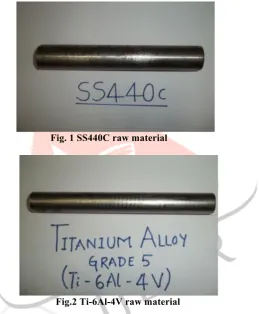
For being cut of any metal the selection of cutting tool is must. So while selecting cutting tool materials some factors are to be considered. Those are type of workpiece, cutting tool properties, type of cutting tool, type of Machinability conditions and many more. While recounting the selection of a material there are some factors which would tell about characteristics of cutting tool during metal cutting operation. Those principal characteristics are hardness, wear resistance, toughness of a material. Based on these selection of cutting would be done. So in this regard we considered initially all the materials, those are stainless steel of grade 440C, stainless steel with molybdenum of grade SS316, Titanium alloy (Ti-6Al-4V), Invar 3, Ferrite stainless steel. Amongst all materials three materials have been considered into account for their better properties. The following tables which give the nominal chemical compositions and material properties of different grades of stainless steel and titanium alloy. And in this study aluminum and mild steel were considered as workpiece material where cutting action was made over aluminum metal.
Fig. 1 SS440C raw material
Fig.2 Ti-6Al-4V raw material
Table.1 Nominal chemical composition of SS440C and 316 alloys
Material C Mn Si Cr P Ni S Mo
Stainless Steel 440C 1.07 1.00 1.0 18.0 0.04 0.03 0.75 1.07
Stainless Steel 316 0.08 2.00 1.00 18.0 0.045 12.0 0.03 3.0
Likewise, the chemical composition of titanium alloy (Ti-6Al-4V) are mentioned below table 2 Table.2 Nominal chemical composition of Titanium alloy
Material Al V Ti
Titanium 6.0 4.0 Balance
B. Heat treatment
IJEDR1902078 International Journal of Engineering Development and Research (www.ijedr.org) 416
Fig.3 SS440C Heat Treated Finished Tool Fig.4 SS316 Heat Treated Finished Tool
Fig.5 Ti-6Al-4V Heat Treated Finished Tool III. MATERIAL CHARACTERIZATION
A. Hardness test
Fig.6 Rockwell Hardness Testing Machine
To check hardness of a finished heat treated material a known hardness device Rockwell hardness machine was employed where hardened steel ball or diamond cone indenter was made to force onto the surface (both before heat treatment and after heat treatment), due its low cost and simplicity Rockwell hardness test shall be used for routine hardness checking components. In this present work Rockwell hardness on tool samples was measured as per ASTM standards ASTM D785. In this test the minor load of 150 kg applied over tested specimen. An indicating device, which follows the movements of the indenter and so responds to changes in depth of penetration of the indenter, is set to a datum position. In order to increase the depth of penetration a major load was applied when it attained equilibrium conditions the major load was removed. Removal of the additional major load allows a partial recovery, so reducing the depth of penetration. The permanent increase in depth of penetration, resulting from the application and removal of the additional major load is used to calculate the Rockwell hardness number. The obtained Rockwell hardness test results have been mentioned in Table 3.
Tool material Hardness Number(HRC) (before hardening)
Hardness Number(HRC) (after hardening)
SS440C 51 58
Titanium Alloy(grade 5) Ti-6Al-4V
40 51
SS316 38 38
IJEDR1902078 International Journal of Engineering Development and Research (www.ijedr.org) 417 IV. RESULTS AND DISCUSSIONS
A. Hardness
Fig.7 Hardness before Heat Treatment
Fig.8 Hardness after Heat Treatment
From Figure 7 and 8 it is easily noticed that before heat treatment the stainless grade of SS440C Has low hardenability compared with when the same cutting was subjected to heat treatment. Same case took place in case of Titanium alloy of Grade (Ti-6Al-4V) has very low hardness compared with heat treated Titanium alloy. But in this case one can notice that the hardness of stainless steel of grade SS316 has same hardness rate before and after heat treatment process. Amongst all cutting tool materials the stainless steel of grade SS440C has high hardness compared to remained cutting tools.
B. Tool Wear
As far as machining knowledge is concerned, tool wear depends upon the cutting speed and time which takes to perform cutting operation. Here we analyzed that as long as machining time passes the greater the flank wear rate. So in this respect one can notice that flank wear rate of SS440C and Ti-6Al-4V almost same as compared to stainless steel of grade SS316 of wear rate was 1.08×10⁻⁴m/min. Eventually the tool wear rate for heat treated stainless steel of grade SS316 which has lowest wear rate. As cutting speed proceeds cutting gradual wearing of metal shall takes place periodically. In figure 9 for stainless steel grade of SS440C flank wear rate increased by increasing the time rate. At 14 min the maximum wear rate was found. In figure 10 the maximum flank wear rate was found at 17.5 min. In figure 11 the maximum wear rate was found at 27.33 min.
Fig.9 Rate of flank wear on SS440C Fig.10 Rate of flank wear on SS316 (Max. Wear rate 1.35×10⁻⁴m/min) (Max. Wear rate 1.08×10⁻⁴m/min)
H A R D N E S S TOOL MATERIALS SS440C SS316 Ti-6Al-4V H A R D N E S S TOOL MATERIALS SS440C SS316 Ti-6Al-4V F L A N K W E A R ( m m)
TIME ELASPSE IN Min.
SS440C F L A N K W E A I N ( m m )
TIME ELASPSE IN Min.
IJEDR1902078 International Journal of Engineering Development and Research (www.ijedr.org) 418 Fig.11 Rate of flank wear on Ti-6Al-4V (Max. Wear rate 1.35×10⁻⁴m/min)
CONCLUSIONS
Based on the experimental observations of present study following conclusions were drawn.
1. Stainless steel of Grade has low flank wear rate as compared to SS440C and Titanium alloy (Ti-6Al-4V). 2. For Aluminum workpiece material, at low cutting speed SS316 has greater shear force than Titanium alloy. 3. At high cutting speed the Titanium alloy was found that it has high shear force than SS316.
4. For aluminum workpiece material, SS316 was found to be cost effective as compared to Titanium alloy(Ti-6Al-4V) 5. Diffusion of material was occurred and deposited on the flank and crater over titanium alpha material deposited more
on the rake face especially on the crater. This was due to high heat concentration by chips. These acted like shield &reduce further crater formation.
FUTURE SCOPE
1. Comparison of study results with FEM analysis.
2. By means of variation of rake angle, the machining parameters shall be influenced.
3. By employing various coating methods it may avoid to flank wear and crater wear problem over cutting tool. 4. Making of heat treatment process further it can able to increase the hardness of the study material.
REFERENCES
[1] Dr. Viktor P. Astakhov, Tool Geometry: Basics.
[2] Arshinov V. and Alekseev G. (1976), Metal Cutting Theory and Cutting Tool Design, Chapter 7 Mir Publishers, Moscow.
[3] David. T. Reid Fundamentals of Tool Design 3rd edition chapter 1.
[4] Pradeep Kumar Patil, A.I. Khandwawala” analytical investigation of the cutting forces on single point cutting tool” new coating developments for high performance cutting tools.
[5] “Life enhancement of single point cutting tool by hard Facing and cryogenic treatment” Hazoor S. Sidhu a*, Kumar Gauravb, *Rakesh Bhatiaa National Conference on Advancements and Futuristic Trends in Mechanical and Materials Engineering (February 19-20, 2010).
[6] M.J. Jackson a,*, G.M. Robinson b, J.S. Morrell b Machining M42 tool steel using nanostructured coated cutting tools received 03.04.2007; published in revised form 01.07.2007.
[7] Fuzzing modelling of a single point lathe cutting tool. R. Marumo*, M. T. Letsatsi and O. S. Motsamai: Journal of Mechanical Engineering Research. Vol. 3(7), pp. 264–288, July 2011; ISSN 2141 - 2383 ©2011.
F L A N K W E A R
(
m m)
TIME ELASPSE IN Min.
3
6
9
12
15
18