Journal of Parkinsonism & Restless Legs Syndrome
Restless legs syndrome
Sujith Ovallath
P Deepa
James Parkinson’s Movement Disorder Research Centre, Kannur Medical College, Kerala, India
Correspondence: Sujith Ovallath Department of Neurology, James Parkinson’s Movement Disorders Research Centre, Kannur Medical College, Anjarakandy, Kannur, Kerala, India
Tel +91 497 285 6410 Fax +91 497 285 2500 Email [email protected]
Background: Restless legs syndrome (RLS) is a common sleep-related disorder characterized
by abnormal sensation and an urge to move the lower limbs. Symptoms occur at rest in the evening or at night, and they are alleviated by moving the affected extremity or by walking. Although the exact etiopathogenesis of RLS remains elusive, the rapid improvement of symptoms with dopaminergic agents suggests that dopaminergic system dysfunction may be a basic mechanism. Dopaminergic agents are the best-studied agents, and are considered first-line treatment of RLS.
Objective: To review the diagnostic criteria, clinical features, etiopathogenesis, and the
treatment options of RLS.
Methods: The suggestions are based on evidence from studies published in peer-reviewed
journals, or upon a comprehensive review of the medical literature.
Results/conclusion: Extensive data are available for proving the link between the
dopamin-ergic system and RLS. A possible genetic link also has been studied extensively. Dopamine agonists, especially pramipexole and ropinirole, are particularly useful in the treatment of RLS. Pharmacological treatment should however be limited to those patients who suffer from clini-cally relevant RLS with impaired sleep quality or quality of life.
Keywords: dopamine, levodopa, pramipexole
Introduction
Restless legs syndrome (RLS) is a common neurologic and sleep-related disorder that
probably has multiple causes. It is characterized by uncomfortable sensations deep
inside the limbs during periods of rest or inactivity, encompassing an irresistible urge
to move them, occurring especially during evening hours. The symptoms are typically
relieved by movements.
1–3The American Sleep Disorder Association has listed RLS
among the causes of intrinsic insomnia.
4Moreover, the majority of RLS patients suffer
from periodic leg movements in sleep (PLMS).
5–9History
The English physician and anatomist Sir Thomas Willis probably made the first
descriptions regarding RLS in the seventeenth century.
10,11Symptoms comparable
to RLS were described by Boissier de Sauvages in 1763, Magnus Huss in 1849, and
Gilles de la Tourette in 1898.
12,13In 1945, the Swedish neurologist Karl Axel Ekbom
coined the expression “restless legs syndrome” and conducted the first clinical and
epidemiological studies on the topic.
14,15In 1995, the International Restless Legs
Dove
press
R E v I E w
open access to scientific and medical research
Open Access Full Text Article
Research and Reviews in Parkinsonism downloaded from https://www.dovepress.com/ by 118.70.13.36 on 27-Aug-2020
For personal use only.
Number of times this article has been viewed
This article was published in the following Dove Press journal: Journal of Parkinsonism & Restless Legs Syndrome
Syndrome Study Group developed standardized diagnostic
criteria for the disease, which was updated in 2003.
3Epidemiology
The prevalence of RLS among Caucasians ranges from 5%
to 15%.
2,16–18The prevalence tends to escalate with age, with
a higher occurrence among women. The disease manifests
itself usually in the fourth and fifth decades.
2,19–21Epidemiological studies are available mostly in
Caucasians. Reports from Asian countries document a lower
prevalence.
22,23The discrepancy could be explained by the
interplay of genetic and environmental factors and cultural
differences.
Possible etiological factors
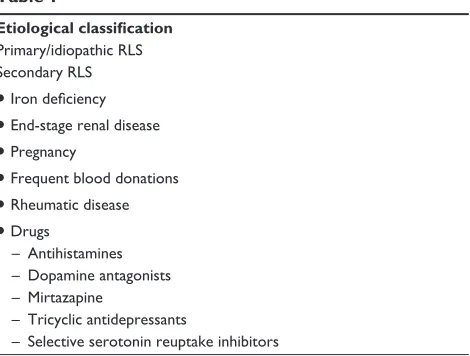
RLS is a disease with multisystem correlates, and so its exact
etiology has not been delineated Table 1. It has been
docu-mented that dopamine antagonists that cross the blood–brain
barrier (like metoclopramide) aggravate features of RLS.
However, the peripheral antidopaminergic domperidone,
which does not cross the blood–brain barrier, does not result
in RLS either.
24,25On high-resolution functional magnetic
resonance imaging, increased activity was uncovered in the
cerebellum, thalamus, red nucleus, and inferior olive. No
cortical activation was noted, and no structural abnormality
was discovered.
26–28Bara-Jimenez and colleagues described
an abnormally increased spinal flexor reflex excitability
during sleep in RLS patients,
29hinting at the probability of
a reversal of circadian-associated spinal cord inhibition.
30Therefore, the accessible evidence suggests that RLS is a
disorder of the central nervous system, more or less
subcorti-cal in nature. This also suggests the hypothesis of a neuronal
network connecting the aforementioned areas, resulting in
the sensorimotor symptoms of RLS.
30,31An abrupt, universal, and almost overall response to
RLS symptoms follows the administration of dopaminergic
medications. Double-blinded and placebo-controlled studies
have validated the advantages of levodopa
32–34and dopamine
agonists like pergolide,
35,36pramipexole,
37and ropinirole
38over other medications. Additionally, they are beneficial at
substantially lower doses when compared to their respective
doses for Parkinson’s disease. All other medications used to
treat RLS need high doses for symptomatic relief.
39,40The
opioid antagonist naloxone does not increase RLS symptoms,
whereas dopaminergic antagonists like pimozide and
meto-clopramide have been well documented to exacerbate it.
41Even though evaluation during a symptomatic period has
not been attempted,
42brain-imaging studies using positron
emission tomography and single-photon emission computed
tomography have disclosed that presynaptic D
2receptor
bind-ing was remarkably reduced, whereas postsynaptic bindbind-ing
was more or less normal. A possibility of decrease in either
the number of D
2receptors or their affinity towards dopamine
was suggested. The rate of dopamine production seems to be
normal or slightly decreased.
43–46Research by Garcia-Borreguero and colleagues revealed
that levodopa-induced inhibition of prolactin secretion links
significantly with polysomnographic findings in RLS/PLMS.
47Dopaminergic pathology was thus proposed. Dysfunction
in a number of pathways is suggested, the most appropriate
candidate being the A11 or dorsoposterior hypothalamus
system. However, the contributions of nigrostriatal (A9) and
tuberoinfundibular systems cannot be excluded.
31,48The recognized secondary causes of RLS, including
end-stage renal disease,
49–51pregnancy,
52,53iron-deficiency
anemia,
54gastric surgery,
55,56and frequent blood donations,
57are all linked with a decrement in body iron stores. Remission
has been reported with iron therapy.
58,59Earley and colleagues
demonstrated that cerebrospinal fluid (CSF) concentrations
of ferritin were significantly lower in RLS patients while
maintaining a more or less normal serum ferritin level.
60A reduced central nervous system iron status was proposed,
even with a high normal serum ferritin level, the slope of
their relationship being abnormally low in RLS.
61Studies
using magnetic resonance imaging have revealed diminished
iron content in substantia nigra.
62Autopsy reports suggest
reduced H-ferritin and iron content, and abnormal
distribu-tion of L-ferritin in the nigral cells.
63Iron is a cofactor for tyrosine hydroxylase, the
rate-limiting enzyme in dopamine synthesis. Hence iron
defi-ciency may result in dopaminergic dysfunction. Studies
show that rats fed an iron-deficient diet had reduced D
1and
D
2receptors in caudate putamen, with decreased dopamine
transporter function.
64Reports regarding brain iron content
and dopaminergic dysfunction often converge at identical
points. Moreover, the circadian patterns of serum iron and
dopamine levels coincide smoothly with those of RLS
symp-toms. A possible, yet to be explored, interplay of iron and
dopamine pathophysiology is thus hinted at.
30Genetics of RLS
Roughly 65% of RLS patients, especially those with an early
onset of symptoms, have at least one first-degree relative with
the disease.
7,65–67The concordance rate between monozygotic
twins also has been reported to be high.
68Most pedigrees
suggest an autosomal dominant inheritance, even though
Dovepress
Ovallath and Deepa
Research and Reviews in Parkinsonism downloaded from https://www.dovepress.com/ by 118.70.13.36 on 27-Aug-2020
recessive models have been proposed as well. Differences in
penetrance and anticipation may explain the heterogeneity in
expression.
66,69Several chromosomal loci have been reported
(on 12q, 14q, 9p, 2q, 20p, and 16p). Sequence variants have
also been proposed, in or around genes on 6p, 2p, or 15q.
70–77The most significant gene identified to this point would be
MEIS1
,
78others being
NOS1
74and
BTBD9
.
79Cardinal features
Uncomfortable and unpleasant
sensations in the limbs
RLS is characterized by uncomfortable or distressing
sensa-tions deep inside the limbs, commonly between the ankle and
knee. Arms are involved now and then, and so are thighs and
feet. The sensory experience may be described as
“creepy-crawly,” burning, tingling, aching, or cramping. The
percep-tion is generally bilateral and symmetrical, but unilateral
presentations are not infrequent. Predominant symptoms in
the upper limbs without involving legs and extension to other
body parts are unusual and atypical of RLS.
1,2An urge to move
The sensations are accompanied by an irresistible urge to
move the affected limb. This is different from the
general-ized inner restlessness or fidgetiness of neuroleptic-induced
akathisia
1,2and may persist for hours on end until a
move-ment is initiated.
Association with rest
and circadian rhythm
The symptoms appear classically when the patient puts his
limbs at rest or during evening hours. He may feel them
during a train or air journey, at the theater, or during a
conference; alternatively, he suffers on getting to bed. Many
patients experience a worsening of symptoms during the
night, regardless of them resting. Thus, the diurnal variation
seems independent from inactivity.
1,2,80Relief on movement
Dramatic and immediate symptomatic relief, either complete
or partial, is gained by movement of the affected limb. It
prevails as long as the activity is continued. Activities like
walking, stretching, or massaging may be helpful. The
patient may wake up from sleep and be forced to walk
around for relief, the behavior being termed ‘night-walker
syndrome.’
1,2,9Periodic limb movements
RLS is commonly accompanied by involuntary,
rhyth-mic muscular jerks in lower limbs, called periodic limb
movements. The classic picture is a regular extension or
fanning of toes and dorsiflexion of the ankle, with infrequent
flexion at knee and hip. When occurring during sleep, it is
termed PLMS. This may occur every 20–40 seconds,
occur-ring throughout the sleep span. Each movement results in a
brief microarousal (of which the patient may not be aware),
resulting in sleep fragmentation. Thus most of the time,
the only complaint regarding PLMS is insomnia or
exces-sive daytime sleepiness. History noted from a bed partner
is often valuable. Diagnosis is essentially by an overnight
polysomnogram. In fact, more than 80% of RLS patients
suffer from PLMS. PLM occurring during a wakeful period
is called PLMW, usually provoked by a suggested
immobi-lization test.
5,81–84Disease course
RLS can present at any age.
30,85–87Generally regarded
as a chronic disease with progressive intensification of
symptoms over years, two major phenotypes have been
described. There are people in whom symptoms manifest
before 45 years of age. The probability of them having a
positive family history is high, and the disease assumes
rather a slow course in them (early onset phenotypes).
In the other group, in which the disease appears late (the
late-onset group), the symptoms are rapidly progressive.
The disparities in clinical course suggest a marked
differ-ence in pathology between the two.
2,23,30,88,89The early onset
group comprises mainly those with the familial form of
the disease, whereas the late-onset cluster consists more of
sporadic RLS. The latter has been more often associated
with secondary causes of RLS.
87Table 1
Etiological classification
Primary/idiopathic RLS Secondary RLS
•
Iron deficiency•
End-stage renal disease•
Pregnancy•
Frequent blood donations•
Rheumatic disease•
Drugs– Antihistamines – Dopamine antagonists – Mirtazapine
– Tricyclic antidepressants
– Selective serotonin reuptake inhibitors
Dovepress Restless legs syndrome
Research and Reviews in Parkinsonism downloaded from https://www.dovepress.com/ by 118.70.13.36 on 27-Aug-2020
Diagnosis
The diagnosis of RLS is essentially based on history. In
1995, the International Restless Legs Syndrome Study Group
developed standardized diagnostic criteria for the disease,
which were updated in 2003.
2,3,90See Table 2.
Diagnosis of PLM
PLMS is diagnosed based on an overnight polysomnogram.
To diagnose PLMS, a PLM index (number of periodic limb
movements per hour of sleep)
$
5 is required.
83PLMS itself is
not diagnostic of RLS, since it may occur as a result of
sleep-disordered breathing or adverse drug effects. Nonetheless,
a high PLMS index offers a sensitive and specific diagnostic
norm.
4,7,8Montplaisir and colleagues suggested that the
inci-dence of PLMW in RLS strongly supports the diagnosis.
8It
even seems to be more specific than PLMS, but adequate
evidence is lacking.
91,92Studies affirm that 1.9% of school-going children and
2% of adolescents suffer from RLS/PLMS.
93Identification
of symptoms and an effective communication regarding the
same can be quite challenging for a child. Up to the age of
12 years, a definite diagnosis of RLS is made only if the child
describes in his or her own words a set of sensations
coher-ent with leg discomfort, besides fulfilling the four esscoher-ential
criteria. The adult criteria are considered appropriate for an
adolescent (
.
12 years old ).
94Differential diagnosis
Many diseases mimic RLS but do not fulfill the essential
diagnostic criteria. A few examples are given below.
•
Akathisia: a generalized motor restlessness with
move-ment stereotypy, usually neuroleptic-induced
•
Nocturnal leg cramps
•
Positional discomfort: relieved by changing the limb
position
•
Painful legs and moving toes: involuntary, spontaneous
flexion and extension of toes, secondary to cord or root
lesions
•
Peripheral neuropathy
•
Lumbosacral radiculopathy
•
Attention deficit/hyperactivity disorder (ADHD)
Consequences of RLS/PLMS
Increased daytime sleepiness results in an overall decline in
the quality of life in these patients. Depression is found
fre-quently, possibly due to underlying brain pathology, insomnia,
or psychological stress due to the chronic illness.
95,96Treat-ment should be cautious, since antidepressants can
aggra-vate the symptoms. Social and occupational disruption,
18,19headaches,
18,19sleep-disordered breathing,
100difficulty in
concentration, and short-term-memory defects have been
reported.
97RLS and PLMS are associated with increased risk
of hypertension,
98,99cardiovascular disease,
100and stroke.
101Sympathetic overactivity,
102,103increment in atherosclerotic
plaque formation
104and rupture, and sleep disturbances are
the proposed causal factors. ADHD has been reported in
children with RLS.
97Treatment
Primary RLS
Primary RLS can be treated by nonpharmacological and
pharmacological measures.
Nonpharmacological treatment
Improvement of sleep hygiene has been found effective in
combating sleep fragmentation.
105A regular sleep pattern;
avoidance of alcohol, coffee, and tobacco; moderate
exer-cises; thermal baths; and massages may help in assuring a
sound sleep.
106Hornyak and colleagues studied the impact
of cognitive behavioral therapy in RLS and reported
symp-tomatic improvement.
107Pharmacological treatment
Levodopa
The response to levodopa is immediate and occurs at low
doses relative to that used in Parkinson’s disease.
32–34In spite
of this, the therapeutic benefit is limited by afternoon
aug-mentation and morning-rebound phenomena. Augaug-mentation
Table 2 Diagnostic criteria for restless legs syndrome (RLS)
Essential criteria
1. An urge to move the legs, usually accompanied or caused by uncomfortable and unpleasant sensations in the legs.
2. The urge to move or unpleasant sensations begin or worsen during periods of rest or inactivity, such as lying or sitting.
3. The urge to move or unpleasant sensations are partially or totally relieved by movement, such as walking or stretching.
4. The urge to move or unpleasant sensations are worse in the evening or night than during the day or only occur in the evening or night.
Supportive clinical features
1. Positive family history.
2. Positive response to dopaminergic therapy.
3. Presence of periodic limb movements (during wakefulness or sleep).
Associated features of RLS
1. variable clinical course, but typically chronic and often progressive. 2. Physical examination normal in idiopathic/familial forms.
3. Sleep disturbance is a common complaint in more affected patients.
Notes: All four essential criteria have to be fulfilled for a definite diagnosis of RLS. The supportive criteria are helpful but not necessary. Needed investigations include serum ferritin and other investigations to rule out secondary causes.
Dovepress
Ovallath and Deepa
Research and Reviews in Parkinsonism downloaded from https://www.dovepress.com/ by 118.70.13.36 on 27-Aug-2020
is characterized by an earlier onset of RLS symptoms
(in the afternoon or early evening), with greater intensity
or with involvement of other body parts. Curiously, intense
dopaminergic therapy as well as iron deficiency and sleep
deprivation result in augmentation.
108–111The reappearance of
symptoms can occur in the morning hours, possibly owing to
the short plasma half-life of levodopa, and is termed morning
rebound.
106Dopaminergic agonists
Presently, dopaminergic agonists are considered the first-line
pharmacological therapy for RLS/PLMS. A longer half-life
and fewer incidences of side effects like augmentation
123are
the major reasons for their current status, backed by
double-blind placebo-controlled trials. The non–ergot derived drugs
pramipexole and ropinirole are both effective,
112–117and can
be used long-term.
118,119Between these, pramipexole seems
to be the better choice in view of earlier efficacy, superior
response, and fewer adverse effects.
120,121Trenkwalder et al
demonstrated the benefits of transdermal rotigotine in RLS.
Interestingly, the transdermal preparation did not
accom-modate signs of augmentation during the study.
122Concerns
with regard to pulmonary fibrosis and cardiac dysfunction
have made treatment with pergolide obsolete.
124–127Antiepileptics
Gabapentin is the favored treatment for a patient who
can-not tolerate dopaminergics. It is as effective as ropinirole
in relieving RLS/PLMS.
128,129The mechanism of action is
unclear. The only known side effect is minimal daytime
sleepiness. The other evaluated anticonvulsants, like
carbam-azepine and valproate, are better avoided because of worse
side effects and drug interactions.
130Opioids
Short-term as well as long-term therapeutic benefits have
been described in RLS when opioids were administered, as
per clinical trials.
123They could be considered as second-line
therapy in refractory RLS.
131,132The drugs proved beneficial
were oxycodone,
133methadone,
134and tramadol.
135Side
effects like nausea, vomiting, urinary retention,
constipa-tion, and dizziness are common. Apprehension regarding
abuse potential and respiratory depression is also a factor.
Vetrugno et al reported augmentation on long-term tramadol
therapy.
136Benzodiazepines
Benzodiazepines work mainly on the quality of sleep, and
not on the pathology of RLS, clonazepam being the most
recognized one.
137In the current scenario, they are not
regarded as an ideal therapy for RLS. Psychological
depen-dence and physiological tolerance are major concerns about
their prescription. However, they may be useful in
RLS-associated insomnia refractory to treatment.
138Secondary RLS
The management of secondary RLS is converged at
identifying and treating the specific causes. Provocative
medications like dopaminergic antagonists,
antipsychot-ics, and antidepressants should be discontinued, tapered,
or administered early during daytime. In the depressed,
bupropion may be used, considering its beneficial effect
on PLM.
4Therapeutic benefits have been observed in studies
con-cerning parenteral iron treatment (intravenous iron dextran)
in idiopathic as well as secondary RLS.
58,59Since higher
serum levels of ferritin are sometimes associated with low
normal CSF ferritin, it is advisable to consider parenteral
iron therapy if first-line pharmaceuticals fail to bring about
a response. This could be done irrespective of serum
fer-ritin levels. If serum ferfer-ritin drops beneath 50
µ
g/mL, oral
iron may be started in the form of 325 mg iron sulfate three
times a day, along with vitamin C. Gastrointestinal irritation
is a limiting factor for oral therapy; allergic reactions often
restrict intravenous iron treatment.
4RLS associated with ESRD is often refractory and
does not improve with hemodialysis.
139,140A fruitful renal
transplantation may result in significant symptomatic
improvement.
141,142Pregnancy-related RLS has been reported to resolve
completely after delivery.
143Vitamin B
12
and folic acid
defi-ciency may lead to RLS, and so do neuropathies. The primary
condition should be treated then.
146,154,156,157Papers based on
clinical trials suggest that gabapentin
131and pregabalin
147are
especially useful in neuropathy-associated RLS.
97Treatment in children and during
pregnancy
There is no single FDA-approved medication for
pediat-ric RLS. Studies have stated the efficacy of levodopa and
dopaminergic agonists in childhood RLS and associated
ADHD.
148–150However, clonazepam may be avoided in
children with ADHD since it may aggravate
hyperactiv-ity.
151Iron therapy may be beneficial when serum ferritin
levels are low.
152,153Drugs are generally not recommended
in pregnancy-related RLS in view of inconsistent reports on
their safety and the benign nature of the condition.
4Dovepress Restless legs syndrome
Research and Reviews in Parkinsonism downloaded from https://www.dovepress.com/ by 118.70.13.36 on 27-Aug-2020
RLS studies from the Indian
subcontinent
There are a few reports of prevalence of RLS from India. The
first Indian population study on RLS revealed prevalence of
the disorder in South India at 2.1%.
159Another trial reported
that RLS had a predominance of females, and that they were
younger than the male counterparts.
160A Hindi-language
version of the RLS scale has been developed for easy
admin-istration of the questionnaire in the local language.
161Conclusion
RLS is a very common sleep-related movement disorder, but
it is mild in the majority of cases. The etiology of RLS is
only partly understood. Some medical conditions, including
renal failure, iron deficiency, and pregnancy, are associated
with high rates of RLS. Most patients with idiopathic RLS
respond well to dopaminergic agents. Second-line
treat-ment options include gabapentin or similar antiepileptic
drugs and opioids. Pharmacological treatment should be
limited to those patients who suffer from clinically relevant
symptoms.
Disclosure
The authors report no conflicts of interest in this work.
References
1. Trenkwalder C, Paulus W, Walters AS. The restless legs syndrome. Lancet Neurol. 2005;4:465–475.
2. Allen RP, Picchietti D, Hening WA, et al. Restless legs syndrome: diag-nostic criteria, special considerations and epidemiology. A report from the restless legs syndrome diagnosis and epidemiology workshop at the National Institute of Health. Sleep Med. 2003;4:101–119.
3. American Sleep Disorders Association, Diagnostic Classification Steering Committee. International Classification of Sleep Disorders. Diagnostic and Coding Manual. 2nd ed. Westchester: American Academy of Sleep Medicine; 2005.
4. Zucconi M, Manconi M. Sleep disturbances in restless leg syndrome (RLS) and periodic limb movements(PLM). In: Pandi-Perumal SR, Monti JM, editors. Clinical Pharmacology of Sleep. Basel: Birkhäuser Verlag; 2006:61–79.
5. Lugaresi E, Tassinari CA, Coccagna G, Ambrosetto C. Particularités cliniques et polygraphiques du syndrome d’impatience des membres inférieurs. (Clinical and polygraphic syndrome in lower limbs). Rev Neurol (Paris). 1965;113:545–555. (French).
6. Coleman RM. Periodic movements in sleep (nocturnal myoclonus). In: Guilleminault C, editor. Sleeping and Waking Disorders:Indications and Techniques. Menlo Park: Addison Wesley; 1982.
7. Montplaisir J, Boucher S, Poirier G, Lavigne G, Lapierre O, Lesperance P. Clinical, polysomnographic, and genetic characteristics of restless legs syndrome: a study of 133 patients diagnosed with new standard criteria.
Mov Disord. 1997;12:61–65.
8. Montplaisir J, Boucher S, Nicolas A, et al. Immobilization tests and peri-odic leg movements in sleep for the diagnosis of restless leg syndrome.
Mov Disord. 1998;13:324–329.
9. Ekbom K, Ulfberg J. Restless legs syndrome. J Intern Med. 2009;266:419–431.
10. Blom S, Ekbom KA. Comparison between akathisia developing on treatment with phenothiazine derivatives and the restless legs syndrome.
Acta Med Scand. 1961;170:689–694.
11. Willis T. The London Practice of Physick. London: Thomas Basset and William Crook; 1685.
12. Ekbom K, Ekbom KA. An early Swedish description of restless legs (Huss 1849). Lakartidningen. 1974;71:2905–2906. Swedish. 13. Konofal E, Karroum E, Montplaisir J, Derenne JP, Arnulf I. Two early
descriptions of restless syndrome and periodic leg movements by Boissier de Sauvages (1763) and Gilles de la Tourette (1898). Sleep Med. 2009;10:586–591.
14. Ekbom KA. Restless legs. Acta Med Scand. 1945;158:1–123. 15. Ekbom KA. Restless legs syndrome. Neurology. 1960;10:868–873. 16. Hening W, Walters AS, Allen RP, et al. Impact, diagnosis and treatment
of restless legs syndrome (RLS) in a primary care population: the REST (RLS epidemiology, symptoms, and treatment) primary care study. Sleep Med. 2004;5:237–246.
17. Rothdach AJ, Trenkwalder C, Haberstock J, Keil U, Berger K. Prevalence and risk factors of RLS in an elderly population: the MEMO study. Memory and Morbidity in Augsburg Elderly. Neurology. 2000;54:1064–1068.
18. Berger K, Luedemann J, Trenkwalder C, John U, Kessler C. Sex and risk of restless legs syndrome in the general population. Arch Intern Med. 2004;164:196–202.
19. Ulfberg J, Nyström B, Carter N, Edling C. Prevalence of restless legs syndrome among men aged 18 to 64 years: an association with somatic disease and neuropsychiatric symptoms. Mov Disord. 2001;16:1159–1163.
20. Ulfberg J, Nyström B, Carter N, Edling C. Restless legs syndrome among working-aged women. Eur Neurol. 2001;46:17–19.
21. Bjorvatn B, Leissner L, Ulfberg J, et al. Prevalence, severity and risk factors of restless legs syndrome in the general adult population in two Scandinavian countries. Sleep Med. 2005;6:307–312.
22. Cho SJ, Hong JP, Hahm BJ, et al. Restless legs syndrome in a com-munity sample of Korean adults: prevalence, impact on quality of life, and association with DSM-IV psychiatric disorders. Sleep. 2009;32:1069–1076.
23. Sevim S, Dogu O, Camdeviren H, et al. Unexpected low prevalence and unusual characteristics of RLS in Mersin, Turkey. Neurology. 2003;61:1562–1569.
24. Winkelmann J, Schadrack J, Wetter TC, Zieglgansberger W, Trenkwalder C. Opioid and dopamine antagonist drug challenges in untreated restless legs syndrome patients. Sleep Med. 2001;2: 57–61.
25. Wetter TC, Stiasny K, Winkelmann J, et al. A randomized controlled study of pergolide in patients with restless legs syndrome. Neurology. 1999;52:944–950.
26. Bucher SF, Seelos KC, Oertel WH, Reiser M, Trenkwalder C. Cerebral generators involved in the pathogenesis of the restless legs syndrome.
Ann Neurol. 1997;41:639–645.
27. Lugaresi E, Cirignotta F, Coccagna G, Montagna P. Nocturnal myoclonus and restless legs syndrome. In: Fahn S, Marsden CD, Van Woert MH, editors. Myoclonus. New York: Raven Press; 1986. 28. Trenkwalder C, Bucher SF, Oertel WH, Proeckl D, Plendl H, Paulus W.
Bereitschafts potential in idiopathic and symptomatic restless legs syndrome. Electroencephalogr Clin Neurophysiol. 1993;89:95–103. 29. Bara-Jimenez W, Aksu M, Graham B, Sato S, Hallett M. Periodic limb
movements in sleep: state-dependent excitability of the spinal flexor reflex. Neurology. 2000;54:1609–1615.
30. Allen RP, Earley CJ. Restless legs syndrome: a review of clinical and pathophysiologic features. J Clin Neurophysiol. 2001;18:128–147. 31. Trenkwalder C, Paulus W. Why do restless legs occur at rest?
Pathophysiology of neuronal structures in RLS. Neurophysiology of RLS (part 2). Clin Neurophysiol. 2004;115:1975–1988.
32. Brodeur C, Montplaisir J, Godbout R, Marinier R. Treatment of rest-less legs syndrome and periodic movements during sleep with L dopa: a double-blind, controlled study. Neurology. 1988;38:1845–1848.
Dovepress
Ovallath and Deepa
Research and Reviews in Parkinsonism downloaded from https://www.dovepress.com/ by 118.70.13.36 on 27-Aug-2020
33. Von Scheele C. Levodopa in restless legs. Lancet.1986;2:426–427. 34. Trenkwalder C, Stiasny K, Pollmacher T, et al. L-Dopa therapy of uremic
and idiopathic restless legs syndrome: a double-blind, crossover trial.
Sleep. 1995;18:681–688.
35. Earley CJ, Yaffee JB, Allen RP. Randomized, double-blind, placebo controlled trial of pergolide in restless legs syndrome. Neurology. 1998;51:1599–1602.
36. Wetter TC, Stiasny K, Winkelmann J. A randomized controlled study of pergolide in patients with restless legs syndrome. Neurology. 1999;52:944–950.
37. Montplaisir J, Nicolas A, Denesle R, Gomez-Mancilla B. Restless legs syndrome improved by pramipexole: a double-blind randomized trial.
Neurology. 1999;52:938–943.
38. Freeman A, Rye D, Bliwise DL, et al. Ropinirole for restless legs syndrome (RLS): an open-label and double-blind placebo-controlled study. Neurology. 2001;56:A5.
39. Walters AS, Wagner ML, Hening WA, et al. Successful treatment of the idiopathic restless legs syndrome in a randomized double-blind trial of oxycodone versus placebo. Sleep. 1993;16:327–332.
40. Garcia-Borreguero D, Larrosa O, De la Llave Y, et al. Treatment of rest-less legs syndrome with gabapentin: a double-blind, cross-over study.
Neurology. 2002;59:1573–1579.
41. Winkelmann J, Schadrack J, Wetter TC, et al. Opioid and dopamine antagonist drug challenges in untreated restless legs syndrome patients.
Sleep Med. 2001;2:57–61.
42. Winkelman JW. Considering the causes of RLS. Eur J Neurol. 2006;13:8–14.
43. Staedt J, Stoppe G, Kogler A, et al. Nocturnal myoclonus syndrome (periodic movements in sleep) related to central dopamine D2-receptor alteration. Eur Arch Psychiatry Clin Neurosci. 1995;245:8–10. 44. Staedt J, Stoppe G, Kogler A, et al. Dopamine D2 receptor alteration
in patients with periodic movements in sleep (nocturnal myoclonus).
J Neural Transm Gen Sect. 1993;93:71–74.
45. Ruottinen HM, Partinen M, Hublin C, et al. An FDOPA PET study in patients with periodic limb movement disorder and restless legs syndrome. Neurology. 2000;54:502–504.
46. Michaud M, Soucy JP, Chabli A, Lavigne G, Montplaisir J. SPECT imaging of striatal pre- and postsynaptic dopaminergic status in rest-less legs syndrome with periodic leg movements in sleep. J Neurol. 2002;249:164–170.
47. Garcia-Borreguero D, Larrosa O, Granizo JJ, de la Llave Y, Hening WA. Circadian variation in neuroendocrine response to L-dopa in patients with restless legs syndrome. Sleep. 2004;27:669–673.
48. Ondo WG, He Y, Rajasekaran S, Le WD. Clinical correlates of 6-hydroxydopamine injections into A11 dopaminergic neurons in rats: a possible model for restless legs syndrome. Mov Disord. 2000;15:154–158.
49. Collado-Seidel V, Kohnen R, Samtleben W, et al. Clinical and biochemi-cal findings in uremic patients with and without restless legs syndrome.
Am J Kidney Dis. 1998;31:324–328.
50. Hui DS, Wong TY, Ko FW, et al. Prevalence of sleep disturbances in Chinese patients with end-stage renal failure on continuous ambulato-tory peritoneal dialysis. Am J Kidney Dis. 2000;36:783–788. 51. Winkelman JW, Chertow GM, Lazarus JM. Restless legs syndrome in
end-stage renal disease. Am J Kidney Dis. 1996;28:372–378. 52. Kurella B, Kraemer S, Winkler P. Restless legs syndrome and pregnancy.
Results of a questionnaire-study. German Neurological Society; September 26–29, 2002; Göttingen, Germany.
53. Lee KA, Zaffke ME, Baratte-Beebe K. Restless legs syndrome and sleep disturbance during pregnancy: the role of folate and iron. J Womens Health Gend Based Med. 2001;10:335–341.
54. Ekbom KA. Restless legs: a clinical study. Acta Med Scand Suppl. 1945;158:1–122.
55. Ekbom KA. Restless legs syndrome after partial gastrectomy. Acute Neurol Scand. 1966;42:79–89.
56. Banerji N, Hurwitz L. Restless legs syndrome, with particular reference to its occurrence after gastric surgery. Br Med J. 1970;4:774–775.
57. Silber MH, Richardson JW. Multiple blood donations associated with iron deficiency in patients with restless legs syndrome. Mayo Clin Proc. 2003;78:52–54.
58. Earley CJ, Heckler D, Allen RP. The treatment of restless legs syndrome with intravenous iron dextran. Sleep Med. 2004;5:231–235.
59. Sloand JA, Shelly MA, Feigin A, Bernstein P, Monk RD. A double-blind, placebo-controlled trial of intravenous iron dextran therapy in patients with ESRD and restless legs syndrome. Am J Kidney Dis. 2004;43:663–670.
60. Earley CJ, Connor JR, Beard JL, Malecki EA, Epstein DK, Allen RP. Abnormalities in CSF concentrations of ferritin and transferrin in rest-less legs syndrome. Neurology. 2000;54:1698–1700.
61. Allen R. Dopamine and iron in the pathophysiology of restless legs syndrome (RLS). Sleep Med. 2004;5:385–391.
62. Allen RP, Barker PB, Wehrl F, et al. MRI measurement of brain iron in patients with restless legs syndrome. Neurology. 2001;56:263–265. 63. Boyer PJ, Ondo WG, Allen RP, et al. Neuropathologic evaluation of
the central nervous system in restless legs syndrome: case report and review of literature. Soc Neurosci. 2000;2:2060.
64. Erikson KM, Jones BC, Hess EJ, Zhang Q, Beard JL. Iron deficiency decreases dopamine D1 and D2 receptors in rat brain. Pharmacol Biochem Behav. 2001;69:409–418.
65. Allen RP, LaBuda MC, Becker P, Earley CJ. Family history study of the restless legs syndrome. Sleep Med. 2002;3:S3–S7.
66. Lazzarini A, Walters AS, Hickey K, et al. Studies of penetrance and anticipation in five autosomal-dominant restless legs syndrome pedigrees. Mov Disord. 1999;14:111–116.
67. Winkelmann J, Muller-Myhsok B, Wittchen HU, et al. Complex seg-regation analysis of restless legs syndrome provides evidence for an autosomal dominant mode of inheritance in early age at onset families.
Ann Neurol. 2002;52:297–302.
68. Ondo WG, Vuong KD, Wang Q. Restless legs syndrome in monozygotic twins: clinical correlates. Neurology. 2000;55:1404–1406.
69. Trenkwalder C, Seidel VC, Gasser T, Oertel WH. Clinical symptoms and possible anticipation in a large kindred of familial restless legs syndrome. Mov Disord. 1996;11:389–394.
70. Desai AV, Cherkas LF, Spector TD, Williams AJ. Genetic influences in self-reported symptoms of obstructive sleep apnoea and legs: a twin study. Twin Res. 2004;7:589–595.
71. Levchenko A, Montplaisir JY, Asselin G, et al. Autosomal dominant locus for restless legs syndrome in French-Canadians on chromosome 16p12.1. Mov Disord. 2009;24:40–50.
72. Lohmann-Hedrich K, Neumann A, Kleensang A, et al. Evidence for linkage of restless legs syndrome to chromosome 9p: are there two distinct loci? Neurology. 2008;70:686–694.
73. Pichler I, Hicks AA, Pramstaller PP. Restless legs syndrome: an update on genetics and future perspectives. Clin Genet. 2008;73:297–305. 74. Winkelmann J, Lichtner P, Schormair B, et al. Variants in the neuronal
nitric oxide synthase (nNOS, NOS1) gene are associated with restless legs syndrome. Mov Disord. 2008;23:350–358.
75. Winkelmann J, Polo O, Provini F, et al. Genetics of restless legs syndrome (RLS): state-of-the-art and future directions. Mov Disord. 2007;22:S449–S458.
76. Winkelmann J, Schormair B, Lichtner P, et al. Genome-wide association study of restless legs syndrome identifies common variants in three genomic regions. Nat Genet. 2007;39:1000–1006.
77. Young JE, Vilarino-Guell C, Lin SC, Wszolek ZK, Farrer M. Clinical and genetic description of a family with a high prevalence of autosomal dominant restless legs syndrome. Mayo Clin Proc. 2009;84:134–138. 78. Xiong L, Catoire H, Dion P, et al. MEIS1 intronic risk haplotype associ-ated with restless legs syndrome affects its mRNA protein expression levels. Hum Mol Genet. 2009;18:1065–1074.
79. Stefansson H, Rye DB, Hicks A, et al. A genetic risk factor for periodic limb movements in sleep. N Engl J Med. 2007;357:639–647. 80. Trenkwalder C, Hening WA, Walters AS. Circadian rhythm of periodic
limb movements and sensory symptoms of restless legs syndrome. Mov Disord. 1999;14:102–110.
Dovepress Restless legs syndrome
Research and Reviews in Parkinsonism downloaded from https://www.dovepress.com/ by 118.70.13.36 on 27-Aug-2020
81. Montplaisir J, Boucher S, Poirier G, Lavigne G, Lapierre O, Lesperance P. Clinical, polysomnographic, and genetic characteristics of restless legs syndrome: a study of 133 patients diagnosed with new standard criteria. Mov Disord. 1997;12:61–66.
82. Montplaisir J, Boucher S, Nicolas A, et al. Immobilization tests and periodic leg movements in sleep for the diagnosis of restless leg syndrome. Mov Disord. 1998;13:324–329.
83. Neikrug AB, Ancoli-Israel S. Sleep disorders in the older adult – a mini review. Gerontology. 2010;56:181–189.
84. Scofield H, Roth T, Drake C. Periodic limb movements during sleep: population prevalence, clinical correlates, and racial differences. Sleep. 2008;31:1221–1227.
85. Walters AS, Picchietti D, Hening W, Lazzarini A. Variable expressivity in familial restless legs syndrome. Arch Neurol. 1990;47:1219–1220. 86. Walters AS, Picchietti DL, Ehrenberg BL, Wagner ML. Restless
legs syndrome in childhood and adolescence. Pediatr Neurol. 1994;11:241–245.
87. Allen RP, Earley CJ. Defining the phenotype of the restless leg syndrome (RLS) using age-of-symptom-onset. Sleep Med. 2000;1:11–19. 88. Milligan SA, Chesson AL. Restless legs syndrome in the older adult:
diagnosis and management. Drugs Aging. 2002;19:741–751. 89. Kushida CA. Clinical presentation, diagnosis, and quality of life issues
in restless legs syndrome. Am J Med. 2007;120:4–12.
90. Walters AS. Toward a better definition of the restless legs syndrome. The International Restless Legs Syndrome Study Group. Mov Disord. 1995;10:634–642.
91. Nicolas A, Michaud M, Lavigne G, Montplaisir J. The influence of sex, age and sleep/wake state on characteristics of periodic leg move-ments in restless legs syndrome patients. Clin Neurophysiol. 1999;110: 1168–1174.
92. Michaud M, Lavigne G, Desautels A, Poirier G, Montplaisir J. Effects of immobility on sensory and motor symptoms of restless legs syndrome. Mov Disord. 2002;17:112–115.
93. Picchietti D, Allen RP, Walters AS, Davidson JE, Myers A, Ferini Strambi L. Restless legs syndrome: prevalence and impact in chil-dren and adolescents – the Peds REST Study. Pediatrics. 2007; 120:253–266.
94. Allen RP, Picchietti D, Hening WA, et al. Restless legs syndrome: diagnostic criteria, special considerations, and epidemiology. A report from the restless legs syndrome diagnosis and epidemiology workshop at the National Institutes of Health. Sleep Med. 2003;4: 101–119.
95. Hornyak M, Kopasz M, Berger M, Riemann D, Voderholzer U. Impact of sleep-related complaints on depressive symptoms in patients with restless legs syndrome. J Clin Psychiatry. 2005;66: 1139–1145.
96. Picchietti D, Winkelman JW. Restless legs syndrome, periodic limb movements in sleep, and depression. Sleep. 2005;28:891–898. 97. Pearson VE, Allen RP, Dean T, Gamaldo CE, Lesagne SR, Earley CJ.
Cognitive deficits associated with restless legs syndrome (RLS). Sleep Med. 2006;7:25–30.
98. Peppard PE, Young T, Palta M, Skatrud J. Prospective study of the association between sleep-disordered breathing and hypertension.
N Engl J Med. 2000;342:1378–1384.
99. Billars L, Hicks A, Bliwise D, et al. Hypertension risk and PLMS in restless legs syndrome. Sleep. 2007;30:A297–A298.
100. Walters AS, Rye DB. Review of the relationship of restless legs syn-drome and periodic limb movements in sleep to hypertension, heart disease, and stroke. Sleep. 2009;32:589–597.
101. Silveira DC, Siddiqui F, Strus J, Fuentes K, Moussouttas M, Walters AS. Restless legs syndrome and cerebral microvascular ischemic disease.
Neurology. 2007;68:A257.
102. Pennestri MH, Montplaisir J, Colombo R, Lavigne G, Lanfranchi PA. Nocturnal blood pressure changes in patients with restless legs syndrome. Neurology. 2007;68:1213–1218.
103. Winkelman JW. The evoked heart rate response to periodic leg move-ments of sleep. Sleep. 1999;22:575–580.
104. Winkelman JW, Shahar E, Sharief I, Gottlieb DJ. Associations of restless legs syndrome and cardiovascular disease in the Sleep Heart Health Study. Neurology. 2008;70:35–42.
105. Aukerman MM, Aukerman D, Bayard M, et al. Exercise and restless legs syndrome: a randomized controlled trial. J Am Board Fam Med. 2006;19:487–493.
106. Montplaisir J, Allen R, Walters A, Ferini-Strambi L. Restless legs syndrome and periodic limb movements during sleep. In: Roth T, Dement WC, editors. Principles and Practice of Sleep Medicine. 5th ed. Philadelphia: Elsevier; 2005.
107. Hornyak M, Grossmann C, Kohnen R, et al. Cognitive behavioral group therapy to improve patients’ strategies for coping with restless legs syndrome: a proof-of-concept trial. J Neurol Neurosurg Psychiatry. 2008;79:823–825.
108. Von Scheele C, Kempi V. Long term effect of dopaminergic drugs in restless legs. A 2-year follow-up. Arch Neurol. 1990;47:1223–1224. 109. Early CJ, Allen RP. Pergolide and carbidopa/levodopa treatment of
the restless legs syndrome and periodic leg movements in sleep in a consecutive series of patients. Sleep. 1996;19:801–810.
110. Garcia Borreguero D, Allen RP, Kohnen R, et al. Diagnostic standards for dopaminergic augmentation of restless legs syndrome: report from a World Association of Sleep Medicine-International Restless Legs Syndrome Study Group consensus conference at the Max Planck Institute. Sleep Med. 2007;8:520–530.
111. Paulus W, Trenkwalder C. Less is more: pathophysiology of dopamin-ergic therapy related augmentation in restless legs syndrome. Lancet Neurol. 2006;5:878–886.
112. Allen R, Becker PM, Bogan R, et al. Ropinirole decreases periodic leg movements and improves sleep parameters in patients with restless legs syndrome. Sleep. 2004;27:907–914.
113. Bogan RK, Fry JM, Schmidt MH, Carson SW, Ritchie SY; TREAT RLS US Study Group. Ropinirole in the treatment of patients with restless legs syndrome: a US-based randomized double-blind, placebo-controlled clinical trial. Mayo Clin Proc. 2006;81:17–27.
114. Montplaisir J, Nicolas A, Denesle R, Gomez Mancilla B. Restless legs syndrome improved by pramipexole: a double-blind randomized trial.
Neurology. 1999;52:938–940.
115. Partinen M, Hirvonen K, Jama L, et al. Efficacy and safety of pramipexole in idiopathic restless legs syndrome: a polysomnographic dose-finding study – the PRELUDE study. Sleep Med. 2006;7: 407–417.
116. Trenkwalder C, Garcia Borreguero D, Montagna P, et al. Ropinirole in the treatment of restless legs syndrome: results from the TREAT RLS 1 study, a 12 week, randomised, placebo controlled study in 10 European countries. J Neurol Neurosurg Psychiatry. 2004;75:92–97.
117. Winkelman JW, Sethi KD, Kushida CA, et al. Eff icacy and safety of pramipexole in restless legs syndrome. Neurology. 2006;67:1034–1039.
118. Montplaisir J, Fantini ML, Desautels A, Michaud M, Petit D, Filipini D. Long-term treatment with pramipexole in restless legs syndrome. Eur J Neurol. 2006;13:1306–1311.
119. Garcia Borreguero D, Grunstein R, Sridhar G, et al. A 52-week open-label study of the long-term safety of ropinirole in patients with restless legs syndrome. Sleep Med. 2007;8:742–752.
120. Manconi M, Ferri R, Zucconi M, et al. First night efficacy of pramipex-ole in restless legs syndrome and periodic legs movements. Sleep Med. 2007;8:491–497.
121. Quilici S, Abrams KR, Nicolas A, et al. Meta-analysis of the efficacy and tolerability of pramipexole versus ropinirole in the treatment of restless legs syndrome. Sleep Med. 2008;9:715–726.
122. Trenkwalder C, Benes H, Poewe W, et al. Efficacy of rotigotine for treatment of moderate to severe restless legs syndrome: a ran-domised, double-blind, placebo-controlled trial. Lancet Neurol. 2008;7:595–604.
123. Happe S, Trenkwalder C. Role of dopamine receptor agonists in the treatment of restless legs syndrome. CNS Drugs. 2004;18: 27–36.
Dovepress
Ovallath and Deepa
Research and Reviews in Parkinsonism downloaded from https://www.dovepress.com/ by 118.70.13.36 on 27-Aug-2020
Journal of Parkinsonism & Restless Legs Syndrome
Publish your work in this journal
Submit your manuscript here: http://www.dovepress.com/journal-of-parkinsonism--restless-legs-syndrome-journal
Journal of Parkinsonism and Restless Legs Syndrome is an online, open access, peer-reviewed journal. The journal publishes review articles, historical reviews, original research articles, case reports, letters to the editor, clinical teaching cases, neuroradiology highlights, neuropathol-ogy highlights, neuropsychiatry highlights, autobiographies, conference
proceedings, abstracts and book reviews. The manuscript management system is completely online and includes a very quick and fair peer-review system, which is all easy to use. Visit http://www.dovepress.com/ testimonials.php to read real quotes from published authors. 124. Bleumink GS, Van der Molen EM, Strijbos JH, Sanwikarja S, Van
Puijenbroek EP, Stricker BH. Pergolide-induced pleuropulmonary fibrosis. Clin Neuropharmacol. 2002:25:290–293.
125. Danoff SK, Grasso ME, Terry PB, Flynn JA. Pleuropulmonary disease due to pergolide use for restless legs syndrome. Chest. 2001;120:313–316.
126. Horvath J, Fross RD, Kleiner Gisman G, et al. Severe multivalvular heart disease: a new complication of the ergot derivative dopamine agonists. Mov Disord. 2004;19:656–662.
127. Baseman DG, O’Suilleabhain PE, Reimold SC, Laskar SR, Baseman JG, Dewey RB Jr. Pergolide use in Parkinson disease is associated with cardiac valve regurgitation. Neurology. 2004;63:301–304.
128. Garcia Borreguero D, Larrosa O, De la Llave Y, Verger K, Masramon X, Hernandez G. Treatment of restless legs syndrome with gabapentin: a double-blind, cross-over study. Neurology. 2002;59:1573–1579. 129. Happe S, Sauter C, Klösch G, Saletu B, Zeitlhofer J. Gabapentin
versus ropinirole in the treatment of idiopathic restless legs syndrome.
Neuropsychobiology. 2003;48:82–86.
130. Oertel WH, Trenkwalder C, Zucconi M, et al. State of the art in restless legs syndrome: practice recommendations for treating restless legs syndrome. Mov Disord. 2007;22:S466–S475.
131. Trenkwalder C, Hening WA, Montagna P, et al. Treatment of restless legs syndrome: an evidence-based review and implications for clinical practice. Mov Disord. 2008;23:2267–2302.
132. Walters AS, Winkelmann J, Trenkwalder C, et al. Long-term follow-up on restless legs syndrome patients treated with opioids. Mov Disord. 2001;16:1105–1109.
133. Walters AS, Wagner ML, Hening WA, et al. Successful treatment of the idiopathic restless legs syndrome in a randomized double-blind trial of oxycodone versus placebo. Sleep. 1993;16:327–332. 134. Ondo WG. Methadone for refractory restless legs syndrome. Mov
Disord. 2005;20:345–348.
135. Lauerma H, Markkula J. Treatment of restless legs syndrome with tramadol: an open study. J Clin Psychiatry. 1999;60:241–244. 136. Vetrugno R, La Morgia C, D’Angelo R, et al. Augmentation of
rest-less legs syndrome with long-term tramadol treatment. Mov Disord. 2007;22:424–427.
137. Saletu M, Anderer P, Saletu-Zyhlarz G, et al. Restless legs syndrome (RLS) and periodic limb movements disorder (PLMD): acute placebo-controlled sleep laboratory studies with clonazepam. Eur Neurop-sychopharmacol. 2001;11:153–161.
138. Hening W, Allen R, Earley C, Kushida C, Picchietti D, Silber M. The treatment of restless legs syndrome and periodic limb movement disorder. An American Academy of Sleep Medicine Review. Sleep. 1999;22:970–999.
139. Huiqi Q, Shan L, Mingcai Q. Restless legs syndrome in uremic patients is related to the frequency of hemodialysis sessions. Nephron. 2000;86:540.
140. Collado-Seidel V, Kohnen R, Samtleben W, et al. Clinical and bio-chemical findings in uremic patients with and without restless legs syndrome. Am J Kidney Dis. 1998;31:324–328.
141. Winkelmann J, Stautner A, Samtleben W, Trenkwalder C. Long-term course of restless legs syndrome in dialysis patients after kidney transplantation. Mov Disord. 2002;17:1072–1076.
142. Molnar MZ, Novak M, Ambrus C, et al. Restless legs syndrome in patients after renal transplantation. Am J Kidney Dis. 2005;45:388–396. 143. Manconi M, Govoni V, De Vito A, et al. Restless legs syndrome and
pregnancy. Neurology. 2004;63:1065–1069.
144. Tunc T, Karadaq YS, Dogulu F, Inan LE. Predisposing factors of rest-less legs syndrome in pregnancy. Mov Disord. 2007;22:627–631. 145. Patrick LR. Restless legs syndrome: pathophysiology and the role of
iron and folate. Altern Med Rev. 2007;12:101–112.
146. Winkelman JW, Finn L, Young T. Prevalence and correlates of restless legs syndrome symptoms in the Wisconsin Sleep Cohort. Sleep Med. 2006;7:545–552.
147. Sommer M, Bachmann CG, Liebetanz KM, et al. Pregabalin in rest-less legs syndrome with and without neuropathic pain. Acta Neurol Scand. 2007;115:347–350.
148. Guilleminault C, Palombini L, Pelayo R, Chervin RD. Sleepwalking and sleep terrors in prepubertal children: what triggers them?
Pediatrics. 2003;111:e17–e25.
149. Konofal E, Arnulf I, Lecendreux M, Mouren MC. Ropinirole in a child with attention-deficit hyperactivity disorder and restless leg syndrome.
Pediatr Neurol. 2005;32:350–351.
150. Walters AS, Mandelbaum DE, Lewin DS, Kugler S, England SJ, Miller M. Dopaminergic therapy in children with restless legs/periodic limb movements in sleep and ADHD. Dopaminergic Study Group.
Pediatr Neurol. 2000;22:182–186.
151. Picchietti MA, Picchietti DL. Restless legs syndrome and periodic limb movement disorder in children and adolescents. Semin Pediatr Neurol. 2008;15:91–99.
152. Simakajornboon N, Gozal D, Vlasic V, Mack C, Sharon D, McGinley B. Periodic limb movement in sleep and iron status in children. Sleep. 2003;26:735–738.
153. Konofal E, Lecendreux M, Arnulf I, Mouren MC. Iron deficiency in children with attention-deficit/hyperactivity disorder. Arch Pediatr Adolesc Med. 2004;158:1113–1115.
154. Pennestri M, Montplaisir J, Colombo R, et al. Nocturnal blood pres-sure changes in patients with restless legs syndrome. Neurology. 2007;68:1213–1218.
155. Earley CJ. Restless legs syndrome. N Engl J Med. 2003;348: 2103–2109.
156. Jankovic J. Post-traumatic movement disorders: central and peripheral mechanisms. Neurology. 1994;44:2008–2014.
157. Bhatt M, Desai J, Mankodi A, et al. Posttraumatic akinetic-rigid syndrome resembling. Parkinson’s disease: a report on three patients.
Mov Disord. 2000;15:313–317.
158. Van Hilten JJ, Geraedts EJ, Marinus J. Peripheral trauma and movement disorders. Parkinsonism Relat Disord. 2007;13:S395–S399. 159. Krauss J, Jankovic J. Movement disorders after TBI. In: Zasler ND,
Katz D, Zafonte R, editors. Brain Injury Medicine: Principles and Practice. New York: Demos; 2007:469–489.
160. Rangarajan S, Rangarajan S, D’Souza GA. Restless legs syndrome in an Indian urban population. Sleep Med. 2007;9:88–93.
161. Gupta R, Lahan V, Goel D. Translation and validation of International Restless Leg Syndrome Study Group rating scale in Hindi language.
Ann Indian Acad Neurol. 2011;14:257–261.
Dovepress
Dove
press
Restless legs syndrome
Research and Reviews in Parkinsonism downloaded from https://www.dovepress.com/ by 118.70.13.36 on 27-Aug-2020