Cancer Management and Research
Dove
press
O R i g i n a l R e s e a R C h
open access to scientific and medical research
Open Access Full Text Article
Mindfulness-based stress reduction in patients
with differentiated thyroid cancer receiving
radioactive iodine therapy: a randomized
controlled trial
Tianji liu1,*
Wenqi Zhang1,*
shuai Xiao2
lei Xu3
Qiang Wen1
lin Bai1
Qingjie Ma1
Bin Ji1
1Department of nuclear Medicine,
China-Japan Union hospital of Jilin University, Changchun, Jilin, China;
2Department of nursing, China-Japan
Union hospital of Jilin University, Changchun, Jilin, China; 3Department
of Psychology and neurology, China-Japan Union hospital of Jilin University, Changchun, Jilin, China
*These authors contributed equally to this work
Objective: The aim of this study was to evaluate the efficacy of mindfulness-based stress reduction (MBSR) on health-related quality of life (QoL), depression, and anxiety in patients with differentiated thyroid cancer (DTC) receiving radioactive iodine therapy (RIT).
Patients and methods: A randomized controlled trial of MBSR with 120 DTC patients was performed. They were randomly assigned into the MBSR intervention group and usual care (UC) group. An 8-week MBSR program was administered to the MBSR group starting 8 weeks before RIT. Health-related QoL, depression, and anxiety were measured immediately before the start of MBSR (T1), immediately after RIT hospitalization was concluded (1 week after concluding the last MBSR session, T2), and 3 months after RIT hospitalization (T3), using the QoL Questionnaire Core 30 Items (QLQ-C30), rating Depression Scale (SDS), and Self-rating Anxiety Scale (SAS).
Results: Fifty-three patients in the UC group and 49 patients in the MBSR group completed the study and were analyzed. Both the UC and MBSR groups reported low QoL and high SDS and SAS scores immediately after RIT hospitalization. Patients randomly assigned to the MBSR group showed significantly greater improvements in emotional function (P=0.012, d=–0.03 for T2 and d=1.17 for T3), fatigue (P=0.037, d=1.00 for T2 and d=–0.69 for T3), global QoL (P=0.015, d=1.61 for T2 and d=1.56 for T3), depression (P=0.027, d=–1.19 for T2 and d=–0.83 for T3), and anxiety (P=0.043, d=–1.00 for T2 and d=–0.86 for T3).
Conclusion: An 8-week MBSR program significantly improved a wide range of scales in health-related QoL and mitigated depression and anxiety among DTC patients receiving RIT.
Keywords: mindfulness-based stress reduction, differentiated thyroid cancer, radioactive iodine therapy, quality of life, anxiety, depression
Introduction
Thyroid cancer, the most frequently occurring endocrine malignancy, is becoming increasingly prevalent worldwide and accounts for more deaths than all other endocrine cancers combined.1 In China, the incidence of thyroid cancer has increased five times
during the past 10 years and is now ranking as the seventh most prevalent malignancy among all cancers.2 Differentiated thyroid cancer (DTC), which includes papillary
and follicular histologies, accounts for 70%–90% of all thyroid cancers. According to the American Thyroid Association (ATA) guidelines, standard management of DTC includes surgical removal of thyroid gland (thyroidectomy) followed by radioactive iodine therapy (RIT) and thyroid-stimulating hormone (TSH) suppression therapy.3 Correspondence: Bin Ji; Qingjie Ma
Department of nuclear Medicine, China-Japan Union hospital of Jilin University, nO.126 Xiantai street Changchun, Jilin, China 130033
Tel +86 431 8499 5196 email [email protected]; [email protected]
Journal name: Cancer Management and Research Article Designation: Original Research Year: 2019
Volume: 11
Running head verso: Liu et al
Running head recto: MBSR in DTC patients receiving radioactive iodine therapy DOI: http://dx.doi.org/10.2147/CMAR.S183299
Cancer Management and Research downloaded from https://www.dovepress.com/ by 118.70.13.36 on 20-Aug-2020
For personal use only.
This article was published in the following Dove Medical Press journal:
Dovepress
liu et al
With an estimated overall 20-year relative survival rate of 95.4%, DTC is known to have a favorable prognosis upon effective treatment.4 However, in clinical practice, while
patients were told they have the “good” cancer, this does not reflect their personal experience with this disease. For example, although RIT after thyroidectomy is associated with dramatic decreases in locoregional recurrences, distant metastasis, and disease-related mortality,5 patients
receiv-ing high-dose radioactive iodine still experience significant depression and anxiety associated with previous surgical complications (such as neck pain, dysphonia, and hypocal-cemia), hormone withdrawal (causing a state of transient hypothyroidism symptoms such as fatigue, neurological deficiencies, and depression), fear of radiation, loneliness of isolation (being housed within radiation isolation wards), and side effect of radioactive iodine (such as swelling neck, sialadenitis, gastrointestinal symptoms, appetite loss, and insomnia).6
In modern medicine, psychological intervention has become an essential part of patient management. Mindfulness is a state of meditation that originated from Buddhist philoso-phy. It can be defined as the awareness that emerges through paying attention on purpose, in the present moment, and nonjudgmentally to the unfolding of experience moment by moment.7 Mindfulness-based stress reduction (MBSR) was
introduced to psychological treatment in 1979 by Kabat-Zinn8
to help patients cope with their stress, pain, and emotions. It is widely used in the field of clinical cancer on patients and has shown improvement in several psychosomatic problems, such as insomnia, stress, anxiety, and depression.9–11
How-ever, to the best of our knowledge, no previous research has investigated the effects of MBSR on patients with thyroid cancer receiving RIT.
Therefore, the aim of this study was to explore whether MBSR intervention is effective in improving health-related quality of life (QoL) and reducing depression and anxiety in DTC patients receiving RIT.
Patients and methods
Patient inclusion
Patients were recruited from the Department of Nuclear Medi-cine in China-Japan Union Hospital, Changchun, China, from September 2015 to June 2016. Inclusion criteria were as fol-lows: 1) planning for RIT with a definitive total thyroidectomy record and pathological report; 2) patients from 18 years to 70 years; 3) normal electrocardiography (ECG) and blood pres-sure. Exclusion criteria included the following: 1) a history of RIT; 2) having metastasis to other organs; 3) having other
types of cancer, cardiovascular diseases, endocrine diseases, or mental disorder; 4) declining to participate in this study. This study was approved by the local independent ethics commit-tees and the institutional review boards of China-Japan Union Hospital, Changchun, China, and conducted in accordance with the Declaration of Helsinki. Written informed consent was obtained from all included patients.
Design and random assignment
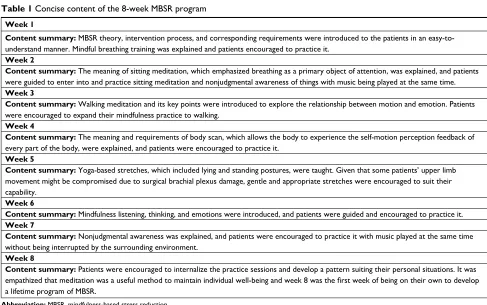
This study was a two-arm randomized controlled trial. The sample size was estimated by G*Power version 3.1 program with a power (1–β) of 80% and a significance level of 5%. Using an effect size of 0.59 which was reported by related studies, we established that a minimum sample size of 94 patients was required. Allowing for 20% loss to follow-up of sample, 120 patients were randomized 1:1 into the MBSR intervention group or the usual care (UC) group. The allo-cation sequence was generated by random permuted block randomization (with a block size of 4) conducted using a computer-based system and concealed in sequentially num-bered envelopes. Patients were blinded to study hypotheses and had no knowledge of the content of the group to which they were not assigned. The research staff were not blinded to the randomization or patient outcome. The UC group underwent admission education, medication guidance, isolation protection education, and discharge guidance, as they were conventionally performed for these patients. As for the MBSR group, we designed a timetable starting 8 weeks before RIT hospitalization (Figure 1), after which they would become a radioactive source. For these patients, in addition to routine guidance, a brief overview of the MBSR program, emphasizing the 8-week session schedule, was given 8 weeks before RIT hospitalization. All sessions were based on the original 8-week MBSR program that was developed by Kabat-Zinn12 and were adjusted according to
the corresponding conditions (Table 1). Each session also included group discussions and individual reports to create an interactive learning environment. The MBSR program was provided by a psychologist who was qualified in delivering mindfulness skills. Prior to the study, we also performed an 8-week pilot feasibility MBSR program with eight patients. The pilot study was designed to help provide the psychologist practice in running the program under clinical supervision and to resolve any potential practical problems.
Data collection
The assessments were conducted at three time points, which were the initial baseline that was immediately before the
Cancer Management and Research downloaded from https://www.dovepress.com/ by 118.70.13.36 on 20-Aug-2020
Dovepress MBsR in DTC patients receiving radioactive iodine therapy
start of MBSR (T1), immediately after RIT hospitalization was concluded (T2), and 3 months after RIT hospitaliza-tion (T3).
Qol questionnaire (QlQ)
QoL was assessed using the QoL Questionnaire Core 30 Items (QLQ-C30) of the European Organization for Research and Treatment of Cancer (EORTC), which is a validated, self-reported, cancer-specific measure of QoL, with high
Figure 1 The relationship of time schedule between RiT procedure and MBsR intervention.
Abbreviations: MBsR, mindfulness-based stress reduction; RiT, radioactive iodine therapy.
RIT schedule Pre-RIT
RIT planning
Thyroid hormone
withdrawal RIT and isolation
MBSR intervention schedule
Pre-intervention
measures Sessions 1–3
Post-intervention
measures Session 4 Sessions 5–8
Week 4 Week 9
Table 1 Concise content of the 8-week MBsR program
Week 1
Content summary: MBsR theory, intervention process, and corresponding requirements were introduced to the patients in an easy-to-understand manner. Mindful breathing training was explained and patients encouraged to practice it.
Week 2
Content summary: The meaning of sitting meditation, which emphasized breathing as a primary object of attention, was explained, and patients were guided to enter into and practice sitting meditation and nonjudgmental awareness of things with music being played at the same time.
Week 3
Content summary: Walking meditation and its key points were introduced to explore the relationship between motion and emotion. Patients were encouraged to expand their mindfulness practice to walking.
Week 4
Content summary: The meaning and requirements of body scan, which allows the body to experience the self-motion perception feedback of every part of the body, were explained, and patients were encouraged to practice it.
Week 5
Content summary: Yoga-based stretches, which included lying and standing postures, were taught. given that some patients’ upper limb movement might be compromised due to surgical brachial plexus damage, gentle and appropriate stretches were encouraged to suit their capability.
Week 6
Content summary: Mindfulness listening, thinking, and emotions were introduced, and patients were guided and encouraged to practice it.
Week 7
Content summary: nonjudgmental awareness was explained, and patients were encouraged to practice it with music played at the same time without being interrupted by the surrounding environment.
Week 8
Content summary: Patients were encouraged to internalize the practice sessions and develop a pattern suiting their personal situations. it was
empathized that meditation was a useful method to maintain individual well-being and week 8 was the first week of being on their own to develop
a lifetime program of MBsR.
Abbreviation: MBsR, mindfulness-based stress reduction.
functional scores and low symptom scores representing better functioning. It has been translated and validated in 81 languages and is used in more than 3,000 studies world-wide. It consists of five functional dimensions (eg, physical, emotional, cognitive, social, and role), three symptomatic dimensions (including pain, fatigue, and nausea), and other dimensions, such as insomnia, appetite, and economic bur-den. The scoring has been linearly transformed to a 0–100 scale according to the EORTC scoring manual.
Cancer Management and Research downloaded from https://www.dovepress.com/ by 118.70.13.36 on 20-Aug-2020
Dovepress
liu et al
self-rating Depression scale (sDs) and
self-rating anxiety scale (sas)
The level of depression and anxiety was assessed by the Zung SDS and the Zung SAS, respectively. Each scale contains 20 items based on a 0–4 scale, with a higher score indicating a higher level of anxiety or depression. The possible range of scores was 0–80 for each scale.
statistical analyses
Statistical analysis was performed using MedCalc software (version 17.4.4; Broekstraat, Mariakerke, Belgium). Com-parisons of categorical variables were performed with either chi-squared test or Fisher’s exact test as appropriate. Student’s
t-test was used for normally distributed continuous variables,
and the Mann–Whitney U test was used for non-normally distributed continuous variables. Linear mixed models were used to assess the interaction between patients’ assignment (UC group vs MBSR group) and time (T1, T2, and T3) in relation to QoL, SDS, and SAS scales, testing whether the rate of scale change varied by study assignment. Linear mixed models were also used to account for baseline differences.
P<0.05 was considered to indicate statistical significance for all analyses. Cohen’s d was calculated for the evaluation of effect size.
Results
Patients
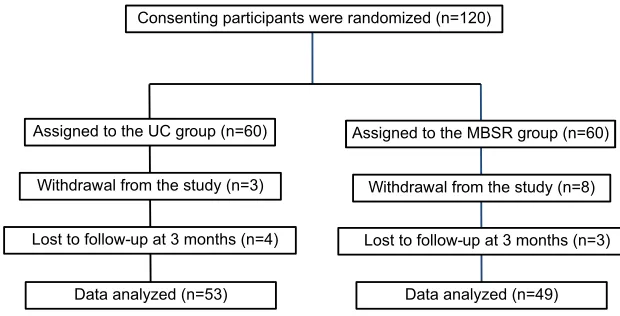
Figure 2 shows an overview of the number of subjects who were randomized and retained. In total, 18 patients (15%) dropped out before the end of this study, resulting in 53 patients in the UC group and 49 patients in the MBSR group for data analysis. The demographic information of the
included patients is summarized in Table 2. There were no statistical differences in age, gender, marital status, residence, educational level, employment status, religion, TNM stage, and radioiodine dose between the two groups (all P<0.05).
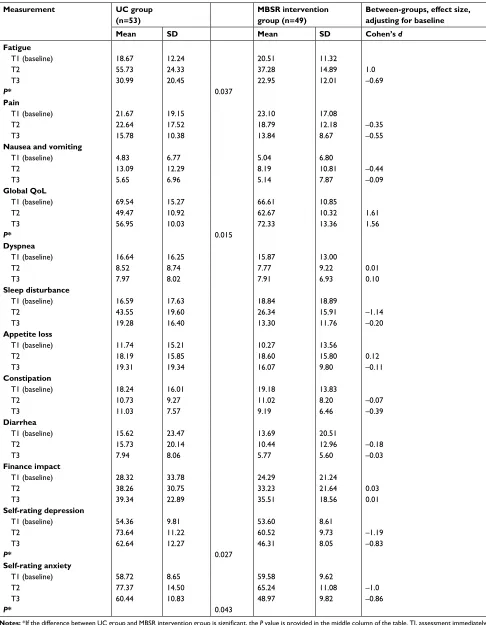
Linear mixed models were used to test the efficacy of MBSR on each QoL, SDS, and SAS. Descriptive data for each outcome are summarized in Table 3.
health-related Qol
Statistically significant QoL improvements were observed in patients in the MBSR group through the 3-month period. Patients randomly assigned to the MBSR group showed significantly greater improvements in emotional function (P=0.012, d=–0.03 for T2 and d=1.17 for T3), fatigue (P=0.037, d=1.00 for T2 and d=–0.69 for T3), and global QoL (P=0.015, d=1.61 for T2 and d=1.56 for T3).
sDs and sas
Patients randomly assigned to the MBSR group demonstrated greater scale improvement in depression (P=0.027, d=–1.19 for T2 and d=–0.83 for T3) and anxiety (P=0.043, d=–1.00 for T2 and d=–0.86 for T3).
Discussion
Our study was the first to explore the effects of MBSR on DTC patients receiving RIT. Important findings from this study include statistically significant improvements in emo-tional function, fatigue, global QoL, depression, and anxiety scales after MBSR intervention compared with those after UC.
Usually several weeks ahead of RIT, DTC patients come to our department for RIT consultation and seek guidance
Figure 2 Flow diagram of patient randomization and retention.
Abbreviations: MBsR, mindfulness-based stress reduction; UC, usual care.
Consenting participants were randomized (n=120)
Assigned to the UC group (n=60) Assigned to the MBSR group (n=60)
Withdrawal from the study (n=3) Withdrawal from the study (n=8)
Lost to follow-up at 3 months (n=4) Lost to follow-up at 3 months (n=3)
Data analyzed (n=53) Data analyzed (n=49)
Cancer Management and Research downloaded from https://www.dovepress.com/ by 118.70.13.36 on 20-Aug-2020
Dovepress MBsR in DTC patients receiving radioactive iodine therapy
Table 2 Comparison of demographic and clinical characteristics
MBSR intervention group (n=49) UC group (n=53) P-value
age, mean ± sD 43.32±10.99 42.38±12.60 0.6899
gender, n (%) 0.8307
Female 34 38
Male 15 15
Marital status, n (%) 0.7409
Married 35 37
single 4 6
Residence, n (%) 1.0000
Urban 34 37
Rural 15 16
educational level, n (%) 0.8354
Middle school or lower 16 19
high school or higher 33 34
employment status, n (%) 0.6960
employed 27 27
Unemployed 22 26
Religion, n (%) 0.6189
Yes 11 9
no 38 44
TnM stage, n (%) 0.7677
i 25 27
ii 8 7
iii 11 14
iV 5 6
Rai dose, mean ± sD 113.5±26.7 109.7±24.9 0.5870
Abbreviations: MBsR, mindfulness-based stress reduction; UC, usual care.
Table 3 Comparison of Qol, depression, and anxiety outcome across time points
Measurement UC group (n=53)
MBSR intervention group (n=49)
Between-groups effect size, adjusting for baseline
Mean SD Mean SD Cohen’s d
Physical function
T1 (baseline) 72.14 15.11 76.27 18.94
T2 67.34 11.65 74.61 17.96 0.21
T3 77.09 16.10 85.72 12.30 0.31
Role function
T1 (baseline) 74.20 12.81 71.04 21.76
T2 58.55 11.86 68.40 12.79 1.17
T3 66.61 10.49 74.63 12.76 0.34
Emotional function
T1 (baseline) 69.23 22.04 71.18 18.38
T2 51.93 14.62 63.49 13.78 –0.03
T3 56.57 16.10 74.12 9.50 1.17
P* 0.012
Cognitive function
T1 (baseline) 71.00 19.62 73.69 16.30
T2 61.81 19.86 69.56 13.97 0.29
T3 70.62 18.25 77.81 16.30 0.26
Social function
T1 (baseline) 65.22 23.71 63.77 24.95
T2 56.11 17.08 65.81 18.49 0.86
T3 62.05 14.34 74.35 17.68 0.63
(Continued)
Cancer Management and Research downloaded from https://www.dovepress.com/ by 118.70.13.36 on 20-Aug-2020
Dovepress
liu et al
Measurement UC group (n=53)
MBSR intervention group (n=49)
Between-groups, effect size, adjusting for baseline
Mean SD Mean SD Cohen’s d
Fatigue
T1 (baseline) 18.67 12.24 20.51 11.32
T2 55.73 24.33 37.28 14.89 1.0
T3 30.99 20.45 22.95 12.01 –0.69
P* 0.037
Pain
T1 (baseline) 21.67 19.15 23.10 17.08
T2 22.64 17.52 18.79 12.18 –0.35
T3 15.78 10.38 13.84 8.67 –0.55
Nausea and vomiting
T1 (baseline) 4.83 6.77 5.04 6.80
T2 13.09 12.29 8.19 10.81 –0.44
T3 5.65 6.96 5.14 7.87 –0.09
Global QoL
T1 (baseline) 69.54 15.27 66.61 10.85
T2 49.47 10.92 62.67 10.32 1.61
T3 56.95 10.03 72.33 13.36 1.56
P* 0.015
Dyspnea
T1 (baseline) 16.64 16.25 15.87 13.00
T2 8.52 8.74 7.77 9.22 0.01
T3 7.97 8.02 7.91 6.93 0.10
Sleep disturbance
T1 (baseline) 16.59 17.63 18.84 18.89
T2 43.55 19.60 26.34 15.91 –1.14
T3 19.28 16.40 13.30 11.76 –0.20
Appetite loss
T1 (baseline) 11.74 15.21 10.27 13.56
T2 18.19 15.85 18.60 15.80 0.12
T3 19.31 19.34 16.07 9.80 –0.11
Constipation
T1 (baseline) 18.24 16.01 19.18 13.83
T2 10.73 9.27 11.02 8.20 –0.07
T3 11.03 7.57 9.19 6.46 –0.39
Diarrhea
T1 (baseline) 15.62 23.47 13.69 20.51
T2 15.73 20.14 10.44 12.96 –0.18
T3 7.94 8.06 5.77 5.60 –0.03
Finance impact
T1 (baseline) 28.32 33.78 24.29 21.24
T2 38.26 30.75 33.23 21.64 0.03
T3 39.34 22.89 35.51 18.56 0.01
Self-rating depression
T1 (baseline) 54.36 9.81 53.60 8.61
T2 73.64 11.22 60.52 9.73 –1.19
T3 62.64 12.27 46.31 8.05 –0.83
P* 0.027
Self-rating anxiety
T1 (baseline) 58.72 8.65 59.58 9.62
T2 77.37 14.50 65.24 11.08 –1.0
T3 60.44 10.83 48.97 9.82 –0.86
P* 0.043
Notes: *If the difference between UC group and MBSR intervention group is significant, the P value is provided in the middle column of the table. Ti, assessment immediately before the start of MBsR; T2, assessment immediately after RiT hospitalization is concluded; T3, assessment 3 months after RiT hospitalization.
Abbreviations: MBsR, mindfulness-based stress reduction; Qol, quality of life; UC, usual care.
Table 3 (Continued)
Cancer Management and Research downloaded from https://www.dovepress.com/ by 118.70.13.36 on 20-Aug-2020
Dovepress MBsR in DTC patients receiving radioactive iodine therapy
regarding thyroid hormone withdrawal, low iodine diet, and the time schedule. This leaves us plenty of time to communi-cate with them. Recognizing the inadequacy of psychological support for these patients, we begin to think over what we could do to reduce their suffering in this period.
MBSR is now regarded as a well-established adjunctive treatment to assist well-being for medical patients in the USA. Since the introduction of this psychological intervention program to China, an increasing number of studies have been conducted to test its applicability in various patient groups such as breast cancer, chronic pain, and chronic insomnia. The results have been encouraging.13–15
In our study, most of the improvements in QoL, depres-sion, and anxiety can be seen immediately after RIT hospi-talization was concluded, when patients were experiencing the most negative impact of 4 weeks of thyroid hormone withdrawal, RIT-associated side effects, and isolation. Previ-ous researchers have reported such changes in other types of cancers receiving MBSR program.9,16–19 However, we thought
that the supportive interaction among the group members may also result in positive health effect. In this regard, future research might be needed to evaluate whether MBSR adds benefit over an active psychological treatment such as cog-nitive behavior therapy (CBT), which could provide coping skills of a different type. Nonetheless, our results indicate that an 8-week schedule ahead of RIT hospitalization is applicable and effective for patients to cope with worsened QoL, depression, and anxiety in this period.
Three months after RIT, DTC patients began to recover from the panic and fear of the disease, as well as the damage caused by necessary medical treatment. However, we still observed significant benefits in the MBSR intervention group compared to the UC group at this time point. Parameters such as emotional function, fatigue, global QoL, depression, and anxiety were significantly better in the MBSR group than the UC group. The effect of MBSR on psychological aspect is more evident in this observation time point.
Two subscales (dyspnea and diarrhea) in QLQ-C30 recov-ered significantly in both the UC and MBSR groups. This is due to the resumption of levothyroxine, which reverses the state of hypothyroidism and leads to less related symptoms. One subscale (appetite loss) continued to be high in the two observation time points in both the UC and MBSR groups. Appetite loss is a side effect from RIT. However, different from nausea and vomiting, which usually disappear 2 or 3 days after RIT, it lasts for a very long period of time.20 Our
results demonstrate that MBSR has no significant impact on this subscale within 3 months after RIT hospitalization.
There are some limitations to this study. First, although the study design is an RCT, this clinical trial was limited by a modest sample size. Further studies with larger study popula-tion are required to confirm our results. Second, to understand the positive effect in patients receiving MBSR, 3-month point seems to be not enough and extended follow-up is needed. Third, because the study population was from one single hospi-tal center, the results may not applicable to the general patients due to several DTC treatment strategies. Finally, we did not evaluate whether patients continuing practicing mindfulness after 3-month time point are benefitted. Because psychological intervention can improve the adherence of traditional treat-ment, we anticipate that DTC patients might benefit from long-term MBSR, even in recurrence and survival. However, future studies are needed to confirm this assumption.
Conclusion
An 8-week MBSR program significantly improved a wide range of scales in health-related QoL and mitigated depres-sion and anxiety among DTC patients receiving RIT.
Acknowledgment
We thank all the participating patients and the research nurses and staff for their efforts in completing this study.
Disclosure
The authors report no conflicts of interest in this work.
References
1. La Vecchia C, Malvezzi M, Bosetti C, et al. Thyroid cancer mortality and incidence: a global overview. Int J Cancer. 2015;136(9):2187–2195. 2. Yang L, Zheng RS, Wang N, et al. Analysis of incidence and mortal-ity of thyroid cancer in China, 2013. Zhonghua Zhong Liu Za Zhi. 2017;39(11):862–867.
3. Haugen BR, Alexander EK, Bible KC, et al. 2015 American thyroid association management guidelines for adult patients with thyroid nodules and differentiated thyroid cancer: the American Thyroid associa-tion guidelines task force on thyroid nodules and differentiated thyroid cancer. Thyroid. 2016;26(1):1–133.
4. Singer S, Lincke T, Gamper E, et al. Quality of life in patients with thyroid cancer compared with the general population. Thyroid. 2012;22(2):117–124.
5. Robbins RJ, Schlumberger MJ. The evolving role of (131)I for the treat-ment of differentiated thyroid carcinoma. J Nucl Med. 2005;46(Suppl 1):28S–37S.
6. Lu L, Shan F, Li W, Lu H. Short-term side effects after radioiodine treatment in patients with differentiated thyroid cancer. Biomed Res
Int. 2016;2016(9):1–5.
7. Kabat-Zinn J. Mindfulness-based interventions in context: Past, present, and future. Clinical Psychology: Science and Practice. 2006;10(2):144–156.
8. Kabat-Zinn J. An outpatient program in behavioral medicine for chronic pain patients based on the practice of mindfulness meditation: theo-retical considerations and preliminary results. Gen Hosp Psychiatry. 1982;4(1):33–47.
Cancer Management and Research downloaded from https://www.dovepress.com/ by 118.70.13.36 on 20-Aug-2020
Dovepress
Cancer Management and Research
Publish your work in this journal
Submit your manuscript here: https://www.dovepress.com/cancer-management-and-research-journal Cancer Management and Research is an international, peer-reviewed open access journal focusing on cancer research and the optimal use of preventative and integrated treatment interventions to achieve improved outcomes, enhanced survival and quality of life for the cancer patient. The manuscript management system is completely online and includes
a very quick and fair peer-review system, which is all easy to use. Visit http://www.dovepress.com/testimonials.php to read real quotes from published authors.
Dove
press
liu et al
9. Zhang MF, Wen YS, Liu WY, Peng LF, Wu XD, Liu QW. Effec-tiveness of mindfulness-based therapy for reducing anxiety and depression in patients with cancer: A Meta-analysis. Medicine. 2015;94(45):e0897–e0890.
10. Anheyer D, Haller H, Barth J, Lauche R, Dobos G, Cramer H. Mind-fulness-based stress reduction for treating low back pain: a systematic review and meta-analysis. Ann Intern Med. 2017;166(11):799–807. 11. Lawrence M, Booth J, Mercer S, Crawford E. A systematic review of
the benefits of mindfulness-based interventions following transient ischemic attack and stroke. Int J Stroke. 2013;8(6):465–474. 12. Kabat-Zinn J. Bringing mindfulness to medicine: an interview with Jon
Kabat-Zinn, PhD. Interview by Karolyn Gazella. Adv Mind Body Med. 2005;21(2):22–27.
13. Zhang JY, Zhou YQ, Feng ZW, Fan YN, Zeng GC, Wei L. Randomized controlled trial of mindfulness-based stress reduction (MBSR) on post-traumatic growth of Chinese breast cancer survivors. Psychol Health
Med. 2017;22(1):94–109.
14. Zhang JX, Liu XH, Xie XH, et al. Mindfulness-based stress reduc-tion for chronic insomnia in adults older than 75 years: a randomized, controlled, single-blind clinical trial. Explore. 2015;11(3):180–185. 15. Wong SY. Effect of mindfulness-based stress reduction programme on
pain and quality of life in chronic pain patients: a randomised controlled clinical trial. Hong Kong Med J. 2009;15(Suppl 6):13–14.
16. Hoffman CJ, Ersser SJ, Hopkinson JB, Nicholls PG, Harrington JE, Thomas PW. Effectiveness of mindfulness-based stress reduction in mood, breast- and endocrine-related quality of life, and well-being in stage 0 to III breast cancer: a randomized, controlled trial. J Clin Oncol. 2012;30(12):1335–1342.
17. Pollard A, Burchell JL, Castle D, et al. Individualised mindfulness-based stress reduction for head and neck cancer patients undergoing radiotherapy of curative intent: a descriptive pilot study. Eur J Cancer
Care. 2017;26(2):e12474.
18. Johns SA, Brown LF, Beck-Coon K, et al. Randomized controlled pilot trial of mindfulness-based stress reduction compared to psychoedu-cational support for persistently fatigued breast and colorectal cancer survivors. Support Care Cancer. 2016;24(10):4085–4096.
19. Schellekens MPJ, van den Hurk DGM, Prins JB, et al. Mindfulness-based stress reduction added to care as usual for lung cancer patients and/or their partners: A multicentre randomized controlled trial.
Psy-chooncology. 2017;26(12):2118–2126.
20. Florenzano P, Guarda FJ, Jaimovich R, Droppelmann N, González H, Domínguez JM. Radioactive iodine administration is associated with persistent related symptoms in patients with differentiated thyroid cancer. Int J Endocrinol. 2016;2016:1–6.
Cancer Management and Research downloaded from https://www.dovepress.com/ by 118.70.13.36 on 20-Aug-2020