IJSRR, 7(4) Oct. – Dec., 2018 Page 88
Research article Available online www.ijsrr.org ISSN: 2279–0543
International Journal of Scientific Research and Reviews
Formulation of Novel Co-Processed Excipient by Microwave Drying
Method and Evaluation of Sustained Release Tablet Prepared by
Direct Compression
Vipul P. Patel
1and Zil P. Patel
2*
1
MEFGI-Faculty of Pharmacy, Marwadi University, Rajkot, Gujarat
2
Kalol Institute of Pharmacy; KIRC Campus, Gandhinagar Email: 1 [email protected]. [email protected]
ABSTRACT
A directly compressible co-processed excipient composed of a hydrophilic natural gum and
ethyl cellulose was developed by microwave drying method. Sustained release co-processed
excipient was formulated and Propranolol HCl was used as model drug. The tablets were prepared by
direct compression method. Xanthan gum and methylcellulose were used as release retardant
polymers. Their ratio was optimized using simple 22 full factorial design. The pre-compression and post-compression parameters were evaluated for the final tablet dosage form. Drug release at 1 hr
and 12 hrs were studied as independent factors. Ethyl cellulose exhibited a negative impact on drug
release from at 12hrs. The optimized formulation was evaluated and stability study
KEYWORDS: Co-processed excipients, Sustained release, microwave drying, direct compression,
*Corresponding author
Zil P. Patel
Kalol Institute of Pharmacy;
KIRC Campus, Gandhinagar
IJSRR, 7(4) Oct. – Dec., 2018 Page 89
INTRODUCTION
The conventional oral dosage forms, such as tablets and capsules are formulated to release
the active drug at once after administration to obtain rapid, repeated dosing of the drug which may
lead to the peril of dose variation and complete systemic drug absorption. This lead to need of a
formulation with control release that maintains a near constant or uniform blood level of a drug often
translates into better patient compliance, as well as enhanced clinical efficacy of the drug for its
intended use. The purpose of any drug delivery system is to make available a therapeutic amount of
drug to the proper site in desired proportion.1, 2 The International Pharmaceutical Excipient Council (IPEC) definition of a co-processed excipient is “a combination of two or more compendial or
non-compendial excipients designed to physically modify their properties in a manner not achievable by
simple physical mixing, and without significant chemical change”. Co-processed excipients provide
improved excipients characteristics like flow property and compression characteristics. Directly
compressible co-processed excipients available in market are Pharmatose, Tablettose, Avicel grades,
etc.3
Microwave drying technique has shown growing application in pharmaceutical industry. It is
a rapid drying method with high efficiency compared to other conventional methods4. It‟s safe use for drying of pharmaceutical grade powders was studied and may be its application can be extended
further5.
MATERIALS AND EQUIPMENT
The model drug propranolol was obtained as gift sample from hetero labs, Hyderabad. The
polymer ethyl cellulose ( Ethocel) was obtained as gift sample from Colorcon, Mumbai. Xanthan
gum and starch were purchased from Chemdyes Corporation, Ahmedabad. Microwave model (IFB
25SC4) was used for drying the granules.
Preparation of Propranolol HCl tablets containing co-processed excipient
A 22 full factorial design with one centre point was used to optimize the ratio of Ethyl cellulose and Xanthan gum. Sieve all excipients through 60# sieve. Mix for 15 minutes and granulate
using suitable binder (starch paste 10%). Pass through sieve no.20 and spread in a borosilicate
petridish of large size (R10cm). Dry granules in a microwave for 4 minutes at maximum power.
Retain the prepared co processed excipients on sieve no 40. The process variables like microwave
power, feed load and drying time were derived by preliminary trial methods. The prepared
co-processed excipients were mixed with active drug components and the other formulation ingredients
IJSRR, 7(4) Oct. – Dec., 2018 Page 90
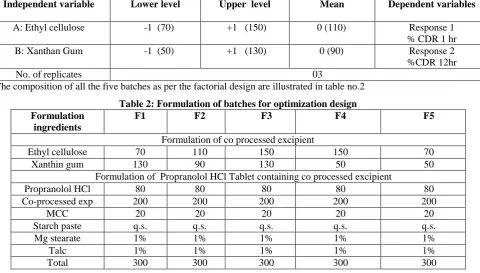
Table 1:Levels of Independent variables and dependent variables
Independent variable Lower level Upper level Mean Dependent variables
A: Ethyl cellulose -1 (70) +1 (150) 0 (110) Response 1
% CDR 1 hr
B: Xanthan Gum -1 (50) +1 (130) 0 (90) Response 2
%CDR 12hr
No. of replicates 03
The composition of all the five batches as per the factorial design are illustrated in table no.2
Table 2: Formulation of batches for optimization design Formulation
ingredients
F1 F2 F3 F4 F5
Formulation of co processed excipient
Ethyl cellulose 70 110 150 150 70
Xanthin gum 130 90 130 50 50
Formulation of Propranolol HCl Tablet containing co processed excipient
Propranolol HCl 80 80 80 80 80
Co-processed exp 200 200 200 200 200
MCC 20 20 20 20 20
Starch paste q.s. q.s. q.s. q.s. q.s.
Mg stearate 1% 1% 1% 1% 1%
Talc 1% 1% 1% 1% 1%
Total 300 300 300 300 300
Evaluation of co-processed excipients
1. % Fines
The prepared co-processed excipients were pre weighed and passed through a 60# sieve. The
fines are collected and weighed separately.
%Fines = wt of fines/ total wt *100
2. Bulk density and Tapped density
25gm of sample was filled in a 100ml measuring cylinder and tapped 50 times. The initial and
final volumes were measured. The densities were calculated as below formula.
Bulk density = W/ V0
Where, W is the weight of polymer and V0 is the bulk volume of the polymer.
Tapped density = W /Vf
where, W is the weight of powder, Vf is the tapped volume of the powder.
3. Hausner’s Ratio (HR) and Carr’s Index (CI)
The pre-calculated tapped densities and bulk densities are used in the following equations to
determine HR and CI to evaluate the compressibility characteristics and flow property.
Hausner‟s ratio (HR) = Tapped density/ Bulk density
Carr‟s index (CI) = (Tapped density - Bulk density) / Tapped density
IJSRR, 7(4) Oct. – Dec., 2018 Page 91
4. Angle of Repose
Fix a glass funnel at 2.5cm height(fix) using a burette stand and place a graph paper below.
25gm of sample is allowed to flow through the funnel. The circumference of the pile formed is
marked with a pencil and the average diameter is measured.
Ɵ = tan-1 (h/r)
Where „h‟ is height of pile and „r‟ is radius of pile
The standard table for reference are given in Table no.2 of chapter 1 (Introduction).
5. Granular friability (F)
10gm of sample was placed in a Roche friabilator and rotated for 4min at 25rpm. The sample
sieved through 60# screen and measure the co processed excipients retained on the sieve.
F= initial wt – final wt/initial wt*100
< 1% Indicates resistance to loss of weight due to facture and abrasion during transportation6. 6. Dilution potential
The prepared co-processed excipients were mixed with Paracetamol (poorly compressible
drug) in an increasing percentage in order of 10% until the mixture can be compressed to form
tablets of acceptable hardness. The dilution potential is the maximum %weight of drug that can be
incorporated into co processed excipients. A value of greater than 30% is desirable.
Evaluation of Propranolol HCl tablets
In vitro drug release profile- %CDR 1hr and %CDR 12 hr
As per USP monograph for Propranolol HCl ER capsule7, 8 the dissolution of tablets was carried in two different media in USP dissolution apparatus I at 100rpm and 37±2ᵒC. Aliquots of one
ml sample were withdrawn at pre determined time interval (replaced with 1ml dissolution media) and
the amount of dug was drug was determined by measuring the UV absorbance at 288nm in a UV
spectrophotometer. The sample tablets are first place in 900ml of 0.1 N HCl for two hours and then
immediately placed in 900ml 6.8pH phosphate buffer for remaining time.
Fitting of Mathematical Models s
Drug release profiles data of the optimized formulation was fitted to various mathematical
models (Zero-order, First-order, Higuchi, Hixon Crowell and Krosmeyer Peppas) in order to describe
the kinetics of drug release, best goodness-of-fit test (R2) were taken as criteria for selecting the most
appropriate model as per table given below:
IJSRR, 7(4) Oct. – Dec., 2018 Page 92
RESULT AND DISCUSSION
Evaluation of co-processed excipients
The results for evaluation parameters for experimental batches are discussed hereby. The
results for evaluation of co-processed excipients are given in table 5.12. while the tables 5.13 and
5.14 exhibit the tablet characteristics; pre- compression and post-compression parameters
respectively.
Table 3:Evaluation of experimental batches for Microwave drying method (compression characteristics of co-processed excipients) B a tches % F ines B ulk dens it y (mg /m
l) Ta
pp ed dens it y (mg /m l) Ang le o f re po se (ᵒ ) Ca rr ’s I nd ex H aus ner’ s Ra tio Dilutio n P o tent ia l ( %)
F1 15.6 0.388±0.01 0.42±1.02 26.113±0.04 7.407±0.05 1.08±0.05 40
F2 16 0.363±1.12 0.4±0.65 24.443±0.04 9.090±0.01 1.1±0.07 50
F3 14 0.438±0.58 0.488±0.33 23.682±0.05 10.204±0.21 1.113±0.42 60
F4 16.8 0.373±0.78 0.404±0.06 25.676±0.14 7.547±0.03 1.081±0.08 50
F5 18.8 0.381±0.23 0.429±1.12 24.057±0.19 11.111±0.01 1.125±0.02 50
*the values represent mean with standard deviation, n=3
The results obtained from the evaluation of co-processed excipients experimental batches
depict excellent flow properties and good compression characteristics. The dilution potential is near
to 50 % which is desirable.
Evaluation of Propranolol HCl tablets
The experimental batches were evaluated for thickness, hardness, friability, uniformity of
weight and drug content. The results obtained are specified in table no.4.the effect of ethyl cellulose
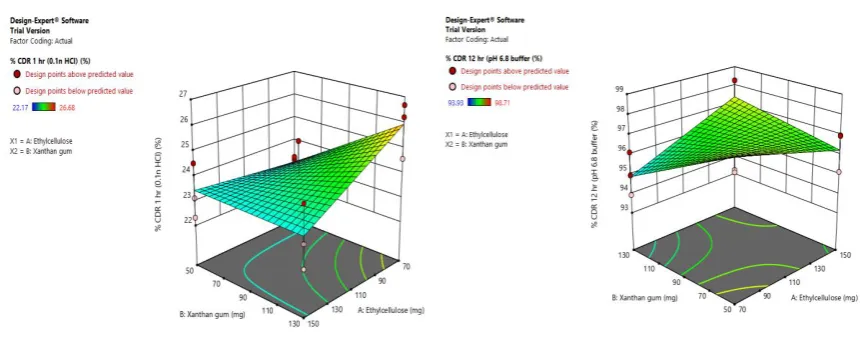
and xanthin gum ratio on the drug release at 1 hr and 12hrs are graphically represented in fig no.1
and 2 respectively
Figure 1: Effect of Factor A and B on %CDR 1hr
(0.1N HCl): 3D Surface Plot
Figure2: Effect of factor A and B on %CDR 12hr
IJSRR, 7(4) Oct. – Dec., 2018 Page 93
The concentration of ethyl cellulose has a negative effect on % CDR 1hr (0.1N)HCl. As the
concentration of ethyl cellulose increases the drug release decreases. While as the concentration of
xanthin gum increases the drug release also increases. Xanthin gum is a hydrophilic polymer and
swells to form a matrix. It is responsible for the burst release of the medicament. The interaction AB
is significant in the given model which indicates that both the factors together have influence on the
given response. The concentration of ethyl cellulose has a positive effect on % CDR 12hr in 6.8pH
phosphate buffer. As the concentration of ethyl cellulose increases the drug release increases. While
as the concentration of xanthin gum increases the drug release also decreases. Xanthin gum is a
hydrophilic polymer and swells to form a matrix. It helps to keep the tablet intact and slows down
drug release. The interaction AB is signify-cant in the given model which indicates that both the
factors together have influence on the given response
Table 4:Evaluation of experimental batches for Microwave drying method Batch
no.
Thickness* (mm)
Uniformity of Weight (mg)
Hardness* (kg)
Friability (%)
Drug content (mg)
F1 3.41±1.35 301±3.28 5.4±1.5 0.05 80±1.02
F2 4.12±1.45 298±2.21 5.7±1.8 0.41 79±0.04
F3 3.23±1.61 300±2.72 5.8±1.5 0.30 81±0.05
F4 4.16±1.23 299±1.28 5.5±1.5 0.51 78±1.24
F5 3.52±1.45 295±4.21 5.5±1.8 0.23 82±0.05
*the values represent mean with standard deviation, n=3
The results for uniformity of weight, friability and drug content fall within the pharmacopoeia
limits as per IP 2010 indicating that the tablet samples pass the respective test. Thickness and
Hardness are within acceptable range.
Drug release kinetics
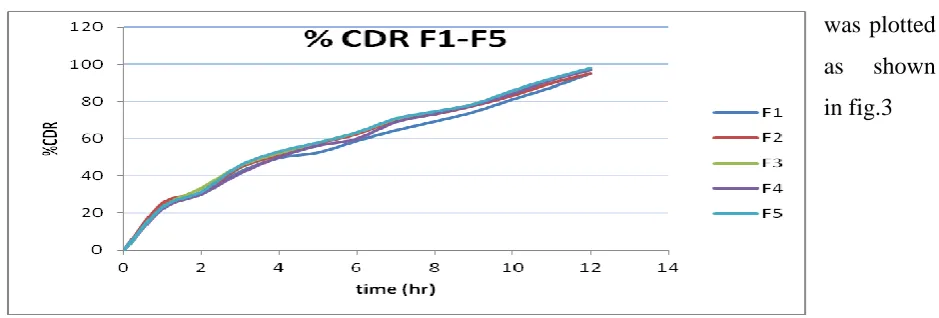
A 12 hr dissolution study was performed for experimental batches F1-F5 and the %CDR vs.
Time graph
was plotted
as shown
IJSRR, 7(4) Oct. – Dec., 2018 Page 94
Figure 3: Dissolution profile for experimental batches F1-F5
Fitting of mathematical model
The drug release profile was studied and different mathematical models were studied to
observe the best fitted model. The R2 (Regression) value was calculated and n value was determined for determination of release kinetics.
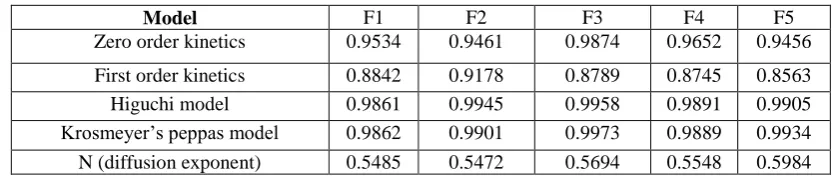
Table 5.15: Fitting of mathematical model experimental batches F1-F5
Model F1 F2 F3 F4 F5
Zero order kinetics 0.9534 0.9461 0.9874 0.9652 0.9456
First order kinetics 0.8842 0.9178 0.8789 0.8745 0.8563
Higuchi model 0.9861 0.9945 0.9958 0.9891 0.9905
Krosmeyer‟s peppas model 0.9862 0.9901 0.9973 0.9889 0.9934
N (diffusion exponent) 0.5485 0.5472 0.5694 0.5548 0.5984
The R2 value was compared and the highest value was obtained for Higuchi model. The experimental batches were seen to follow the Higuchi model for diffusion through polymer matrix.
The n value for all batches is in near to 0.5, thus the release mechanism observed from the n value is
Fickian diffusion.
Stability study
The experimental batches were subjected to stability study for two months at ambient
conditions (25ᵒC, 65% RH).The results for drug release and drug content were compared with the
initial data with student‟s t test. During the Stability study no remarkable changes were observed in
drug content. No significant changes were observed in %CDR of the Propranolol HCl SR(Sustained
Release) tablets.
CONCLUSION
The microwave drying method proves to be an efficient drying technique with further
adaptability in pharmaceutical industries. The co processed excipients composed of ethyl cellulose
and xanthin gum exhibit excellent flow properties and better compression characteristics. Presence of
ethyl cellulose depicts Higuchi model of release kinetics and provides a fickian diffusion (n = 0.5) It
can be concluded that the prepared novel co processed formulations can be suitably used for
designing sustained release formulation of different BCS class I drugs. The tablets can be directly
compressed with incorporation of minimum 50 % W/W of drug alone (or drug along with other
IJSRR, 7(4) Oct. – Dec., 2018 Page 95
REFERENCES:
1. YW. C. Novel Drug Delivery System. Revised and Expanded.. New York: CRC Press; 2005; 2
2. Vamsy KA, Srinath KR CP. Formulation development and evaluation of divalproex sodium extended release tablet. Int J Res Pharm Biomed Sci. 2011; 2: 809-832.
3. Gohel MC, Jogani PD. A review of co-processed directly compressible excipients. J Pharm Pharm Sci. 2005; 8(1): 76-93.
4. Wang W, Zhao C, Sun J, et al. Quantitative measurement of energy utilization efficiency and study of influence factors in typical microwave heating process. Energy. 2015; 87: 678-685. doi:10.1016/j.energy.2015.05.036.
5. Mcloughlin CM, McMinn WAM, Magee TRA, Member A. Microwave Drying of Pharmaceutical Powders. Food Bioprod Process. 2000; 78(2): 90-96. doi:10.1205/096030800532798.
6. Certificate A. Indian Pharmacopoeia The Pharmacopoeia Commission ; Govt. ofIndia, Ministry of Health & Family Welfare . Sector 23, Raj Nagar, Ghaziabad; 2010; 1: 412. 7. USP Monographs_ Propranolol Hydrochloride Extended-Release Capsules. pharmacopoeial
forum USP29–NF24. 2006; 1843.