26
Increasing Data Secrecy In Cloud By
Implementing Image Cryptography
Prathamesh Vijay Lahande, Dr. Parag Ravikant KaveriAbstract: Cloud provides an easy platform for users for the purpose of accessing and storing data from anywhere using the internet. Hence in spite the data being private, sensitive as well as confidential, the user decides to reside the data using the cloud by trusting the cloud. But, the privacy of this data resting on the cloud often gets compromised due to various issues, leading towards the security breach of the cloud and affecting the integrity of the data. This research paper contributes a methodology of encryption and decryption for securing the data on cloud. Traditionally, encryption process generates a cipher-text from a private text using a key, but the methodology proposed generates a cipher image from private text. Using this proposed methodology, the user can store any kind of data on the cloud without worrying about its breach or its integrity being affected.
Index Terms: ASCII; Cipher-Image; Cipher-Text; Cloud; Cryptography; Data Integrity; Decryption; Encryption; Pixel.
—————————— ——————————
1.
INTRODUCTION
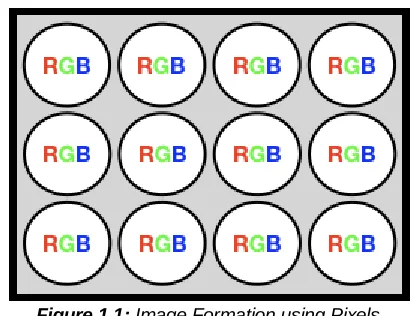
Cryptography is the methodology used for making the communication between the sender and receiver secure in the environment which is public and users who might be unauthorized and attackers who are malicious are present [6]. Cryptography, one of the branches of securing information [13], can be referred to as the practice and study of hiding and securing information [1] and caring about the confidentiality of data in the cloud [20]. Cryptography mainly constitutes two processes: Encryption and Decryption. Encryption algorithm is the method where the data is transformed into a format that is unrecognizable using a particular key for prevention of access, usually that is unauthorized. Decryption is the method, exactly opposite to Encryption method, that is used for reconstructing the data into its original format [5]. An image is a collection of data in visual format that usually resembles an object in physical form [22]. When an image is stored in an electronic form, it is made up of pixels. A pixel or picture the smallest addressable element a picture represented on the screen [22]. Every pixel is made up of RGB color space, where R indicates for color red, G indicates for color green and B for color blue. It is the red, green and blue values that together constitute what the pixel will look like. Also a collection of pixels stored in rows and columns together constitute how the image will look like. Image cryptography is the Cryptography done using images by transferring encrypted textual data into an image format thereby disguising encrypted or normal textual information [10]. Image Cryptography enhances privacy and confidentiality in cryptographic communication [10].
Figure 1.1: Image Formation using Pixels
Data confidentiality means that only certain people who are authorized can use the private data, whereas Data integrity means that the data is not modified or tampered [18]. Ensuring the Data Integrity of the cloud is as important and essential as securing the private data of the user [7]. The concerns of the user mainly revolve around the privacy and security of the data and information contained in the image. Once the data is uploaded to the cloud, it is up to the cloud service providers to protect and security of the data of the user [14]. If this security and privacy is compromised, then this becomes the main problem to the further development of cloud based image processing systems. Cloud computing is trending technology that uses the network to provide service to the user [4], [20], also provides an easy way of using cloud services, cloud resources and cloud applications using the Internet [7]. However, cloud computing is also the capability to access computing resources maintained and owned by some other third party using the Internet [2]. Without actually installing the applications, the end user can access the applications and personal files too using any desired computer having internet access [3]. Cloud Computing has evolved through a variety of implementations and it provides services such as Software as a Service (SaaS), Platform as a Service (PaaS) and Infrastructure as a Service (IaaS) [8], [11], [17], [19], [21]. In the IaaS, the hardware assets, for example, hard-disk, memory, networking resources are given in the rent and are charged according to the usage. In the PaaS, this not only provides all the facilities as in IaaS, yet additionally gives operating system facilities, their updates, etc. Consequently, make all work effectively. SaaS provides software to the user to utilize it efficiently on the cloud [9].
————————————————
Mr. Prathamesh Vijay Lahande is working as a Teaching Associate and also currently pursuing PhD degree from Symbiosis International Deemed University, Pune, India.
Mobile- +91 9028 731 330. E-mail: [email protected] Dr. Parag Ravikant Kaveri is currently working as an Assistant
27
2
LITERATURE
SURVEY
Pap er No
Paper
Findings Method Used
Impleme ntation Platform Advantages/ Disadvantages [1] Symmetri
c key
encryptio n
Character from file to cipher text. Cipher text back
to character.
Amazon S3
Algorithms basic. Easy to crack
the algorithm. [2] AES, RSA, Blow Fish, DES.
AES, RSA,
BlowFish, DES
NetBean s Java
AES: Low RAM needed, faster than others. RSA: Highest
memory utilizer. Blow Fish:
Requires less than 5KB to execute DES: Requires
memory more than AES.
[3]
Cryptogr aphy & Steganog raphy
Algorithm implementing RC4 stream cipher and
RGB Pixel
shuffling with Steganography with the use of
High Least
Significant Bit.
Cloud
Algorithm better than traditional encryption decryption algorithm. [4] Classical Cryptogr aphy (CC) and Quantum Cryptogr aphy(QC)
- Cloud
CC: Math
computation widely used, Digital Signature present, Expenditure zero.
QC: Quantum
mechanics, Digital Sign Not Present, High Cost.
[5]
Module uses secret key for encryptio n.
Encryption done by Elliptic Curve Cryptography Approach
Cloud -
[6]
Cloud Computin g, Cryptogr aphy & Steganog raphy
Cryptography and
Steganography. Cloud -
[7] Fully Homomo rphic Encryptio n Scheme
Key space, Key Sensitivity Histogram, Correlation, PSNR, MSE and Noise analyses are done.
Cloud
Provides better security than basic Encryption Decryption Algorithms. [8] Fully homomor phic encryptio
n and
searchabl e encryptio n
Methodology guarantees that
the service
provider of the cloud cannot view the content of the data the end user stored. - - [9] SLAs, Present SLAs, Standardi zing SLAs. - - - [10] Merging Cryptogr aphy and Steganog raphy for Encryptio
n and
Encryption and Decryption by splitting file into 2 parts, each part has different encryption algorithm. Java, Cloud Encryption, Decryption Algorithm provides security. Decryptio n. [11] Visual Cryptogr aphy, Image Cryptogr aphy
Text entered at a particular location in image.
-
Sender and
Receiver need to know what image to use and the area where the text is stored. [12] Proposed algorithm operates at frequenc y domain
The encryption algorithm uses the discrete cosine
transform to
convert the target image into the frequency domain
Images
Encryption is better because of the use of Discrete Cosine Transform.
3 EXISTING
METHODOLOGY
Cryptography is changing the content of the original plain text data to make it into such a format that should not be understanding to humans, should not have any meaning and should not be readable during its transmission. This process is called Encryption. Exactly opposite to this process is called Decryption where the original plain text is got back from its encrypted data [15], [16], [20]. For encryption and decryption, the key plays a vital role in any encryption method and often the security of a cipher depends on the quality of the key [12].
3.1. Encryption:
Encryption is the methodology where the original plain text is converted to an unintelligible format using a key. The unintelligible format is called cipher text which is difficult to understand.
3.2. Decryption:
Decryption is the methodology where the cipher text is converted back to its original plain text by using the same key that was used for encrypting it.
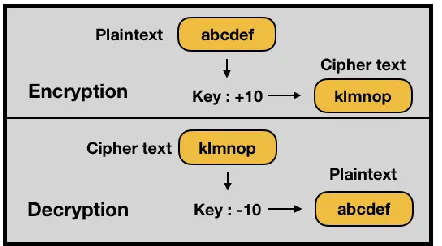
Following image depicts Encryption and Decryption method:
Figure 3.1: Process of Encryption and Decryption
28 Algorithm 1: Encryption
Input: File to encrypt.
Output: Encrypted File containing Cipher-Text
(i). Extract a character from the file. Example: Let us say character is ‗P‘.
(ii). Get the corresponding ASCII value of that character. In our case, ASCII value of ‗P‘ is 80.
(iii). Convert that ASCII value into its corresponding binary value. So binary value of 80 is ―1010000‖.
(iv). Check if the binary is in 8-bits. If NOT, then make it into 8-bit binary by adding preceding 0s to it. In our case, binary value ―1010000‖ constitutes to 7 bits. Hence add one preceding 0 to it for it to become ―0101 0000‖.
(v). Reverse this 8-bit binary value. Reversing ―0101 0000‖ gives us ―0000 1010‖.
(vi). Extract the first 4 chunk of bits from entire 8 bits from this reversed 8 bit-binary value and reverse these 4 bits as well. In our case, after extracting first 4 bits from ―0000 1010‖, we get ―0000‖. Reversing these 4 bits gives us ―0000‖.
(vii). Similarly extract the last 4 bits and reverse them as well. In our case, extracting last 4 bits from ―0000 1010‖ are ―1010‖. Reversing them gives us ―0101‖. (viii). Concatenate both the reversed 4 bits obtained from
step 6 and 7. i.e. concatenate ―0000‖ and ―0101‖ to give ―0000 0101‖.
(ix). Convert these concatenated bits to its corresponding ASCII value. ASCII value of ―0000 0101‖ is 5.
(x). A separate key is used for adding to the value obtained in step 9. In this case let us say that key is 10. So 10 is added to 5 to obtain 15.
(xi). Corresponding character of the ASCII value 15 is written to the encryption file.
(xii). Repeat the above process for all the characters in the input file.
Following diagram depicts this encryption process:
Figure 3.2: Encryption Procedure [1] Compiled by Researcher.
Algorithm 2: Decryption
Input: Encrypted File containing Cipher-Text. Output: Original File.
(i). Extract a character from the encrypted file.
(ii). Get the corresponding decimal value of that extracted character. i.e. 15.
(iii). Since our key is 10 so subtract 10 from this extracted character to get 5
(iv). Convert the extracted character to its corresponding. (v). 8-bit binary. In this case binary of 5 is ―0000 0101‖. (vi). Get the first 4 chunk of bits from this 8-bit binary and
reverse them. First 4-bits from ―0000 0101‖ are ―0000‖ and reversing them gives ―0000‖.
(vii). Get the other last 4 chunk of bits and reverse them as well. Last 4 bits from ―0000 0101‖ are ―0101‖ and reversing them gives ―1010‖.
(viii). Concatenate the two 4-bits obtained from step 5 and step 6. i.e. concatenate ―0000‖ and ―0101‖ to get ―0000 1010‖.
(ix). Reverse the bits obtained in step 7. i.e. reverse ―0000 1010‖ to get ―0101 0000‖.
(x). Convert these bits to its corresponding decimal value i.e. 80.
(xi). Obtain the corresponding character of ASCII value of 80 i.e. P (Original Text Back).
(xii). Repeat the above process for all the characters in the encrypted file to get the original text back.
Following diagram depicts this decryption process:
Figure 3.3: Decryption Procedure [1] Compiled by Researcher.
3.3. Encryption Decryption Expression:
29 Figure 3.4: Encryption Decryption Expression
4 RESEARCH
PROBLEM
AND
OBJECTIVE
4.1 Following are the problems or gaps observed in the existing system
1. Methodology of Encryption and Decryption is very basic. 2. When an uninvited third party accesses the cipher text, it is easy to crack the encryption procedure, since the encryption process is very simple to understand. 3. A more rigorous and complex approach of encryption is
needed to secure the data of the user.
4. Integrity of data on the cloud is affected when an uninvited third party accesses the private data of the user.
5. Security of the cloud is compromised when private data of the user on the cloud is hacked.
6. Private data of the user is now in the open leading to breaching of privacy of the users‘ data.
7. User may suffer a huge loss when his data is hacked by the third party, leading him to abandon the cloud platform.
4.2 Objective
Following are the objectives proposed from this research paper:
1. Provide a more rigorous and complex encryption process to secure the private date.
2. Integrity of the cloud data should be maintained. 3. Improve the cloud security.
4. Prohibit privacy breaches to happen. 5. Minimize the user‘s loss.
6. Minimize data intrusion and spying.
7. Proposed Methodology
5.1. Encryption
Encryption process proposed in this methodology undergoes five stages where the private, sensitive and confidential data of the user within the file gets converted to a cipher image, rather than a cipher text. Before the encryption process starts, following initialization is done: Three arrays namely red array, green array and blue array are created. Each array has values initialized from 0 to 255. These arrays basically represent the ASCII values running from 0 to 255.
Algorithm 3: Encryption
Input: File to encrypt
Output: Encrypted Cipher-Image
Following are the five stages proposed in encryption:
(i). Every character in the private text of the file is added with a key.
(ii). The character obtained from step 1 is used as an index to get red, green and blue values from Red array, Blue array and Green array respectively. This
means for every character, we will have three values: one value from red array, one from green and last one from blue array.
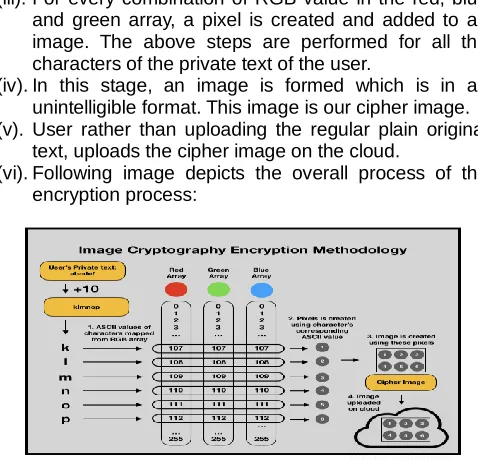
(iii).For every combination of RGB value in the red, blue and green array, a pixel is created and added to an image. The above steps are performed for all the characters of the private text of the user.
(iv).In this stage, an image is formed which is in an unintelligible format. This image is our cipher image. (v). User rather than uploading the regular plain original
text, uploads the cipher image on the cloud.
(vi).Following image depicts the overall process of the encryption process:
Figure 5.1. Proposed Encryption Method
5.2. Decryption
Process of decryption proposed in this methodology also undergoes four stages like the encryption process. It is important to understand that unlike the traditional decryption process that decrypts the cipher-text, the proposed decryption process deciphers the cipher-image. Similar to encryption process, before the decryption process starts, following initialization is done: Three arrays namely red array, green array and blue array is created. Each array has values initialized from 0 to 255. These arrays basically represent the ASCII values running from 0 to 255.
Algorithm 2: Decryption
Input: Cipher-Image Output: Original Plain Text
Following are the five stages proposed in decryption:
(i). Cipher image resides on the cloud, earlier uploaded by the user after encryption procedure.
(ii). This image is downloaded on the local machine of the user for decryption procedure.
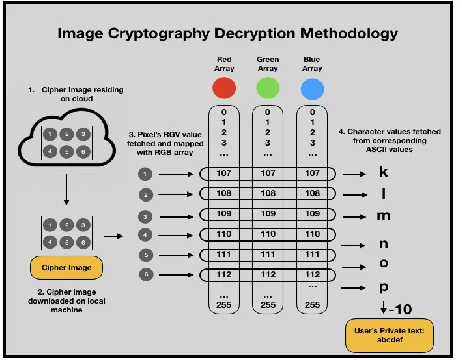
(iii).From the cipher image, for every pixel, its red, green and blue values are fetched and mapped to the Red array, Green array and Blue array. Thus for every pixel, we have three values, one for red, second for green and last one for blue. These values are the ASCII values of the corresponding character of the private text.
(iv).Above process is carried out for all the pixels in the cipher image. These ASCII values are then mapped to its corresponding character.
30 Following image depicts the overall process of the decryption
process:
Figure 5.2. Proposed Decryption Method
5.3. Encryption Decryption Expression:
dk(ek(w) + ASCII x RGB) = Message block (w)and k for key.
6
RESULTS
AND
CONCLUSION
Following are the results computed and some conclusions are drawn:
Existing Method: Cipher is in the form of text. Designed Method: Cipher is in the form of an image.
Existing Method: Cipher-Text is easy to understand. Designed Method: Cipher-Image is unintelligible and is in dirty format, hence difficult to understand.
Existing Method: Simple basic encryption and decryption mechanism.
Designed Method: Complex encryption and decryption mechanism.
Existing Method: Privacy and Security is minimum. Designed Method: Privacy and Security higher than existing system.
The main objective of this paper was to put forward a new method of Encryption and Decryption. This method will encrypt and generate a cipher image of the private data and this image is uploaded to the cloud. This provides an extra security level to the users‘ data. Like the traditional Encryption, a key can also be used for providing an extra level of security to the users‘ data. i.e. first level would be the conversion of the plain text from its original form to cipher-text, and level two would be to use this cipher-text to generate the cipher-image. Data secrecy of the cloud has improved after the proposed Encryption and Decryption methodology is implemented on the cloud. User now can store his private, sensitive and confidential text in the form of cipher images conveniently without being worried about its security.
7 FUTURE
APPLICATIONS
1. Data is now encrypted in the form of images and not text, security is improved.
2. Deciphering an image is difficult as compared to deciphering a cipher text.
3. Even if any uninvited third party gets access to the cipher image on the cloud, he will neither understand it nor decipher it.
8
FUTURE
SCOPE
The proposed methodology has been tested and implemented on text files. This methodology can be applied to larger files and even for other file formats. Files having multi-media file formats such as audios, videos, etc. can also be encrypted and decrypted using this proposed methodology.
ACKNOWLEDGMENT
I would like to convey my special thanks of gratitude to my parents Mr. Vijay Ramdas Lahande and Ms. Jyoti Vijay Lahande, Ms. Gayatri Venugopal Ma‘am, my family and my friends who helped me in this research paper.
REFERENCES
[1] Prerna, Parul Agrawal, ―Cryptography Based Security for Cloud Computing System‖, International Journal of Advanced Research in Computer Science, Volume 8, No. 5, May-June 2017, ISSN No. 0976-5697.
[2] Rachna Arora, Anshu Parashar, ―Secure User Data in Cloud Computing Using Encryption Algorithms‖, International Journal of Engineering Research and Applications (IJERA), Vol. 3, Issue 4, Jul-Aug 2013, pp.1922-1926, ISSN: 2248-9622.
[3] Arjun Kumar, Byung Gook Lee, HoonJae Lee, Anu Kumari, ―Secure Storage and Access of Data in Cloud Computing‖.
[4] Gunavathy.S, Dr.Meena.C, ―A survey: data security in cloud using cryptography and steganography‖, International Research Journal of Engineering and Technology (IRJET), May 2019, e-ISSN: 2395-0056, p-ISSN: 2395-0072.
[5] May Hattim, ―An efficient image cryptography using hash-LSB steganography with RC4 and pixel shuffling encryption algorithms‖, March 2017.
[6] Harshad R. Pawar, Dr. Dinesh G. Harkut, ―Classical and Quantum Cryptography for Image Encryption & Decryption‖.
[7] Kim-Kwang Raymond Choo, Josep Domingo-Ferrer, Lei Zhang, ―Cloud Cryptography: Theory, Practice and Future Research Directions‖.
[8] Balachandra Reddy Kandukuri, Ramakrishna Paturi V, Dr. Atanu Rakshit, ―Cloud Security Issues‖, 2009 IEEE International Conference on Services Computing.
[9] S.V.N.Srivalli, Ben SwarupMedikonda, ―Development of a Cloud-based Secure Text File Application using Hybrid Cryptography and Steganography‖, International Journal of Recent Technology and Engineering (IJRTE), ISSN: 2277-3878, Volume-8, Issue-1, May 2019.
[10]Elizabeth Chang, ―Disguising Text Cryptography using Image Cryptography‖, January 2004.
31 Technology and Exploring Engineering (IJITEE) ISSN:
2278-3075, Volume-8 Issue-10, August 2019.
[12]Sandeep Bhowmik, Sriyankar Acharyya, ―Image Cryptography: The Genetic Algorithm Approach‖.
[13]Sara Tedmori, Nijad Al-Najdawi, ―Lossless Image Cryptography Algorithm Based on Discrete Cosine Transform‖, International Arab Journal of Information Technology · September 2012.
[14]Zhan Qin, Jian Weng, Yong Cui, Kui Ren, ―Privacy-preserving Image Processing in the Cloud‖.
[15]Rongzhi Wang, ―Research on data security technology based on cloud storage‖.
[16]Punam V. Maitri, Aruna Verma, ―Secure File storage in Cloud Computing using Hybrid Cryptography Algorithm‖, IEEE WiSPNET 2016 conference.
[17]K. Brindha, N. Jeyanthi, ―Secured Document Sharing Using Visual Cryptography in Cloud Data Storage‖, ISSN: 1311-9702, 2015.
[18]Brindha Krishnamurthy, Jeyanthi Nagamalai, ―Securing Cloud Data using Visual Cryptography‖, February 2015. [19]Bernd GroBauer, ToBias Walloschek, and elmar sTöcker,
―Understanding Cloud Computing Vulnerabilities‖.
[20]Eng. Hashem H. Ramadan, Moussa Adamou Djamilou, ―Using Cryptography Algorithms to Secure Cloud Computing Data and Services‖, American Journal of Engineering Research (AJER), 13th October 2017, e-ISSN: 2320-0847 p-e-ISSN: 2320-0936 Volume-6, Issue-10, pp-334-337.
[21]Manish M. Potey, C A Dhote, Deepak H. Sharma, ―Cloud Computing – Understanding Risk, Threats, Vulnerability and Controls: A Survey‖, International Journal of Computer Applications (0975 – 8887) Volume 67– No.3, April 2013
[22]https://en.wikipedia.org/wiki/Image
![Figure 3.2: Encryption Procedure [1] Compiled by Researcher.](https://thumb-us.123doks.com/thumbv2/123dok_us/8632668.1422376/3.612.321.543.409.624/figure-encryption-procedure-compiled-researcher.webp)