United Kingdom Vol. VI, Issue 6, June 2018
Licensed under Creative Common Page 134
http://ijecm.co.uk/
ISSN 2348 0386
THE PRACTICAL MODEL OF HEDGING
IN ISLAMIC FINANCIAL MARKETS
Ehab Injadat
Independent Researcher, Ajloun, Jordon [email protected]
Abstract
The Islamic law disapproved using the current conventional hedging instruments that are used
in current derivatives markets although these instruments are considered the effective tools
used to protect from systematic risks in global financial markets. However, the evaluation in
Islamic finance and also the expanding nature of the industry of the Islamic finance should be
taken into account. As such, the hedging product becomes vital in Islamic finance and a similar
demand will also be facing the market. This is a call for the formulation of Islamic hedging model
to provide services of Islamic hedging. In this context various opinions of hedging model show
that the concept of hedging is not fully unify and is frequently out of offer hedging services.
Consequently, this study has tried to develop model of Islamic hedging. Therefore, the Islamic
law perspective, conditions and requirements for applying this model as protection tool from
systematic risks will be presented in this section. The methodology used in this study is
qualitative research method of document analysis, through highlights the literature materials
such as academic research’s relating to hedging including contemporary and classic
jurisprudence scriptures. This study finds that the perception of hedging according to Islamic law
is different from the conventional hedging. The Islamic model of hedging in the financial markets
must be used to manage& reduce risks, involves real activity, applied by Shari’ah compliant
instrument, and conduct on Halal products.
Licensed under Creative Common Page 135 INTRODUCTION
Hedging is a process of undertaking the procedures and measures for protection from harms. Hedging is also an art of managing risks. Generally, Islam allows hedging because the basic goal of hedging is to protect and avoid probable risks. Thus, it is in line with the concept of
Maqassid al-Shari’ah (Islamic purposes). In fact, this was what Islamic law has originally prescribed in keeping and protecting the money from damage and loss. The following is a clarification of the concept of hedging by the Islamic Shari’ah scholars. By hedging, the loss from risk that continuously occurs in the financial market can be minimized (Ahmad & Halim, 2014). Nevertheless, in the context of conventional market, hedging involves the use of derivative instruments that Islam views as controversial. Ayub (2011) & Smolarskiet al. (2006) stated that hedging could be different from gharar and gambling, and it could be used as economic and cooperative instruments for risk management where the returns are justified by taking risks (al-ghunmbil-ghurm). Risk reduction purposes appears to be permissible under
Shari’ah. So, there is no room for doubt that hedging is in line with the goal and principles of Islam, but there is a difference in terms of the method to be used to achieve the goals.
Dusuki (2010) concluded that risk management is important, and strategic actions must be taken to handle risk efficiently and promptly. Hattab (2010) declared that hedging is important to protect Muslims from the financial crises and major risks. Therefore, hedging must be taken into account. He also added that the hedging instrument is a one of the most complex contemporary tools invented by the human mind in the modern era and some of these tools are forbidden by the OIC Figh Academy.
Obaidullah (2002) stated that hedging is consistent with the Islamic rationality, but hedging with current conventional derivatives is fraught with serious dangers. In addition, Razifet al. (2012) further said that hedging in general is accepted by Shari’ah as long as it fulfills the objective of Shari’ah in protecting property.
Licensed under Creative Common Page 136 Al-Ghoul (2008) stated that Shari’ah does not object the opinion of reducing risk by hedging, provided that certain conditions are met. In an attempt to be compliant with Shari’ah, the risk in hedging should be inevitable, insignificant, unintentional, and the probability of a failure should be less than the possibility of success.
Three conditions have been outlined by al-Suwailem, (2007) and Dusuki (2010) in order to manage risk in accordance with the Shari’ah provisions: the instrument must be in line with the Shari’ah law (al-ghunmbil-ghurm), the instrument does not contain ambiguity (gharar) or riba
or gambling, and the instrument is in compliant with the Shari’ah principles and is used merely for risk avoidance and management, as stipulated by Shari’ah. The grounds for Islamic hedging must be the hadith of al-kharaj bi al-daman and the al-ghunm bi al-ghurm principle. As summarized by Aboziad (2014) & Ahmad & Halim (2014) Islamic hedging must fulfill the followings, the instruments are permissible, the purpose is hedging and hedging only, and the process includes actual buy and sell. Islamic hedging to reduce risks must be associated with genuine economic activities only.
Meanwhile, Some suggested hedging is purchasing assurance policy to transfer risk. (Obaidullah, 2004; Kolb & Overdahl, 2006). Besides, hedging is as investment activities intended to reduce and avoid risks by using current hedging contract in the financial markets )Kamali, 2002, Obaidullah, 2004). In hedging activity gain is vital in the sense that the profits made will offset against any future price fluctuations (Abu Bakar, 2010).
Based on the above, there are numerous opinions of hedging model show that the hedging in Islamic law is not fully unify and may involve speculation activities. Even though the main objective of hedging is to reduce the risk of loss, the questions arise whether the concept of hedging can be used to avoid risks, or eliminate risks, or gains and trade, or perhaps simply to reduce risks alone. The inconclusiveness in applying hedging instruments causes the business to be tainted from risk protection by those who want to make easy profits and speculation. Therefore, this study tries to develop Shari’ah-compliant hedging model, where hedging model should be compliant with Islamic law.
RESEARCH METHODOLOGY
Licensed under Creative Common Page 137 FINDINGS
Islamic hedging Model
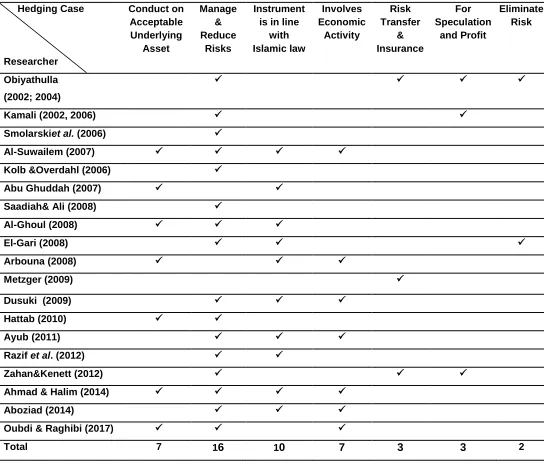
The conditions for hedging from the perspectives of Shari’ah as reported by Islamic finance researchers’ opinions and recent publications about hedging are presented in Table 1.
Table 1: Shari’ah Compliant Hedging Model
Hedging Case Conduct on
Acceptable Underlying Asset Manage & Reduce Risks Instrument is in line
with Islamic law Involves Economic Activity Risk Transfer & Insurance For Speculation and Profit Eliminate Risk Researcher Obiyathulla (2002; 2004)
Kamali (2002, 2006)
Smolarskiet al. (2006)
Al-Suwailem (2007)
Kolb &Overdahl (2006)
Abu Ghuddah (2007)
Saadiah& Ali (2008)
Al-Ghoul (2008)
El-Gari (2008)
Arbouna (2008)
Metzger (2009)
Dusuki (2009)
Hattab (2010)
Ayub (2011)
Razif et al. (2012)
Zahan&Kenett (2012)
Ahmad & Halim (2014)
Aboziad (2014)
Oubdi & Raghibi (2017)
Total 7 16 10 7 3 3 2
Licensed under Creative Common Page 138 Firstly, hedging process must be done only for the purpose of managing and reducing the expected risks in the financial market. Meanwhile, hedging are not allowed to transfer risk or eliminate risk, the rule of investment in Islamic law does not permit the risk to be eliminated in totality As well as not allowed to be used for speculation and arbitrage. So designing hedging market will be only to offer hedging without speculation activities. the hedging process includes taking a relatively limited amount of risk where the possibility of a gain outweighs that of a loss; its ultimate goal is to reduce the risk of a loss.
Secondly, the hedging instrument must be compliant with Islamic law, the hedging instrument should not contain any prohibited elements as those found in conventional derivatives instruments such as riba, gharar, and gambling.
Thirdly, the hedging activity must be through economic contract linked with real activity such as actual buy and sale guided by Islamic rules (al-ghunmbil-ghurm), embedded in the hedging feature. Where accepted risks that can be hedged these include the risks that are inherent in real activity which generate. It’s clear in prohibiting the getting of returns and profits without bearing the responsibility of economic activity. Instead, Islamic law stipulates taking the responsibility for real activity carried out through the ownership of properties and benefits which generates the wealth with an emphasis on risk reduction or cancellation, and yet that last one is impossible. Therefore, the best way to control the risk is by linking it with the real activity which generates wealth which in turn will cover and compensate the risks, and consequently traders will achieve two purposes at the same time: generate profit (wealth) and control risk
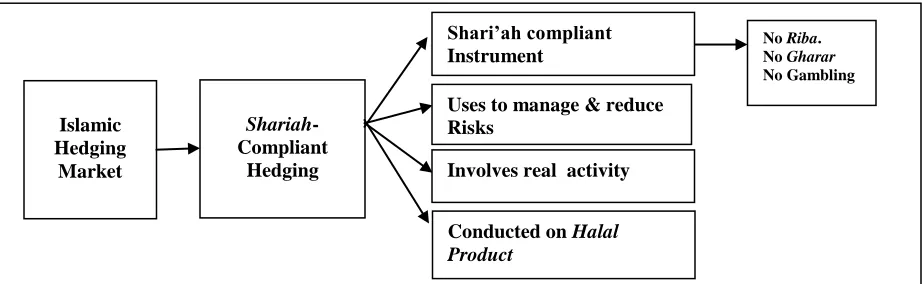
Lastly, the underlying assets in hedging contract must be compliant assets with Islamic law. Hedging will not be valid if the hedging instrument used contradicts with any of the conditions mentioned. As such, all efforts in establishing the Shari’ah-compliant derivatives market will be focusing on providing the services of Islamic hedging that are fully Shari’ah compliant as presented in Figure 1. Figure 1 illustrates the four conditions for hedging provided by derivatives market from the perspective of Shari’ah.
Figure 1. Shari’ah Compliant Hedging Model
Islamic Hedging
Market
Shariah -Compliant
Hedging
Shari’ah compliant Instrument
Uses to manage & reduce Risks
Involves real activity
Conducted on Halal Product
No Riba.
No Gharar
Licensed under Creative Common Page 139 CONCLUSION
Hedging itself is permissible in Islamic law. However, in order for hedging activities to comply with Islamic law, and avoid misusing prohibited purposes as what happened in conventional derivatives markets, four conditions must be met in using any derivative contract for hedging in Islam, hedging process must be used only for the purpose of managing and reducing the expected risks in the financial market, hedging must be applied by Shari’ah compliant instrument, hedging activity must be involve economic activity linked with real activity, and the underlying assets in hedging contract must be compliant assets with Islamic law (halal product). Further studies are recommended regarding to developing Islamic hedging through the use of Islamic contracts or the development of conventional hedging contracts.
REFERENCES
Ahmad, A. A. & M. A. Halim. 2014. “The Concept of Hedging in Islamic Financial Transactions”. Asian Social Science. Vol. 10. (8). P. 42-49.
Abozaid, A. 2014. “The Jurisprudential and Purpose Analysis of Financial Derivatives”. Journal of King Abdul-Aziz University: Islamic Economic. Vol. 27. (3). P. 3-44.
Abu Ghuddah, A. 2007. Buhuth fi al-Muamalatwa al-Asalib al-Masrifyah al-Islamiah. Jeddah: Dallat al-Barakah. Al-Ghoul, W. 2008. “Risk Management and Islamic Finance: Never the Twain Shall Meet? (cover story)”. Journal of Investing. Vol. 17. (3). P. 96-104.
Al-Suwailem, S. I. 2007. Hedging in Islamic Finance. Jeddah: Islamic Development Bank- Islamic Institute for Research and Training.
Arbouna, M. B. 2008. A paper presented at International Islamic Capital Market Forum on 13 November 2008. Organized by securities commission Malaysia
Ayub, M. 2008. “Financial Engineering by Islamic Financial Institutions”. Journal of Islamic Banking and Finance. P. 72-75.
Dusuki, A. W. 2010. “Shari’ah Parameters on the Islamic Foreign Exchange Swap as a Hedging Mechanism in Islamic Finance”. ISRA International Journal of Islamic Finance .Vol. 1. (1). P. 77-97.
El-Gari, M. A. 1993. “Towards an Islamic Stock Market”. Islamic Economic Studies. Vol. 1. (1). P. 1-20.
Hattab, K. 2010. Hedging and Catastrophic losses. <http://Kamalhattab.info/blog/?p=115>. Accessed: 23 June 2013. Kamali, M.H. 2002. Islamic Commercial Law: An Analysis of Futures and Options. Cambridge: The Islamic Texts Society.
Kamali, M. H. 2005. “Fiqhi Issues in Commodity Futures” In Financial Engineering and Islamic Contracts. M. Iqbal, & T. Khan (eds.). New York: Palgrave Macmillan. P. 20-57.
Kolb, R. W., & J. A. Overdahl. 2006. Understanding Futures Markets. Oxford: Blackwell Publishing.
Metzger, L. 2009. “Measuring Hedging Effectiveness for Derivatives”. The Journal of Government Financial Management. Vol. 58. (4). Retrieved August 5, 2010, from http://www.questia.com/PM.qst?a=o&d=5037703645 Obaidullah, M. 2002. “Islamic Risk Management: Towards Greater Ethics and Efficiency”. International Journal of Islamic Financial Services. Vol. 3. (4). P. 30-48.
Obaidullah, M. 2004. Value preservation through risk management-a shariah compliant proposal for equity risk management. MPRA Research Paper 12632. Germany: University Library & Munich. Retrieved August 6, 2009, from http://ideas.repec.org/p/pra/mprapa/12632.html
Licensed under Creative Common Page 140 Razif, N. F. M., S. Mohamad & N. N. Abdul Rahman. 2012. “Permissibility of Hedging in Islamic Finance”. Middle-East Journal of Scientific Research. Vol. 12. (2). P. 155-159.
Saadiah, M., T. Ali. 2008. Islamic Hedging: Gambling or Risk Management?. Paper submitted to the 21st Australian Finance and Banking Conference.
Smolarski, J., M. Schapek& M. Tahir. 2006. “Permissibility and Use of Options for Hedging Purposes in Islamic Finance”. Thunderbird International Business Review. Vol. 48. (3). May. P. 425-443.