O R I G I N A L R E S E A R C H
The Challenges In Conducting Research Studies In
Arabic Countries
This article was published in the following Dove Press journal: Open Access Journal of Clinical Trials
Nagham Sheblaq 1
Amal Al Najjar2
1Oncology Department, Ministry of National Guard Health Affairs, Riyadh, Saudi Arabia;2Security Force Hospital, Riyadh, Saudi Arabia
Background: The fraction of patients participating in clinical research studies has been relatively low and declined further in recent years, and many barriers are facing healthcare providers in conducting such studies. Our aim in this study is to identify common barriers facing our healthcare providers to conduct clinical trials in those patients in the MENA region.
Methods: A qualitative study was carried out between July 2014 and April 2015 where the semistructured survey was conducted using Survey Monkey software to all healthcare providers who work in seven different domain areas (physicians, pharmacists, nurses, clinical research associates, clinical research coordinators, auditors, and IRB members and data entry clerks). Results:Of 329 responders from 7 specialties, the majority [183 (55.62%)] were males and 193 (58.66%) from Saudi Arabia. Physicians and pharmacists represent the majority [155 (47.11%) and 76 (23.10%)] of the total group, respectively, and the least were nurses and auditors [5 (1.52%) in each]. The highest rate barrier reported by physicians and pharmacists was inadequate training in clinical research implementation [76 (23.1%)], while clinical research coordinator reported the same barrier in 18 (5.5%). Clinical research associates reported a lack of incentive and credit for research work in 17 (5.2%). Reviewers reported a lack of leadership support and lack of financial grant support [5 (1.5%)] for both. The top reported strength points were having an opportunity for professional development [96 (29.2)] and being in an academic institution [97 (29.5)]. Of the total participants, 200 (60.79) of the participants suggested the need for more training on research methodology.
Conclusion: This study demonstrated the barriers that face healthcare providers in the MENA region. Because of the inadequate training in clinical research implementation and the lack of designed system operating procedures for the research process, we should address to facilitate clinical research in the region.
Keywords: clinical research in Arabic countries, barriers to participating, attitude, conducting research studies
Introduction
Scientific research is the most important thing that allows the creation of new guidelines for treating patients, and the success of a country’s development efforts depends upon the degree to which its planners and program managers use and apply research for decision-making.
Medical research involving human participants has increased greatly in many developing countries during the recent decade, motivated by the need to address the high burden of diseases in these countries. The ethical conduct of research specific to developing countries has been the subject of recent discussions1–3and has been addressed in several research ethics guidelines.4,5
Correspondence: Nagham Sheblaq The Ministry of National Guard Health Affairs, 14611 Ar rimayah, KSA-Riyadh, Kingdom of Saudi Arabia
Tel +966553014124
Email [email protected]
Open Access Journal of Clinical Trials
Dove
press
open access to scientific and medical researchOpen Access Full Text Article
Open Access Journal of Clinical Trials downloaded from https://www.dovepress.com/ by 118.70.13.36 on 26-Aug-2020
Healthcare providers’and community awareness about the need for clinical research and the manner in which it is con-ducted is important, as there appears to be a relationship between knowledge/awareness and willingness to participate.6 Many studies have conducted in Western countries to detect the actual barriers facing healthcare providers in the research field,7–11but there is not enough data about the barriers faced by researchers and health service providers in the Middle East. Therefore, our aim was to gather data about points of strength and weakness on institutions, which are interested in scientific medical research on the MENA region.
Such results included in western studies, however, might not be generalizable to developing countries that incorporate different ethnicity, religions, cultures, economic, and politi-cal backgrounds.
The main objectives of this study:
1. Clarify the main barriers and challenges facing healthcare providers in Arabic countries.
2. Make an association and relation between common barriers among healthcare providers and the MENA region.
3. Provide information about strengths in Arabic coun-tries in the researchfield.
Methods
Data were collected online using Survey Monkey software and sent to all healthcare providers who work in seven different domain areas (physicians, pharmacists, nurses, clinical research associates, clinical research coordinators, auditors, and IRB members and data entry clerks).
The tool composed offive major elements:
1. The socio-demographic section includes questions asking about gender, region, work area, specialty, and age.
2. Questions about barriers that every participant face at his/her institution/country that affects his/her role in the researchfield.
3. Questions about the strengths and opportunities healthcare providers have at their institution/country that affect their role in the researchfield.
4. What type of research study the participants have at their institution?
5. Every healthcare provider was asked to give Suggestions to Improve Arab Countries Research Field.
The site IRB (King Abdullah International Medical Research Center-KAIMRC) exempts the online survey review, as no harm will be encountered plus no identified information will be gathered or declared. All participants must sign electronically on the short-informed consent before proceeding into the survey.
Statistical Analysis
The collected data have been organized, tabulated, and statis-tically analyzed using SPSS version 19 (Statistical Package for Social Studies) created by IBM, Chicago, USA.12 The research in data analysis was based on the descriptive method, which is based on iterations and percentages.
Results
First: Demographic Characteristics
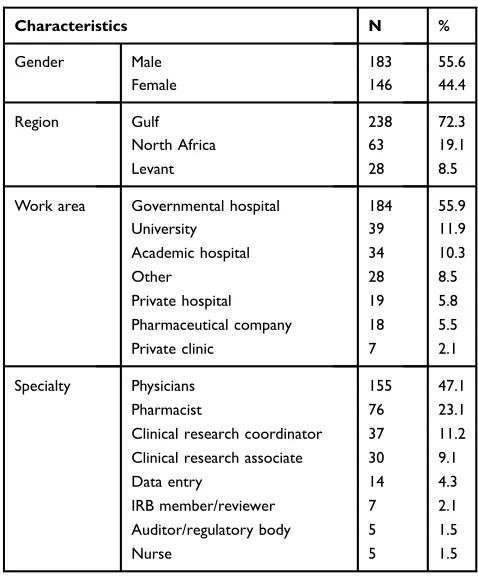
Table 1shows some demographic characteristics, and the results in table indicates the following: the size of the respondents is 329, 183 of them are males and 146 are females, and while 72% of the respondents were from Gulf, 19.1% from North Africa and 8.5% from Levant; 55.9% work in governmental hospitals, 11.9% in univer-sity, 10.3% in academic hospitals, 5.8% in private hospi-tals, 5.5% in pharmaceutical companies, 2.1% in private clinics, and 8.5% in other organizations; 47.1% of the
Table 1Demographic Characteristics (n=329)
Characteristics N %
Gender Male 183 55.6
Female 146 44.4
Region Gulf 238 72.3
North Africa 63 19.1
Levant 28 8.5
Work area Governmental hospital 184 55.9
University 39 11.9
Academic hospital 34 10.3
Other 28 8.5
Private hospital 19 5.8
Pharmaceutical company 18 5.5
Private clinic 7 2.1
Specialty Physicians 155 47.1
Pharmacist 76 23.1
Clinical research coordinator 37 11.2 Clinical research associate 30 9.1
Data entry 14 4.3
IRB member/reviewer 7 2.1
Auditor/regulatory body 5 1.5
Nurse 5 1.5
Open Access Journal of Clinical Trials downloaded from https://www.dovepress.com/ by 118.70.13.36 on 26-Aug-2020
respondents were physicians, 23.1% pharmacists, and 11.2% clinical research coordinators.
Second: Barriers Affecting Roles
Barriers Affecting Physicians’Role
The respondents indicated that 17 barriers affecting physi-cian’s role as revealed in Table 2; the barriers affecting physician's role the most were: inadequate training in clin-ical research implementation (49.03%), lack of well-designed system operating procedures for local research practice (45.16%), and lack of financial/grant support (44.52%).
On the other side, the barriers affecting physician’s role the least were: never thought about research (6.45%), could not find appropriate study (4.52%), and not inter-ested in clinical trial (3.87%).
Barriers Affecting Clinical Research Associates’
(CRA) Role
The respondents indicated 13 barriers affecting clinical research associates’(CRA) role as revealed inTable 3; the barriers affecting clinical research associates’(CRA) role the most were: lack of incentive/credit for research work (56.67%), no enough time to be the CRF for multiple studies (53.33%), and lack offinancial/grant support (50%). On the other side, the barriers affecting clinical research associates’ (CRA) role the least were: lack of leadership support (33.33%), complexity of approval
Table 2Barriers Affecting Physicians’Role
Physicians’Barriers N =155 % Ranking
Inadequate training in clinical research implementation
76 49.03 1
Lack of well-designed System operating procedures for local research practice
70 45.16 2
Lack offinancial/grant support 69 44.52 3
Lack of infrastructure and research staff (research team, ethic committee, Institutional Review Board, etc.)
66 42.58 4
Lack of time 65 41.94 5
Lack of incentive/credit for research work
61 39.35 6
Lack of leadership support 56 36.13 7 Overloaded by inappropriate tasks 55 35.48 8
Complexity of approval process of site Institutional Review Board
41 26.45 9
No Institutional Review Board committee at my Institution
36 23.23 10
I don’t know how to start 31 20 11 Complexity of approval process of
country regulatory bodies
27 17.42 12
Difficulty in international guideline adaptation
25 16.13 13
Difficulty in convincing patient for participation
24 15.48 14
Never thought about research 10 6.45 15
Could notfind appropriate study 7 4.52 16 Not interested in clinical trial 6 3.87 17
Table 3Barriers Affecting Clinical Research Associates’(CRA) Role
Clinical Research Associates’ Barriers
n = 30 % Ranking
Lack of incentive/credit for research work
17 56.67 1
No enough time to be the CRF for multiple studies
16 53.33 2
Lack offinancial/grant support 15 50.00 3 Inadequate training in clinical research
implementation
13 43.33 4
Lack of PI support in the rest of study process
13 43.33 5
Lack of infrastructure and research staff (research team, ethic committee, Institutional Review Board, etc.)
12 40.00 6
Lack of well-designed system operating procedures for local research practice
12 40.00 7
Overloaded by inappropriate tasks 12 40.00 8
Complexity of approval process of site Institutional Review Board
11 36.67 9
Difficulty in convincing patient or participation
11 36.67 10
Lack of leadership support 10 33.33 11 Complexity of approval process of
country regulatory bodies
9 30.00 12
Difficulty in international guideline adaptation
5 16.67 13
Open Access Journal of Clinical Trials downloaded from https://www.dovepress.com/ by 118.70.13.36 on 26-Aug-2020
process of country regulatory bodies (30%), and difficulty in international guideline adaptation (16.67%).
Barriers Affecting Clinical Research Coordinators’
(CRC) Role
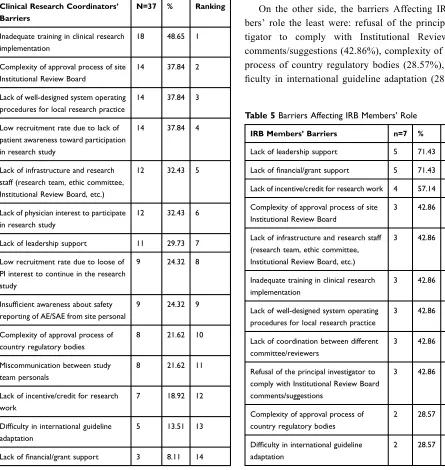
The respondents indicated 14 barriers affecting clinical research coordinators’(CRC) role as revealed in Table 4; the barriers affecting clinical research coordinators’(CRC) role the most were: inadequate training in clinical research implementation (48.65%), complexity of approval process of site Institutional Review Board (37.84%), and lack of
well-designed system operating procedures for local research practice (37.84%).
On the other side, the barriers affecting clinical research coordinators’(CRC) role the least were: lack of incentive/credit for research work (18.92%), difficulty in international guideline adaptation (13.51%), and lack of
financial/grant support (8.11%).
Barriers Affecting IRB Members’Role
The respondents indicated 11 barriers affecting IRB members’ role as revealed in Table 5; the barriers affecting IRB members’ role the most were: lack of leadership support (71.43%), lack of financial/grant sup-port (71.43%), and lack of incentive/credit for research work (57.14%).
On the other side, the barriers Affecting IRB mem-bers’ role the least were: refusal of the principal inves-tigator to comply with Institutional Review Board comments/suggestions (42.86%), complexity of approval process of country regulatory bodies (28.57%), and
dif-ficulty in international guideline adaptation (28.57%).
Table 4 Barriers Affecting Clinical Research Coordinators’ (CRC) Role
Clinical Research Coordinators’ Barriers
N=37 % Ranking
Inadequate training in clinical research implementation
18 48.65 1
Complexity of approval process of site Institutional Review Board
14 37.84 2
Lack of well-designed system operating procedures for local research practice
14 37.84 3
Low recruitment rate due to lack of patient awareness toward participation in research study
14 37.84 4
Lack of infrastructure and research staff (research team, ethic committee, Institutional Review Board, etc.)
12 32.43 5
Lack of physician interest to participate in research study
12 32.43 6
Lack of leadership support 11 29.73 7
Low recruitment rate due to loose of PI interest to continue in the research study
9 24.32 8
Insufficient awareness about safety reporting of AE/SAE from site personal
9 24.32 9
Complexity of approval process of country regulatory bodies
8 21.62 10
Miscommunication between study team personals
8 21.62 11
Lack of incentive/credit for research work
7 18.92 12
Difficulty in international guideline adaptation
5 13.51 13
Lack offinancial/grant support 3 8.11 14
Table 5Barriers Affecting IRB Members’Role
IRB Members’Barriers n=7 % Ranking
Lack of leadership support 5 71.43 1 Lack offinancial/grant support 5 71.43 2
Lack of incentive/credit for research work 4 57.14 3
Complexity of approval process of site Institutional Review Board
3 42.86 4
Lack of infrastructure and research staff (research team, ethic committee, Institutional Review Board, etc.)
3 42.86 5
Inadequate training in clinical research implementation
3 42.86 6
Lack of well-designed system operating procedures for local research practice
3 42.86 7
Lack of coordination between different committee/reviewers
3 42.86 8
Refusal of the principal investigator to comply with Institutional Review Board comments/suggestions
3 42.86 9
Complexity of approval process of country regulatory bodies
2 28.57 10
Difficulty in international guideline adaptation
2 28.57 11
Open Access Journal of Clinical Trials downloaded from https://www.dovepress.com/ by 118.70.13.36 on 26-Aug-2020
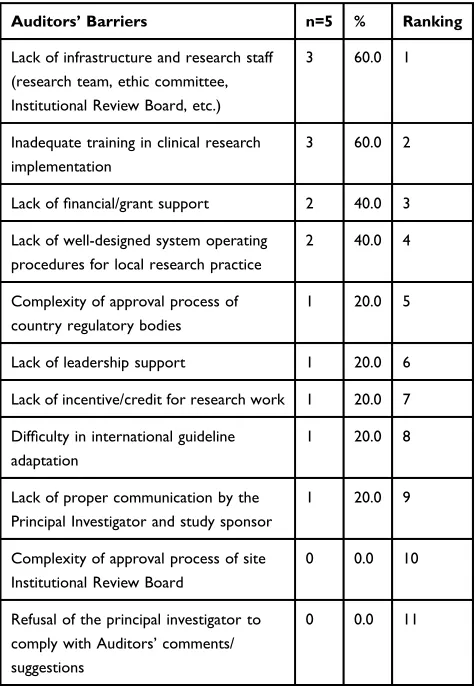
Barriers Affecting Auditors/Regulatory Body’s Role The respondents indicated 11 barriers affecting auditors/ regulatory body’s role as revealed inTable 6;the barriers affecting auditors/regulatory body’s role the most were: lack of infrastructure and research staff (research team, ethic committee, Institutional Review Board, etc.) (60%), inadequate training in clinical research implementation (60%), and lack of financial/grant support (40%).
On the other side, the barriers affecting auditors/regula-tory body’s role the least were: lack of proper communica-tion by the principal investigator and study sponsor (20%), complexity of approval process of site Institutional Review Board (0%), and refusal of the principal investigator to comply with auditors’comments/suggestions (0%).
Barriers Affecting Pharmacists’Role
The respondents indicated 15 barriers affecting Pharmacists’ role as revealed inTable 7;the barriers affecting pharmacists’ role the most were: inadequate training in clinical research implementation (42.11%), complexity of approval process of
site Institutional Review Board (39.47%), and lack offi nan-cial/grant support (36.84%).
On the other side, the barriers affecting pharmacists’ role the least were: difficulty in international guideline adaptations (18.42%), not interested in research (6.58%), never thought about research (1.32%).
Barriers Affecting Data Entry Clerks’Role
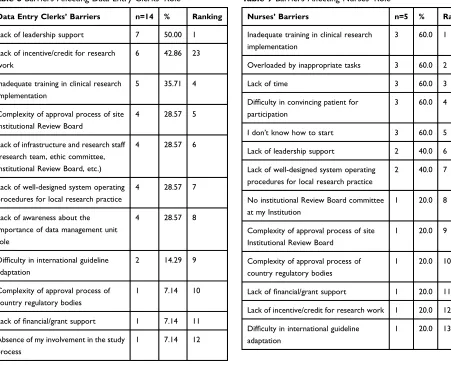
The respondents indicated 12 barriers affecting data entry clerks’ role as revealed in Table 8;the barriers affecting data entry clerks’ role the most were: lack of leadership support (50%), lack of incentive/credit for research work (42.86%), and inadequate training in clinical research implementation (35.71%).
Table 6Barriers Affecting Auditors/Regulatory Body’s Role
Auditors’Barriers n=5 % Ranking
Lack of infrastructure and research staff (research team, ethic committee, Institutional Review Board, etc.)
3 60.0 1
Inadequate training in clinical research implementation
3 60.0 2
Lack offinancial/grant support 2 40.0 3
Lack of well-designed system operating procedures for local research practice
2 40.0 4
Complexity of approval process of country regulatory bodies
1 20.0 5
Lack of leadership support 1 20.0 6
Lack of incentive/credit for research work 1 20.0 7
Difficulty in international guideline adaptation
1 20.0 8
Lack of proper communication by the Principal Investigator and study sponsor
1 20.0 9
Complexity of approval process of site Institutional Review Board
0 0.0 10
Refusal of the principal investigator to comply with Auditors’comments/ suggestions
0 0.0 11
Table 7Barriers Affecting Pharmacists’Role
Pharmacists’Barriers n=76 % Ranking
Inadequate training in clinical research implementation
32 42.11 1
Complexity of approval process of site Institutional Review Board
30 39.47 2
Lack offinancial/grant support 28 36.84 3 Lack of well-designed system operating
procedures for local research practice
28 36.84 4
Lack of incentive/credit for research work
25 32.89 5
Lack of infrastructure and research staff (research team, ethic committee, Institutional Review Board, etc.)
24 31.58 6
Lack of leadership support 23 30.26 7 Insufficient time to conduct research
and generate ideas
22 28.95 8
Lack of awareness amongst pharmacist of available research projects at my institution
21 27.63 9
Complexity of approval process of country regulatory bodies
20 26.32 10
Lack of confidence about my ability to do research
17 22.37 11
I don’t know how to start 15 19.74 12
Difficulty in international guideline adaptations
14 18.42 13
Not interested in research 5 6.58 14
Never thought about research 1 1.32 15
Open Access Journal of Clinical Trials downloaded from https://www.dovepress.com/ by 118.70.13.36 on 26-Aug-2020
On the other side, the barriers affecting data entry clerks’role the least were: complexity of approval process of country regulatory bodies (7.14%), lack of financial/ grant support (7.14%), and absence of my involvement in the study process (7.14).
Barriers Affecting Nurses’Role
The respondents indicated 13 barriers affecting nurses’ role as revealed in Table 9;the barriers affecting nurses’ role the most were: inadequate training in clinical research implementation (60%), overloaded by inappropriate tasks (60%), and lack of time (60%).
On the other side the barriers affecting nurses’role the least were: lack offinancial/grant support (20%), lack of incentive/credit for research work (20%), and difficulty in international guideline adaptation (20%).
Common Barriers Among All Specialties
Table 10reveals the common barriers among all specialties; it is clear from the table that among the barriers training ranks
first (45.6%) followed by system operating procedures (40.4%), infrastructure (37.7%),financial support (37.4%), incentives (36.8%), leadership support (34.3%), approval process–IRB (31.3%), approval regulatory body (20.7%), and International Guidelines Adaptation (16.4%).
Table 11 reveals the regions that have most common barriers: Gulf has the most common barriers in approval process _IRB; North Africa has the most common barriers infinancial, approval process _ regulatory, and International
Table 8Barriers Affecting Data Entry Clerks’Role
Data Entry Clerks’Barriers n=14 % Ranking
Lack of leadership support 7 50.00 1
Lack of incentive/credit for research work
6 42.86 23
Inadequate training in clinical research implementation
5 35.71 4
Complexity of approval process of site Institutional Review Board
4 28.57 5
Lack of infrastructure and research staff (research team, ethic committee, Institutional Review Board, etc.)
4 28.57 6
Lack of well-designed system operating procedures for local research practice
4 28.57 7
Lack of awareness about the importance of data management unit role
4 28.57 8
Difficulty in international guideline adaptation
2 14.29 9
Complexity of approval process of country regulatory bodies
1 7.14 10
Lack offinancial/grant support 1 7.14 11
Absence of my involvement in the study process
1 7.14 12
Table 9Barriers Affecting Nurses’Role
Nurses’Barriers n=5 % Ranking
Inadequate training in clinical research implementation
3 60.0 1
Overloaded by inappropriate tasks 3 60.0 2
Lack of time 3 60.0 3
Difficulty in convincing patient for participation
3 60.0 4
I don’t know how to start 3 60.0 5
Lack of leadership support 2 40.0 6
Lack of well-designed system operating procedures for local research practice
2 40.0 7
No institutional Review Board committee at my Institution
1 20.0 8
Complexity of approval process of site Institutional Review Board
1 20.0 9
Complexity of approval process of country regulatory bodies
1 20.0 10
Lack offinancial/grant support 1 20.0 11 Lack of incentive/credit for research work 1 20.0 12
Difficulty in international guideline adaptation
1 20.0 13
Table 10Common Barriers Among All Specialties
Common Barriers N % Ranking
Training 150 45.6 1
System operating procedures 133 40.4 2
Infrastructure 124 37.7 3
Financial support 123 37.4 4
Incentives 121 36.8 5
Leadership support 113 34.3 6
Approval process–IRB 103 31.3 7 Approval regulatory body 68 20.7 8 International Guidelines Adaptation 54 16.4 9
Open Access Journal of Clinical Trials downloaded from https://www.dovepress.com/ by 118.70.13.36 on 26-Aug-2020
Guidelines Adaptation; and Levant has the most common barriers in training, operating system, infrastructure, incen-tives, and leadership.
Third: Overall Strengths/Opportunities
Exist In Institutions
Table 12reveals the overall strengths/opportunities that exist in institutions; there are 9 overall strengths/opportunities that exist in institutions which are: being in an academic institu-tion, opportunity for professional development, presence of well-trained support staff, availability of funding, being in a research institution, training in the researchfield at my insti-tution, requirement by instiinsti-tution, awards/recognition, and
financial incentive, with 29.8%, 29.2%, 25.5%, 21.9%, 21.6%, 18.8%, 17.6%, 16.4%, and 11.9%, respectively.
Table 13reveals the regions that have more strengths/ opportunities: Gulf has more strengths/opportunities in presence of well-trained support staff, training in the research field at my institution, availability of funding, requirement by institution, being in the research
institution, financial incentive, and awards/recognition; North Africa has more strength/opportunities in being in an academic institution; and Levant has more strengths/ opportunities in opportunity for professional development.
Fourth: Suggestions To Improve Arab
Countries Research Field
Table 14 reveals suggestions to improve Arab Countries Research Field; there are 7 suggestions which are: increase training workshop about research for all medical health staff, increase awareness and interest in the importance of research, the critical need for infrastructure to support research, improve communication/collaboration among institution and universi-ties, database/website for the available research project for the interested healthcare provider to participate, provide adequate compensation for time (ie, funds or replacement for their work), and exchange national/international expertise to reach a well-defined national research guidelines, with 60.8%, 56.8%, 56.5%, 56.5%, 54.1%, 53.5%, and 52.9%, respectively.
Discussion
This study reveals several important data regarding the challenges and barriers facing healthcare providers in the MENA region that might be applicable to individuals in other developing countries.
Seven specialties of healthcare providers were included in our study and we have mentioned the barriers facing every category in the respective tables.
Many barriers facing healthcare providers in conduct-ing research detected previously in many studies con-ducted in western countries.
A study conducted by Eva Hummers-Pradier et al 200813 identified barriers to general practitioners (GPs’)
Table 11Region And Common Barriers
Common Barriers Region
Gulf (n=238) North Africa (n=63) Levant (n=28)
N % n % n %
Training Yes 101 42.4 30 47.6 19 67.9
Operating system Yes 86 36.1 32 50.8 15 53.6
Infrastructure Yes 82 34.5 25 39.7 17 60.7
Financial Yes 73 30.7 36 57.1 14 50.0
Incentives Yes 84 35.3 21 33.3 16 57.1
Leadership Yes 72 30.3 27 42.9 14 50.0
Approval process _IRB Yes 83 34.9 12 19.0 8 28.6
Approval process _ Regulatory Yes 48 20.2 17 27.0 3 10.7
International Guidelines Adaptation Yes 35 14.7 14 22.2 5 17.9
Table 12Overall Strengths/Opportunities That Exist In Institutions
Strengths/Opportunities N %
Being in an academic institution 98 29.8 Opportunity for professional development 96 29.2 Presence of well-trained support staff 84 25.5
Availability of funding 72 21.9
Being in a research institution 71 21.6 Training in the researchfield at my institution 62 18.8
Requirement by institution 58 17.6
Awards/recognition 54 16.4
None 48 14.6
Financial incentive 39 11.9
Open Access Journal of Clinical Trials downloaded from https://www.dovepress.com/ by 118.70.13.36 on 26-Aug-2020
participation in primary healthcare research. Nearly all respondents (88/96) considered general practice research to be important, but 58% had not previously participated in research projects and 56% would not do so in the future. Some GPs expressed concerns about recruiting their own patients for the study. Some doctors complained of not being sufficiently recognized as a partner or not having a voice in the research process.
A study conducted by Suzanne Bakken et al 2009 detected barriers, enablers, and incentives for research participation. The survey and qualitative data of this study indicated a strong interest in clinical research among current and potential Practice-Based Research Network“PBRN”members if it was relevant to improving quality of care in their practice or community. They also
identified important perceived barriers (lack of time, inadequate training in research methods, lack of collabora-tors and support staff, institutional review board hurdles, and community distrust of research) and the necessary requirements for overcoming barriers to conducting research in busy clinical settings, which included colla-borators, mentors, research support staff, and a trusting patient–clinician relationship.14
Hiroaki Yanagawa et al conducted a study in Japan about nurse awareness of clinical research. The authors found that that clinical nurses have only limited knowledge of clinical research and the importance to have chances to make nurses aware of clinical research-related issues is suggested to establish an extended research team.15
Those suggestions given by these study participants may help to remove the barriers facing conduction of clinical research studies in Arabic countries especially as there are many fears from the public to participate in clinical trials as conducted in a study by Susan S Khalil et al 2007, which detected attitudes, understanding, and concerns regarding medical research amongst Egyptians. All individuals valued the importance of medical research; however, most would not participate in research that involved more than minimal risk. Individuals were comfortable with studies involving surveys and blood sampling, but many viewed drug trials as being too risky. So trying to remove the barriers may help to increase the trust of the public people to participate in any kind of research studies.16
Another study of Giselle Corbie-Smith et al about attitudes and beliefs of African Americans toward partici-pation in Medical Research found that African-American participants described distrust of the medical community as a prominent barrier to participation in clinical research.
Table 13Region And Strengths/Opportunities
Strengths/Opportunities Region
Gulf (n=238) North Africa (n=63) Levant (n=28)
N % N % N %
Presence of well-trained support staff Yes 68 28.6 13 20.6 3 10.7
Training in the researchfield at my institution Yes 53 22.3 6 9.5 3 10.7
Availability of funding Yes 60 25.2 8 12.7 4 14.3
Requirement by institution Yes 45 18.9 8 12.7 5 17.9
Opportunity for professional development Yes 71 29.8 15 23.8 10 35.7
Being in an academic institution Yes 61 25.6 28 44.4 9 32.1
Being in the research institution Yes 57 23.9 9 14.3 5 17.9
Financial incentive Yes 35 14.7 2 3.2 2 7.1
Awards/Recognition Yes 43 18.1 7 11.1 4 14.3
Table 14Suggestions To Improve Arab Countries Research Field
Suggestions n %
Increase training workshop about research for all medical health staff
200 60.8
Increase awareness and interest in the importance of research
187 56.8
The critical need for infrastructure to support research 186 56.5 Improve communication/collaboration among
institution and universities
186 56.5
Database/website for the available research project for the interested healthcare provider to participate
178 54.1
Provide adequate compensation for time (ie, funds or replacement for their work)
176 53.5
Exchange national/international expertise to reach a well-defined national research guidelines
174 52.9
Open Access Journal of Clinical Trials downloaded from https://www.dovepress.com/ by 118.70.13.36 on 26-Aug-2020
Participants described real and perceived examples of exploitation to support their distrust of researchers. The goal of the consent process, to inform patients of risks and benefits to facilitate self-determination, was misinterpreted by these participants. Understanding the importance of interpersonal trust within the clinical relationship may prove to be a significant factor in enhancing participation in clinical trials.17 Therefore, there is a great need to remove the barriers facing all researchers to facilitate working and improvement in the research field.
In addition, the suggestions included in our study may help to increase scientific research publications in Arabic countries, due to decreased capacity to absorb scientific knowledge in Arabic countries because of bad research infrastructure, leading to low levels of scientific output. A study of the comparative performance of the world’s major science-producing countries found that researchers in eight countries–led by the USA, the UK, Germany, and Japan– produce almost 85% of the world’s most cited publica-tions, while another 163 countries, mostly developing countries, account for less than 2.5%.18
According to our study, we found that retrospective and observational studies were the most common type of research studies conducted in the MENA region. Which selected by 44.7% of participants followed by basic research, which selected by 30.1% of this study participants, the question here is why there are no clinical trials and more study types to be conducted in our Arabic countries?
We suggested conducting more studies with larger sample size for each specialty of the seven specialties included in our study and to get more data about the barriers and challenges to conducting clinical scientific research in every Arabic country separately as every coun-try has its conditions.
We faced many limitations to collect the sample for this study through internet, but once collected, the partici-pants showed a good general understanding of the concept of research and the importance of scientific research work to advance medical progress and so they agreed to com-plete our online questionnaire.
Conclusions
This study demonstrated the barriers faced by healthcare providers in the MENA region. Inadequate training in clinical research implementation and the lack of designed system operating procedures for the research process should be addressed to facilitate clinical research in this region. In addition, this study provided a good association
between Arabic regions included and barriers faced by healthcare providers in conducting research and so this study could be a good reference for authorities to improve the clinical research in Arabic countries especially every country has its conditions.
Many suggestions given by the participants to improve research field such as increasing training work-shop about research for all medical health staff categories to improve research field and increasing awareness and interest about the importance of research are very impor-tant. This study provides a good association between Arabic regions included and barriers facing healthcare providers in conducting research so this study could be a good reference for authorities to improve the clinical research in Arabic countries.
There is also a great need for providing a database/ website for the available research project for the interested healthcare provider to participate. Authorities responsible for the development of scientific research should provide infrastructure to support research and improve communi-cation/collaboration among institutions and universities.
Acknowledgments
The authors would like to thank all the healthcare provi-ders who participated in the research. We would like also to thank also all administrative persons who facilitate the condition of the work.
The authors also would like to thank Mr. Mohamed Al Khayat and Mr. Ahmed Qudaimat, clinical research coor-dinators, for their help in data collection.
Disclosure
The authors report no conflicts of interest in this work.
References
1. Bhutta ZA. Ethics in international health research: a perspective from the developing world.Bull World Health Organ.2002;80:114–120. 2. Shapiro HT, Meslin EM. Ethical issues in the design and conduct of
clinical trials in developing countries.Mass Med Soc.2001. 3. Benatar SR. Reflections, and recommendations on research ethics
in developing countries. Soc Sci Med. 2002;54(7):1131–1141. doi:10.1016/S0277-9536(01)00327-6
4. Vallotton MB. Council for international organizations of medical sciences perspectives: protecting persons through international ethics guidelines.Int J Integr Care.2010;10(5). doi:10.5334/ijic.478 5. Willis L. Nuffield Council on Bioethics. The ethics of research related
to healthcare in developing countries.Med Conflict Survival.2003;19 (1):74.
6. Tallon D, Chard J, Dieppe P. Relation between agendas of the research community and the research consumer.Lancet.2000;355(9220):2037– 2040. doi:10.1016/S0140-6736(00)02351-5
Open Access Journal of Clinical Trials downloaded from https://www.dovepress.com/ by 118.70.13.36 on 26-Aug-2020
7. Ridda I, Lindley R, MacIntyre RC. The challenges of clinical trials in the exclusion zone: the case of the frail elderly.Australas J Ageing.
2008;27(2):61–66. doi:10.1111/j.1741-6612.2008.00288.x
8. Ferrari A, Montello M, Budd T, Bleyer A. The challenges of clinical trials for adolescents and young adults with cancer. Pediatr Blood Cancer. 2008;50(S5):1101–1104. doi:10.1002/ (ISSN)1545-5017
9. Somkin CP, Altschuler A, Ackerson L, et al. Organizational barriers to physician participation in cancer clinical trials.Am J Manag Care.
2005;11(7):413–421.
10. Murillo H, Reece EA, Snyderman R, Sung NS. Meeting the chal-lenges facing clinical research: solutions proposed by leaders of medical specialty and clinical research societies. Acad Med.
2006;81(2):107–112. doi:10.1097/00001888-200602000-00002 11. Stening BW, Zhang MY. Methodological challenges confronted when
conducting management research in China.Int J Cross Cult Manage.
2007;7(1):121–142. doi:10.1177/1470595807075179
12. Nie NH, Bent DH, Hull CH.SPSS: Statistical Package for the Social Sciences. Vol. 227. New York: McGraw-Hill;1975.
13. Hummers-Pradier E, Scheidt-Nave C, Martin H, Heinemann S, Kochen MM, Himmel W. Simply no time? Barriers to GPs’ partici-pation in primary health care research.Fam Pract.2008;25(2):105– 112. doi:10.1093/fampra/cmn015
14. Bakken S, Lantigua RA, Busacca LV, Bigger JT. Barriers, enablers, and incentives for research participation: a report from the Ambulatory Care Research Network (ACRN).J Am Board Family Med.2009;22(4):436–445. doi:10.3122/jabfm.2009.04.090017 15. Yanagawa H, Takai S, Yoshimaru M, Miyamoto T, Katashima R,
Kida K. Nurse awareness of clinical research: a survey in a Japanese University Hospital. BMC Med Res Methodol. 2014;14(1):85. doi:10.1186/1471-2288-14-85
16. Khalil SS, Silverman HJ, Raafat M, El-Kamary S, El-Setouhy M. Attitudes, understanding, and concerns regarding medical research amongst Egyptians: a qualitative pilot study. BMC Med Ethics.
2007;8(1):9. doi:10.1186/1472-6939-8-9
17. Corbie-Smith G, Thomas SB, Williams MV, Moody-Ayers S. Attitudes and beliefs of African Americans toward participation in medical research. J Gen Intern Med. 1999;14(9):537–546. doi:10.1046/j.1525-1497.1999.07048.x
18. King DA. The scientific impact of nations. Nature. 2004;430 (6997):311–316. doi:10.1038/430311a
Open Access Journal of Clinical Trials
Dove
press
Publish your work in this journal
The Open Access Journal of Clinical Trials is an international, peer-reviewed, open access journal publishing original research, reports, editorials, reviews and commentaries on all aspects of clinical trial design, management, legal, ethical and regulatory issues, case record form design, data collection, quality assurance and data auditing
methodologies. The manuscript management system is completely online and includes a very quick and fair peer-review system, which is all easy to use. Visit http://www.dovepress.com/testimonials.php to read real quotes from published authors.
Submit your manuscript here:https://www.dovepress.com/open-access-journal-of-clinical-trials-journal
Open Access Journal of Clinical Trials downloaded from https://www.dovepress.com/ by 118.70.13.36 on 26-Aug-2020