The essence of Mathematics lies in its freedom. — CANTOR
3.1 Introduction
The knowledge of matrices is necessary in various branches of mathematics. Matrices are one of the most powerful tools in mathematics. This mathematical tool simplifies our work to a great extent when compared with other straight forward methods. The evolution of concept of matrices is the result of an attempt to obtain compact and simple methods of solving system of linear equations. Matrices are not only used as a representation of the coefficients in system of linear equations, but utility of matrices far exceeds that use. Matrix notation and operations are used in electronic spreadsheet programs for personal computer, which in turn is used in different areas of business and science like budgeting, sales projection, cost estimation, analysing the results of an experiment etc. Also, many physical operations such as magnification, rotation and reflection through a plane can be represented mathematically by matrices. Matrices are also used in cryptography. This mathematical tool is not only used in certain branches of sciences, but also in genetics, economics, sociology, modern psychology and industrial management.
In this chapter, we shall find it interesting to become acquainted with the fundamentals of matrix and matrix algebra.
3.2 Matrix
Suppose we wish to express the information that Radha has 15 notebooks. We may express it as [15] with the understanding that the number inside [ ] is the number of notebooks that Radha has. Now, if we have to express that Radha has 15 notebooks and 6 pens. We may express it as [15 6] with the understanding that first number inside [ ] is the number of notebooks while the other one is the number of pens possessed by Radha. Let us now suppose that we wish to express the information of possession
Chapter
3
of notebooks and pens by Radha and her two friends Fauzia and Simran which is as follows:
Radha has 15 notebooks and 6 pens,
Fauzia has 10 notebooks and 2 pens,
Simran has 13 notebooks and 5 pens.
Now this could be arranged in the tabular form as follows:
Notebooks Pens
Radha 15 6
Fauzia 10 2
Simran 13 5
and this can be expressed as
or
Radha Fauzia Simran
Notebooks 15 10 13
Pens 6 2 5
which can be expressed as:
respectively. Similarly, in the second arrangement, the entries in the first row represent the number of notebooks possessed by Radha, Fauzia and Simran, respectively. The entries in the second row represent the number of pens possessed by Radha, Fauzia and Simran, respectively. An arrangement or display of the above kind is called a
matrix. Formally, we define matrix as:
Definition 1 A matrix is an ordered rectangular array of numbers or functions. The numbers or functions are called the elements or the entries of the matrix.
We denote matrices by capital letters. The following are some examples of matrices:
5 – 2
A 0 5
3 6
⎡ ⎤
⎢ ⎥
= ⎢ ⎥
⎢ ⎥
⎣ ⎦
,
1
2 3
2 B 3.5 –1 2
5
3 5
7
i
⎡ + − ⎤
⎢ ⎥
⎢ ⎥
= ⎢ ⎥
⎢ ⎥
⎢ ⎥
⎣ ⎦
,
3
1 3
C
cos sin 2 tan
x x
x x x
⎡ + ⎤
= ⎢ ⎥
+
⎣ ⎦
In the above examples, the horizontal lines of elements are said to constitute, rows of the matrix and the vertical lines of elements are said to constitute, columns of the matrix. Thus A has 3 rows and 2 columns, B has 3 rows and 3 columns while C has 2 rows and 3 columns.
3.2.1 Order of a matrix
A matrix having m rows and n columns is called a matrix of orderm × n or simply m × n
matrix (read as an m by n matrix). So referring to the above examples of matrices, we have A as 3 × 2 matrix, B as 3 × 3 matrix and C as 2 × 3 matrix.We observe that A has 3 × 2 = 6 elements, B and C have 9 and 6 elements, respectively.
In general, an m × n matrix has the following rectangular array:
or A = [aij]m × n, 1≤i≤m, 1≤j≤n i, j∈ N Thus the ith row consists of the elements a
i1, ai2, ai3,..., ain, while the j
th column
consists of the elements a1j, a2j, a3j,..., amj,
In general aij, is an element lying in the ith row and jth column. We can also call
it as the (i, j)th element of A. The number of elements in an m × n matrix will be
$
Note In this chapter1. We shall follow the notation, namely A = [aij]m × n to indicate that A is a matrix of order m × n.
2. We shall consider only those matrices whose elements are real numbers or functions taking real values.
We can also represent any point (x, y) in a plane by a matrix (column or row) as
x y
⎡ ⎤ ⎢ ⎥
⎣ ⎦ (or [x, y]). For example point P(0, 1) as a matrix representation may be given as
0 P
1 ⎡ ⎤ = ⎢ ⎥
⎣ ⎦ or [0 1].
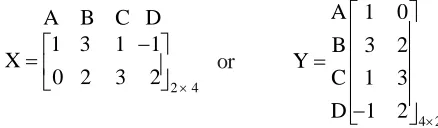
Observe that in this way we can also express the vertices of a closed rectilinear figure in the form of a matrix. For example, consider a quadrilateral ABCD with vertices A (1, 0), B (3, 2), C (1, 3), D (–1, 2).
Now, quadrilateral ABCD in the matrix form, can be represented as
2 4
A B C D
1 3 1 1 X
0 2 3 2 × −
⎡ ⎤
= ⎢ ⎥
⎣ ⎦ or
4 2
A 1 0
B 3 2 Y
C 1 3
D 1 2 ×
⎡ ⎤
⎢ ⎥
⎢ ⎥
=
⎢ ⎥
⎢− ⎥
⎣ ⎦
Thus, matrices can be used as representation of vertices of geometrical figures in a plane.
Now, let us consider some examples.
Example 1 Consider the following information regarding the number of men and women workers in three factories I, II and III
Men workers Women workers
I 30 25
II 25 31
III 27 26
Solution The information is represented in the form of a 3 × 2 matrix as follows:
30 25
A 25 31
27 26
⎡ ⎤
⎢ ⎥
= ⎢ ⎥
⎢ ⎥
⎣ ⎦
The entry in the third row and second column represents the number of women workers in factory III.
Example 2 If a matrix has 8 elements, what are the possible orders it can have?
SolutionWe know that if a matrix is of order m × n, it has mn elements. Thus, to find all possible orders of a matrix with 8 elements, we will find all ordered pairs of natural numbers, whose product is 8.
Thus, all possible ordered pairs are (1, 8), (8, 1), (4, 2), (2, 4)
Hence, possible orders are 1 × 8, 8 ×1, 4 × 2, 2 × 4
Example 3Construct a 3 × 2 matrix whose elements are given by 1| 3 | 2
ij
a = i− j .
Solution In general a 3 × 2 matrix is given by
11 12
21 22
31 32
A
a a
a a
a a
⎡ ⎤
⎢ ⎥
= ⎢ ⎥
⎢ ⎥
⎣ ⎦
.
Now 1| 3 |
2
ij
a = i− j , i = 1, 2, 3and j = 1, 2.
Therefore 11
1
|1 3 1| 1 2
a = − × = 12 1|1 3 2 | 5
2 2
a = − × =
21
1 1
| 2 3 1|
2 2
a = − × = 22 1| 2 3 2 | 2
2
a = − × =
31
1
| 3 3 1| 0 2
a = − × = 32 1| 3 3 2 | 3
2 2
a = − × =
Hence the required matrix is given by
5 1
2 1
A 2
2 3 0
2
⎡ ⎤
⎢ ⎥
⎢ ⎥
= ⎢ ⎥
⎢ ⎥
⎢ ⎥
⎣ ⎦
3.3 Types of Matrices
In this section, we shall discuss different types of matrices.
(i) Column matrix
A matrix is said to be a column matrix if it has only one column.
For example,
0
3
A 1
1/ 2
⎡ ⎤
⎢ ⎥
⎢ ⎥
⎢ ⎥
= −
⎢ ⎥
⎢ ⎥
⎣ ⎦
is a column matrix of order 4 × 1.
In general, A = [aij]m × 1 is a column matrix of order m × 1. (ii) Row matrix
A matrix is said to be a row matrix if it has only one row.
For example,
1 4
1
B 5 2 3
2 ×
⎡ ⎤
= −⎢ ⎥
⎣ ⎦ is a row matrix.
In general, B = [bij]1 × n is a row matrix of order 1 × n. (iii) Square matrix
A matrix in which the number of rows are equal to the number of columns, is said to be a square matrix. Thus an m × n matrix is said to be a square matrix if
m = n and is known as a square matrix of order ‘n’.
For example
3 1 0
3
A 3 2 1
2
4 3 1
−
⎡ ⎤
⎢ ⎥
⎢ ⎥
=
⎢ ⎥
⎢ − ⎥
⎣ ⎦
is a square matrix of order 3.
In general, A = [aij]m × m is a square matrix of order m.
$
Note If A = [aij] is a square matrix of order n, then elements (entries) a11, a22, ..., annare said to constitute the diagonal, of the matrix A. Thus, if
1 3 1
A 2 4 1
3 5 6
−
⎡ ⎤
⎢ ⎥
=⎢ − ⎥
⎢ ⎥
⎣ ⎦
.
(iv) Diagonal matrix
A square matrix B = [bij]m × m is said to be a diagonal matrix if all its non diagonal elements are zero, that is a matrix B = [bij]m × m is said to be a diagonal matrix if bij = 0, when i≠j.
For example, A = [4], B 1 0 0 2 −
⎡ ⎤
= ⎢ ⎥
⎣ ⎦,
1.1 0 0
C 0 2 0
0 0 3
−
⎡ ⎤
⎢ ⎥
= ⎢ ⎥
⎢ ⎥
⎣ ⎦
, are diagonal matrices
of order 1, 2, 3, respectively. (v) Scalar matrix
A diagonal matrix is said to be a scalar matrix if its diagonal elements are equal, that is, a square matrix B = [bij]n × n is said to be a scalar matrix if
bij = 0, when i ≠j
bij = k, when i = j, for some constant k. For example
A = [3], B 1 0
0 1
−
⎡ ⎤
= ⎢ − ⎥ ⎣ ⎦,
3 0 0
C 0 3 0
0 0 3
⎡ ⎤
⎢ ⎥
= ⎢ ⎥
⎢ ⎥
⎣ ⎦
are scalar matrices of order 1, 2 and 3, respectively. (vi) Identity matrix
A square matrix in which elements in the diagonal are all 1 and rest are all zero is called an identity matrix. In other words, the square matrix A = [aij]n × nis an
identity matrix, if 1 if 0 if
ij
i j
a
i j
= ⎧
= ⎨ ≠
⎩ .
We denote the identity matrix of order n by In. When order is clear from the context, we simply write it as I.
For example [1], 1 0 0 1
⎡ ⎤
⎢ ⎥
⎣ ⎦,
1 0 0
0 1 0
0 0 1
⎡ ⎤
⎢ ⎥
⎢ ⎥
⎢ ⎥
⎣ ⎦
are identity matrices of order 1, 2 and 3,
respectively.
(vii) Zero matrix
A matrix is said to be zero matrix or null matrix if all its elements are zero.
For example, [0], 0 0 0 0
⎡ ⎤
⎢ ⎥
⎣ ⎦,
0 0 0 0 0 0
⎡ ⎤
⎢ ⎥
⎣ ⎦, [0, 0] are all zero matrices. We denote zero matrix by O. Its order will be clear from the context.
3.3.1 Equality of matrices
Definition 2 Two matrices A = [aij] and B = [bij] are said to be equal if (i) they are of the same order
(ii) each element of A is equal to the corresponding element of B, that is aij = bij for all i and j.
For example, 2 3 and 2 3
0 1 0 1
⎡ ⎤ ⎡ ⎤
⎢ ⎥ ⎢ ⎥
⎣ ⎦ ⎣ ⎦ are equal matrices but
3 2 2 3
and
0 1 0 1
⎡ ⎤ ⎡ ⎤
⎢ ⎥ ⎢ ⎥
⎣ ⎦ ⎣ ⎦ are
not equal matrices. Symbolically, if two matrices A and B are equal, we write A = B.
If
1.5 0
2 6
3 2
x y
z a
b c
−
⎡ ⎤
⎡ ⎤
⎢ ⎥
⎢ ⎥ = ⎢
⎥
⎢ ⎥
⎢ ⎥
⎢ ⎥
⎣ ⎦ ⎣ ⎦
, then x = – 1.5, y = 0, z = 2, a = 6, b = 3, c = 2
Example 4 If
3 4 2 7 0 6 3 2
6 1 0 6 3 2 2
3 21 0 2 4 21 0
x z y y
a c
b b
+ + − −
⎡ ⎤ ⎡ ⎤
⎢ − − ⎥ ⎢= − − + ⎥
⎢ ⎥ ⎢ ⎥
⎢ − − ⎥ ⎢ + − ⎥
⎣ ⎦ ⎣ ⎦
Find the values of a, b, c, x, y and z.
Solution As the given matrices are equal, therefore, their corresponding elements must be equal. Comparing the corresponding elements, we get
x + 3 = 0, z + 4 = 6, 2y – 7 = 3y – 2
a – 1 = – 3, 0 = 2c + 2 b – 3 = 2b + 4, Simplifying, we get
a = – 2, b = – 7, c = – 1, x = – 3, y = –5, z = 2
Example 5 Find the values of a, b, c, and d from the following equation:
2 2 4 3
5 4 3 11 24
a b a b
c d c d
+ − −
⎡ ⎤ ⎡ ⎤
=
⎢ − + ⎥ ⎢ ⎥
Solution By equality of two matrices, equating the corresponding elements, we get 2a + b = 4 5c – d = 11
a – 2b = – 3 4c + 3d = 24 Solving these equations, we get
a = 1, b = 2, c = 3 and d = 4
EXERCISE 3.1
1. In the matrix
2 5 19 7
5
A 35 2 12
2
17
3 1 5
⎡ − ⎤
⎢ ⎥
⎢ ⎥
= −
⎢ ⎥
⎢ − ⎥
⎣ ⎦
, write:
(i) The order of the matrix, (ii) The number of elements, (iii) Write the elements a13, a21, a33, a24, a23.
2. If a matrix has 24 elements, what are the possible orders it can have? What, if it has 13 elements?
3. If a matrix has 18 elements, what are the possible orders it can have? What, if it has 5 elements?
4. Construct a 2 × 2 matrix, A = [aij], whose elements are given by:
(i)
2
( ) 2
ij
i j
a = + (ii) ij
i a
j
= (iii)
2
( 2 ) 2
ij
i j
a = +
5. Construct a 3 × 4 matrix, whose elements are given by:
(i) 1| 3 |
2
ij
a = − +i j (ii) aij = −2i j
6. Find the values of x, y and z from the following equations:
(i) 4 3
5 1 5
y z
x
⎡ ⎤ ⎡= ⎤
⎢ ⎥ ⎢ ⎥
⎣ ⎦ ⎣ ⎦ (ii)
2 6 2
5 5 8
x y
z xy
+
⎡ ⎤ ⎡= ⎤
⎢ + ⎥ ⎢ ⎥
⎣ ⎦ ⎣ ⎦(iii)
9
5
7
x y z
x z
y z
+ +
⎡ ⎤ ⎡ ⎤
⎢ + ⎥ ⎢ ⎥=
⎢ ⎥ ⎢ ⎥
⎢ + ⎥ ⎢ ⎥
⎣ ⎦ ⎣ ⎦
7. Find the value of a, b, c and d from the equation:
2 1 5
2 3 0 13
a b a c
a b c d
− + −
⎡ ⎤ ⎡ ⎤
=
⎢ − + ⎥ ⎢ ⎥
8. A = [aij]m × n\ is a square matrix, if
(A) m < n (B) m > n (C) m = n (D) None of these 9. Which of the given values of x and y make the following pair of matrices equal
3 7 5
1 2 3
x
y x
+
⎡ ⎤
⎢ + − ⎥
⎣ ⎦ ,
0 2
8 4
y−
⎡ ⎤
⎢ ⎥
⎣ ⎦
(A) 1, 7
3
x=− y= (B) Not possible to find
(C) y = 7, 2 3
x=− (D) 1, 2
3 3
x= − y= −
10. The number of all possible matrices of order 3 × 3 with each entry 0 or 1 is:
(A) 27 (B) 18 (C) 81 (D) 512
3.4 Operations on Matrices
In this section, we shall introduce certain operations on matrices, namely, addition of matrices, multiplication of a matrix by a scalar, difference and multiplication of matrices.
3.4.1 Addition of matrices
Suppose Fatima has two factories at places A and B. Each factory produces sport shoes for boys and girls in three different price categories labelled 1, 2 and 3. The quantities produced by each factory are represented as matrices given below:
Suppose Fatima wants to know the total production of sport shoes in each price category. Then the total production
In category 1 : for boys (80 + 90), for girls (60 + 50)
In category 2 : for boys (75 + 70), for girls (65 + 55)
In category 3 : for boys (90 + 75), for girls (85 + 75)
This can be represented in the matrix form as
80 90 60 50
75 70 65 55
90 75 85 75
+ +
⎡ ⎤
⎢ + + ⎥
⎢ ⎥
⎢ + + ⎥
⎣ ⎦
This new matrix is the sum of the above two matrices. We observe that the sum of two matrices is a matrix obtained by adding the corresponding elements of the given matrices. Furthermore, the two matrices have to be of the same order.
Thus, if 11 12 13
21 22 23
A a a a
a a a
⎡ ⎤
= ⎢ ⎥
⎣ ⎦ is a 2 × 3 matrix and
11 12 13
21 22 23
B b b b
b b b
⎡ ⎤
= ⎢ ⎥
⎣ ⎦ is another
2×3 matrix. Then, we define 11 11 12 12 13 13
21 21 22 22 23 23
A + B a b a b a b
a b a b a b
+ + +
⎡ ⎤
= ⎢ + + + ⎥
⎣ ⎦.
In general, if A = [aij] and B = [bij] are two matrices of the same order, say m × n. Then, the sum of the two matrices A and B is defined as a matrix C = [cij]m × n, where
cij = aij + bij, for all possible values of i and j.
Example 6 Given A 3 1 1 2 3 0
⎡ − ⎤
= ⎢ ⎥
⎣ ⎦ and
2 5 1
B 1
2 3 2
⎡ ⎤
⎢ ⎥
= ⎢− ⎥
⎢ ⎥
⎣ ⎦
, find A + B
Since A, B are of the same order 2 × 3. Therefore, addition of A and B is defined and is given by
2 3 1 5 1 1 2 3 1 5 0
A + B 1 1
2 2 3 3 0 0 6
2 2
⎡ + + − ⎤ ⎡ + + ⎤
⎢ ⎥ ⎢ ⎥
=⎢ ⎥ ⎢= ⎥
− + +
⎢ ⎥ ⎢ ⎥
⎣ ⎦ ⎣ ⎦
$
Note1. We emphasise that if A and B are not of the same order, then A + B is not
defined. For example if A 2 3 1 0
⎡ ⎤
= ⎢ ⎥
⎣ ⎦,
1 2 3
B ,
1 0 1
⎡ ⎤
= ⎢ ⎥
⎣ ⎦ then A + B is not defined.
2. We may observe that addition of matrices is an example of binary operation on the set of matrices of the same order.
3.4.2 Multiplication of a matrix by a scalar
Previously quantities (in standard units) produced by factory A were
Revised quantities produced by factory A are as given below:
Boys Girls
2 80 2 60 1
2 2 75 2 65
3 2 90 2 85
× ×
⎡ ⎤
⎢ × × ⎥
⎢ ⎥
⎢ × × ⎥
⎣ ⎦
This can be represented in the matrix form as
160 120
150 130
180 170
⎡ ⎤
⎢ ⎥
⎢ ⎥
⎢ ⎥
⎣ ⎦
. We observe that
the new matrix is obtained by multiplying each element of the previous matrix by 2.
In general, we may define multiplication of a matrix by a scalar as follows: if A = [aij]m × n is a matrix and k is a scalar, then kA is another matrix which is obtained by multiplying each element of A by the scalar k.
In other words, kA = k[aij]m × n = [k(aij)]m × n, that is, (i, j)th element of kA is ka
ij
for all possible values of i and j.
For example, if A =
3 1 1.5
5 7 3
2 0 5
⎡ ⎤
⎢ ⎥
−
⎢ ⎥
⎢ ⎥
⎣ ⎦
, then
3A =
3 1 1.5 9 3 4.5
3 5 7 3 3 5 21 9
2 0 5 6 0 15
⎡ ⎤ ⎡ ⎤
⎢ ⎥ ⎢ ⎥
− = −
⎢ ⎥ ⎢ ⎥
⎢ ⎥ ⎢ ⎥
⎣ ⎦ ⎣ ⎦
For example, let A = 3 1 5 x
⎡ ⎤
⎢− ⎥
⎣ ⎦, then – A is given by
– A = (– 1)A ( 1) 3 1 3 1
5 x 5 x
− −
⎡ ⎤ ⎡ ⎤
= − ⎢ ⎥ ⎢= ⎥
− −
⎣ ⎦ ⎣ ⎦
Difference of matrices If A = [aij], B = [bij] are two matrices of the same order, say m × n, then difference A – B is defined as a matrix D = [dij], where dij= aij– bij, for all value of i and j. In other words, D = A – B = A + (–1) B, that is sum of the matrix A and the matrix – B.
Example 7 If A 1 2 3 and B 3 1 3
2 3 1 1 0 2
−
⎡ ⎤ ⎡ ⎤
=⎢ ⎥ =⎢ ⎥
−
⎣ ⎦ ⎣ ⎦, then find 2A – B.
Solution We have
2A – B = 2 1 2 3 3 1 3
2 3 1 1 0 2
−
⎡ ⎤ ⎡ ⎤
−
⎢ ⎥ ⎢− ⎥
⎣ ⎦ ⎣ ⎦
=
2 4 6 3 1 3
4 6 2 1 0 2
− −
⎡ ⎤ ⎡ ⎤
+
⎢ ⎥ ⎢ − ⎥
⎣ ⎦ ⎣ ⎦
=
2 3 4 1 6 3 1 5 3 4 1 6 0 2 2 5 6 0
− + − −
⎡ ⎤ ⎡ ⎤
=
⎢ + + − ⎥ ⎢ ⎥
⎣ ⎦ ⎣ ⎦
3.4.3 Properties of matrix addition
The addition of matrices satisfy the following properties:
(i) Commutative Law If A = [aij], B = [bij] are matrices of the same order, say
m × n, then A + B = B + A.
Now A + B = [aij] + [bij] = [aij + bij]
= [bij+ aij] (addition of numbers is commutative) = ([bij] + [aij]) = B + A
(ii) Associative Law For any three matrices A = [aij], B = [bij], C = [cij] of the same order, say m × n, (A + B) + C = A + (B + C).
Now (A + B) + C = ([aij] + [bij]) + [cij]
= [aij + bij] + [cij] = [(aij + bij) + cij] = [aij + (bij + cij)] (Why?)
(iii) Existence of additive identity Let A = [aij] be an m × n matrix and O be an m × n zero matrix, then A + O = O + A = A. In other words, O is the additive identity for matrix addition.
(iv) The existence of additive inverse Let A = [aij]m × n be any matrix, then we have another matrix as – A = [– aij]m × n such that A + (– A) = (– A) + A= O. So – A is the additive inverse of A or negative of A.
3.4.4 Properties of scalar multiplication of a matrix
If A = [aij] and B = [bij] be two matrices of the same order, say m × n, and k and l are scalars, then
(i) k(A +B) = k A + kB, (ii) (k + l)A = k A + l A
(ii) k (A + B) = k ([aij] + [bij])
= k [aij + bij] = [k (aij + bij)] = [(k aij) + (k bij)]
= [k aij] + [k bij] = k [aij] + k [bij] = kA + kB
(iii) (k + l) A = (k + l) [aij]
= [(k + l) aij] + [k aij] + [l aij] = k [aij] + l [aij] = k A + l A
Example 8 If
8 0 2 2
A 4 2 and B 4 2
3 6 5 1
−
⎡ ⎤ ⎡ ⎤
⎢ ⎥ ⎢ ⎥
=⎢ − ⎥ =⎢ ⎥
⎢ ⎥ ⎢− ⎥
⎣ ⎦ ⎣ ⎦
, then find the matrix X, such that
2A + 3X = 5B.
Solution We have 2A + 3X = 5B
or 2A + 3X – 2A = 5B – 2A
or 2A – 2A + 3X = 5B – 2A (Matrix addition is commutative)
or O + 3X = 5B – 2A (– 2A is the additive inverse of 2A) or 3X = 5B – 2A (O is the additive identity)
or X = 1
3 (5B – 2A)
or
2 2 8 0
1
X 5 4 2 2 4 2
3
5 1 3 6
⎛ ⎡ − ⎤ ⎡ ⎤⎞
⎜ ⎢ ⎥ ⎢ ⎥⎟
= ⎜ ⎢ ⎥− ⎢ − ⎥⎟ ⎜ ⎢⎣− ⎥⎦ ⎢⎣ ⎥⎦⎟
⎝ ⎠
=
10 10 16 0
1
20 10 8 4
3
25 5 6 12
⎛⎡ − ⎤ ⎡− ⎤⎞
⎜⎢ ⎥ ⎢+ − ⎥⎟
⎜⎢ ⎥ ⎢ ⎥⎟
⎜⎢⎣− ⎥ ⎢⎦ ⎣− − ⎥⎦⎟
=
10 16 10 0 1
20 8 10 4 3
25 6 5 12
− − + ⎡ ⎤ ⎢ − + ⎥ ⎢ ⎥ ⎢− − − ⎥ ⎣ ⎦ = 6 10 1 12 14 3 31 7 − − ⎡ ⎤ ⎢ ⎥ ⎢ ⎥ ⎢− − ⎥ ⎣ ⎦ = 10 2 3 14 4 3 31 7 3 3 − ⎡ ⎤ − ⎢ ⎥ ⎢ ⎥ ⎢ ⎥ ⎢ ⎥ ⎢− − ⎥ ⎢ ⎥ ⎢ ⎥ ⎣ ⎦
Example 9 Find X and Y, if X Y 5 2 0 9
⎡ ⎤
+ = ⎢ ⎥
⎣ ⎦ and
3 6 X Y 0 1 ⎡ ⎤ − = ⎢ − ⎥ ⎣ ⎦.
Solution We have(X Y) (X Y) 5 2 3 6
0 9 0 1
⎡ ⎤ ⎡ ⎤
+ + − =⎢ ⎥ ⎢+ ⎥
−
⎣ ⎦ ⎣ ⎦.
or (X + X) + (Y – Y) = 8 8 0 8 ⎡ ⎤ ⎢ ⎥ ⎣ ⎦ ⇒ 8 8 2X 0 8 ⎡ ⎤ = ⎢ ⎥ ⎣ ⎦
or X = 1 8 8 4 4
0 8 0 4
2
⎡ ⎤ ⎡ ⎤
=
⎢ ⎥ ⎢ ⎥
⎣ ⎦ ⎣ ⎦
Also (X + Y) – (X – Y) = 5 2 3 6
0 9 0 1
⎡ ⎤ ⎡− ⎤
⎢ ⎥ ⎢ − ⎥
⎣ ⎦ ⎣ ⎦
or (X – X) + (Y + Y) = 5 3 2 6
0 9 1
− − ⎡ ⎤ ⎢ + ⎥ ⎣ ⎦ ⇒ 2 4 2Y 0 10 − ⎡ ⎤ = ⎢ ⎥ ⎣ ⎦
or Y = 1 2 4 1 2
0 10 0 5
2 − − ⎡ ⎤ ⎡ ⎤ = ⎢ ⎥ ⎢ ⎥ ⎣ ⎦ ⎣ ⎦
Example 10 Find the values of x and y from the following equation:
5 3 4
2
7 3 1 2
x y − ⎡ ⎤ ⎡ ⎤ + ⎢ − ⎥ ⎢ ⎥ ⎣ ⎦ ⎣ ⎦ = 7 6 15 14 ⎡ ⎤ ⎢ ⎥ ⎣ ⎦
Solution We have
5 3 4
2
7 3 1 2
x y − ⎡ ⎤ ⎡ ⎤ + ⎢ − ⎥ ⎢ ⎥ ⎣ ⎦ ⎣ ⎦ = 7 6 15 14 ⎡ ⎤ ⎢ ⎥ ⎣ ⎦ ⇒
2 10 3 4 7 6
14 2 6 1 2 15 14
or
2 3 10 4
14 1 2 6 2
x
y
+ −
⎡ ⎤
⎢ + − + ⎥
⎣ ⎦ =
7 6 15 14
⎡ ⎤
⎢ ⎥
⎣ ⎦ ⇒
2 3 6 7 6
15 2 4 15 14
x
y
+
⎡ ⎤ ⎡ ⎤
=
⎢ − ⎥ ⎢ ⎥
⎣ ⎦ ⎣ ⎦
or 2x + 3 = 7 and 2y – 4 = 14 (Why?)
or 2x= 7 – 3 and 2y= 18
or x= 4
2 and y =
18 2
i.e. x= 2 and y = 9.
Example 11 Two farmers Ramkishan and Gurcharan Singh cultivates only three varieties of rice namely Basmati, Permal and Naura. The sale (in Rupees) of these varieties of rice by both the farmers in the month of September and October are given by the following matrices A and B.
(i) Find the combined sales in September and October for each farmer in each variety.
(ii) Find the decrease in sales from September to October.
(iii) If both farmers receive 2% profit on gross sales, compute the profit for each farmer and for each variety sold in October.
Solution
(ii) Change in sales from September to October is given by
(iii) 2% of B = 2 B
100× = 0.02 × B
= 0.02
=
Thus, in October Ramkishan receives Rs 100, Rs 200 and Rs 120 as profit in the sale of each variety of rice, respectively, and Grucharan Singh receives profit of Rs 400, Rs 200 and Rs 200 in the sale of each variety of rice, respectively.
3.4.5 Multiplication of matrices
Suppose Meera and Nadeem are two friends. Meera wants to buy 2 pens and 5 story books, while Nadeem needs 8 pens and 10 story books. They both go to a shop to enquire about the rates which are quoted as follows:
Pen – Rs 5 each, story book – Rs 50 each.
How much money does each need to spend? Clearly, Meera needs Rs (5 × 2 + 50 × 5) that is Rs 260, while Nadeem needs (8 × 5 + 50 × 10) Rs, that is Rs 540. In terms of matrix representation, we can write the above information as follows:
Requirements Prices per piece (in Rupees) Money needed (in Rupees)
2 5 8 10
⎡ ⎤
⎢ ⎥
⎣ ⎦
5 50 ⎡ ⎤ ⎢ ⎥ ⎣ ⎦
5 2 5 50 260 8 5 10 50 540
× + ×
⎡ ⎤ ⎡= ⎤
⎢ × + × ⎥ ⎢ ⎥
⎣ ⎦ ⎣ ⎦
Suppose that they enquire about the rates from another shop, quoted as follows:
pen – Rs 4 each, story book – Rs 40 each.
Again, the above information can be represented as follows:
Requirements Prices per piece (in Rupees) Money needed (in Rupees)
2 5 8 10
⎡ ⎤
⎢ ⎥
⎣ ⎦
4 40 ⎡ ⎤ ⎢ ⎥ ⎣ ⎦
4 2 40 5 208 8 4 10 4 0 432
× + ×
⎡ ⎤ ⎡ ⎤
=
⎢ × + × ⎥ ⎢ ⎥
⎣ ⎦ ⎣ ⎦
Now, the information in both the cases can be combined and expressed in terms of matrices as follows:
Requirements Prices per piece (in Rupees) Money needed (in Rupees)
2 5 8 10
⎡ ⎤
⎢ ⎥
⎣ ⎦
5 4 50 40
⎡ ⎤
⎢ ⎥
⎣ ⎦
5 2 5 50 4 2 40 5 8 5 10 5 0 8 4 10 4 0
× + × × + ×
⎡ ⎤
⎢ × + × × + × ⎥
⎣ ⎦
=
260 208
540 432
⎡ ⎤
⎢ ⎥
⎣ ⎦
The above is an example of multiplication of matrices. We observe that, for multiplication of two matrices A and B, the number of columns in A should be equal to the number of rows in B. Furthermore for getting the elements of the product matrix, we take rows of A and columns of B, multiply them element-wise and take the sum. Formally, we define multiplication of matrices as follows:
The product of two matrices A and B is defined if the number of columns of A is equal to the number of rows of B. Let A = [aij] be an m × n matrix and B = [bjk] be an
n × p matrix. Then the product of the matrices A and B is the matrix C of order m × p. To get the (i, k)th element c
ik of the matrix C, we take the i
th row of A and kth column
of B, multiply them elementwise and take the sum of all these products. In other words, if A = [aij]m × n, B = [bjk]n × p, then the ith row of A is [a
i1ai2 ... ain] and the k
th column of
B is
1 2 . . .
k k
nk
b b
b
⎡ ⎤ ⎢ ⎥ ⎢ ⎥ ⎢ ⎥ ⎢ ⎥ ⎢ ⎥ ⎣ ⎦
, then cik = ai1b1k + ai2 b2k + ai3 b3k + ... + ainbnk =
1
n ij jk j
a b
=
∑
.The matrix C = [cik]m × p is the product of A and B.
For example, if C 1 1 2 0 3 4
−
⎡ ⎤
= ⎢ ⎥
⎣ ⎦ and
2 7 1
D 1
5 4
⎡ ⎤
⎢ ⎥
= −⎢ ⎥
⎢ − ⎥
⎣ ⎦
and is given by
2 7 1 1 2
CD 1 1
0 3 4
5 4
⎡ ⎤
−
⎡ ⎤ ⎢ ⎥
=⎢ ⎥ ⎢− ⎥
⎣ ⎦ ⎢ − ⎥
⎣ ⎦
. This is a 2 × 2 matrix in which each
entry is the sum of the products across some row of C with the corresponding entries down some column of D. These four computations are
Thus CD 13 2 17 13
−
⎡ ⎤
= ⎢ − ⎥
⎣ ⎦
Example 12 Find AB, if A 6 9 and B 2 6 0
2 3 7 9 8
⎡ ⎤ ⎡ ⎤
=⎢ ⎥ =⎢ ⎥
⎣ ⎦ ⎣ ⎦.
SolutionThe matrix A has 2 columns which is equal to the number of rows of B. Hence AB is defined. Now
6(2) 9(7) 6(6) 9(9) 6(0) 9(8) AB
2(2) 3(7) 2(6) 3(9) 2(0) 3(8)
+ + +
⎡ ⎤
= ⎢ + + + ⎥
⎣ ⎦
= 12 63 36 81 0 72 4 21 12 27 0 24
+ + +
⎡ ⎤
⎢ + + + ⎥
⎣ ⎦ =
75 117 72
25 39 24
⎡ ⎤
⎢ ⎥
Remark If AB is defined, then BA need not be defined. In the above example, AB is defined but BA is not defined because B has 3 column while A has only 2 (and not 3) rows. If A, B are, respectively m × n, k × l matrices, then both AB and BA are defined if and only if n = k and l = m. In particular, if both A and B are square matrices of the same order, then both AB and BA are defined.
Non-commutativity of multiplication of matrices
Now, we shall see by an example that even if AB and BA are both defined, it is not necessary that AB = BA.
Example 13 If
2 3 1 2 3
A and B 4 5
4 2 5
2 1
⎡ ⎤
−
⎡ ⎤ ⎢ ⎥
=⎢ ⎥ =⎢ ⎥
−
⎣ ⎦ ⎢ ⎥
⎣ ⎦
, then find AB, BA. Show that
AB ≠ BA.
Solution Since A is a 2 × 3 matrix and B is 3 × 2 matrix. Hence AB and BA are both defined and are matrices of order 2 × 2 and 3 × 3, respectively. Note that
2 3 1 2 3
AB 4 5
4 2 5 2 1
⎡ ⎤
−
⎡ ⎤ ⎢ ⎥
= ⎢− ⎥ ⎢ ⎥
⎣ ⎦ ⎢ ⎥
⎣ ⎦
= 2 8 6 3 10 3 0 4
8 8 10 12 10 5 10 3
− + − + −
⎡ ⎤ ⎡ ⎤
=
⎢− + + − + + ⎥ ⎢ ⎥
⎣ ⎦ ⎣ ⎦
and
2 3 2 12 4 6 6 15
1 2 3
BA 4 5 4 20 8 10 12 25
4 2 5
2 1 2 4 4 2 6 5
− − + +
⎡ ⎤ ⎡ ⎤
−
⎡ ⎤
⎢ ⎥ ⎢ ⎥
=⎢ ⎥⎢ ⎥=⎢ − − + + ⎥
−
⎣ ⎦
⎢ ⎥ ⎢ − − + + ⎥
⎣ ⎦ ⎣ ⎦
10 2 21
16 2 37
2 2 11 −
⎡ ⎤
⎢ ⎥
= −⎢ ⎥
⎢− − ⎥
⎣ ⎦
Clearly AB ≠ BA
In the above example both AB and BA are of different order and so AB ≠ BA. But one may think that perhaps AB and BA could be the same if they were of the same order. But it is not so, here we give an example to show that even if AB and BA are of same order they may not be same.
Example 14 If A 1 0
0 1
⎡ ⎤
= ⎢ − ⎥ ⎣ ⎦ and
0 1 B
1 0
⎡ ⎤
= ⎢ ⎥
⎣ ⎦, then
0 1 AB
1 0
⎡ ⎤
= ⎢− ⎥
⎣ ⎦.
and BA 0 1
1 0 −
⎡ ⎤
= ⎢ ⎥
$
Note This does not mean that AB ≠ BA for every pair of matrices A, B for which AB and BA, are defined. For instance,If A 1 0 , B 3 0
0 2 0 4
⎡ ⎤ ⎡ ⎤
=⎢ ⎥ =⎢ ⎥
⎣ ⎦ ⎣ ⎦, then AB = BA = 3 0
0 8
⎡ ⎤
⎢ ⎥
⎣ ⎦
Observe that multiplication of diagonal matrices of same order will be commutative.
Zero matrix as the product of two non zero matrices
We know that, for real numbers a, b if ab = 0, then either a = 0 or b = 0. This need not be true for matrices, we will observe this through an example.
Example 15 Find AB, if A 0 1 0 2 −
⎡ ⎤
= ⎢ ⎥
⎣ ⎦ and
3 5 B
0 0
⎡ ⎤
= ⎢ ⎥
⎣ ⎦.
Solution We have AB 0 1 3 5 0 0
0 2 0 0 0 0
−
⎡ ⎤ ⎡ ⎤ ⎡ ⎤
=⎢ ⎥ ⎢ ⎥ ⎢= ⎥
⎣ ⎦ ⎣ ⎦ ⎣ ⎦.
Thus, if the product of two matrices is a zero matrix, it is not necessary that one of the matrices is a zero matrix.
3.4.6 Properties of multiplication of matrices
The multiplication of matrices possesses the following properties, which we state without proof.
1. The associative law For any three matrices A, B and C. We have
(AB) C = A (BC), whenever both sides of the equality are defined.
2. The distributive law For three matrices A, B and C.
(i) A (B+C) = AB + AC
(ii) (A+B) C = AC + BC, whenever both sides of equality are defined.
3. The existence of multiplicative identity For every square matrix A, there exist an identity matrix of same order such that IA = AI = A.
Now, we shall verify these properties by examples.
Example 16 If
1 1 1 1 3
1 2 3 4 A 2 0 3 , B 0 2 and C
2 0 2 1
3 1 2 1 4
−
⎡ ⎤ ⎡ ⎤
−
⎡ ⎤
⎢ ⎥ ⎢ ⎥
=⎢ ⎥ =⎢ ⎥ = ⎢ ⎥
−
⎣ ⎦
⎢ − ⎥ ⎢− ⎥
⎣ ⎦ ⎣ ⎦
, find
Solution We have
1 1 1 1 3 1 0 1 3 2 4 2 1
AB 2 0 3 0 2 2 0 3 6 0 12 1 18
3 1 2 1 4 3 0 2 9 2 8 1 15
− + + + −
⎡ ⎤ ⎡ ⎤ ⎡ ⎤ ⎡ ⎤
⎢ ⎥ ⎢ ⎥ ⎢ ⎥ ⎢ ⎥
=⎢ ⎥ ⎢ ⎥ ⎢= + − + + ⎥ ⎢= − ⎥
⎢ − ⎥ ⎢− ⎥ ⎢ + − − + ⎥ ⎢ ⎥
⎣ ⎦ ⎣ ⎦ ⎣ ⎦ ⎣ ⎦
(AB) (C)
2 2 4 0 6 2 8 1
2 1
1 2 3 4
1 18 1 36 2 0 3 36 4 18
2 0 2 1
1 15 1 30 2 0 3 30 4 15
+ + − − +
⎡ ⎤
⎡ ⎤
−
⎡ ⎤ ⎢ ⎥
⎢ ⎥
= −⎢ ⎥⎢ ⎥ ⎢= − + − + − − + ⎥
−
⎣ ⎦ ⎢ ⎥
⎢ ⎥ + + − − +
⎣ ⎦ ⎣ ⎦
=
4 4 4 7
35 2 39 22
31 2 27 11 −
⎡ ⎤
⎢ − − ⎥
⎢ ⎥
⎢ − ⎥
⎣ ⎦
Now BC =
1 6 2 0 3 6 4 3 1 3
1 2 3 4
0 2 0 4 0 0 0 4 0 2
2 0 2 1
1 4 1 8 2 0 3 8 4 4
+ + − − +
⎡ ⎤
⎡ ⎤
−
⎡ ⎤ ⎢ ⎥
⎢ ⎥ = + + − +
⎢ ⎥ ⎢ ⎥
⎢ ⎥⎣ −
⎦ ⎢ ⎥
⎢− ⎥ − + − + − − +
⎣ ⎦ ⎣ ⎦
=
7 2 3 1
4 0 4 2
7 2 11 8
− −
⎡ ⎤
⎢ − ⎥
⎢ ⎥
⎢ − − ⎥
⎣ ⎦
Therefore A(BC) =
7 2 3 1
1 1 1
2 0 3 4 0 4 2
3 1 2 7 2 11 8
− −
− ⎡ ⎤
⎡ ⎤
⎢ ⎥
⎢ ⎥ −
⎢ ⎥
⎢ ⎥
⎢ ⎥
⎢ − ⎥ − −
⎣ ⎦ ⎣ ⎦
=
7 4 7 2 0 2 3 4 11 1 2 8
14 0 21 4 0 6 6 0 33 2 0 24 21 4 14 6 0 4 9 4 22 3 2 16
+ − + + − − + − + −
⎡ ⎤
⎢ + + + − − + − − + + ⎥
⎢ ⎥
⎢ − + + − − + − − − + ⎥
⎣ ⎦
=
4 4 4 7
35 2 39 22
31 2 27 11 −
⎡ ⎤
⎢ − − ⎥
⎢ ⎥
⎢ − ⎥
Example 17 If
0 6 7 0 1 1 2
A 6 0 8 , B 1 0 2 , C 2
7 8 0 1 2 0 3
⎡ ⎤ ⎡ ⎤ ⎡ ⎤
⎢ ⎥ ⎢ ⎥ ⎢ ⎥
= −⎢ ⎥ =⎢ ⎥ = −⎢ ⎥
⎢ − ⎥ ⎢ ⎥ ⎢ ⎥
⎣ ⎦ ⎣ ⎦ ⎣ ⎦
Calculate AC, BC and (A + B)C. Also, verify that (A + B)C = AC + BC
Solution Now,
0 7 8
A + B 5 0 10
8 6 0
⎡ ⎤
⎢ ⎥
= −⎢ ⎥
⎢ − ⎥
⎣ ⎦
So (A + B) C =
0 7 8 2 0 14 24 10
5 0 10 2 10 0 30 20
8 6 0 3 16 12 0 28
− +
⎡ ⎤ ⎡ ⎤ ⎡ ⎤ ⎡ ⎤
⎢− ⎥ ⎢ ⎥ ⎢− = − + + ⎥ ⎢ ⎥=
⎢ ⎥ ⎢ ⎥ ⎢ ⎥ ⎢ ⎥
⎢ − ⎥ ⎢ ⎥ ⎢ + + ⎥ ⎢ ⎥
⎣ ⎦ ⎣ ⎦ ⎣ ⎦ ⎣ ⎦
Further AC =
0 6 7 2 0 12 21 9
6 0 8 2 12 0 24 12
7 8 0 3 14 16 0 30
− +
⎡ ⎤ ⎡ ⎤ ⎡ ⎤ ⎡ ⎤
⎢− ⎥ ⎢ ⎥ ⎢− = − + + ⎥ ⎢ ⎥=
⎢ ⎥ ⎢ ⎥ ⎢ ⎥ ⎢ ⎥
⎢ − ⎥ ⎢ ⎥ ⎢ + + ⎥ ⎢ ⎥
⎣ ⎦ ⎣ ⎦ ⎣ ⎦ ⎣ ⎦
and BC =
0 1 1 2 0 2 3 1
1 0 2 2 2 0 6 8
1 2 0 3 2 4 0 2
− +
⎡ ⎤ ⎡ ⎤ ⎡ ⎤ ⎡ ⎤
⎢ ⎥ ⎢ ⎥ ⎢− = + + ⎥ ⎢ ⎥=
⎢ ⎥ ⎢ ⎥ ⎢ ⎥ ⎢ ⎥
⎢ ⎥ ⎢ ⎥ ⎢ − + ⎥ ⎢ ⎥−
⎣ ⎦ ⎣ ⎦ ⎣ ⎦ ⎣ ⎦
So AC + BC =
9 1 10
12 8 20
30 2 28
⎡ ⎤ ⎡ ⎤ ⎡ ⎤ ⎢ ⎥ ⎢ ⎥ ⎢ ⎥+ = ⎢ ⎥ ⎢ ⎥ ⎢ ⎥ ⎢ ⎥ ⎢ ⎥ ⎢ ⎥− ⎣ ⎦ ⎣ ⎦ ⎣ ⎦ Clearly, (A + B) C = AC + BC
Example 18 If
1 2 3
A 3 2 1
4 2 1
⎡ ⎤
⎢ ⎥
=⎢ − ⎥
⎢ ⎥
⎣ ⎦
, then show that A3 – 23A – 40 I = O
Solution We have 2
1 2 3 1 2 3 19 4 8
A A.A 3 2 1 3 2 1 1 12 8
4 2 1 4 2 1 14 6 15
⎡ ⎤ ⎡ ⎤ ⎡ ⎤
⎢ ⎥ ⎢ ⎥ ⎢ ⎥
= =⎢ − ⎥ ⎢ − ⎥ ⎢= ⎥
⎢ ⎥ ⎢ ⎥ ⎢ ⎥
So A3 = A A2 =
1 2 3 19 4 8 63 46 69
3 2 1 1 12 8 69 6 23
4 2 1 14 6 15 92 46 63
⎡ ⎤ ⎡ ⎤ ⎡ ⎤
⎢ − ⎥ ⎢ ⎥ ⎢= − ⎥
⎢ ⎥ ⎢ ⎥ ⎢ ⎥
⎢ ⎥ ⎢ ⎥ ⎢ ⎥
⎣ ⎦ ⎣ ⎦ ⎣ ⎦
Now
A3 – 23A – 40I =
63 46 69 1 2 3 1 0 0
69 6 23 – 23 3 2 1 – 40 0 1 0
92 46 63 4 2 1 0 0 1
⎡ ⎤ ⎡ ⎤ ⎡ ⎤
⎢ − ⎥ ⎢ − ⎥ ⎢ ⎥
⎢ ⎥ ⎢ ⎥ ⎢ ⎥
⎢ ⎥ ⎢ ⎥ ⎢ ⎥
⎣ ⎦ ⎣ ⎦ ⎣ ⎦
=
63 46 69 23 46 69 40 0 0
69 6 23 69 46 23 0 40 0
92 46 63 92 46 23 0 0 40
− − − −
⎡ ⎤ ⎡ ⎤ ⎡ ⎤
⎢ − ⎥ ⎢+ − − ⎥ ⎢+ − ⎥
⎢ ⎥ ⎢ ⎥ ⎢ ⎥
⎢ ⎥ ⎢− − − ⎥ ⎢ − ⎥
⎣ ⎦ ⎣ ⎦ ⎣ ⎦
=
63 23 40 46 46 0 69 69 0
69 69 0 6 46 40 23 23 0
92 92 0 46 46 0 63 23 40
− − − + − +
⎡ ⎤
⎢ − + − + − − + ⎥
⎢ ⎥
⎢ − + − + − − ⎥
⎣ ⎦
=
0 0 0
0 0 0 O
0 0 0
⎡ ⎤
⎢ ⎥ =
⎢ ⎥
⎢ ⎥
⎣ ⎦
Example 19 In a legislative assembly election, a political group hired a public relations firm to promote its candidate in three ways: telephone, house calls, and letters. The cost per contact (in paise) is given in matrix A as
A =
40 Telephone 100 Housecall
50 Letter
Cost per contact
⎡ ⎤
⎢ ⎥
⎢ ⎥
⎢ ⎥
⎣ ⎦
The number of contacts of each type made in two cities X and Y is given by
Telephone Housecall Letter
1000 500 5000 X B
Y 3000 1000 10, 000
→
⎡ ⎤
= ⎢ ⎥→
Solution We have
BA = 40,000 50,000 250, 000 X Y 120,000 + 100,000 +500,000
+ + →
⎡ ⎤
⎢ ⎥ →
⎣ ⎦
= 340, 000 X Y 720,000 → ⎡ ⎤ ⎢ ⎥ → ⎣ ⎦
So the total amount spent by the group in the two cities is 340,000 paise and 720,000 paise, i.e., Rs 3400 and Rs 7200, respectively.
EXERCISE 3.2
1. Let A 2 4 , B 1 3 , C 2 5
3 2 2 5 3 4
−
⎡ ⎤ ⎡ ⎤ ⎡ ⎤
=⎢ ⎥ =⎢ ⎥ =⎢ ⎥
−
⎣ ⎦ ⎣ ⎦ ⎣ ⎦
Find each of the following:
(i) A + B (ii) A – B (iii) 3A – C
(iv) AB (v) BA
2. Compute the following:
(i) a b a b
b a b a
⎡ ⎤ ⎡ ⎤
+
⎢− ⎥ ⎢ ⎥
⎣ ⎦ ⎣ ⎦ (ii)
2 2 2 2
2 2 2 2
2 2
2 2
a b b c ab bc
ac ab
a c a b
⎡ + + ⎤ ⎡ ⎤ + ⎢ ⎥ ⎢ ⎥ − − + + ⎣ ⎦ ⎢ ⎥ ⎣ ⎦ (iii)
1 4 6 12 7 6
8 5 16 8 0 5
2 8 5 3 2 4
− − ⎡ ⎤ ⎡ ⎤ ⎢ ⎥ ⎢+ ⎥ ⎢ ⎥ ⎢ ⎥ ⎢ ⎥ ⎢ ⎥ ⎣ ⎦ ⎣ ⎦ (iv)
2 2 2 2
2 2 2 2
cos sin sin cos
sin cos cos sin
x x x x
x x x x
⎡ ⎤ ⎡ ⎤
+
⎢ ⎥ ⎢ ⎥
⎢ ⎥ ⎢ ⎥
⎣ ⎦ ⎣ ⎦
3. Compute the indicated products.
(i) a b a b
b a b a
−
⎡ ⎤ ⎡ ⎤
⎢− ⎥ ⎢ ⎥
⎣ ⎦ ⎣ ⎦ (ii)
1 2 3 ⎡ ⎤ ⎢ ⎥ ⎢ ⎥ ⎢ ⎥
⎣ ⎦[2 3 4] (iii)
1 2 1 2 3
2 3 2 3 1 −
⎡ ⎤ ⎡ ⎤
⎢ ⎥ ⎢ ⎥
⎣ ⎦ ⎣ ⎦
(iv)
2 3 4 1 3 5
3 4 5 0 2 4
4 5 6 3 0 5
− ⎡ ⎤ ⎡ ⎤ ⎢ ⎥ ⎢ ⎥ ⎢ ⎥ ⎢ ⎥ ⎢ ⎥ ⎢ ⎥ ⎣ ⎦ ⎣ ⎦ (v) 2 1
1 0 1 3 2
1 2 1 1 1 ⎡ ⎤ ⎡ ⎤ ⎢ ⎥ ⎢ ⎥ ⎢ ⎥ −⎣ ⎦ ⎢− ⎥ ⎣ ⎦ (vi) 2 3 3 1 3
1 0 1 0 2
4. If
1 2 3 3 1 2 4 1 2
A 5 0 2 , B 4 2 5 and C 0 3 2
1 1 1 2 0 3 1 2 3
− −
⎡ ⎤ ⎡ ⎤ ⎡ ⎤
⎢ ⎥ ⎢ ⎥ ⎢ ⎥
=⎢ ⎥ =⎢ ⎥ =⎢ ⎥
⎢ − ⎥ ⎢ ⎥ ⎢ − ⎥
⎣ ⎦ ⎣ ⎦ ⎣ ⎦
, then compute
(A+B) and (B – C). Also, verify that A + (B – C) = (A + B) – C.
5. If
2 5 2 3
1 1
3 3 5 5
1 2 4 1 2 4
A and B
3 3 3 5 5 5
7 2 7 6 2
2
3 3 5 5 5
⎡ ⎤ ⎡ ⎤
⎢ ⎥ ⎢ ⎥
⎢ ⎥ ⎢ ⎥
⎢ ⎥ ⎢ ⎥
=⎢ ⎥ =⎢ ⎥
⎢ ⎥ ⎢ ⎥
⎢ ⎥ ⎢ ⎥
⎢ ⎥ ⎢ ⎥
⎣ ⎦ ⎣ ⎦
, then compute 3A – 5B.
6. Simplify cos cos sin + sin sin cos
sin cos cos sin
θ θ θ − θ
⎡ ⎤ ⎡ ⎤
θ⎢ ⎥ θ⎢ ⎥
− θ θ θ θ
⎣ ⎦ ⎣ ⎦
7. Find X and Y, if
(i) X + Y 7 0 and X – Y 3 0
2 5 0 3
⎡ ⎤ ⎡ ⎤
=⎢ ⎥ =⎢ ⎥
⎣ ⎦ ⎣ ⎦
(ii) 2X + 3Y 2 3 and 3X 2Y 2 2
4 0 1 5
−
⎡ ⎤ ⎡ ⎤
=⎢ ⎥ + =⎢ ⎥
−
⎣ ⎦ ⎣ ⎦
8. Find X, if Y = 3 2 1 4
⎡ ⎤
⎢ ⎥
⎣ ⎦ and 2X + Y =
1 0
3 2
⎡ ⎤
⎢− ⎥
⎣ ⎦
9. Find x and y, if 2 1 3 0 5 6
0 1 2 1 8
y x
⎡ ⎤ ⎡ ⎤ ⎡ ⎤
+ =
⎢ ⎥ ⎢ ⎥ ⎢ ⎥
⎣ ⎦ ⎣ ⎦ ⎣ ⎦
10. Solve the equation for x, y, z and t, if 2 3 1 1 3 3 5
0 2 4 6
x z
y t
−
⎡ ⎤ ⎡ ⎤ ⎡ ⎤
+ =
⎢ ⎥ ⎢ ⎥ ⎢ ⎥
⎣ ⎦ ⎣ ⎦ ⎣ ⎦
11. If 2 1 10
3 1 5
x⎡ ⎤⎢ ⎥+y⎡ ⎤ ⎡ ⎤⎢ ⎥ ⎢ ⎥− =
⎣ ⎦ ⎣ ⎦ ⎣ ⎦, find the values of x and y.
12. Given 3 6 4
1 2 3
x y x x y
z w w z w
+
⎡ ⎤ ⎡= ⎤ ⎡+ ⎤
⎢ ⎥ ⎢− ⎥ ⎢ + ⎥
13. If
cos sin 0
F ( ) sin cos 0
0 0 1
x x
x x x
−
⎡ ⎤
⎢ ⎥
= ⎢ ⎥
⎢ ⎥
⎣ ⎦
, show that F(x) F(y) = F(x + y).
14. Show that
(i) 5 1 2 1 2 1 5 1
6 7 3 4 3 4 6 7
− −
⎡ ⎤ ⎡ ⎤ ⎡≠ ⎤ ⎡ ⎤
⎢ ⎥ ⎢ ⎥ ⎢ ⎥ ⎢ ⎥
⎣ ⎦ ⎣ ⎦ ⎣ ⎦ ⎣ ⎦
(ii)
1 2 3 1 1 0 1 1 0 1 2 3
0 1 0 0 1 1 0 1 1 0 1 0
1 1 0 2 3 4 2 3 4 1 1 0
− −
⎡ ⎤ ⎡ ⎤ ⎡ ⎤ ⎡ ⎤
⎢ ⎥ ⎢ − ⎥ ⎢≠ − ⎥ ⎢ ⎥
⎢ ⎥ ⎢ ⎥ ⎢ ⎥ ⎢ ⎥
⎢ ⎥ ⎢ ⎥ ⎢ ⎥ ⎢ ⎥
⎣ ⎦ ⎣ ⎦ ⎣ ⎦ ⎣ ⎦
15. Find A2 – 5A + 6I, if
2 0 1
A 2 1 3
1 1 0
⎡ ⎤
⎢ ⎥
= ⎢ ⎥
⎢ − ⎥
⎣ ⎦
16. If
1 0 2
A 0 2 1
2 0 3
⎡ ⎤
⎢ ⎥
= ⎢ ⎥
⎢ ⎥
⎣ ⎦
, prove that A3 – 6A2 + 7A + 2I = 0
17. If A 3 2 and I= 1 0
4 2 0 1
−
⎡ ⎤ ⎡ ⎤
= ⎢ − ⎥ ⎢ ⎥
⎣ ⎦ ⎣ ⎦, find k so that A
2 = kA – 2I
18. If
0 tan
2 A
tan 0
2
α
⎡ − ⎤
⎢ ⎥
= ⎢ ⎥
α
⎢ ⎥
⎢ ⎥
⎣ ⎦
and I is the identity matrix of order 2, show that
I + A = (I – A) cos sin sin cos
α − α
⎡ ⎤
⎢ α α⎥
⎣ ⎦
19. A trust fund has Rs 30,000 that must be invested in two different types of bonds. The first bond pays 5% interest per year, and the second bond pays 7% interest per year. Using matrix multiplication, determine how to divide Rs 30,000 among the two types of bonds. If the trust fund must obtain an annual total interest of:
20. The bookshop of a particular school has 10 dozen chemistry books, 8 dozen physics books, 10 dozen economics books. Their selling prices are Rs 80, Rs 60 and Rs 40 each respectively. Find the total amount the bookshop will receive from selling all the books using matrix algebra.
Assume X, Y, Z, W and P are matrices of order 2 × n, 3 × k, 2 × p, n × 3 and p × k, respectively. Choose the correct answer in Exercises 21 and 22.
21. The restriction on n, k and p so that PY + WY will be defined are: (A) k = 3, p = n (B) k is arbitrary, p = 2
(C) p is arbitrary, k = 3 (D) k = 2, p = 3
22. If n = p, then the order of the matrix 7X – 5Z is:
(A) p × 2 (B) 2 × n (C) n × 3 (D) p × n
3.5. Transpose of a Matrix
In this section, we shall learn about transpose of a matrix and special types of matrices such as symmetric and skew symmetric matrices.
Definition 3 If A = [aij] be an m × n matrix, then the matrix obtained by interchanging the rows and columns of A is called the transpose of A. Transpose of the matrix A is denoted by A′ or (AT). In other words, if A = [a
ij]m × n, then A′ = [aji]n × m. For example,
if
2 3
3 2
3 5
3 3 0
A 3 1 , then A 1
5 1
0 1 5
5
× ×
⎡ ⎤ ⎡ ⎤
⎢ ⎥ ⎢ ⎥
=⎢ ⎥ ′ =⎢ − ⎥
⎢ − ⎥ ⎢⎣ ⎥⎦
⎢ ⎥
⎣ ⎦
3.5.1 Properties of transpose of the matrices
We now state the following properties of transpose of matrices without proof. These may be verified by taking suitable examples.
For any matrices A and B of suitable orders, we have
(i) (A′)′ = A, (ii) (kA)′ = kA′ (where k is any constant) (iii) (A + B)′ = A′ + B′ (iv) (A B)′ = B′ A′
Example 20 If A 3 3 2 and B 2 1 2
1 2 4
4 2 0
⎡ ⎤ ⎡ − ⎤
=⎢ ⎥ =⎢ ⎥
⎣ ⎦
⎣ ⎦ , verify that
Solution (i) We have
A = ( )
3 4
3 3 2 3 3 2
A 3 2 A A
4 2 0 4 2 0
2 0
⎡ ⎤
⎡ ⎤ ⎢ ⎥ ′ ⎡ ⎤
′ ′
⇒ = ⇒ = =
⎢ ⎥ ⎢ ⎥ ⎢ ⎥
⎣ ⎦ ⎢⎣ ⎥⎦ ⎣ ⎦
Thus (A′)′ = A (ii) We have
A = 3 3 2 ,
4 2 0
⎡ ⎤
⎢ ⎥
⎣ ⎦ B =
2 1 2 5 3 1 4
A B
1 2 4 5 4 4
⎡ ⎤
−
⎡ ⎤ −
⇒ + = ⎢ ⎥
⎢ ⎥
⎣ ⎦ ⎣ ⎦
Therefore (A + B)′ =
5 5
3 1 4
4 4
⎡ ⎤
⎢ ⎥
−
⎢ ⎥
⎢ ⎥
⎣ ⎦
Now A′ =
3 4 2 1
3 2 , B 1 2 ,
2 0 2 4
⎡ ⎤ ⎡ ⎤
⎢ ⎥ ⎢ ⎥
′ = −
⎢ ⎥ ⎢ ⎥
⎢ ⎥ ⎢ ⎥
⎣ ⎦ ⎣ ⎦
So A′ + B′ =
5 5
3 1 4
4 4
⎡ ⎤
⎢ ⎥
−
⎢ ⎥
⎢ ⎥
⎣ ⎦
Thus (A + B)′ = A′ + B′ (iii) We have
kB = k 2 1 2 2 2
1 2 4 2 4
k k k
k k k
− −
⎡ ⎤ ⎡ ⎤
=
⎢ ⎥ ⎢ ⎥
⎣ ⎦ ⎣ ⎦
Then (kB)′ =
2 2 1
2 1 2 B
2 4 2 4
k k
k k k k
k k
⎡ ⎤ ⎡ ⎤
⎢− ⎥= −⎢ ⎥= ′
⎢ ⎥ ⎢ ⎥
⎢ ⎥ ⎢ ⎥
⎣ ⎦ ⎣ ⎦
Example 21 If
[
]
2A 4 , B 1 3 6
5 − ⎡ ⎤ ⎢ ⎥
=⎢ ⎥ = −
⎢ ⎥ ⎣ ⎦
, verify that (AB)′ = B′A′.
Solution We have
A =
[
]
2
4 , B 1 3 6
5 − ⎡ ⎤
⎢ ⎥ = −
⎢ ⎥ ⎢ ⎥ ⎣ ⎦
then AB =
[
]
2
4 1 3 6
5 − ⎡ ⎤
⎢ ⎥ −
⎢ ⎥ ⎢ ⎥ ⎣ ⎦
=
2 6 12
4 12 24
5 15 30
− −
⎡ ⎤
⎢ − ⎥
⎢ ⎥
⎢ − ⎥
⎣ ⎦
Now A′ = [–2 4 5] ,
1
B 3
6 ⎡ ⎤ ⎢ ⎥ ′ = ⎢ ⎥ ⎢− ⎥ ⎣ ⎦
B′A′ =
[
]
1 2 4 5
3 2 4 5 6 12 15 (AB)
6 12 24 30
−
⎡ ⎤ ⎡ ⎤
⎢ ⎥ − = −⎢ ⎥= ′
⎢ ⎥ ⎢ ⎥
⎢− ⎥ ⎢ − − ⎥
⎣ ⎦ ⎣ ⎦
Clearly (AB)′ = B′A′
3.6 Symmetric and Skew Symmetric Matrices
Definition 4 A square matrix A = [aij]is said to be symmetric if A′ = A, that is, [aij] = [aji] for all possible values of i and j.
For example
3 2 3
A 2 1.5 1
3 1 1
⎡ ⎤
⎢ ⎥
=⎢ − − ⎥
⎢ − ⎥
⎣ ⎦
is a symmetric matrix as A′ = A
Definition 5 A square matrix A = [aij]is said to be skew symmetric matrix if A′ = – A, that is aji = – aij for all possible values of i and j. Now, if we put i = j, we have aii = – aii. Therefore 2aii = 0 or aii = 0 for all i’s.
For example, the matrix
0
B 0
0
e f
e g
f g
⎡ ⎤
⎢ ⎥
= −⎢ ⎥
⎢− − ⎥
⎣ ⎦
is a skew symmetric matrix as B′= –B
Now, we are going to prove some results of symmetric and skew-symmetric matrices.
Theorem 1 For any square matrix A with real number entries, A + A′ is a symmetric matrix and A – A′ is a skew symmetric matrix.
Proof Let B = A + A′, then
B′ = (A + A′)′
= A′ + (A′)′ (as (A + B)′ = A′ + B′) = A′ + A (as (A′)′ = A)
= A + A′ (as A + B = B + A) = B
Therefore B = A + A′ is a symmetric matrix
Now let C = A – A′
C′ = (A – A′)′ = A′ – (A′)′ (Why?) = A′ – A (Why?)
= – (A – A′) = – C
Therefore C = A – A′ is a skew symmetric matrix.
Theorem 2 Any square matrix can be expressed as the sum of a symmetric and a skew symmetric matrix.
Proof Let A be a square matrix, then we can write
1 1
A (A A ) (A A )
2 ′ 2 ′
= + + −
From the Theorem 1, we know that (A + A′) is a symmetric matrix and (A – A′) is
a skew symmetric matrix. Since for any matrix A, (kA)′ = kA′, it follows that 1(A A ) 2 + ′
is symmetric matrix and 1 (A A )
Example 22 Express the matrix
2 2 4
B 1 3 4
1 2 3
− − ⎡ ⎤ ⎢ ⎥ = −⎢ ⎥ ⎢ − − ⎥ ⎣ ⎦
as the sum of a symmetric and a
skew symmetric matrix.
Solution Here
B′ =
2 1 1
2 3 2
4 4 3
− ⎡ ⎤ ⎢− − ⎥ ⎢ ⎥ ⎢− − ⎥ ⎣ ⎦
Let P =
4 3 3
1 1
(B + B ) 3 6 2
2 2
3 2 6
− − ⎡ ⎤ ⎢ ⎥ ′ = ⎢− ⎥ ⎢− − ⎥ ⎣ ⎦ = 3 3 2 2 2 3 3 1 2 3 1 3 2 − − ⎡ ⎤ ⎢ ⎥ ⎢ ⎥ − ⎢ ⎥ ⎢ ⎥ ⎢− ⎥ ⎢ − ⎥ ⎢ ⎥ ⎣ ⎦ ,
Now P′ =
3 3 2 2 2 3 3 1 2 3 1 3 2 − − ⎡ ⎤ ⎢ ⎥ ⎢ ⎥ − ⎢ ⎥ ⎢ ⎥ ⎢− ⎥ ⎢ − ⎥ ⎢ ⎥ ⎣ ⎦ = P
Thus P = 1(B + B )
2 ′ is a symmetric matrix.
Also, let Q =
1 5
0
2 2
0 1 5
1 1 1
(B – B ) 1 0 6 0 3
2 2 2
5 6 0
5 3 0 2 − − ⎡ ⎤ ⎢ ⎥ − − ⎡ ⎤ ⎢ ⎥ ⎢ ⎥ ⎢ ⎥ ′ = ⎢ ⎥ ⎢= ⎥ ⎢ − ⎥ ⎢ ⎥ ⎣ ⎦ ⎢ − ⎥ ⎢ ⎥ ⎣ ⎦
Then Q′ =
1 5 0
2 3 1
0 3 Q
Thus Q = 1(B – B )
2 ′ is a skew symmetric matrix.
Now
3 3 1 5
2 0
2 2 2 2 2 2 4
3 1
P + Q 3 1 0 3 1 3 4 B
2 2
1 2 3
3 5
1 3 3 0
2 2
− − − −
⎡ ⎤ ⎡ ⎤
⎢ ⎥ ⎢ ⎥
− −
⎡ ⎤
⎢ ⎥ ⎢ ⎥
− ⎢ ⎥
⎢ ⎥ ⎢ ⎥
=⎢ ⎥ ⎢+ ⎥= −⎢ ⎥=
⎢ − − ⎥
⎢− ⎥ ⎢ ⎥ ⎣ ⎦
⎢ − ⎥ ⎢ − ⎥
⎢ ⎥ ⎢ ⎥
⎣ ⎦ ⎣ ⎦
Thus, B is represented as the sum of a symmetric and a skew symmetric matrix.
EXERCISE 3.3
1. Find the transpose of each of the following matrices:
(i) 5 1 2 1 ⎡ ⎤ ⎢ ⎥ ⎢ ⎥ ⎢ ⎥ ⎢ ⎥− ⎣ ⎦
(ii) 1 1 2 3 −
⎡ ⎤
⎢ ⎥
⎣ ⎦ (iii)
1 5 6
3 5 6
2 3 1
−
⎡ ⎤
⎢ ⎥
⎢ ⎥
⎢ − ⎥
⎣ ⎦
2. If
1 2 3 4 1 5
A 5 7 9 and B 1 2 0
2 1 1 1 3 1
− − −
⎡ ⎤ ⎡ ⎤
⎢ ⎥ ⎢ ⎥
=⎢ ⎥ =⎢ ⎥
⎢− ⎥ ⎢ ⎥
⎣ ⎦ ⎣ ⎦
, then verify that
(i) (A + B)′ = A′ + B′, (ii) (A – B)′ = A′ – B′
3. If
3 4
1 2 1 A 1 2 and B
1 2 3 0 1
⎡ ⎤
−
⎡ ⎤
⎢ ⎥
′ = −⎢ ⎥ = ⎢ ⎥
⎣ ⎦
⎢ ⎥
⎣ ⎦
, then verify that
(i) (A + B)′ = A′ + B′ (ii) (A – B)′ = A′ – B′
4. If A 2 3 and B 1 0
1 2 1 2
− −
⎡ ⎤ ⎡ ⎤
′ =⎢ ⎥ =⎢ ⎥
⎣ ⎦ ⎣ ⎦, then find (A + 2B)′ 5. For the matrices A and B, verify that (AB)′ = B′A′, where
(i)
[
]
1
A 4 , B 1 2 1
3 ⎡ ⎤ ⎢ ⎥
= −⎢ ⎥ = − ⎢ ⎥
⎣ ⎦
(ii)
[
]
0
A 1 , B 1 5 7
2 ⎡ ⎤ ⎢ ⎥
=⎢ ⎥ =
6. If (i) A cos sin sin cos
α α
⎡ ⎤
= ⎢− α α⎥
⎣ ⎦, then verify that A′ A = I
(ii) If A sin cos cos sin
α α
⎡ ⎤
= ⎢− α α⎥
⎣ ⎦, then verify that A′ A = I
7. (i) Show that the matrix
1 1 5
A 1 2 1
5 1 3
−
⎡ ⎤
⎢ ⎥
= −⎢ ⎥
⎢ ⎥
⎣ ⎦
is a symmetric matrix.
(ii) Show that the matrix
0 1 1
A 1 0 1
1 1 0
−
⎡ ⎤
⎢ ⎥
= −⎢ ⎥
⎢ − ⎥
⎣ ⎦
is a skew symmetric matrix.
8. For the matrix A 1 5 6 7
⎡ ⎤
= ⎢ ⎥
⎣ ⎦, verify that
(i) (A + A′) is a symmetric matrix (ii) (A – A′) is a skew symmetric matrix
9. Find 1(A A)
2 + ′ and ( ) 1
A A
2 − ′ , when
0
A 0
0
a b
a c
b c
⎡ ⎤
⎢ ⎥
= −⎢ ⎥
⎢− − ⎥
⎣ ⎦
10. Express the following matrices as the sum of a symmetric and a skew symmetric matrix:
(i) 3 5 1 1
⎡ ⎤
⎢ − ⎥
⎣ ⎦ (ii)
6 2 2
2 3 1
2 1 3
−
⎡ ⎤
⎢− − ⎥
⎢ ⎥
⎢ − ⎥
⎣ ⎦
(iii)
3 3 1
2 2 1
4 5 2
−
⎡ ⎤
⎢− − ⎥
⎢ ⎥
⎢− − ⎥
⎣ ⎦
(iv) 1 5 1 2
⎡ ⎤
⎢− ⎥
Choose the correct answer in the Exercises 11 and 12.
11. If A, B are symmetric matrices of same order, then AB – BA is a (A) Skew symmetric matrix (B) Symmetric matrix
(C) Zero matrix (D) Identity matrix
12. If A cos sin , sin cos
α − α
⎡ ⎤
= ⎢ α α⎥
⎣ ⎦ then A + A′ = I, if the value of α is
(A) 6 π
(B) 3 π
(C) π (D) 3
2 π
3.7 Elementary Operation (Transformation) of a Matrix
There are six operations (transformations) on a matrix, three of which are due to rows and three due to columns, which are known as elementary operations or
transformations.
(i) The interchange of any two rows or two columns. Symbolically the interchange
of ith and jth rows is denoted by R
i↔ Rj and interchange of i
th and jth column is
denoted by Ci↔ Cj.
For example, applying R1↔ R2 to
1 2 1
A 1 3 1
5 6 7
⎡ ⎤
⎢ ⎥
= −⎢ ⎥
⎢ ⎥
⎣ ⎦
, we get
1 3 1
1 2 1
5 6 7
⎡− ⎤
⎢ ⎥
⎢ ⎥
⎢ ⎥
⎣ ⎦
.
(ii) The multiplication of the elements of any row or column by a non zero
number. Symbolically, the multiplication of each element of the ith row by k,
where