© 2016 IJSRSET | Volume 2 | Issue 1 | Print ISSN : 2395-1990 | Online ISSN : 2394-4099 Themed Section: Engineering and Technology
Numerical Simulation of Double Action Powder Compaction Process
Partha A. P
1, Dr. B. M. Rajaprakash
21
Bangalore University, Bangalore, Karnataka, India 2
Department of Mechanical Engineering, Bangalore University, Bangalore, Karnataka, India
ABSTRACT
The extensive utilization of aluminum reinforced with silicon carbide composites in different structural applications has motivated the need to find a cost effective technological production method for these composites. Homogeneity, machinability, and interfacial reaction of the constituents represent the large problems pertaining to these composites. Production of a homogenous, high strength and near net shape structural components made from aluminum-silicon carbide composites can be achieved using powder metallurgy (PM) technology. In the present work double acting compaction process is simulated for four cases of different compositions and compaction densities. The compact pressures and relative densities are plotted. The simulation parameters derived are presented.
Keywords : Powder Metallurgy, Cost Effective Techniques, Homogeneity, Machinability
I.
INTRODUCTION
A faster alternative to the conventional method of trial and error is to optimize the whole process by computer simulation. Finite element simulations of the compaction process in combination with appropriate material laws for the powder allow quantitative predictions of the green density distribution, of the sinter distortions, and of the tool loadings as discussed by Modnet and Coube et.al. [1-5]. The prediction of crack formation and its avoidance is an even more demanding challenge. The state of the art in simulating die compaction and an overview about sinter simulations is presented by researchers Cocks and Oleysky et.al. [6, 7]. Powder Metallurgy (PM) has long been an attractive process technology for both advanced and conventional materials and has got wide application in manufacturing of high-performance component in different fields according to Exner et.al, Kraft et.al and Qi et.al.[8-11]. One of the critical issues in powder compaction is the density gradients in the green compact due to tool-powder interface friction. The density gradients cause differential sintering rates and hence alter the geometric integrity of the product by non-uniform distortions. Density gradients also cause non-uniform stresses in the component which can cause non-uniform spring back and component damage during ejection. The process
parameters play an important role in order to predict the correct behavior of the process. The process parameters need to be linked to the process behavior to develop the transfer functions. However the mechanical behaviors and process parameter are too complicated to be determined by traditional ways with the intention of achieving optimization, whereas the numerical simulation based on the finite element method (FEM) provides a flexible and highly-efficient approach for these problems and an effective way in simulation of powder compaction processes. The stress-strain and many more process parameters can be determined through simulation. In a forming operation, powder consolidates into a desired shape, normally by applying pressure. After forming the green body is sintering so that the mechanical resistance of the final component is effective. Powder compaction process saves both time and money in the manufacture of mechanical parts in serial production. The assumption of metal powder system is time-dependent, elasto-plastic, compressible continuous materials and one of the major advantages is that near net shape parts produced by this method need little or no machining.
also has been proved to be an effective way in simulation of powder compaction processes. In a forming operation, powder consolidates into a desired shape, normally by applying pressure. After forming the green body is sintering so that the mechanical resistance of the final component is effective. Using powder compaction one can save both time and money in the manufacture of mechanical parts in serial production. One of the major advantages is that near net shape parts produced by this method need little or no machining. FEM has also been providing to be an effective way in simulation of powder compaction processes. The simulation of powder forming process has great difference than the conventional core free materials. The assumption of metal powder system is time dependent, elasto-plastic, compressible continuous materials. The work in this paper is based on the above assumptions. The two yield criteria’s such as Von-Misses criterion geometrically appears as an ellipsoidal surface, as discussed by Kuhn et.al, Green and Oyane et.al. [16-18], used for geological materials such as cam-clay model and drucker-prager cap model and so on by Lewis et.al and Tran et.al. [19,20].
II.
METHODS AND MATERIAL
Powder compaction is an important step in the field of powder metallurgy. Powder compaction determines the finally quality of the product. Properties like density, uniformity, mechanical properties and material properties are determined based on how good the powder compaction is. Rejection rates of the final products go high if the powder compaction process is not well designed. There is a possibility of presence of large density areas as well as low density areas in the same product. This huge variation is attributed to the bad compaction of the powder. Usage of these kinds of products in an engineering application will lead to catastrophic failures which are not safe enough to use. When there are low pressures during the compaction of the powder, densification happens at high rate. During densification, the particles re-organize themselves and start deforming as the inter-particles contact each other. As the pressure increases, the rate at which the densification occurs decreases. This is due to the fact that work hardening occurs and it results in bulk compression of the compact specimen.
Research was focused on several important features or factors of the powder compaction process because it plays a key role in the mechanics of the densification of the powder. These factors were considered such as die wall friction, density distribution within the compact, high velocity compaction and lubrication. These were the major areas of the research in the powder compaction process. The dry wall friction and effects of the lubrications were discussed in detail by authors Li et.al, Al-Qureshi et.al and Nor et.al. [21-23]. Density distribution within the compact was researched by authors Beck et.al. and Molinari et.al. [24, 25]. Other researchers Sethi et.al. and Wang et.al. focused their research work on advanced compaction techniques such as high velocity compaction [26, 27].
Density of the specimen produced using powder compaction process is important since it determines the quality of compaction. Particle distribution determines the powder densification progression. It becomes non-uniform due to the presence of the dry friction between the particles and the wall. It becomes difficult to measure the effects of the dry friction between the particles and the die wall. But sometimes, it is possible to estimate the effects using the finite element method. Effects like forces at the die-powder interface, internal plastic strains, pressure transmission through the powder etc can be estimated using FEM and it provides useful information to the researchers to some extent. This area of research has gained lot of momentum in the last few decades. There are many areas of research opportunities in the field of powder compaction using FE techniques since it is difficult to determine the effect experimentally. Many researchers focused in this area and published several research articles are presented below.
In this research work, the simulations of the double acting compaction are used to understand the variation of properties of the compaction process like compact density, relative density etc. These results are proposed to be used for prediction of the process variables in the double acting compaction processes for getting the designed values of the compaction density. In this paper, double action compaction was simulated with the simulation approach validated in the previous chapters and the parameters that were derived in the single action compaction. The only change that is introduced here with respect to the single action compaction is to convert the fixed boundary condition defined at the bottom line into the moving boundary condition. In this case, both the top surface moves downwards and bottom surface moves upwards, there by compressing the powder.
III.
RESULTS AND DISCUSSION
Simulation
The Drucker-Prager material model is used for pressure-dependent inelastic behavior of materials such as soils, rock, concrete, and powder. Because ANSYS offers three different Drucker-Prager constitutive models, this medel hopes to provide a comparison of the available options. The Drucker-Prager plasticity model is different from typical metal plasticity models since it contains a dependence on hydrostatic pressure. For metal plasticity (assuming Mises or similar yield surface), only the deviatoric stress is assumed to cause yielding – if we plot the yield surface in principal stress space, this results in a cylinder whose axis is the hydrostatic pressure line, indicating that yielding is independent of the hydrostatic stress state. For the Mises yield surface, theoretically, one could have infinite hydrostatic compression, and no yielding would occur.
On the other hand, the Drucker-Prager plasticity model has a term that is dependent on the hydrostatic pressure. For a linear yield surface (“linear” referring to the linear shape when plotted in the plane of effective stress vs. hydrostatic pressure), this means that if there is some hydrostatic tension, the yield strength would be smaller. Conversely, as hydrostatic compression increases, so would the yield strength. When the yield surface is plotted in principal stress space, it would look like a
the yield strength changes, depending on the hydrostatic stress state and (b) some inelastic volumetric strain can occur, as defined by the flow potential. Because of these points, the Drucker Prager material model is used for geo mechanics or powder compaction or any other application where both hydrostatic dependence and inelastic volume strain are important.
The following cases were simulated for double action compaction:
1. 8 mm compaction for Al+5%SiC 2. 2 mm compaction for Al+10%SiC 3. 8 mm compaction for Al+15%SiC 4. 6 mm compaction for Al+20%SiC .
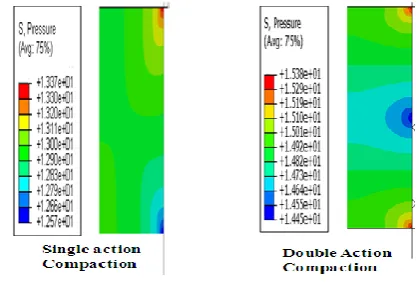
Figure 1: Compact pressure contour plot for 8 mm compact density for a case of Al+5%SiC for Single and double action
compactions
Figure 2: Compact pressure contour plot for 2 mm compact density for a case of Al+10%SiC for Single and double action
Figure 3: Compact pressure contour plot for 8 mm compact density for a case of Al+15%SiC for Single and double action
compactions
Figure 4: Compact pressure contour plot for 6 mm compact density for a case of Al+20%SiC for Single and double action
compactions
The compact pressures from the simulations were plotted against that of the single action compaction for the comparison purposes in Figs 1 to 4. In case of single of compaction, the contours vary from top to bottom of the model since the bottom surface is constrained and top surface moves downwards. Where as in case of the double action compaction, the contours are symmetric about the central line (located at half the height of the model) since both the top and bottom surfaces move simultaneously. It can be observed that in all the cases, the compact pressures are higher by almost 15% in the case of double action compaction compared to that of the single action compaction.
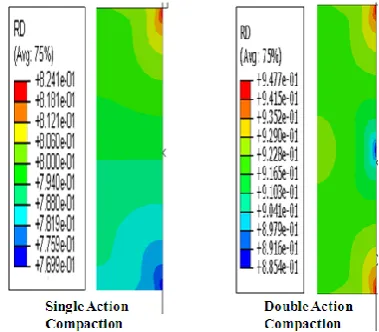
Figure 5: Relative density contour plot for 100 Mpa compact density for a case of Al+5%SiC for Single and double action
compactions
Figure 6: Relative density contour plot for 200 Mpa compact density for a case of Al+10%SiC for Single and double action
compactions
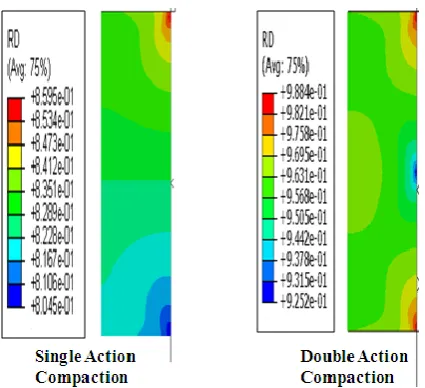
Figure 7: Relative density contour plot for 300 Mpa compact density for a case of Al+15%SiC for Single and double action
Figure 8: Relative density contour plot for 400 Mpa compact density for a case of Al+20%SiC for Single and double action
compactions
The relative density has been simulated for aluminum silicon carbide composites with different contents of silicon carbide this has been computed for different levels of compact pressure. It has been found that with increase in the percentage of silicon carbide in the metal matrix composites there has been decrease in the relative density. This trend has been found at all the levels of compact pressures investigated. In Figs. 5 to 8 the relative density contour plots are shown both for single action compaction and double action compaction. Again here, as explained above, the contours are symmetric about the central line in case of the double action compaction.
Table 1: Values of Typical Constants Evaluated for Single Acting Powder Compaction Process
Sim Settings
Pure Sim
5% SIC-Sim
10% SIC-Sim
15%
SIC-Sim 20% SIC-Sim
25% SIC-Sim
30% SIC-Sim Cohesion
Coefficient 2.9 2.6 2.6 2.4 2.4 2.2 2.1 Friction
Angle 32 34 35 32 34 32 32
Flow
Angle 30 30 30 30 30 30 30
The typical simulated values of compact density for different silicon carbide in aluminum silicon carbide metal matrix composites have been presented in Table 1. Hence, it can be concluded that based on the above results, the modeling approach along with the
parameters derived is applicable to for the double action compaction as well for the prediction purposes.
IV.
CONCLUSION
In this research work studies has been conducted for double acting compaction simulation for different compact densities. The simulation shows that the double acting compaction yield better relative density compared to single acting compaction at least by 15%. The locations of the maximum void ratios are different in both models. The distribution of relative density contours is symmetric about X- axis in case of double action compaction. It has been found that better relative density can be achieved by increasing the compact pressure.
V.
REFERENCES
[1] German, R.M.. Powder Metallurgy Science. (2nd
ed.). Princeton, NJ: Metal Powder Industries Federation. 1994.
[2] Huo, S., Heath, B., Ryan, D. Applications of powder
metallurgy aluminums for automotive valve-trains. SAE International Journal of Materials and Manufacturing 2009, 1(1), 511-15.
[3] Li, Y. Y., Ngai, T. L., Zhang, D. T., Long, Y., Xia,
W. Effect of die wall lubrication on warm compaction powder metallurgy. Journal of Materials Processing Technology 2002, 129, 354-8.
[4] PM Modnet, Computer Modelling Group,
“Comparison of computer models representing
powder compaction process“, Powder
Metallurgy.1999,vol. 42, p. 301.
[5] O. Coube and H. Riedel, “Numerical Simulation of
Metal Powder Die Compaction with Special Consideration of Cracking”,Powder Metallurgy., 2000, vol. 43, p. 123.
[6] A.C.F. Cocks, “Constitutive Modelling of Powder
Compaction and Sintering“,
Prog.Material.Science.,2001, vol. 46, p. 201.
[7] E.A. Olevsky, Theory of Sintering: From Discrete to
Continuum“, Material. Science. Engineering. Research, 1998, vol. 23, p. 41.
[8] H.E. Exner and T. Kraft, “Review on Computer
Simulations of Sintering Processes”, Powder Metallurgy World Congress EPMA, Shrewsbury, U.K., 1998, vol. 2, p. 278.
[9] T. Kraft and H. Riedel, “Numerical Simulation of
[10] T. Kraft, “Optimising Press Tool Shapes by Numerical Simulation of Compaction and Sintering – Application to a Hard Metal Cutting Insert”,
Modelling Simulations, Material Science
Engineering.
[11] J.Z. Qi, L.M. Chen. New technologies in powder
metallurgy J]. Powder Metallurgy Industry, Vol. 14-1 (2004), p. 23-28
[12] Y.Y. Li, N.T. Leo, Z.Y. Xiao, D.T. Zhang, W.P.
Chen. Study on Mechanical properties of warm compacted iron-based materials J]. J Cent South Univ Technol (English Edition), Vol. 9-3 (2002), p. 154-158
[13] F. Han. The trend of global PM parts Industry J].
Powder Metallurgy Technology, Vol. 19-4(2001), p. 508-51 1.
[14] G. Nagile, T. Altan. Simulation of manufacturing
processes: past, Present and future C]. 7th ICTP, Yokohama, Japan. Oct. 2002, vol. 1: 271-281
[15] Zahlan, N. Knight, D.T., Backhouse, A. and Leiper,
G.A., “Modelling powder compaction and pressure cycling”, Journal on Powder Technology, Vol.114, 2001, pp.112-117.
[16] H.A. Kuhn, C.L. Downey. Deformation
characteristics and plasticity theory of sintered powder materials J]. International Journal of Powder Metallurgy, Vol. 7(1971), p. 15-25.
[17] R.J. Green. A plasticity theory for porous solids J].
International Journals of Mechanical Sciences., Vol. 14 (1972), p. 215-224
[18] M. Oyane, S. Shima. Theory of plasticity for porous
metals J]. Bulletin of the JSME, Vol. 16(1973), p. 1254-1262
[19] D.V. Tran, R.W. Lewis, D.T. Gethin, et al.
Numerical modeling of Powder compaction
processes: displacement based finite element Method, Journal on Powder Metallurgy, Vol. 36 (1993), p. 257-263
[20] R.W. Lewis, A.R. Khoei. A plasticity model for
metal powder forming Processes J]. International Journal of Plasticity, Vol. 17 (2001), p. 1695-1692
[21] W. Li, S. J. Park, P. Suri, A. Antonyraj, and R. M.
German, "Investigation on die wear behaviour during compaction of aluminium matrix composite powders," Powder Metallurgy, vol. 54, pp. 202-208, 2011.
[22] H. A. Al-Qureshi, M. R. F. Soares, D. Hotza, M. C.
Alves, and A. N. Klein, "Analyses of the fundamental parameters of cold die compaction of powder metallurgy," Journal of Materials Processing Tech, vol. 199, pp. 417-24, 2008.
[23] S. S. M. Nor, M. M. Rahman, F. Tarlochan, B.
Shahida, and A. K. Ariffin, "The effect of lubrication in reducing net friction in warm powder compaction
process," Journal of Materials Processing
Technology, vol. 207, pp. 118-124, 2008.
[24] G. Beck, S. Selig, D. A. Doman, and K. Plucknett,
"Densitometry analysis to determine density distribution in green compacts," presented at the International Conference on Powder Metallurgy and Particulate Materials, San Francisco, 2011.
[25] A. Molinari, E. Santuliana, I. Cristofolini, A. Rao, S.
Libardi, and P. Marconi, "Surface modifications induced by shot peening and their effect on the plane bending fatigue strength of a Cr-Mo steel produced by powder metallurgy," Materials Science & amp; Engineering: A (Structural Materials: Properties, Microstructure and Processing), vol. 528, pp. 2904-11, 2011.
[26] G. Sethi, N. S. Myers, and R. M. German, "An
overview of dynamic compaction in powder metallurgy," International Materials Reviews, vol. 53, pp. 219-34, 2008.
[27] J. Z. Wang, X. H. Qu, H. Q. Yin, M. J. Yi, and X. J.
Yuan, "High velocity compaction of ferrous powder," Powder technology, vol. 192, pp. 131-136, 2009.
[28] J. C. Cunningham, I. C. Sinka, and A. Zavaliangos,
"Analysis of tablet compaction. I. Characterization
of mechanical behavior of powder and
powder/tooling friction," Journal of Pharmaceutical Sciences, vol. 93, pp. 2022-2039, 2004.
[29] I. Aydin, B. J. Briscoe, and N. Ozkan, "Modeling of
powder compaction: A review," MRS Bulletin, vol. 22, pp. 45-51, 1997.
[30] I. C. Sinka, "Modelling powder compaction," in
KONA, Leicester, UK. 2007.
[31] L. Federzoni, H. Riedel, O. Coube, M. Oldenburg,
H. A. Haggblad, D. T. Gethin, P. Mosbah, J. Virta, H. Martikainen, and A. Frachon, "State-of-the-art
review - comparison of computer-models
representing powder compaction process," Powder Metallurgy, vol. 42, pp. 301-311, 1999.