On the Use of Self-
?
Island-based Evolutionary
Computation Methods on Complex Environments
?Rafael Nogueras and Carlos Cotta
ETSI Inform´atica, Campus de Teatinos, Universidad de M´alaga, 29071 M´alaga, Spain
Abstract. We consider the use of island-based evolutionary algorithms (EAs) on
fault-prone computational settings. More precisely, we consider scenarios plagued with correlated node failures. To this end, we use the sandpile model in order to induce such complex, correlated failures in the system. Several EA variants fea-turing self-adaptive capabilities aimed to alleviate the impact of node failures are considered, and their performance is studied in both correlated and non-correlated scenarios for increasingly large volatility rates. Simple island-based EAs are shown to have a significant performance degradation in the correlated scenario with re-spect to its uncorrelated counterpart. Resilience is however much improved via the use of self-?properties (self-scaling and self-healing), which leads to a more gen-tle degradation profile. The inclusion of self-generation also contributes to boost performance, leading to negligible degradation in the scenarios considered.
Keywords:evolutionary algorithms, memetic algorithms, self-?properties, ephemeral
computing, sandpile model.
1.
Introduction
The use of parallel environments is of paramount interest for tackling intensive compu-tational tasks. This turns out to be one of the fundamental advantages of metaheuristics, and more specifically of its population-based variants, given their amenability for being implemented in parallel and distributed environments [2]. In particular, evolutionary al-gorithms (EAs) [14] have a long success story in this kind of environments, dating back to the 1980s [19,21,22]. In this sense, there has been during the last years an important focus on the use of EAs in emergent computational scenarios that depart from classical dedi-cated networks so common in the past. Among these we can cite cloud computing [35], P2P networks [37,60], or volunteer computing [9,51], just to name a few. The dynamic nature of the underlying computational substrate is one of the most distinguished features of some of these new scenarios –consider for example a P2P network in which nodes may enter or leave the system subject to some uncontrollable dynamics caused by user interventions, network disruptions, eventual crashes, etc. The termchurnis used to denote this phenomenon [54]. Under some circumstances, a potential solution to this issue might be to hide these computational fluctuations under an intermediate layer, thus providing a virtual stable environment to algorithms running on it. Nonetheless, this can constitute a formidable challenge, mainly in situations in which the underlying substrate is composed
of nodes with low computing power just providing brief, ephemeral bursts of computa-tion (think of, e.g., a large colleccomputa-tion of low-end networked devices –cell phones, smart wearables, etc.– contributing their idle time). Making an effective use of such highly-volatile resources is the key idea that underlies the notion ofEphemeral Computing (Eph-C), which has been recently defined as the use and exploitation of computing resources whose availability is ephemeral (i.e., transient and short-lived) to carry out complex com-putational tasks [10].
In order to approach Eph-C, algorithms can be made fully aware of the complex dy-namic nature of the underlying computational environment and adapted to work natively on these conditions. In this sense, EAs can fit very well to this scenario. To begin with, they are intrinsically resilient at a fine-grained scale (this has been shown in master-slave models, where a reliable node runs the central logic of the algorithm and individual op-erations –such as fitness calculations or applications of reproductive operators– are dis-tributed on fault-prone nodes [28,29,30,31]). The situation is however somewhat different at a coarse grain level. Consider, for example, the so-called island model of evolutionary algorithms [55], whereby multiple populations evolve in parallel (be it just as an algo-rithmic construct or as truly physically-distributed processes) and occasionally exchange information (leading to better solutions as well as to a great reduction of the computa-tional cost necessary to achieve these [1]). As it is well known, an unstable computacomputa-tional environment such as the one described can lead to the loss of the current best solution [23] and will also negatively impact genetic diversity and the progress of the search process. In order to address these problems effectively, several strategies have been proposed in the past, such as redundancy [15] or epidemic algorithms [16] in the case of fine-grained models, and checkpointing [34,45] in the case of coarse-grained models, to name just a few.
Although checkpointing (that is, saving periodic snapshots of the state of the volatile nodes), seems to be a very sensible option in advance, it is important to consider that in order for it to work properly, some type of access to external stable storage is required. The main drawback of this is that it can contribute a significant overhead, mainly when the frequency of these snapshots is required to be high, e.g., due to a high failure rate in the nodes [43], with the subsequent performance degradation. A much more attractive option is to provide the algorithms with (self-)adaptive strategies so that they can react autonomously to changes in the environment, adjusting their behavior or functioning ac-cordingly. Such strategies are often captured under the general umbrella term of self-?
to bridge the notion of memetic algorithms [40] –understood as optimization algorithms that combine local and global search strategies (often using an evolutionary search en-gine for the latter purpose) and orchestrate their interplay in a synergistic way– with some specific self-?properties such as self-organization and self-generation [27].
Recent work has precisely studied the use of self-?properties such as self-scaling [46] and self-healing [47] in this context, providing some evidence on the contribution of these techniques to the robustness of the algorithm when run on unstable computational envi-ronments. Quite interestingly, these previous studies have however only considered simple network models in which the dynamics of each node is independent of the rest of the net-work, that is, the availability of a computing node does not depend on the availability of other nodes. A more general situation would encompass complex correlated availability patterns, that is, situations in which the dynamics of each node might be affected by the dynamics of other nodes, see e.g., [25]. Overall, the presence of correlated failures puts to test the robustness and resilience of the EA, and hence studying it can provide a wider perspective on the usefulness of self-?techniques to cope with computational instability. In this work, our initial study carried out with EAs in [49] is extended to island-based multimemetic algorithms (MMAs). MMAs [26] are an extension of memetic algorithms in which computational representations of problem solving strategies (neighborhood def-initions for a local search operator in this case) are explicitly stored and evolved as a part of solutions, very much in line with the concept of memetic computing anticipated above. By deploying these techniques in a scenario as described different self-?properties (self-generation, self-scaling and self-healing) are layered and put to test in this demanding context. More precisely, we consider their deployment on a simulated computational en-vironment that allows experimenting with different churn rates and, therefore, exploring their limits, see Sect. 2.1. We relied on previous work [42,44,46] to address the different self-?properties considered, as described in Sect. 2.2. We present the results of a broad empirical evaluation of the strategies considered in Sect. 3. We close with conclusions and an outline of future work in Sect. 4.
2.
Methodology
We consider an island-based EA running on a simulated unstable environment. Each is-land runs on a computational node of the system, whose availability fluctuates along time. When a computational node goes down, its contents are lost. Similarly, when a computa-tional node is reactivated, the island running on it must be created anew in some way. In the following subsections we shall describe in more detail the model of the computational scenario and the mechanisms used by the EA to cope with instability.
2.1. Network Model
island topology
underlying network
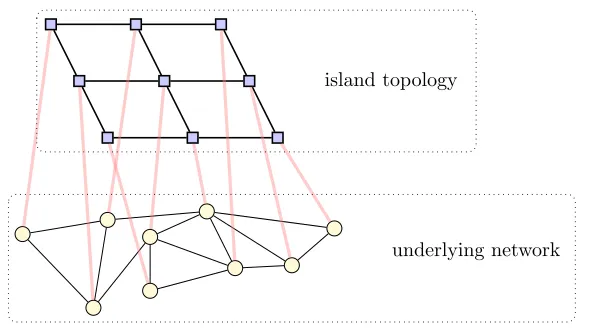
Fig. 1.Depiction of the network model: a toroidal von Neumann 2D grid (wrap-around links not shown to avoid clutter) is overlaid on an underlying scale-free network.
p(d)∼d−γfor some constant parameterγ) and hence there will be a few hubs with large connectivity and increasingly more nodes with a smaller number of neighbors. To gener-ate this kind of networks we use the Barab´asi-Albert model [3], whereby the network is grown from a clique ofm+ 1nodes by adding a node at a time, connecting it tomof the nodes previously added (selected with probability proportional to their degree – the so-called, preferential attachment mechanism [6]) wheremis a parameter of the model.
As stated before, these nodes are volatile, and may abandon the system and re-enter it at a later time, eventually repeating the process over and over again. To model this instability we consider two scenarios: (i) independent or non-correlated failures and (ii) correlated failures. The first one is the simplest model. Therein, the dynamics of each node is independent of other nodes. Each of them can switch from active to inactive or vice versa independently of other nodes with some probability that only depends on the time it has been in its current state. More precisely, letp(t)be the probability of remaining in the same state after timet. Following previous work, as well as the commonly observed behavior of e.g., P2P systems [54],p(t)follows a Weibull distribution:
p(t) = exp (−(t/β)η) (1)
This distribution is controlled by two parametersβ andη. The first one is the scale pa-rameter and captures the spread of the distribution. The larger this papa-rameter, the less frequent failure events are. The second one is the shape parameter and captures the effect that time has on failure events: forη >1(resp.η <1), the longer the time elapsed, the more (resp. less) likely a failure event will be. Ifηwas exactly 1, failures would be time-independent (i.e., the hazard function would be constant) and hence the time to failure would be exponentially distributed.
a
0
b
5
c
0
d
0
e
1
g 0 i
0
f
h
(a)
a
1
c
1
d
1
e
2
g 1 i
0
f
h b
6
(b)
c
1
d
1
g 1 i
1
b
f
h a
1
e
2
(c)
c
1
d
1
g 1 i
1
a b
e f
h
(d)
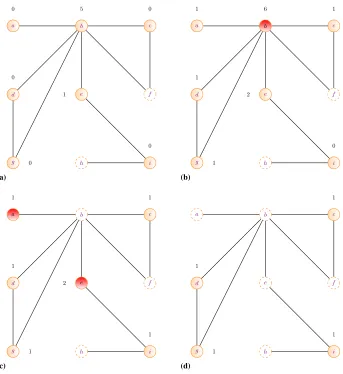
Fig. 2.Example of failure propagation in the sandpile model. Active (resp. inactive) nodes are depicted with solid (resp. dashed) borders. The numbers next to each active node indicate the cumulated number of failure events. The thresholdθifor each node equals here its degree. (a) Initial state (b) Failure on nodeb(c) Failure propagation to nodesaande(d) Final state.
of such micro-failures effectively equals this threshold, the node is disconnected from the system, and each of the active neighbors of this node receives an additional micro-failure event1. In case any of these neighbors now accumulated a number of micro-failures equal to its own threshold, it would go down as well, propagating in turn another micro-failure to its active neighbors, and so on (hence the possibility of cascading failures). Fig. 2 shows an example: after nodeb(which was in a critical state, i.e., one event short of going down) fails, neighboring nodesaande(which were also in such a critical state) fail as well. We have considered for simplicity that the thresholdθiof each nodeiis constant and equal to the number of neighbors (active or inactive) of the node. As to reactivation, just like in the non-correlated case a single event is required.
2.2. Algorithmic Model
The core algorithm considered is a steady-state EA with one-point crossover, bit-flip mu-tation, binary tournament selection and replacement of the worst parent. This algorithm is deployed on a computational environment such as described in the previous section by means of the island-model, whereby each node hosts an island that runs an instance of the previously mentioned EA. After each iteration of the basic EA, these islands perform mi-gration (stochastically with probabilitypmig) of a single individual to neighboring islands. In each migration event the migrant is randomly selected from the current population and the receiving island inserts it in its population by replacing the worst individual [41].
Four variants of the island-based EA are considered by endowing it with different sets of self-?properties:
– ∅: a simple island-based EA (simply termed EA in the following) in which every island has a fixed size and random reinitialization is used whenever a new node enters the system.
– {self-generation}: an island-based MMA (simply denoted as MMA in the following) obtained by endowing EA with self-generation capabilities.
– {self-scaling, self-healing}: a self-adaptive island-based EA (denoted as EA∗) ob-tained by augmenting the EA with self-scaling and self-healing to re-size each island individually in response to fluctuations in the number of active neighbors and in the population sizes of these.
– {self-scaling, self-healing, self-generation}: a self-adaptive island-based MMA (termed MMA∗) obtained by endowing the MMA with self-scaling and self-healing capabilities.
These self-?properties are described in the following.
Self-generation. Self-generation refers to the capability of the algorithm to redefine the search tools it uses, that is, to create and adapt these to the circumstances of the search process. We have considered a framework similar to that defined by Smith [52,53]. More specifically, each individual in the population contains a binary genotype and a single meme, the latter being represented as a rewriting rule. These rules have the formA→C,
1It must be noted that these so-called micro-failures are not intended to represent any real phenomenon, but
where both AandC are strings of the same length taken from {0,1,#}∗, that is, the binary alphabet used to represent the solutions plus a wildcard (‘#’). This meme defines a neighborhood relationship in the search space: given a genotype g ∈ {0,1}n (i.e., a binary string of lengthn), its neighborhoodN(M)(g)induced by memeM ≡A→Cis defined as
N(M)(g) ={g0|g M
−→g0} (2)
i.e., it is composed of all binary strings attainable by applying the rewriting ruleM to
g, that is, finding a match of the antecedentAing(using the wildcard as “don’t care” symbol) and replacing it with the consequentC(where the wildcard now means “don’t change”). This neighborhood is subsequently used to optimizegby samplingN(M)(g)
w times (where wis a parameter used to keep the cost of the process under control) and keeping the best solution found (if better than the original genotype g). Note that since memes are a part of solutions, they are also subject to mutation [52], and they are transferred from parents to offspring through local selection (the offspring inherits the meme of the best parent).
Self-scaling. Self-scaling refers to the capability of the algorithm to adapt its functioning in response to changes in the scale parameters of the task being tackled, either of the problem under consideration or of the computational substrate on which the algorithm is run. In this context we focus precisely on this latter issue, and use self-scaling strategies aimed to attain a rather stable global population size across the islands that are active in each particular moment. To this end, each island periodically monitors the state of its neighbors to determine: whether they are active or not, their population sizes and the number of active neighbors they have in turn. When a neighboring island is detected to have just gone down, the island increases its own population size in order to compensate the loss of the former. This is done by calculating the fraction of the population size of the deactivated island corresponding to the number of active neighbors it had (e.g., if an island with population size µandν active neighbors went down, each of the latter would attempt to grow their populations byµ/ν individuals). On the other hand, if all neighboring islands are active then they exchange individuals in order to balance their population sizes. See [46] for details. Note that this is a completely autonomous and decentralized policy and therefore each node cannot comprehend the global state of the network, for instance, a node does not account for the simultaneous failure of nodes that are themselves neighbors, hence the interest of studying the robustness of the EA in the correlated scenario.
A simple solution is to have the population grow by introducing new random solutions (the random immigrant strategy [20]). While this would certainly promote diversity by introducing completely new genetic material, it could also drag backwards the search process by moving the population away from promising regions of the search space that might have been identified. As an alternative a self-sampling procedure could be used. This amounts to maintaining within each island a probabilistic model of its current popu-lation in order to sample it whenever the popupopu-lation needs to grow. This has the advantage of introducing diversity due to the stochastic sampling, keeping as well the momentum of the search since the newly created individuals are coherent with the current state of the population (unlike the case of using random individuals to this end). In this work we have considered the use of a tree-like bivariate probabilistic model such as that used in the COMIT estimation of distribution algorithm [5] – see also [47] for details.
3.
Experimentation
In order to study the resilience of the island-based EAs described in previous section, these have been put to test in a broad variety of scenarios. Before reporting the results obtained, next subsection describes in more detail the experimental setting considered.
3.1. Experimental Setting
We considernι = 64islands whose initial size isµ= 32individuals and a total number of evaluationsmaxevals= 250 000. We use crossover probabilitypX = 1.0, mutation probabilitypM = 1/`, where`is the genotype length, and migration probabilitypmig=
1/(5µ) = 1/160. Regarding the network parameters, we usem = 2in the
Barab´asi-Albert model in order to define the topology of the underlying network; as for node de-activation/reactivation, we use the shape parameter η = 1.5 (larger than 1 and hence implying an increasing hazard rate with time), and scale parametersβ =−1/log(p)for
p= 1−1/(knι),k∈ {1,2,5,10,20}. To interpret these parameters, note that they would correspond to an average of one micro-failure event everykcycles if the failure rate was constant. This provides different scenarios ranging from low volatility (k = 20) to very high volatility (k= 1). Notice thus there is an inverse relationship between the value of this parameter and stability: large values of this parameter correspond to great stability (actually, full stability fork = ∞, a scenario that has been also included in the experi-mentation to gauge the results) and small values correspond to high volatility (hitting a maximum fork= 1/nι). In order to have a more meaningful comparison between both scenarios (accommodating the fact that several micro-failure events are required in order to take down a node in the correlated case but only one is needed in the non-correlated case), in the non-correlated scenario we adjustkvalues ask0=kθ˜, whereθ˜is the average of allθivalues in the correlated scenario (which in this case is also the average degree of the network). Note at any rate that the main focus of the experimentation is the relative behavior of the algorithms considered in either scenario rather than a comparison between scenarios in absolute terms.
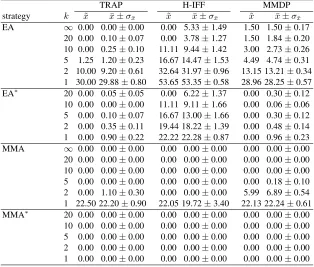
Table 1.Results (averaged for 25 runs) of the different EAs on the three problems considered under the network model with non-correlated failures. The median (x˜), mean (x¯) and standard error of the mean (σ¯x) are indicated.
TRAP H-IFF MMDP
strategy k x˜ x¯±σ¯x x˜ x¯±σ¯x x˜ x¯±σx¯
EA ∞ 0.00 0.00±0.00 0.00 5.33±1.49 1.50 1.50±0.17 20 0.00 0.10±0.07 0.00 3.78±1.27 1.50 1.84±0.20 10 0.00 0.25±0.10 11.11 9.44±1.42 3.00 2.73±0.26 5 1.25 1.20±0.23 16.67 14.47±1.53 4.49 4.74±0.31 2 10.00 9.20±0.61 32.64 31.97±0.96 13.15 13.21±0.34 1 30.00 29.88±0.80 53.65 53.35±0.58 28.96 28.25±0.57 EA∗ 20 0.00 0.05±0.05 0.00 6.22±1.37 0.00 0.30±0.12
10 0.00 0.00±0.00 11.11 9.11±1.66 0.00 0.06±0.06 5 0.00 0.10±0.07 16.67 13.00±1.66 0.00 0.30±0.12 2 0.00 0.35±0.11 19.44 18.22±1.39 0.00 0.48±0.14 1 0.00 0.90±0.22 22.22 22.28±0.87 0.00 0.96±0.23 MMA ∞ 0.00 0.00±0.00 0.00 0.00±0.00 0.00 0.00±0.00 20 0.00 0.00±0.00 0.00 0.00±0.00 0.00 0.00±0.00 10 0.00 0.00±0.00 0.00 0.00±0.00 0.00 0.00±0.00 5 0.00 0.00±0.00 0.00 0.00±0.00 0.00 0.18±0.10 2 0.00 1.10±0.30 0.00 0.00±0.00 5.99 6.89±0.54 1 22.50 22.20±0.90 22.05 19.72±3.40 22.13 22.24±0.61 MMA∗ 20 0.00 0.00±0.00 0.00 0.00±0.00 0.00 0.00±0.00
10 0.00 0.00±0.00 0.00 0.00±0.00 0.00 0.00±0.00 5 0.00 0.00±0.00 0.00 0.00±0.00 0.00 0.00±0.00 2 0.00 0.00±0.00 0.00 0.00±0.00 0.00 0.00±0.00 1 0.00 0.00±0.00 0.00 0.00±0.00 0.00 0.00±0.00
EA∗(the based EA endowed with self-healing and self-scaling), MMA (an island-based EA with self-generation) and MMA∗(the island-based EA endowed with all three self-?properties: self-generation, self-scaling and self-sampling). With regard to memes, as explained in Sect. 2.2, they are represented by rewriting rules. Their length varies be-tweenlmin= 3andlmax= 9and they have a mutation probabilitypr= 1/lmax, and are applied with parameterw = 1. The experimental benchmark comprises three test func-tions, namely Deb’s trap function [11] (TRAP, concatenating 32 four-bit traps), Watson et al.’s Hierarchical-if-and-only-if function [58] (HIFF, using 128 bits) and Goldberg et al.’s Massively Multimodal Deceptive Problem [18] (MMDP, using 24 six-bit blocks). We perform 25 simulations for each algorithm, problem, volatility scenario and failure model.
3.2. Experimental Results
0.2 0.4 0.6 0.8 1 0
10 20 30 40 50 60 70
1/k
deviation from optimum (%)
non−correlated correlated
(a)
0.2 0.4 0.6 0.8 1
0 5 10 15 20 25 30 35 40 45 50
1/k
deviation from optimum (%)
non−correlated correlated
(b)
0.2 0.4 0.6 0.8 1
0 10 20 30 40 50 60 70
1/k
deviation from optimum (%)
non−correlated correlated
(c)
0.2 0.4 0.6 0.8 1
0 1 2 3 4 5 6 7 8 9 10
1/k
deviation from optimum (%)
non−correlated correlated
(d)
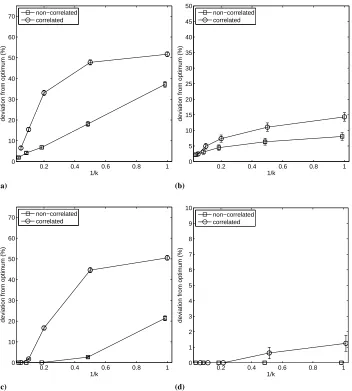
Fig. 3.Average deviation from the optimal solution across all problems for each algorithmic variant and network failure model. (a) EA (b) EA∗(c) MMA (d) MMA∗. Notice the different range of the Y axis in each case.
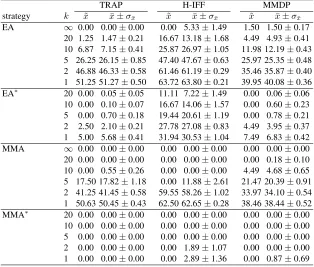
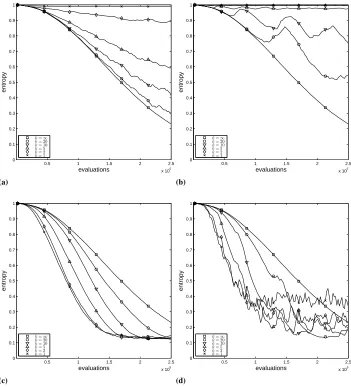
this case too. As a matter of fact –and this leads to the second observation– the degrada-tion of performance in the correlated case is much less marked for EA∗than it was for EA. More precisely, if we conduct a ranksum test on the results obtained by each algorithm on each problem and network scenario we observe that the performance of EA significantly (at levelα= 0.01) degrades in the correlated scenario with respect to the non-correlated one for all churn rates, whereas EA∗is only significantly degraded for moderate and high churn rates (k 65for TRAP and HIFF andk 6 2for MMDP). This is not to say that EA∗is not adversely affected by the new scenario (in the non-correlated case the perfor-mance of EA∗ was only significantly degraded with respect to the stablek = ∞case for k 6 5in HIFF and k 6 2 in TRAP, whereas in the correlated scenario there are statistically significant differences fork62in MMDP,k65in TRAP andk 610in HIFF) but this degradation is mostly in the most volatile cases (unlike EA, whose perfor-mance is degraded with respect tok=∞in the correlated case for all churn rates in all three problems) and not so large in magnitude as for EA. A result consistent with this can also be seen in Fig. 4, in which the genetic diversity of the population (measured using Shannon’s entropy) is depicted for each algorithm and scenario (the data corresponds to the TRAP function, but the behavior is qualitatively similar in the remaining problems). Notice how EA faces increasingly large difficulties to converge as the volatility goes up, and how these difficulties are noticeable even for low-volatility settings in the correlated scenario. EA∗ can however maintain a better focus on the search, and seems mostly af-fected in the most volatile settings of the correlated scenario. The use of self-scaling seems crucial for this, since it damps perturbations in the overall size of the population and con-tributes to exchange genetic information among islands (it can be actually regarded as a self-adaptive, instability-driven migration process). This information exchange provides the convergence boost required to overcome to a great extent the perturbation caused by island losses (this perturbation is further alleviated by the use of self-healing, which helps avoiding having to create solutions from scratch, something that would contribute diver-sity but hamper convergence). This said, it is clear that a decentralized strategy such as the one considered, whereby each island takes decisions based on the interaction with its neighbors, can be more sensitive to simultaneous failures of neighboring nodes which is more frequent in the correlated scenario considered. Hence, while the EA∗can be better equipped than plain EAs to withstand unstable scenarios, it is not immune to churn.
As for the EAs endowed with self-generation, we can draw similar observations. If we look firstly at MMA (Fig. 3c) we obtain the expected result, as in the case of the EA, i.e., the performance of the algorithm degrades as the volatility of the node increases, but this degradation is negligible in the non-correlated scenario except for the most volatile setting (k=1), unlike the much more marked degradation that takes place in the correlated scenario. In this sense, it must be taken into account the non-linear relationship between the value ofkand instability, which makes the growth in churn when going fromk= 2to
Table 2.Results (averaged for 25 runs) of the different EAs on the three problems considered under the network model with correlated failures. The median (x˜), mean (x¯) and standard error of the mean (σx) are indicated.¯
TRAP H-IFF MMDP
strategy k x˜ x¯±σ¯x x˜ x¯±σ¯x x˜ x¯±σx¯
EA ∞ 0.00 0.00±0.00 0.00 5.33±1.49 1.50 1.50±0.17 20 1.25 1.47±0.21 16.67 13.18±1.68 4.49 4.93±0.41 10 6.87 7.15±0.41 25.87 26.97±1.05 11.98 12.19±0.43 5 26.25 26.15±0.85 47.40 47.67±0.63 25.97 25.35±0.48 2 46.88 46.33±0.58 61.46 61.19±0.29 35.46 35.87±0.40 1 51.25 51.27±0.50 63.72 63.80±0.21 39.95 40.08±0.36 EA∗ 20 0.00 0.05±0.05 11.11 7.22±1.49 0.00 0.06±0.06
10 0.00 0.10±0.07 16.67 14.06±1.57 0.00 0.60±0.23 5 0.00 0.70±0.18 19.44 20.61±1.19 0.00 0.78±0.21 2 2.50 2.10±0.21 27.78 27.08±0.83 4.49 3.95±0.37 1 5.00 5.68±0.41 31.94 30.53±1.04 7.49 6.83±0.42 MMA ∞ 0.00 0.00±0.00 0.00 0.00±0.00 0.00 0.00±0.00 20 0.00 0.00±0.00 0.00 0.00±0.00 0.00 0.18±0.10 10 0.00 0.55±0.26 0.00 0.00±0.00 4.49 4.68±0.65 5 17.50 17.82±1.18 0.00 11.88±2.61 21.47 20.39±0.91 2 41.25 41.45±0.58 59.55 58.26±1.02 33.97 34.10±0.54 1 50.63 50.45±0.43 62.50 62.65±0.28 38.46 38.44±0.52 MMA∗ 20 0.00 0.00±0.00 0.00 0.00±0.00 0.00 0.00±0.00
10 0.00 0.00±0.00 0.00 0.00±0.00 0.00 0.00±0.00 5 0.00 0.00±0.00 0.00 0.00±0.00 0.00 0.00±0.00 2 0.00 0.00±0.00 0.00 1.89±1.07 0.00 0.00±0.00 1 0.00 0.00±0.00 0.00 2.89±1.36 0.00 0.87±0.69
former includes local search contributes to improve slightly the results and counteracts the effects of degradation for large values ofk, but cannot prevent it for smallk. At any rate, the greater hardness of the correlated scenario makes degradation being qualitatively noticeable for larger values ofk.
On the other hand, if we now consider the case of MMA∗, three fundamental issues can be observed: firstly, its performance is considerably better than that of MMA in these latter settings; secondly, the degradation of performance is much more gentle for any value ofk; thirdly, the performance is considerably better and more stable in the case of the MMA than in the EA, for all values ofk and for both the correlated and the non-correlated cases, being in the latter case very close to 0, i.e., the MMA with the self-?
0.5 1 1.5 2 2.5 x 10⁵ 0 0.1 0.2 0.3 0.4 0.5 0.6 0.7 0.8 0.9 1 evaluations entropy
k=∞
k= 20
k= 10
k= 5
k= 2
k= 1
(a)
0.5 1 1.5 2 2.5
x 105 0 0.1 0.2 0.3 0.4 0.5 0.6 0.7 0.8 0.9 1 evaluations entropy
k=∞
k= 20
k= 10
k= 5
k= 2
k= 1
(b)
0.5 1 1.5 2 2.5
x 105 0 0.1 0.2 0.3 0.4 0.5 0.6 0.7 0.8 0.9 1 evaluations entropy
k=∞
k= 20
k= 10
k= 5
k= 2
k= 1
(c)
0.5 1 1.5 2 2.5
x 105 0 0.1 0.2 0.3 0.4 0.5 0.6 0.7 0.8 0.9 1 evaluations entropy
k=∞
k= 20
k= 10
k= 5
k= 2
k= 1
(d)
Fig. 4.Genetic diversity for the TRAP function. The top row corresponds to EA and the bottom row to EA∗; the left column corresponds to non-correlated failures, and the right row to correlated failures.
0.5 1 1.5 2 2.5 x 10⁵ 4.4 4.6 4.8 5 5.2 5.4 5.6 5.8 6 6.2 evaluations meme lengths
k=∞
k= 20
k= 10
k= 5
k= 2
k= 1
(a)
0.5 1 1.5 2 2.5
x 105 0 0.1 0.2 0.3 0.4 0.5 0.6 0.7 0.8 0.9 1 evaluations improvement rate
k=∞
k= 20
k= 10
k= 5
k= 2
k= 1
(b)
0.5 1 1.5 2 2.5
x 105 4 4.5 5 5.5 6 evaluations meme lengths
k=∞
k= 20
k= 10
k= 5
k= 2
k= 1
(c)
0.5 1 1.5 2 2.5
x 105 0 0.1 0.2 0.3 0.4 0.5 0.6 0.7 0.8 0.9 1 evaluations improvement rate
k=∞
k= 20
k= 10
k= 5
k= 2
k= 1
(d)
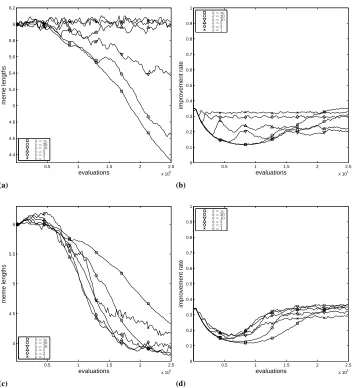
Fig. 5.Meme dynamics in the correlated scenario. The top row corresponds to MMA and the bottom row to MMA∗. The left column shows meme lengths and the right column the improvement rate.
during the whole run). However, MMA∗ maintains a much more consistent profile (Fig. 5c–5d) across all configurations considered, indicating that the algorithm could keep the momentum of the search in spite of the larger instability.
4.
Conclusions and Future Work
have analyzed how these unstable scenarios can affect the performance of several variants of island-based EAs, and observed a marked degradation of the results in absence of ap-propriate policies to deal with this harder setting. Endowing the EA with self-?properties can however increase its resilience and make it able to withstand from low up to moder-ately high volatility. Stacking together self-generation, self-scaling, and self-healing re-dound in increased resilience and a much more stable behavior, leading in some cases to a negligible loss of performance in the scenarios considered.
There are several lines of research for future work. First of all, the network model could be expanded, either by trying new topologies or by considering other different models of correlated faults. In line with the latter, the use of dynamic thresholds could be considered (work is in progress in this area [48]) or even the utilization of completely dif-ferent correlation models, e.g., [8,59]. A complementary issue of interest is the potential heterogeneity of the network, allowing a one-to-many mapping between some computing nodes and the islands of the algorithm. In the longer term, a related problem is the op-timization of the network itself to cope with this kind of failures. Some recent work has addressed this issue [56], paving the way for other developments in this direction. Finally, other non-evolutionary algorithms could be deployed in this scenario. These works are currently underway.
Acknowledgments.This work is supported by the Spanish Ministerio de Econom´ıa and European
FEDER under Projects EphemeCH (TIN2014-56494-C4-1-P –http://ephemech.wordpress. com) and DeepBIO (TIN2017-85727-C4-1-P) and by Universidad de M´alaga, Campus de Excelen-cia Internacional Andaluc´ıa Tech.
References
1. Alba, E.: Parallel evolutionary algorithms can achieve super-linear performance. Information Processing Letters 82(1), 7–13 (2002)
2. Alba, E.: Parallel Metaheuristics: A New Class of Algorithms. Wiley-Interscience, Hoboken, New Jersey, USA (2005)
3. Albert, R., Barab´asi, A.L.: Statistical mechanics of complex networks. Review of Modern Physics 74(1), 47–97 (2002)
4. Babao˘glu, ¨O., Jelasity, M., Montresor, A., Fetzer, C., Leonardi, S., van Moorsel, A., van Steen, M. (eds.): Self-star Properties in Complex Information Systems, Lecture Notes in Computer Science, vol. 3460. Springer-Verlag, Berlin Heidelberg (2005)
5. Baluja, S., Davies, S.: Using optimal dependency-trees for combinatorial optimization: Learn-ing the structure of the search space. In: 14th International Conference on Machine LearnLearn-ing. pp. 30–38. Morgan Kaufmann Publishers (1997)
6. Barab´asi, A.L., Albert, R.: Emergence of scaling in random networks. Science 286(5439), 509– 512 (1999)
7. Berns, A., Ghosh, S.: Dissecting self-?properties. In: Third IEEE International Conference on Self-Adaptive and Self-Organizing Systems - SASO 2009. pp. 10–19. IEEE Press, San Francisco, CA (2009)
8. B¨ottcher, L., Lukovi´c, M., Nagler, J., Havlin, S., Herrmann, H.J.: Failure and recovery in dy-namical networks. Scientific Reports 7, 41729 EP – (2 2017)
10. Cotta, C., Fern´andez-Leiva, A.J., Fern´andez de Vega, F., Ch´avez, F., Merelo, J.J., Castillo, P.A., Bello, G., Camacho, D.: Ephemeral computing and bioinspired optimization - challenges and opportunities. In: 7th International Joint Conference on Evolutionary Computation Theory and Applications. pp. 319–324. SCITEPRESS, Lisboa, Portugal (2015)
11. Deb, K., Goldberg, D.: Analyzing deception in trap functions. In: Whitley, L. (ed.) Second Workshop on Foundations of Genetic Algorithms. pp. 93–108. Morgan Kaufmann Publishers, Vail, Colorado, USA (1993)
12. Dorogovtsev, S.N., Goltsev, A.V., Mendes, J.F.F.: Critical phenomena in complex networks. Rev. Mod. Phys. 80, 1275–1335 (Oct 2008)
13. Eiben, A.E.: Evolutionary computing and autonomic computing: Shared problems, shared so-lutions? In: Babao˘glu et al. [4], pp. 36–48
14. Eiben, A.E., Smith, J.E.: Introduction to Evolutionary Computation. Natural Computing Series, Springer-Verlag, Berlin Heidelberg (2003)
15. Gagn´e, C., Parizeau, M., Dubreuil, M.: Distributed beagle: An environment for parallel and dis-tributed evolutionary computations. In: 17th Annual International Symposium on High Perfor-mance Computing Systems and Applications - HPCS 2003. pp. 201–208. Sherbrooke, Quebec, Canada (2013)
16. Garc´ıa Arenas, M., Collet, P., Eiben, A.E., Jelasity, M., Merelo Guerv´os, J.J., Paechter, B., Preuß, M., Schoenauer, M.: A framework for distributed evolutionary algorithms. In: Merelo Guerv´os, J.J., et al. (eds.) Parallel Problem Solving from Nature - PPSN VII. Lec-ture Notes in Computer Science, vol. 2439, pp. 665–675. Springer Verlag, Berlin Heidelberg (2002)
17. Ghosh, D., Sharman, R., Rao, H., Upadhyaya, S.: Self-healing systems - survey and synthesis. Decision Support Systems 42(4), 2164–2185 (2007)
18. Goldberg, D., Deb, K., Horn, J.: Massive multimodality, deception and genetic algorithms. In: M¨anner and Manderick [32], pp. 37–48
19. Gorges-Schleuter, M.: ASPARAGOS: an asynchronous parallel genetic optimization strategy. In: Schaffer, J. (ed.) Third International Conference on Genetic Algorithms. pp. 422–427. Mor-gan Kaufmann Publishers, San Francisco, CA (1989)
20. Grefenstette, J.: Genetic algorithms for changing environments. In: M¨anner and Manderick [32], pp. 137–144
21. Grefenstette, J.J.: Parallel adaptive algorithms for function optimization. Tech. Rep. CS-81-19, Vanderbilt University, Nashville, TN (1981)
22. Grosso, P.: Computer simulation of genetic adaptation: Parallel subcomponent interaction in a multilocus model. Ph.D. thesis, University of Michigan, Ann Arbor (1985)
23. Hidalgo, J., Lanchares, J., Fern´andez de Vega, F., Lombra˜na, D.: Is the island model fault tolerant? In: Thierens et al. [57], pp. 2737 – 2744
24. Hinterding, R., Michalewicz, Z., Eiben, A.: Adaptation in evolutionary computation: A survey. In: Fourth IEEE Conference on Evolutionary Computation. pp. 65–69. IEEE Press, Piscataway, New Jersey (1997)
25. Kong, Z., Yeh, E.M.: Correlated and cascading node failures in random geometric networks: A percolation view. In: 2012 Fourth International Conference on Ubiquitous and Future Networks (ICUFN). pp. 520–525. IEEE, Phuket, Thailand (July 2012)
26. Krasnogor, N., Blackburne, B., Burke, E., Hirst, J.: Multimeme algorithms for protein struc-ture prediction. In: Merelo Guerv´os, J.J., et al. (eds.) Parallel Problem Solving From Nastruc-ture - PPSN VII. Lecture Notes in Computer Science, vol. 2439, pp. 769–778. Springer Verlag, Berlin Heidelberg (2002)
27. Krasnogor, N., Gustafson, S.: A study on the use of “self-generation” in memetic algorithms. Natural Computing 3(1), 53–76 (2004)
29. Lombra˜na Gonz´alez, D., Jim´enez Laredo, J., Fern´andez de Vega, F., Merelo Guerv´os, J.J.: Characterizing fault-tolerance of genetic algorithms in desktop grid systems. In: Cowling, P., Merz, P. (eds.) Evolutionary Computation in Combinatorial Optimization. Lecture Notes in Computer Science, vol. 6022, pp. 131–142. Springer-Verlag, Berlin Heidelberg (2010) 30. Lombra˜na Gonz´alez, D., Jim´enez Laredo, J., Fern´andez de Vega, F., Merelo Guerv´os, J.J.:
Characterizing fault-tolerance in evolutionary algorithms. In: Fern´andez de Vega, F., et al. (eds.) Parallel Architectures and Bioinspired Algorithms, Studies in Computational Intelligence, vol. 415, pp. 77–99. Springer-Verlag, Berlin Heidelberg (2012)
31. Lombra˜na Gonz´alez, D., Fern´andez de Vega, F., Casanova., H.: Characterizing fault tolerance in genetic programming. Future Generation Computer Systems 26(6), 847–856 (2010) 32. M¨anner, R., Manderick, B. (eds.): Parallel Problem Solving from Nature - PPSN II. Elsevier
Science Inc., New York, NY, USA (1992)
33. Matei, R., Iamnitchi, A., Foster, P.: Mapping the Gnutella network. IEEE Internet Computing 6(1), 50–57 (Jan 2002)
34. Melab, N., Cahon, S., Talbi, E.: Grid computing for parallel bioinspired algorithms. Journal of Parallel and Distributed Computing 66(8), 1052–1061 (2006)
35. Meri, K., Arenas, M., Mora, A., Merelo, J.J., Castillo, P., Garc´ıa-S´anchez, P., Laredo, J.: Cloud-based evolutionary algorithms: An algorithmic study. Natural Computing 12(2), 135– 147 (2013)
36. Michalewicz, Z.: Repair algorithms. In: B¨ack, T., et al. (eds.) Handbook of Evolutionary Com-putation, pp. C5.4:1–5. Institute of Physics Publishing and Oxford University Press, Bristol, New York (1997)
37. Milojiˇci´c, D., Kalogeraki, V., Lukose, R., Nagaraja, K., Pruyne, J., Richard, B., Rollins, S., Xu, Z.: Peer-to-peer computing. Tech. Rep. HPL-2002-57, Hewlett-Packard Labs (2002)
38. Muszy´nski, J., Varrette, S., Bouvry, P., Seredy´nski, F., Khan, S.U.: Convergence analysis of evolutionary algorithms in the presence of crash-faults and cheaters. Computers & Mathematics with Applications 64(12), 3805 – 3819 (2012)
39. Neri, F., Cotta, C.: Memetic algorithms and memetic computing optimization: A literature re-view. Swarm and Evolutionary Computation 2, 1–14 (2012)
40. Neri, F., Cotta, C., Moscato, P. (eds.): Handbook of Memetic Algorithms, Studies in Computa-tional Intelligence, vol. 379. Springer-Verlag, Berlin Heidelberg (2012)
41. Nogueras, R., Cotta, C.: An analysis of migration strategies in island-based multimemetic al-gorithms. In: Bartz-Beielstein, T., et al. (eds.) Parallel Problem Solving from Nature - PPSN XIII. Lecture Notes in Computer Science, vol. 8672, pp. 731–740. Springer Verlag, Berlin Heidelberg (2014)
42. Nogueras, R., Cotta, C.: Self-sampling strategies for multimemetic algorithms in unstable com-putational environments. In: Ferr´andez Vicente, J., et al. (eds.) Bioinspired Computation in Ar-tificial Systems. Lecture Notes in Computer Science, vol. 9108, pp. 69–78. Springer Verlag, Berlin Heidelberg (2015)
43. Nogueras, R., Cotta, C.: Sensitivity analysis of checkpointing strategies for multimemetic al-gorithms on dynamic complex networks. In: 10th International Conference on Large Scale Sci-entific Computations. Lecture Notes in Computer Science, vol. 9374, pp. 233–240. Springer Verlag, Berlin Heidelberg (2015)
44. Nogueras, R., Cotta, C.: A study on meme propagation in multimemetic algorithms. Interna-tional Journal of Applied Mathematics and Computer Science 25(3), 499–512 (2015) 45. Nogueras, R., Cotta, C.: Studying fault-tolerance in island-based evolutionary and
multi-memetic algorithms. Journal of Grid Computing 13(3), 351–374 (2015)
46. Nogueras, R., Cotta, C.: Studying self-balancing strategies in island-based multimemetic algo-rithms. Journal of Computational and Applied Mathematics 293, 180–191 (2016)
48. Nogueras, R., Cotta, C.: Evaluating island-based EAs on unstable networks with complex fail-ure patterns. In: Proceedings of GECCO’ 17 Companion (late breaking abstract). Berlin, Ger-many (2017), 2 pages
49. Nogueras, R., Cotta, C.: A performance analysis of self-?evolutionary algorithms on networks with correlated failures. In: Ivanovi´c, M., B˘adic˘a, C., Dix, J., Jovanovi´c, Z., Malgeri, M., Savi´c, M. (eds.) Intelligent Distributed Computing XI – IDC 2017, Studies in Computational Intelli-gence, vol. 737, pp. 3–13. Springer, Cham (2018)
50. Ong, Y., Lim, M., Chen, X.: Memetic computation –past, present and future. IEEE Computa-tional Intelligence Magazine 5(2), 24–31 (2010)
51. Sarmenta, L.: Bayanihan: Web-based volunteer computing using java. In: Masunaga, Y., Katayama, T., Tsukamoto, M. (eds.) Worldwide Computing and Its Applications - WWCA 1998. Lecture Notes in Computer Science, vol. 1368, pp. 444–461. Springer-Verlag, Berlin Heidelberg (1998)
52. Smith, J.E.: Self-adaptation in evolutionary algorithms for combinatorial optimisation. In: Cotta, C., Sevaux, M., S¨orensen, K. (eds.) Adaptive and Multilevel Metaheuristics, Studies in Computational Intelligence, vol. 136, pp. 31–57. Springer-Verlag, Berlin Heidelberg (2008) 53. Smith, J.E.: Self-adaptative and coevolving memetic algorithms. In: Neri et al. [40], pp. 167–
188
54. Stutzbach, D., Rejaie, R.: Understanding churn in peer-to-peer networks. In: 6th ACM SIG-COMM Conference on Internet Measurement - IMC 2006. pp. 189–202. ACM Press, New York, NY, USA (2006)
55. Tanese, R.: Distributed genetic algorithms. In: 3rd International Conference on Genetic Algo-rithms. pp. 434–439. Morgan Kaufmann Publishers, San Francisco, CA, USA (1989) 56. Tang, X., Liu, J., Hao, X.: Mitigate cascading failures on networks using a memetic algorithm.
Scientific Reports 6, 38713 EP – (12 2016)
57. Thierens, D., et al. (eds.): Genetic and Evolutionary Computation - GECCO 2007. ACM Press, New York, NY, USA (2007)
58. Watson, R., Hornby, G., Pollack, J.: Modeling building-block interdependency. In: Eiben, A., et al. (eds.) Parallel Problem Solving from Nature - PPSN V. Lecture Notes in Computer Sci-ence, vol. 1498, pp. 97–106. Springer Verlag, Berlin Heidelberg (1998)
59. Watts, D.J.: A simple model of global cascades on random networks. Proceedings of the Na-tional Academy of Sciences 99(9), 5766–5771 (2002)
60. Wickramasinghe, W., Steen, M.V., Eiben, A.E.: Peer-to-peer evolutionary algorithms with adaptive autonomous selection. In: Thierens et al. [57], pp. 1460–1467
Rafael Noguerasobtained his MSc and PhD in Computer Science from the University of M´alaga in 1998 and 2015 respectively and his MSc in Electronic Engineering from the University of Granada in 2012, all in Spain. He worked in industry for more than ten years before returning to Public Administration in 2012. He has interests in the field of evolutionary computation, primarily in memetic algorithms in distributed systems and ephemeral computing systems with self-* properties.
Carlos Cotta obtained his MSc and PhD in Computer Science from the University of M´alaga, Spain, in 1994 and 1998, respectively. He holds a full professorship at this uni-versity since 2017. His main research areas involve metaheuristic optimization, in par-ticular hybrid and memetic approaches with the focus on both algorithmic and applied aspects (particularly combinatorial optimization) and complex systems.