RESEARCH ARTICLE
ANALYSIS OF BIODIESEL PROPERTIES FROM VARIOUS OIL RESOURCES AND DEVELOP
RELATIONSHIPS AMONG THE PROPERTIES
*
Elangovan,
T. and Anbarasu, G.
Department of Thermal Engineering, Sri Ramakrishna Engineering College, Coimbatore-641022,
Tamilnadu, India
ARTICLE INFO
ABSTRACT
Due to the increasing attention of the depletion of fossil fuel resources and environmental issues, biodiesel became more crisis in the recent years. Biodiesel development is a promising and important field of research because the importance it gains from the rising petroleum price and its environmental advantages. This paper reviews the different types of biodiesel, different methodologies used for production of biodiesel, the characteristics and processes of biodiesel. The major application of biodiesel in automobile industry, the challenges of biodiesel industry development and the biodiesel standards are discussed as well. Biodiesel is prepared by a two-step process of esterification and transesterification from various oil with methanol in the presence of catalyst. Acid catalyst is used for the esterification and Base catalyst (KOH) for the transesterification reaction. The properties of biodiesel vary depending on the feedstock, vegetable oil processes, production methods and degree of purification. The objective of this study is to develop the mathematical relationships between viscosity, density, calorific value and flash point among various biodiesel samples. There is a high regression between several properties of biodiesel and the relationships between them are observed to be considerably regular. The fuel properties such as density, flash point, Kinematic viscosity, Calorific value are found out for different biodiesel and the properties are compared with diesel.
Copyright © 2016Elangovan and Anbarasu. This is an open access article distributed under the Creative Commons Attribution License, which permits
unrestricted use, distribution, and reproduction in any medium, provided the original work is properly cited.
INTRODUCTION
ENERGY act a main role in human life. Today, the energy crisis becomes one of the world issues. Fuels are of great importance because they can be burned to produce certain amounts of energy. More aspects of everyday life rely on fuels, in particular the transport of people and goods. Major energy resources derived from fossil fuels such as petrol, oil, coal and natural gas. Vegetable oils cannot be straight used in the diesel engine because its possess high viscosity, high density, high flash point and lower heating value. So it needs to be transferred into biodiesel to make it consistent with fuel properties of diesel. Biodiesel is an alternative diesel fuel prepared from vegetable oil and animal fats. It can act both as a replace and an additive to diesel fuel. Importance of biodiesel demand increases due to
(i) Increasing petroleum prices,
(ii) Limited amount of fossil fuel reserves, and (iii) Environmental advantages of biodiesel.
*Corresponding author: Elangovan,T.
Department of Thermal Engineering, Sri Ramakrishna Engineering College, Coimbatore-641022, Tamilnadu, India.
Different methods used for production of biodiesel are:
(i) Direct use/blending, (ii) Micro-emulsion, (iii) Pyrolysis, and (iv)Transesterifcation
Direct Use/Blending
Vegetable oil can be straightly used as a fuel in diesel engine without any changes in the engine. The very first diesel engine (by Rudolf Diesel) was calibrated using vegetable oil as fuel. The primary concern with vegetable oil as the fuel is its higher viscosity, which leads to create problems in the long run of engine:
Advantages of vegetable oil as diesel fuel are:
(i) Liquid nature and transportability,
(ii) High heat content (80 percent of diesel fuel), (iii) Ready viability, and
(iv) Renewability.
ISSN: 0976-3376
Vol.07, Issue, 03, pp.2658-2664, March, 2016Asian Journal of Science and TechnologyAvailable Online at http://www.journalajst.com
ASIAN JOURNAL OF
SCIENCE AND TECHNOLOGY
Article History:
Received 29th December, 2015
Received in revised form
16th January, 2016
Accepted 10th February, 2016
Published online 31st March, 2016
Key words:
Alternate fuel, Biodiesel, Biofuel,
The problems arrived only after long periods. Some of common problems are:
(i) Coking and trumpet creation on the injectors to such a range that fuel atomization becomes difficult,
(ii) Carbon deposits, (iii) Oil ring sticking, and (iv) Thickening and gelling.
Micro-emulsions
Micro emulsion is defined as a colloidal dispersion of fluid microstructures (1-150 nanometer) in solvent forming two immiscible phases. The most common solvents used are methanol and ethanol. Micro-emulsions is the probable solution to the high viscosity of vegetable oil. Their atomization is relatively easy because of lower viscosity.
Pyrolysis
Pyrolysis means transformation of one substance to another substance by application of heat. Catalysts are helpful to speed up the process. Different products can be attained from the same material depending on different paths of reaction and this process makes pyrolytic chemistry difficult. Pyrolysis of vegetable oil gives different lower hydrocarbons that can be used as fuel
Transesterification
Transesterfication is one of organic treatment where an alcohol group in ester is substituted. It can also be a treatment of vegetable oil/fat with alcohol to give ester and glycerol. The applicability of transesterification is not restricted to the laboratory. Several relevant industrial processes use this reaction to produce different types of compounds. An example is the making of PET (polyethylene terephthalate) which involves a step where dimethyl terephthalate is transesterified with ethylene glycol in the incidence of zinc acetate as catalyst. Further large number of acrylic acid derivatives are made by transesterification of methyl acrylate with different alcohols, in the presence of acid catalysts.
Transesterification of Vegetable Oils
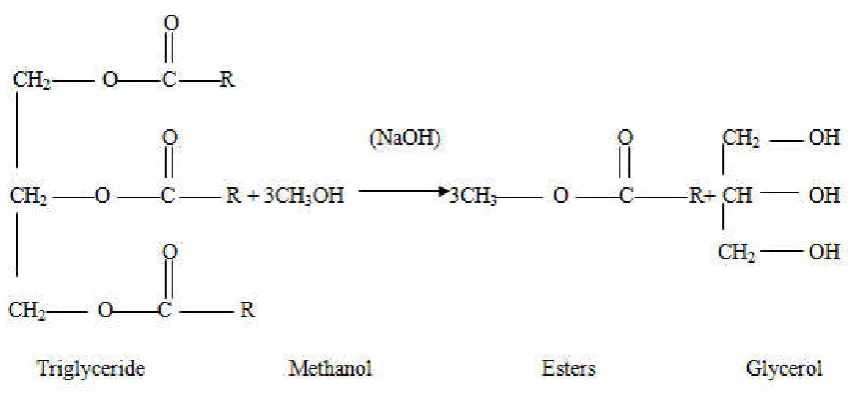
In transesterification of vegetable oils, a triglyceride reacts with three molecules of alcohol in the presence of catalyst, generating a mixture of fatty acids alkyl esters and glycerol (Fig. 1).
Oils (triglycerides) + Methanol → Biodiesel + Glycerol
The overall process is a sequence of three following reactions, in Which die-glycerides and mono-glycerides are made as intermediates.
Transesterification is a flexible reaction thus excess alcohol is used to increase the yields of the alkyl esters and to permit its phase separation from the glycerol formed.
Conversion of vegetable oil to biodiesel is effected by several parameters, namely
(i) Reaction timing,
(ii) Reactant ratio (Molar ratio of alcohol to vegetable oil), (iv) Type of catalyst,
(v) Amount of catalyst, and (vi) Temperature of reaction.
Acid Catalyzed Transesterification
Transesterification is catalyzed by Bronzed acids. These catalysts provide very high yields in alkyl esters, but the rate of reaction is slow, needful, usually, temperatures above 100 °C and more than 3h to reach complete conversion. H2SO4 is a commonly used acid catalyst in Acid catalyzed transesterification. Figure 2 gives the mechanism of an acid catalyzed process.
Base Catalyzed Transesterification
procedures usually use base catalysts such as, alkaline metal alkoxides and hydroxides as well as potassium or sodium carbonates.
Fig 2. Mechanism of an acid catalyzed process
The mechanism of the base-catalyzed transesterification of vegetable oils is shown in Figure 3. Alkaline metal alkoxides (for the base catalyzed transesterfication) are the most active catalysts, since they provide very high yields in small reaction times even if they are applied at low molar concentrations. However, they require absence of water, which makes them unsuitable for typical industrial processes. Alkaline metal hydroxides (KOH and NaOH) are inexpensive than metal alkoxides, but less active. Undesirable side reaction (saponification) reduces the ester yields and makes the regaining of the glycerol difficult due to the formation of emulsions. For this study, base (KOH, Base catalyzed process) has been used as catalyst.
Transesterification setup and method
Experimental Setup
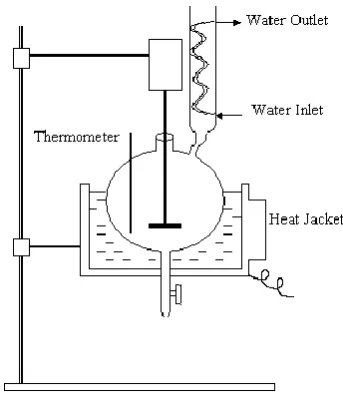
Reaction or transesterfication was carried out in a system, as shown in Figure 4. Reactor contained of spherical flask, which was put inside the heat jacket. Oil was used as the heat transfer medium from heat jacket to the reactor. The thermostat was a part of heat jacket, which maintained the temperature of oil and chance the temperature of the reaction at a desired value. The reaction was carried out at around 65- 70°C. Spherical flask consisted of the four openings. The center one was used for putting stirrer in the reactor. The motor propelled the stirrer. The thermometer was put inside the second opening to continuously monitor the temperature of the reaction. The alcohol being volatile vaporized during the reaction so the condenser was placed in the third opening to reflux the oil vapors back to the reactor to avoid any reactant loss. Fourth opening was used for filling reactants to the reactor.
Experimental Process
A known quantity of oil (100 ml for each run) was taken inside the reactor and heated at about 70 °C. This temperature was
maintained throughout the reaction by the thermostat inside the heat jacket. Preheating process was used to remove unwanted moisture present in the oil. The transesterification was carried out in basic medium and to attain it, KOH was used as base catalyst. The catalyst was dissolved in alcohol (Me OH). Once the oil temperature reached 70°C, alcohol solution (containing dissolved catalyst) was added to the reactor and an equilibrium temperature was kept. During the reaction alcohol gets vaporized. To prevent any reactant loss the condenser was used to condense the alcohol vapor and reflux it return into the reactor. The condenser was also useful in maintaining normal atmospheric pressure inside the reactor (Figure 5). One time the reaction was over the products (Biodiesel and Glycerin) were taken out through the outlet in the lower side of the reactor and placed in the separating funnel. The two phases (having different density) are made as a result of transesterification. The separation process was done using a separating funnel (separation took around two or three hours). Upper layer contained of biodiesel, alcohol, and some of soap (formed as a result of side reaction saponification – free fatty acids get transformed to soap). Lower layer consisted of glycerin, catalyst, excess alcohol, impurities.
Purification of the upper layer (to obtain biodiesel) was done in two steps.
(i) Elimination of alcohol - by keeping mixture at raised temperature ~80 °C
(ii) Elimination of saponified products - by washing with warm water. Water is immiscible with the biodiesel, hence can be simply separated from biodiesel.
Effect of Temperature on Conversion
Effect of temperature on conversion is well known from the chemical kinetics, rate of reaction increases with temperature. Transesterification was carried out at boiling point of the mixture, as that is the highest temperature attainable at normal conditions. Vegetable oil and alcohol mixture form two different phases when put in the reactor. The reaction takes place at the contact surface of the two phases. To increase the surface area contact with reactants are agitated using stirrer. Hence stirring speed also affects the rate of reaction.
Compare the fuel properties of different biodiesel with diesel
Biodiesel is a mono-alkyl ester made from vegetable oils and animal fats based feedstock. The data indicate that the biodiesel is compatible with petroleum diesel and can be blended in any percentage with diesel to create the suitable biodiesel blend. The blending of biodiesel with diesel is communicated as Bxx where xx indicates the percentage of biodiesel in the blend For example B10 blend is made by mixing 10% biodiesel with 90% diesel which can be used in a CI engine with no modification with comparable power output. Table 1 shows compare.
Testing of biodiesel
Biodiesel production depends upon the feedstock of biodiesel, production process, storage and handling.
Biodiesel quality is evaluated through the determination of chemical composition of fuel and physical properties of the fuel. Impurities and other inconsequential components created due to incomplete reaction are the major issues in the quality of biodiesel i.e., mono, di, triglycerides, glycerol, alcohol, catalysts and free fatty acid present in the biodiesel. Moreover, biodiesel composition could be changed during storage and handling. The biodiesel can absorbs water and undergoes oxidation during storage process. Therefore, the testing methods and fuel properties and engine test methods are addressed in the standards. Each of the country have its own fuel quality testing methods and standards to specify the properties of the fuel. Here the standard testing methods and limits are described with reference to ASTM / EN/ IS standards. In India, IS 15607 states the properties of biodiesel, B100 is given in Table 2 (D7: EU27 Report 2009).
Fig. 5. Experimental process
Mathematical relationships
Density vs Kinematic viscosity
There occurs a number of correlations for estimating the properties of fuel upon its physical properties. The more important properties of various biodiesel are given in Table 1 (Lakshmi Narayana Rao, 2010; Gaurav Dwivedi, 2013;
Muthu, 2010; Antony Raja, 2011; Md.Hasan Ali, 2013). Kinematic viscosity is the resistance to flow of a fluid under gravity. It is the time taken for a stable volume of fuel to flow under gravity through the capillary tube Viscometer submerged in a thermostatically measured bath at 40ºC. This is the product of measured time flow and calibration a constant of Viscometer. The viscosity of vegetable oils reduces hugely when blending with consider amount of diesel or transesterification. However, as compared to diesel, biodiesel has a slightly higher viscosity. From Table 1, measured values of kinematic viscosity of biodiesel are in the range of 3.04 and 5.96 cSt. The kinematic viscosity is a basic important design parameter for the fuel injectors used in diesel engines. Fuel viscosity has an influence on the fuel droplet size and spray characteristics. Viscosity is inversely proportional to temperature.
Fuel specification viscosity upper limit, ensure that fuel will flow freely during cold starting. Higher viscosity biodiesel leads to poor atomization and incomplete combustion and increases carbon deposits. More, higher viscosity biodiesel needs higher pumping power also. Fuels with lower viscosity drips past plunger over the clearance among the plunger and barrel during fuel compression. Density is mass of the substances occupying a unit volume at 15ºC. Density of fuel is estimated as per ASTM D4052. Hydrometers are applicable to evaluate the density of liquids. Biodiesel is somewhat higher than conventional diesel. Diesel engine injectors normally works on volume metering system. If the fuel having higher density, large mass of fuel is injected and therefore more power and more emissions. The fuel injector’s work on a volume based metering system, Hence a higher density for biodiesel results in the supply of little greater mass of fuel.
Table 1. Compare the fuel Properties of Biodiesel with Diesel Fuel (Lakshmi Narayana Rao, 2010; Gaurav Dwivedi, 2013; Muthu, 2010; Antony Raja, 2011; Md.Hasan Ali, 2013)
S.NO Type of Biodiesel Viscosity at 40°C cSt Density kg/m3 Flash Point °C Calorific Value MJ/kg
1. Sesame oil methyl esters (SSME) 3.04 880 170 40.7
2. Soybean oil methyl esters(SBME) 4.08 865 161 41.24
3. Sunflower oil methyl esters (SFME) 4.16 863 154 41.14
4. Jatropha oil methyl esters (JME) 4.82 840 128 42.8
5. Neem oil methyl esters (NME) 5.96 878 140 38.15
6 Calophyllum Inophyllum methyl esters (CIME) 3.7 869 120 36.86
7. Diesel 2.86 840 65 44.34
Table 2. Biodiesel specification (D7: EU27 Report 2009)
S .No Fuel properties Unit Diesel Biodiesel
1 Fuel standard ASTM D 975 ASTM D 6751
2 Fuel composition C 10- 21 HC C 12- 22 FAME
3 Lower heating value MJ/kg 42.52 37.12
4 Kinematic viscosity at 40°C cSt 1.3-4.1 1.9-6.0
5 Density at 15°C kg/m3 848 878
6 Water, by wt. ppm 161 0.05% max.
7 Carbon Weight (%) 87 77
8 Hydrogen Weight (%) 13 12
9 Oxygen Weight (%) 0 11
10 Sulfur Weight (%) 0.05 max. 0
11 Boiling point °C 188 to 343 182 to 338
12 Flash point °C 60 to 80 100 to 170
13 Cloud point °C -15 to 5 -3 to 12
14 Pour point °C -35 to -15 -15 to 16
15 Cetane number 40 to 55 48 to 60
16 Auto ignition temperature °C 316 N.A
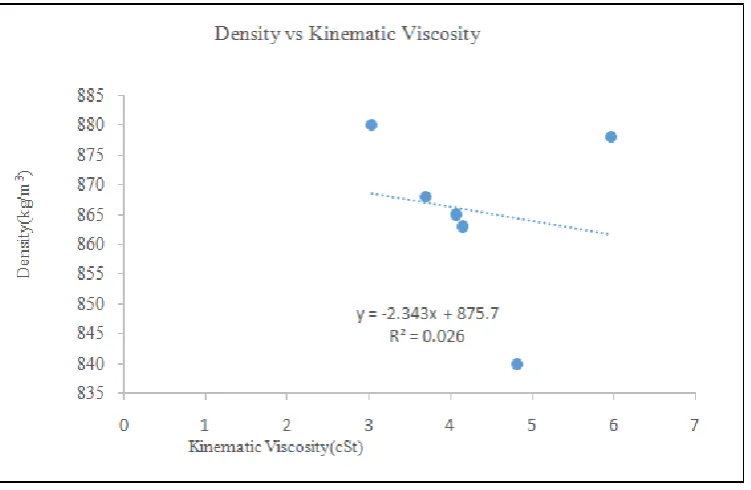
Increase in viscosity of biodiesel increases its density. The mathematical relationship between viscosity and density is shown in Figure 6. From that, we can realize that viscosity of biodiesel decreases with the correlation between the viscosity and density is: Density= -2.3433 * viscosity +875.73 with coefficient of regression value of 0.0269. There is significantly high regression between viscosity and density for biodiesel samples.
Flash point vs. Kinematic viscosity
The flash point is defined as the lowest temperature corrected to a barometric pressure of 101.30 kPa (760 mm Hg), at which the use of an ignition source causes the vapors of a specimen to ignite under specified environments of test. The flash point of the fuel is evaluated as per ASTM D93 test method. The flash point of biodiesel is higher than diesel (>130 ºC) which makes biodiesel safer than diesel in handling and Biodiesel
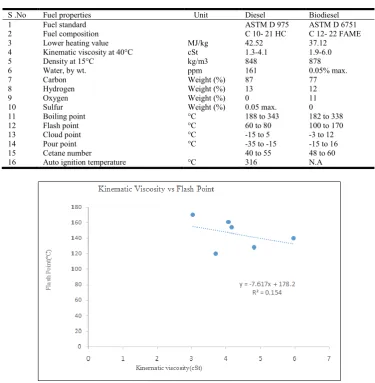
storage point of view. A lowest flash point for biodiesel is specified in restricting the alcohol content. The flash point of biodiesel will decrease drastically if the alcohol used in production of biodiesel is not completely removed from it. Moreover, it decreases the combustion quality of fuel. Excess methanol in the fuel may also affect engine seals, elastomers and corrode metal components. Hence, alcohol content in biodiesel is given in the biodiesel specification to a limit value of 0.24 mg/kg. Figure 7 depicts the correlation between viscosity and flash point of biodiesel. Higher the viscosity of biodiesel increases the flash point of biodiesel, however it affects the burning quality of biodiesel and affects its atomization. The mathematical correlation between the viscosity and flash point can be written as Flash point = -7.617 * viscosity + 178.2 with thecoefficient of regression 0.154.
Fig. 8. Correlation between density and flash point
Density vs. Flash point
Figure 8 shows the correlation between the density and flash point of biodiesel samples. The flash point of a volatile material is the lowest temperature at which vapors of a fluid will ignite. The flash point of biodiesel increases with the density also. Higher density fuel increases its heat carrying capacity also. The mathematical correlation between the density and flash point can be written as Flash point = 1.46 * density – 1099.90 with the coefficient of regression 0.91.
Density vs. Calorific value
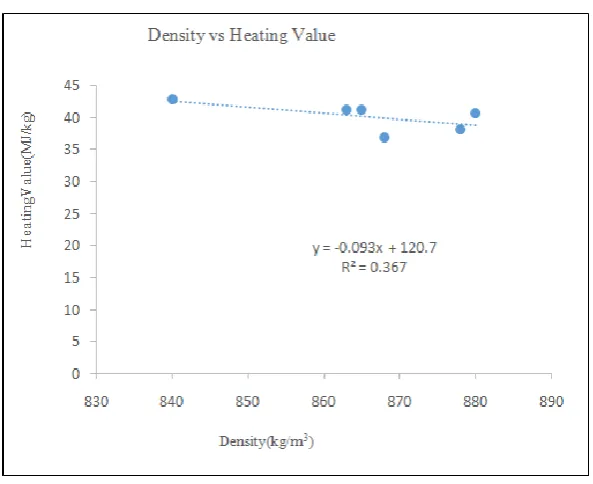
The Calorific value is most important property that defines as the amount of heat energy liberated during the combustion process. The mathematical correlation between density and calorific value of biodiesel is shown in Figure 9. The mathematical correlation between the density and High Heating Value (HHV) can be written as HHV = -0.0931 * density + 120.75 with the coefficient of regression value of 0.367.
Conclusion
The transesterification of vegetable oil reduces its viscosity and the properties of biodiesel depend on biodiesel feed stock i.e. vegetable oils and processing technologies employed. However, there is a mathematical correlation between the biodiesel properties. The mathematical correlations have been established between flash point, density, and viscosity and calorific value. The biodiesel viscosity is one of the most important parameters required in the design of the combustion process. The viscosity must be closely correlated with design parameters of fuel flow systems. Hence, the neat biodiesel or biodiesel blends should meet the preferred viscosity in order to avoid damage of fuel injectors and fuel pump. A mathematical correlation developed between calorific value and density of biodiesel with viscosity of fuel. These mathematical correlations between these properties follow the linear regression with higher coefficient of regression.
These physical properties of fuel are the significant parameters in the design of fuel systems for biodiesel engine.
REFERENCES
Amita Mahajan. Properties of Biodiesel Produced from
Various Oilseeds International Journal of Research in
Environmental Science and Technology, 2011; 1 (4) 26-29
Antony Raja, S. Biodiesel production from jatropha oil and its characterization. Vol. 1 (1) April (2011)
Biofuels and the sustainability challenge A global assessment of sustainability issues, trends and policies for biofuels and related feedstocks By: Aziz Elbehri,Anna Segerstedt and Pascal Liu D7: EU27 Report 2009
Daming Huang.Biodiesel: an Alternative to Conventional Fuel. Energy Procedia 16 1874 – 1885 (2012)
Gaurav Dwivedi. Diesel engine performance and emission analysis using biodiesel from various oil sources – Review 4. 434-447. (2013)
IS: 15607. Biodiesel specification, Bureau of Indian Standards, 2006
Istadi I. Characterization of K2O/CaO-ZnO Catalyst for
Transesterification of Soybean Oil to Biodiesel. Procedia
Environmental Sciences, 23.394 – 399(2015)
Jinlin Xue.Effect of biodiesel on engine performances and
emissions. Renewable and Sustainable Energy Reviews, 15
1098–1116 (2011)
Lakshmi Narayana Rao G. Relationships among the physical properties of biodiesel and engine fuel system design requirement. Volume 1, pp.919-926(2010)
Md.Hasan Ali .Biodiesel from Neem oil as an alternative fuel
for Diesel engine. Procedia Engineering, 56 625 – 630
(2013)
Muthu H. Synthesis of biodiesel from neem oil using sulfated zirconia via tranesterification. Vol. 27, No. 04, pp. 601 - 608, (2010)
Silitonga. A.S. Overview properties of biodiesel diesel blends from edible and non-edible feedstock (2013)
Vivek and A K Gupta. Biodiesel production from Karanja oil. Vol. 63, pp 39-47(2004)