Ecclesiology
Today
I
SSUE33
C
o n t e n t s
Ecclesiology
Today
Articles
Chairman’s Letter 2
The Protestants in Rome
John Elliott 3
Two Eastern-Christian Churches in London Society
Nial Finnernan 9
Dom Paul Bellot OSB,Twentieth Century Monk Architect and Quarr Abbey, Isle of Wight
Stewart Abbott 15
Henry Woodyer and Wokingham
Peter Blacklock 26
Two Late Nineteenth-century Roman Catholic Churches in Toronto
Malcolm Thurlby 30
‘It is barbaric art in that it is entirely uncomposed, but it is full of vitality and zest.’
Some thoughts on the Stoke Dry fragments.
Chris Tuckley 49
Odds & Ends
Best of 300 – Tourist Church Awards 64
Regular Features
Book Reviews 65
News
Your Letters 69
Churchcrawler Writes
71
Issue 33 May 2004
Hon. Editor John Elliott, MA,PhD
ISSN: 1460–4213
ÓThe Ecclesiological Society 2004
All rights reserved
Society website: www.ecclsoc.org
Charity No: 210501
Journal of the
Ecclesiological Society
THIS HAS BEEN A COMPLICATED FEW MONTHS, during which we have mailed four items – both this and the January edition of Ecclesiology Today, our anniversary present of Temples worthy of His presence, and the booklet entitled How do we keep our Parish Churches? Everyone who is currently a member should have received all of these: but it is easy to get in a muddle, with joiners, leavers, re-joiners with late subscriptions (usually accompanied by letters of apology – thank you), and changes of address.
With the publication a year or two back of our books on Southwark churches and Albi Cathedral, it has been a rich haul. And looking forward, we are hoping for one more substantial publication, probably within the next twelve months.
One member expressed some astonishment at what we managed to produce for the subscription. I hope we do provide value for money. But I need to disillusion anyone who thinks that this level of largesse is the norm. To put it bluntly, we have been playing catch-up. In addition, the Southwark book was supported by a legacy left to us many years ago by R Harrison, for publications on London churches; and Templeswas subsidised by a more recent legacy, from F R Goodger.
The norm is for three issues of Ecclesiology Today per year, the cost of which is approximately met by subscriptions, and, from time to time, a one-off publication, normally a booklet , typically paid for from our investment income or dedicated funds.The new format ofEcclesiology Todayseemed to win general approval, but is more expensive to produce, so we may find ourselves producing fewer one-off publications in future.We will see.
Incidentally, the Society is always grateful to receive legacies.We are by no means needy. But capital gifts do allow us to undertake special projects, some of them outside the routine of our activities. As well as supporting the issue of Temples, the Goodger Fund helped finance the printing of a book on the stained glass of Frederick Preedy, underwrote the risk of production of the Society’s tie (sales of which have been good, allowing the Fund to be paid back), and was used for the purchase of a part set of The Ecclesiologistfor use by the Editor of Ecclesiology Today.
I and the other members of Council look forward to meeting you at our forthcoming events.
ROME, AND IN FACT MUCH OF ITALY, has always been attractive to those wishing to escape the cold and damp of northern Europe. Strangely it has also been popular with Americans.
In the eighteenth and nineteenth centuries it was not just the weather of Rome that called but, in an age which looked to the
John Elliott teaches at the University of Reading, edits Ecclesiology Todayand is a director of Spire Books Ltd.
The Protestants in Rome
John Elliott
past for its inspiration, the Roman ruins were an almost overpowering fascination for those who could afford to travel that far. More practically the eternal city could also provide anonymity for illicit unions that would have spelt ruination at home.
However, many of the visitors were Protestants rather than Roman Catholics and when in Rome they certainly did not want to do what the Romans did. More problematically if illness struck them down on their travels they could not be buried in the graveyards under Roman Catholic control.
Perhaps the most spectacular is St Paul’s Within the Walls, the American Episcopal church which was designed by G.E.Street and built on the Via Nazionale, close to the Piazza della Repubblica and the Opera house. You won’t find it listed in many of the tourist guides but it is well worth the trouble involved in locating it.
In 1859, Alonzo Potter, the Bishop of Pennsylvania, celebrated the Eucharist in a private house on Trinità dei Monti.This was the first time that such a “Protestant” service had been held in the Rome. A series of temporary homes were then used to provide services, until in 1866, an old granary outside the Porta del Popolo was renovated as a more permanent home which would hold 500. In 1869 a new constitution gave Rome and its citizens a freedom of worship and non-Roman Catholic churches were permitted to be built within the walls of the city.
Just a few years later, in 1872, a plot of land was bought for $18,500. In November 1872 the foundations were started, and on the feast of St. Paul, 25th January 1873, the cornerstone was laid, The Churchmanof 27 January 1873 reporting:
Several of the Roman papers of yesterday or today give more or less detailed accounts of an event which must have awakened unwonted reflections in the mind of many a thoughtful Roman; the first stone has been freely, formally, and openly laid, of a church which is designed to rise toward heaven, a solemn witness, in this papal city, of a faith which is Catholic without being papal, and Protestant without ceasing to be
Above: stained glass by Clayton & Bell.
Catholic. If the completed church arrests the attention of Italians in any proportion to the effect of this laying of its cornerstone, the Festival of St Paul, 1873, will be an epoch, not merely as a friend said to me, in the history of our Church, but in that of the Church of Italy as well.
[Fifty Years of St. Paul's American Church, Rome: some historical notes and descriptions by the Rector(Walter Lowrie, Rome 1926)]
Street provided the design, writing:
We are going to start for Rome tomorrow night. I am going to look at a church I have just built for the English at Geneva, and then to look at sites for two churches in Rome - one for the English, the other for the Yankee Episcopalians. By very odd coincidence they both came to me without knowing the other's intentions.
The result is spectacular. Polychrome brick from Siena alternating with uneven courses of travertine from Tivoli and in a style that in London might be called Ruskinian Gothic. The western end and campanile can be seen from half a mile away, standing proud as a fusion of All Saints, Boyne Hill in Maidenhead; St James the Less, Pimlico and the Carey Street front of the Law Courts in the Strand. Wonderfully different from everything around it and so magnificently English in a foreign sort of way!
While the provision of a purpose-built place of worship had to wait until 1872, the “Protestants” of Rome made provision for those who died in the city as early as 1738 when a 25 year-old Oxford graduate named Langton was buried in land adjacent to the Cestius Pyramid.
The pyramid is a striking local landmark just off the via Aventino along which travellers from the Flumicino airport will pass on their way into the city. Supposedly built in the first century BC, the pyramid provides a dramatic beacon at one end of what must be one of the best preserved eighteenth and nineteenth-century graveyards anywhere in the world.
If you had to be buried this was the place to be, row upon row of tombs recording the tourist life of Rome while also being a Who’s Whoof north European and American society. This is the last resting place of Shelley (1792-1822), Keats (1795-1821) and August Goethe (1789-1830). Of Rosa Bathhurst (-1824), who drowned in the Tiber aged 16; Constance Fenimore Woolson (1845-89), American poet and writer; William Harding of Scarborough (-1821), an English gentleman; August Riedel (1799-1883), a German painter from Bayreuth; and William Shelley (1816-19), the son of Percy Bysshe Shelley and Mary Wollstonecraft.
Another must on the itinerary.
OF THE SO-CALLED MONOPHYSITE CHURCH congregations currently active in London, two of the largest communities are represented by the Egyptian Copts and the Armenians. This contribution introduces two of the most important of their church buildings in our Capital, and finally considers how the physical nature and use of space of each building reflects the ritual and liturgical demands of each church, as well as the broader socio-economic concerns and identities of the eastern Christian diaspora communities who worship in them.
St Sarkis Armenian Church
(Iverna Gardens, Kensington, London W8)
The Armenian nation is the oldest continually Christian country in the world, and although the history of the Armenian peoples is linked indelibly to the notion of a global diaspora set against the historical background of continual persecution, the collapse of the Soviet Union in 1991 resulted finally in the recreation of an independent Armenian homeland in the mountainous Caucasus region, and the reassertion of a proud sense of nationhood linked to a very distinct form of Christian belief of high antiquity and considerable liturgical and ecclesiastical artistic beauty. It is not known when the first Christian Armenians came to this country; undoubtedly many contacts were made via Byzantium and eastern Mediterranean trade in the late first millennium AD, and certainly during the first crusade in the late eleventh century; what is clear is that the anti-Chalcedonian views of the Armenians did not in any way preclude their acceptance into western Christian society. In 1863 an Armenian chapel in Romford Street, Manchester is reported, and in 1870, in London, the first Armenian church of the Holy Trinity (Kensington) was constructed; we certainly know from census records that by 1923 there were 500 Armenians in London. With such a growing congregation it was clear that a new and larger place of worship would need to be found, and in 1922 Calouste Gulbenkian the famous Armenian oil millionaire --stepped in with a donation of £15000 to help construct a church to be dedicated to the memory of his parents.
The church of St Sarkis presents an odd contrast against the Victorian surrounds of Iverna Gardens; designed by the
Dr Niall Finneran teaches in the Department of Archaeology at the University of Southampton
Two Eastern-Christian Churches in London
architectural partnership of Mewès and Davis, it represents to all intents a piece of classical Armenian ecclesiastical architecture (Fig 1). The fundamental design recalls the bell tower of the monastery at Haghbad in Armenia; the ground-plan is in the standard shape of a Greek cross, with a seven-sided belfry in the centre, and the whole edifice is faced with Portland stone and has recently been cleaned and restored. The interior is also richly adorned; a baldacchino surmounts an alabaster altar inlaid with marble, onyx and lapis lazuli, and the seven-sided electrolier lamp is particularly ornate.
St Sarkis represents the essence of the individuality of Armenian ecclesiastical architecture.The geographical position of Armenia, on the fringes of the old Byzantine sphere of influence, has shaped this peculiar form of architecture. Although initially growing from simple basilican forms, eastern influences --particularly from Persia -- have combined to form a very distinctive type of church building, seen to great effect here. Perhaps the most important Armenian contribution to western ecclesiastical architecture is the squinch/pendentive, a feature borrowed perhaps from Sassanid Persia, and representing a solution to the problem of placing a circular central dome -- a key feature of the Armenian church -- onto essentially a square sub-structure. The architectural focus is upon the centralised, square, Fig 1: External view of the
shape rather than on the longitudinal axis as is seen in ‘western’ church building down the centuries, essentially an inheritance of Roman civic architecture upon which the basilican form was based. As with other eastern churches, including the Greek and Russian Orthodox churches, rich interior paintings and decoration play their part in actively reflecting the cycle of the liturgy and the ritual year itself. St Sarkis embodies an ideal of the Armenian fashion of church building, and at the same time reflects the deep sense of national pride felt by the Capital’s Armenian diaspora community, as well as contributing greatly to the rich heritage of London’s church architecture.
St Mark’s Coptic Cathedral
(Allen Street, Kensington, London W8)
Situated just around the corner from St Sarkis, this church – one of the largest European Coptic churches and certainly the first dedicated Coptic church of its kind in Europe – is the centre of worship for the Capital’s large Egyptian Christian community, yet as an architectural statement (externally at least) it differs considerably from the overtly Armenian version nearby. It is not known exactly when the first Egyptian Christians arrived in London en masse, but it is clear that after the Second World War there were sufficient numbers to warrant their own place of worship. From 1971, services were held in St Andrew’s Church in Holborn, but it soon became clear that dedicated premises were required, and moves were made to acquire a church in London for the sole use of the Coptic community.
In 1976 the former Scottish Presbyterian church in Allen Street was purchased by the community with a view to conversion into a cathedral dedicated to St Mark, who is credited with introducing Christianity into Egypt. The external contrast with the purpose-built Armenian church could not be greater; this church is a solid and very utilitarian-looking building, no doubt betraying its origins as a place of worship for the Capital’s Scottish Protestant community. Indeed, the only outward sign that this church building is something out of the ordinary is the sign outside, proclaiming, in both English and Coptic, that this is the headquarters of the Coptic Patriarchate of London (Fig 2). Built originally in 1863, and designed by the architect J. McCulloch, the building underwent alteration on two occasions in the late 19th century, with firstly the addition of a chancel arch and galleries, and latterly with the opening of the nave roof. These alterations would, unwittingly, prove ideal for the future creation of a Coptic ritual space albeit in a westernised ecclesiastical architectural setting.
The church was consecrated amid scenes of great celebration in the traditional Coptic manner by Pope Shenouda 3rd on the 27th January 1979 -- the Coptic ceremony of church dedication enacted here consisted of the placing of seven new jars in front of the iconostasis (altar screen) each containing: jasmine, basil, lemon, citron, shaddock, vine leaves and a piece of the tree of Mary. Although the exterior of the church does not betray an overt statement of Coptic ownership, the interior has been reshaped to accord to notions of Coptic ritual space. Of special note are the magnificent internal decorations – especially the glass (Fig 3) --by the famed Egyptian Christian artist Issac Fanous Youssef, and the richly-decorated iconostasis, replete with colourful icons depicting scenes from the Holy Family’s sojourn in Egypt as well as a cast of martyrs and biblical personalities. The iconography within the church refers back to the content of the ritual being played out within the space, and also reinforces the historical Coptic Christian identity through reference to saints and martyrs. The iconostasis separates the sacred and secular zones within the church; it is clear that in many cases the internal design of the Coptic church reflects distant pagan, pharaonic religious roots; some idiosyncrasies, unique to the Coptic ritual cycle and use of space are visible here. The usual gendered divisions are noted --males to the left, fe--males to the right -- and the distancing of the altar from the main nave, an emphasis here on the separation of transverse space, is achieved as in other Coptic churches elsewhere by the use of the iconostasis or heikal screen, a division further emphasised by retention of the original chancel arch.The original galleries may also be used to emphasise the division of gendered space on the longitudinal axis.
The two churches, whilst physically almost adjacent, and representing Christian communities of high antiquity and similar liturgical outlook, embody a number of different contrasts. Both churches are witness to a rich heritage of cultural syncretism within the religions they represent, albeit in differing ways. Outwardly the architecture of St Sarkis speaks of an amalgam of Christian and non-Christian eastern architectural forms; more nebulously it is the internal use and differentiation of liturgical and secular space in St Mark’s that recalls the pharaonic temple heritage of the Coptic church. To me, the design of St Sarkis, so faithful to the Armenian archetype of a church building, makes a number of clear and unambiguous statements about the community who worship there. The decision to construct a church anew reflected a degree of economic wealth within the Armenian community of London as well as a good deal of overt ambition; the ability to conceive and construct such a building is Fig 3: Stained glass, Egyptian style. A
indicative of the recognition, post-World War One, of the recent sufferings of the Armenian peoples at the hands of the Ottoman Turks, and also, through this recognition, places their cultural achievement into a westernised rather than oriental culture-historical framework.The church makes a nationalistic statement, and serves as a totem and focus for a historically highly dispersed diaspora.
St Mark’s makes no overt nationalistic statement in its outward appearance.The fact that the London Coptic community did not construct a church along the lines of an Egyptian Coptic church reflects a different communal history and – initially at least – a very different set of socio-economic circumstances within the diaspora community.Whilst being unable to reproduce externally in West London the facets of a Coptic church, new solutions have been attempted.What the Copts have been able to do successfully is reflect their traditional use of sacred space in a western Christian church building; they have spatially recast the pre-existing building to great effect to reflect liturgical concerns.This reuse of a western Christian church is not confined to London’s Coptic community; a similar dilemma was faced by the Capital’s Ethiopian community when they converted a Victorian Anglican church in Down Street Mayfair; here the western Christian emphasis on longitudinal ritual space was remodelled to admit the Ethiopian emphasis on ritual circularity. The majority of Ethiopian churches are based upon a concentric spatial design, emphasising gendered zones and differing grades of sacred space culminating in the central holy of holies where the Tabot – or Ark – is kept. Here – as with St Mark’s – a new type of spatial use was negotiated within the confines of a pre-existing ecclesiastical building.
Aside from the different meanings embodied in the architecture and the use of space within each building, the churches themselves merit a visit for their rich and unusual decorative splendour and embellishments within. Each church bears witness to the rich heritage and the sheer tenacity of Christian communities who, at many times in their history, have been the subject of attack and persecution in their homelands and beyond. These buildings, testament to these great Christian survivors, also provide a rich addition to London’s ecclesiastical architectural heritage as well as emphasising the cosmopolitan and dynamic nature of Christian congregations in contemporary multi-cultural London.
Notes
"Monophysites" (an inaccurate appellation; the term Meaphysite is now more commonly used, although itself having improper connotations) held that Christ embodied the human and divine natures in one body.These churches include: the Egyptian Copts, the Ethiopian Orthodox Church, the Syrian Orthodox Church (formerly known as Jacobites), The Armenian Apostolic Church, and the Malankara Orthodox Churches (Syrian rite) of Kerala, southern India who trace the roots of their faith to a mission in the region by St. Thomas. For a full discussion of the history of these churches see Aziz Atiya (1980 reprint) A History of Eastern Christianity(Milwood, New York: Kraus); also useful are: J. Binns (2002)
An Introduction to the Christian Orthodox Churches (Cambridge: Cambridge University Press) and D. Winkler and K. Augustin (1999) Die Ostkircher: Ein Leitfaden (Graz: Schneider). Hypothetically, given their relative theological isolation and proud independence, it is notionally possible that the ecclesiastical art and architecture of these communities is much more overtly nationalistic in character, and perhaps more prone to borrowings of pre-Christian motifs. I would argue that it is in these churches that we see more fundamental forms of cultural syncretism, something that is often reflected in liturgy.
2 King Trdat 3rd’s conversion in around AD 301 was marked by the mass conversion of pagan temples into churches (Atiya 1980: 317); a similar theme is noted in Western Europe and in Egypt (next section). This accounts for the architectural idiosyncrasies of Armenian ecclesiastical architecture which betrays many syncretic borrowings from the non-Christian east, especially Sassanid Persia. 3 K.Taverdi (1988-89) A History of Armenians in Britain (unpublished ms.), published
QUARR ABBEY ON THE NORTH-EAST COAST OF THE ISLE OF WIGHT, has been a home to the Benedictine Community of St Pierre de Solesmes since they started construction of the new Abbey on this site in 1907. The reason for their residence on the Island1 was political; they were forced
into exile from France by the anti-clerical laws of 1901 and found temporary accommodation in the vacant Appuldurcombe House. Appuldurcombe,2 a mostly eighteenth-century mansion in the
centre of a large estate provided the seclusion needed for the monastic life if not the ideal building layout. A temporary prefabricated Iron Chapel was constructed to provide a suitable space for worship.
The lease on Appuldurcombe was short and the monks, realising that a return to France in the foreseeable future would not be possible, began a search for another less temporary home in exile. A suitable Island location on the north coast was found at Quarr. It had advantages of being available for immediate
Stewart Abbott is a PhD student at Southampton University researching residential buildings on the Isle of Wight.
Aerial view of Quarr Abbey. Photograph courtesy of the Abbot, Quarr Abbey
Dom Paul Bellot OSB, Twentieth Century Monk
Architect and Quarr Abbey, Isle of Wight
habitation on a long lease at an affordable rent with the possibility of later purchase.
The available accommodation at Quarr was a cottage in the grounds of the ruins of the pre-Reformation Cistercian Quarr Abbey.3 It is tempting to think of the choice of site as
providential, a re-use of a site of memory, but it can also be viewed as one of practicality with a significant coincidence in the re-use of a historic monastic site for the Community. The original Abbey, in ruins since the Reformation, dated back to 1132 and was located a couple of hundred yards away from the cottage that was to be the home to the community and site of the new Abbey built to the designs of Paul Bellot who had trained as an architect
before joining the Order. The temporary Chapel at
Appuldurcombe was moved to Quarr in 1907.
The new buildings, intended as home to the Community during its exile from France, were started in 1907 and by 1908 all but the church and guest house were ready for occupation. It was never the intention of the monks to remain on the Island; the eventual aim of the community was to return to Solesmes in France when the political conditions were favourable.
Nikolas Pevsner, whilst compiling the Buildings of England volume for Hampshire and the Isle of Wight, recorded Quarr Abbey. In an article published in 1967 Pevsner remarked on the nature of the buildings at Quarr that "One can still discover Entrance to the church.
‘Pioneers’ buildings in England; i.e. buildings of about 1900 looking forwards, not backwards."4 Since that time nothing more
significant appears to have been published in Britain on the work of Bellot until 1996 when Peter Willis’Dom Paul Bellot: Architect and Monk was published in Newcastle upon Tyne. In the same year, Maurice Culot and Martin Mead’s book Dom Paul Bellot, Moine-Architecte 1870-1944 appeared, written in French and published in Paris.5 These publications were followed in the same
year with a lecture on Bellot’s work given as part of a Victorian Society series and a review of Culot and Meade’s book appeared in The Society of Architectural Historians of Great Britain Newsletter.6
Pevsner’s enthusiasm expressed in his 1967 article has not led to a wider knowledge of this impressive group of buildings, perhaps because the Abbey complex represents Bellot’s sole group of buildings in this country, or rather on the Island. Willis’ book deals with Bellot’s writing about architecture and Culot and Meade focus on his corpus of works with a mainly descriptive text. Essential as these works are, they do not specifically further our understanding of one of the most interesting aspects of the Abbey, namely Bellot’s dual function as a member of the Community and architect of the twentieth century Quarr.7 Our
knowledge of the Abbey and its construction has not significantly developed since Pevsner’s detailed 1967 article. The purpose of this paper is to promote a wider interest in and knowledge of the work of Bellot at Quarr and examine his dual role as monk and architect.8
Dom Paul Bellot OSB, was born in Paris in 1876, the son of a surveyor. From 1899-1901 he studied architecture at the Ecole des Beaux-Arts in Paris afterwards joining the Benedictine community of Solesmes. The ethos of the Ecole des Beaux-Arts shared common ideas with the Benedictine order, notably that the past can teach much that is relevant for the present and that freedom of spirit must be restrained by discipline. Bellot became a postulant in October 1902 and was ordained priest in June 1911 at Quarr which was still under construction.
Architect’. His chosen life was as a member of the Benedictine Order and he owed obedience to God and the Order. There had been nineteenth-century architects with strong religious faith, for example Augustus Pugin, who constructed monastic buildings as part of their activity, but Bellot designed no secular buildings and all his work was executed when he was a member of the Benedictine Community of St Pierre de Solesmes. He, as all members of the Order, used his skills to the Glory of God, a mediaeval concept that was a component of all pre-Reformation monastic building. This link with the past gives him a special position as monk architect in the first half of the twentieth century.
Bellot’s writings come from published transcripts of lectures he gave in Canada in 1934 and formed the basis of Willis’ book. Bellot stresses his links with tradition and the past in the context of his faith; this is perhaps the most important aspect of his motivation and inspiration but has received least comment in context with Quarr; he never wrote solely as an architect; his faith underlay his thinking and designs. We have to look more closely at his writings to understand this link between his faith, his duty to the Order and his practice as an architect.
Bellot expressed his mix of faith, tradition and innovation. He wrote
It is as we study and meditate on the art past that we shall have the means to recreate the tradition of real beauty, and then, as St. Benedict, the Patriach of the monks of the West, said ‘God will be glorified in all things’.9
The mix of tradition and the influence of God in his work is the second key to our understanding. In England our Arts and Crafts practitioners were meditating on the past but Bellot in his meditations was looking to new forms to use rather than developing or updating past forms. He was concerned with recreating "the tradition of real beauty" rather than re-using the recognised past forms of beauty; it appears that his created associations were not always visual recreations but new forms that would act as signifiers of beauty. In this country in the early years of the twentieth century the recognised forms for religious buildings remained gothic with a very few exceptions, notably Lethaby’s church at Brockhampton which is generally described as ‘Arts and Crafts’. Neither Gothic nor Arts and Crafts were part of Bellot’s thinking and practice. Certainly there are gothic details to be found at Quarr but the overall impression is not of gothic, but rather of a new structural and decorative form in a building for an international community; after all gothic had been international at an earlier period.
Church porch detail showing use of coloured brick and glass.
How powerful was the influence of gothic in religious buildings in Britain in the early years of the twentieth century? Lethaby’s church at Brockhampton was a vernacular inspiration but does not appear to have started a started a trend in building style. There had been no new monastic buildings in England between the Reformation and the mid nineteenth century when the two-fold results of the emancipation of the Catholic Community and the emergence of the Oxford Movement resulted in a rebirth of monastic buildings to house the returning (Catholic) Orders and newly founded (Anglo-Catholic) communities. These coincided with the secular revival of Gothic forms in buildings. But even this is not the complete answer;
ruined monastic buildings had captured the imagination of eighteenth-century and nineteenth-century intellectuals. The greatest of these ruins in England were in gothic form. The ruined abbeys rich in association and cultural memory, inspired writers and artists; the Picturesque fed on such objects which, if they did not exist, were constructed in situations that fitted the aesthetic requirements of Picturesque theoretical writings. The Gothic novel further loaded the image of the gothic ruin with a range of meanings and histories; the link between gothic architecture and monastic buildings was strengthened to such an extent that it became the accepted myththat such buildings had to be gothic to be real and at the same time signifiers of the past with all the associated resonances.10 This was a very English way of
viewing things; the associative distinction between real and imagined monastic buildings was still culturally unclear in England when Bellot was working on the designs for Quarr; he may not even have been aware of it.
The influence on Bellot of St Benedict, who wrote little on architecture as such, combined with the architectural training he received in Paris are now considered; the synthesis of these Upper tower space above the Sanctuary
influences help us to understand the monk architect dialogue that is a constant theme in Bellot’s writings and work. He cites the influences of four main architectural theorists: Viollet-le-Duc, Desiderius Lenz, Odilo Wolff and Le Corbusier; however he more often quotes the religious and philosophical writings of St Thomas Aquinas as interpreted by Jacques Maritain (1882-1914). Maritain was a great influence on Bellot and visited Quarr in 1907 and 1914.11 From St Thomas he takes an understanding of
order which was essential to beauty and that "art which proceeds from our innermost spirits becomes vital and creative."12 From
Odilo Wolff he takes the theory, published in Vienna in 1912, of the predominance of the hexagon and the 60 degree triangle that governed all ancient art. The 60 degree triangle can be seen to have mystical and religious significance. Willis says "There is little doubt that Bellot was committed practically to the use of the golden section as well as the hexagon: indeed, he had a set-square made which would provide him with the proportions of the golden section."13 Bellot’s overall practicality is expressed in his
directive that "the architect must not superimpose the laws of the beautiful upon the laws of the useful, but must know how to derive beauty from the laws of the useful."14
With these influences in mind Bellot’s writings and practice seem understandable from his position as monk architect. He shows the strong theological grounding and belief that underpins his work as architect in the following statement.
That is where your professional and personal lives, as intellectuals and Christians, can, as necessary, come together and unite. Your work will then rise out of your whole being, will come from all the values within you, and will have the fullness and the vigour necessary to be of real use to society.15
However we must not view Bellot as isolated from the practices of other architects; he understood the writings and work of Le Corbusier and identified in them the lack of humanity that was alien to his own views which were imbued with the spirit of St Benedict. He did not have the social agenda of Le Corbusier and many other architects of his time. His principles were based on Christian faith and tradition. He had an almost simplistic sense of ‘taste’.
Taste is the experience of beauty and goodness; and so in order to be a man of taste, it is essential to distinguish between good and evil, beauty and ugliness. Taste is moreover the respect for truth.16
Architecture should evoke joy through light, recollection through shadow, rest through silence; in this way it is truly human. It can achieve this aim with the interplay of volume, space and lines, which, as they throw light into the shadows and shadows onto the light, balance our perceptions as they extend them.17
A visit to the Church at Quarr, the only interior space easily accessible to visitors, shows this drama in practice whatever the time of day or external lighting conditions.
The third key to our understanding Bellot’s work is the dynamic between his membership of the Community, his role of architect and the Community of monks. Bellot’s designs for Quarr were subject to approval of the monks of the community in Chapter; decisions were group-based and inspired by prayer. However the preliminary sketches for Quarr that are available, his designs seem to have been implemented without major change.
To the building of Quarr, Bellot was asked to provide accommodation for 100 monks following the traditional plan of a Benedictine monastery. The monks did not physically build the monastery at Quarr but 300 skilled local builders were employed. These men were used to building local cottages and other small scale buildings found on the Island; the challenges of the large scale nature of the structure must have been immense. Funds for building were limited and the time scale for completion of such a large group of buildings was short.
The original Quarr had been built of local stone but this was now exhausted. Bellot’s favoured material for construction of the new Abbey was brick of varied colours. He used bricks of warm colours, pink, light red, pale yellow and a few of rich red. He was not content to use local materials but imported bricks from Belgium. His choice may seem strange as local brick was readily available but he chose the hard bricks produced in Belgium for their superior strength and durability, another international dimension to the building. Today these bricks show very little sign of weathering although there have been some issues of subsidence. At a time when new materials such as steel were coming to be used in new building Bellot relied on the tradition of brick; the Abbey is a traditional brick building with magical use of different coloured bricks and mortar to create patterns and define the internal spaces.18
the sanctuary. It must be remembered that the function of the church at Quarr was monastic rather than parocial; the small nave and large chancel and sanctuary fitted the tradition and requirements of the Order where Gregorian Chant forms a central part of religious practice. The hierarchy of space is reinforced by the volume of each area, from the sanctuary with the largest volume to the nave with the smallest volume. There was no need here for gothic detailing to denote hierarchy, since manipulation of volume, space and light produce the effect; spirituality and aspiration are sensed without elaborate decoration. This absence of decoration in the nave gives way to a greater use of coloured bricks in the construction as one approaches the sanctuary. The arches rise without a break for capitals, a Spanish convention. The whole structure seems to have been elevated to make sense of the Gregorian Chant that is a core component of daily worship by the monks. It is possible to see the high altar and the enactment of the liturgy from the nave.
In 1967 Pevsner commented on the visual inspiration of Quarr as being Spanish and Belgian rather than English. This has not been a central aspect of this study but needs to be briefly examined. From what has been written here so far we would not expect to observe English influence. After all this was a
The Cloisters.
Community of French monks, who spoke French. Bellot was a Frenchman building from his experience of upbringing, faith and training. He used step gables found in northern France and Belgium and recorded a debt to Spanish decorative forms, seen for example in the round tower of the Church. In a 1920s Ward Lock & Co. guide book to the Island, the Abbey Church is described as being in "the Byzantine style, strikingly magnificent."19 Attempt
to describe the visual aspects are fraught with problems; we can best describe it as an eclectic building with its visual base firmly outside England.
Many questions remain. Perhaps the most intriguing is why such a large Abbey was built when it was envisaged that the residence of the Community at Quarr would be temporary; indeed the monks returned to Solesmes in 1922. There is a look of permanence in the scale and quality of the structure; perhaps a resonance of the permanence and durability of the Benedictine Order itself. Although the Community returned to France, twenty-five monks were allowed to remain at Quarr which was given the status of Priory in 1925 and raised to the rank of an Abbey in 1937, gradually transforming itself into an English speaking community within the Constituent house of the Solesmes Congregation.
The Abbey is a mix of old form with its plan determined by function, clothed in a forward-looking structure that reflects the Benedictine aims. It is the dynamic between old and new; tradition and innovation that were made possible by Bellot’s dual role of monk and architect. Pevsner’s perceptive comment made in 1967 still holds: "historically Quarr belongs … among the most daring and successful church buildings of the early twentieth century in England." 20
Acknowledgement and grateful thanks are due to Eva Pirie, for the French translations of the quoted sections of Bellot’s writing, and Abbot Cuthbert Johnson OSB, for permission to reproduce some of the images of Quarr.
Notes
1 The Island will now be used to denote the Isle of Wight
2 The Island has a long and distinguished history as offering places of retreat and refuge from unfavourable situations elsewhere.
3 In Island usage the term cottage was used for a retreat from the mainland. In this instance it was a substantial Victorian structure with magnificent sea views. 4 Nikolas Pevsner, ‘Quarr and Bellot’,Architectural Review, April 1967, p 307 5 Peter Willis,Dom Paul Bellot: Architect and Monk, Newcastle upon Tyne, 1996.
6 In October 2003 as part of the Douai Abbey (Berkshire) Pastoral Programme at a Study Day organised jointly with the School of Continuing Education, University of Reading the author gave a presentation on Bellot and Quarr Abbey. In 2004 the Twentieth Century Society conducted a study tour including some of his buildings in mainland Europe.
7 Willis deals with the dynamic of Bellot’s work in general and gives his architectural work primacy over his position as monk.
8 Discussion of Bellot's other works in relation to Quarr would make an interesting study.
9 Willis p 2
10 Myth is used here in the sense and usage of Roland Barthes. 11 Willis p 14
12 Willis p 15 13 Willis p 21
14 Quoted on the website of Quarr Abbey. 15 Willis p 15
16 Willis p 16 17 Willis p 22
18 There is a parallel here with the work of Kramer and Klerk who were designing buildings in the Netherlands using coloured hard bricks arranged in elaborate patterns. Bellot is more likely to have known of their work than of work by architects in Britain.
THERE’S A CURIOUS SYMMETRY about the Henry Woodyer churches of the Berkshire commuter town of Wokingham. Both were largely built in 1862-4 and both now have a huge problem with their bells – eight each - and tower.
Yet one, St Paul’s, is among his best work – the sort of building that radiates quality, art and warmth. The other, All Saints, is lumpen, uninspiring and cold. They explain why Woodyer is in the premiership, but not at the top. He’s like my local football team, Southampton, who don’t do much then suddenly reach the heights by beating Manchester United or Arsenal
All Saints has had a £50,000 appeal for its bells for some time. Problems at St Paul’s began on the night of January 28 this year when a snowstorm was heralded by a spectacular display of lightning. That evening, the rector, Fr Roger Stillman, and a parishioner were about to say evening prayers in the lady chapel when there was a mighty thud in the tower area, the lights went out for only a minute, and houses nearby shuddered. However, nothing seemed amiss, prayers were said, and the two went home in the snow.
The town suffered a 20-minute power cut, but the choir arrived in church to practise as usual and went home with all apparently still well. But at 11 p.m., Fr Stillman heard one of the bells ringing and, fearing intruders, ran from the rectory to the church porch in the tower. But by now the bell was silent and he still could find nothing amiss. Off he went to get ready for bed. But, 20 minutes later, a late-night patron of the kebab stall opposite the church saw flames shooting up through the roof of the tower "like a rocket" and called help. By the time the rector arrived, firemen were fighting the flames.
The bells’ metal frame crashed through its floor, then the ringing chamber floor and hit the ground 80ft below, bringing the bells with it. Two survived intact but the rest were badly cracked and one even began to melt in the intense heat. The louvres turned the tower into a gigantic chimney with the flames fed by the ready supply of oxygen.
The thud had been a lightning strike. Somehow a spark seems to have jumped over the lightning conductor and started a fire in the tower timbers that smouldered then burst into life. No other part of the building was affected and Fr Stillman was able to say his usual mass in the chapel the next morning, when workmen
Henry Woodyer and Wokingham
moved in to make the tower safe. He is confident his insurers will meet the £250,000 bill, possibly half of it for renewing the bells. He is heartened by an outpouring of support from the town – the church has 220 people on its electoral role, about 100 of whom attend the main service each Sunday. But still it’s a setback for a rector who has spent much of his ten years there trying to protect Woodyer’s brilliance and minimise the damage done in the early 1960s - when else?
Then, a stone-coloured wash was splashed over the east wall behind the altar and the magnificent vestry door from the chancel, leaving only a beautiful gilded stone angel and crockets over the door as reminders of what we have lost. Happily, the
original paint is now starting to show through the wash. Curiously, there appear to be two patterns, one on top of the other, below the wash on the east wall. This was discovered by an Australian, a friend of a friend, who was called in when the church bought a 1900 organ and wanted to paint the pipes in a Victorian manner.
Woodyer’s Fr Willis organ was "crumbling", according to the rector, when it was removed in 1996 and replaced by a Henry Jones organ from St Thomas’s, Shepherd’s Bush, which was being used by the Orthodox Church. The organ, bought for £1, exactly fitted the space left by the Willis organ, but the cost of Victorian-style paintwork was prohibitive. That was where the friend of a friend came in. He was flown from Australia, given a work permit by the British Government, and did the work – all for less than the British quotations.
The two patterns could be explained by the fact that Woodyer had two goes at St Paul’s. His client was John Walter, owner of The Times newspaper, with whom he had been at Eton; another example of Woodyer commissions obtained through his network of friends, relatives and friends of friends.
In his first campaign,Woodyer built the church for 600 people. His four-stage tower with its elegant broach spire 170ft high is built into the northwest corner. The nave is 50ft high.
In his second campaign, in 1873, the whole place was enlarged for another 240 people, giving it, as Pevsner says, the "prosperous High Victorian" look it retains despite the modernisers, who nevertheless spared the Heaton Butler and Bayne murals on the chancel arch and the west end’s blank arcade.
Fr Stillman has rescued the rich Minton tiles of the sanctuary from under a carpet and his aim is to refurbish the rickety Hardman windows. The east window has already been renovated - it is a stunning Moses and Christ at the Transfiguration.
public recognition of Woodyer’s genius since the 19th century. Even the Hardman glass doesn’t rescue the building and neither does Sir Arthur Blomfield’s excellent woodcarving.
But it is doubtful if Woodyer would have cared what Sir John thought, still less what I think. He was an old Etonian gentleman to his fingertips with a country estate near Guildford, his own coach and no hesitation in putting down a patron he felt deserved it. One good opinion he may well have valued, however, was that of his old teacher, William Butterfield. And, by more curious symmetry, Butterfield was also building a church in Wokingham in 1864, St Sebastian’s, finished the next year. We do not know Butterfield’s opinion of his former pupil’s work
I am grateful for extensive help from the book Henry Woodyer Gentleman Architect, edited by John Elliott and John Pritchard (University of Reading). I also consulted William Butterfieldby Paul Thompson (Routledge & Keegan Paul).
From the Editor
In this volume of Ecclesiology Today, the second in its new form, we have a range of articles which deal with different aspects of ecclesiology, including several which have an emphasis on overseas church architecture.This is a trend which will hopefully be repeated on other occasions.
In a time of Empire the Church of England saw it as its duty to replicate the mother church wherever Britain held sway. The results were often interesting as architects conditioned to keeping the rain and cold out and the heat in were faced with the task of reversing these priorities in tropical zones and tested more severely than they ever were at home in areas which were subject to large snowfalls and prolonged winters.
These buildings provide striking evidence of the enormous reach of Victorian British culture.
ST MARY’S, BATHURST STREET AT ADELAIDE STREET, and St Paul’s, Power Street at Queen Street East (Figs 1-4, 8 and 9), are two Roman Catholic churches of the late 1880’s in Toronto, designed by the eminent, Irish-trained architect, Joseph Connolly (1840-1904).1 The difference in style between
the two buildings is striking, the one Gothic, the other variously described as Italian Romanesque,2 Italian Renaissance and
Roman Renaissance. Why are they so different? What is significant about the choice of style? The aims of the patrons, the training of the architect, ethnic and religious associations, and the historical situation in the late nineteenth-century Roman Catholic church in Toronto help us understand.
Born in Limerick, Ireland, and trained in the Dublin office of James Joseph McCarthy (1817-81), Connolly advanced to become McCarthy’s chief assistant in the late 1860s.3 He
subsequently made a study tour in Europe and in 1871 he was in practice for himself in Dublin but no records survive of any commissions.4 By 13 August 1873 he had moved to Toronto
where he entered into partnership with the engineer, surveyor, architect Silas James, an association that was dissolved by 23 April 1877, after which Connolly practised alone.5 In all he was
responsible for designing or remodelling twenty-eight Roman Catholic churches and chapels in the Gothic style in the province, plus the Roman Catholic cathedral in Sault-Sainte-Marie, Michigan (1881), and James Street Baptist church in Hamilton (1879). Moreover, his churches of Holy Cross at Kemptville (1887-89),6 St John the Evangelist at Gananoque (1891),7 and St
Dismas at Portsmouth (1894-94),8 were inspired by the
round-arched Hiberno-Romanesque style introduced by Augustus Welby Pugin at St Michael’s, Gorey (Co. Wexford) (1838-39).9
This style was also adopted by J.J. McCarthy in St Laurence at Ballitore (Co. Kildare) (1860) and elsewhere, and enjoyed considerable popularity in late nineteenth-century Ireland.10
Connolly also completed many other commissions for the Roman Catholics in Ontario, including convents, schools, orphanages and rectories, and two classicizing churches including St Paul’s,Toronto. His last commission was in 1897 and he died of bronchial asthma in 1904.
Professor Malcolm Thurlby teaches art and architectural history at
York University,Toronto.
Two Late Nineteenth-century Roman Catholic
Churches in Toronto by Joseph Connolly: St Mary’s,
Bathurst Street and St Paul’s, Power Street
Connolly has been designated the ‘Irish-Canadian Pugin’,11 a
label that at once reflects his association with J.J. McCarthy, the ‘Irish Pugin’, and Augustus Welby Northmore Pugin (1812-52), the great champion of Pointed or Christian architecture.12 Two
of McCarthy’s early churches, St Kevin at Glendalough (Co. Wicklow) (1846-49), and St Alphonsus Liguori, Kilskyre (Co. Meath) (1847-54), received the rare distinction of a positive review in The Ecclesiologist, not least because they ‘imitate ancient models’.13 McCarthy soon assimilated the rudiments of Irish
medieval Gothic design and, in so doing, began to interpret, rather than simply imitate, his models.This is well illustrated in his 1853 design for St Patrick’s, St John’s, Newfoundland, in which he demonstrated both a command of Irish medieval sources and a thorough knowledge of A.W. Pugin’s Irish churches.14 By the
1860s, in keeping with contemporary progressive architects in England and Ireland, he was attracted by the early Gothic of northern France, and included such references in his work.15 This
was to have a profound impact on Connolly’s Gothic churches.
ST MARY’S, BATHURST STREET, TORONTO.
The cornerstone of St Mary’s, Toronto, was laid on 15 August 1884, and the dedication performed on 17 February 1889.16 The
spire was not completed until 1905 by Arthur Holmes, Connolly’s former assistant in the 1880s, to the original design. The incumbent at the time was the Very Reverend Francis Patrick Rooney, Vicar-General of the Diocese of Toronto, who was appointed at St Mary’s in 1870 and continued in office until his death on 27 December 1894.17 The church served a largely
working-class Irish Catholic community in the late nineteenth century.18 It is this Irish heritage that is clearly reflected in the
architecture.
St Mary’s is a fine example of Connolly’s Gothic church-design repertoire.The three-aisled basilican plan, with a polygonal apsidal sanctuary, transepts slightly lower than the nave, and a morning chapel to the liturgical north (geographical south), was used earlier by Connolly at St Patrick’s in Hamilton (1875). The repertoire is inherited from McCarthy who incorporated a morning chapel at St Brigid’s, Kilcullen (Co. Kildare) (1869), at the very time Connolly was chief assistant in McCarthy’s office. The polygonal apse and lower transepts are adapted from St Macartan’s cathedral, Monaghan (1861-83).19 The tower at St
Mary’s is placed centrally in the façade, in contrast to most of Connolly’s other large churches (Figs 1 and 2). He used twin towers at Our Lady at Guelph (1876) and St Peter’s Basilica (1880), London, while single angle towers graced St Patrick’s, Kinkora (1882); St Michael’s, Belleville (1886); St Mary’s, Grafton (1875); St Patrick’s at Hamilton, and Sault-Sainte-Marie (MI) (1881).
Connolly provided St Joseph’s, Macton (1886), with a central façade tower and there followed the rectangular plan of Pugin and Ashlin’s St Augustine’s tower.20
Connolly also seems to have adapted the idea of enclosing the side portals and windows at St Mary’s, Toronto, within a giant arch, from the central arch of Pugin and Ashlin’s St Augustine’s Dublin (Figs 1 and 5). However, the majority of the façade detailing is inherited from J.J. McCarthy, in particular the south transept and west facades of Monaghan (Figs 1, 2 and 7).They all share a central rose window enclosed in a moulded pointed arch on columns and capitals, with recessed roundels above and below the rose.The blind arcade beneath the rose at St Mary’s is a plain version of that on the south transept at Monaghan, while the gable with a roundel above the central doorway at St Mary’s reflects the central west portal at Monaghan.The design of the spire with the corner niches is also related to Monaghan Cathedral (Figs 1, 2 and. 7), although the angled placement of the niches on Connolly’s tower is closer to McCarthy’s original scheme at Monaghan.21 The gables that rise above the belfry openings
between the angle turrets recall McCarthy’s unexecuted design for the south-west tower of St Brigid’s, Kilcullen, and other near-contemporary major churches in Ireland.22 One may cite the
south-west tower of Pugin and Ashlin’s St Colman’s cathedral, Fig. 3.Toronto, St Mary, Bathurst
Cobh (Co. Cork) (1869) and, most interestingly, the crossing tower of William Burges’s St Fin Barre’s cathedral at Cork (1865). Burges’s design reveals an intimate knowledge of the early Gothic of Laon Cathedral, a building that supplies a precise analogue for Connolly’s turrets.23
Inside St Mary’s, Toronto, the two-storey elevation, larger arches to the transepts carried on piers rather than columns, the rich acanthus capitals of the main arcades, and the apse vault, all follow McCarthy’s Monaghan Cathedral (Figs 4 and 6). In contrast to Monaghan, Connolly introduces polished granite shafts in the nave arcades at St Mary’s and opts for simple, chamfered arches rather than repeating the mouldings from Monaghan. The proportions of the St Mary’s elevation are squatter, we may say less cathedral-like than at Monaghan. In this regard they are more in keeping with McCarthy’s parish church at Killorglin (Co. Kerry), where there are also polished grey granite shafts and rich acanthus capitals.
The precise parallels cited for St Mary’s,Toronto, might lead to the accusation that Connolly was a somewhat uninspired architect. His design for St Paul’s church, Toronto, will clearly demonstrate that this is not the case, so why does St Mary’s seem so conservative? It makes sense that Connolly should have emulated McCarthy and Pugin and Ashlin, the most successful
Roman Catholic Church designers in Ireland during Connolly’s time there. Connolly’s Gothic also has much in common with the work of his contemporary architects in Ireland. William Hague (1840-1900), another pupil of J.J. McCarthy, perpetuated Gothic according to his mentor and, for example, in the Church of the Sacred Heart at Omagh (Tyrone) (1893-99), he used polished granite shafts and rich acanthus capitals in the arcade columns similar to those at St Mary’s Toronto.24 Nor was such detailing
confined to McCarthy and his students in that O’Neill and Byrne used these very same motifs in the nave of St Patrick, Killygordon Fig. 5. Dublin, St Augustine, exterior
(Donegal) (1893-95), in which the proportions of the nave elevation are close to St Mary’s,Toronto.25 Connolly’s church was
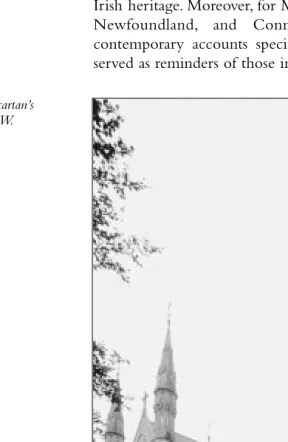
at once up to date and yet reflective of a well-established tradition of Irish Roman Catholic church building. It is this very Irish-ness that was so important for the Irish priest and his predominantly Irish congregation at St Mary’s. While we have no record of the patron’s demands at St Mary’s, the building speaks clearly of its Irish heritage. Moreover, for McCarthy’s St Patrick’s in St John’s, Newfoundland, and Connolly’s St Patrick’s, Hamilton, contemporary accounts specifically mention that the churches served as reminders of those in the homeland.26
ST PAUL’S, POWER STREET, TORONTO
At St Paul’s, Toronto (Figs 8 and 9) the foundation stone was laid on 9 October 1887, and the dedication performed on 22 December 1889.27 A contemporary account of St Joseph’s at
Chatham, virtually an architectural twin of St Paul’s, Toronto, describes the church as being built in the ‘Roman Renaissance’ style. This label is derived from the second chapter of the third volume of John Ruskin’s The Stones of Venice.28 Ruskin initially
discussed the Casa Grimani in Venice as an example of this style ‘because it is founded, both in its principles of superimposition, and in the style of its ornament, upon the architecture of classic Rome at its best period’. He listed St Peter’s Basilica in Rome as an example of the style ‘in its purest and fullest form’. In its external form Ruskin observed that the Roman Renaissance style ‘differs from Romanesque work in attaching great importance to the horizontal lintel or architrave above the arch’. This is used in Connolly’s internal elevations above the main arcade, and on his façades, although in the Toronto façade vertical elements penetrate the entablature above the first storey.
The interior of St Paul’s, Toronto (Fig. 8), has been convincingly compared with the great Roman basilica of St Paul’s outside the Walls.29 The association might also be extended to S.
Clemente, Rome, the church of the Irish Dominicans in the city since 1667. However, both these Roman churches are wood-roofed and Connolly’s churches are vaulted in the manner of Roman Baroque churches as in Carlo Maderno’s extension to the nave of St Peter’s Basilica (1606-1612). There, the two-storey elevation, in which the clerestory lunettes are cut into the high barrel vault, is derived from the nave of Il Gesù Rome, begun in 1568 by Vignola.30 The massive, compound piers of Il Gesù and
Roman Baroque churches were not suitable for Connolly’s St Paul’s where there needed to be greater openness between the nave and aisles. It is thus possible to read Connolly’s churches as a fusion of the main arcades of an Early Christian basilica with the high barrel vault and clerestorey windows from the Roman Baroque tradition.
Be that as it may, Connolly’s terms of reference were significantly broader. The immediate inspiration for the nave, the low transepts and the apse articulation, seems to have been St Mel’s cathedral, Longford (1840-56), by J.B. Keane (Figs 8 and 9).31 The churches share the same Ionic order for the main arcade
the high barrel vault that springs from the entablature above the main arcade.32 However, Connolly chose not to adopt this
scheme, or that of most Roman Baroque churches, in which lunettes cut directly into the high barrel vault. Rather than springing the high vault immediately above the entablature, Connolly provided a more fully articulated upper storey in which the shallow pilasters that carry the transverse arches of the vault provide an illusion of height far greater than their actual scale.This is an arrangement encountered in eighteenth-century France in the churches of Contant d’Ivry, as in the nave of Saint-Vaast at Arras, begun in 1755, and in La Madeleine in Paris, begun in 1764.33
A Venetian association may be suggested for the east end of St Paul’s where the three-apse east end is paralleled at Torcello Cathedral. Ruskin gives a plan of this church, which may be pertinent in that it has ten-bay arcades like St Paul’s.34 In this
connection it is interesting that in Connolly’s obituary in the Canadian Architect and Builder, St Pauls’s is labelled as ‘Italian Romanesque’, an association that best fits aspects of the façade and the campanile.35
The façade of St Paul’s (fig. 10) is an brilliant amalgam of the Tuscan Romanesque San Miniato al Monte in Florence and Venetian church façades of Andrea Palladio (1508-1580): San Giorgio Maggiore, Sant’ Andrea della Vigne (1570) and Il Redentore.36 The roundels in the spandrels of the façade also
recall Venice and Ruskin - the Fondaco della Turchi and the Palazzo Dario37 are good parallels - while the coloured marble
insets may derive from the ‘Decoration by Discs’, on the Palazzo Badoari Particiazzi, illustrated in colour by Ruskin.38 Be that as
it may, the setting of the roundels adjacent to the capitals of the main pilasters recalls the Arch of Augustus at Rimini, which may also have supplied the inspiration for the continuation of the vertical articulation into the entablature. Alberti’s façade of San Francesco, Rimini (1450), itself modelled on the Arch of Augustus, may also have been a point of reference here.39 The
superimposition of the Corinthian over the Ionic order follows Vitruvian principles as discussed in Joseph Gwilt’s 1867 Encyclopedia of Architecture.40 The bell tower is set off to the side in
the tradition of the Italian Romanesque campanile, as at Santa Maria in Cosmedin, and San Giorgio in Velabro, in Rome, to cite just two examples.
J.J. McCarthy’s Thurles cathedral (Co. Tipperary) (1865-72) may have played an intermediary role for the Italian Romanesque-style campanile offset to the left of the St Paul’s, Toronto, façade.41 The division of the ground floor of the Thurles
headed doorways with carved tympana, one in the centre to the nave and one each to the aisles, separated by slightly narrower blind arches. At Thurles, there is no clear separation between the nave and aisle façades whereas Connolly provided this with bold Ionic pilasters, a motif that he also used at the outside angles of the front. Moreover, Connolly incorporated a full entablature between the lower and upper sections of the façade, a feature entirely lacking at Thurles.
The architectural confessionals that project from the aisle walls in St Paul’s, Toronto, are taken neither from a Roman, nor a classicizing, tradition but are adapted from A.W. Pugin and his followers. In an account of St George’s, Lambeth (Southwark),The Ecclesiologist records that ‘Mr Pugin has ingeniously met with the question of confessionals, which are indispensible to a modern Roman Catholic church, by making them constructional, and placing them between the buttresses, approached of course by a series of doors from the nave. This was an afterthought, but is more felicitous than architectural afterthoughts generally are’.42
They are used by J.J. McCarthy at St Saviour, Dublin (1852-61),43
and St Ignatius, Galway (1860),44 and subsequently by Pugin and
Ashlin in St Augustine’s, Dublin, and Cobh Cathedral.45
Connolly included them in a number of his Gothic churches, including the chapel of St John that he added to the north-east of St Michael’s Cathedral, Toronto (1890). There, a small pointed Fig. 9. Longford, St Mel’s Cathedral,
gable is placed above the window in the middle of the confessional while at St Paul’s the walls of the confessional are built somewhat higher and it is topped with a pediment in the tradition of a Greco-Roman temple.
For St Paul’s, Toronto, the choice of style for the church concerns specific personalities, Archbishop Lynch and the Right Reverend Timothy O’Mahony, the pastor of St Paul’s. O’Mahony was born in Ireland in 1825 and had completed his priestly training in Rome.46 In 1879 he met Archbishop Lynch in Rome
and he was invited to Canada to become Lynch’s auxilliary. Bishop O’Mahony was made pastor of St Paul’s and he determined to replace the small brick church of 1823.47 As at St
Mary’s, Toronto, there is no written documentation that pertains to discussions between patron and architect at St Paul’s. However, a letter from Kennedy, McVittie & Holland, Architects, Barrie, Ont., 9 May 1883, preserved in the Archives of the Roman Catholic Archdiocese of Toronto, records that Archbishop Lynch preferred the ‘Italian Style of Church Architecture’.48 This
architectural ultramontanism is further witnessed in Toronto in the church of Our Lady of Lourdes, Sherbourne Street (1885-1886), which was built for Archbishop Lynch by Commander F.C. Law.49 Here, the narthex of the original façade recalls S.
Lorenzo fuori le mura, Rome, while the articulation of the aisleless interior with a barrel vault carried on a full entablature and stepped Ionic pilasters, plus the ribbed dome on a drum and pendentives, proudly proclaim Roman Baroque connections.The entrance and transept facades adapted elements from classical temple façades, and like St Paul’s, Toronto, a campanile projected to the left of the west (east) front.
Loretto abbey church, located on Wellington Street near Spadina, Toronto, built by Beaumont Jarvis in 1897 and demolished in 1961, continued this Romanizing theme.50 It had
a single-storey elevation with coffered barrel vaults over the chancel, transepts and nave, and a ribbed dome on pendentives over the crossing. The walls of the chancel and transepts were articulated with Corinthian pilasters.The lower, single-bay chapels in the angles of the transepts and chancel communicated with the main spaces through a trabeation on plain Ionic pilasters.The slim Ionic columns that separated the nave and aisles may have been inspired by Connolly’s nave at St Paul’s.
CHURCHES OF OTHER DENOMINATIONS IN LATE NINETEENTH-CENTURY TORONTO
ultramontane link with Rome. The latter is obviously specific to the Roman Catholics but what of the Gothic of St Mary’s? It is here that the Irish-ness of the design sets it apart from contemporary churches of other denominations in Toronto and elsewhere in Ontario.Two Anglican churches, St Matthew and St John (1889) on First Avenue by Strickland and Symons, and St Thomas on Huron Street by Eden Smith (1892), conform to English High Victorian Gothic principles. In accordance with the liturgical tradition of the high church, they are both fitted with a rood screen, and a piscina and sedilia. The 1875 split in the Presbyterian congregation of St Andrew’s,Toronto, resulted in the construction of two new churches; New Old St Andrew's by Langley, Langley and Burke, was Gothic, while New St Andrew’s by William George Storm, was Romanesque.51 This was not the
contemporary Romanesque of Henry Hobson Richardson but Romanesque intended to reflect the style of Norman Scotland and thereby provide a geographical, if not a temporal, association with the home of Presbyterianism.52 At the same time, the Baptist
congregation of Jarvis Street adhered to the Gothic style for their new church by Langley, Langley and Burke (1874-5). However, the amphitheatrical seating plan in the sanctuary of their church was quite distinct from either Anglican or Catholic medieval-inspired basilicas, and was the first use of this plan in the city.53 In
1886/7 Langley and Burke used a similar plan for the Sherbourne Street Methodist, Toronto, but on this occasion Gothic gave way to their interpretation of Richardsonian Romanesque. This stylistic choice eradicated any possible association between Methodism and either the ‘Papists’ or the Anglicans that might be implied by a Gothic church.54
CONCLUSION