*Prof .Dr., Department of Chemical and Biological Engineering, Georgian Technical University, Tbilisi, Geogia. E-mail: [email protected]
**Ph.D., Scientific Center ”Nanodughabi”, Georgian Technical University, Tbilisi, Geogia. E-mail: [email protected]
*** Ph.D., Caucasian Institute of Mineral Resources, Tbilisi State University, Tbilisi, Geogia. E-mail: [email protected]
**** Ph.D., Department of Chemical and Biological Engineering, Georgian Technical University, Tbilisi, Geogia. E-mail: [email protected]
***** Assoc. Prof. Dr., Department of Metallurgy, Metals Science and Metal Processing, Georgian Technical University, Tbilisi, Geogia. Faculty of Computer Technologies and Engineering, International Black Sea University
E-mail: [email protected]; [email protected]
****** Assoc. Prof. Dr., Department of Metallurgy, Metal Science and Metal Processing, Georgian Technical University, Tbilisi, Georgia. E-mail: [email protected]
******* Prof. Dr., Department of Chemical and Biological Engineering, Georgian Technical University, Tbilisi, Geogia. E-mail: [email protected]
******** Ph.D., Scientific Center ”Nanodughabi”, Georgian Technical University, Tbilisi, Geogia. E-mail: irakliigiorgadze @yahoo.com
********* Ph.D., Scientific Center ”Nanodughabi”, Georgian Technical University, Tbilisi, Geogia. E-mail: [email protected]
Innovative Solution of Utilization of the Clay Slates Accumulated in the
Gorge of the River Duruji
Archil SARUKHANISHVILI* Rajden SKHVITARIDZE**
Elena SHAPAKIDZE*** Marina KAPANADZE****
Tamar LOLADZE***** Dimitri ERISTAVI****** Maia MSHVILDADZE*******
Iralki GIORGADZE******** Shalva VERULAVA*********
Abstract
The article deals with the innovative solution of utilization of the clay slates accumulated in the gorge of the river Duruji. Kvareli Region of Georgia is subject to the impact of mudslides with frequent periodicity. The “carrier” of these mudslides is the River Duruji. The bulk of the mudslides is represented by flat rounded stones of different sizes. The level of accumulation of this bulk exceeds the altitude of the regional center by ten meters, which could cause irreparable ecological and social damage to Kvareli City and the region on the whole. The package of measures on preventing the impact of mudslides includes clearing the riverbed and the fan of the area of about 147 km2 from stony mass. This is associated with the displacement of about 5 mln. tones of the bulk to the places remote from the river, which causes significant losses of fertile land. Based on the physical-chemical and technological investigations performed, it is proposed to use the stony mass – diluvium (of talus) of shale “elemental raw material” for the production of building materials.
The Kvareli Region is located in Eastern Georgia and is part of the province of Kakheti (Figure 1). The region is located at the Chief Caucasian Range in close proximity to the bor-der of Russia (Georgian Soviet Encyclopedia, 1986). Like other regions of Kakheti, Kvareli Region is renowned for its developed agriculture, primarily for viticulture and oenology. However, the Kvareli Region belongs to the Georgian high-lands, which are considered ecologically dangerous. The reason is the fact that the Kvareli Region is subject to the ecologically catastrophic impact of mudslides with frequent periodicity. This causes sensible damage to the life activity of the regional center and adjoining territories.
Figure 1. Map of the Kvareli Region: 1. The White Duruji; 2.The Black Duruji; 3. The Duruji; 4. Sagarejo Region
The “carrier” of these mudslides is the River Duruji, the head of which in the form of two channels (the Black and the White Duruji) is situated on the south slope of the Cauca-sian Range. The Black Duruji surrounds the so-called Black Rock formed mainly of shales. According to the opinion of the experts of Georgia Service of Engineering Control of Dangerous Geological Processes, it is virtually inexhaust-ible supply of the products of rock disintegration under the impact of the environment. The River Duruji flows in the ra -vine with the level difference of 2,500 m forming the fan near which the regional center Kvareli with the population of 25,000 people is situated.
The level of the Duruji channel, the basin of which makes up 116 km2, and the fan (36 km2), which is located in the immediate proximity of Kvareli City, increase every year. Currently the fan level exceeds the altitude of Kvareli by ten and more meters. This circumstance makes the Kva-reli Region an ecologically “hot place” from the standpoint of natural disasters (Gavardashvili, 2008).
With the aim of minimizing the probable impact of mud-slides on the life activity of the region, along with other mea-sures (construction of protective facilities, working out of monitoring and warning measures, clearing of the riverbed
from wood pulp etc.), it is foreseen to transfer the products of rock disintegration from the riverbed and the fan (5 mln. tones) to the areas remote from the River Duruji. Without denying the suitability of the decision made, it should be noted that it could lead to other ecologically dangerous sit-uation, namely, losing the significant areas of richly fertile land.
The detritus bulk can be subdivided into two compo-nents: fine-grained (grain size ≤0.1 mm) and coarse-grained (grain size >0.1 mm.). The estimated first component makes up 25%. It was studied in detail at the Institute of Water In-dustry and Engineering Ecology of Georgia. It was revealed that this part of the bulk brought out by the element is the ultimate cause of the existence of the world-known grape cultivar (and, respectively, wine) Kindzmarauli. It is recom-mended to use this bulk for expanding the areas of cultiva-tion of the mencultiva-tioned grape cultivar and in the produccultiva-tion of ceramics of various kinds.
As for the second, more significant part of detritus, which is one of the main causes of possible catastrophic impact of mudslides, its origin is much less known, which hampers to draw more or less correct conclusions about the possibility of using the “lump” part of the bulk.
Working Methodology
Sampling, sample preparation for the analysis of the coarse-grained detritus of mudslides and determination of the chemical composition were performed in accordance with the methods adopted in the assessment of nonmetal-lic mineral raw materials (Knapovich & Morachevski, 1956). The phase composition of the samples was determined by microscopy (optical microscope Labor-Lux 12), X-ray phase analysis (diffractometer DRON -1.5), IR spectrosco -py (spectrometer “THERMONICOLET, AVATAR 370”) and petrochemical recalculations. The sequence of changes in the phase composition of heat treatment products was pre-dicted by the thermodynamic-petrochemical method (TPM). The TPM involved a thermodynamic approach to the as-sessment of the possibility of one or another physical-chem-ical process (Gibbs free energy minimization technique), the estimation of the phase composition by the correspond-ing state diagrams and the petrochemical recalculation for determination of that composition. The results obtained by TPM were compared with the experimental ones. The dis-crepancy did not exceed 10-15%.
Results
The analysis of the coarse-grained part of mudslide detritus allowed us to infer that it could be referred to typical shales with a smaller portion of clay minerals and was represent-ed in the form of the products of weathering of the Black Rock and sediments displaced under gravity and by water. Hence, this part of the detritus is shale deluvium.
This conclusion is based on the analysis of the chem-ical and mineralogchem-ical compositions of the samples of the abovementioned part of detritus and their structure. The average analysis of 20 samples revealed the following ox-ide composition (wt.%): SiO2 - 57.50; Al2O3 -19.68; Fe2O3
-7.40; CaO -1.06; MgO - 3.02; K2O - 3.73; Na2O - 1.39; SO3
-0.90;LOI - 5.32. This composition shows predominance of MgO over CaO and of K2O over Na2O, which, according to
(Zaridze, 1980), is a specific feature of shale.
In the diffraction pattern the reflexes, characteristic of shale, were found (Fig. 2).
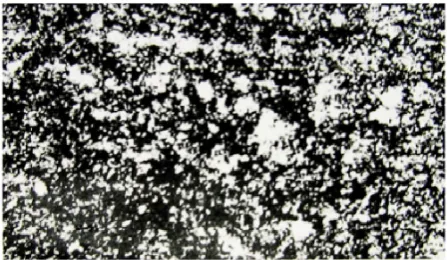
The microscopic examination mainly confirmed the presence of the mineral formations shown in Fig. 3 and ad-ditionally registered the presence of the substances of or-ganic origin and ore minerals. It is difficult to identify them in detail because of their small sizes. The micrograph shown in Fig. 3 allows us to infer that the material clearly reveals the silty micaceous origin characteristic of pelitic shale. The pelitic bulk is represented mainly by kaolin, an organic substance and ore minerals. Among the latter, wustite and goethite were found.
Figure 3.Micrograph of the deluvium, x125. Structure – blastopel-itic, texture – spotted. Consists of relict pelitic clay particles, an or-ganic substance and ore minerals, scales of chlorites and micas, quartz grains, feldspars and amphiboles.
The results of petrochemical calculations are in good agreement with the experimental ones, which allows us to assess quantitatively the mineralogical composition of deluvium (wt.%): Q+Fsp 26-32; Mi 24-29; K+0 9-25; Kh 9-12; Am 7-11; O (the substances of organic origin.) 1-4. As expected, the thermal influence caused dehydration of water-containing silicates (Figure 4). The derivatogramm pattern recorded a set of endothermal effects, which are generally associated with releasing both chemically bound (hygroscopic) and structural water (Zaridze, 1980; Eitel, 1962). Thus, being heated up, muscovite loses water within the ranges of 513-593, 873-883, 1033-1073K and at 1173K, depending on the scale size; amphiboles – at ≥1073К; clay minerals – within the range of 373-1273К. The most inten -sive endoeffect with the peak at 353K must be associated with the removal of absorbed moisture and the substances of organic origin, and the single effect at lower temperature – with the oxidation of wustite into hematite.
Simultaneous consideration of the results of derivato-graphic, microscopic and X-ray phase analysis, and of TPM
forecast of physical-chemical processes proceeding during heat treatment of the deluvium and the phase composition of heat treatment products allowed us to derive the following conclusions:
The heat treatment of deluvium in the low temperature range (323-593K) leads to the oxidation of wustite, con-tained in the deluvium, into hematite and to the removal of absorbed moisture and substances of organic origin. Partial dehydration is quite possible.
Over the temperature range of 573-1073К, Kh loses structural water completely, Mi does it to a considerable de-gree, while Am and K lose the structural water insignificant -ly. Quartz takes part in the dehydration as well. Iron-con-taining water silicates are likely to undergo the following conversions:
Fe2++ structural (OH-) →Fe3++ structural (О2-)+Н;
4H+O2→2H2O,
It can be the cause of emergence of hematite mainly on the grain surfaces. These conversions start in that tem-perature range and go on at higher temtem-peratures. The pos-sibility of the conversions of this type was noted by sev-eral scholars (Eitel, 1962; Tarasovich, 1988; Ismail, 1970; Newman, Brown, 1966). There is a possibility of interaction between the products of oxidation of organic substances and Fe2+, because the presence of siderite was observed
in the heat treatment products over the temperature range of 1073-1273K. In this temperature range, especially in the interval from 1070K to 1273K, the deluvium structure is de-structive, which promotes the active interaction between the water-containing compounds and the rest components of heat treatment products, except feldspars. The latter are distinguished by their activity over this temperature range.
The temperature range of 1073-1473K, especially above 1273K, causes complete release of structural water, though some of its part in the form of (OH-) and (H3O)
re-mains in the bulk of heat treatment products even at higher temperature. This is evidenced by the IR absorption spectra in the region of 4,000-2,500 cm-1 (Fig. 5).
Without considering the details of the complete data rendered by these spectra, we should note that at 1573K there appears the band sufficient for justifying the possibility of the existence of abovementioned ions in the heat treat-ment product.
In this region, a portion of the liquid phase ap-pears and grows. This is the result of melting of a number of compounds and formation of eutectics: K2MgSi5O12 melts at
1362K; Na2Si2O5 – at 1147K; K2Si2O5 – at 1309K; acmite -
at 1263К; albite - at 1309К; orthoclase – at 1443К.
K2MgSi5O12 + tridymite + L (liquid) - 1260К; orthoclase
+ tridymite + L (1263К) etc., where L is the melt, are the examples of eutectics.
In the temperature range higher than 1473K, the basic process is melting of high-melting compounds, in the melt the content of which reaches 100% at 1673K.
in some fields of silicate industry as both a single initial raw material and a constituent of the initial composition. Two ex-amples of this possibility in laboratory and semi-industrial conditions are demostrated below.
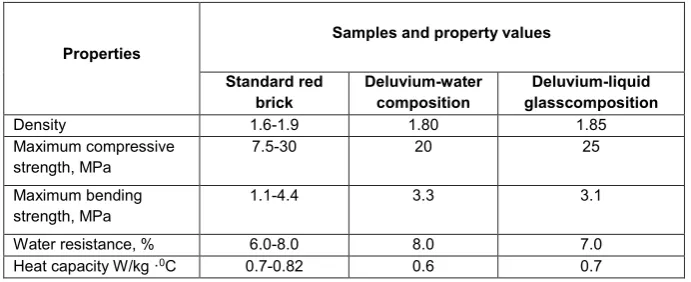
When studying the behavior of the deluvium over the temperature range of 1025-1073К, a change in the color was observed: black deluvium became reddish-brown. The investigation of the lump deluvium showed that the for-mation of hematite on the surface was responsible for the change in the colour. The increase in the heat treatment temperature caused the “penetration” of this compound into the bulk volume. The colour of ground deluvium turned out to be very close to that of the majority of ceramic wall materials, and the phase composition was almost identical to standard materials. These prerequisites allowed formu-lating the initial mixtures deluvium-water and deluvium-liq-uid glass, which in the temperature interval of 1223-1303K yielded the material having the properties corresponding to standard so-called red brick produced by the compressive method (Table 1).
Destructive character of the product of deluvium heat treatment over the temperature range from 873 to 1223K allowed us to assume that the product could be used as an active cement additive. The assumption proved to be true, which is justified by the data given in Table 2.
Besides the presented applications of the deluvium, we performed the tests on the possibility of using it as the basic raw material for production of Portland clinker, as the sec-ondary raw material – in glass production and production of glass enamels for different purposes. The tests yielded good results.
Conclusion
The bulk of the fan of mudslides is the shaledeluvium, which has all signs of mineral raw materials “delivered” by the el-ement for its application to the production of building mate-rials and products. Therefore, the deluvium should be con-sidered as the “elementary raw material” with all resulting consequences. The practical use of this raw material, on the one hand, will allow producing the building materials for the region, including the construction of protective facilities, and on the other hand, ridding the region of a new ecological threat – the loss of significant areas of the fertile land.
Acknowledgements
We are grateful to all participants of the Project TACIS Bis-tro Bis/Geo/01/01 for their assistance in the implementation of this Project.
References
Georgian Soviet Encyclopedia. (1986). Tbilisi: Mtavari Samecniero Redakcia, 10,637.
Gavardashvili, G. V. (2008). Current ecological state of the basin of the River Duruji. Ecolog.Syst. Prib., 8, 51-55. Knapovich, Y. N., & Morachevski, Y. V. (1956). Analysis of Mineral Raw Materials. Goskhimizdat, pp. 7-23; 73-142. Zaridze, G.M. (1980). Petrography of Magnetic and Meta-morphic Rocks. Moscow: Nedra, pp. 318-324.
Eitel, W. (1962). ThePhysical Chemistry of The Silicates. Moscow: IL, pp. 722-740.
Tarasovich, Y. I. (1988). The Structure and Chemistry of the Surface of Lamellar Silicates. Kiev: naukovaDumka, pp. 248.
Ismail, F. T. (1970). Oxidation-Reduction Mechanism of Octahydrolizonein Mica-Type Structures. Soil Sci., 110(3), 167-171.
Figure 4. Derivatogramm pattern of the diluvium.
Figure 5. IR absorption spectra of the deluvium and the products of its heat treatment in the region of 4,000-2,500 cm-1.
Figure 2. Diffraction pattern of the deluvium. Legends: Kh – chlorites; Fsp – feldspars; Q – Quartz; K- clay minerals; G – Goethite; Mi – mi
Table 1.Properties of the ceramic wall product