EFFICIENCY OF LEACHING TESTS IN THE CONTEXT OF THE INFLUENCE
OF THE FLY ASH ON THE ENVIRONMENT
Jan Kalembkiewicz1, Elżbieta Sitarz-Palczak2
1 Department of Inorganic and Analytical Chemistry, Faculty of Chemistry, Rzeszow University of Technology, 6 Powstancow Warszawy Ave., 35-959 Rzeszow, Poland, e-mail: [email protected]
2 Department of Inorganic and Analytical Chemistry, Faculty of Chemistry, Rzeszow University of Technology, 6 Powstancow Warszawy Ave., 35-959 Rzeszow, Poland, e-mail: [email protected]
INTRODUCTION
Depositing waste at landfills and taking place in these uncontrolled processes physical, chemi -cal, and biological properties pose a serious threat to the environment. For this reason, the waste from storage must be evaluated together with or -ganic designation degree of toxicity [Witkowska-Kit 2000]. The degree of impact on the environ -ment of waste containing contaminants in a form of toxic substances or harmful, depending on is not only the type and concentrations of these sub -stances, but mainly their mobility. The mobility of pollutants contained in the waste, expressed as susceptibility to leaching them in water (also called leaching test), is the most important eco -logical sights indicator release for depositing waste at landfills. In Poland there is a lack of uniform standards and regulations relating to the preparation of aqueous extract and evaluate the
Volume 16, Issue 1, Jan. 2015, pages 67–80
DOI: 10.12911/22998993/589 Research Article
ABSTRACT
The leachability of heavy metals (Cu, Pb and Zn) from the coal fly ash samples was studied. The investigations executed using three leachability tests (USEPA, TCLP, ASTM).The effect of different parameters was determined (the diameter of ash grains, the kind of leaching solutions, pH of leaching solutions, the volume ratio of leaching solutions to the mass of ash samples, and the leaching time) on the leachability of the heavy metals from fly ash samples. Moreover, the influence of pH and changes in the redox potential of the leaching solutions as well as the presence of organic com -pounds that could potentially form complexes with metals and solubility changes of metals. The concentration of the metals studied (Cu, Pb and Zn) in all obtained solu -tions was determined by FAAS method. On the basis of the research investigations, optimal leachability conditions for Cu, Pb and Zn from fly ash in this study have been determined. We have also found that pH of the leaching solution, and the presence of organic compounds which have a potential capacity of complexion the metals are the important factors in determining the solubility of Cu, Pb and Zn.
Keywords: heavy metals, fly ash, leaching test. Received: 2014.09.12
Accepted: 2014.10.28 Published: 2015.01.02
reliability of the results obtained in the leaching test. Currently, two procedures are used to draw up the waste water. The first procedure is the re -sult of the regulation of the Council of Ministers, 1997. The second procedure was established by Polish Standards [PN-Z-15009/1997]. The results obtained after the application of the above pro -cedures do not indicate a total of the contents of the component in the waste, which can be subject to physicochemical change in the environment, give only an approximate indication in terms of assessing potential risks posed to the environment at the time referred to the waste.
at the end of the entire period of the process will be given a stable state of molecules. In the dy -namic tests and column, the substance resulting in leaching constantly flows through the sample. Summary and comparison of group recruitment tests and column charts are contained in the fol -lowing works [Zandi et al. 2007, Fällman, Aurell 1996, Egemen, Yurteri 1996, Lewin 1996, Wahl -ström 1996, Quevauviller et al. 1996].
Most waste in the field of employment is due to the structure of coal-fired power generation. As a result of burning coal solid waste (furnace waste) is produced: fly ash, slag, mixture of ash and slag, microspheres, boiler ash, flue gas desul -furization gypsum fluidized beds using limestone (wet method), wastes from flue gas desulfuriza -tion methods (dry and semi-dry methods), etc. [Galas et al. 2005]. Fly ash according to [Bilite -wski et al. 2003] its the residues from the com -bustion of ground coal in amber furnaces, which are lifted of emissions and are captured by dust device. Ashes are contained in the mixture of dust-gas created from coal (hard coal and lignite).
Ash properties primarily depend on the chem -ical composition of non-flammable substances contained in different grades of coal burned [Pa -chowski 2002]. Fly ash, formed as a result of burning coal, may contain trace amounts of sub -stances which during liquidation or disposal may be washed out, what poses a potential threat to the environment. Environmental conditions have a huge impact on the mobility of ash as well as on the physical and chemical properties. In order to simulate the behavior of the leached fly ashes in different environmental conditions and to reduce the discrepancies between the measurements made on the ground, and these have been devel -oped in the laboratory, standard leaching tests. The most common tests used by eluting extrac -tion procedures, i.e. the “Extrac-tion” Procedure (EP) [Esakku et al 2008, Sophia, Swaminathan 2005], the “Toxicity by Characteristic Leach -ing Procedure” (TCLP) [Gitari et al. 2009, Lu et al. 2009, Jing et al 2006, Janus et al. 1998] and standardized extraction procedure developed by the American Society Of Testing And Materials (ASTM) [Dermata et al. 2004, Mangialardi 2003]. The leaching tests are widely used mainly as in -dicators to estimate the potential release of trace metals from the ash, in order to assess their impact on the environment in the process of rendering or deposition of fly ash under laboratory conditions [Sarode et al., 2010]. In addition, they allow the
classification of trace elements of ash on the basis of their behavior during the leaching under differ -ent conditions and to id-entify the mechanisms of leaching [Fytiano, Tsaniklidi 1998, Hardaway et al. 1999, Janus et al. 1998, Praharaj et al. 2002, Sitarz-Palczak, Kalembkiewicz 2012].
Existing standard leaching schemes are insuf -ficient because they do not depict any scenarios of waste liquidation or disposal , including ash. To reduce the surface storage of the ashes, new mar -keting options for their re-use are still searched for, which requires comprehensive and preceded by studies of their composition, physicochemical properties and susceptibility to further processing by various technologies and behavior in contact with various external factors.
The tests carried out in the framework of this work were to assess the impact on the environ -ment from coal ash as they deposit in landfills and the certification of fitness for non-industrial utilization. To this end, studies were carried out regarding changes to the solubility of selected heavy metals (Cu, Pb and Zn) in the fly coal ash in anaerobic conditions.
MATERIALS AND METHODS
Apparatus
Reagents and solutions
All chemicals and reagents were of analyti -cal grade or higher purity and were obtained from POCH, Gliwice, Poland. The solutions were pre -pared by dissolving appropriate compounds in double-distilled water from the Water Purifica -tion System (SolPure 7 POLL LAB, Poland). The reagents were prepared and stored in clean poly -ethylene bottles. Glassware and plastic ware (PE) used throughout the experimental work were pre -viously soaked in 10% nitric acid bath overnight and washed thoroughly in double distilled water. Standard solutions were prepared from standard solutions for atomic absorption (Sigma-Aldrich Chemie GmbH, Switzerland) – the concentration of all metals in standard solutions were the same and equals 1.000 µg·cm-3 in 1% of HNO
3. Work -ing standard solutions contain-ing Cu, Pb and Zn were prepared by serial dilution of the appropri -ately of standard solution for atomic absorption.
Sample collection and preparation
Coal fly ash samples used for the experiments were collected from the electric filter from Rz -eszów S.A power-plant (Rz-eszów, Poland). The 0.5 kg sample was prepared from overall air-dried 10 kg sample by a “quarterning” method – ac -cording to Polish Branch Standard [BN-81/0623– 01] procedure. After that, the air-dried ash was sieved, initially through a laboratory sieve of 1 mm diameter, and then milled in an agate mortar to fine powder (φ ≤ 100 μm) – according to Polish Standard [PN-77/G-04528/00].
Fly ash
Physicochemical characteristics of ash sam -ples included determination of pH using potenti -ometric method [PN-ISO-10390]; determination of organic carbon content - Tiurin method [PN-95-Z-15005] and composition of granulometric by using the sieve methods [PN-R-04032]. The total content of metals is obtained after mineral -ization in a mixture of concentrated HNO3 acid, HF and HCl under conditions described in the work [Sitarz-Palczak, Kalembkiewicz 2008].
Standard leaching tests
Three standard leaching tests (USEPA, TCLP, ASTM) were selected for this study to determine stability of trace elements (Cu, Pb and Zn) in fly
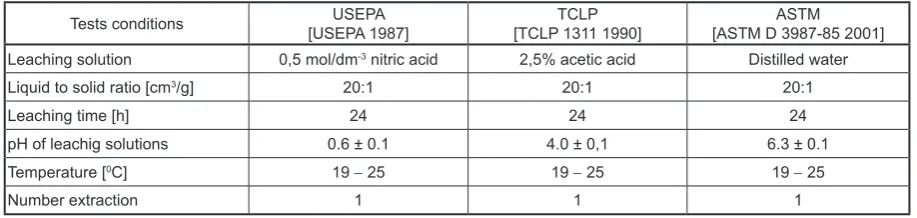
ash samples under three different conditions (Ta -ble 1). Leaching tests were carried out based on the principles laid in standard procedures. To ob -tain USEPA, TCLP and ASTM extracts 5 g of fly ash was agitated in polyethylene bottle containing 100 cm3 of extracting medium for the specified time periods of 24 and 18 h, respectively. After the required period of agitation, all extracts were stirred with a glass rod and filtered through 0.45 µm filter paper. The filtrates were acidified with a concentrated HNO3 addition and transferred to a polyethylene bottle and stored in a cool dry place for further analysis by atomic absorption spectro -photometry (FAAS). All extractions were carried out as triplicate runs.
Effect of parameters of ash and leaching process
-ing solutions 2.5% CH3COOH (TCLP); pH = 2.5; the ratio of the volume of leaching solution to the mass of the sample L:S = 50:1 [cm3:g]. Assuming the following leaching times: 0,5; 2; 4; 6; 8, 12 and 24 h. subsequent procedure was the same as in the case of leaching procedures described above.
Effects of selected organic compounds with a potential capacity of complexion the metals on the solubility of Cu, Pb and Zn in anaerobic con -ditions
In order to determine the effect of complexion substances on the contents of selected metals in the soluble forms contained in the ashes two se -ries of complete extractions by shaking samples of ash were performed, with the complexion ad -dition substances: citric acid or tartaric acid with the following concentrations: 10, 20, 40, 100 mg·dm-3 corresponding 6.25; 12.50; 25.00; 62,50 mg·kg-1 ash. The solubility change of Cu, Pb and Zn in anaerobic conditions was studied in a se -ries of incubation of samples of ash with the addi -tion of organic substances constituting a potential source of easily accessible coal they were glu -cose and tartaric acid with a concentration of 200 mg·dm-3. Incubations are performed at in con -finement without access of oxygen for a period of 7 days, stirring the sample for 10 minutes from time to time to ensure the balance between the permanent and the solution. After the incubation was carried out through the extraction conditions of shaking in leaching tests (USEPA and TCLP), which is given in Table 1.
RESULTS AND DISCUSSION
Basic physicochemical properties of ash were presented in Table 2. On the basis of the obtained results, it was concluded that coal ash shows slightly alkaline pH. Working with [Łączny 2002] it is known that the energy (fly ashes) com -pounds of heavy metals present in the waste are
in slightly alkaline environment, because the ions of these metals in this environment are generally less mobile complex compounds. If intended for the storage of fly ash, or other energy waste will have basic character, the main threat to the envi -ronment will be releasing such compounds as so -dium, potassium and calcium sulphate. So in the case of investigational ash (wood and coal) there is no risk of wash of heavy metal ions with alka -line base nature of these wastes. Organic carbon content in the ash residue of unburned carbon [Su, Wong 2003]. Based on the results of the analysis, the granulometric composition it was found that the greatest part is the fraction of particulate mat -ter, which is consistent with the results obtained by [Antonkiewicz 2014]. The total content of trace metals in the ash is varied. Since they all oc -cur at concentrations above 50 mg · kg-1 can they have a large impact on the environment (Table 2). In a view of the fact that ash is a heterogeneous material, elements contained therein are not even -ly distributed. The content of organic carbon as -sessed in fly ash reveal the presence of unburned coal residues. The surface layer is enriched in Table 1. Conditions of leaching tests
Tests conditions [USEPA 1987]USEPA [TCLP 1311 1990]TCLP [ASTM D 3987-85 2001]ASTM
Leaching solution 0,5 mol/dm-3 nitric acid 2,5% acetic acid Distilled water
Liquid to solid ratio [cm3/g] 20:1 20:1 20:1
Leaching time [h] 24 24 24
pH of leachig solutions 0.6 ± 0.1 4.0 ± 0,1 6.3 ± 0.1
Temperature [0C] 19 - 25 19 - 25 19 - 25
Number extraction 1 1 1
Table 2. Physicochemical properties of fly ash (the results presented reflect values of data taken from 10 samples)
Parameter Value of parameter
pH:
H2O
1 mol·dm-3 KCl
9.1 8.9
Content of organic carbon [g·kg-1] 53.9
Texture [%]: Clay (0 – 2 µm) Silt (2 – 50 µm) Sand (> 50 µm)
0.9 75.7 23.4
Total content [mg·kg-1] of metal
Cu Pb Zn
copper and zinc, while lead is distributed evenly between the sensor and the surface of the grains [Izquierdo, Quero 2012].
Standard leaching tests
In natural conditions (under the influence of atmospheric conditions and the presence of mi -croorganisms – in landfills there are numerous physical, chemical and biological processes, not subject to the control. These processes give rise to, first and foremost, the aging of the deposited material, its weathered and leaching. Aging is generally to reduce the solubility, and weathered to the creation of partially soluble products. The leachability applies to an easily soluble metal form, present in the waste, i.e. first of all, salt, in which the composition has sulfates of calcium, potassium, sodium and magnesium. The im -mediate effect of leaching is an increase in per -meability of the deposits, increased salinity of groundwater and surface water. The leachability of Cu, Pb and Zn in fly ash obtained after the ap -plication of three standard leaching tests (USEPA TCLP and ASTM) was presented in Table 3. The highest degree of leaching for Pb of 56.8% in relation to the total content of Pb in the fly ash, were obtained using the USEPA test; respectively 22.3% was obtained by means of TCLP proce -dure. While the ASTM test using distilled water was obtained the lowest value of leaching equal to 2.5% in relation to the total contents of Pb in the fly ash. The degree of leaching for copper was 62.7% using the USEPA test and only 19.6% in the case of the TCLP test in relation to the total content of Cu in the fly ash. The leachability of copper in the case of ASTM test was below the limit of detection for this metal, as determined by FAAS method. Zinc showed the greatest percent
-age of leachability using the USEPA procedures and it was 35% in relation to the total content of the metal in the ashes. and 14.6% after applying the TCLP test. The leachability of Zn in ASTM test does not exceed the limit of detection for the determination of this metal by the FAAS method. In summary, containing a test in which the largest were the concentration of soluble forms in respect of all designated metals in coal ash is the USEPA. In the light of the above, it can be concluded that this test shows the highest efficiency in relation to the determined metals Cu, Pb and Zn. The USE -PA procedure is more effective due to aggressive conditions during the leaching of metals. Taking into account the value of the degree of leaching of individual elements, it can be concluded that the degree of leaching of Cu, Pb and Zn is decreasing in the following series: Cu > Pb > Zn. In spite of all processes taking place in the environment it is suggested that the most appropriate and best sim -ulating natural conditions is ASTM procedure, in which the eluting solution is distilled water. How -ever, research carried out for the TCLP test may be helpful in the diagnosis of possible risks which might occur in the event of “acid rain”.
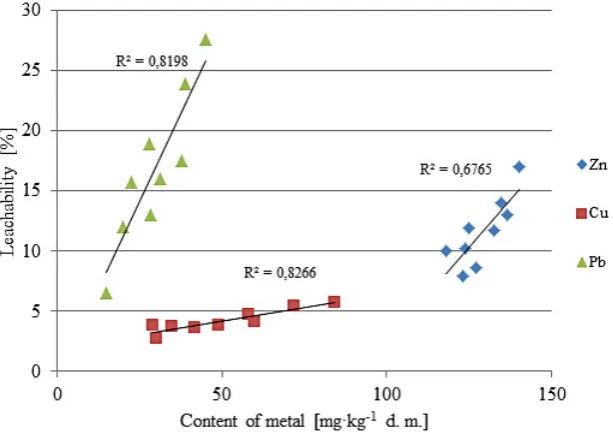
Statistical analysis of the results obtained on the concentrations of metals in the soluble forms, and their total content in the ash was carried out using a linear regression. Figure 1 shows the ob -tained relationship between leachability of Cu, Pb and Zn in relation of the total content of these metals in studied the ashes after application of the TCLP test. On the basis of the obtained result, it was found that an important relationship between the soluble forms of metals and their total content in fly ash prove the obtained correlation values of the coefficients, which are : Zn – 0.68, Cu – 0.83, Pb – 0.82. The results of the studies on the content of the soluble forms Cu, Pb and Zn in fly ash al
-Table 3. Summary of the concentrations of Cu, Pb and Zn in the soluble forms and relative leaching of these metals by USEPA TCLP and ASTM procedures (concentration of metal in the fly ash and the confidence interval were given for n = 10 at p = 95%)
Procedure Concentration of metals [mg·kg-1] Cu Pb Zn
USEPA Leachability 40.0 (± 2.6) 57.5 (± 2.9) 70 (± 3.5)
Relative leaching [%] 62.7 56.8 35.0
TCLP Leachability 12.5 (± 0.7) 22.6 (± 1.1) 29.1 (± 1.6)
Relative leaching [%] 19.6 22.3 14.6
ASTM Leachability < l. d. 2.5 (± 0.2) < l. d.
Relative leaching [%] - 2.5 < l. d.
low an approximate assessment of the risks posed to the water – soil environment at the time by a specified waste. For this purpose, the concentra -tions of trace investigated metals received in the soluble forms in the ash were compared with the limit values for wastewater entering into waters or into the ground, assembled in a Table 3. On the basis of the obtained results, it was found that the concentration of Zn obtained after leaching at the USEPA, TCLP and ASTM tests exceed ac -ceptable concentrations for this metal for waste -water entering into -waters or into the ground. The same situation occurs in the case of Cu and Pb after leaching with USEPA TCLP, tests from the fly ash. The obtained results, due to the hetero -geneity of the test material, should be verified on the basis of the follow-up testing of leachability of metals from the ashes.
In assessing the dangers of fly ash containing pollution in a form of heavy metals, in addition to the degree of leaching, one should take into ac -count the additional effect of the aging of waste. It can be both beneficial and detrimental. This is a very important ecological factor for the future in relation to the waste deposited in landfills. It may actually happen that the waste with low leaching today become more washed out after a few years, or waste with high leaching become harmless after a few years of storage. Linked to this need for constant monitoring of ash storage facilities, which, in the light of the obtained results pose a risk of contamination of the environment water near the landfill.
Effect of parameters of ash and leaching process
There is a number of factors that may affect the leach of each constituent elements in fly ash leaching tests. Some of these factors are related to the properties and composition of fly ash, oth -ers depend on conditions of leaching [Zandi et al., 2007]. Test conditions (LS ratio, leachant pH and leaching time) have a great impact on these results. The conditions for measuring potential leachability have not been clearly addressed in literature; there are a few contradictory studies on the principles of leaching and effects of control factors such as pH and LS ratio on fly ash leach -ing behavior [Fällman 1997].
Particle size of fly ash
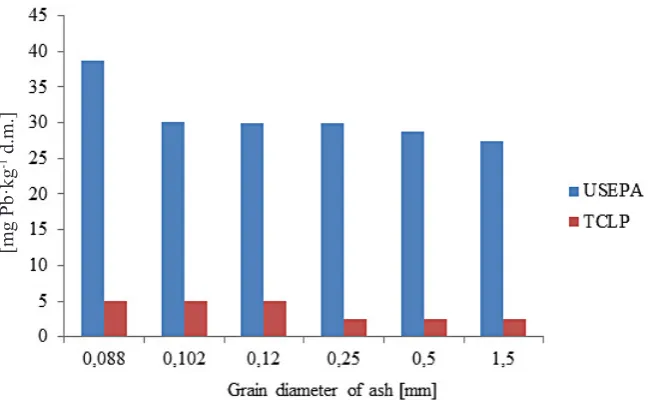
Fly ash have poorly developed a pore struc -ture. The degree of development of the structure of the surface of the grains and the size of the specific surface area to a large extent determine the susceptibility of the ashes on the leaching of soluble parts from them. Therefore, it can be seen, that both the grain diameter as well as their appropriate size will determine indirectly the leaching solutions on the tested metals. Figures 2 - 4 illustrate the effect of particle diameter on the leachability of soluble forms of Cu, Pb and Zn from the fly ash using the USEPA TCLP tests. On the basis of the results presented in Figures 2 - 4, it was concluded that particle diameter of fly ash has a significant effect on the leachability Figure 1. Relation between leachability of Zn, Cu and Pb and total concentration this metals in fly ash
Figure 2. Content of Zn in the soluble forms in the fly ash with different grain diameter of ash obtained by the use of the leaching test (USEPA, TCLP) and determined by FAAS method
Figure 3. Content of Cu in the soluble forms in the fly ash with different grain diameter of ash obtained by the use of the leaching test (USEPA, TCLP) and determined by FAAS method
Figure 4. Content of Pb in the soluble forms in the fly ash with different grain diameter of ash obtained by the use of the leaching test (USEPA, TCLP) and determined by FAAS method
[mg Pb
·kg
of soluble forms of Zn and Cu, as well as in the application of the tests USEPA and TCLP. With regard to both the highest of leaching metals were received by the ash of 0.088 mm diameter and solution of HNO3 (USEPA) respectively, for was equal to 72 mg·kg-1, while for Cu 38 mg·kg-1 in respect of the dry mass of the ash. The effect of particle of diameter of ash on leachability of Pb shows an inverse relationship, as in the case of other metals by applying USEPA and TCLP tests, namely the leachability of Pb increases with ash particle diameter. The leachability of lead using the USEPA test shows the highest concentration of soluble forms of metal particle diameter ash equal: 0.088 and 1.5 mm. The lowest Pb content in the soluble forms was received for grain diam -eter of ash equals 0.102 mm.
Leachability as a function of pH
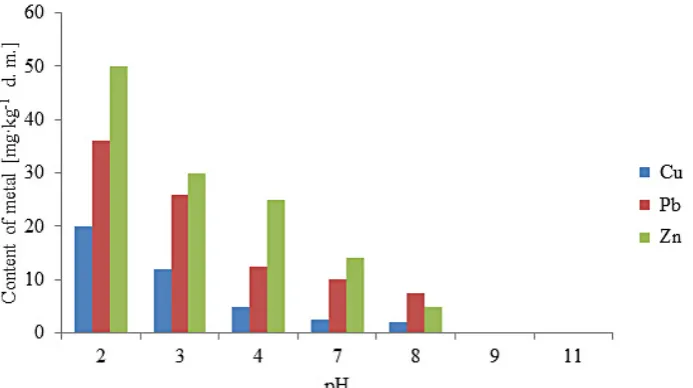
The pH of the solution is very important as it determines the surface charge of the fly ash, and the degree of ionization and speciation of the el -ements in solution. The interactions between the charged ions in solution and the surface of fly ash particles contribute to release or adsorption of spe -cies. The results shown in Figure 5 indicate the trend of pH release of Cu, Pb and Zn. The con -centration of soluble forms of all studied metals in fly ash decreases with increasing alkalinity of the leaching solution. pH in the range of 2 to 3 found the largest leachability for all heavy metals tested; respectively for Zn 25–15%, copper 31–19% and lead 36–26% in relation to the total contents of the metals in the fly ash. Low concentrations of these
metals were observed in leachate solution (2.5% CH3OOH) at high pH (> 9) but increased at pH < 9. The leaching trend for these metals indicates the dependence of the release of some metals on the dissolution of hydrous oxides of iron and man -ganese. Mn and Fe-oxides present in fly ash are formed during combustion of coal, and on hydro -lysis form Mn and Fe hydroxides. Trace metals, such as Cu and Pb are associated with these hy -droxides and on dissolution of these hy-droxides, the trace metals are bound to be released into so -lution. Adsorption/desorption also plays a role in controlling the concentrations of heavy metals.
Fly ash material generates an alkaline pH within a few minutes of contact with water in most cases, due to higher quantities of soluble basic oxides than the soluble acid phases [Choi et al 2002, Reardon et al. 1995]. Several studies [Cho et al. 2005, Lee, Saunders 2003, Steenari et al. 1999] have shown that at higher pH, the surfaces of the fly ash particles are negatively charged. This would lead to increase in the ad -sorption of most heavy metals from the solution. The increase in adsorption of heavy metals ions in fly ash solutions at higher pH (> 10) may also be attributed to calcium content which provides alkalinity in the system raising the pH to strongly alkaline values, thereby facilitating the uptake of metal ions by the fly ash.
The pH of the environment has a great impact an chemical speciation of leachate elements from fly ash in the aqueous environment except for highly soluble elements which are mobile under both acidic and basic conditions. The difference
between total quantity of element in the fly ash and the potentially leachable constituent is due to structure and mineralogy of the fly ash and as -sociations of the element major insoluble phases present in the fly ash.
Solubility of metal compounds is an impor -tant property that allows metals to penetration into the structure of the porous adsorbent. The concentration of such speciation forms of met -als as: MOH+, M(OH)
2, M(OH)3-, M(OH)42- at pH 6 < are too small to affect the sorption process the dominant forms of metal M2+ (M = Cu, Zn,
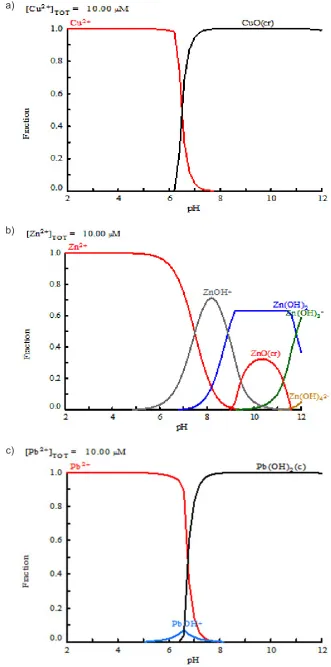
Pb) [Ho, et al., 2002]. This is confirmed by the data presented in Figure 6 the speciation graph of metal ions, whose curves are compatible with the data from literature [Zirino, Yamamoto, 1972, Cuppett et al. 2006, Cárdenas López et al. 2007, Deliyanni et al., 2007]. They have been generated on the basis of the program Medusa [http://www.kemi.kth.se/medusa/]. The specia -tion curves for the different ions of heavy metals indicate that different forms dominate in the so -lution within a certain range of pH; for example Zn2+ is a dominant form in solution at pH < 6.
Above this pH in solution increases the concen -tration of ZnOH+ and ZnO. With regard to the
adsorption of Cu and Pb it should be kept in mind that these speciation forms of metals, or simple ions Cu2+ and Pb2+ have mainly to pH about 6,
above which exponentially increases the concen -tration of CuO and Pb(OH)2. In general, there are different mechanisms that may control the release of a particular constituent from a partic -ular fly ash in an aqueous environment. Highly soluble elements available on the surface of the fly ash often fall into the category of available controlled leaching if the concentration released into the leachant is limited only by the amount of the element in the fly ash. These element are ex -pected to become mobile soon after contact with
aqueous environment and leach at high concen -trations. Leachability of some other constituents may be solubility controlled where leachability of elements in the fly ash can be described by dissolution and precipitation processes.
Leachability as a function of redox potential
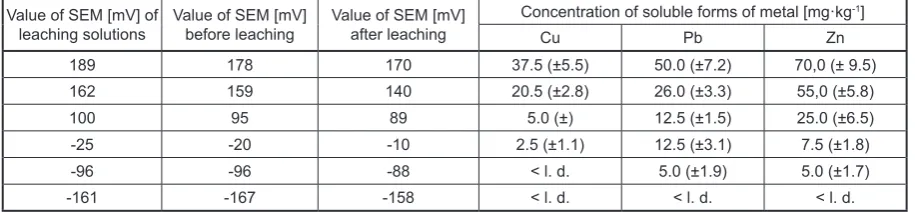
The leaching of some metals e.g., Fe, Cr, As can depend significantly on the redox conditions. The redox conditions can change due to the access of air to the sample during the storage or in per -forming the leaching test [Wahlström1996]. The results concerning the effect of the potential redox on the contents of metals in the soluble form in the fly ash are shown in Table 4. At high values of the potential (≈170 mV), the concentration of Cu, Pb and Zn in the soluble forms are highest and are re -spectively equal to: Cu - 37.5; Pb - 50 and Zn - 80 mg·kg-1. At the same time, as the high value of the potential suggests, these metals are present in the oxidized forms by taking the highest oxidation: CuII, PbIV and ZnII. Along with the decline in the potential decrease the content of Cu, Pb and Zn in the soluble forms, which testifies to their presence in the reduced forms.
Leachability as a function of L:S ratio
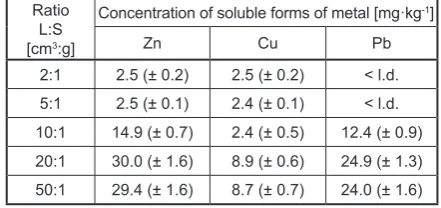
The ratio of the volume of leaching solution to the mass of sample fly ash (L:S) is one of the more important factors affecting the leaching of trace elements from the ashes samples. The most com -monly used ratio of the liquid phase to the solid phase (L:S) is located in the range (10−20): 1, but with a higher ratio, for example 50:1, the leaching substance is more easily mixed with fly ash, and trace components are increasingly leached away from the seeds of the ash. The results shown in Table 5 fully confirmed the correlation.
Table 4. Effect of the redox potential of leaching solutions on the content of Cu, Pb and Zn in the soluble form in the fly ash obtained after the TCLP procedure (concentration of metal in the fly ash and the confidence interval were given for n = 6 at p = 95%)
Value of SEM [mV] of
leaching solutions Value of SEM [mV] before leaching Value of SEM [mV] after leaching
Concentration of soluble forms of metal [mg·kg-1]
Cu Pb Zn
189 178 170 37.5 (±5.5) 50.0 (±7.2) 70,0 (± 9.5)
162 159 140 20.5 (±2.8) 26.0 (±3.3) 55,0 (±5.8)
100 95 89 5.0 (±) 12.5 (±1.5) 25.0 (±6.5)
-25 -20 -10 2.5 (±1.1) 12.5 (±3.1) 7.5 (±1.8)
-96 -96 -88 < l. d. 5.0 (±1.9) 5.0 (±1.7)
-161 -167 -158 < l. d. < l. d. < l. d.
Figure 6. Speciation curves of a) Cu, b) Zn, c) Pb Comments: (c) – solid substance , (cr) – crystalline form
a)
b)
Table 5. The content of Cu, Pb and Zn in the soluble forms in fly ash (φ =1,5 mm) obtained by a variety relations of volume of 2.5% acetic acid (pH = 2.5) to the mass of the sample – L:S (concentration of metal in the fly ash and the confidence interval were given for n = 6 at p = 95%)
Ratio L:S
[cm3:g]
Concentration of soluble forms of metal [mg·kg-1]
Zn Cu Pb
2:1 2.5 (± 0.2) 2.5 (± 0.2) < l.d.
5:1 2.5 (± 0.1) 2.4 (± 0.1) < l.d.
10:1 14.9 (± 0.7) 2.4 (± 0.5) 12.4 (± 0.9)
20:1 30.0 (± 1.6) 8.9 (± 0.6) 24.9 (± 1.3)
50:1 29.4 (± 1.6) 8.7 (± 0.7) 24.0 (± 1.6)
l. d. – limit of detection by FAAS method.
Leachability as a function of time
The execution time of the leaching test is an important parameter affecting the mobility and speciation of trace elements in fly ashes. The study of the effect of execution time of leaching of trace metals (Cu, Pb and Zn) from ash are es -sential from the perspective of the protection of the environment. The main objective of the re -search is to estimate the leaching time quantity of heavy metals in the soluble forms that are subject to migration, with the ash landfills in the wild in real life conditions. The results of these studies are necessary to assess the potential of the pos -sible time of the release of the components of fly ash in the context of its liquidation in render -ing specific conditions [Zandi et al., 2007]. The results obtained for this aspect of the study are shown in Figure 7. Time of leaching showed a significant impact on the concentration of Cu, Pb and Zn in soluble forms. Copper concentrations were relatively constant for the execution time of the leaching test from 0.5 to 12 h. For the leach -ing time equal to 24 h, the contents of this metal increases. Lead showed a tendency to increase the concentration over the execution time of leach -ing test from 15 to 25 mg·kg-1. Zinc, like lead, showed an increase to the highest concentration with increasing execution time of the leaching test. It achieved the highest concentration after 24 hours of leaching test duration.
Effects of selected organic compounds with a potential capacity of complexion the metals on the solubility of Cu, Pb and Zn in anaerobic con -ditions
One of the effective ways of reducing the solubility of heavy metals is the use of probing
by using specific groups of organic compounds, obtained by chemical synthesis or isolated from natural substances. For complexion compounds tartaric acid, citric acid, glucose were used. For complexion compounds of natural origin may be classified as humic substances. In order to deter -mine the effect of selected organic compounds with a potential capacity of complexion of metals on the solubility of Cu, Pb and Zn in anaerobic conditions, the fly ash made with the addition of complexion reagents i.e. tartaric acid, citric acid and glucose. The results of the concentrations of studied metals in the soluble forms in fly ash containing tartaric acid in the concentration range 10–200 mg dm-3, the obtained after applying the TCLP test are shown in Figure 8. The presence of tartaric acid affects the concentration of the form soluble forms of Pb. Namely, for Zn there was an increase in the concentration of metal in relation to the concentration of the metal in the soluble forms in the ash without tartaric acid, whereas for Pb it was reduced. The concentration of the soluble forms of Cu in the fly ash throughout the range of concentrations C4H6O6 is the same.
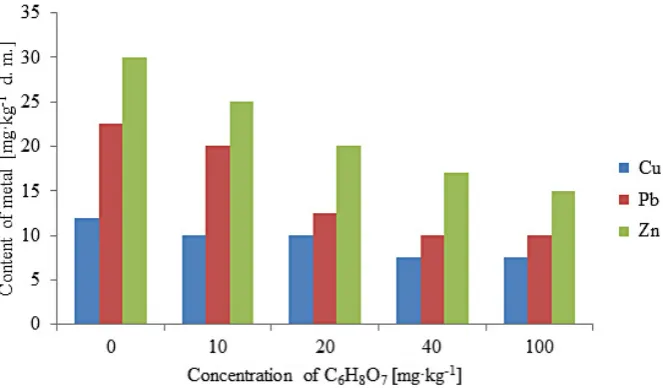
Figure 9 illustrates the changes in concentra -tions of metals in the soluble forms contained in the ashes under the influence of different con -centrations of citric acid in the range of 10-100 mg·dm-3 introduced into the fly ash. The addition of citric acid to the fly ash caused an increase in the concentration of soluble forms of Zn in the ash as compared with to the fly ash no the com -plexion substances addition. This is different in the case of the other elements; for Cu concentra -tion in the soluble forms decreased by half the value of the concentration of copper in the soluble forms in the fly ash with no citric acid addition, whereas for Pb it was equal to zero. Regardless of the value of the concentrations C6H8O7, the quan -tity of soluble forms of metal in the ash remains the same. Generally, the presence of citric acid is beneficial for leaching of Zn, as compared to other elements.
The concentrations of the investigated met
-als in solutions obtained after leaching contain
-ing fly ash with addition of 200 mg·dm-3of
Figure 7. Relation between a time of leaching and the concentration of Zn, Cu and Pb in the soluble forms in the fly ash having a grain diameter φ = 1.5 mm, obtained by leaching with 2.5% CH3COOH, pH 2.5
Figure 8. Changes of concentrations of soluble forms of Zn, Cu and Pb in the fly ash with the addition of tartaric acid, obtained by the use the TCLP test
CONCLUSIONS
1. The contents of metals in the soluble forms re -ceived after leaching the fly ash using the stan -dard leaching testing exceeds the permissible concentrations of Cu, Pb and Zn in relation to the standards for waste entering into waters or into the ground.
2. Considering, the solubility and mobility of heavy metals the fly ash can pose a threat to water and soils in the area of storage and stor -age creates the risk of inorganic contamination of the environment.
3. With regard to the ageing of inorganic waste, such as fly ash, it should be pointed out that monitoring both the composition and mobility of heavy metals present in the fly ashes is important. 4. Depending on the chemical composition of the
leaching solutions and the diameter of the grains examined fly ash, exhibits a different level of mo -bility of Cu, Pb and Zn in the soluble forms de -pending on the conditions of the leaching process. 5. On the basis of the conducted research it can
be concluded that the optimal method for as -sessment of the impact of surface ash storage on the environment is the TCLP test made un -der the following conditions: particle diameter ash φ = 1.5 mm; pH 2.5% CH3COOH = 2.5; L:S ratio = (20) 50: 1; leaching time = 24 h. 6. In addition, it was found that the presence
of organic compounds with a potential com -plexion of metals has a significant impact on the concentration of Cu, Pb and Zn in solu -ble forms. Generally, the addition of tartaric or citric acid in the fly ash causes a decrease in the concentrations of metals in the soluble forms, with regard to ash without the above mentioned acids added after being applied of the TCLP test in optimal conditions.
7. Presence of glucose in fly ash caused an in -crease in the concentration of the soluble forms of Zn received by TCLP procedure compared to the concentrations of the metal in the solu -ble forms in fly ash with no glucose addition. The contents of Cu and Pb in the soluble forms has not been a significant change.
REFERENCES
1. Witkowska-Kit B., Zasucha J. 2000. Metody badań szkodliwego oddziaływania odpadów na środowisko, Utylizacja Odpadów Przemysłowych i Komunalnych, 2, 5–7 [In Polish].
2. Rozporządzenie Rady Ministrów z dnia 30.12.1997 r. w sprawie opłat za składowanie odpadów. Dz. U. RP, Nr162, poz. 1135 [In Polish].
3. Polska Norma PN-Z-15009/1997. Odpady stałe – Przygotowanie wyciągu wodnego [In Polish]. 4. Zandi M., Russel N.V. 2007. Design of a leaching
test framework for coal fly ash accounting for en -vironmental conditions. Environ. Monit. Assess., 131, 509–526.
5. Fällman A.M. Aurell B. 1996. Leaching tests for environmental assessment of inorganic substances in wastes, Sweden. Sc. Total Environ., 178, 71–84. 6. Fällman A.M. 1997. Performance and design of
the availability test for measurement of potentially leachable amounts from waste materials. Environ. Sc. Tech., 31, 735–744.
7. Egemen E., Yurteri C. 1996. Regulatory leaching tests for fly ash: a case study. Waste Management & Research, 14, 43–50.
8. Wahlström M. 1996. Nordic recommendation for leaching tests for granular waste materials. Sc. To -tal Environ., 178, 95–102
9. Lewin K. 1996. Leaching tests for waste compli -ance and characterisation: recent practical experi -ences. Sc. Total Environ., 178, 85–94
10. Quevauviller Ph., van der Sloot H.A., Ure A., Muntau H., Gomez A., Rauret G. 1996. Conclu -sions of the workshop: harmonization of leaching/ extraction tests for environmental risk assessment. Sc. Total Environ., 178, 133–139.
11. Galas K., Uliasz – Bocheńczyk A. 2005. Źródła i użytkowania popiołów lotnych ze spalania węgla w Polsce. Gospodarka Surowcami Mineralnymi, 21(1), 23–40 [In Polish].
12. Bilitewski B., Hardtle G., Merk K. 2003. Podręcznik gospodarki odpadami, Teoria i prak -tyka. Wydawnictwo Seidel-Przywecki Sp. z o.o, Warszawa, p. 45 [In Polish].
13. Pachowski J.2002 Rozwój technologii powstawa -nia ubocznych produktów elektrow-nianych oraz ich charakterystyka i możliwości zastosowań w technologiach budownictwa drogowego. Drogi i Mosty, 1, 59–99 [In Polish].
14. Esakku S., Karthikeyan O.P., Nagendran R. 2008. Heavy metal fractionation and leachability studies on fresh and partially decomposed municipal solid waste. Practice Periodical of Hazardous, Toxic, and Radioactive Waste Management, 12, 127–132. 15. Sophia A.C., Swaminathan, K. 2005. Assessment
of the mechanical stability and chemical leachabil -ity of immobilized electroplating waste. Chemo -sphere, 58, 75–82.
17. Gitari W.M., Fatoba O.O., Petrik L.F., Vadapalli V.R.K. 2009. Leaching characteristics of selected South African fly ashes: Effect of pH on the release of major and trace species. J. Environ. Sc. and Health Part A, 44, 206–220.
18. Lu S.G., Chen Y.Y., Shan H.D., Bai S.Q. 2009. Mineralogy and heavy metal leachability of mag -netic fractions separated from some Chinese coal fly ashes. J. Hazardous Materials, 169, 246–255. 19. Jing C., Liu S., Korfiatis G.P., Meng X. 2006.
Leaching behavior of Cr(III) in stabilized/solidi -fied soil. Chemosphere, 64, 379–385.
20. Dermata S.D., Moon D.H., Menounov N., Meng X., Hires R. 2004. An evaluation of arsenic release from monolithic solids using a modified semi-dynamic leaching test. J. Hazardous Materials, 116, 25–38. 21. Mangialardi T. 2003. Disposal of MSWI fly ash
through a combined washing-immobilization pro -cess. J. Hazardous Materials, 98, 225–240. 22. Sarode D.B., Jadhaw R.N., Khatik V.A., Ingle S.T.,
Attarde S.B. 2010. Extraction and leaching of heavy metals from thermal power plant fly ash and its ad -mixtures. Polish J. Environ. Stud., 6, 1325–1330. 23. Fytianos K., Tsaniklidi B. 1998. Leachability of
heavy metals in greek fly ash from coal combus -tion. Environ. Int., 4, 477–486.
24. Hardaway C., Gauthreaux K., Sneddon J., Beck J. 1999. Evaluation of contaminated sed-iments by toxicity characteristic leaching procedure extrac -tion techniques. Microchem. J., 63, 398–404. 25. Praharaj T., Powell M.A., Hart, B.R., Tripathy S.
2002. Leachability of elements from sub – bituminous coal fly ash from India. Environ. Int., 27, 609–615. 26. Sitarz-Palczak E., Kalembkiewicz J., 2012. Study
of remediation of soil contamined with heavy met -als by coal fly ash, J. Environ.Prot., 3, 1373–1383. 27. Sitarz-Palczak E., Kalembkiewicz J., Zapała l.,
2008. A study of the chemical forms or species of manganese found in coal fly ash and soil, Micro -chem. J., 90, 37–43.
28. The Perkin – Elmer Corporation, Analytical Meth -ods For Atomic Absorption Spectrophotometry, Norwalk Connecticut, USA, 1982.
29. Polska Norma Branżowa BN-81/0623-01. Popioły lotne i żużle z kotłów opalanych węglem kami -ennym i brunatnym. Pobieranie i przygotowanie próbek [In Polish].
30. Polska Norma PN-77/G-04528-00.Paliwa stałe. Oznaczanie składu chemicznego popiołu. Przy -gotowanie próbki popiołu i roztworów do badań [In Polish].
31. Polska Norma PN-ISO-10390. Jakość gleby. Ozna-czanie pH [In Polish].
32. Polska Norma PN-95/Z-15005. Oznaczanie zawar-tości węgla organicznego w kompoście z odpadów miejskich [In Polish].
33. Polska Norma PN-R-04032. Gleba i utwory min -eralne – Pobieranie próbek i oznaczanie składu granulometrycznego [In Polish].
34. Łączny J.M. 2002. Model matematyczny oddziaływania składowisk odpadów energety -cznych na środowisko. Zakład Narodowy im. Ossolińskich, Wrocław, p. 16 [In Polish].
35. Su D.C., Wong J.W.C. 2003. Chemical speciation and phytoavailability of Zn, Cu, Ni and Cd in soil amended with fly ash-stabilized sewage sludge. Environ. Int., 29, 895–900.
36. Antonkiewicz J. 2014. Effect of fly ashes and sew -age sludge on Fe, Mn, Al, Si and Co uptake by grass mixture. J. Ecol. Eng., 3, 6–13.
37. Izquierdo M., Quero X. 2012. Leaching behavior of elements from coal combustion ash; an over -virw. Int. J. Coal Geology, 94, 54–66.
38. Choi S.K., Lee S., Song Y.K., Moon H.S. 2002. Leaching characteristics of selected Korean fly ashes and its implications for the groundwater composition near the ash disposal mound. Fuel, 81, 1083–1090.
39. Reardon E.J., Czank C.A., Warren C.J., Dayal R., Johnston H.M. 1995. Determining controls on el -ement concentrations in fly ash leachate. Waste Manag. Res., 13, 435–450.
40. Steenari B.M., Schelauder S., Lindqvist O. 1999. Chemical and leaching characteristics of ash from combustion of coal, peat and woo in a 12MW CFB – a comparative study. Fuel, 78, 249–258.
41. Cho H., Oh D., Kim K. 2005. A study on removal characteristics of heavy metals from aqueous solu -tions by fly ash. J Hazardous Materials, 127, 187–195. 42. Lee M.K., Saunders J.A. 2003. Effect of pH on
metals precipitation and sorption: Field bioreme -diation and geochemical modeling approaches. Va -dose Zone J., 2, 1770–185.
43. Ho Y.S., Huang C.T., Huang H.W. 2002. Equilib -rium sorption isotherm for metal ions on tree fern. Process Biochemistry, 37, 1421–1430.
44. Cuppett J.D., Duncan S.E., Dietrich A.M. 2006. Evaluation of copper speciation and water quality factors that affect aqueous copper tasting response. Chemical Senses, 31, 689–697.
45. Zirino A., Yamamoto S. 1972. A pH-dependent model for the chemical speciation of copper, zinc, cadmium and lead in seawater. Limnology and Oceanography, 17, 661–671.
46. Cárdenas-López C., Camargo G., Giraldo L., Moreno-Piraján J.C. 2007. Design of an adsorbent employing activated carbon fiber to remove lead. Ecletica Quimica, 32, 61–72.