INTRODUCTION
High-performance random packings, as a packed column internals, are widely used for sep-aration processes such as rectification and absorp -tion in chemical industry and environmental pro-tection due to their high efficiency at low pressure drop [5]. The recent interest is connected with the technologies for flue gas scrubbing, heat recovery and fuel production. The uniform liquid distribu -tion in the packed bed cross-sec-tion is crucial for the efficiency of the mass transfer processes and for their impact on the environment.
In recent years, there has been an increasing interest in the liquid phase distribution and wall flow observations in larger, industrial columns dimensions [1, 3-4], as well as in the packings of open structure (fourth generation) [7, 9, 11]. These lattice-type open-structure packings are characterized by a complex shape (a kind of a
lattice of curved thin lamellae), low pressure drop, and their liquid spreading capacity in the radial direction is weaker than that of convention-al packings of previous generations. The latter is due to the absence of liquid discharge surface (s) in the packing element; in practice, the liquid, passing through the packing layer, forms much drops and streams, which is also confirmed by the higher effective surface of these packings than the specific one [5]. For the open-structured packings a distance of 5 to 6 column diameters from the top of the column is required before the “steady conditions” between flow in the wall zone and flow in the bulk zone is attained. It has also been found that the flow in the open-structure packings is very sensitive to the initial distribution.
In the last 10 years, there has only been a lim -ited number of studies about the 4th generation random packings except our research in this field [3-4, 8-9, 11], which investigate experimentally Accepted: 2019.09.16
Available online: 2019.09.21
Volume 20, Issue 9, October 2019, pages 116–120
https://doi.org/10.12911/22998993/112500
Flow Simulation and Identification of Important Model Parameters
in Industrial Packed Beds for High-Performance Random Packings
Tatyana Petrova
1*, Daniela Dzhonova-Atanasova
11 Laboratory of transfer processes in multiphase media, Institute of Chemical Engineering, Bulgarian Academy of Sciences, Acad. G. Bonchev Str., Bl. 103, 1113, Sofia, Bulgaria,
* Corresponding author’s e-mail: [email protected]
ABSTRACT
The goals of this work were: first, to simulate the liquid flow distribution in a large diameter (1.2 m) packed column with an RMSR 70-5 high performance random packing (layer height up to 3 m), by a dispersion model. Second, to find and estimate the important model parameters and flow maldistribution factor, using experimental data and two different optimization approaches. A three-parameter dispersion model for prediction of radial liquid distribution and two different approaches to determine some of the model parameters from experimental data were used. In parallel, a two-parameter optimization procedure for model parameters identification was performed based on the minimum of residual variance between model and experimental liquid velocities over a column cross-section. The simulated and experimental flow maldistribution, were estimated by means of an integral estimation – a maldistribution factor. The comparison between the model and experimental liquid distribution and respective maldistribution factors at packing heights H = 1 m and H = 2.5 m for liquid load 16.6·10-3 m3/m2·s showed very
good agreement, even for a high packing layer. In conclusion, the presented model predictions and estimations
about RSRM 70-packing 5 characteristics and behaviour will complement the information about its efficiency and
operation in industrial processes.
and model the radial liquid distribution and mal -distribution [3-4, 9] in those packings. Moreover, there is insufficient information about the radial spreading ability and wall flow effects in these packings [2, 7], especially in the column diam-eters greater than 0.5 m. In contrast, the older type of packings are widely examined in the literature. Therefore, the motivation of our work is to fill the gap and test our models in industrial scale area, based on the existing experimental data for high-performance random packings.
The aim of this study is to simulate and com-pare with experimental data the liquid distribu -tion in large diameter columns (close to industrial scale) with high performance open-structure ran-dom packings. Here, a three-parameter dispersion model for simulation of radial liquid distribution and two different approaches were employed to determine some of the model parameters from the experimental data. In parallel, two-parameter op -timization procedure for model parameters identi-fication was performed based on the minimum of residual variance between model and experimen -tal liquid velocities over a column cross-section. The simulated and experimental flow maldistri -bution was estimated by an integral estimation – a maldistribution factor. The experimental data for liquid distribution in an RMSR 70-5 high-perfor -mance random packing for a packed column with a diameter of 1.2 m and packing layer heights up to 3 m, for 16.6·10-3 m3/m2·s liquid load and two types of initial irrigation (uniform and point source), were kindly provided by Florian Ha -nuschfrom the University of Munich, Germany.
By the two above-mentioned methods, two of the model parameters were estimated, using the experimental data for the wall flow at differ -ent packing heights at initial uniform irrigation, and also the data for point source initial irrigation, measured in a 1.2 m diameter column RMSR 70-5 for random packing. Finally, the comparison be -tween model and experimental liquid distribution and maldistribution factors at packing heights H = 1 m and H = 2.5 m for liquid load 16.6·10-3 m3/m2·s, shows very good agreement, even for a higher packing layer.
MATERIALS AND METHODS
The simulation was performed using a disper-sion model created [10] and widely used in recent years for predicting the liquid distribution for
older packing generations and for small diameter columns. It was tested successfully in the near past for a 0.5 m column diameter and Raschig Super-Rings [7], and for Pall rings and a column diameter of 0.6 m [6]. Here, for brevity, only the dispersion model solutions for uniform initial ir-rigation and the physical meaning of the model parameters were presented.
Analytical dimensionless solutions for the ir-rigation density fu and for the wall flow Wu of the above-mentioned model in the form of infinite series at uniform initial irrigation are given below:
( )
∑
∞ = − + = 1 2 0 0n n n
u n
u(r,z) A A J (q r)exp q z
f ,
( ) ( )
( )
∑
∞ = − − + = 1 2 1 exp 2 1 1 n n n n n u nu q z
q q J q A C
W (1)
with coefficients:
C C
A = +
1
0 ,
(
)
(
n)
n( )
nn u n q J C q C B / q C B / q À 0 2 2 2 2 4 2 2 2 − + + −
= (2)
The parameter Bis a criterion for exchange of liquid between the column wall and the pack -ing; parameter C expresses the equilibrium dis -tribution of entire liquid flow between the wall and the packing when equilibrium state is at -tained z→∞. In Eq. (1) and (2) J0,J1 are Bes-sel functions of the first kind, zero and first order;
n
q are the roots of the characteristic equation, fol-lowing from boundary condition at the column wall. In the dimensionless axial coordinate z =
D·H/R2 the third model parameter is included – D is the packing radial liquid distribution coef -ficient, [m], also called packing spreading coef -ficient. H is the packing layer height [m], and R is the column radius [m].
As explained above, three model parameters should be determined – C,D and B. In the light of the experimental data used in this paper, C is calculated from the wall flow data for L0 = 60 [m3/m2·h], G = 0 (G is the gas load [m3/m2h]), collected for uniform initial irrigation for packing RMSR 70-5 at heights of 1 m, 1.5 m, 2.5 m and 3 m. In [6] the relation C=1−Wz→∞ Wz→∞ is de-veloped, which is practically the case, when in Eq. (1) for model wall flow the second term disappears at z→∞. The calculated value is C = 5.944.
The other two parameters – B,D can be iden -tified by non-linear optimization approach, mini -mizing the residual variance 2
(
)
∑
=
− −
= k
1 i
2 ic ie i 2
A k11 n f f
S (3)
where ni is the number of packing redumpings,
i
f is the mean dimensionless density of irrigation (flow velocity) in i-th annular section of the 7th segment liquid collecting device, delimited by the radii ri−1 and ri
(
ri >ri−1)
and it is determined by the expression:( )
r,z rdr fr r
2
f i
1 i
r
r 2
1 i 2 i
i
∫
− − −
= (4)
Here the experimental and theoretically cal -culated values with “e” and “c” indices (Eq. (1)) of the liquid density of irrigation are denoted. If the global minimum of 2
A
S exists for some opti -mal values of B and D, searching in physically possible intervals for these two parameters, then they can be identified. As it was found in [7], in the case 2
A
S of invariance in respect to parameter D, this global minimum cannot be found and the other approaches have to be used.
In the case of unknown value of D for the packing considered, another approach (single jet method) is developed, which is explained in de -tail in [2], and needs experimental data for radial liquid distribution, measured after relatively short packing layer and at central point initial irriga-tion. Fortunately, such data was available and we applied the single jet method to determine D for a packing RMSR 70-5. The results are presented in Figure 2. For older packing types, usuallyD depends on the liquid initial density (velocity) of irrigation. Here, the same situation can be ob -served – the values for L = 10 m3/m2·h and L = 15 m3/m2·h practically coincide. The determined mean value of D by the single jet method [7] for packing RMSR 70-5 is D = 0.009062 m, using Eq. (5), where q L Q m= ,[ ]2 :
DH 4
r HD 4
1 ln ) q
ln( − 2
=
0 0 i ns
1
i i
0
f F1 F L LL
M =
−=
(5)
As mentioned above, we can also try the two-parameter identification procedure to determine
D ,
B for the RMSR 70-5 packing by searching the minimal value of 2
A
S , using the Eq. (1) and (4)
Fig. 1. Photograph of high-performance random packings used in this study –
RMSR, RVT Process Equipment
Fig. 2. Values of ln(q) versus r2 according to Eq.(5) for determination of
for model mean dimensionless density of irriga-tion fic, and experimental data for radial distribu -tion of fie .The results of the two-parameter iden-tification were successfully obtained and they are illustrated in Figure 3 (a) and (b). The values of D from the single-jet method and from the two-parameter identification procedure (although dif -ferent experimental data are used), are very close – 0.00906 m and 0.0095 m, which confirms the results in general for the considered packing.
RESULTS AND DISCUSSION
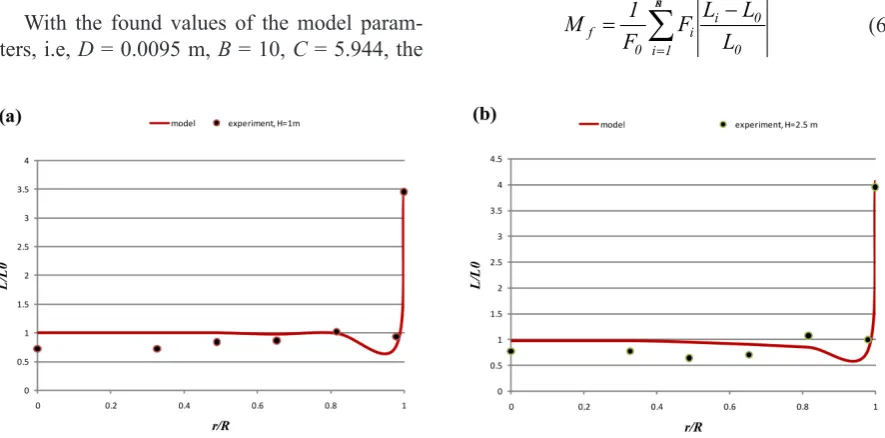
With the found values of the model param-eters, i.e, D = 0.0095 m, B = 10, C = 5.944, the
model solution was calculated by Eq. (1) at pack -ing heights H = 1 m and H = 2.5 m and com -pared with respective experimental data for initial uniform irrigation, for initial liquid load L0 = 60 m3/m2·h, or 16.6·10-3 m3/m2·s. The comparison between the model and experimental liquid dis -tribution shows very good agreement, even for a higher packing layer (Figure 4 (a) and (b)).
The model and experimental radial liquid distribution results can also be estimated by means of the maldistribution factors. The for -mula for calculating the maldistribution factor is given in [3] as:
0 0 i ns
1
i i
0
f F1 F L L L
M =
∑
−=
(6)
Fig. 3. Two -parameter identification of model parameters with optimum criteria – mini
-mal value of residual variance = 0.91e-01 at D = 0.0095 m, B = 10, C = 5.944, for H = 1 m, packing RMSR 70-5 presented as 3D plot (a), and presented as contour plot (b)
Fig. 4. Comparison between liquid radial distributions obtained by dispersion model in this work and experimental data for RMSR 70-5, H = 1 m, L = 16.6·10-3 m3/m2·s,
In Eq. (6) the ratio Fi F0 represents the ratio of the area of the respective segment i to the entire area of the column section, m2, ns is the number of segments of the liquid collecting device. Accord-ingly, Li L0 is the mean dimensionless theoreti-cal or experimental irrigation density in the i seg-ment, delimited by the ri−1and ri
(
ri >ri−1)
radii, which is obtained from the dispersion model ac -cording to Eq. (4). As can be seen from Eq. (1) and (6) the model maldistribution factor and the solu -tion depends on r, z and the B, C and D dispersion model parameters for the respective packing and current packing layer height z = D·H/R2. Theoreti-cal Mf, calculated for optimal parameter values are Mf = 0.172 for H = 1 m, and Mf = 0.242 for H = 2.5m. The corresponding experimental ones are Mf =
0.198 (for H = 1 m) and Mf = 0.265 for H = 2.5 m.
This again confirms that the model predictions are in good agreement with the experimental data.
CONCLUSIONS
The obtained results confirm the dispersion model ability to successfully simulate the radial liquid flow distribution in a packed column of a large diameter of 1.2 m with a RMSR 70-5 high-performance random packing. Two different ap -proaches (two-parameter identification and single jet method) are independently applied to obtain one of the model parameters – the coefficient of radial spreading of the RMSR 70-5 packing. The values of D are very close. The other two model parameters were also determined and the compari-son between model results for the liquid distribu -tion and respective experimental data at two pack -ing heights shows good agreement. The model and experimental maldistribution factors of the liquid distribution also are very close to each other. The presented model predictions and estimations about the RSRM 70-5 packing characteristics and behav -iour will complement the information about its ef -ficiency and operation in industrial processes.
Acknowledgements
This work was financially supported by the National Science Fund at the Bulgarian Ministry of Education and Science, Contract No DN 07/14/ 15.12.2016. The authors also express their special thanks to Florian Hanusch from the University of Munich, Germany for the access to the experimental data, obtained during project “Cell Model for Design of Packed Columns and Liquid Distributors”, (http:// www.ext.apt.mw.tum.de/maldistribution_en/data).
REFERENCES
1. Dzhonova-Atanasova D., Petrova T., Semkov Kr., Darakchiev S., Stefanova K., Nakov S., Popov R.
2018. Experimental investigation of liquid dis
-tribution in open structure random packings as a basis for model refinement. Chemical Engineering
Transactions, 70, 2077-2082.
2. Dzhonova-Atanasova D., Kolev N., Nakov Sv. 2007. Determination of liquid radial spreading coefficients of some highly effective pack-ings. Chemical engineering Technology, 30 (2), 202-207.
3. Hanusch F., Rehfeldt S., Klein H. 2018a. Liquid maldistribution in random packed columns: ex
-perimental investigation of influencing factors.
Chemical Engineering and Technology, 41(11), 2241-2249.
4. Hanusch F., Engel V., Kender R., Rehfeldt S., Klein H. 2018b. Development and application of the TUM-WelChem cell model for prediction of liquid
distribution in random packed columns. Chemical
Engineering Transactions, 69, 739 -744.
5. Hegely L., Roesler J., Alix P., Rouzineau D., Mey
-er M. 2017. Absorption methods for the det-ermi -nation of mass transfer parameters of packing
in-ternals: A literature review. AIChE Journal, 63(8),
3246–3275.
6. Petrova T., Stefanova K., Dzhonova-Atanasova D., Semkov Kr. 2017. Modeling of a liquid spreading in randomly packed metal Pall rings. Proc. Int. Sci.
Conf. MATHMODEL 2017, 26-29.
7. Petrova T., Semkov Kr., Dzhonova-Atanasova
D. 2018. Modeling of liquid distribution in a
packed column with open-structure random packings. Chemical Engineering Transactions, 70, 1051-1056.
8. Schug S. 2018. Untersuchung der Fluiddynamik in
Packungskolonnen mittels Computertomographie.
Ph.D.Thesis, Der Technischen Fakultät der Fried
-rich-Alexander-Universität Erlangen-Nürnberg, Erlangen-Nürnberg, Germany (in German).
9. Schultes M., Brauer J., Chen P., Doong S. 2018. Marinization of mass transfer columns for FLNG
applications. Chemical Engineering Transactions, 69, 301-306.
10. Staněk V., Kolář V. 1968. Distribution of liquid over a random packing: Verification of the bound
-ary condition of liquid transfer between a packed bed and the wall of a cylindrical column and evalu -ation of its parameters. Collection of Czechoslovak Chemical Communications, 33(4), 1062-1077. 11. Van Holt F., Brinkmann J., Grunewald M.2018.Ex
-perimental and theoretical studies on local liquid
phase distribution in packed columns. Chemical