Volume 13, Number 4, December 2018
What Drives E-Book Use: A Comparative Study of
Paper-Based Books and E-Books in Japan
Mahendra Singh
International Business Studies Department Temple University, Japan
Email: [email protected]
Yoshiki Matsui
Department of Business Administration Yokohama National University, Japan
ABSTRACT
The objective of this paper is to examine the reasons for adoption of e-books using the extended unified theory of acceptance and use of technology2 (UTAUT2) and two additional constructs – “long-tail effect” and “trust.” To achieve this goal, the authors conducted a comparative study in Japan of e-book and paper-based book purchases through online channels. The paper-based book is a physical product, whereas the e-book is a digital one. This study found some differences in the reasons for user adoption of these two products. The differences reveal the importance of external market situations, industry standards, and the inherent characteristics of the products as factors affecting the motivations for adoption of one product or the other. The construct “trust” was found to have a significant relationship to the intention to use both types of products, whereas “long-tail effect” was found to have a significant relationship to the intention to use paper-based books. On the other hand, the “price value” construct of UTAUT2 was found to have a significant relationship for e-books, but was not found to have a significant relationship for paper-based books purchased through online channels. It is proposed that future research include the relationship of both “long-tail effect” and “trust” constructs to the existing UTAUT2 research framework.
International Journal of Business and Information
1.
INTRODUCTION
Information and communication technologies (ICT) are continuously affecting the ways businesses are being operated and the ways in which people live their lives. In recent years, many technological innovations have resulted in the obsolescence of various products that were considered to be great innovations in their time.
For centuries, books have enabled the smooth transfer of knowledge from one generation to the next, resulting in the continued evolution of human civilization. For all those years, the word book meant a paper-based book. But, because of technological innovations in recent years, the word no longer implies a paper-based book. Technological innovations have led to the evolution and increasing popularity of a new kind of non-paper-based book called an e-book.
An e-book can be defined as digital content consisting of text, images, and other materials that can be stored, published, and distributed through electronic devices. These devices include dedicated e-book readers such as Amazon Kindle, multi-function tablets such as Apple iPad, and even computers and smartphones. The concept of an e-book is said to have originated in Project Gutenberg, founded by Michael Hart in 1972, in an effort to digitize publications with expired copyrights and to distribute these publications widely at no charge (Jin, 2014). In the 1990s, when the Internet gained widespread popularity, organizations began to realize the business possibilities of the digital form of books. The Rocket eBook, launched around 1998 by NuvoMedia, is considered to be the first e-book reader. The first reader was based on an LCD screen, but later the technology evolved into e-ink, which resulted in higher visibility and contrast and had the added benefits of consuming les energy and being easy on the eye. The Sony Librie, launched in 2004, is considered to be the first book reader based on e-ink technology.
In 2008, Amazon launched Kindle, a portable reader that was a bigger success in the e-book reader category. During the Christmas shopping season in 2009, Amazon’s e-book sales outpaced those of printed books (The Guardian, 2009). In 2011, Amazon reported that purchases of electronic books had surpassed those of printed books, which signaled an important change in the way people consume information (Computerworld, 2011).
Volume 13, Number 4, December 2018
increase of almost 33.6% in the global sales of e-book content over the previous year (Shim et al., 2016). In recent years, downloadable audio books are also becoming popular. An audio book is the audio recording of the text written in a book. Although audio books are considered as a separate category of books, it can be argued that they are also a part of the e-book family since they are digital. In 2016, publishers’ revenue from e-books totaled $2.26 billion, and their revenue from audio books was $643 million (Association of American Publishers, 2016). Although the sales of both types of books continue to increase, there has recently been some decline in e-book revenues, but an increase in audio book revenues. The change could be due to the shift of users from e-books to audio books.
Commonly understood advantages of e-books and and reasons for their adoption include their portability, screen readability in bright sunlight, and long battery life. Other possible reasons for the adoption of e-books include the lower price compared with paper-based books and the feeling of enjoyment experienced by some readers in using books. Although there have been numerous studies on e-books in the recent years, the basic question concerning reasons for the adoption of e-books has not been adequately answered.
An e-book is a technology-driven product that can be purchased and distributed only through digital sales, making it a product closely associated with online shopping. During the years of the Internet bubble, many impactful papers were published on the adoption of online shopping, but, with the continued evolution of new Internet technologies that have brought disruptive innovations to businesses, the focus of researchers has moved to other topics, such as big data, social networks, and artificial intelligence, leaving this basic question not fully answered (Singh & Matsui, 2015).
For analyzing technology acceptance among organizations and individual consumers, the extended unified theory of acceptance and use of technology (UTAUT2) framework is considered the latest. The UTAUT2 framework has seven constructs: performance expectancy, effort expectancy, social influence, facilitating conditions, hedonic motivation, price value, and habit.
International Journal of Business and Information product offerings for online shoppers because they can purchase products usually not easily available at physical stores. LT is considered a prominent strength of e-commerce (Singh & Matsui, 2017). LT is also relevant to e-books because online sellers are not restricted to keeping only a few books as inventory, but, instead, are able to offer books for which customer demand has decreased over time.
Online shopping is conducted remotely through the Internet in the absence of face-to-face interaction and carries inherent risks associated with the Internet, such as data theft, virus attacks, and online fraud, which make trust a very important requirement for users to conduct online shopping (Singh & Matsui, 2017). Since e-books are sold and distributed through online channels, these challenges are relevant for e-books also, making trust an important factor to consider while purchasing an e-book.
Findings from earlier research support the inclusion of trust and LT in an organized research framework such as UTAUT, which could explain all the user motivations for online shopping (Singh & Matsui, 2017). In the current study, UTAUT2 and the two additional constructs of LT and trust are used to examine drivers for the adoption of e-books rather than paper-based books. To understand these drivers, the authors conducted a comparative study of e-books and paper-based books. Since e-books can be purchased only through digital channels, the authors included only those paper-based books purchased through online channels.
2.
THEORETICAL BACKGROUND
Many models and frameworks have tried to explain the reasons for the adoption and diffusion of technology. The unified theory of acceptance and use of technology (UTAUT), which is one of the most recent frameworks, has evolved from the synthesis of eight predecessor research models:
• The theory of reasoned action (TRA) • The technology acceptance model (TAM) • The motivational model (MM)
• The theory of planned behavior (TPB)
• A model combining the technology acceptance model and the theory of planned behavior (C-TAM-TPB)
Volume 13, Number 4, December 2018
The UTAUT was formulated with four core determinants of intention and use. After being tested, it was found to outperform the eight individual models (Venkatesh et al., 2003).
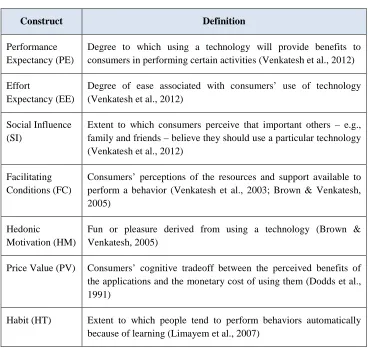
UTAUT originally had four constructs – performance expectancy, effort expectancy, social influence, and facilitating condition. It has been used mainly to explain the reasons for technology adoption by organizations. However, three additional constructs – hedonic motivation, price value, and habit – were subsequently added to the framework (Table 1), extending its relevance to explain the adoption of technology in the individual consumer context.
Table 1
Definitions of UTAUT2 Constructs
Construct Definition
Performance Expectancy (PE)
Degree to which using a technology will provide benefits to consumers in performing certain activities (Venkatesh et al., 2012)
Effort
Expectancy (EE)
Degree of ease associated with consumers’ use of technology (Venkatesh et al., 2012)
Social Influence (SI)
Extent to which consumers perceive that important others – e.g., family and friends – believe they should use a particular technology (Venkatesh et al., 2012)
Facilitating Conditions (FC)
Consumers’ perceptions of the resources and support available to perform a behavior (Venkatesh et al., 2003; Brown & Venkatesh, 2005)
Hedonic
Motivation (HM)
Fun or pleasure derived from using a technology (Brown & Venkatesh, 2005)
Price Value (PV) Consumers’ cognitive tradeoff between the perceived benefits of the applications and the monetary cost of using them (Dodds et al., 1991)
International Journal of Business and Information The extended UTAUT2 model, which was introduced in 2012, integrates the various fragmented theories and research studies into a unified theoretical model to explain the organizational adoption of technology and brings in the relevance of the model to individual consumers. For that reason, it is widely used by researchers to explain the adoption of technology by individual consumers and organizations.
E-books are basically the technological version of paper-based books. Therefore, technology acceptance theories are relevant in explaining the adoption of e-books as well. For these reasons, the UTAUT2 framework is appropriate for conducting such research and was used as the basic research framework in the current study.
2.1. UTAUT2 Constructs and Hypotheses
This section discusses the seven UTAUT2 constructs listed in Table 1 and presents the associated hypotheses.
2.1.1. Performance Expectancy (PE)
Performance expectancy is the expectation that, by using technology for some activity, the user’s performance will improve. The five constructs from the different predecessor models that pertain to performance expectancy are perceived usefulness (TAM and C-TAM-TPB), extrinsic motivation (MM), job fit (MPCU), relative advantage (IDT), and outcome expectations (SCT) (Venkatesh et al., 2003). By conducting shopping online, users can expect to receive some benefits such as purchasing from the place of their convenience and saving time. By purchasing paper-based books through online channels, users can receive the benefits of online shopping. In the case of e-books, these benefits are accentuated because the purchase is instantaneous. These possible improvements could be the reason for adoption of e-books. We therefore posit the following hypotheses regarding performance expectancy:
H1-PB: Performance expectancy has a positive effect on the user’s intention to use paper-based books purchased through online channels.
H1-EB: Performance expectancy has a positive effect on the user’s intention to use e-books.
2.1.2. Effort Expectancy (EE)
Volume 13, Number 4, December 2018
perceived ease of use (TAM), complexity (MPCU), and ease of use (IDT) (Venkatesh et al., 2003). If a user thinks that it is easy to use the technology for conducting an activity, he or she may have a higher acceptance of the new technology. In this case, if the user thinks that e-books are easy on the eyes, can be carried more easily, and reduce the efforts associated with navigation and search functionalities, these reasons may encourage the adoption of e-books. We posit these hypotheses regarding effort expectancy:
H2-PB: Effort expectancy has a positive effect on the user’s intention to use paper-based books purchased through online channels.
H2-EB: Effort expectancy has a positive effect on the user’s intention to use e-books.
2.1.3. Social Influence (SI)
Social influence represents the social pressure from important others, such as family and friends, for the adoption of new technology. Related constructs from the predecessor models, which are direct determinants of intention to use, are represented as subjective norm (TRA, TAM, TPB, C-TAM-TPB), social factors (MPCU), and image (IDT) (Venkatesh et al., 2003). If socially connected people use e-books instead of paper-based books, their choice could be a factor of influence to others. Social influence can be explicit or perceived. Regarding social influence, we posit the following hypotheses:
H3-PB: Social influence has a positive effect on the user’s intention to use paper-based books purchased through online channels.
H3-EB: Social influence has a positive effect on the user’s intention to use e-books.
2.1.4. Facilitating Conditions (FC)
International Journal of Business and Information H4-PB: Facilitating conditions have a positive effect on the user’s intention to use paper-based books purchased through online channels.
H5-PB: Facilitating conditions have a positive effect on the user’s paper-based book use purchased through online channels
H4-EB: Facilitating conditions have a positive effect on the user’s intention to use e-books.
H5-EB: Facilitating conditions have a positive effect on the user’s e-book use.
2.1.5. Hedonic Motivation (HM)
Hedonic motivation is defined as the fun or pleasure derived from using a technology, and it has been shown to play an important role in determining technology acceptance and use (Brown & Venkatesh, 2005). In information systems research, hedonic motivation (conceptualized as perceived enjoyment) has been found to influence technology acceptance and use directly (Van der Heijden, 2004; Thong et al., 2006). In the consumer context, hedonic motivation has also been found to be an important determinant of technology acceptance and use (Brown & Venkatesh, 2005; Childers et al., 2001). For some people, using something new, innovative, and technology-driven can be exciting and entertaining; hence, hedonic motivation can have an influence on intention to use. Regarding hedonic motivation, we propose the following hypotheses:
H6-PB: Hedonic motivation has a positive effect on the user’s intention to use paper-based books purchased through online channels.
H6-EB: Hedonic motivation has a positive effect on the user’s intention to use e-books.
2.1.6. Price Value (PV)
Volume 13, Number 4, December 2018
procuring a product. In addition, e-books tend to have a lower price compared with the same book in paper form. Regarding price value, we propose the following hypotheses:
H7-PB: Price value has a positive effect on the user’s intention to use paper-based books purchased through online channels.
H7-EB: Price value has a positive effect on the user’s intention to use e-books.
2.1.7. Habit (HT)
Habit is defined as the extent to which people tend to perform behaviors automatically because of learning (Limayem et al., 2007). The passage of chronological time (i.e., experience) can result in the formation of differing levels of habit, depending on the extent of interaction and familiarity that is developed with a target technology. The empirical findings about the role of habit in technology use have delineated different underlying processes (Venkatesh et al., 2012). Habit represents the involuntary behavior to use technology for any activity. Users with the habit of Internet browsing will tend to browse online stores as part of their natural behavior, and, in the case of e-books, they will tend to browse the digital version of e-books. Habit can influence intention to use as well as use behavior. Regarding habit, we propose the following hypotheses:
H8-PB: The habit of online browsing has a positive effect on the user’s intention to use paper-based books purchased through online channels.
H9-PB: The habit of online browsing has a positive effect on the user’s paper-based book use purchased through online channels.
H8-EB: The habit of online browsing has a positive effect on the user’s intention to use e-books.
H9-EB: The habit of online browsing has a positive effect on the user’s e-book use.
2.2. Additional Constructs to UTAUT2
This section discusses two additional constructs to UTAUT2 – namely, long-tail effect (LT) and trust (TR).
2.2.1. Long-Tail Effect (LT)
brick-and-International Journal of Business and Information mortar businesses, however, have limited space to keep the inventory in their retail stores. Generally, these stores limit their stock to the best-selling products only. By contrast, online stores have no such constraints on the number of products. They can even display products that have very low demand. This situation results in the inclusion of a long list of product offerings that individually have a low demand, but that collectively form a significant amount of sales. This phenomenon is called the “long-tail effect” (LT). Information technology in general and Internet markets in particular have the potential to substantially increase the collective share of niche products, thereby creating a longer tail in the distribution of sales (Brynjolfsson et al., 2011).
Many prior studies emphasize LT as the strength of e-commerce, but hardly any studies examine the importance of large product selection or product variety as a reason for users to adopt the digital version of products or online shopping. Even UTAUT2 does not contain a variety of product offerings as a factor for customer motivation for online shopping. In the current study, LT is proposed as an additional construct to analyze user motivations for adoption of e-books. Regarding LT, we propose the following hypotheses:
H12-PB: A large product selection at an online store for paper-based books results in a positive effect on the user’s intention to use paper-based books through online channels.
H12-EB: A large product selection for e-books results in a positive effect on the user’s intention to use e-books.
2.2.2. Trust (TR)
Trust is important in any buy–sell transaction, but it becomes crucial when the transaction is conducted through digital channels. Because online shopping involves transactions through the Internet, all the inherent risks associated with use of the Internet – such as online fraud, data privacy, and security issues – become relevant. Besides these issues, the lack of face-to-face interaction with the seller accentuates the user’s sense of insecurity and anxiety. In such a situation, whether an online vendor is trustworthy and whether the online vendor has taken sufficient actions to safeguard the interests of users become important prerequisites for the use of online shopping.
Volume 13, Number 4, December 2018
where there are interactions with an e-vendor (Reichheld & Schefter, 2000). Consumer trust is as important to online commerce as the widely accepted TAM use-antecedents, perceived usefulness, and perceived ease of use (Gefen et al., 2003).
Trust has various aspects in the e-commerce context, such as whether online shops will keep their promises and commitments regarding their products and services, whether they will ensure the security of the transactions, and whether they will consistently stay trustworthy through their capabilities. In the case of e-books, this trust also involves the possibility of viruses, stealing data from the devices through the digital product, and harmful cookies attached with the e-book. Trust can influence intention to use as well as use behavior. Regarding trust, we posit the following hypotheses:
H10-PB: Trust in an online vendor has a positive effect on the user’s intention to use paper-based books purchased through online channels.
H11-PB: Trust in an online vendor has a positive effect on the user’s paper-based book use purchased through online channels.
H10-EB: Trust in an online vendor and e-books has a positive effect on the user’s intention to use e-books.
H11-EB: Trust in an online vendor and e-books has a positive effect on the user’s e-book use.
2.2.3. Intention to Use (IU) and Use Behavior (UB)
Besides the seven constructs of the UTAUT2 framework, LT, and trust, we propose the following hypotheses as being related to intention to use and to use behavior:
H13-PB: The user’s intention to use paper-based books purchased through online channels has a positive effect on the use of paper-based books.
H13-EB: The user’s intention to use e-books has a positive effect on the use of e-books.
3.
RESEARCH METHODOLOGY
International Journal of Business and Information 3.1. Measurements
This research was conducted in Japan with the aim of examining the user motivations behind online shopping, using the UTAUT2 framework with two additional constructs (LT and trust). User data were collected relating to online shopping for e-books and paper-based books. The measurement items related to the seven constructs in UTAUT2, plus LT and trust, were adopted from various related studies (Venkatesh et al., 2012; Escobar-Rodriguez & Carvajal-Trujillo, 2013; Hong & Cha, 2013; Gefen et al., 2003; Singh & Matsui, 2017). Corresponding to the nine constructs and intention to use, we created 35 measurements. We measured use behavior by asking the average number of times in a year that the user purchased an e-book or paper-based book through online channels. We present the measurement items for paper-based books for reference at the end of this paper. Besides these, we created a few other measurement items related to user demographics.
All the measurement items were first compiled in a questionnaire in English, and then the Japanese version of the questionnaire was created. Native Japanese academic professionals reviewed the first Japanese version of the questionnaire, which was further reviewed by 10 other native Japanese professionals. The feedback from these professionals was incorporated into the questionnaire. Finally, the Japanese version was independently translated back into English to ensure consistency between the English and Japanese versions. The questionnaire was based on a 5-point Likert scale that ranged from 1 (“strongly disagree”) to 5 (“strongly agree”).
3.2. Participants and Data Collection
Initially, the questionnaire was conducted independently, face to face, with 10 native Japanese respondents to ensure that the questions were clear and easy to understand. The survey was administered online as well as through a paper-based questionnaire. For the online data collection, the web-based survey software Survey Monkey was used, and the questions in the questionnaire were set in random mode so that each respondent would receive a random sequence of questions. The first level of respondents were students, staff, and faculty members of three universities in Japan, employees of two companies in Japan, and social contacts on social networking websites such as Facebook.
Volume 13, Number 4, December 2018
were directly approached for the questionnaire. First-level respondents totaled 392, with 87 additional referrals from the first level of respondents, for a total of 479. The response rate of first-level respondents was 62%. Out of the total of 479 respondents, 82% were first-level respondents and 18% were referrals.
The survey was conducted over a five-month period from December 2015 to April 2016. Of the 479 respondents, 16 had no experience with online shopping, and 86 had never purchased an e-book or paper-based book online. These 102 respondents were excluded from the data, leaving 377 respondents who had experience with online shopping for a paper-based book or e-book.
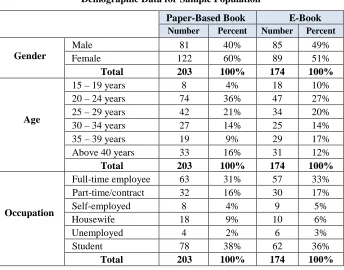
Of the 377 respondents, 174 had experience using e-books (Table 2), whereas the remaining 203 had experience purchasing paper-based books online. As a general rule, the minimum sample size should be at least five times as many observations as the number of variables to be analyzed, and a more acceptable sample size would be to have a 10:1 ratio (Hair et al., 2009). These sample sizes pass the criteria for this study.
Table 2
Demographic Data for Sample Population
Paper-Based Book E-Book
Number Percent Number Percent
Gender
Male 81 40% 85 49%
Female 122 60% 89 51%
Total 203 100% 174 100%
Age
15 – 19 years 8 4% 18 10%
20 – 24 years 74 36% 47 27%
25 – 29 years 42 21% 34 20%
30 – 34 years 27 14% 25 14%
35 – 39 years 19 9% 29 17%
Above 40 years 33 16% 31 12%
Total 203 100% 174 100%
Occupation
Full-time employee 63 31% 57 33%
Part-time/contract 32 16% 30 17%
Self-employed 8 4% 9 5%
Housewife 18 9% 10 6%
Unemployed 4 2% 6 3%
Student 78 38% 62 36%
International Journal of Business and Information
4.
ANALYSES AND RESULTS
For the analysis, structural equation modeling (SEM) was conducted using SPSS 23 and AMOS 23. SEM simultaneously tests multiple hypotheses by estimating the relationships between a set of multiple independent and dependent variables in a structural model (Gefen et al., 2000). SEM can impute relationships between unobserved constructs from observed variables, which was required in the current study and hence was selected for the analysis. The constructs in the current research are reflective and not formative. The causal action flows from the latent variables such as performance expectancy and effort expectancy.
4.1. Measurement Model
Based on the total of nine constructs and intention to use, we created a measurement model. We then conducted a factor analysis to examine the convergent validity, discriminant validity, and reliability of the constructs. A factor analysis is an interdependence technique whose primary purpose is to determine the underlying structure among the variables in the analysis (Hair et al., 2009).
Multicollinearity means that the variance independent variables explained in dependent variables overlap each other and thus do not explain unique variance in the dependent variable. The simplest and most obvious means of identifying collinearity is to examine the correlation matrix for the independent variables. The presence of high correlations (generally 0.9 and higher) is the first indication of substantial collinearity. Also, multicollinearity can be tested by a variance inflation factor (VIF) for which the suggested threshold is 3, with an acceptable threshold of 5 (Hair et al., 2009). As shown in Table 4 and Table 5, none of the correlations between the independent variables was found to be more than 0.7, and also no VIF for any of the variables was found to be higher than 3 for both product categories. The VIF ranged between 1.2 and 2.1. Therefore, no significant multicollinearity problem exists in the data.
Volume 13, Number 4, December 2018
were compared with an additional common latent factor and without a common latent factor. The difference between the two sets of standardized regression weights was not significantly high. In addition, Harman’s single-factor test was conducted, and none of the single factors explained the variance more than 50%, hence passing Harman’s one-factor test. Both of the tests indicated the absence of any considerable common method bias in the data.
For convergent validity, a pattern matrix was examined to check the factor loadings of the measurement items on the respective constructs and the cross-factor loadings. A cross-factor analysis was conducted using the maximum likelihood estimation method and promax rotation. All the factor loadings in this study were greater than 0.7 for e-books, except for one item in performance expectancy, facilitating conditions, and LT. Similarly, all of the factor loadings were greater than 0.7 for paper-based books, except for one item in facilitating conditions and LT. None of the items had a cross-loading higher than 0.2. For both the products, one measurement item related to facilitating conditions was excluded from the analysis because of its low factor loading and high cross-loadings.
Validity is how well the concept is defined by the measures, whereas reliability relates to the consistency of the measures (Hair et al., 2009). Reliability was tested through the computation of Cronbach’s alpha for each factor. The generally agreed upon lower limit for Cronbach’s alpha is 0.70, although it may decrease to 0.60 in exploratory research (MacCallum et al., 1994). Cronbach’s alpha for each construct was found to be higher than 0.7, as shown in Table 3, hence passing the reliability criteria.
Table 4 and Table 5 present the factor correlation matrixes for paper-based books and e-books, respectively. None of the correlations between the factors exceeded 0.7, which is also an indicator of passing the discriminant validity test.
Table 3
Measurement Model Assessment (Paper-Based Books and E-Books)
Construct Paper-Based Books (PB) E-Books (EB) Scale Item Cronbach’s
Alpha
Factor
Loading Scale Item
Cronbach’s Alpha Factor Loading Performance Expectancy PE1_PB 0.931
0.822 PE1_EB
0.893
0.677
PE2_PB 0.927 PE2_EB 0.935
PE3_PB 0.823 PE3_EB 0.831
PE4_PB 0.954 PE4_EB 0.780
International Journal of Business and Information Construct
Paper-Based Books (PB) E-Books (EB)
Scale Item Cronbach’s Alpha
Factor
Loading Scale Item
Cronbach’s Alpha Factor Loading Effort Expectancy EE1_PB 0.923
0.862 EE1_EB
0.918
0.947
EE2_PB 0.778 EE2_EB 0.815
EE3_PB 0.896 EE3_EB 0.821
EE4_PB 0.823 EE4_EB 0.844
Social Influence
SI1_PB
0.937
0.853 SI1_EB
0.930
0.940
SI2_PB 0.916 SI2_EB 0.884
SI3_PB 0.908 SI3_EB 0.886
Facilitating Conditions
FC1_PB
0.794
0.887 FC1_EB
0.834
0.845
FC2_PB 0.726 FC2_EB 0.779
FC3_PB 0.576 FC3_EB 0.647
FC4_PB Dropped FC4_EB Droppe
d Hedonic
Motivation
HM1_PB
0.938
0.896 HM1_EB
0.930
0.932
HM2_PB 0.959 HM2_EB 0.918
HM3_PB 0.873 HM3_EB 0.872
Price Value
PV1_PB
0.886
0.770 PV1_EB
0.877
0.788
PV2_PB 0.904 PV2_EB 0.851
PV3_PB 0.729 PV3_EB 0.827
Habit
HT1_PB
0.916
0.922 HT1_EB
0.917
0.794
HT2_PB 0.822 HT2_EB 0.940
HT3_PB 0.771 HT3_EB 0.860
HT4_PB 0.864 HT4_EB 0.759
Trust
TR1_PB
0.956
0.894 TR1_EB
0.925
0.900
TR2_PB 0.959 TR2_EB 0.785
TR3_PB 0.864 TR3_EB 0.760
TR4_PB 0.876 TR4_EB 0.883
Long Tail Effect
LT1_PB
0.924
0.930 LT1_EB
0.879
0.925
LT2_PB 0.965 LT2_EB 0.911
LT3_PB 0.704 LT3_EB 0.664
Intention to Use
IU1_PB
0.960
0.721 IU1_EB
0.958
0.743
IU2_PB 0.914 IU2_EB 0.722
Volume 13, Number 4, December 2018 4.2. Structural Model
Structural equation modeling was conducted for the selected products with seven constructs of UTAUT2, LT, trust, intention to use, and use behavior. Model fit indices were analyzed to ensure that the model could be used.
The chi-square value is the traditional measure used for evaluating overall model fit, and it assesses the magnitude of discrepancy between the sample and fitted covariance matrices (Hu & Bentler, 1999). A good model fit provides an insignificant result at the 0.05 threshold (Barrett, 2007). The RMSEA value between 0.08 and 0.10 provides a mediocre fit, and anything below 0.08 shows a good fit (MacCallum et al., 1996). However, more recently, a stringent upper limit of 0.07 (Steiger, 2007) seems to be the general consensus among authorities in this area.
A cut-off criterion of CFI ≥ 0.90 was initially considered to be high; however, recent studies have shown that a value greater than 0.90 is needed to ensure that mis-specified models are not accepted (Hu & Bentler, 1999). Values for the standardized RMR range from 0.0 to 1.0, with well-fitting models obtaining values less than 0.05 (Byrne, 1998; Diamantopoulos & Signaw, 2000); however, values as high as 0.08 are deemed acceptable (Hu & Bentler, 1999).
The path diagrams of the testing model for paper-based books and e-books are shown in Figure 1 and Figure 2, respectively.
For paper-based books, the chi-square was 1044.7 with 512 degrees of freedom. The root mean square error of approximation (RMSEA) was 0.072, comparative fit index (CFI) was 0.926, and root mean square residual (RMR) was 0.052. All of these model fit indices indicated the acceptance of the model for paper-based books.
International Journal of Business and Information 4.3. Results
For paper-based books, all seven constructs of UTAUT2, along with the additional constructs trust and LT, had positive regression weights; however, only habit, LT, performance expectancy, and trust were found to have a significant positive effect on intention to use. Both additional constructs (trust and LT) were found to have a significant relationship with intention to use. Similarly, facilitating conditions, habit, and trust had positive regression weights, but only trust was found to have a significant positive direct effect on use behavior. Also, it was found that intention to use has a significant positive effect on use behavior. The results are presented in Table 6.
For e-books, all seven constructs of UTAUT2, along with the additional constructs trust and LT, had a positive regression weight; however, only performance expectancy, trust, price value, and habit were found to have a significant positive effect on intention to use. It is important to note that, regarding the two additional constructs for e-books, only trust was found to be significant; LT was not found to have a significant relationship with intention to use. Similarly, facilitating conditions, habit, and trust had a positive regression weight, but only trust was found to have a significant positive direct effect on use behavior. Also, it was found that intention to use has a significant positive effect on use behavior. The results are presented in Table 7.
5.
CONCLUSIONS
The current research contributes to the understanding of user motivations behind purchase of e-book and paper-based book through online channels in Japan. The findings from this research indicate that user motivations behind intention to use for e-book are performance expectancy, trust, price value, and habit. However, direct predictors for use behavior were found to be intention to use and trust. Effort expectancy, social influence, facilitating conditions, hedonic motivation, and LT have positive regression weights but were not significant predictors for intention to use.
Volume 13, Number 4, December 2018
Effort expectancy and facilitating conditions were not found to be significant predictors of intention to use for both types of products. Effort expectancy reflects ease of use, and facilitating conditions reflects the items and support required to use the products. In a developed country such as Japan where computers and laptops are basic commodities and the Internet penetration rate is among the highest in the world (91% in 2015; Internet World Stats, 2016), facilitating conditions for online shopping and ease of use have become the norm. These factors may be positively affecting the adoption of these products through digital channels, but just because one possesses the required items for purchasing these products and is adept at using them does not necessarily result in intention to use or an actual purchase. This fact is also reflected in the research findings.
The effect of social influence was found to be insignificant, probably because people are already using online channels generally to collect information about tourism, places to visit, and so forth, but intention to use is not necessarily driven by social influence. Moreover, the number of habitual users and the number of frequent users of online channels are increasing, and these users will tend to have a minimal effect from social pressure when it comes to using these products through digital channels.
Hedonic motivation was also not found to be a significant predictor of intention to use, and this finding could be explained by the fact that there are so many more interesting, engaging, and entertaining websites and apps on smartphones, so that e-books or paper-based books purchased through online channels do not have much hedonic motivation to offer, at least in the countries where higher bandwidth is easily available.
The current study indicates that habit is a significant predictor of intention to use for online shopping of both the products. However, habit was not found to be a significant indicator for use behavior, and this may be because habitual users are engaged with digital channels, but just because they are highly engaged with online activities does not mean their frequent visits online will translate into a purchase decision. However, indirectly through intention to use, habit is a predictor of use behavior as well.
Performance expectancy was found to have a significant positive effect on intention to use for both the products. This reflects that users believe e-book and online book shopping improves their performance because of it being useful, saving time for them, and so forth.
International Journal of Business and Information products. Factors such as the absence of common cyber laws, anxiety due to the absence of face-to-face interactions with the seller, and online frauds makes trust an important predictor of online shopping and digital products.
The main difference between the intention to use predictors for e-books and paper-based books purchased through online channels is that the price value is one of the main user motivations for online shopping for e-books, and LT was not found to be a significant construct. On the other hand, for paper-based books, LT was found to be a significant construct, and price value was not found to be a significant construct. This is because publishing and the book industry in Japan (Japan Book Publishers Association) have set the guidelines and policies for a fixed retail price of books. Detailed fieldwork was also conducted to compare the prices of books in physical stores and online book stores in Japan, and it was found that there was no difference in the retail price of books between the two channels of sales. When online retailers are not free to decide the price of their books, they are not able to pass on price benefits to consumers. Therefore, price value is not a significant construct for books in Japan. However, for e-books, price value is an important reason for selecting the product.
LT was found to have no significant relationship to intention to use for e-books. This may be because there are still only a limited number of books available in e-book form. In the future, if the acceptance of e-books increases, then there is a possibility that LT may become an important reason for the adoption of e-books. However, in the current study, LT was not found to be a significant factor for intention to use e-books.
From the current research, we can conclude that the user motivations for adoption of products are influenced by external market situations, industry standards, and the inherent characteristics of the products.
In the current research, LT was found to be a significant factor for physical products, but not for virtual products. Many prior studies have also emphasized the importance of trust with regard to user’s intention to use and their use behavior. The current study proposes the inclusion of trust and LT in an organized research framework such as UTAUT2 so as to subsequently arrive at a comprehensive research framework that could explain all the user motivations for online shopping.
Volume 13, Number 4, December 2018
developing countries or even in the remote parts of Japan, the reasons for online shopping may carry different weights.
Also, the current research focused on e-books and paper-based books purchased through online channels. Other products, depending on their inherent characteristics, may have a different ranking of reasons for their adoption.
Future research could be conducted with additional constructs of trust and LT, along with the UTAUT2 constructs for different products, and in different geographical regions of the world. Also, the product characteristics related to the new construct could be tested to further understand user motivations for online shopping.
REFERENCES
Association of American Publishers. (2018). Retrieved from:
http://newsroom.publishers.org/book-publishing-annual-statshot-survey-reveals-religious-crossover-and-inspirational-books-supported-trade-book-growth-in-2016
Barrett, P. (2007). Structural equation modelling: Adjusting model fit, Personality and Individual Differences 42(5), 815-824.
Brown, S.A., & Venkatesh, V. (2005). Model of adoption of technology in the household: A baseline model test and extension incorporating household life cycle, MIS Quarterly 29(4), 399- 426.
Brynjolfsson, E.; Hu, Y.; & Simester, D. (2011). Goodbye Pareto principle, hello long tail: The effect of search costs on the concentration of product sales, Management Science 57(8), 1373- 1386.
Byrne, B.M. (1998). Structural Equation Modeling with LISREL, PRELIS. and SIMPLIS: Basic Concepts, Applications, and Programming, Mahwah, New Jersey: Lawrence Erlbaum Associates.
Childers, T.L.; Carr, C.L.; Peck, J.; & Carson, S. (2001). Hedonic and utilitarian motivations for online retail shopping behavior, Journal of Retailing 77(4), 511-535.
Computerworld. (2018). Retrieved from:
https://www.computerworld.com/article/2508262/mobile-wireless/amazon--e-books-now-outsell-pring-books.html
Diamantopoulos, A., & Signaw, J.A. (2000). Introducing LISREL, London: Sage Publications.
International Journal of Business and Information Escobar-Rodriguez, T., & Carvajal-Trujillo, E. (2013). Online drivers of consumer purchase of website airline tickets, Journal of Air Transport Management 32, 58-64.
Gefen, D.; Karahanna, E.; & Straub, D.W. 2003. Trust and TAM in online shopping: An integrated model, MIS Quarterly 27(1),51-90.
Gefen, D.; Straub, D.W.; & Boudreau, M.C. (2000). Structural equation modeling and regression: Guidelines for research practice, Communications of the Association for Information Systems 4(7), 1-70.
Hair, J.F.; Black, W.C.; Babin, B.J.; & Anderson, R.E. (2009). Multivariate Data Analysis 7th Edition, Pearson.
Hong, I.B., & Cha, H. S. (2013). The mediating role of consumer trust in an online merchant in predicting purchase intention, International Journal of Information Management 33(6), 927- 939.
Hu, L.T., & Bentler, P.M. (1999). cCtoff criteria for fit indexes in covariance structure analysis: Conventional criteria versus new alternatives, Structural Equation Modeling 6(1), 1-55.
Internet World Stats. (2016). Retrieved form:
http://www.internetworldstats.com/stats3.htm#asia on December 15th, 2016
Jin, C. H. (2014). Adoption of e-book among college students: The perspective of an integrated TAM, Computers in Human Behavior 41, 471-477.
Limayem, M.; Hirt, S.G.; & Cheung, C.M.K. (2007). How habit limits the predictive power of intentions: The case of IS continuance, MIS Quarterly 31(4), 705-737.
MacCallum, R.C.; Browne, M.W.; & Sugawara, H.M. (1996). Power analysis and determination of sample size for covariance structure modeling, Psychological Methods 1(2), 130-149.
MacCallum, R.C.; Roznowski, M.; Corinne, M.M.; & Reith, J.V. (1994). Alternative strategies for cross-validation of covariance structure models, Multivariate Behavioral Research 29(1), 1-32.
Podsakoff, P.M.; MacKenzie, S.B.; Lee, J.Y.; & Podsakoff, N.P. (2003). Common method bias in behavioral research: a critical review of the literature and recommended remedies, Journal of Applied Psycholog 88(5), 879-903.
Volume 13, Number 4, December 2018
Shim, D.; Kim, J.G.; & Altmann, J. (2016). Identifying key drivers and bottlenecks in the adoption of E-book readers in Korea, Telematics and Informatics 33, 860-871. DOI: 10.1016/j.tele.2015.12.009
Singh, M., & Matsui, Y. (2015). A bibliometric analysis on online shopping, International Journal of e-Education, e-Business, e-Management and e-Learning 5(2), 55-61.
Singh, M., & Matsui, Y. (2017). How long tail and trust affect online shopping behavior: An extension to UTAUT2 framework, Pacific Asia Journal of the Association for Information Systems 9(4), 1-24.
Steiger, J.H. (2007). Understanding the limitations of global fit assessment in structural equation modeling, Personality and Individual Differences 42(5), 893-898.
DOI: 10.1016/j.paid.2006.09.017
Swaminathan, V.; Lepkowska-White, E.; & Rao, B.P. (1999). Browsers or buyers in cyberspace? An investigation of factors influencing electronic exchange, Journal of Computer-Mediated Communication 5(2), 1-19.
DOI: 10.1111/j.1083-6101.1999.tb00335.x
The Guardian. (2018). Retrieved from:
https://www.theguardian.com/business/2009/dec/28/amazon-ebook-kindle-sales- surge
Thong, J.Y.L.; Hong, S.J.; & Tam, K.Y. (2006). The effects of post-adoption beliefs on the expectation–confirmation model for information technology continuance, International Journal of Human-Computer Studies 64(9), 799-810.
DOI: 10.1016/j.ijhcs.2006.05.001
Van der Heijden, H. (2004). User acceptance of hedonic information systems, MIS Quarterly 28(4), 695-704. DOI: 10.2307/25148660
Van der Velde, W., & Ernst, O. 2009. The future of e-books? Will print disappear? An end-user perspective, Library Hi Tech 27(4), 570-583.
DOI: 10.1108/07378830911007673
Venkatesh, V.; Morris, M.G.; Davis, G.B.; & Davis, F.D. (2003). User acceptance of information technology: Towards a unified view, MIS Quarterly 27(3), 425-478. DOI: 10.2307/30036540
International Journal of Business and Information ABOUT THE AUTHORS
Mahendra Singh is an associate professor in the International Business Studies
Department at Temple University in Japan. He is also an adjunct professor at Globis University, Japan; Sophia University, Japan; and Yokohama National University, Japan. He received his bachelor’s degree from the Indian Institute of Technology, Roorkee, India; his MBA from the International University of Japan; and his Ph.D. from Yokohama National University, Japan. He has extensive corporate experience in senior managerial positions at global companies such as Amazon Japan, McKinsey & company Japan, and Citibank Japan. His expertise and research interests are in the areas of information systems, e-business, and strategy.
Yoshiki Matsui is a professor in the Department of Business Administration at