Volume-6 Issue-1
International Journal of Intellectual Advancements
and Research in Engineering Computations
Abstract—This project emphasis on performance
analysis of cooling tower in industries. The motive of this project is to improve the efficiency of the cooling tower. Cooling tower is one of the main utility in industries.Cooling towers are heat removal devices used to transfer the water’s heat to the air, both directly and through evaporation of some of the water. Cooling towers may either use the evaporation of water to remove process heat and cool the working fluid.The mixing of warm water and cooler air releases latent heat of vaporization, causing a cooling effect to the water. They are a key component of many refrigeration systems and can be found in industries such as power plants, chemical processing, steel mills, and many manufacturing companies where process cooling is necessary.In this present be trained, the explanation affecting the performance like environmental stipulations, cooling water quality and then the fan angle were studied on induced draft cooling tower of thermal power stations.The main aim of the paper is to analyze the efficiency of the cooling tower by changing the cooling tower fan material and its angle.
Keywords – Power plants, Industries, Evaporation, Refrigeration, Performance,Cooling tower, Fan material,Angle
I. INTRODUCTION
Over heating of machine elements is common problem in industry. It is caused due to continuous operation of machine and atmospheric conditions of the surroundings. Operation cannot be stopped or in
other words the machine cannot be given time to be cooled down and therefore there has to be provision for cooling. Water is the best cooling medium as it is cheap and available in abundance. However it has to be noted that continuous flow of fresh water to the machine is not advisable as it creates great waste. Cooling towers are the water conservation devices. Waste heat is rejected to the atmosphere by
evaporative and sensible heat transfer. This allows water to be recycled to the chiller condenser to repeat the cycle.
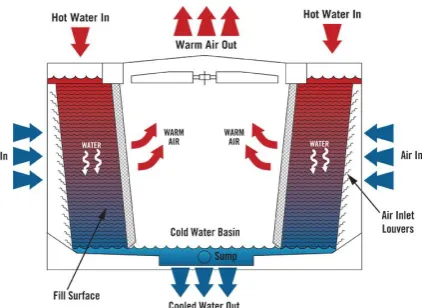
The above diagram represents the Induced draught cross flow cooling tower. We had to know, when the hot waters enters the cooling tower from upwards to downward. In the Cooling tower base has a cold water basin. When the hot water enter the tower, the water flow towards the cold water basin via fills and drift eliminators. At this time, the waste heat is rejected by the principle of evaporation.
Fig .1 Working of Cooling Tower
Performance of Cooling Tower with Different Fan Material– A Critical
Review
S. Balakrishnan
1, S.Selvakumar
2, P.Sivasankar
2, G.Srigautham
2, G.Tharun
2,
1Assistant Professor,
2UG Students
Department of Mechanical Engineering, Nandha Engineering College, Erode-52,
Tamil Nadu, India.
1
[email protected]
,
2[email protected]
Types of cooling tower:
Cooling towers are classified by the direction of air flow.
1) Natural draft cooling tower
2) Mechanical draft cooling tower
i) Forced draft cooling tower
ii) Induced draft cross flow cooling tower
iii) Induced draft counter flow cooling
tower
Natural Draft Cooling Tower: A cooling tower is an open direct contact write warm exchanger where high temp water from framework or condenser gets cooled by coordinate contact with natural air
Mechanical Draft Cooling Tower: Cooling tower fan is used to reduce the heat by the evaporation.
Cross Flow Tower: Air is drawn across the falling water and the fill is located outside the tower.
Counter Flow Tower: Air is drawn up through the falling water and the fill is therefore located inside the tower, although design depends on specific site conditions.
Components of cooling tower:
The basic components of a cooling tower includes 1. Frame and casing
2.Fill
3.Cold water basin 4.Drift eliminators 5.Air inlets 6.Louvers 7.Nozzles 8. Fans
Performance of cooling tower:
Range:
These measured parameters and then used to determine the cooling tower performance in several ways. It is the difference between the cold water in the basin and the warmer cooling water return. Ex. Design is 95-85=10
Approach:
It is the difference between the cold cooling water temperature and the wet bulb temperature.
Ex.Typical 6 to 10 degrees
Cooling towers cannot cool water below the wet bulb temperature of the outside air.
Evaporation rate:
E = 0.001X R X dT X EFC Where:
R = Recirculation Rate (3 gpm/ton) dT = Temperature Range
EFC = Evaporative Cooling Factor, ~75% Example: 1000 ton cooling load
E = 0.001x3000gpmx10Fx0.75 = 22.5 gpm = 32,400 gallons per day Cycle of Concentration:
The ratio between the impurity concentration in the recirculating water to the same impurity concentration in the makeup water.
II. LITERATURE REVIEW
[1] R.Ramkumar A.Ragupathyhas examined an exploratory examination of the warm execution of constrained draft counter stream wet cooling tower with extended wire work write pressing. The pressing utilized as a part of this work is wire work with vertical [VOWMP] and level [HOWMP] introductions. The pressing is 1.25 m stature and having a crisscross shape. From the analyses it is presumed that the vertical introduction of the pressing upgrade the execution of the cooling tower
[2]Mr. Bhupesh Kumar Yadav, Mr. S.L.Soni “Experimental Study of the Performance of Cooling Tower” Here Author discussed about Cooling tower is used to reduce the temperature of hot water stream. It is mainly used in air conditioning plants, chemical plants etc. Evaporation loss and effectiveness are two important performance parameters of cooling tower. Effectiveness of the cooling tower model comes out to be 52.94%. Practical evaporation loss is calculated i.e. 9.25 kg/hr. Validation of practical values is done using empirical relations. For calculating theoretical evaporation loss various empirical relations i.e. Modified Apjohn equation, Modified Ferrel equation andCarrier equation are provided. By reviewing literature it is came to know that results provided by carrier equation is most satisfactory. So analytical calculation is done using carrier equation and thus theoretical evaporation loss is calculated as 5.45 kg/hr which comes nearer to practical value.
of vitality and exergy for a shower cooling tower (SCT). The model is utilized to foresee the variety in temperature and exergy along the pinnacle length. The legitimacy of the model for anticipating varieties in gas and fluid attributes along the pinnacle length was analyzed against some working information estimated in a cooling tower organization. The outcomes demonstrate that the exergy of water diminishes as tower stature increments. The appropriation of the exergy misfortune is high at the base and slowly diminishes climbing to the highest point of the pinnacle. In addition, 1.50 m/s air speed brings about less exergy pulverization. With a decline in the span of the water beads, the liquids conveying vitality have more open doors for mass and vitality exchanges. [4] Mr. Ronak Shah,Mr.Trupti Rathod “Thermal Design of Cooling tower” Here author described a detailed methodology for thermal design of cooling tower. The technical data is taken for Mechanical draft cooling tower. The design of cooling tower is closely related to tower Characteristic and different types of losses generated in cooling tower. Even though losses are generated in the cooling tower, the cooling is achieved due to heat transfer between air and water. In ideal condition, the heat loss by water must be equal to heat gain by air. But in actual practice it is not possible because of some type of losses. Cooling tower performance increases with increase in air flow rate and characteristic decreases with increase in water to air mass ratio.
5] Pushpa B. S, VasantVaze, P. T. Nimbalkar “Performance Evaluation of Cooling Tower in Thermal Power Plant” has utilized an evaporative cooling tower is a warmth exchanger where change of warmth happens from flowing water to the climate. The warm water from the condenser is taken as a gulf water to the cooling tower and it is permitted to course through the spouts. As it tumbles down crosswise over astounds or louvers, the water is broken into little beads. All the while air is attracted through the air bay louvers gave at the base of the pinnacle and after that this air ventures upward through the pinnacle the other way of water stream. In this procedure a little bit of water gets vanished which expels the warmth from the rest of the dilute making it cool. This water is gathered in a bowl and is reused in the cooling water framework process. On account of dissipation, some amount of water is lost and in this way to make up the misfortune, the crisp water is continually added to the cooling water bowl. In a Natural Draft Cooling Tower, warm water is cooled
by dissipation process. Here, water gets cooled when a limit layer is shaped between immersed water and soaked air. In the event that the mass stream rate is perfect, at that point the execution of cooling tower and additionally the power plant will be progressed. In this investigation, it is demonstrated that by limiting the extent of water bead, the execution of Natural Draft Cooling Tower can be upgraded. Investigation of Sensitivity Analysis is done which demonstrates the reliance of parameters like air temperature, water temperature, relative dampness and rate of warmth misfortune. Further, effectiveness is likewise checked by utilizing power age information and result found was great.
[6] Upasna Sethi, Mansha Kumari ,Dharini Shah “A Review in Design and Performance Analysis of Cooling Tower “has explained ,Cooling towers are equipment devices commonly used to dissipate heat from power generation units, water-cooled refrigeration, air conditioning and industrial processes. Numerous factors can affect the operating performances and the design of the indirect air cooling system of power plant. A review mainly focuses on two things such as Design and Performance of cooling tower. It provides the base of the selection in cooling tower.
[7] Lu, W. Cai “A Universal Engineering Model for Cooling Towers” has portrayed about a widespread designing model, which can be utilized to plan both counter stream and cross stream cooling towers. By utilizing major laws of mass and vitality adjust, the adequacy of warmth trade is approximated by a moment arrange polynomial condition. Gauss - Newton and Liebenberg-Marquardt strategies are then used to decide the coefficients from makes information. Contrasted and the current models, the new model has two primary preferences: (1) As the designing model is gotten from building point of view, it includes less info factors and has better depiction of the cooling tower activity; (2) There is no iterative calculation required, this component is essential for online improvement of cooling tower execution. Despite the fact that the model is basic, the outcomes are extremely precise.
attempt to deal with the technology, applications of cooling towers.
[9] B Bhavani Sai, I Swathi, K S L Prasanna, K Srinivasa Rao “Design Of Cooling Tower” has portrayed a nitty gritty philosophy of an Induced draft cooling tower of counter stream compose in which its productivity, viability, attributes are figured. The specialized information has been taken from a mechanical draft cooling tower. Cooling towers are warm evacuation gadgets used to exchange process squander warmth to the air. Cooling towers make utilization of dissipation whereby a portion of the water is vanished into a moving air stream and accordingly released into the air. Accordingly, the rest of the dilute is cooled altogether.
[10] Mr.R. Sattanathan “Experimental Analysis on Performance of a Counter Flow Tray Type Cooling Tower” The main aim of this project is to increase the cooling rate by modifying the design i.e. by replacing the fill material with the aluminium trays and reducing the height to provide an energy efficient. In this, use trays for the water to move horizontally in each tray and get a large surface area for the water to evaporate.
[11]A.Vijayaragavan,S.Arunraj,P.Parthasarthy,M.Sun dar Raj “Performance And Analysis Of Cooling Tower (IRJET)”- the motive of the project deals with the performance study and analysis of induced draft cooling tower, which is one of the deciding factors used for increasing the power plant efficiency also modelling and analysis of flow using software. Here ANSYS workbench is used for CFD analysis of cooling tower. Here various domains are defined like porous and air. In boundary condition the inlet water temperature 380c, inlet air temperature 200c, volume of circulating water circulated in cooling tower 30 m3/hr.
[12]Pipat Juangjandee, Thawan Sucharitakul “Performance Evaluation Of Induced-Draft Cross-Flow Cooling Tower” - the motive of the project is to study the performance of the cooling tower in coal-fire power plant. From this study, it was found that the cooling tower thermal efficiency is 51.63%, lower than designed and guarantee values, 70.97% and 70.97% respectively.
[13] Piyush Yadav ,Sagar Gojare ,Bhushan Patil ,Krushna Kanthale,. A.S Dube “Performance
Evaluation of Evaporated Water In Cooling Towers” The main aim of the project is to use drift eliminators in cooling towers in order to minimize water loss from the system. Finally, to optimize the efficiency and the thermal performance of the cooling towe r drift eliminator is proposed.
[14] Yadavalli Basavaraj,G Raghavendra Setty,Santhosh Naik “Prediction of Blade Resonance of Cooling Tower Fans Using Vibration Analysis”-This paper deals with the study is to is to find the resonance of cooling tower fan using vibration analysis. This method can eliminate the failures of the cooling tower fan blades, shorten the repair cycle, ensures the smooth production of the enterprise and improve economic efficiency.
[15] M.V.H.Satish Kumar “Measurement of air flow requirement, alter the fan blade angle for optimum performance and Energy consumption of a cooling tower”-In this paper regards, the air flow requirements have been calculated for different climatic conditions and made suitable fan blade angle to evaluate the shaft power, efficiency and energy savings are to be calculated.
III. SUMMARYOFLITERATIVEREVIEW
1) In the experimental results, the VOWMP is having better performance than HOWMP. It is due water passing over the flank angle of the wire mesh fills and fine water droplets formed in the VOWMP In the design and fabrication of river cleaning system which is used to remove the waste debris, plastic waste and garbage waste with the help of the water wheels, conveyor, open and close belt drive.
2) Evaporation loss and effectiveness are two important performance parameters of cooling tower. Effectiveness of the cooling tower model comes out to be 52.94%. Practical evaporation loss is calculated i.e. 9.25 kg/hr.
3) The model is used to predict the variation in temperature and exergy along the tower length.The results show that the exergy of water decreases as tower height increases. The distribution of the exergy loss is high at the bottom and gradually decreases moving up to the top of the tower.
it is not possible because of some type of losses.
5) If the mass flow rate is ideal, then the performance of cooling tower as well as the power plant will be improved. In this study, it is showed that by minimizing the size of water droplet, the performance of Natural Draft Cooling Tower can be enhanced.
6) Various parameters related to cooling tower is calculated i.e. range, approach, effectiveness and evaporation loss.
7) As the engineering model is derived from engineering perspective, it involves fewer input variables and has better description of the cooling tower operation.There is no iterative computation required, this feature is very important for online optimization of cooling tower performance.
8) The climatic conditions like air dry bulb and wet bulb temperature, relative humidity will affect the performance of the cooling tower.
9) Cooling towers make use of evaporation whereby some of the water is evaporated into a moving air stream and subsequently discharged into the atmosphere. As a result, the remainder of the water is cooled down significantly
10) The losses of the cooling tower are high in winter season as compare to summer season.
11) Water outlet temperature of cooling tower decreases as the air inlet angle decreases. Hence the cooling efficiency and effectiveness of cooling tower increases
12) Water flow should be analyzed and readjusted because it less than the designed value quite big. The hot water flow distribution is in poor condition. All distribution valves have to be readjusted.
13) The drift eliminator mainly affects two parameters of cooling towers: their thermal performance and the amount of water drift loss.
14) By changing the predefined speed the fan has run upto 1430rpm and found vibration to the minimum limits
15) The efficiency of the fan can be improved by altering the fan blade according to the airflow requirement with respect to the climatic conditions.
IV. CONCLUSION
Our literature review highlights the ongoing advancement and literatures about the Performance analysis of cooling tower. Many specific empirical studies have been carried out and categories such as changing of cooling tower fan blade material and changing cooling tower fan angle. We focus more on to improve the efficiency of the cooling tower.
REFERENCES
[1] R. Ram Kumar A. Ragupathy, Thermal Performance of Forced Draft Counter Flow Wet
Cooling Tower with Expanded Wire
MeshPackingInternational Journal on “Technical and Physical Problems of Engineering” (IJTPE), Issue. 6, Vol. 3, No. 1, Mar. 2011.
[2]Bhupesh Kumar Yadav, S. L. Soni, Experimental Study of the Performance of Cooling Tower ISSN: 2249 – 8958, Volume-4 Issue-2, December 2014
[3]Xiaoni Qi, Yongqi Liu, Zhenyan Liu, Exergy Based Performance Analysis of a Shower Cooling Tower - Journal of Mechanical Engineering 59(2013)4, 251-259.
[4] Ronak Shah, TruptiRathod, Thermal Design Of Cooling Tower, International Journal of Advanced Engineering Research and StudiesE-ISSN2249–8974.
[5] Pushpa B. S, VasantVaze, P. T. Nimbalkar Performance Evaluation of Cooling Tower in Thermal Power Plant - A Case Study of RTPS, Karnataka International Journal of Engineering and Advanced Technology (IJEAT), International Journal of Engineering and Advanced Technology (IJEAT) ISSN: 2249 – 8958, Volume-4 Issue-2, December 2014.
[6]Upasna Sethi, ManishaKumari, and Dharini Shah “A Review in Design and Performance Analysis of Cooling Tower “e-ISSN: 2395 -0056 Volume: 03 Issue: 12 | Dec -2016 p-ISSN: 2395-0072.
[7] Lu, W. CAI, A Universal Engineering Model for Cooling Towers, (2002). International Refrigeration and Air Conditioning Conference. Paper 625.
Engineering Trends and Technology (IJETT) – Volume 38 Number 9- August 2016
[9] B Bhavani Sai, I Swathi, K S L Prasanna, K Srinivasa Rao, Design Of Cooling Tower, International Journal of Scientific & Engineering Research, Volume 4, Issue 5, May-2013 1560 ISSN 2229-5518
[10] Mr.R. Sattanathan “Experimental Analysis on Performance of a Counter Flow Tray Type Cooling Tower” Volume 4 Issue 4, April 2015
[11]A.Vijayaragavan,S.Arunraj,P.Parthasarthy,M.Sun dar Raj “Performance And Analysis Of Cooling Tower (IRJET)”e-ISSN: 2395 -0056 Volume: 03 Issue: 04 | Apr-2016 www.irjet.net p-ISSN: 2395-0072
[12] Pipat Juangjandee,Thawan Sucharitakul “Performance Evaluation Of Induced-Draft Cross-Flow Cooling Tower”
[13] Piyush Yadav, Sagar Gojare ,Bhushan Patil ,Krushna Kanthale, A.S Dube “Performance Evaluation of Evaporated Water In Cooling Towers”Vol-2 Issue-3 2016 IJARIIE-ISSN (O)-2395-4396.
[14] Yadavalli Basavaraj,G Raghavendra Setty,Santhosh Naik “Prediction of Blade Resonance of Cooling Tower Fans Using Vibration Analysis” Vol. 6, Issue 4, April 2017ISSN(Online): 2319-8753ISSN (Print): 2347-6710.