INTRODUCTION
The composition of groundwater is mainly shaped by the hydrochemical as well as physical and biological processes. One of the factors af-fecting the chemical composition of groundwa-ter is the dissolution of minerals. The biological and biochemical changes occurring with the par-ticipation of microorganisms are other important processes. Microorganisms participate in the ma-jority of oxidation-reduction processes, which in many cases, determine the migration of elements and their compounds [Appelo and Postma 2005, Tekerlekopoulou at al. 2013]. The main ground-water contamination is dissolved gases, mainly CO2, iron and manganese compounds, and to a lesser extent, natural organic matter (NOM), the source of which are usually humic substances that give the groundwater color and elevated CODMn values. Humic substances infiltrate into the groundwater as a result of leaching from the brown coal of peat deposits, as well as from the
soils abundant in humus [Pisarek and Głowacki 2015, Tekerlekopoulou at al. 2013].
The presence of organic compounds in ground-water may adversely affect its taste and smell, which may lead to the secondary development of bacteria in the water distribution system. More-over, they may be precursors of the by-products arising e.g. during water disinfection [Świetlik 2004, Hua 2007, Chiang at al. 2009]. Among the contaminants found in groundwater, color signifi -cantly complicates the technological process, forc-ing the use of the treatment methods characteris-tic of surface waters [Dąbrowska 2016, Sillanpää 2018, Szlachta and Adamski 2009]. The effective methods of removing the color originating from humic compounds include chemical oxidation pro-cesses using ozone, sorption propro-cesses on granular activated carbons, coagulation and membrane pro-cesses. Often, only a combination of several meth-ods allows to obtain the appropriate water qual-ity [Sillanpää et al. 2018, Kaleta 2017, Krupińska 2012, Pietrzyk and Papciak 2018, Piekutin 2013].
Accepted: 2019.08.30 Available online: 2019.09.21 Volume 20, Issue 9, October 2019, pages 138–144
https://doi.org/10.12911/22998993/112497
Color Removal from Groundwater by Coagulation
and Oxidation Processes
Jacek Leszczyński
11 Bialystok University of Technology, ul. Wiejska 45E , 15-351 Białystok, Poland
e-mail: [email protected]
ABSTRACT
The paper concerns the experimental research related to the removal of color and permanganate index (CODMn) in
the presence of iron and manganese from the underground water by means of coagulation and ozonation. The tests were carried out on a laboratory and technical scale in the real underground water treatment system. Ozone, as a strong oxidizing agent, was used to reduce the color intensity and to convert the iron Fe2+ and manganese ions Mn2+
to Fe(OH)3 and MnO2, respectively. In order to optimally remove the color to a value below 15 mg/L, the ozone dose of 3 mg/L was sufficient, which also ensured the proper removal of iron and manganese, by 94% and 83%, respectively. However, ozonation conducted under these conditions, did not provide sufficient removal of organic
compounds expressed as CODMn below the assumed value of 3 mg/L. The effect of aluminum sulfate and polyalu -minum chloride (PAC) was also studied, as a result of which it was found that polyalu-minum chloride proved to
be more effective reagent. Under the technical conditions of water purification at a dose of 16 mg/L coagulant, the efficiency of color removal was 65.2% and CODMn – 50.8%, which ensured that the values of the tested indicators in the purified water were maintained below the permissible level.
Among the above-mentioned processes, the coagulation carried out directly in the filter bed together with the removal of iron and manganese is used to remove the organic pollutants from un-derground water. However, this process requires the use of special contact filters. The effective -ness of coagulation depends on many factors, e.g. pH and temperature of water, type and dose of coagulant, contact time, type of filter filling, and many other parameters, the impact of which often determines the efficiency of the process [Matilainen et al. 2010, Libecki and Dziejowski 2008, Świderska-Bróż et al. 2008]. The effective -ness of coagulation also depends on the chemi-cal composition of water, e.g. higher content of calcium and magnesium in water improves the removal efficiency of humic substances [Kaleta and Puszkarewicz 2019].
The most commonly used coagulants are based on hydrolyzable aluminum and iron salts, including aluminum sulfate and iron(III) sulfate. For the proper course of coagulation with these reagents, it is necessary to have a proper natural alkalinity ensuring their hydrolysis. This require-ment is not always met; therefore, it is often nec-essary to correct the alkalinity before coagulation. In addition, a right reaction time is required for the proper hydrolysis of these coagulants. In this situation, the so-called pre-hydrolyzed coagulants as polyaluminum chloride, can be applied [Iv-ancev-Tumbas 2001, Nowacka 2014, Matilainen et al. 2010, Ghernaout et al. 2009]. Polyaluminum chlorides are also polymerized coagulants. As a result of their use, a larger amount of hydrolysis products is also formed than using traditional alu-minum coagulants [Yan et al. 2008]. Most NOMs can be removed by coagulation, although the hy-drophobic fraction and compounds with high mo-lecular weight are removed more efficiently than the hydrophilic fraction and compounds with low molecular weight [Sillanpää et al. 2018].
Ozonation is a recognized method used to re -move color as well as reduce the concentration of disinfectant by-products from chlorine com-pounds. Ozone also reacts with organic substanc -es, which leads to their increased biodegradability. The use of the ozonation process as pre-oxidation additionally improves the taste and smell of wa-ter and has a positive effect on the effectiveness of coagulation. In groundwater, ozone can be used in addition to the oxidation of iron and manganese as well as sulfides, nitrites, arsenic and bromide ions. However, ozonation of the NOM-containing water
can lead to the formation of aldehydes, ketones and carboxylic acids, as well as bromides and bro-mates. Therefore, this process is usually combined with coagulation and sorption on biologically ac-tive carbon filters to effecac-tively eliminate the ozo -nation by-products [Chiang at al. 2009].
The aim of the present study was to examine the possibility of removing the color and CODMn in a real underground water treatment system in-cluding aeration and a two-stage filtration process using coagulation and ozonation.
MATERIALS AND ANALYTICAL METHODS
The water for tests came from an underground intake located in northeastern Poland. The intake consists of two deep wells with an operational ca-pacity of approximately 100 m3/h. In the existing technological system, water is treated by aeration and two-stage filtration on quartz filters and filters with a catalytic bed. A dosing system for sodium hypochlorite is provided for a periodic disinfec-tion of water. The treated water is collected in the equalizing tank, from where it is pumped to the network with a set of multi-stage pumps.
Hydrated aluminum sulfate (Al2(SO4)3 × 18H2O), polyaluminum chloride (PAC), 95–97% H2SO4 (w/w) and NaOH were used in the technological test. During the tests: pH, color, turbidity, iron, manganese, permanga-nate index (CODMn), ammonium ion and nitrate were determined. The analytical tests were carried out according to the standard procedure [APHA 1998]. The pH-meter (Hach session 4) was used for the pH determination, while the turbidity was determined with the nephelometric method us-ing the WTW 550 IR device. The color was de-termined on the platinum-cobalt scale using the Hach DR 4000 spectrophotometer. The concen-tration of ozone in the air-ozone mixture was de -termined by means of the iodometric method [In-ternational Ozone Association 1987]. The basic statistical analysis included calculation of mean value and standard deviation. The achieved test results represent an average of at least three rep-etitions, and the standard deviation of measured values did not exceed 5% level.
Experimental procedures
treatment station. In the initial laboratory tests, reagents and process parameters were selected, such as reagent type, dose, contact time and pH. Then, the results of laboratory experiments were applied in the real technological system of the water supply station. As a criterion satis-fying the purification efficiency, the following were assumed: color ≤ 15 mgPt/L and CODMn ≤ 3.0 mgO2/L.
The experimental tests on a laboratory scale were carried out in technological systems including aeration, coagulation and filtration as well as ozonation and filtration. Aluminum sulfate and polyaluminum chloride (PAC) were used in the coagulation process. The doses of aluminum sulfate and PAC were 4–20 mg/L based on Al2O3. Coagulation was carried out in the water samples after aeration in a sys-tem including the step of fast and slow mixing, sedimentation, decanting and filtration. In the first phase of the process, the sample water, to-gether with the reagent, was mixed intensively for 2 min at a speed of about 100 rpm, then slowly with an intensity of about 35 rpm in the assumed time of 10 and 15 minutes. Sedimen -tation time was 60 minutes. Before the coagu -lation, water was aerated using a ceramic dif-fuser for 15 minutes.
Ozonation was carried out in a static sys -tem in 1 L water samples. The installation con-sisted of a contact chamber with a diameter of 0.05 m equipped with a ceramic diffuser with a diameter of 30 mm. The source of ozone was an ozonator with a capacity of approximately 6 g O3/h. During the tests, the flow of ozone was 0.5 L/min, the concentration of ozone in the air-ozone mixture was 1.0 mgO3/L. Dose of the oxidant was determined by the ozonation time, which was from 4 to 10 min, providing a dose of 2 to 5 mgO3/L.
The tests in the real system were carried out using aluminum sulfate and polyaluminum chloride applying the doses of reagents deter-mined on the basis of preliminary tests. Each time after determining the assumed dose of the coagulant, several research series were carried out and the obtained water samples were sub-jected to analytical determinations. The water for analytical tests was collected after 60 min -utes of pump operation, which ensured proper water exchange in fast filters.
RESULTS AND DISCUSSION
Characteristics of water
The results of the raw water tests are pre-sented in Table 1. The raw water was charac-terized by an increased color in the range of 26–28 mgPt/L and the CODMn value in the range 6.4–6.8 mgO2/L, also contained elevated iron and manganese concentrations, 3.4–3.8 mgFe/L and 0.28–0.32 mgMn/L, respectively. According to the tests carried out at the water treatment plant, the technological system used effectively re -moves iron and manganese compounds, and there were no exceedances of ammonium ion and tur-bidity. At the same time, the organic compounds that give it an increased color and CODMn above the acceptable level, remain in the treated water.
Laboratory tests
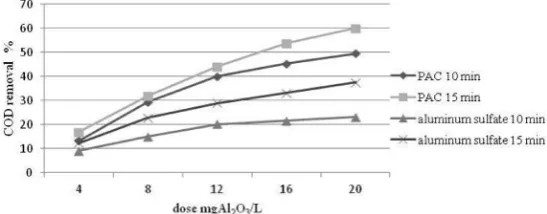
During the tests, two aluminum coagulants were tested, and tests were carried out using ozone to remove color and to oxidize iron and manganese. Due to the short contact time that can be achieved during the filtration of water in the real technological system, the tests were carried out at two reaction times of 10 and 15 minutes. The initial color and CODMn values in raw water were 27 mg/L and 6.6 mg/L, respectively. The ef -fectiveness of color and CODMn removal after the coagulation process using aluminum sulfate and polyaluminum chloride, depending on the dose of coagulants and the reaction time, is shown in Figure 1. The reduction of color due to aluminum sulfate to values below 15 mg/L was obtained at a dose of 16 mg/L of coagulant after 15 minutes of reaction; however, the water still contained an over-norm CODMn value above 5 mg/L. The low-est CODMn content of 4.1 mg/L was recorded at
Table 1. Characteristics of the raw water
Parameter Value Standard deviation
pH 6.7 0.1
Color (Pt-Co units) 27 1
Turbidity (NTU) 2.33 0.58
CODMn (mg O2/L) 6.6 0.2
Iron (mg Fe/L) 3.6 0.2
Manganese (mg Mn/L) 0.3 0,02
Nitrate (mg NO3-/L) 1.07 0.23
Ammonium ion
this reaction time using a dose of 20 mg/L of co-agulant. In this case, the effect of color reduction and CODMn was 50% and 37.5%, respectively. With a reaction time of 10 minutes and the high-est dose of aluminum sulfate (20 mg/L), the color removal efficiency was 38% and the CODMn – 23.1%; thus, the values of these indicators in the treated water were 16.7 mg/L and 5.1 mg/L, and it still exceeded the assumed levels. In addition, in the case of the water after coagulation with a shorter contact time, the turbidity increased above 3 NTU already at a dose of 12 mg/L. The effect of removing the color and CODMn shown in Figures 1 and 2 does not proceed in proportion to the amount of coagulant introduced; therefore, further increasing the dose of aluminum sulfate seems unjustified.
In the case of polyaluminum chloride, the proper color removal efficiency was obtained at the 8 mg/L dose and the contact time of 15 min-utes. A slightly higher dose of 12 mg/L was re-quired to lower the color below 15 mg/L with a reaction time of 10 min. The maximum reduction of color at a dose of 20 mg/L at the longest and the shortest contact times was 75% and 58%, respec -tively. On the other hand, lowering the CODMn to the assumed value at a longer reaction time was obtained using a dose of polyaluminum chloride of 16 mg/L. In the second case, even at a dose of 20 mg/L, CODMn was 3.3 mg/L, which exceeded
the assumed value. At the same time, in the case of polyaluminum chloride, even at the highest dose, the turbidity of water after the process did not exceed 1 NTU.
The studies carried out by Rucka at al. [2019] also indicate the high efficiency of polyalumi -num chloride in the removal of humic substances, which for TOC were in the range of 37.2–59.4% and 20.0–41.5% for pre-hydrolyzed and hydro -lyzing coagulants, respectively. Moreover, the effect increased along with the molecular weight of humic substances present in water. According to the Nowacka and Włodarczyk-Makuła [2014], application of pre-hydrolyzed aqueous solutions of aluminum polychlorosulfate Flokor 1 SAW/B, Flokor 105V during the coagulation process, al -lowed to improve the water quality in comparison with unhydrolyzed aluminum sulfate(VI). At the same time, the dose of these coagulants was lower by 36.4%. Higher efficacy of pre-hydrolyzed co -agulants is also confirmed by other studies [Duan and Gregory 2003, Nowacka et al. 2014].
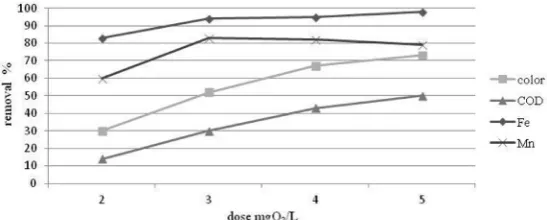
Ozonation and filtration of water proved to be a very effective process for removing the color, iron and manganese. The results of the tests are presented in Figure 3. The initial color and COD values in raw water were 27 mg/L and 6.4 mg/L, respectively. After the process, the color value in the assumed range of <15 mg/L was obtained al-ready at the ozone dose of 3 mgO3/L. The applied Fig. 1. Comparison of the color removal efficiency using polyaluminum chloride and alu
-minum sulfate depending on the dose of coagulants and contact time
dose also ensured the effective removal of iron and manganese to 0.2 mg/L and 0.04 mg/L, re-spectively. However, the CODMn value in this case still exceeded the assumed value and amounted to 4.5 mg/L. Even the highest dose of ozone used did not allow the CODMn to fall below 3 mg/L. The highest reduction efficiency of this indicator at the 5mg/L ozone dose was 50%, which ensured the removal of CODMn to the value of 3.2 mg/L. In the case of color, Fe and Mn, the effect at this dose of ozone was 73%, 98% and 79%, respec -tively. However, such a high dose of ozone in the presence of organic compounds may lead to the formation of the unwanted oxidation by-prod-ucts [Sadrnourmohamadi and Gorczyca 2015, Ivancev-Tumbas and Dalmacija 2001]. In addi-tion, in the waters containing manganese, the use of high doses of ozone can lead to the oxidation of manganese to Mn7+, which results in a decrease in the manganese removal efficiency and may lead to the appearance of a pink color. This ef-fect was observed at the dose of 4 mgO3/L, where the concentration of manganese was higher than
at the dose of 3 mgO3/L. For the optimal removal of iron and manganese, Araby et al. [2009] used a dose of 3 mg/L ozone, which ensured removal of iron and manganese by 96% and 83%, respec -tively. These studies also confirmed the fact that the effectiveness of manganese removal above 3.5 mgO3/L was reduced.
Technological tests on a real scale
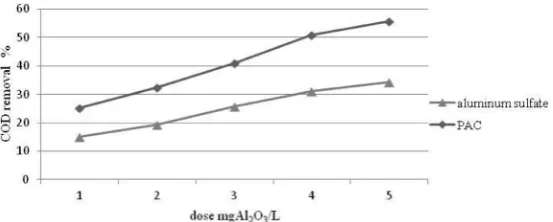
The results of the technological tests con-ducted on a technical scale in the real system of the water treatment station are presented in Tables 2, 3 as well as in Figures 4 and 5. Dur -ing the tests, slight fluctuations in color in the range of 25–28 mg/L in raw water were found, which required a correction of the established doses of reagents. The main tests were carried out at the maximum observed color of 28 mg/L and CODMn 6.4 mg/L. The results of coagulation studies with aluminum sulfate and polyaluminum chloride confirm the conclusions obtained in lab -oratory tests, where significantly higher efficien -cy was obtained using polyaluminum chloride, Fig. 3. Effect of ozone dose on the removal of color, CODMn, Fe and Mn
Table 3. Values of selected indicators of water quality after coagulation using aluminum sulfate
Parameter Dose [mg Al2O3/L]
4 8 12 16 20
Color (Pt-Co units) 22 19 18 16 15
Turbidity (NTU) < 1 1 2 3 5
CODMn (mg O2/L) 5.4 5.2 4.7 4.4 4.2
Iron (mg Fe/L) 0.2 0.1 0.1 0.2 0.2
Manganese (mg Mn/L) 0.02 0.01 0.05 0.07 0.08
Table 2. Values of selected indicators of water quality after coagulation using polyaluminum chloride
Parameter Dose [mg Al2O3/L]
4 8 12 16 20
Color (Pt-Co units) 18 15 12 9 8
Turbidity (NTU) < 1 < 1 1 1 2
CODMn (mg O2/L) 4.8 4.3 3.8 3.1 2.8
Iron (mg Fe/L) 0.1 0.05 0.1 0.1 0.05
especially with shorter reaction times. In this case, the color value of 15 mg/L was obtained al-ready at a dose of 8 mg/L coagulant. Using alumi -num sulfate, the color at the level of 15 mg/L was recorded only at a dose of 20 mg/L. At the same time, by dosing the aluminum sulfate, already at a dose of 12 mg/L in water after the second degree of filtration, increased turbidity above 2 NTU ap -peared. Similarly to the laboratory tests, the ef -fect was also significantly worse in relation to CODMn. Only polyaluminum chloride allowed to lower the CODMn to the assumed value of 3 mg/L. This effect was obtained at a dose of 20 mg/L of coagulant. However, the use of such a high dose of coagulant increased the turbidity in water af-ter the process to 2 NTU. Therefore, under the conditions discussed, the dose of polyaluminum chloride should not exceed 16 mg/L. In this case, the CODMn was 3.1 mg/L, which only slightly exceeded the assumed value of 3 mg/L. Regard-less of the applied dose of both aluminum sulfate and polyaluminum chloride, the iron concentra-tion did not exceed the permissible values and was at the highest dose of coagulants – 0.2 and 0.05 mgFe/L, respectively. The concentration of manganese after coagulation with aluminum sul-fate did not exceed the limit value of 0.05 mg/L at a dose of 12 mg/L, whereas after the use of polyaluminum chloride at the dose of 16 mg/L. In both cases, higher doses of coagulants resulted in a decrease in the manganese removal efficiency.
CONCLUSIONS
The currently operated underground water treatment system, together with installed devices, ensures effective removal of iron and manga -nese, while the values of color and CODMn are still elevated above the permissible limits in the treated water.
Preliminary laboratory tests showed the pos-sibility of effective removal of color and CODMn to the values assumed using PAC at the dose of 16 mg/L. In this case, reduction of these indica -tors was 71.7% and 53.8%, respectively. The use of ozone also proved to be an effective way to remove color, iron and manganese; however, wa-ter still had an increased CODMn value after the process, higher than assumed one, even at a dose of 5 mg O3/L. In addition, the use of ozone at the treatment station would require a thorough recon-struction of the existing technological system. However, the advantage of this process would be the possibility of giving up the second stage of filtration designed to remove manganese.
In the existing technological system, removing the color without significant investment outlays is possible only with the use of coagulation carried out in the currently used filter beds. The experiments on a technical scale showed greater efficiency of poly -aluminum chloride dosed before the first stage of filtration. The assumed color values of less than 15 mg/L were obtained with a dose of polyaluminum Fig. 4. Effect of coagulant doses on the extent of color removal
chloride – 8 mgAl2O3/L, while CODMn removal to 3.1 mg/L level required a dose of 16 mg/L.
REFERENCES
1. APHA (American Public Health Association) 1998.
Standard Methods for the Examination of Water and
Wastewater. American Public Health Association, Washington, DC.
2. Appelo C.A.J., Postma D. 2005.
Geochemis-try, groundwaterand pollution. Taylor&Francis,
Amsterdam.
3. Araby R.El., Hawash S., Diwani G.El. 2009. Treat -ment of iron and manganese in simulated
ground-water via ozone technology. Desalination, 249(3),
1345–1349.
4. Chiang P.C., Chang E.E., Chang P.C., and Huang,
C.P. 2009. Effects of pre-ozonation on the remov
-al of THM precursors by coagulation. Sci. Tot-al
Environ., 407(21), 5735–5742.
5. Dąbrowska L. 2016. Removal of organic matter
from surface water using coagulants with various
basicity. J Ecol Eng., 17(3), 66–72.
6. Duan J., Gregory J. 2003. Coagulation by
hydro-lyzing metal salts. Adv. Colloid Interface Sci.,
100–102, 475–502.
7. Ghernaout D., Ghernaout B., Kellil A. 2009. Natural
organic matter removal and enhanced coagulation. Desalin. Water Treat., 2, 203–222.
8. Hua G., Reckhow D.A. 2007. Characterization of
disinfection byproduct precursors based on
hydro-phobicity and molecular size. Environ Sci Technol.,
41, 3309–3315.
9. International Ozone Association 1987. Standardisa -tion Committee-Europe: Iodometric Method for the
Determination of Ozone in a Process Gas, 001/87.
10. Ivancev-Tumbas I., Dalmacija B. 2001. Effects of
coagulation processes on aldehydes formation in groundwater treated with common oxidative agents. Water Res., 35, 3950–3958.
11. Kaleta J., Puszkarewicz A. 2019. Inflence of Wa
-ter Hardness on the Effctiveness of Coagulation of Humic Compounds. J. Ecol. Eng., 20(6), 126–134.
12. Kaleta J., Papciak D., Puszkarewicz A. 2017. Evalu
-tion of the effiency of the adsorp-tion process in re -moving humic substances from water. Ecological Engineering 18(4), 107–115.
13. Krupińska I. 2012. Suitability of Coagulation for Treatment of Groundwater. Rocznik Ochrona Środowiska, 14, 491–501.
14. Libecki B., Dziejowski J. 2008. Optimization
of humic acids coagulation with aluminum and iron(III) salts. Polish Journal of Environmental
Study, 17(3), 397–403.
15. Matilainen A., Vepsäläinen M., Sillanpää M. 2010.
Natural organic matter removal by coagulation dur-ing drinkdur-ing water treatment: A review. Advances in
Colloid and Interface Science, 159, 189–197. 16. Nowacka A., Włodarczyk-Makuła M. 2014. Impact
of Selected Pre-Hydrolyzed Aluminum Coagulants on Improvingof Treated Water Quality. Rocznik Ochrona Środowiska, 16, 336–350.
17. Nowacka A., Włodarczyk-Makuła M., Macherzyński B. 2014. Comparison of effectiveness of coagulation with aluminum sulfate and pre-hydrolyzed aluminum
coagulants. Desalin. Water Treat., 52, 3843–3851. 18. Piekutin J. 2013. Removal of petroleum
hydro-carbons from water. Ann. Set Environ. Prot., 13, 2468–2478.
19. Pietrzyk A., Papciak D. 2018. The effectiveness
of organic matter removal in unit processes of the
technological groundwater treatment system. E3S
Web Conf., 44
20. Pisarek I., Głowacki M. 2015. Quality of groundwa -ter and aquatic humic substances from main
reser-voire of ground water. J. Ecol. Eng., 16(5), 46–53.
21. Rucka K., Solipiwko-Pieścik A.,·Wolska M. 2019.
Efectiveness of humic substance removal
dur-ing the coagulation process. SN Appl. Sci., 1:535
https://doi.org/10.1007/s42452–019–0541–1. 22. Sadrnourmohamadi, M., Gorczyca, B. 2015. Effects
of ozone as a stand-alone and coagulation-aid treat-ment on the reduction of trihalomethanes precursors fromhigh DOC and hardness water. Water Res., 73, 171–180.
23. Sillanpää M., Ncibi M.C., Matilainen A., Vepsäläin -en M. 2018. Removal of natural organic matter in drinking water treatment by coagulation: a compre-hensive review. Chemosphere, 190, 54–71. 24. Szlachta M., Adamski W. 2009. Effects of natural
organic matter removal by integrated processes:
Alum coagulation and PAC-adsorption Water Sci
Technol., 59(10), 1951.
25. Świderska-Bróż M., Rak M., Mołczan M., Biłyk A. 2008. Effct of the basicity of aluminium coagulants
and the pH of the water on the removal of organic
pollutants. Ochrona Środowiska, 30(4), 29–33. 26. Świetlik J., Dąbrowska A., Raczyk-Stanisławiak U.,
Nawrocki J. 2004. Reactivity of natural organic
mat-ter fraction with chlorine dioxide and ozone. Wat.
Res., 38(3), 547–558.
27. Tekerlekopoulou A. G., Pavlou S., Vayenas D.V.
2013. Removal of ammonium, iron and manganese
from potable water in biofiltrationunits: A review.J. Chem. Technol. Biotechnol., 88, 751−773.
28. Yan M., Wang, D. Ni J., Qu J., Chow Ch.W.K., Liu H.
2008. Mechanism of natural organic matter removal