Themed Section: Science and Technology
An Experimental Study on the Properties of Concrete by the Partial
Replacement of Sand with Glass Powder
Shaik Mohammed Ghouse1, Dr. C. Rama Chandrudu2, D. Mohammed Rafi3
*1M.Tech Student, St.Mark Educational Institution Society Group of Institutions, Anantapur, Andhra Pradesh,
India
*2 & *3 Professor and Assistant Professor, Civil Engineering Department , Chiranjeevi Reddy Institute of
Engineering & Technology, Anantapur, Andhra Pradesh, India ABSTRACT
Disposal of more than 300 tonnes waste glass daily derived from post-consumer beverage bottles is one of the major environmental challenges for India, and this challenge continues to escalate as limited recycling channels can be identified and the capacity of valuable landfill space is going to be saturated at an alarming rate. For this reason, in the past ten years, a major research effort has been carried out to find practical ways to recycle waste glass for the production of different concrete products such as concrete blocks, self-compacting concrete and architectural mortar. Some of these specialty glass-concrete products have been successfully commercialized and are gaining wider acceptance. This paper gives an overview of the current management and recycling situation of waste glass and the experience of using recycled waste glass in concrete production India. Glass is widely used in our lives through manufactured products such as sheet glass, bottles, glassware, and vacuum tubing. Glass is an ideal material for recycling. The use of recycled glass helps in energy saving. The increasing awareness of glass recycling speeds up inspections on the use of waste glass with different forms in various fields. One of its significant contributions is to the construction field where the waste glass was reused for concrete production. The application of glass in architectural concrete still needs improvement. Laboratory experiments were conducted to further explore the use of waste glass as coarse and fine aggregates for both ASR (Alkali-Silica-Reaction) alleviation as well as the decorative purpose in concrete. The study indicated that waste glass can effectively be used as fine aggregate replacement (up to 50%) without substantial change in strength. Keywords : Alleviation, Landfill, Glass Powder, Vacuum Tubing
I.
INTRODUCTIONLaboratory investigations were carried out to assess the potential of the crushed recycled glass as natural sand replacement using ratios of 30%, 45% and 60%. Replacement of cementetious materials in concrete was also considered using cement replacement ratios of 7.5%, 15% and 25% of powder glass. The effects of glass sand replacement and cementetious materials replacement with powder glass on fresh and hardened concrete properties were assessed. It was concluded that with the incorporation of 45% of crushed glass as
Glass is a transparent material produced by melting a mixture of materials such as silica, soda ash, and CaCO3 at high temperature followed by cooling where solidification occurs without crystallization. Glass is widely used in our lives through manufactured products such as sheet glass, bottles, glassware, and vacuum tubing. Glass is an ideal material for recycling. The use of recycled glass saves lot of energy and the increasing awareness of glass recycling speeds up focus on the use of waste glass with different forms in various fields. However, the applications are limited due to the damaging expansion in the concrete caused by ASR between high-alkali pore water in cement paste and reactive silica in the waste glasses. The chemical reaction between the alkali in Portland cement and the silica in aggregates forms silica gel that not only causes crack upon expansion, but also weakens the concrete and shortens its life (Swamy, 2003). Ground waste glass was used as aggregate for mortars and no reaction was detected with fine particle size, thus indicating the feasibility of the waste glass reuse as fine aggregate in mortars and concrete. Estimated cost for housing is more and some construction materials like natural sand are also becoming rare. Waste glasses are used as aggregates for concrete. In this study, an extensive experimental work was carried out to find the suitability of use of waste glass in concrete with the following objectives:
1. To study the workability of concrete mode using glass waste as partial replacement of fine aggregate. 2. To study the compressive strength of concrete mode using glass waste as partial replacement of fine
aggregate.
II.
INTRODUCTION OF GLASS IN CONCTRETEGlass is one of the oldest man-made materials. It is produced in many forms such as packaging or container glass, flat glass, and bulb glass, all of which have a limited life in their manufactured forms and
therefore need to be recycled so as to be reusable in order to avoid environmental problems that would be created if they were to be stockpiled or sent to landfills. The construction industry has shown great gains in the recycling of industrial by-products and waste, including waste glass materials.
Quantities of waste glass have been rising rapidly during the recent decades due to the high increase in industrialization and the considerable improvement in the standards of living, but unfortunately, the majority of these waste quantities are not being recycled but rather abandoned causing certain serious problems such as the waste of natural resources and environmental pollution. Recycling of this waste by converting it to aggregate components could save landfill space and also reduce the demand for extraction of natural raw material for construction activities. Herein is a quick review for some of the previous research studies concerned with the waste glass as an aggregate material, but from different points of view and perspectives.
III.
CONCRETE COMPOSITE MATERIALSand plastic, concrete is not a uniform material due to the fact that it contains a ratio of gravel and sand, thus failure mode or location of the failure is unpredictable. Due the nature of concrete, concrete has an ability to have its recipe changed or altered to meet situational needs. Thus, if a job calls for high strength, lightweight or weather resistant concrete, its recipe is available or a custom one can be devised. Concrete has three main components when it's freshly mixed and they are water, cement and aggregates. Water is needed to begin the hydration process for the concrete and after four weeks of curing until full potential strength of the concrete can be achieved.
Water
Water is one of the most important elements in concrete production. Water is needed to begin the hydration process by reacting with the cement to produce concrete. There has to be a sufficient amount of water available so that the reaction can take its full course but if too much water is added, this will in fact decrease the strength of the concrete. The water-cement ratio is an important concept because other than the recipe for the concrete mix, the amount of water used would also determine its finial strength . In more details, if too little water were added, there would not be enough water available to finish the reaction, thus some of the cement would harden and bond with other dry cement shorting the hydration process. On the other hand, if too much water were added then while the cement is undergoing hydration the cement would be in a slurry solution, and the probability of cement bonding with aggregates would decrease. And as a result, when the hydration process is completed, the cement content would still be in a slurry solution and with no strength. The type of water that can be used to mix concrete must be potable which is essentially has neither noticeable taste nor odor. Basically, water containing less than 2000 ppm of total 7 dissolved solids can be used. Thus the type of water that was used to mix concrete
throughout the testing program was normal tap water with attention paid for not including impurities.
Cement
There are currently more than eight types of cement that are used under specific conditions. Cement is a very important part of the concrete because it is the cement, which gives the concrete its strengths. Because of the importance of cement, the ASTM has set guide lines to follow for the make-up of cement. For experimental program of this research study, normal Portland Cements Type I was used.
Water is the element that is used to begin the hydration reaction where cement reacts with the water to produce a rock like substance. The reaction is also exothermic, where heat is released in the chemical reactions. This is an important fact because in very large structure like concrete dams, the heat released can pose a potential problem.
When the chemical reaction has reached the end, the initial cement past is transformed into a substance, which has tremendous strength. But using too much cement in concrete is expensive, and thus aggregates would take the place of cement without reducing its strength and reduce the cost. In the engineering practice in Palestine, the dominating range of water-cement ratios in the concrete mix process is between 0.4 up to 0.6. For this research, three different categories for water-cement ratios were used during testing phase: 0.4, 0.5, and 0.6.
Aggregates
coarse aggregate and reduce the amount of cement required. If only coarse aggregates are used then there would be voids between the particles and the voids created would be filled with cement paste. Thus fine aggregates are used to fill those voids. In essence, the goal is to produce a concrete mixture that has the least amount of void spaces thus using less cement paste to fill the voids between the particles. When fresh aggregates are used to mix concrete, the aggregates themselves also contain some moisture either from water condensing on the particles or the aggregates was washed in some way with water.
Waste Glass
Theoretically, glass is a fully recyclable material; it can be recycled without any loss of quality. There are many examples of successful recycling of waste glass: as a cullet in glass production, as raw material for the production of abrasives, in sand-blasting, as a pozzolanic additive, in road beds, pavement and parking lots, as raw materials to produce glass pellets or 9 beads used in reflective paint for highways, to produce fiberglass, and as fractionators for lighting matches and firing ammunition. Waste glass can also be produced from empty glass bottles and pots, and come in several distinct colors containing common liquids and other substances. This waste glass is usually crushed into small pieces that resemble the sizes of gravels and sands. Therefore - as an alternative - there is a potential to partially replace the concrete mix aggregate with waste glass due to the lack of natural recourses in Gaza Strip.
IV.
USE OF RECYCLED GLASS BOTTLES AS FINEAGGREGATES IN CONCRETE MIXTURE
As time goes by, human civilization is continuously becoming more industrialized. More factories are built, vehicles are continuously growing in number, and buildings were built all around. As a result of these, our natural environment was permanently changed from what it has been twenty years or more.
Over, the last several decades, sociologists have investigated the public's increasing concern about the environment, but they have had little success explaining attitudes. toward the environment or the adoption of pro-environment behaviors like recycling The researcher examine the role of social context in the link between individual attitudes about the environment and recycling behavior by comparing communities that vary in their access to recycling programs. Results show that people with access to a structured recycling program have much higher levels of recycling than do people lacking such access. Furthermore, individual attitudes toward the environment affect recycling behavior only in the community with easy access to a structured recycling program. Individual concern about the environment enhances the effect of the recycling program, but does not overcome the barriers presented by lack of access. The human population is continuously growing in number, because of this; there is a great demand of constructing more structures to facilitate the needs of the community. Quarry operations become rampant to satisfy the need for gravel and sand for construction. As a consequence there are massive destruction of mountains which has been one of the major costs of landslides, and flashfloods during earthquakes and typhoons resulting to loss of thousands or even millions of lives.
V.
EXPERIMENTAL INVESTIGATIONexperiment shall be conducted in accordance with the standards which are applicable in our country, in which in our case, specified by ASTM requirements. Bottles from junkshops are used in this study. These bottles are crushed and use as a replacement for fine aggregates for concrete mixture. The researcher used manually crushed and clean bottles and chosen bottles with the same property for uniformity. The crushed samples were passed through sieve analysis to ensure that the size of the cullet will be less than 2.0 mm but greater than 0.0625 mm with accordance to ASTM standards. The research concentrates on the effect of using recycled bottles as fine aggregate and not on its properties as an aggregate. The researchers used only Portland Pozzolanic Cement (Type IP), which are commonly used in the field at present, for the specimens. This type of cement has low hardening characteristics. It will also cover the difference between the common concrete cement and concrete recycled glass bottles in terms of its properties as a fine aggregate. The specimens are tested for compressive strength using Universal Testing Machine (UTM) on its 7th, 14th, 21st and 28th day of curing. This will be the basis for the data. The study focuses on compressive strength and elastic modulus. This study also gives emphasis on the environmental concerns and not on its economic aspect. In addition, study is also delimited to durability, creep, shrinkage and water tightness. These four properties of hardened concrete are time-dependent properties which will entail so much time to determine.
VI.
PROJECT DESIGNThe researcher believes that glass bottles can be processed into construction grade cullet using any convenient mechanical method. For cullet-aggregate blends, glass cullet can be blended with natural aggregates by any convenient mechanical method. Normal precautions should be followed to prevent segregation. Typical aggregates for construction include sands, gravels, crushed rock and recycled
concrete. The glass cullet and cullet aggregate blends should be compared with these standard specifications for each specific application. The intent of this research is to encourage regulatory departments to amend specifications to allow glass cullet and cullet aggregate blends as an alternative to conventional aggregate in numerous applications. Several states in United States of America, including the Washington State Department of Transportation, have already included specifications for glass aggregate.
Project Design
VII.
RESULTS AND DISCUSSIONDesign of Concrete Mixture with Recycled Glass Bottles
Materials
These are waste glass bottles, Portland cement, sand, gravel, water, crushing tools, mixing tools, cylindrical molds and, experimental and testing equipment.
Operation and Testing Procedures
1) Collect waste glass bottles 2) Clean the collected bottles.
3) Crush the bottles. After crushing, the crushed bottles must pass through sieve number 10 with 2 mm opening diameter. Make sure that the sizes of particles are uniform.
5) Follow the experimental procedures from the ASTM specifications:
a) Making and Curing of Concrete Test Specimen (ASTM C192).
b) Slump in Consistency of Mixture (ASTM C143). c) Compressive Strength of Cylindrical Specimens (ASTM C39)
d) Modulus of Elasticity (NSCP Section 5.8.5)
Fig 1 : Design of Concrete Mixture with Recycled Glass Bottles
COMPRESSIVE STRENGTH
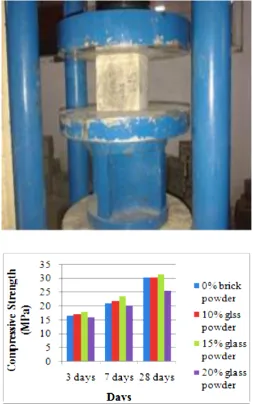
As per design obtained in accordance to code IS-10262, mix proportion of various materials (viz. Cement, Sand, Aggregate and Water) is calculated for M-20, M-25 and M- 30 grade of concrete. The cubes were crushed in the laboratory in accordance to code IS 1343-1980. The results of crushing strength of cubes for 3, 7 and 28 days of various grades of concrete prepared as per mix design are shown below:
It is observed that the compressive strength of cubes (sand is partially replaced by glass powder) of M-20 mix decrease initially at 10% glass powder. But as percentage of glass powder increased to 20% strength increases and further increase in glass powder again
reduces the strength. Compressive strength of cubes (sand is partially replaced by glass powder) of M-20 mix increases up to 15% glass powder. As glass powder exceeds 15%, compressive strength decreases. In M-25 and M-30 concrete mix, compressive strength also follows the same trend as it did in the M-20 mix. Compressive strength is maximum at 20% powder, and then it starts decreasing. Optimum percentage of glass and glass which can replace sand is 15% and 20%
respectively. Compressive strength of cubes
COMPARISON OF COMPRESSIVE STRENGTH OF M-20 MIX FOR DIFFERENT PERCENTAGE OF GLASS POWDER
Workability
The slump tests were performed according to IS 1199-1959. The value is presented in table below:
The results show that with increase in glass powder, the slump value decreases and with increase of glass content, the slump value increases.
Slump Test Results
The amount of water greatly affects the consistency of the mixture. Based on the water cement ratio and slump test, the use of recycled bottles as concrete material has no significant effect on the consistency of the mixture. The consistency and procedural of mixing cement and aggregates implementing the Class A mixture.
SPLIT TENSILE STRENGTH
Three numbers of samples in each of concrete were subjected to testing using the compression testing machine as shown in Figure 6. The result of the average strength of cylinders is shown in Table 2 and the comparison of split tensile strength of conventional concrete with that of glass powder concrete is illustrated using bar chart. The concrete where sand was partially replaced by glass powder showed a decrease in split tensile strength. The split strength decreased as the level of replacement of glass powder increased. The strength increased with the number of days of curing. The maximum split tensile strength attained was 3.22 N/mm for 10% replacement at the end of 28 days.
VIII.
CONCLUSIONSOn the basis of results obtained, following conclusions can be drawn:
(2) Similarly replacement of fine aggregate by crushed glass powder is also found to be very effective. The optimum replacement is found to be 15% at which the strength of concrete at 3 days, 7 days & 28 days are higher than those of concrete prepared without replacement of sand. Even at 20% replacement of sand there is marginal decrease in the achieved strength at 3, 7 & 28 days. The target strength is 26.6 MPa for M-20 grade of concrete whereas at 28 days the achieved strength is 25.80 MPa, thus there is a deficiency of only 3%. The target strength is 31.6 MPa for M-25 grade of concrete whereas at 28 days the achieved strength is 28.8 MPa, thus there is a deficiency of only 8.86%. The target strength is 38.25 MPa for M-30 grade of concrete whereas at 28 days the achieved strength is 35.90 MPa, thus there is a deficiency of only 6.14%.
(3)Where ever brick bat aggregates are used made from slightly over brunt bricks, this will be hard and eventually absorb less water.
(4) Results of this investigation suggest that brick powder or structural concrete.
IX.
BIBLIOGRAPHY[1]. Specification for Coarse and Fine Aggregate
from Natural Sources for Concrete. IS 383-1970, Bureau of Indian Standard, New Delhi.
[2]. IS Method of Mix Design IS 10262-1981,
Bureau of Indian Standard, New Delhi.
[3]. Method of Tests for Strength of Concrete. IS
516-1959, Bureau of Indian Standard, New Delhi.
[4]. Code of Practice for Plain and Reinforced
Concrete. IS 456-2000, Bureau of Indian Standard, New Delhi.