Creating A Model For High Impact
Practices At A Large, Regional,
Comprehensive University: A Case Study
Shari McMahan, Ph.D., California State University Fullerton, USAABSTRACT
Student engagement in High Impact Practices (HIPs) has been gaining the attention of higher education leaders and researchers. When students are actively engaged in the learning process they report greater gains in learning and personal development. Students involved in HIPs show better retention, higher GPA and succeed in graduating college in a timely manner. Less advantaged students benefit even more when they participate in these practices. As university funding models are becoming performance based, HIPs are more important in ensuring students success. The following presents a case-study at a large, regional, comprehensive university- California State University Fullerton in Southern California. In 2013, the Strategic Plan was implemented at CSUF. The plan contained four goals. Goal number two was to “improve student persistence, increase graduation rates University-wide, and narrow the achievement gap for underrepresented students.” One of the objectives for this goal was to “Increase participation in High-Impact Practices (HIPs) and ensure that 75% of CSUF students participate in at least two HIPs by graduation.” How do you get a university of over 38,000 students to have 75% of the students participating in HIPs? A strategic plan task force was created to define HIPs, create an assessment report on HIP outcomes (focusing on increased retention and graduation rates), and develop a system for creating HIPs on a campus as large as CSUF (a result of the AAC&U experience).This case study describes their preliminary work.
Keywords: High Impact Practices; Student Success; Student Engagement
igh-impact practices (HIPs) occur when students are actively engaged in the learning process. Students involved in HIPs report greater gains in learning and personal development. Research indicates that less-advantaged students benefit even more when they participate equitably in these practices (Kuh, 2008). As funding models are changing to performance based models it is important for institutions to do what they can to implement practices that can ensure student success.
The following teaching and learning practices have been widely tested and have been shown to be beneficial in terms of retention and student engagement for college students (Kuh, 2008). These include:
First-Year Seminars and Experiences Common Intellectual Experiences Learning Communities
Writing-Intensive Courses
Collaborative Assignments and Projects Undergraduate Research
Diversity/Global Learning
Service Learning, Community-Based Learning Internships
Collecting data on HIPs is increasing in popularity at most institutions. How does an institution of over 38,000 students ensure students get HIPs? How are HIPs defined? And how do we get faculty on board to teach using HIPs? This case study conducted at California State University Fullerton, one of the largest universities in one of the largest university systems in the world, studied HIPs- what works, what doesn’t and how to create a framework for HIPs. HIPs are particularly relevant for an institution like CSUF as close to 50% of the incoming class is first generation and 40% are underrepresented.
In 2013, the Strategic Plan was implemented at CSUF. The plan contained four goals. Goal number two was to “improve student persistence, increase graduation rates University-wide, and narrow the achievement gap for underrepresented students.” One of the objectives for this goal was to “Increase participation in High-Impact Practices (HIPs) and ensure that 75% of CSUF students participate in at least two HIPs by graduation.” A strategic plan task force was created to define HIPs, create an assessment report on HIP outcomes (focusing on increased retention and graduation rates), and develop a system for creating HIPs on a campus as large as CSUF (a result of the AAC&U experience).
METHODS
Defining HIPs
After reviewing several AAC&U documents, National Survey of Student Engagement documents, campus websites, and George Kuh’s work on HIPs it was decided by the strategic planning task force that “In a high-impact learning experience, students actively pose and solve problems, work collaboratively in a community of peers, experience real-world applications of knowledge, and reflect on learning processes.” Kuh, 2008 identifies several common elements across the practices that—when employed—make the practices high-impact: demand considerable time and effort that deepen student investment, provide learning opportunities outside of the classroom, require meaningful interactions with faculty and students, encourage interaction with diverse others and reflect on the person they are, and provide frequent and meaningful feedback (Brownell and Swaner, 2010). Our research process started with identifying the most common HIPs in the literature and looking at their effects on retention and graduation rates.
Assessment of HIPs on Graduation and Retention
As our strategic plan goal was to close the gaps and look at retention and graduation rates we began to inventory HIPs on our campus as it relates to these issues. We involved our institutional research office to look at a variety of HIP courses (using the Kuh rubric) and activities (e.g. residence halls) as it relates to grade point average (GPA), time to degree, persistence at different time points and using control groups as matched comparisons. We learned a lot from this experience. Some courses/activities we expected yielded no significant findings others had very positive findings. Those courses/activities yielding positive findings are listed below.
RESULTS
Freshman Programs
In Freshman Programs (FP) teams from academic and student affairs and peer mentors facilitate the learning environment. The longitudinal analysis of FP data revealed greater retention and higher six year graduation rates. Significant group differences in both 1-year and 2-year retention were observed between participants and non-participants. The disparity in 6-year graduation rates between participants and non-participants was ten percentage points, which was also significantly different. FP participants persisted and completed a college degree better than did those who did not participate in a FP. As noted, the positive findings were even obtained after controlling for student previous GPA to separate out the exclusive effects of the FP. Holding other variables constant, logistic regression analysis indicated that FP participation is significant predictors of 1-year and 2-year retention and 6-year graduation rates.
showed significant improvement in retention, graduation, and college GPA. In addition to resulting in increased retention and graduation rates, FP encouraged students to achieve a high GPA throughout college. The students who participated in the FP accomplished a significantly higher college GPA at 1-year and 2-year retention and 6-year graduation.
Supplemental Instruction
Supplemental Instruction (SI) is a peer-facilitated review session conducted in a collaborative group learning setting in which students can openly discuss lecture materials with their peers. We examined the effects of SI on course success and grade in a Biology high-risk gateway course. Regardless of student ethnicity, SI significantly improved grades and success rates for both underrepresented and non-underrepresented students. SI in a collaborative group learning environment has been validated as an effective high-impact practice that promotes student active engagement in learning, peer-to-peer interaction, and peer-to-leader interaction, which results positive learning outcomes, including course retention, success, and high grades.
Study Abroad Programs
GPA disparity between participants and non-participants are widened after participants spent summer at Italy for 2011, 2012, 2013 groups. Pre-Campus GPA before spending summer study-abroad at Italy and post-Campus GPA after summer study-abroad, have been compared. Overall, participants gained more GPA and maintained the GPA for multiple terms after they came back to campus. However, due to the very small number of participants, and student pre-study-abroad factors such as previous GPA (high school GPA or transfer GPA), or such socio-economic status, it is early to conclude that Study Abroad Program has positive and significant effects on student learning outcome. In alumni data, Study abroad does appear to be the most significant impactful experience that occurred as a result of being a student on this campus. However, the sample was relatively small.
Residence Halls
First-time full-time freshmen who lived on campus during annual year 2011-12 and 2012-13 were compared with other first-time full-time freshmen who lived off campus. The two groups had a similar pre-college academic preparedness (measured by High School GPA and SAT scores). Results indicate residence hall students did better than comparison group, in terms of first semester academic standing and first year GPA. In looking at differences between underrepresented and non-underrepresented students, underrepresented students did better on first year GPA.
Undergraduate Research (College based)
College of Health & Human Development’s 2011-12 graduates (in the departments of Kinesiology, Health Science, Human Services, and Child and Adolescent studies) were studied. A total of 739 students participated in undergraduate research courses in College of Health and Human Development between 2000 and 2011. Student enrollment data for a total of 37 terms have been employed to extract course taking, demographics, student major, and background characteristics. As we had student degree and graduation data up to summer 2013, we included those students who have graduated in two years since they took research courses. Approximately 90% of students attained baccalaureate degrees in two years after they participated in undergraduate research. Those graduates who had participated in undergraduate research consequently enrolled in graduate school at a significantly higher rate than those who did not. GPA’s were also significantly higher for those that participated in the research class.
Other
DISCUSSION & CONCLUSIONS
The AAC&U Experience
The academy provided a useful experience in terms of framing HIPs understanding who we as a campus are, as not every course or activity can be HIP designated, and develop the HIP framework.
It was clear that some but not all classes and co-curricular activities have HIP qualities. In order to determine whether a student will experience HIPs we had to develop a framework for determining what is a HIP, The evaluation criteria continues to evolve but we found a great starting point to be the criteria set forth by the CSU Chancellor’s office listed as taxonomies http://www.calstate.edu/engage/taxonomies/index.shtml and also for co-curricular activities the framework created from the University of Texas A&M framework. http://studentaffairs.tamu.edu/DSAHIPform.
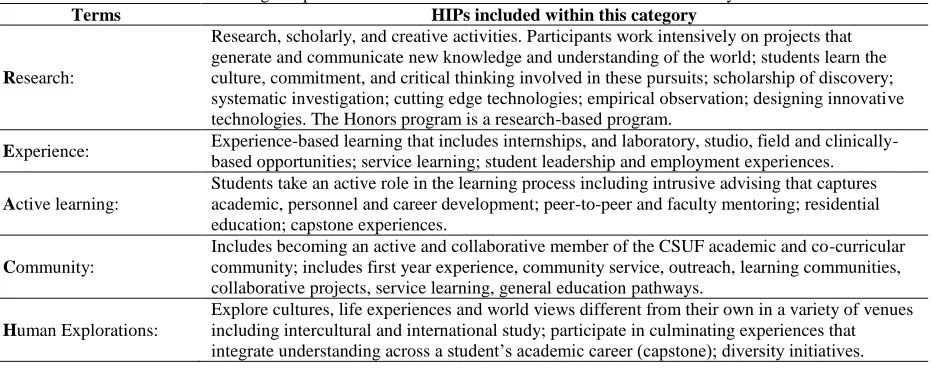
The HIP literature is so vast with countless HIPs to choose from. Was there a way to consolidate HIPs that were more pronounced or had better success at our campus? It was for this reason that the REACH acronym was founded. REACH stands for: R-research, E-experience, A-active learning, C-community and H-human explorations (Table 1). Credit must be given to the team from Indiana University Purdue University Indianapolis (IUPUI) and their theme using the RISE acronym. R-research, I- international experience, S-service learning and E-experiential learning http://uc.iupui.edu/UndergraduateEducation/RISEtotheIUPUIChallenge/DevelopingaRISECourse.aspx.
REACH is also in the University tagline: Titans reach higher…We are now finalizing the REACH criteria and developing a plan to designate HIP classes/activities, track designated HIPs and develop a structure to increase HIPs through a request for proposals linked to a summer stipend to modify courses/activities to include HIPs.
Table 1: High Impact Practice Activities Associated with the REACH acronym
Terms HIPs included within this category Research:
Research, scholarly, and creative activities. Participants work intensively on projects that generate and communicate new knowledge and understanding of the world; students learn the culture, commitment, and critical thinking involved in these pursuits; scholarship of discovery; systematic investigation; cutting edge technologies; empirical observation; designing innovative technologies. The Honors program is a research-based program.
Experience: Experience-based learning that includes internships, and laboratory, studio, field and clinically-based opportunities; service learning; student leadership and employment experiences.
Active learning:
Students take an active role in the learning process including intrusive advising that captures academic, personnel and career development; peer-to-peer and faculty mentoring; residential education; capstone experiences.
Community:
Includes becoming an active and collaborative member of the CSUF academic and co-curricular community; includes first year experience, community service, outreach, learning communities, collaborative projects, service learning, general education pathways.
Human Explorations:
Explore cultures, life experiences and world views different from their own in a variety of venues including intercultural and international study; participate in culminating experiences that integrate understanding across a student’s academic career (capstone); diversity initiatives.
Recommendations
AUTHOR INFORMATION
Dr. Shari McMahan currently serves as Deputy Provost at California State University Fullerton. She is passionate about higher education and committed to educating underserved populations. She is a strong proponent of high impact practices, faculty and staff diversity, and cultural competency. Since coming to CSUF, she has acquired over $1,000,000 in external funding, published 50 journal articles, books chapters, monographs, and given over 100 presentations to scholarly and community groups regarding her research. She obtained a Ph.D. and B.A. in Social Ecology from the University of California, Irvine and a M.S. in Health Science from California State University, Northridge. E-mail: [email protected]
REFERENCES
Brownell, J.E. & Swaner, L.E. (2009). High-Impact Practices: Applying the Learning Outcomes Literature to the Development of Successful Campus Programs. Peer Review 11(2), 26-30.
Brownell, J. E., & Swaner, L.E. (2010). Five high-impact practices. Washington DC: Association of American Colleges and Universities.
http://studentaffairs.tamu.edu/DSAHIPform. University of Texas A &M, Submitting a DSA Experience for High Impact Practice Designation.
http://www.calstate.edu/engage/taxonomies/index.shtml. Taxonomies of High Impact Practices. CSU Chancellor’s office.
http://uc.iupui.edu/UndergraduateEducation/RISEtotheIUPUIChallenge/DevelopingaRISECourse.aspx. Developing a RISE course. Indiana University Purdue University Indianapolis.
Kuh, G. D., Kinzie, J., Buckley, J. A., Bridges, B. K., & Hayek, J. C. (2006). What matters to student success: A review of the literature: Commissioned report for the National Symposium on Postsecondary Student Success: Spearheading a dialog on student success. Washington, DC: National Center for Education Statistics.
Kuh, G. D. (2009). The National Survey of Student Engagement: Conceptual and empirical foundations. In R. GonyeaandG.Kuh (Eds.), Using student engagement data in institutionalresearch. New Directions for Institutional Research, No. 141(pp. 5-20). San Francisco: Jossey-Bass.