FPGA IMPLEMENTATION OF HUMMINGBIRD
CRYPTOGRAPHIC ALGORITHM WITH IMPROVED
SECURITY AND THROUGHPUT: A REVIEW
Nikita Samri
, Shubhada Thakar
1
P.G. Student,
2Assistant Professor, Department of Electronics Engineering,
Government College of Engineering Amravati (India)
ABSTRACT
Light weight cryptographic algorithms are essential to provide security in many resource constraint devices like
RFID cards, smart cards and wireless sensors. The importance of RFID tags is increasing day by day. As they are
resource constraint devices, they support only light weight cryptographic algorithm. Hummingbird is one of the
Lightweight Authenticated Cryptographic Encryption Algorithm. Hummingbird is a combination of both block
cipher and stream cipher along with a rotor machine equipped. This cryptographic algorithm is designed to deal
with the trade off among security, cost and performance. The security and throughput of Hummingbird
Cryptographic algorithm is improved by adding Hash functions. This paper gives the review work of hummingbird
cryptographic algorithm done on different platform like microcontroller, sparton-3FPGA etc.
Keywords:
Cryptography, Ciphertext, Hash function, Novel rotor, Plaintext, Private Key, Public Key,
RFID tags.
I.
INTRODUCTION
Information security and confidentiality has become important in many applications such as smart cards, Radio
Frequency Identification tags (RFID). In these applications, user needs the access of private information. In
electronic transactions, while making online payments customers provide credit or debit card private information. In
these applications, unauthorized person can easily access the private information, if security is not provided. To
protect privacy, the cryptographic algorithm embedded into these devices. RFID cards, smart cards are highly
resource constraint devices, which supports only lightweight cryptographic algorithms. Cryptographic algorithms
are of two types: symmetric key and asymmetric key. In symmetric key algorithms, same key is used for both
encryption and decryption. In asymmetric, public key is used for encryption and private key for decryption.
Symmetric
key algorithms are again divided into block cipher and stream cipher. Block cipher encrypts block by block data,
convert it into ciphertext of same size. Both encryption and decryption uses same secret key which may not have
same size as block data. Original data can be recovered by decrypting the ciphertext.
The various cryptographic methods like Advanced Encryption Standard (AES), Data Encryption Standard (DES)
have been failed to meet the requirements of constrained devices. DES has a block size of 64 bits and a key size of
56 bits. 64bit blocks became common in block cipher designs after DES. Key length depended on several factors,
including government regulation. The 56bit key length used for DES was too short. Due to the large area required
for AES, it cannot be used for highly constrained devices such as RFID tags, smart cards etc. AES has a fixed block
size of 128 bits and a key size of 128, 192, or 256 bits. Key used is usually larger one and it is measured in bits. As
the length of key increases, the security of cryptographic algorithm also increases. To overcome the drawbacks of
AES and DES cryptographic algorithms, an ultra-light weight cryptographic algorithm called hummingbird
algorithm has been proposed for resource constrained devices. Hummingbird is a combination of block cipher and
stream cipher. It is based on a rotor machine which is equipped with novel rotor stepping rules. The Hummingbird
algorithm uses a 256 bit of secret key. It takes 16 bit block data and performs the encryption in stream wise.
In block cipher, Shannon was the first who introduced the concept of confusion and diffusion for security. These
two properties play important role for security purpose. In a block cipher confusion is performed at a substitution
layer and diffusion is done at a permutation. User cannot easily identify and separate the components after confusion
and diffusion techniques. The most commonly used confusion method uses s-boxes.
Hummingbird algorithm provides lower area, lower power consumption requirements. Also low cost and less
processing time can be achieved. This model is considered as a hybrid model, as it is a combination of both block
and stream cipher. It can provide the designed security with small block size. Therefore it can meet the stringent
response time and power consumption requirements for the light weight resource constrained devices like RFID
tags, Smart cards. It is developed with both lightweight software and lightweight hardware for resource constrained
devices. Hummingbird is resistant to the most common attacks to block ciphers and stream ciphers like cube attacks
birthday attack, structure attacks, algebraic attacks, differential and linear cryptanalysis.
Hummingbird mutual authentication protocol is used to achieve the trust relationship between RFID tags and
readers. By using this protocol, the reader can identify the correct key that is communicating with a tag without
exposing the identity of tags. In this protocol, the reader first sends a QUERY signal with a 16 bit SESSION ID as
input to the tag. After receiving the QUERY, the tag will generate four 16 bit random vectors. These 4 random
vectors will be used for initializing the four status registers. After initialization, it perform three times encryption of
RS1#RS3 message data as input and generate three cipher texts CTO,CTl,CT2 as tag indicators. After that the tag
will transmit these three cipher texts together with the initialized vectors to the reader. With the key present, reader
perform encryption and generate three cipher texts
.
Three cipher text of both tag and reader are then compared.If it matches, then the tag will accept otherwise move for the next tag.This protocol takes much area to store these indicators for further comparison. To reduce the area consumption, hash
algorithm is used for secured mutual authentication. It will convert the key into hashes and compare with the hashed
The hash function is designed by designer. Only the designer knows what mathematical functions are used inside
hash algorithm. Hashing is not reversible process. It is impossible to have two different inputs which have the same
hash value. This is the main security property of hash called strong collision resistance. Only the designer knows the
internal structure of a hash function. That is why the hash function is not easily broken by an un-authorized person
.
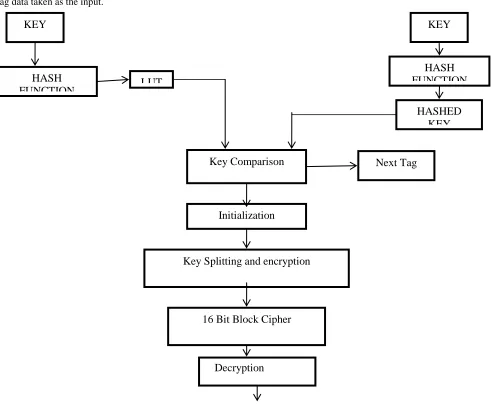
The hash algorithm will be performed first on the reader side to convert the 64 bit reader key into hashes and save it
in the LUT for future comparison. Similarly in the tag side the 64 bit tag key also converted into hashes. Size of both
the hash keys should be equal. Now tag will send the 64 bit hashed key to the reader. Then both the hashed key will
be compared on reader side. If both matches, it will accept the tag otherwise will move for the next tag. If key
matches, the tag will generate four random initialization vectors with the encrypted data to the reader. The reader
will do the initialization process by generating 16 bit cipher text. After initialization, key is divided as per
requirement and encryption is done using hashed key. Decryption is performed using same key where the encrypted
tag data taken as the input.
Fig. No.1, Flowchart of Secured Hummingbird Mutual Authentication Protocol using Hash Functions
.
HASH
FUNCTION
KEY
Key Comparison
Initialization
Key Splitting and encryption
16 Bit Block Cipher
Next Tag
LUT
KEY
HASH
FUNCTION
HASHED
KEY
II. RELATED WORK
F. Xinxin et. al. explained the efficient software implementation of an lightweight cryptographic Hummingbird
algorithm on a zero-power 4-bit MARC4 microcontroller from Atmel. Also the performance of Hummingbird and
the other ultra-lightweight block cipher PRESENT on the same platform is compared. Experimental results show
that after a system initialization phase 58% of faster throughput can be obtained with hummingbird than the block
cipher PRESENT on the 4-bit ATAM893-D microcontroller running at 16KHz, 500KHz and 2MHz, respectively.
Hummingbird can process one data block with less than 12 ms under a typical low power configuration of a 4-bit
microcontroller such as an 1:8V supply voltage and a 500KHz clock frequency. Because of high data throughput
and low current consumption, the ATAM893-D, a member of Atmel’s MARC4 family of 4-bit single-chip
microcontrollers is selected, as the target 4-bit platform. This makes it a perfect candidate for energy constrained
wireless applications such as keyless entry, wireless keyboards for PC and multimedia, wireless sensors as well as
other applications requiring an extremely low current consumption for extended battery life. [1]
G. Guang explains an efficient hardware implementations of a stand-alone Hummingbird component in
field-programmable gate array (FPGA) devices. Hummingbird is a new ultra-lightweight cryptographic algorithm suitable
for resource-constrained devices like RFID tags, smart cards, and wireless sensors. An encryption only core and an
encryption/decryption core is implemented on the low-cost Xilinx FPGA series Spartan-3. By comparing results
with other lightweight block cipher implementations on the same series gives better result of this method.
Experimental results highlight that in the context of low-cost FPGA implementation Hummingbird has favorable
efficiency and low area requirements. [2]
Hummingbird cryptographic algorithm implemented by coprocessor approach and serialized data processing
principles is explained by T. San et. al. This work mainly reduces area, hence implementation on hardware can be
achieved. This paper gives an enhanced hardware implementation of the Hummingbird cryptographic algorithm that
is based on the memory blocks embedded within Spartan-3 FPGAs. The enhancement is from the introduction of the
coprocessor approach. Also it can be obtained from the employment of serialized data processing principles. Due to
compact architecture, remaining reconfigurable area in FPGAs can be used for other purposes. By comparing with
the other FPGA implementation of the Hummingbird cryptographic algorithm indicate that the proposed architecture
gives better efficiency and area. [3]
Paper [4] presents a novel ultra-lightweight encryption scheme, referred to as Hummingbird. This method is
motivated by the design of the well-known Enigma machine. It shows that Hummingbird is resistant to the most
common attacks such as linear and differential cryptanalysis. Also some properties for integrating the Hummingbird
algorithm into a privacy-preserving identification and mutual authentication protocol is investigated.
The paper [5] describes a secure UHF RFID tag baseband with hummingbird cryptographic engine using SMIC
0.13um technology. Security can be enhanced by an improvement of the Gen 2 protocol based on secure engine. The
the entire die area. The overall power consumption of baseband is 30.67uw at a clock frequency of 1.28 MHz and
with 1.2V power supply, which is suitable for resource-constrained devices like RFID tags.
The privacy-preserving mutual authentication protocol for RFID systems using the recently proposed
ultra-lightweight cryptographic algorithm hummingbird-2 is explained by F. Xinxin. The new protocol is resistant to the
most common attacks of RFID systems. Also the proposed protocol is implemented on a battery less MS430-based
WISP tag and determine the performance of the key search process on a laptop. Experimental results show that the
hummingbird-2 mutual authentication protocol provides a highly effective and efficient security and privacy
solution for low-cost passive RFID tags. [6]
M.Biao et. al. gives two different FPGA-based implementations for both throughput oriented and area oriented
hummingbird cryptography. The throughput oriented design is optimized for operation speed. The area oriented
design consumes smaller area resource usage. Both designs have been implemented on a Xilinx low-cost Spartan-3
XC3S200 FPGA. Experimental result shows that, the proposed design cost less FPGA slices while throughput can
be obtained. It gives throughput and area oriented hummingbird design for FPGA with loop unrolled and round
based structure respectively. [7]
In paper [8] an efficient hardware implementation of Hummingbird Cryptographic algorithm is implemented to get
improved security and improved throughput by adding Hash functions. In this paper, encryption and decryption core
is implemented on Spartan 3E and have compared the results with the other existing lightweight cryptographic
algorithms. The results show that this algorithm has higher security and throughput than the existing algorithms.
In all above papers hummingbird cryptographic algorithm is implemented on different platforms like
microcontroller, sparton-3FPGA, using coprocessor approach etc. In some of papers power consumption is reduced
but area is increased. In some papers, area is reduced but power consumption is increased. In some paper they try to
reduce the trade-off between area, power, cost requirements and check the hummingbird cryptography security
performance.
II.
CONCLUSIONS
Use of Hash algorithm along with hummingbird cryptographic algorithm makes system more secure. The size of the
key and the internal state of Hummingbird provides a security level which is suitable for resource constrained
devices. The security and throughput of Hummingbird Cryptographic algorithm is improved by adding Hash
algorithms. Hummingbird is a hybrid model which is a combination of both block cipher and stream cipher. Hence it
is resistant to the most common attack to both block and stream cipher.
Various papers are discussed about hummingbird cryptographic algorithm on different platform like microcontroller
based on ASIC, sparton-2 FPGA, sparton-3 FPGA, etc. In all these papers, there is an enhanced research on
reducing area, power requirement, & increasing speed with aim of giving better security to resource constrained
REFERENCES
[1] F. Xinxin, H. Honggang, G. Guang, E. M. Smith, and D. Engels, "Lightweight implementation of
Hummingbird cryptographic algorithm on 4-bit microcontrollers," in internet Technology and Secured
Transactions, 2009. ICITST 2009. International Conference for, 2009, pp. 1-7.
[2] F. Xinxin, G. Guang, K. Lauffenburger, and T. Hicks, "FPGA implementations of the Hummingbird
cryptographic algorithm," in Hardware-Oriented Security and Trust (HOST), 2010 IEEE International
Symposium on, 2010, pp. 48-51.
[3] T. San and N. At, "Compact Hardware Architecture for Hummingbird Cryptographic Algorithm," in Field
Programmable Logic and Applications (FPL), 2011 International Conference on, 2011, pp. 376-381.
[4] X. F. Daniel Engels, Guang Gong, Honggang Hu, Eric M. Smith, "Ultra-Lightweight Cryptography for
Low-Cost RFlD Tags:Hummingbird Algorithm and Protocol," FC'1O Proceedings of the 14th international
conference on Financial cryptograpy and data security,Springer-Verlag Berlin, Heidelberg ©201O, vol.
ISBN:3-642-14991-X 978-3-642-14991-7, pp. 3-18 2010.
[5] X. Mengqin, S. Xiang, W. Junyu, and J. Crop, "Design of a UHF RFID tag baseband with the hummingbird
cryptographic engine," In ASIC (ASICON), 2011 IEEE 9th international Conference on, 2011, pp. 800-803.
[6] F. Xinxin, G. Guang, D. W. Engels, and E. M. Smith, "A lightweight privacy-preserving mutual
authentication protocol for RFID systems," in GLOBECOM Workshops (GC Wkshps), 2011 IEEE, 2011,
pp. 1083-1087.
[7] M.Biao, R. C. C. Cheung, and H. Yan, "FPGA-based high throughput and area-efficient architectures of the
Hummingbird cryptography," in IECON 2011- 37th Annual Conference on IEEE industrial Electronics
Society, 2011, pp. 3998-4002.
[8] Harikrishnan T, C. Babu, “Cryptanalysis of Hummingbird algorithm with improved security and