Received December 12, 2010 Xiaohui Wang ()
Department of Business Management, Lingnan College, and Lingnan-ISC Environment, Health and Safety Academy for Chinese Enterprises, Sun Yat-sen University, Guangzhou 510275, China
E-mail: [email protected]
Jing Gao
Lingnan-ISC Environment, Health and Safety Academy for Chinese Enterprises, Sun Yat-sen University, Guangzhou 510275, China
E-mail: [email protected]
Xiqing Xie
Department of Management, Guangdong School of Administration, Guangzhou 510275, China E-mail: [email protected]
RESEARCH ARTICLE
Xiaohui Wang, Jing Gao, Xiqing Xie
A Study to Develop a Competency Model for
Chinese EHS Managers
© Higher Education Press and Springer-Verlag 2011
Abstract With the continuous progress of China’s industrialization, problems with the environment, health and safety (EHS) have become increasingly prominent. A study on EHS managers’ competency model shall help Chinese enterprises build up an EHS professional team and accomplish EHS managerial goals. This article adopts the “behavioral event interview” (BEI) method to extract characteristic indexes for EHS managers, and then conducts a questionnaire-based survey to collect data to establish and validate a basic competency model for Chinese EHS managers.
Keywords EHS management, EHS managers, competency model, Chinese enterprises
1 Introduction
corporate environment, health and safety (EHS) have been developed gradually, and applied in many large domestic enterprises. Better EHS management for an enterprise means foreseeable improvement in its environmental governance, occupational health and safety performance. Undoubtedly, EHS management plays an important role in a firm’s sustainable development.
However, surveys have shown that the lack of qualified EHS managers undermines the performance of EHS management in China. EHS mangers’ overall quality has a vital impact on EHS management in a corporate, whereas competency indicators can report EHS mangers’ capability and qualifications. Given the current EHS pressure that Chinese enterprises are facing, it is necessary and urgent to explore the competency of EHS managers in Chinese enterprises. This study, based on the relevant competency literature, intends to construct a competency model for Chinese EHS managers.
2 Overview of EHS Management and Competency Literature
2.1 EHS Management
EHS management refers to a company’s administrative behaviors to avoid potential hazards, and its ability to reduce potential personnel injury, property loss and environmental pollution through risk analysis and hazard identification (Zhang, 2008). In the early 20th century, as the modern industry emerged and developed rapidly in Western countries, production incidents and environmental pollution occurred one after another, causing a large number of personnel injuries and property losses. Companies began to set up positions for safety management and EHS training. In the 1930s, Western countries appointed government officials to supervise work and production safety, promulgate laws and regulations on labor safety and occupational hygiene. In doing so, developed countries gradually established good systems to maintain workplace safety, which becomes the rudiment of modern safety management (Chen, 2006).
several competence features. Only when these features match with the goals of the organization’s EHS management and job requirements, can the EHS managers fully employ their talents and expertise to the operation of EHS system.
An EHS manager is neither the traditional engineering nor a technical expert, but managerial personnel. However, most Chinese domestic enterprises require a safety engineer certificate as a must when recruiting new EHS staff. On the contrary, the fact is that, in China, there are no well-established professional standards or career certificates that can combine the affairs of environment, health and safety all together and that imbed managerial components of corporate operation. Consequently, this situation becomes a bottleneck that restrains the selection, placement and promotion of the right EHS managers (Wang, Gao and Wei, 2010).
2.2 Review of Competency Studies
Along with the changes of production and managerial environment, traditional job analysis methods can hardly meet the needs of modern human resource management. Under such circumstances, scholars developed the concept of competency, trying to explore the potential and deep-seated characteristics such as motivation, trait, self-image, attitude, values, expertise, knowledge and behavioral skills to differentiate the capacities that can frame outstanding performance and ordinary performance (Gao, 2009). Managers working in contemporary organizations often focus more on results than on the people who achieve those results. However, regular performance appraisal of employees is critical to improving the efficiency and output of an organization. Performance appraisal has changed significantly over the past decade. Companies today are looking for certain key characteristics, known as competencies that can help people in their field to achieve success. Managers and employees need to focus on those competencies, especially during performance review (Kessler, 2008).
evaluation, individual counseling, incentive design, career development, succession planning, and change management (McLagna, 1996).
By interviewing over 2 000 managers through “behavioral event interview” (BEI), Boyatzis (1982) concluded that a managers’ competency model is comprised of six feature clusters, namely goal and action management, leadership, staff management, directing subordinates, care for others, and specialized knowledge. Other scholars investigated high-level executives’ competency. For example, Spencer and Spencer (1993) suggested that there are four kinds of competence features that could be used to distinguish superior entrepreneurs and ordinary ones. They are 1) the achievement kind—initiative, capturing opportunities, perseverance and caring for qualities; 2) personal growth kind—being self-confident; 3) control and instruction kind—monitoring; and lastly 4) caring-others-kind—establishing relations.
In recent years, Chinese scholars have also done a great deal of studies on competency model. Following the approach of BEI (behavioral event interview) technique, Shi et al. (2002) proposed that a competency model of managers in Chinese communication industry consists of 10 features: influence, organizational commitment, information seeking, desire for achievements, team leadership, insight of interpersonal relationship, initiative, awareness of serving customers, self-confidence, and developing others. Similarly, Zhong and Shi (2004) constructed a competency model for high-performance managers in Chinese family businesses, including authoritative guidance, initiative, capturing opportunities, information seeking, organizational awareness, command, kindness and care, self-control, self-confidence, autonomous learning and influencing others.
Furthermore, Chinese scholars have also conducted research on EHS management. Wang et al. (2003) gave a detailed introduction of the EHS management system of Motorola (China) Electronics Limited. Li et al. (2005) summarized the EHS system of the construction industry in China.Xu (2006) conducted research on EHS management from the perspective of corporate social responsibility in China. Wang and Ma (2007) found that since EHS management emphasizes hazard prevention, total participation and total control, it should be adopted as a systematic mechanism. More recently, Wang, Gao and Wei (2010) proposed that a nation-wide EHS manager certificate system should be established in China.
lacking; 2) most studies of Chinese scholars on EHS management about the EHS management system are based on certain industries rather than on individual professionals; 3) there have been no studies that combine the three areas—environment, health, and safety together to discuss the professional competency in literature both at home and abroad. Therefore, this paper aims to contribute to existing research by filling the above gaps.
3 Research Methods
This study adopts an empirical design consisting of three steps: first, selecting best indicators of EHS managers’ competency according to the BEIs and analysis of interview contents; second, conducting a questionnaire survey based on indicators selected; third, performing an exploratory factor analysis (EFA) and confirmatory factor analysis (CFA) on the survey data, and then deriving a competency model of corporate EHS managers in China.
3.1 Survey Samples
The interviewees of the BEIs were EHS managers with good performance in their companies. One part of their performance was based on well EHS management statistics, while the other was based on comments from colleagues of these managers. Due to the time limit and the range of the interviewees’ selection, a total of 24 senior EHS managers were selected from big cities like Guangzhou, Zhongshan, Shanghai, Suzhou, and Wuhan to participate in one-hour interviews. Most participating managers came from foreign-owned enterprises, because EHS management in these enterprises is relatively well developed, as compared with domestic enterprises.
3.2 BEI and questionnaire
The BEI is an exploratory technique for open behavior review, asking interviewees to describe three most successful and three worst events in detail from their work experience. Then the researchers analyzed the contents of the interviews to determine the competence features of the interviewees. Through these analyses, the behavior of the person with superb achievements could be summarized to determine the indicators of this role’s competence features.
The BEI technique used in this study combined structural and semi-structural questions together. Based on the BEI outlines, the interviews were conducted with EHS managers to understand basic tasks, duties, responsibilities, and requirements of their jobs and their successful and unsuccessful stories or events during the last one to two years. Then analyses were done on the behavioral characters of those events or stories to study the interviewees’ competency and further explore which ones can help them acquire even better job performance.
The questionnaire method is to use strictly-designed psychometric items or questions in written form to collect materials and data from the objects being studied (Wang and Chen, 2002). The questionnaire used in this study was compiled according to previous literature and the competence indicators identified from the pilot BEI of EHS managers. The response of the questions accompanied with the five-point Likert scale, and the participants could choose any point from 1–5 according to their own facts or judgments. The collection of the participants’ choices is the supporting data for following analyses.
Because this EHS managers’ competency survey was the first one held in China, there was no mature or validated questionnaire to refer to. The questionnaire was actually developed by the authors and the research team. The design of the questions was to combine qualitative and quantitative ones together: qualitative questions were mainly designed to get the competency indicators of EHS managers, and quantitative questions were designed to get the objective judgment on items and facts. In the questionnaire, most items of question were set according to the competency indicators from the BEI analysis, and the other items were based on the literature review and the O*NET career development questionnaire.
3.3 Data Processing
number of key behavioral events reflecting competencies.
After the initial questionnaire survey, SPSS 13.0 was used to do EFA on the 247 paper questionnaires to check the structure of the competency. Principal component analysis (PCA) was used to extract the components of competency, and then varimax was used to analyze their mutual relationships. Once the competency model was extracted, corresponding option of items in the questionnaire were revised according to the selected competency indicators. In addition, another questionnaire was administered online with 134 responses collected. Finally, LISREL 8.72 was used to conduct CFA to verify the validity of the results.
4 Data Analysis
4.1 Analysis of the BEI Results
Based on the relevant literature and expert advice, EHS managers’ competency dimensions were developed. Through coding and analyzing the audio records and manuscripts of BEI, we identified the key behaviors and events of EHS managers. According to EHS managers’ job description, requirements of businesses, and the McBer competency dictionary, frequency analysis of key behavioral events were done to extract significant indicators (entries) with significance test and its results. These indicators were problem-solving ability, knowledge of EHS engineering, EHS laws and regulations, written communication, sensitivity to problems, conversation skills, self-directed learning, coordination, information gaining, decision-making ability, communicating with people within the organization, team spirit, developing others, motivation for achievement, initiative, self-control, press-bearing ability, flexibility, attention to details, integrity, and analytical thinking. These 21 indicators are the primary competency indicators for EHS managers in Chinese enterprises.
4.2 Exploratory Factor Analysis
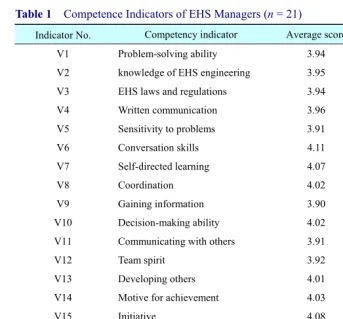
The result of EFA is presented in Table 1 below, consisting of 21 competency indicators of EHS managers.
Table 1 Competence Indicators of EHS Managers (n = 21)
Indicator No. Competency indicator Average score Standard deviation
V1 Problem-solving ability 3.94 0.93 V2 knowledge of EHS engineering 3.95 0.92
V3 EHS laws and regulations 3.94 0.96
V4 Written communication 3.96 0.90
V5 Sensitivity to problems 3.91 0.95
V6 Conversation skills 4.11 0.90
V7 Self-directed learning 4.07 0.91
V8 Coordination 4.02 1.02
V9 Gaining information 3.90 0.90
V10 Decision-making ability 4.02 0.90
V11 Communicating with others 3.91 0.95
V12 Team spirit 3.92 0.87
V13 Developing others 4.01 0.99
V14 Motive for achievement 4.03 0.87
V15 Initiative 4.08 0.85
V16 Self-control 3.86 0.98
V17 Pressure-bearing ability 3.98 0.93
V18 Flexibility 4.08 0.90
V19 Attention to details 4.08 0.86
V20 Integrity 4.14 0.91
V21 Analytical thinking 4.00 0.87
Note: Most of the competence indicators are items with average score above 3.9; the rest are items with score under 3.9, but considered as the very important by the EHS professionals, e.g., self-control. The naming of these indicators comes from an induction of the behavioral features of the EHS managers with referring to the Competency Dictionary.
resources, knowledge of finance and business, business connections, innovation and crisis management capacities, organizing skills, labor relation strategy, interpersonal skills, and change management. Rosenbaum (2001) suggested seven new competency indicators for sales manager, namely self-evaluation, continuous learning, keen insight of customers’ demand beyond the products, integration of internal resources, combination of the strategic targets of both customers and suppliers, development of loyal relationship between customers and suppliers, and comprehension of the financial implication caused by decision making.
Compared with the above research findings, except for managers’ general competence indicators such as communicating with people within the organization, decision-making ability, written communication, conversation skills, and integrity, particular personality and skill indicators essential to EHS managers’ competency and performance can be identified. These particular indicators include developing others, self-control, EHS laws and regulations, sensitivity to problems, problem-solving ability, pressure-bearing ability, and knowledge of EHS engineering.
4.2.1 Similarities of Estimated Variables
The EFA model requires certain correlation among the factors. The Kaiser-Meyer-Olkin (KMO) value of the correlation was obtained by Bartlett’s Test of Sphericity. Results showed that KMO, the statistical indicator of the correlation of variables, equaled 0.895, displaying no marked difference among the question items in the questionnaire, so the result is suitable for factor analysis. The Bartlett’s Test of Sphericity also reached a significant level, reflecting certain relationship among the items so that the values are effective. Details are shown as follows:
Table 2 Analysis of the Variable Correlation of the Questionnaire
Coefficient of variable appropriateness (KMO value) 0.895 Chi-square approximation 1 536.945
Degree of freedom 171 Bartlett’s test of Sphericity
Significance 0.000
4.2.2 Extraction of Common Factors
varimax of maximizing variance, keeping the Eigenvalue bigger than 1, and no limiting the extracting quantity of the factors.
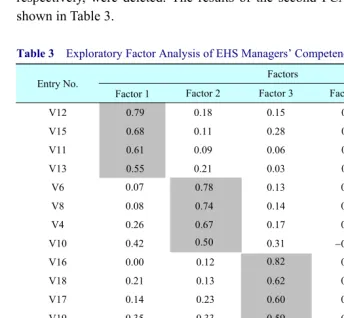
The EFA model extracted a total of five factors. However, a few problems existed in the classification of indicators. For example, motivation for achievement, which loaded on Factor 2 was deleted due to low value (0.4); similarly, self-directed learning, with loaded on Factor 4 (0.34) and 5 (0.21), respectively, were deleted. The results of the second PCA after adjustment are shown in Table 3.
Table 3 Exploratory Factor Analysis of EHS Managers’ Competency—After Adjustment
Factors Entry No.
Factor 1 Factor 2 Factor 3 Factor 4 Factor 5
V12 0.79 0.18 0.15 0.10 0.07
V15 0.68 0.11 0.28 0.03 0.08
V11 0.61 0.09 0.06 0.19 0.33
V13 0.55 0.21 0.03 0.32 0.32
V6 0.07 0.78 0.13 0.20 0.06
V8 0.08 0.74 0.14 0.09 0.14
V4 0.26 0.67 0.17 0.14 0.14
V10 0.42 0.50 0.31 −0.10 0.07
V16 0.00 0.12 0.82 0.12 0.10
V18 0.21 0.13 0.62 0.35 0.23
V17 0.14 0.23 0.60 0.36 0.14
V19 0.35 0.33 0.59 −0.14 0.07
V20 0.40 0.11 0.52 0.06 −0.02
V1 −0.03 0.02 0.07 0.73 0.05
V5 0.27 0.16 0.21 0.53 0.25
V21 0.41 0.30 0.18 0.50 −0.09
V9 0.36 0.42 0.16 0.50 0.01
V2 0.11 0.02 0.16 0.19 0.79
V3 0.19 0.28 0.10 −0.08 0.76
Cronbach’ α 0.75 0.77 0.75 0.73 0.71
4.2.3 Factor Labels and Explanation
are named according to the content of items (indicators) in the questionnaire. Factor 1 includes four indicators—team spirit, initiative, communication within the organization, and developing others, which reflect the tendency of EHS managers to coordinate with the team and partners. Therefore, according to this connotation, Factor 1 is labeled “teamwork.”
Four entries are included in Factor 2—conversation skills, coordination ability, written communication ability, decision-making ability, reflecting the EHS managers’ ability to communicate and make decisions. Hence Factor 3 is named “communicating and decision-making.”
Factor 3 contains five indicators—self-control, flexibility, attention to details, press-bearing ability, and integrity, which reflect the personal traits of EHS managers. Accordingly, this factor is called “personal traits.”
Factor 4 consists of four indicators—problem-solving, sensitivity to problems, analytical thinking, and information gaining, reflecting EHS managers’ ability to solve problems. As a result, Factor 4 is named as “problem-solving.”
Factor 5 includes two entries—knowledge of EHS engineering, and EHS laws and regulations, reflecting the professional ability needed by EHS managers. So it is named as “professional EHS knowledge.”
4.2.4 Reliability Tests
High reliability of the questionnaire was found after calculating the reliability by Cronbach’ α. As shown in Table 3, α for each factor is 0.75, 0.77, 0.75, 0.73 and 0.71, respectively, and all of which were above 0.7. In addition, the total reliability of the questionnaire was as high as 0.89, showing that all the 5 dimensions of the EHS managers’ competency are highly reliable.
4.3 Confirmatory Second-Order Factor Analysis
After identifying the structure of the competency model by EFA, the result still needs to be confirmed by CFA. Due to the lack of a mature competency model of EHS managers and a corresponding scale of the competency that can be referred to, the conception and drafted indicators of EHS managers’ competency in this paper were initially deduced from literature review and BEIs of selected EHS managers. The CFA would find out whether the competency structure fits the real data or not.
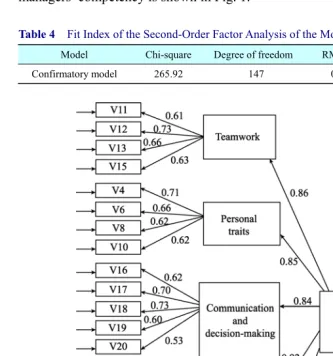
confirmatory second-order factor analysis on the 134 collected responses, with the result shown in Table 4. The structure model of second-order factors of EHS managers’ competency is shown in Fig. 1.
Table 4 Fit Index of the Second-Order Factor Analysis of the Model
Model Chi-square Degree of freedom RMSEA CFI
Confirmatory model 265.92 147 0.06 0.97
Fig. 1 Structural Equation Model of EHS Managers’ Competency
factor on the second-order level, and the competency model has good construct validity.
5 Conclusion
21 indicators were extracted from the BEIs to EHS managers, and the frequency analysis of their key events or stories. Then, 19 indicators were eventually identified by EFA, including team spirit, initiative, communication within the organization, developing others, self-control, flexibility, attention to details, press-bearing ability, integrity, conversation skills, coordination ability, written communication, decision-making ability, problem-solving ability, sensitivity to problems, analytical thinking, information gaining, knowledge of EHS engineering, and EHS laws and regulations.
Through EFA and CFA, we conclude that the competency of EHS managers consists of five dimensions: teamwork, personal traits, communicating and decision-making, problem-solving, and professional EHS knowledge. The second-order factor analysis on the competency structure shows that the five dimensions can be aggregated into one dimension, reflecting that the five-dimension construction of EHS managers’ competency model has a good validity.
6 Discussion
As regards to team work, cooperation among several departments is needed for the accomplishments of managerial tasks in EHS managers’ daily work. From this perspective, team spirit means the managers’ willingness to cooperate with others for accomplishing various complex tasks. Initiative means that, other than the prescribed work, the managers will try to find out the problems in the EHS affairs and propose suggestions and strategies to solve or eliminate them. Communication within the organization means the managers need to communicate with members of the organization on EHS daily work or special cases and try to maintain a good managerial system. Developing others means they should help EHS staff and other employees to improve their work-related knowledge and skills, and to achieve mutual development.
communication, coordination, explanation, and instruction. Flexibility means that they must consider the features of their industries, production and employees under given circumstances when doing the EHS management and system construction, rather than sticking to the rigid EHS standards and rules. Attention to details requires the managers to be sensitive to potential safety problems and hidden risks. Pressure-bearing ability means that the EHS managers must always be able to undertake their jobs and responsibilities when facing certain pressures. Integrity requires the managers to commit to the EHS affairs, abiding by the principles of justice, fairness and honesty, rather than walking through the process.
Regarding the dimension of communicating and decision-making, the daily work of EHS managers requires them to do much communication and make decisions in emergencies. Also needed is the conversation skill to express the information clearly and accurately. Coordination ability is that in daily work, especially in managing EHS projects and performance indicators involving the work of several departments, EHS managers should be able to facilitate mutual understanding and the cooperation of tasks. Written communication reflects the requirement for the managers to draft documents for constructing the EHS managerial protocols and operation systems. Decision-making ability allows them to do comprehensive analysis and propose reasonable decisions for job duties.
The dimension of problem-resolving reflects EHS managers’ strong abilities to guard the site and deal with problems. Ability to solve problems means the managers can effectively solve hidden dangers on site and eliminate hidden hazard source. Sensitivity to problems is that they can detect the hidden dangers in middle-term and long-term, and devote to avoid them by systematic design. When handling the EHS managerial affairs, the managers can holistically analyze various factors to find out the source of hazards and provide solutions to any problems. That is what analytical thinking means. Gaining information means that they can acquire the information needed for work through various media including the enterprise’s work site and sources outside the enterprise.
improvement plan to ensure the legal compliance and the lawful accomplishment of work.
7 Implication and Limitation
Along with the nation-wide implication of EHS management system in Chinese enterprises, there has been a growing interest on the positive impact of the system on corporate and social sustainable development. Accordingly, the market demand for EHS managers is increasing. Therefore, training and developing EHS managers is becoming a top priority for many Chinese enterprises.
Using the competency theory to study whether the managers are competent to the jobs is a difficult but necessary step to the establishment of EHS management system in China. It can help identify the competence requirements for managers’ high-performance work, and can be instructive to enterprises and governmental agencies such as the Department of Human Resource and Social Safety (the department of labor). Studies on the competency of EHS managers can also help provide a guideline for Chinese enterprises in examining, selecting, recruiting, training, and promoting of EHS managers, or in their effort to improve EHS management level. Moreover, this paper can also be used as a reference to build China’s professional certificating system for EHS managers. Therefore, it is fair to say, this study will help facilitate the formation of the academic discipline for and accelerate the practice of EHS management in China.
This paper is the first research report focusing on EHS managers’ competency in the Chinese context. However, it also has limitations. First, the sample is relatively small. Second, the competency model needs additional evidences to confirming its reliability and validity. Because this study is supported by an agency of Guangdong provincial authorities, the findings and results from this study are likely to be applied to the building of a governmental-administrated certificating program for EHS managers. We hope more researchers will conduct studies on EHS managers’ competency in the Chinese context.
Acknowledgements This work is supported by the National Natural Science Foundation of China (No. 70872114). We would like also to express our gratitude for helpful suggestions of reviewers and contributions from other participants in the research project.
References
Medical Press Ltd.
Boyatizis, R. E. 1982. The competent manger: A model for effective performance. New York: Wiley-Interscience.
Chen, Z. 陈志峰. 2006. 浅谈现代安全生产管理理念 (A Brief talk about modern safety management ideas). Retrieved April, 2011, from http://www.wzjt.gov.cn.
Gao, J. 高建设. 2009. 胜任特征: 高层管理者胜任特征模型构建与应用(Competency: Construction and application of senior managers’ competency model). 北京:航空工业出 版社 (Beijing: Aerospace Industry Press).
Li, J. 李靖, & Bao, C. 包存宽. 2005. 关于建筑企业中的EHS管理体系研究 (EHS management system in building industry). 环境污染与防治 (Journal of Environment Pollution and Control), 27(6): 468–472.
McClelland, D. C. 1973. Testing for competence rather than for intelligence. Journal of American Psychologist, 28(1): 1–14.
McLagan, P. A. 1996. Great ideas revisited: Competency models. Training and Development, 50: 60–65.
Mirible, R. J. 1997. Everything you wanted to know about competency modeling. Training and Development, 51(8): 73–77.
Rifkin, K. I., Fineman, M., & Ruhne, C. H. 1999. Developing technical managers first you need a competency model. Research technology Management, 42(2): 53–57.
Kessler, R. 2008. Competency-based performance reviews: How to perform employee evaluations the fortune 500 ways. Franklin Lakes, NJ: The Career Press.
Rosenbaum, B. L. 2001. Seven emerging sales competencies. Business Horizons, 44(1-2): 33–36.
Rumelt, R. P., Schendel, D. E., S., & Teece, D. J. 1994. Fundamental issues in strategy: A research agenda. Boston: Harvard Business School Press.
Selmer, J., & Chiu, R. 2004. Required human resources competencies in the future: a framework for developing HR executives in Hong Kong. Journal of World Business, 39(4):324–336.
Shi, K. 时勘, Wang, J. 王继承, Li, C. 李超平. 2002. 企业高层管理者胜任特征模型评价 的 研 究 (Assessment on competency model of senior managers). 心 理 学 报 (Acta Psychologica Sinica), 34(3): 306–311.
Spencer, L. M., & Spencer, S. M. 1993. Competence at work: Models for superior performance. New York: John Wiley & Sons.
Wang, C. 王重鸣, & Chen, M. 陈民科. 2002. 管理胜任力特征分析:结构方程模型检验 (Managerial competency modeling: A structural equation testing). 心 理 学 报 (Acta Psychologica Sinica), 25(5): 513–516.
Wang, G. 王冠平, Zhu, G. 祝刚, Shi, H. 施汉昌. 2003. 摩托罗拉 (中国) 电子有限公司 EHS管理体系 (EHS management system in MCEL). 三峡环境与生态 (Journal of Environment and Ecology in the Three Gorges), 25(11): 13–15.
Wang, X. 王晓晖, Gao, J. 高静, & Wei, H. 韦慧. 2010. 创建我国环境健康安全管理师职 业认证体系刍议 (A review on establishing the national EHS professional certificating system in China). 中国人力资源开发 (Journal of Human Resource Development of China ), (3): 101–104.
management system and its development in domestic and foreign enterprises). 化工管理 (Chemical Enterprise Management), (2): 44–47.
Xu, T. 徐挺. 2006. 以EHS推动我国的企 业社会责任进 程(EHS pushing the social responsibility of the Chinese enterprises). 乡镇经济 (Journal of Rural Economy), (4): 62–64.
Zhang, L. 张立勇. 2008. 浅谈企业HSE文化的培育与创建 (Brief talk about cultivating and creating enterprises’ HSE culture). 吐 哈 油 气 (Tunufan-Hami Oil and Gas), 13(2): 198–200.