Sensor Fault Identification in Complex Systems
K. Ezhilarasi S. Subathra
Assistant Professor U.G. Student
Department of Instrumentation and Control Engineering Department of Instrumentation and Control Engineering Saranathan college of Engineering, Tiruchirappalli, India Saranathan college of Engineering, Tiruchirappalli, India
JS. Kruthika K. Hemapriyadharshini
U.G. Student U.G. Student
Department of Instrumentation and Control Engineering Department of Instrumentation and Control Engineering Saranathan college of Engineering, Tiruchirappalli, India Saranathan college of Engineering, Tiruchirappalli, India
Abstract
In the process control industries, one of the main works is to identify and channelize the fault sensor. The process of sensor troubleshooting is essential to increase the production flow without any interruption. In this project the level measurement in the conical tank is considered and the capacitive sensor is used to measure the level of the water inside the conical tank. First the standard sensor is placed inside and the level is measured and monitored and the history of data’s are obtained. Using LABVIEW, programming is done for the standard sensor to measure the level. Now the measuring sensor is placed and the measurement of the level is done. Using any of the soft computing techniques, the fault can be identified and it is indicated in the display or alarm. Keywords: ANFIS, Fault Identification, Neural Network, LabVIEW
_______________________________________________________________________________________________________
I. INTRODUCTION
The Experimental evaluation of an automatic procedure for sensor fault detection and identification in a real process under closed-loop control is the objective of the present research. However the recent trend of generalized use of automatic supervision systems has introduced the need of improved algorithms for earlier detection and identification of the fault. This is much important in the Process Control system that a failure in one of the sensors used in the control loop can lead to erratic behaviour or even instability of the system. In parallel there are development of systematic algorithm for Fault identification and correction in the Process Control.
The fault identification can be done using Neural Network. In the paper [1] design of fuzzy interference controller and the modern predictive controller has been discussed. The fuzzy logic implementation technique for analog system is done by various methods. Fuzzy has many membership functions that will be suitable for the analog system. Fuzzy is a continuous time varying system so modeling can’t be achieved [2]. The experiment results show that the designed pressure sensor prototype implements the self-validating function [3]. It can detect fault in real-time and identify sensor status with high accuracy.
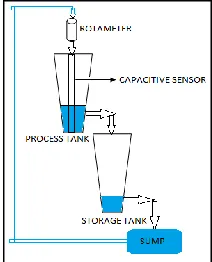
This paper deals with the experimental implementation of such an automated scheme in the complex system, a conical tank. The setup is composed with two conical tanks, a storage tank and a process tank which is to be controlled. The tank consists of the capacitive sensor. Our main goal is to identify the data fault in the sensor. This is done using one of the soft computing techniques and represented in graphical format. The controller design and redundancy of the fault sensor can be implemented in future.
II. PROCESS DESCRIPTION
Fig. 2: Monitoring Level in LabVIEW
Methodology
ANFIS (Adaptive Neuro Fuzzy Inference System) is a type of artificial neural network. This integrates both neural network and Fuzzy so that it has a potential to produce the benefits of both in a single framework. In fuzzy systems, adjusting the parameters of membership function is difficult and need human experts with sufficient knowledge to design rules. Neural network training is a prolonged task and based on the quality and quantity the performance is depended [6]. To overcome the above disadvantages, ANFIS model is proposed for sensor fault diagnosis.
ANFIS model consists of single output and single input. The first step is to train the neural network with the datas obtained, then the model is created. The testing process is done with different data with the model created. If there occurs an error it will be indicated in the result graph. The general block diagram of ANFIS based fault identification is shown.
III. TRAINING
Fig. 3: Input Output Mapping
The obtained datas from the capacitive sensor are saved as .dat file in workspace of the MATLAB. The continuous mapping of input and output is shown in figure 1.
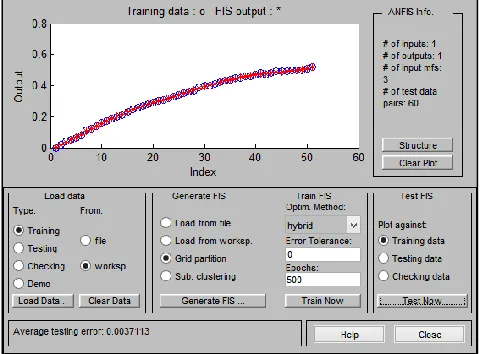
Fig. 4: Training Neural Network with Obtained Datas
For the initial training process, the datas are loaded from the workspace. The output of the training datas are shown in above figure
Fig. 6: Rules build based on Membership Function
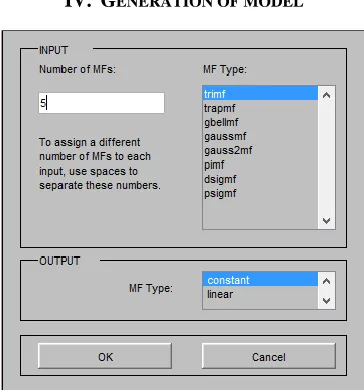
Many types of membership functions are available. Here the number of input sets are denoted. The output varies from 0 to 1 (Fuzzy rules). By varying the input (central red line), the output can be varied.
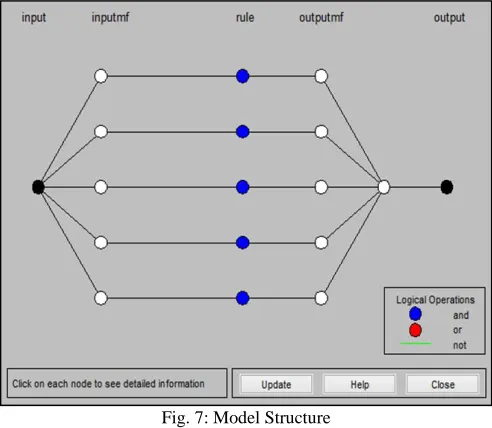
Fig. 7: Model Structure
Fig. 8: Error Detection
For training the FIS model, the epochs value is selected to minimise the error as much as possible. As the epochs value increases the error value is reduced. When the created model is exactly matched with the output datas the error value is minimum. For Eg. Epochs is 100, the error value is 0.3. When the epochs is increased as 300, the error value is 0.0312.
V. OPTIMISATION
Fig. 9: Training using the Back Propagation Algorithm
Fig. 11: Testing using Hybrid Algorithm
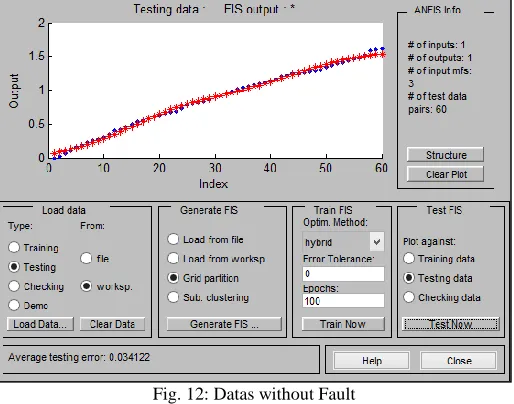
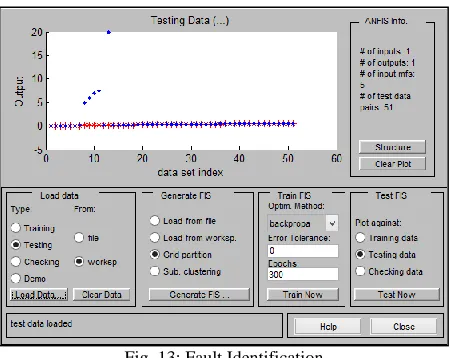
For testing the created model another set of sensor data (10ohm resistance) is loaded in the testing part. By applying the testing data in Test FIS icon, the datas are found to be deviated from model created with datas(5ohm resistance).
Fig. 12: Datas without Fault
Fig. 13: Fault Identification
After the data to be tested is loaded, it is checked with the model created.
VII.CONCLUSION
Nowadays in the process control industries, the major problematic area is the sensor fault identification. If the sensor becomes fault then the whole automatic process will get collapsed. In order to overcome this issue the sensor data faults can be identified using the ANFIS model identification method and the fault can be identified. This method may reduce the complexity in finding the sensor fault in the automation field.
VIII. FUTURE WORK
After the fault identification process, faulty sensor is replaced or by-passed with redundant sensor there comes the redundancy. This channelization of the sensor is done by using the LABVIEW. Further this work is enhanced to store the dynamic data obtained by the level measurement in the cloud, which helps to perform the forecast proceedings. The work is projected to highlight the implementation of the data driven based fault diagnosis and troubleshooting practice of nonlinear system sensor.
REFERENCES
[1] S. M. J.M.G.Sá da Costaa, J.M.C.Sousa, L.F.Mendonça, Journal, “Fault tolerant control using a fuzzy predictive approach”, Volume 39, Issue
12, 15 September 2012, Pages: 10630-10638 doi.org/10.1016/j.eswa.2012.02.094
[2] Franchi ; N. Manaresi ; R. Rovatti ; A. Bellini ; G. Baccarani” Analog synthesis of nonlinear functions based on fuzzy logic”, journal, IEEE Journal of Solid-State Circuits ( Volume: 33, Issue: 6, Jun 2007), Page(s): 885 - 895.
[3] Zhigang Feng ; Qi Wang ; Katsunori Shida,” Design and Implementation of a Self-Validating Pressure Sensor”, journal, IEEE Sensors Journal ( Volume: 9, Issue: 3, March 2009 ) pages: 207 - 218. Sponsored by: IEEE Sensors Council .
[4] A.S. Willsky, 1976, “A survey of design methods for failure detection in dynamic systems”, Automatica, 12, 601-611.
[5] P.M. Frank, 1990, “Fault diagnosis in dynamic systems using analytical and knowledge based redundancy - a survey and some new results”, Automatica, 26 ,pp. 459- 474.
[6] F.J. Uppal, R.J. Patton, 2002, “Fault diagnosis of an electro pneumatic valve actuator using neural network with fuzzy capabilities”, Proc. of 10th European Symp. On Artificial Neural Networks, Belgium.
[7] Akhlaghi P, Kashanipour AR, Salahshoor K., “Intelligent fault diagnosis of distillation column system based on PCA and multiple ANFIS”, In: Proceeding of IEEE conference on cybernetics and intelligent systems, pp. 905–910.
[8] Ling T. G., Rahmat, M. F., Husain A. R., 2012, “ANFIS modeling of electro-hydraulic actuator system”, Proceedings of IEEE 8th International Colloquium on Signal Processing and Its Applications, pp. 89-92, Malaysia.
[9] Kaur and A. Kaur, 2012, “Comparison of Mamdani-Type and Sugeno-Type Fuzzy Inference System for Air Conditioning System”, International Journal of Soft Computing and Engineering, Vol. 2, Iss. 2, pp. 2231 – 2307.
[10] Design and Implementation of an Intrinsically Safe Liquid-Level Sensor Using Coaxial Cable Received: 11 April 2015 / Accepted: 21 May 2015 / Published: 28 May 2015 Sensors 2015, 15(6), 12613-12634; doi: 10.3390/s150612613 .
[11] Soft Computing Approaches to Fault Diagnosis for Dynamic systems,European Journal of Control, Volume 7, Issues 2–3, 2001, Pages 248-286.
[12] "Fuzzy logic and neural network applications to fault diagnosis"International Journal of Approximate Reasoning, Volume 16, Issue 1, January 1997, Pages 67-88.
[13] Shobha R. Savanur* and Ambalal V. Patel,” Sensor/Control Surface Fault Detection and Reconfiguration using Fuzzy Logic”, Received 22 September 2009Defence Science Journal, Vol. 60, No. 1, January 2010, pp. 76-86” 2010, DESIDOC
[14] P.Zhang*T.Jeinsch**S.X.Ding*P.Liu,”Process Monitoring and Fault Diagnosis – Status and Applications”,IFAC Proceedings Volume 44, Issue 1, January 2011, Pages 12401-12406.