RESEARCH ARTICLE
STUDENTS’ PERCEPTION ON ELECTRONIC BOOKS TOWARDS READING COMPREHENSION
*Madylyn D. Machete and Maria Morena E. de la Pena
Biliran Province State Univesity, Philippines
ARTICLE INFO ABSTRACT
This study sought to determine the effects of class size on academic achievement of the pupils. A meta-analysis was undertaken from studies published in 2008 onwards that reported data on class size of elementary schools and pupils’ academic achievement. The primary hypothesis for this thesis was there was a significant effect between class size and pupil’s academic achievement. An extensive systematic review of the literature was conducted using bibliographic databases and other sources, resulting in the review of hundreds of abstracts and articles. Initially this review resulted in the identification of approximately 133 articles, from which 72 were identified as potential studies for inclusion in this meta-analysis. As data were abstracted from each potential study and evaluated, 32 studies remained for inclusion in this meta-analysis. Of these 32 studies, 13 either reported effect sizes in the results section or included sufficient data to calculate the effect sizes. Of these 13 studies, five studies showed no significant effect of class size on pupils’ academic achievement and the remaining 8 studies reported a significant effect of class size on pupils’ academic achievement. Therefore, it is safe to note that class size has a significant effect on pupils’ academic achievement in elementary schools.
INTRODUCTION
Electronic-book is a text in digital form, as digital reading material, as a book in a computer file format or electronic file of words, or as images with unique identifiers. The metadata may be displayed on computer screen, and may use a computer application like Kindle, Amazon, Moon Reader among many others that is downloaded to a computer, laptop, tablet, android or smart phones, notebook and dedicated portable device (Chen, 2012). As postulated by Long and Szabo in their research on E–readers and its effects, students today are digital natives. It means that they have been raised surrounded with technology, and that they spend many hours using such devices as computers, video games, digital music players, iPads, e – readers and cellular phones. In addition, the influx of this available technology can help the students to cope with the 21st century skills and competencies as mandated in the Republic Act No. 10533, otherwise known as the “Enhanced Basic Education Act of 2013” or the K to 12 Basic Education. Another aspect of K to 12 Basic Education is the Information Communication Technology (ICT) – based curriculum. ICT as described by Professor Kale stands for information and communication technologies, and is defined as a diverse set of technological tools and resources used to communicate and to create, disseminate store and manage information. Furthermore, majority of the students who owned an android or smart phones do have a form of reading application in it, which they can use wherever they are, even on a bus, inside the campus, in the dark and at home. As of 2014, 63 percent of students are already using electronic books, while 27 percent planned to in the future (www.SuccessConciousness.com).
*Corresponding author: Madylyn D. Machete, Biliran Province State Univesity, Philippines
A survey conducted by the National Literacy Trust in United Kingdom with 34, 910 students ranging from 8-16 years old also reported that students preferred to read on electronic devices compared to the 32 percent who preferred to read using actual and printed books. Pitcher et al. (2007) reveal that many teachers are faced with the challenge of providing reading instruction to students who have little or no motivation to read. There are many reasons why students lack motivation. There are some students who can read but lack the desire to read and there are some students who lack the motivation to read because they are reading below grade level. To address this reading gap, Schechty (2002) surmised that the digital text can be a motivating factor in increasing student engagement which leads to higher academic achievement but can also be a roadblock to instruction when it is not working properly. In contrast; however, the school should not disregard the value of teachers and human elements in the teaching and learning process because teachers can affect learnings than gadgets do. Teacher–learner relationship inside the classroom is also a big factor in the students’ achievement (Kolowich, 2010). Since the focus of education in the K to 12 curriculum is to produce globally competitive graduates with 21st century skills, it is apparent for the students to be adept with the different information and communication technologies (ICTs) which are rapidly gaining importance in every aspect of the students’ life especially in the education sector. The advent of gadgets and other reading devices in the lives of the 21st century learners maybe used as a form of enhancement to their reading abilities, reading habit and reading comprehension. Though, some studies claim that traditional libraries are still the best source of information, e – books are here to stay and it somehow attracts the students to try to read a book or form of story in digital format because that is what our students nowadays – tech Article History:
Received 28th March, 2019 Received in revised form 12th April, 2019 Accepted 26th May, 2019 Published online 30th June, 2019
International Journal of Recent Advances in Multidisciplinary Research
Vol. 06, Issue 06, pp. 4971-4979, June, 2019
Keywords:
savvy millennials who cannot refuse anything that technology can offer which may be upgraded to latest version but will be a perennial part of this generation. This research gets its motivation on the belief that technology can be a tool to influence the students to read, but teachers can still influence learning despite the appearance of different forms of technology. Electronic books can be an aid to reading and education which could further the interest of the students to read more.
Objectives of the Study: This study primarily aimed to
enhance students’ perception on electronic books towards reading comprehension in Naval School of Fisheries.
Specifically, it sought to:
1. Determine the demographic profile of students with e-books in terms of:
sex;
number of hours spent using e–books;
availability of devices with e – books reader; and
level of reading comprehension.
2. Identify the kind of reading materials student read on their devices such as:
periodicals;
novels;
short stories;
magazines;
learners’ materials;
research studies; and
others.
3. Find out the reading comprehension level of the students who are users and non-users of e-books.
4. Determine the perception of the students toward e-books. 5. Ascertain the significant relationship between the demographic profile of the students with e-books and their reading comprehension level.
6. Propose a classroom policy on the use of e-books.
Hypothesis
Ho1: There is no significant relationship between the
demographic profile of the students with e–books and their reading comprehension level.
Framework of the Study: This study is anchored on the
following theoretical and conceptual framework as its main and strong foundation in the due course of the proceedings.
Theoretical framework. This study uses Mayer’s (2001)
Cognitive Theory of Multimedia Learning (CTML).
This theory postulated that people learn better from words and pictures than from words alone. It adheres to the idea that learners can better understand an explanation when it is presented in words and pictures, than when it is presented in words alone. It further believes that electronic educational technology can be an effective tool to promote effective learning. This multimedia principle, also known as multimedia effect promotes a combination of audio, visuals, and text to acquire deeper understanding of the text. Mayer also identified three ways on how a multimedia instruction can be viewed: Delivery – Media View, the Presentation – Modes View, and the Sensory Modality View. He further explained that the
delivery media view is the presentation of material using two or more delivery devices. The focus is on the physical system used to deliver the information such as computer screen, projector and other electronic devices. He specified that “textbook does not constitute multimedia because the only presentation device is ink printed on paper” (Mayer 2001 p.6). Although he believed in the importance of how the information is delivered, he stressed that the information should not be focused on the device used to present the information but rather on how people learns. The focus of the instruction is how the learners learn and not on the technology. The second view of multimedia suggests on how a material is represented – such as the use of words and pictures. It could be represented verbally as an on – screen text or narration, or static graphics or animation. This second view adheres to the idea that learners are thinking actively by “processing the information using various coding systems to represent knowledge – such as verbal and pictorial knowledge representations.” The third view of this theory is the sensory modality where the theorist believes that two or more sensory systems in the learner are involved. It could be auditory and visuals and the more senses are involved, the more a learner could understand the presented information. CTML centers on the idea that learners attempt to build meaningful connections between words and pictures and that they learn more deeply than they could have with words and pictures which is referred to as the multimedia principle (Mayer 2005).
The aforementioned theory could have an impact in the effective use of electronic books by the students in the classroom setting at Naval School of Fisheries.
Conceptual framework: This study primarily aimed to
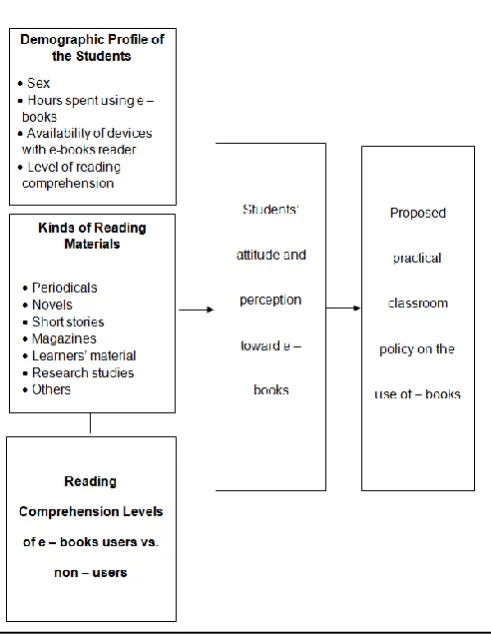
enhance students’ perception on electronic books towards reading comprehension in Naval School of Fisheries. The conceptualization of this research involves the demographic factors of the students, the kinds of reading materials the students have in e–book format, the reading comprehension levels of e–books users compared to non – users, the perception of the students towards e–books and the proposed classroom policy on using e-books. This was pursued by determining first the independent variables which is the demographic profile of the students such as sex, number of hours they spent reading the electronic print, availability of devices with e–book readers and the students’ level of reading comprehension. The dependent variables students’ perception and attitude toward e – books, and the proposed classroom policy on using e–books as the outcome of this research. Figure 1 shows the interplay between the dependent and independent variables.
Importance of the Study
The findings of this study are beneficial and will serve as realizations to the following:
Supervisors. They will have the needed insight on the benefits
and limitations of e – book technology as an aid to promote learning inside the classroom that will enable them to craft policies around the use of e – books.
School heads: They will be provided with essential
Figure 1. The Conceptual Framework of the Study
Teachers: Educators may be able to provide additional
educational activities and reading materials that are engaging and gratifying for both the teachers and the learners with the use of e – books.
Students: Improved reading habit, reading comprehension and
perception on e – books as a source of material to improve learning because of the outcome of this research.
Future researchers: The researcher wishes to provide relevant
and sufficient help to future researchers who want to take on additional study on this topic. A more extensive and a broader conduct of study on this topic will help education policy makers to come up with innovative approach on the use of electronic books in the school.
Scope and Delimitation of the Study: The scope of this study
is centered on the perception of electronic books and its effects on the reading comprehension of the students as a learning tool. The respondents are limited to the students of the Science Technology and Engineering Program (STEP) of the Naval School of Fisheries, from Grade 7 to Grade 10.
Definitions of Terms: The following terms are mentioned
several times all throughout the study. These terms were defined conceptually to provide better understanding of the ideas behind the research work.
E-book: This is the term used for a content - either a book, a
magazine or research study that is stored electronically in a portable handheld device such as mobile phones or laptops. E– Book is a result of the cell phone revolution that somewhat characterized the millennials of the 21st century education.
E – Book reader: This is simply the software or the
application needed to access electronic books; without a reader it is impossible for the reader to read the content of the device. Software companies have developed a lot of e – readers for the convenient and personal preference of the readers.
Electronic Devices: This refers to thehandheld or portable
gadgets where digital formats are stored. 9 out of 10 students in the Philippines use electronic devices in their studies. The rapid increase of use of these devices paved the way to the innovation of e – book phenomena. It may be a mobile phone, android or smartphone, tablets iPads and laptop.
Reading Comprehension: This refersthe phrase used to refer
to the level of understanding one gets from reading whether from reading traditional books or from e–books. It is an actual experience between the reader, the author and the medium or devices from which the reader reads. It could be a worthwhile experience regardless of the kind of medium (traditional or e – book) you are reading on. The reading comprehension level of the students will be measured using the Degree of Reading Power Standardized Reading Test.
Students’ Perception: Thisterm used to define the students’
thoughts and beliefs about the use of electronic books. Furthermore, it is the views of the students to the quality of learning with the use of electronic gadgets (i.e. smartphones and other handheld devices).
Review of Literature
to be installed and set up in electronic equipment, such as laptop, Kindle, or IPad. Although most students rely on traditional paper print books, the population of students applying e –book in their study life is increasing rapidly because many more “smart’ and inexpensive electronic equipment are displayed in markets in which an e – book can be installed. In a study conducted by De Luna (2015), in the University of the Philippines, she surmised that e-book technology is impacting global and local education. In the country, only few institutions have examined e–books as a form of educational tool. She further stressed that technology dictates how sociological and ideological subsystems are formed. Electronic books have the potential to create or build a culture of learning, but it also possesses the ability to destroy the system as we know it. E-book technology certainly falls not only within the area of technological innovation directly linked to teaching and learning but also under researches that engage theoretical framings concerning the impact and consequence of human beings’ adoption of and adaptation to new communication technologies (De Luna, 2015). The e-book involves a complex set of technologies including not only the format of the files that allows the text to be read on different devices by “flowing” to the appropriate dimensions, but also the technology of the devices themselves, their screens, their battery life, and their portability. Consequently, when we decide to read an e-book we are also taking decisions on the presentation of the text (e.g., the font size) as well as on the nature of the device we choose to adopt. We are also involved in other decisions, such as whether or not to use library e-book services, or a subscription service such as Scribd or Skoobe, and whether to use a multi-purpose device such as the iPad, or to use an e-reader and, if the latter, which online retailer to favour, by choosing a Kindle or a Kobo (Wilson, 2016). Asnan &Tamta (2017) said that E-learning, as an ICT instrument has emerged as a very important tool to assist and facilitate teaching and learning process. It provides the tools for learners to be in contact with peers and teachers inside and outside the classroom. Besides, it also empowers the learners to manage their own learning and in the most appropriate way for each learner.
Hall (2001) reported that e-learning is the fastest growing and most promising in the educational industry. ICTs can empower teachers and learners, making significant contributions to learning outcomes and achievement. Students no longer need to spend long periods travelling to a location to attend a course; they can now have access to learning when they want it, at the time they want it - day or night, wherever they want it - at home, at work, in their local library. The learning no longer needs to be a passive experience, with the learners all sitting in front of the teacher and "learning by telling". The e-learning makes e-learning an active and interesting experience. The appearance of digital technology in the educational setting cannot be denied which prompted lawmakers in California and Florida, USA to enact a law that all college textbooks be available in electronic form by 2020 and requiring public schools to convert their textbooks to digital versions according to a research study presented by Alexander and Singer (2017). It has been found out in the research conducted by Cayley Reid (2016) that “electronic books can be a dynamic tool in the classroom as they provide children with authentic features to promote language and literacy development.” The same positive review about e –book was also found in a 2013 study published by PLOS One that individuals with poor eyesight or reading disorder like dyslexia benefit from e – readers because
of the range of text size and text spacing options available in the e – readers. Moreover, reading comprehension on an e - reader and electronic screen is just as good as with paper (Eveleth, 2013). However, the glowing reviews of the use of e- readers as an effective tool for reading should be taken with a grain of salt because other researches show that e – books fares less well than print readers. While e – books and e – readers could be beneficial to reading, no other studies bodes well. In the study of Ramasubbu (2012) comparing the resulting comprehension from reading an e–book versus reading a paper book, it was shown that students’ reading comprehension was materially higher while reading the paper book. Furthermore, e–books may be bad for reading comprehension. A few recent studies indicate that e–books may negatively affect reading comprehension due to the very thing that attract kids, including audio and animation. All of this interaction, the New York Times reported, that it can disrupt the reading fluidity and interfere with reading comprehension. With the emergence of the Internet, e-learning has increasingly become the promising solution that continues to grow day after day. Considering students’ perception toward e-learning is important in successful development of e-learning in higher education, it offers many opportunities for supporting teaching –learning process and ensuring better and improved learning outcomes. A study showed that students have favorable perceptions towards e-learning. It also highlighted variables which were found to be significantly related with students’ perceptions towards e-learning (Asnan & Tamta, 2017).
The reasons that students give further indicate their reasons are not based solely on whether or not they already own an e-reader and suggest a complexity of preferences for and against e-books. Students who say they are at least somewhat likely to use e-books for research express positive attributes, including the ability to access and carry more materials, the functionality of e-readers and perceived convenience. The same researchers added that the respondents when asked about the best feature of e – books answered that they are drawn to the portable nature of e – books. 12.3 percent of the students said that resources are readily available for their research if they have access to e – books. A similar number (12.3%) responded that e –books are easier to access and more available. Some respondents suggest (8.7%) that they would not be tied to the library to do research with books and that they could do research at hours in which the library is not open. The survey findings suggest that, while a majority of these researches do not necessarily favor e – books over print books, they do appreciate the convenience of the electronic format. Moreover, the results also indicate that many researchers may be entirely unaware of the library e–books available in their areas of study or may not fully realize all the features already being offered by some of these e-books, such as highlighting, note taking, accessibility options and downloading (Gilbert and Fister, 2015). The study conducted by Orbis Cascade Alliance Team (2015) generated a different result. In that said study, 81 percent of the students perceived e-books as the better option compared to the actual book because they will be able to print only the pages they desire to print, they have clear reference for having automatic citation tools, distance also matter to those students who are living far from actual books because they have the option to just read at home and save time and money.
According another survey, the best benefit of e-book was its lower price than traditional books. Being of “light weight” and “flexible” were two advantages of e-books recognized by the respondents; 100 percent of the sample owned a laptop which could be used as an e-book reader; 75 percent admitted that they spent hours on learning every week using electronic tools; and 74 percent was iPhone and other smartphone users, allowing them to read e-books on these devices as well (Chen, 2012). Moreover, 45 percent of the sample used special e-book readers besides laptops and smart phones, such as iPads and Kindles; 89 percent held an idea that it was really helpful to look for materials for their coursework through Internet, and where they could read material instantly; 47 percent took an e-book reader to class instead of regular print texte-books; 91 percent stated that their professors used electronic equipment to teach in class, such as a Smart blackboard and/or a projector; and 56 percent admitted that an e-book reader was expensive. On the other hand, 78 percent of the sample disagreed that e-book would replace traditional print books in the future and they think that the regular book would keep its special position (Chen, 2012). Foreign studies, even those conducted by e-book platforms, have evaluated awareness, usage, attitudes, and behaviors with strikingly similar user responses in the following areas: preferences to browse or read chapters versus reading a full book; complaints regarding platforms and e-book accessibility; and satisfaction levels in the middle range between satisfied and very satisfied (Orbis Cascade Alliance Assessment Team, 2015). A study by Seimans (2005), who supported the theory of connectivism explained the following key concepts about learning in the digital world: learning is not the accumulation of knowledge; it
is finding and meaningfully connecting what you need when you need it; learning is dynamic, constantly changing and adapting as new connections are formed.The core skills of learning according to Seimans (2005), are: expertise in finding what is needed; skill in assessing the quality/validity of sources; cultivation of connections among information, ideas, things and people.
Connectivist elements in a traditional module: Connectivist
principles are applied to one facet of a course, where students are encouraged to work with each other in more self-directed, networked ways. This manifests itself very differently depending on the interpretation of connectivism, the subject matter, the platform used, and the assessment requirements.
Digital literacies: Connectivist theory stresses the primacy of
learner skills in finding, assessing and connecting. While these skills are important whether the learning is social, digital, cognitive or concrete, the massive amount of information and connections available online suggests that digital literacies are especially important if learners are to develop robust networks. Digital literacy skills: Digital literacy is crucial in and outside of academia. Even if connectivist pedagogy does not seem feasible in your context, learning and assessment activities can be designed to develop aspects of student digital literacies. There is “no medium fits all” approach in reading. It cannot be denied that the many conveniences of online texts cannot be downplayed, which include breadth and speed of access. Rather the goal is simply to remind today’s digital natives – and those who shape their educational experiences – that the printed word’s value for learning and academic development cannot be discounted (Alexander and Singer 2017). The above related readings are somehow connected to the present study because it talks the advantages and disadvantages of using e-Books to the reading comprehension of the students. These formed the foundation of the researcher’s concept and served as the foundation for the supplementation of the data as presented here.
METHODOLOGY
This chapter presents the methods used in this study. It discusses the research design, research locale, research respondents, research instrument, data gathering procedure, data scoring, and statistical treatment of data.
Research Design: This study utilized the
descriptive-correlational research with the aid of a survey questionnaire and open–ended interview questions. This design is appropriate, because it is typically used to explain the respondents’ perception toward e-books; and usually gathers in-depth data from 20 or so participants that provides the basis for decision making about the research.
Research Locale: This study covered the Grade 10 students in
Naval School of Fisheries (NSF), Naval, Biliran. NSF has two academic programs: Strengthened Technological and Vocational Education Program (STVEP) with majors in aquaculture and fish capture, and Science and Technology Education Program (STEP) catering the students with inclination to science and mathematics. NSF is among the secondary schools in Naval with highest number of enrolment.
Research Respondents: This study involved the 10 percent of
STVEP and STE programs of Naval School of Fisheries. Random sampling or stochastic sample was used in selecting the respondents without consideration of their gender or academic grades.
Research Instrument: The study utilized the survey
questionnaire as the main instrument in data gathering. The questions were adapted from the open-ended questionnaire developed by Julie Gilbert and Barbara Fister with slight modification to accommodate the needs of this study. The questionnaire consists of four parts:
Part I elicited information on the demographic profile of the
students with e-booksin terms of:sex, number of hours spent using e–books, availability of devices with e – books reader, and level of reading comprehension.
Part II identified the kind of reading materials student read on
their devices such as: periodicals, novels, short stories, magazines, learners’ materials, research studies, and others.
Part III dealt on the reading comprehension level of the
students who are users and non-users of e-books.
Part IV solicited data on the perception of the students toward e-books.
Data Gathering Procedure: The data gathering eventually
follows the following steps: modification and production of the structured questionnaire; asking permission from the school heads for the conduct of the study; distribution and retrieval of the questionnaire; data grouping and tabulation with statistically treating the data for analysis and interpretation; and drawing out the findings and conclusion of the study.
Data Scoring: The data collected were systematically
tabulated and described carefully in order to obtain accurate information. The information gathered from the survey questionnaires were analyzed using following descriptive interpretation:
Range Description 4.6 – 5.0 Strongly Agree 3.5 – 4.5 Agree 2.6 – 3.4 Neutral 1.5 – 2.5 Disagree 1.0 – 1.4 Strongly Agree
Statistical Treatment of Data: Data in this study were
analyzed using the descriptive statistics such as weighted mean, simple percentage and relative frequency which were used for the structured survey, but for the open–ended questions, the researcher used the thematic analysis of the data. The thematic analysis used codes in interpreting the data gathered from the respondents to effectively analyze the responses. The Pearson R Moment of Correlation was also used to find any significant relationship among the variables of the study.
RESULTS AND DISCUSSION
This chapter presents the results, analysis, and interpretation of data from the survey conducted. The results are presented according to the sequence of the objectives, with their corresponding analysis and textual presentations of the interpretations contained therein.
Demographic Profile of Students with e-Books: The
demographic profile of students with e-books was categorized into: sex, number of hours spent using e–books, availability of devices with e–books reader, and level of reading comprehension. These are shown in Table 1.
Sex. As reflected, 146 or 68.2 percent of the respondents are female, and the remaining 31.8 percent (68) are male.
Number of Hours spent using E-Books. One third or 39.3
percent (83) are using e-Books for less than 30 minutes per week, and 8 or 3.7 percent spent 11-15 hours using e-Books per week.
Availability of devices. Smartphones is the number 1 device
available to 165 students, while iPad is very rare, where only 15 have it.
Level of reading comprehension. Almost all are independent
readers, with a frequency of 208 or 97.2 percent, and no one is a frustration nor non-reader.
This result means that the students with e-Books are mostly female, only spent less than 30 minutes per week reading e-Books using their smartphones; yet, they were considered independent readers.
Table 1. Demographic Profile of Students with e-Books
Sex f %
Male 68 31.8
Female 146 68.2
Total 214 100
Number of Hours Spent Using e-Books f %
Less than 30 minutes per week 83 39.3
31 minutes – 2 hours per week 32 15.0
2 – 5 hours per week 48 22.4
5 – 10 hours per week 27 12.6
11 – 15 hours per week 8 3.7
More than 15 hours per week 15 7.0
Total 214 100
Availability of Devices f Rank
Smartphones 165 1
Computers 80 2
Laptop 51 3
Tablets 32 4
iPad 15 5
**multiple response set
Level of Reading Comprehension f %
Independent Reader 208 97.2
Instructional Reader 6 2.8
Frustration Reader 0 0
Non-reader 0 0
Total 214 100
In the study of Asnan & Tamta (2017), they highlighted variables which were found to be significantly related with students’ perceptions towards e-learning. The results also showed that students have favorable perceptions towards e-learning.
Reading Materials Student Read on their Devices: Table 2
Table 2. Reading Materials Student Read on their Devices
**multiple response
The result signifies that most students read worthwhile reading materials, which could enhance their vocabulary and comprehension. As everyone knows, textbooks are very expensive to be afforded by all students. Consequently, the e- book offers a far less expensive alternative than paper print books. E–book has become one of the most popular and important tools for college students, and its price is far lower than textbooks. Also, e-Books can be transported at the speed of light anywhere around the world instantly. No heavier books. At present, there are several e- book devices, for example, some commonly used devices are PCs, PDAs, Blackberries, Pcoket PCs, Tablets, Sony Readers, mobile phones, iPods, and Kindle (Chen, 2012).
Reading Comprehension Level of the Students: The reading
comprehension level of the students who are users and non-users of e-books is presented in Table 3.
Table 3. Reading Comprehension Level of the Students
Level of Reading Comprehension E-book Users E-book Non-Users
f % f %
Independent Reader 122 95.52 86 100
Instructional Reader 6 4.48 0 0
Frustration Reader 0 0 0 0
Non-reader Reader 0 0 0 0
Total 128 100 86 100
As reflected, 122 or 95.52 percent of e-Book users are independent readers, and the remaining 6 or 4.48 percent are instructional readers. It can also be noted that no one is either frustration or non-reader. On the other hand, non-users of e-Book are all independent readers, which means that none is either instructional, frustration, or non-reader. This finding suggests that the reading comprehension level of non-e-Book users is higher than the e-Book users. This finding supports that of Alexander and Singer (2017), who debunked the idea that e –books and digital content is superior compared to the traditional books. Although the students favored the use of digital content for reading, the researchers also found out that the overall comprehension was better for print versus digital printing. In specific questions, comprehension was significantly better when participants read printed texts.
Perception of the Students toward e-Books: The perception
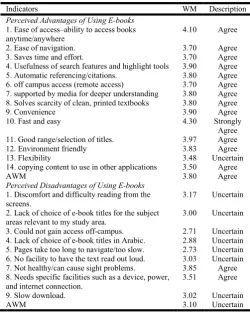
of the students toward e-books were elicited and are presented in Table 4. Table 1 displays 14 perceived advantages of using e-Books, where only one was described as strongly agree, having a weighted mean of 4.30, the highest. On the other hand, the lowest weighted mean was 3.48 described as uncertain. The data reveal that the students strongly agree that using e-Books is fast and easy; yet, they are uncertain of its flexibility. This was corroborated by Alexander and Singer (2017), who found in their study that: students overwhelmingly preferred to read digitally, reading was significantly faster
online than in print students judged comprehension as better online than in print.
Table 4. Perception of Students toward E-books
Indicators WM Description
Perceived Advantages of Using E-books 1. Ease of access–ability to access books anytime/anywhere
4.10 Agree
2. Ease of navigation. 3.70 Agree
3. Saves time and effort. 3.70 Agree
4. Usefulness of search features and highlight tools 3.90 Agree
5. Automatic referencing/citations. 3.80 Agree
6. off campus access (remote access) 3.70 Agree
7. supported by media for deeper understanding 3.80 Agree 8. Solves scarcity of clean, printed textbooks 3.80 Agree
9. Convenience 3.90 Agree
10. Fast and easy 4.30 Strongly
Agree
11. Good range/selection of titles. 3.97 Agree
12. Environment friendly 3.83 Agree
13. Flexibility 3.48 Uncertain
14. copying content to use in other applications 3.50 Agree
AWM 3.80 Agree
Perceived Disadvantages of Using E-books 1. Discomfort and difficulty reading from the screens.
3.17 Uncertain
2. Lack of choice of e-book titles for the subject areas relevant to my study area.
3.00 Uncertain
3. Could not gain access off-campus. 2.71 Uncertain
4. Lack of choice of e-book titles in Arabic. 2.88 Uncertain 5. Pages take too long to navigate/too slow. 2.73 Uncertain 6. No facility to have the text read out loud. 3.03 Uncertain
7. Not healthy/can cause sight problems. 3.85 Agree
8. Needs specific facilities such as a device, power, and internet connection.
3.51 Agree
9. Slow download. 3.02 Uncertain
AWM 3.10 Uncertain
On the other hand, there were 9 perceived disadvantages of using e-Books, but the one that obtained the lowest weighted mean was on gaining access in off-campus (2.71); and the highest weighed mean was 3.85, which states that it is not healthy and cause sight problems. The weighted means of 3.80 and 3.02 signify that the students agree on the advantages of using e-Books, but they are uncertain of its advantages. This further signifies that there are more advantages in using e-Books than its disadvantages. This particular finding supports that of Intel Corporation (2012), who expresses that effective learning comes from using information communication technology (ICT) to broaden educational opportunities and help students develop the skills students will need to thrive in the 21st – century and has been shown to have positive effects on students’ learning.
Relationship of Variables: This section shows the
relationship among the variables tested in the study. These are shown in Tables 5-7.
Profile and comprehension level: The significant relationship
between the socio-demographic profile of the students and their comprehension level is illustrated in Table 5.
Table 5. Significant Relationship between the Demographic Profile of the Students and their Comprehension Level
Variables X2 df p-value Decision
Sex 3.645 2 0.162 Accepted
Number of Hours Spent Using E-books
4.706 12 0.967 Accepted
Kind of Reading Materials Student Read f Rank
Short Stories 183 1
Learners’ Materials 174 2
Research Studies 146 3
Novels 137 4
Periodicals 111 5
The table shows a p-value of 0.162 for sex, which is significantly lower than the mean of 3.645. For the number of hours spend using e-Books, the p-value was 0.967, still lower than its mean of 4.706. The hypothesis was accepted, which means that there is no significant relationship between the demographic profile of the students with e-Books and their comprehension level. Technology can help teachers provide an enriched classroom experience, but it can also provide challenges that can interfere with the learning experience. Technology can provide a positive experience in the classroom, but technology can also be a hindrance in the classroom (Seimans, 2005).
Profile and perception. The significant relationship between
the socio-demographic profile of the students and their perceptions toward e-Books is shown in Table 6.
Table 6. Significant Relationship between the Demographic Profile of the Students and their Perception towards E-Books
Variables X2 df p-value Decision
Sex 12.124 2 0.000 Rejected
Number of Hours Spent Using E-books
53.165 12 0.021 Rejected
As reflected, the p-value of 0.000 for sex is significantly lower than the mean of 12.124. For the number of hours spend using e-Books, the p-value was 0.021, still lower than its mean of 53.165. The decision was to reject the null hypothesis, which means that there is no significant relationship between the demographic profile of the students and their perceptions towards e-Books.
This finding validates that of Orbis Cascade Alliance Team (2015), who generated result that 81 percent of the students perceived e-books as the better option compared to the actual book because they will be able to print only the pages they desire to print, they have clear reference for having automatic citation tools, distance also matter to those students who are living far from actual books because they have the option to just read at home and save time and money.
Comprehension and perception: The significant relationship
between the comprehension level of the students who are readers and non-readers of e-Books and their perceptions toward e-Books is presented in Table 7.
Table 7. Significant Relationship between the Reading Comprehension Level of the Students who are Readers and
Non-Readers of E-Books and their Perceptions towards E-Books
Variables M SD r-value p-value Decision
Non-readers of E-Books 2.95 .02 0.134 0.217 Accepted
Readers of E-Books 3.00 .00 0.451 0.045 Rejected
As shown in the table, non-readers of e-books obtained a p-value of 0.217, which is significantly lower than the mean of 2.95. For readers of e-books, the p-value was 0.045, still lower than its mean of 3.00. The decision was to both accept and reject the null hypothesis, which means that there is no significant relationship between the demographic profile of the students who are non-readers of e-books and their perception towards e-books. In contrast, there is a significant relationship between the demographic profile of the students who are readers of e-books and their perception towards e-books. This was in consonance with the findings of Reid (2016), who said
that electronic books can be a dynamic tool in the classroom as they provide children with authentic features to promote language and literacy development.” The same positive review about e –book was also found in a 2013 study published by PLOS One that individuals with poor eyesight or reading disorder like dyslexia benefit from e–readers because of the range of text size and text spacing options available in the e– readers.
Summary, Conclusion, and Recommendation: This chapter
discusses and presents the summary of findings, conclusion and recommendations based on the results drawn from the study.
Summary of Findings
This research primarily aimed to enhance students’ perception on electronic books towards reading comprehension in Naval School of Fisheries.
Demographic profile of students with e-books. The students
with e-Books are mostly female, only spent less than 30 minutes per week reading e-Books using their smartphones; and were considered independent readers.
Reading materials student read on their devices. The most
read material by the students is short stories, while the least was magazines.
Reading comprehension level of the students who are users
and non-users of e-books. The reading comprehension level of
non-e-Book users is higher than the e-Book users.
Perception of the students toward e-books. The students
perceived that the use of e-Books is fast and easy, but they are also aware of its number one disadvantage, where they perceived it to cause sight problems.
Conclusion
After a thorough analysis of the findings obtained from the results of this study, it was concluded that electronic books have in no way or another affect the reading comprehension in Naval School of Fisheries.
Recommendations
Based on the formulated findings and conclusion, the following recommendations are hereby suggested:
1. School heads shall intensify programs that could motivate students to read materials from the library, instead of using their smartphones most of the time. 2. Teachers should plan interesting day-to-day activities to
influence the students to actively participate in the discussion; thus, improve their performance.
3. Students shall always be reminded and monitored to make sure that they are utilizing their time in worthwhile activities, rather than reading irrelevant materials from their gadgets.
4. Parents should limit their children in the use of gadgets since it was perceived to cause sight problems. 5. A replication of this study is hereby recommended to
REFERENCES
Alexander, P. and Singer, L. 2017. Reading on Paper and Digitally: What the Past Decades of Empirical Research Reveal. (Research Article) https://doi.org/ 10.3102%2F0034654317722961.
Ansari, M. A and Tamta, P. 2017. A Study of University Student’s Perceptions towards e-Learning (Dissertation, G.B Pant University of Agriculture and Technology, India). Retrieved from www.researchgate.net
Chen,Y. L. 2012. Exploratory Research: The Effects of Electronic Books on College Students. (MBA Student Scholarship, Johnson &Wales University, USA). Retrieved from https://scholarsarchive.jwu.edu/ mba_student/14/.
De Luna, T. (2015, April). Innovation in Education: Utilization and Employment of e-Books in Philippine Educational Institutions. International Journal of Information and Education Technology, Vol. 5, No. 4. Retrieved from http://www.ijiet.org/papers/514-I10020.
Fister, B. and Gilbert, J. 2015. The Perceived Impact of E-books on Student Reading Practices: A Local Study (College and Research Libraries). http:// doi:10.5860/crl.76.4.469
Landow, G. 1994. Hypermedia and Literary Studies. Cambridge: MIT Press. Retrieved from http://www2.idehist.uu.se/
Mayer, R. 2012. Multimedia Learning. California: Cambridge University Press. https://doi.org/10.1017/ CBO9780511811678.
National Literacy Trust United Kingdom, 2015. The Impact of eBooks on the Reading Motivation and Reading Skills of Children and Young People. Retrieved from https://literacytrust.org.uk/research-services/
Nowak, L. 2008. Digital reading theory and its relationship to academic reading practices. Essays on the Design of the Electronic Text. University of Toronto.
Orbis Cascade Alliance Assessment Team. 2016. Ebook User Studies: A Literature Review. Retrieved from https://www.orbiscascade.org/
Rosenblatt, L. 1978. The Reader, the text and the poem: The transactional theory ofthe literary work. Carbondale ILL. Southern Illinois University Press. Retrieved from www.google.com/transactional-reading.
Seimans, G. 2005 Connectivism: A Learning Theory for the Digital Age. International Journal of Instructional Technology and Distance Learning. Retrieved from http://er.dut.ac.za/
Thorsten, S. 1999. English Literature on the Internet (MA Thesis, University of Bayreuth, Germany). http://webdoc.sub.gwdg.de/edoc/
Vijayalakshmi, M. 2016. Information and Communication Technology in Education. Retrieved from https:// www.slideshare.net
Wilson, T. 2016. Theoretical approaches to e-book research. (A Conceptual Paper) http://dx.doi.org/10.15291/ libellarium.v9i1.277.