Mining Words and Targets using Alignment
Model
Dr.C.Sundar R.Priyanga
Associate Professor PG Scholar
Department of Computer Science & Engineering Department of Computer Science & Engineering Christian College Of Engineering & Technology. Christian College Of Engineering & Technology.
DindigulTamilnadu-624619 India DindigulTamilnadu-624619 India
Abstract
Opinion target is defined as the object about which user expresses their opinions, typically as nouns or noun phrases. Opinion words are the words that are used to express user’s opinions. Constructing an opinion words lexicon is also important because the lexicon is beneficial for identifying opinion expressions. Opinion mining is also called sentiment analysis, involves building a system to collect and categorize opinions about a product. Existing system uses Sentence-level extraction and corpus –level extraction. Sentence level extraction is the task of opinion target/word extraction is to identify the opinion target mentions or opinion expressions in sentences. These tasks are usually regarded as sequence-labeling problems. Sequence labeling models are used to build the extractor, such HMM. Corpus-level extraction did not identify the opinion target/word mentions in sentences, but aimed to extract a list of opinion targets or generate a sentiment word lexicon from texts. To overcome these problems by using alignment models.
Keywords: Opinion word, opinion target, alignment model
________________________________________________________________________________________________________
I. INTRODUCTION
Data mining (sometimes called knowledge discovery) is the process of analyzing data from different perspectives and summarizing it into useful information - information that can be used to increase revenue, cuts costs, or both. Data mining software is one of a number of analytical tools for analyzing data. It allows users to analyze data from many different dimensions or angles, categorize it, and summarize the relationships identified. Technically, data mining is the process of finding correlations or patterns among dozens of fields in large relational databases.
Data, Information, and Knowledge Data are any facts, numbers, or text that can be processed by a computer. Today, organizations are accumulating vast and growing amounts of data in different formats and different databases. This includes: operational or transactional data such as, sales, cost, inventory, payroll, and accounting nonoperational data, such as industry sales, forecast data, and macro-economic data meta data - data about the data itself, such as logical database design or data dictionary definitions Information The patterns, associations, or relationships among all this data can provide information. Knowledge Information can be converted into knowledge about historical patterns and future trends.
Data Warehouses Dramatic advances in data capture, processing power, data transmission, and storage capabilities are enabling organizations to integrate their various databases into data warehouses. Data warehousing is defined as a process of centralized data management and retrieval. Data warehousing, like data mining, is a relatively new term although the concept itself has been around for years. Data warehousing represents an ideal vision of maintaining a central repository of all organizational data. Centralization of data is needed to maximize user access and analysis.
Opinion mining is also called sentiment analysis, involves building a system to collect and categorize opinions about a product. Automated opinion mining often uses machine learning, a type of artificial intelligence (AI), to mine text for sentiment. Opinion mining can be useful in several ways. It can help marketers to evaluate the success of an advertisement cause or new product launch and also determine which versions of a product or service are popular and identify which demographics like or dislike particular product features. For example, a review on a website might be broadly positive about a digital camera, but be specifically negative about how heavy it is. Being able to identify this kind of information in a systematic way gives the vendor a much clearer picture of public opinion than surveys or focus groups do, because the data is created by the customer.
II. RELATED WORKS
Mining and Summarizing Customer Reviews M. Hu and B. Liu, 10th ACM, 2004.This task is performed in three steps: (1) mining product characters that have been commented on by customers (2) identifying opinion sentences in each review and deciding whether each opinion sentence is positive or negative (3) summarizing the results using reviews of a number of products sold online demonstrate the effectiveness of the technique do not find features on which opinions have been expressed. Structure-Aware Review Mining and Summarization F. Li, S. J. Pan 2012 .The linguistic structure can be naturally integrated into model representation. Linear-chain structure is defined by using conjunction structure and syntactic tree structure in the framework. The framework can employ rich features to simultaneously extract object features, positive opinions and negative opinions. Hard to identify the low-frequency object features and opinions.
HMM-based Learning Framework for Web Opinion Mining K. Liu, L. Xu, Jul.2012. The goal is to mine customer reviews of a product and extract particular product related entities on which reviewers express their opinions. Complex product entities and opinion expressions as well as infrequently mentioned entities can be effectively and efficiently identified . It is used a fixed list of keywords to realize high frequency feature words. Collecting a large training set could be expensive and difficult to accomplish.
Bootstrapping Both Product Features and Opinion Words B. Wang and H. 2008,.A bootstrapping iterative learning strategy is proposed alternately. A linguistic rule is adopted to identify low frequent features and opinion words. A mapping function from opinion words, the feature is proposed to identify implicit features in sentence. The final feature lexicon and opinion word lexicon are identified with very few knowledge (only ten seed opinion words) and augmented by each other alternately. Learn the semantic orientation of each opinion word, calculate the polarity of each subjective sentence, and then construct a feature based summary system
Mining Opinion Features in Customer Reviews M. Hu and B. Liu San Jose 2004. It summarizes all the customer reviews of a product. This summarization task is different from traditional text summarization which is based on the specific features of the product that customers have opinions to determine whether the opinions are positive or negative. These techniques are highly effective. The most representative sentences are not extracted, but only identify and extract those specific product features and the opinions related with them. Improve the feature extraction and the subsequent summarization.
Expanding Domain Sentiment Lexicon through Double Propagation G. Qiu, L. Bing Comput 2011. A double propagation approach that exploits the relations between sentiment words and topics or product features, and also sentiment words and product features them to extract new sentiment words. As the method propagates information through both sentiment words and features, it referred as double propagation. This approach is able to extract a large number of new sentiment words. The polarity assignment method is effective. Unable to extract unpaired adjectives while extract through product features.
Authoritative Sources in a Hyperlinked Environment B. Liu, 2007.Address within our framework is the distillation of broad search topics, through the discovery of “authoritative” information sources on such topics. Traffic and the development of algorithms and tools to exploit information gained from traffic patterns. Link-based methods to handle information needs other than broad-topic queries on the www pose many interesting challenges.
Modeling Review Comments B. Liu 2012.Clearly, the information in comments is valuable for both future readers and brands. This paper proposes two latent variable models to simultaneously model and extract these key pieces of information . Enable classification of comments accurately. Works are not concerned with review comments.
Opinion Target Extraction Using Word-Based Translation Model W. Jin and H. H. Huang 2009. Capture opinion relations more precisely, especially for long-span relations. In particular, compared with previous syntax-based methods, our method can effectively avoid noises from parsing errors when dealing with informal texts in large Web corpora. Our approach is more effective and robust than state-of-art methods. The precision of result can be improved.
III. PROPOSED WORK
Previous work generally adopted a collective extraction strategy. The intuition represented by this strategy was that in sentences, opinion words usually co-occur with opinion targets, and there are strong modification relations and associations among them. In previous methods, mining the opinion relations between opinion targets and opinion words was the key to collective extraction. To this end, the most adopted techniques have been nearest neighbor rules and syntactic patterns.
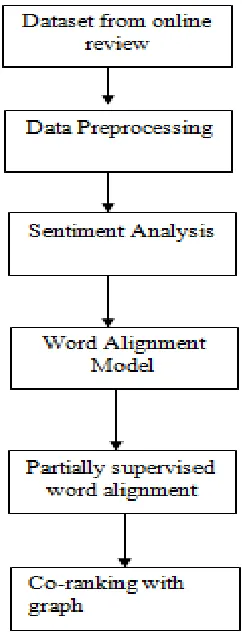
Sentiment Analysis
Sentiment analysis technology is to automatically classify unstructured reviews as positive or negative or neutral. Sentiment analysis technology is needed to extract investor sentiment because manual collection would be impractical. Two approaches for sentiment analysis are the machine learning approach and the lexicon approach.
Machine Learning Approach
The basic process of the machine learning approach includes pretreatment, text expression (feature selection, dimension reduction, feature weighting), classification, and results.
Lexicon approach
The basic process of the lexicon approach includes pretreatment, word segmentation, part-of-speech (POS) tagging, polarity (bullish or bearish) tagging, combining, and results output.
Word Alignment Model
Opinion relation identification used as a word alignment process. Word-based alignment model used to perform monolingual word alignment, which has been widely used in many tasks such as collocation extraction and tag suggestion. A bilingual word alignment algorithm is applied to the monolingual scenario to align a noun/noun phase (potential opinion targets) with its modifiers (potential opinion words) in sentences. There are several word alignment models for usage, such as IBM-1, IBM-2 and IBM-3. Some constraints in the alignment model as follows:
Nouns/noun phrases (adjectives/verbs) must be aligned with adjectives/verbs (nouns/noun phrases) or a null word. Aligning to a null word means that this word either has no modifier or modifies nothing. Other unrelated words, such as prepositions, conjunctions and adverbs, can only align with themselves.
Partially-Supervised Word Alignment Model
The standard word alignment model is usually trained in a completely unsupervised manner, which may not obtain precise alignment results. Thus, to improve alignment performance, perform a partial supervision on the statistic model and employ a partially-supervised alignment model to incorporate partial alignment links into the alignment process. The partial alignment links are regarded as constraints for the trained alignment model. The alignments generated by the PSWAM must be as consistent as possible with the labeled partial alignments. To fulfill this aim, we adopt an EM-based algorithm. For training a simpler alignment model, such as the IBM-1 and IBM-2 models, easily obtain all possible alignments from the observed data. Those inconsistent alignments with pre-provided partial alignment links (illegal alignments) could be filtered out; therefore, they would not be counted for parameter estimation in subsequent iterations.
Syntactic Patterns
Automatic method for partial alignment generation is needed. To fulfill this aim, syntactic parsing are used. As mentioned in the first section, although current syntactic parsing tools cannot obtain the whole correct syntactic tree of informal sentences, some short or direct syntactic relations can be still obtained precisely. Thus, some high-precision low-recall syntactic patterns are designed to capture the opinion relations among words for initially generating the partial alignment links.
Co-Ranking with Graph
After mining the opinion associations between opinion target candidates and opinion word candidates, construct the Opinion Relation Graph. Then calculate the confidence of each opinion target/word candidate on this graph, and the candidates with higher confidence than a threshold are extracted as opinion targets or opinion words.
Assume that two candidates are likely to belong to a similar category if they are modified by similar opinion words or modify similar opinion targets. If know one of them to be an opinion target/word, the other one has a high probability of being an opinion target/word. Then forward the confidences among different candidates, which indicates that the graph-based algorithms are applicable. Graph based co-ranking algorithm is to estimate the confidence of each candidate. Then calculate association between opinion word/target.
Fig. 1: System Architecture
IV. EXPERIMENTAL ANALYSIS AND RESULT
Learning Bayesian networks is known to be an NP-hard problem, and this, combined with the growing interest in learning models from high-dimensional domains, leads to the necessity of finding more efficient learning algorithms. Widely used local search algorithms, such as Hill Climbing. One of these algorithms families, called constrained Hill Climbing (CHC), greatly improves upon the efficiency of the original approach, obtaining models with slightly lower quality but maintaining their theoretical properties. Different modifications to the most scalable version of these algorithms, fast constrained Hill Climbing, to improve the quality of its output by relaxing the constraints imposed to include some diversification in the search process. The aim of these new approaches is to adjust the trade-off between efficiency and accuracy of the algorithm, as they do not modify its complexity and only imply a few more search iterations. Perform an intensive experimental evaluation of the modifications proposed with an extensive comparison between the original algorithms and the new modifications covering several scenarios with quite large data sets.
In existing system extract words and targets by explicit features, labeled training data are insufficient or come from the different domains than the current texts; they would have unsatisfied extraction performance. To overcome these problem by using word alignment model. This method is focused on detecting opinion relations between opinion words and targets. Using this model opinion relations are captured more precisely and more effectively. From the reviews opinion words and targets are extracted efficiently. By using sentiment analysis positive, negative and neutral results are expressed. Calculate the confidence of each candidate.
algorithm to estimate the confidence of each candidate. Opinion Relation Graph. Graph based co-ranking algorithm is to estimate the confidence of each candidate. Then calculate association between opinion word/target. Exploit random walking with restart algorithm to propagate confidence among candidate and estimate the confidence on Opinion relation graph.
Experimental results for datasets with different languages and different sizes prove the effectiveness of the proposed method. In future work, consider additional types of relations between words, such as topical relations, in Opinion Relation Graph. This may be beneficial for co-extracting opinion targets and opinion words. The items with higher ranks are extracted out.
REFERENCES
[1] M. Hu and B. Liu, “Mining and summarizing customer reviews,” in Proc. 10th ACM SIGKDD Int. Conf. Knowl. Discovery Data Mining, Seattle, WA, USA, 2004, pp. 168–177.
[2] F. Li, S. J. Pan, O. Jin, Q. Yang, and X. Zhu, “Cross-domain coextraction of sentiment and topic lexicons,” in Proc. 50th Annu. Meeting Assoc. Comput. Linguistics, Jeju, Korea, 2012, pp. 410–419.
[3] L. Zhang, B. Liu, S. H. Lim, and E. O’Brien-Strain, “Extracting and ranking product features in opinion documents,” in Proc. 23th Int. Conf. Comput. Linguistics, Beijing, China, 2010, pp. 1462–1470.
[4] K. Liu, L. Xu, and J. Zhao, “Opinion target extraction using wordbased translation model,” in Proc. Joint Conf. Empirical Methods Natural Lang. Process. Comput. Natural Lang. Learn., Jeju, Korea, Jul. 2012, pp. 1346–1356.
[5] M. Hu and B. Liu, “Mining opinion features in customer reviews,” in Proc. 19th Nat. Conf. Artif. Intell., San Jose, CA, USA, 2004, pp. 755–760.
[6] A.-M. Popescu and O. Etzioni, “Extracting product features and opinions from reviews,” in Proc. Conf. Human Lang. Technol. Empirical Methods Natural Lang. Process., Vancouver, BC, Canada, 2005, pp. 339–346.
[7] G. Qiu, L. Bing, J. Bu, and C. Chen, “Opinion word expansion and target extraction through double propagation,” Comput. Linguistics, vol. 37, no. 1, pp. 9–27, 2011.
[8] B. Wang and H. Wang, “Bootstrapping both product features and opinion words from chinese customer reviews with crossinducing,” in Proc. 3rd Int. Joint Conf. Natural Lang. Process., Hyderabad, India, 2008, pp. 289–295.
[9] B. Liu, Web Data Mining: Exploring Hyperlinks, Contents, and Usage Data, series Data-Centric Systems and Applications. New York, NY, USA: Springer, 2007.
[10] G. Qiu, B. Liu, J. Bu, and C. Che, “Expanding domain sentiment lexicon through double propagation,” in Proc. 21st Int. Jont Conf. Artif. Intell., Pasadena, CA, USA, 2009, pp. 1199–1204.
[11] R. C. Moore, “A discriminative framework for bilingual word alignment,” in Proc. Conf. Human Lang. Technol. Empirical Methods Natural Lang. Process., Vancouver, BC, Canada, 2005, pp. 81–88.
[12] X. Ding, B. Liu, and P. S. Yu, “A holistic lexicon-based approach to opinion mining,” in Proc. Conf. Web Search Web Data Mining, 2008, pp. 231– 240.
[13] F. Li, C. Han, M. Huang, X. Zhu, Y. Xia, S. Zhang, and H. Yu, “Structure-aware review mining and summarization.” in Proc. 23th Int. Conf. Comput. Linguistics, Beijing, China, 2010, pp. 653–661.
[14] Y. Wu, Q. Zhang, X. Huang, and L. Wu, “Phrase dependency parsing for opinion mining,” in Proc. Conf. Empirical Methods Natural Lang. Process., Singapore, 2009, pp. 1533–1541.
[15] T. Ma and X. Wan, “Opinion target extraction in chinese news comments.” in Proc. 23th Int. Conf. Comput. Linguistics, Beijing, China, 2010, pp. 782– 790.