ISSN (e): 2250-3021, ISSN (p): 2278-8719
Vol. 08, Issue 8 (August. 2018), ||V (III) || 85-94
Design an Application of Dynamic Energy Estimation for Query
Processing Results in Banking Framework Using Data Mining
Techniques
Mr.P.Hariharan
1, S.Guru
21(Assistant Professor, Department of Computer Science and Application, Adhiparasakthi college of
arts and science (Autonomous), India)
2
(M.Phil (CS) Research Scholar, Department of Computer Science and Application, Adhiparasakthi college of arts and science (Autonomous), India)
Corresponding Author: Mr.P.Hariharan1
Abstract :
Data centers are renowned to consume giant amounts of energy. Since information is during all the main applications in a typical information center, building energy-aware information systems has become a lively analysis topic recently. The quantification of the energy price of information systems is a very important task in coming up with such systems. During this paper, we tend to report our recent efforts on this subject, with a spotlight on the energy price estimation of question plans throughout question improvement. We tend to begin from building a series of physical models for energy estimation of individual relative operators supported their resource consumption patterns. Since the execution of individual queries may be a combination of relative operators, we tend to use the physical models as a basis for a comprehensive energy price estimation model for entire question plans. To additional improve model accuracy underneath system dynamics and also the variations of work characteristics, we tend to develop an internet model estimation theme that dynamically corrects the static model supported advanced modeling techniques adopted from management engineering. Mistreatment the price model as a basis, the analysis model will utilizes the trade-offs between power and performance of plans, and helps the question optimizer choose plans that meet performance needs however lead to lower energy price. Finally, an inexperienced information framework integrated with the 2 higher than models is projected to boost poster software. Experimental results reveal that, with reliable and correct applied math information, the projected framework during this study is able to do important energy savings and improve energy potency.Keywords -
Energy consumption, CPU Dynamic Voltage and Frequency Scaling, Web search engines --- --- Date of Submission: 06-08-2018 Date of acceptance: 23-08-2018 --- ---I.
INTRODUCTION
1.1
General presentation
Data centers (DC) are familiar to be the “SUVs of the school world” for his or her monumental energy consumption. Triggered by this drawback, there square measure recently plenty of efforts on energy management in knowledge centers but, those solutions focus primarily on the operating system (OS) level. As a result, they cannot be directly applied to application-level energy management, as a result of the dearth of adequate data of application behavior. Therefore, it's necessary to style application-specific energy estimation and management mechanisms. During this paper, we have a tendency to target a really necessary form of DC application – direction systems (DBMSs).
Energy management could be a comparatively new topic within the info analysis field. The theme in such analysis is to style DBMSs with energy consumption as a fantabulous performance goal, as advocated by the Claremont report. Current add energy-aware DBMS has centered on energy-aware question improvement that considers each time performance and energy usage because the target and power management policies in distributed databases. Not like different studies that specialize in the implementation of energy-aware DBMS, this paper reports our work on a key issue that has up to now received very little attention – modeling the energy value of info systems.
the power-saving opportunities, a sensible approach is to supply correct energy estimation in question improvement method. During this manner, the model may give valuable insights for different energy management policies, like energy consolidation and projection within the DC. Our static model supported offline analysis will partly succeed this goal however it's essential that our model be strong underneath system and employment variations. Thus, we have a tendency to propose an internet estimation answer supported the static model to make a dynamic energy value calculator for correct, strong and quick estimation of energy value in DBMS.
Specially, we have a tendency to style and judge a two-level framework to satisfy the on top of style goals. In DBMS, every question set up could be a distinctive path to execute a series of relative operators that consists of a collection of basic operations; we have a tendency to 1st introduce our study of power break down of basics operations of relative operators. Supported that, we have a tendency to build a static model that describes the energy consumption of relative operators consistent with their resource desires. The statistics of relative operators square measure provided from a changed DBMS kernel and their energy value coefficients square measure derived from a coaching question set exploitation classic regression tools. Such models show a high accuracy in predicting energy consumption in an exceedingly static setting. However, the values of energy value coefficients (e.g., variety of Joules required to method associate indexed tuple) of the model rely upon system states (e.g., computer hardware utilization) and employment statistics (e.g., table cardinality, question arrival rate, etc.). To any improve the static model by creating it convertible to environmental and employment dynamics, we have a tendency to propose an internet model estimation theme that uses a algorithmic least sq. (RLS) calculator to sporadically update the model parameters.
1.2
OBJECTIVE
(i) The identification energy-sensitive layers of the question optimizer,
(ii) The definition of mathematical price models estimating the energy consumption of SQL queries, and (iii) the event of a graphical computer programme that plays the role of a diagnostic tool for finish users, developers and DBA to extend their energy awareness and pushing them to avoid wasting it.
1.3 CONTRIBUTION
This study planned a brand new method of optimizing and process queries. Our contributions are summarized as follows.
(1) We offer an in depth study of the impact of memory size and cache structures (i.e. cached data) on varied prices of question processing. As a consequence, 3 main cache structures (Database Buffer Cache, wordbook Cache, and Library Cache) in memory are related to I/O and central processing unit resource consumption, which helps improve prediction accuracy of the energy value model.
(2) We have a tendency to propose associate degree correct and moveable energy value model for DBMS in a static atmosphere to predict energy value of question process and thus the DBMS is energy-aware.
(3) We have a tendency to propose an easy however sensible query-plan analysis model based on associate degree in-depth analysis of question improvement mechanisms. The analysis model is accustomed value the prevalence of alternative question plans towards a particular improvement goal. With the help of associate degree correct value model, the question optimizer (embedded with the analysis model) will take each power and performance into thought and choose plans with lower energy value and higher energy potency.
(4) We have a tendency to propose a inexperienced info framework that integrated with the two higher than models. We have a tendency to utilize our framework to reinforce a commercial DBMS with question workloads generated from TPC benchmarks. Numerical analysis and experimental results verified the effectiveness of the planned framework.
II.
LITERATURE SURVEY
Moreno et al (2010) have addressed the importance of energy savings while not degrading the performance in cloud computing, since over a technological advance it portrayed a business model wherever the satisfaction of shoppers has high priority. The state of art in energy-aware computing for cloud environments shows that the initials efforts for saving energy have started primarily targeted within the reduction of energy waste generated by idle servers principally supported by VM consolidation and live migration. These, in conjunction with planning algorithms have boosted up 2 main trends: “dynamic server´s pool resizing” and “dynamic processor scaling”.
Buysse et al (2011) investigated that the IT infrastructure and optical network is integration of Associate in Nursing operation facilitating the energy economical. The projected energy economical routing formula at context level for provisioning of IT services. The IT resources square measure executed with the acceptable originates from specific supply sites (e.g. datacenters). The routing approach followed is unicast, the IT service is delivery of results that square measure needed then finding the precise location of the duty execution has been chosen freely. In this scenario, IT and network resources square measure needed to support the services, once the energy efficiency is achieved, the smallest amount energy consumption is known and turning off of any unused IT resources and networks.
Wang et al (2012) have projected a replacement energy-efficient multi-job planning model supported the Google’s immense processing framework, Map Reduce, and make the corresponding formula. Meanwhile, projected individual cryptography and encryption effective technique and construct the individual fitness price of the servers and overall perform of the energy potency. Also, a neighborhood search operator is introduced for looking ability of the projected formula to see if the model is so as to accelerate the focused speed and enhance.
Quan et al (2011) projected a technique that probably reduces the energy consumption of the interior IaaS information centre. To save lots of energy, the resources allocation by the work consolidation and frequency adjustment is rearranged. Within the reallocation formula, the advantage of the actual fact that new generation laptop parts have higher performance and consume less energy than the recent generation is taken. Kim et al (2010) evaluated Apache Hadoop on low power machines and study of the practicableness, and projected AnSwer (Augmentation and Substitution) that is energy saving technique to scale back energy consumption by introducing low power machines. The projected system implements AnSwer in Hadoop and through an experiment studied AnSwer comprehensive to live the impact on performance and power savings. Moreover, the opposite benchmark tools square measure wont to study the behavior of information process frameworks in numerous ways.
III.
SYSTEM DESIGN
3.1 SYSTEM ARCHITECTURE
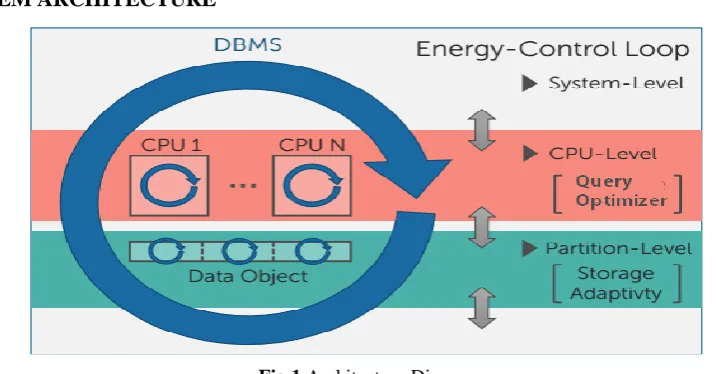
Fig 1 Architecture Diagram
3.1.1
Automatic database tuning toward CPU energy conservation
` The main objective of this analysis thrust is to harness energy-efficient question process and active management of C.P.U. frequency/power modes, that square measure simply accessible in several trendy CPUs. For the primary paradigm, we have a tendency to propose associate degree energy-aware question optimizer that selects question plans with balanced performance and energy prices to realize energy conservation.
3.1.2
Power-aware storage management
IV.
SYSTEM IMPLEMENTATION
4.1 Regression Model.
Impelled by the higher than empirical observations, we have a tendency to investigate whether or not it's possible to a priori estimate the height power consumption of a question. Specially, we glance into whether or not this estimation might be allotted only victimization info provided by the question execution set up, while not requiring any run-time inputs. The challenge here, as mentioned earlier, is that multiple operators could also be death penalty in parallel, particularly on today’s multi-core computing platforms, and that we have to be compelled to capture their combination power utilization. Further, in pipelined plans, power consumption of associate degree operator depends on the most rates at that upstream operator’s square measure funneling knowledge into the pipeline. Supported these observations, we've got developed a model whereby a question set up is 1st segmental into pipelines, victimization techniques developed antecedently for SQL execution progress indicators. for every of those pipelines, we have a tendency to apply a function that takes as input the rates and sizes of the information flowing through the pipeline operators, associate degreed outputs an estimate of the height power consumption. The perform has been developed through fitting step-wise regression toward the mean models on a group of coaching examples, that square measure fastidiously chosen with a read to minimizing the amount of samples needed to realize the specified accuracy. Our analysis indicates that, once the set up statistics square measure accurately calculable within the information system, this power model, albeit high-level, is often ready to estimate the height power inside ± 15 August 1945 of the consumption encountered at run-time. Therefore, it seems to be a great tool for incorporation within the style work table of information servers.
4.2 Question set up choice.
Modern information engines usually opt for question execution plans with the target of minimizing the calculable question execution time, and to our information, peak power issues square measure presently in a roundabout way taken under consideration. During this state of affairs, it's entirely potential that peak power-efficient plans could also be discarded in favor of time-power-efficient plans. A probably potent application of the above-named model is that it will facilitate to quantify the height power-efficiency of the assorted set up alternatives thought-about by the optimizer, thereby supporting creating weighted decisions between peak power and reaction time issues. Our beta experiments during this regard, victimization candidates sourced from a parametric-optimal set of plans (POSP) [9], discovered, for a few queries, plans that reduced the height power by around twenty to forty watts. This can be a major reduction given the eighty W dynamic power vary of our tested machine. Further, these enhancements were obtained even whereas confining our attention to solely the set of plans whose running times were inside an element of 2 of the optimizer’s original time-efficient selection
4.3
Testbed and Workloads
The testbed contains one pc and an influence meter (WattsUpPro electric meter with a ±1.5% measuring error). The laptop, named server hereafter, is put in with the PET increased PostgreSQL to run package service. The work generator produces datasets and workloads that make eventualities of a real-world information services. First, the work generator borrows knowledge and queries from 3 sets of benchmarks:
(1) The generator produces a question pool that consists of two, 000 queries derived from the twenty two customary queries within the TPC-H benchmark by ever-changing the choice predicates. The work generator attracts queries from such pool with a predefined distribution of question time of arrival and options like the amount of resource sharing, question priority, and execution level.
(2) We have a tendency to demonstrate the potential of energy saving in process giant datasets; we have a tendency to additionally use a 1TB astronomical information that has fifty three million distinctive astronomical objects like stars, galaxies, and quasars. The set of four hundred against this information square measure extracted from the question templates announce on the web site of the SDSS project – large-scale scientific information. a pair of The SDSS question set chiefly consists of enormous table scans and joins of few tables (mostly two-table joins).
(3) Finally, we have a tendency to use a TPC-C benchmark tool named TPCC-UVa3 to come up with OLTP-style workloads. One factor to imply here is that TPCC-UV a could be a closed benchmark tool therein users cannot access or modify the queries. Such a tool forms a black-box testing surroundings for the effectiveness of the PET functionalities.
4.4
Power observation Configuration
index-only, bitmap, and TIDs scan sorts, hash, merge, and nested loop be part of sorts, type and hash combination.
4.5 SQL Queries work
In this module, users will offer either one SQL question or a work to be dead. Queries supported vary from straightforward transactional operations to a lot of advanced coverage operations involving many giant size tables. The work consists of queries generated from the benchmarks tools and might be run at the same time at a predefined execution level. The execution is completed in an exceedingly separate thread for every question and therefore the results square measure displayed in an exceedingly tree table gizmo. Associate degree example of question that users will introduce is Q7 of TPC-H that could be a nested question of 2 levels that joins seven tables; it additionally contains a fancy ordering and grouping operations.
4.6 Power Consumption Timeline
When the user executes a question, we'll dynamically show the period power consumption via the facility meter. Once the question finishes death penalty, we'll calculate and show the full energy that has been consumed. This could offer users a true observation of the energy that has been saved victimization the specified trade-off parameters. As an example, in Figure one (c), for a 1.7% performance degradation, we get 12.4% of power saving. Also, users will compare the calculable and therefore the real values to ascertain the accuracy of mathematical models or more refine their parameters.
4.7 Execution set up
When the user submits a question, the question optimizer selects its best execution set up relative to the pre-defined trade-off. We’ll show this execution set up with numerous info, like calculable price, power consumption, I/O and C.P.U. prices for each physical operator through mouse hovering events. Users will determine that operator consumes a lot of power, for example, we will square measure going to show that C.P.U. intensive operators like type and combination are power hungry in traditional servers. Moreover, we'll highlight during which case I/O intensive operators result in high power consumption.
V. RESULTS
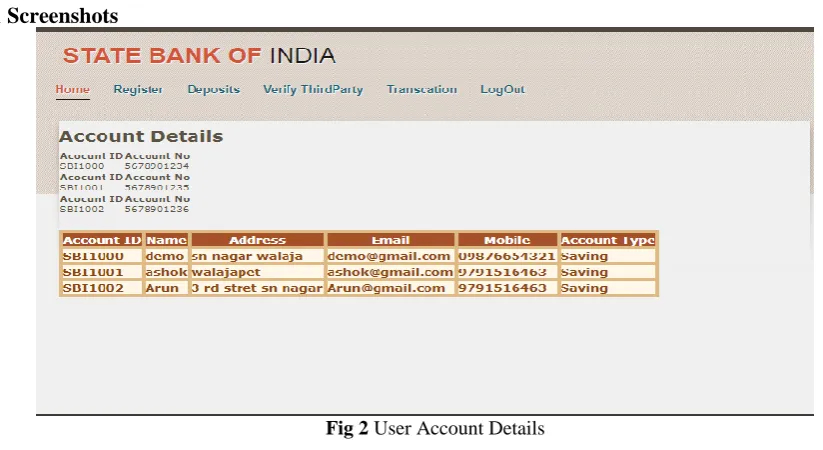
5.1 Screenshots
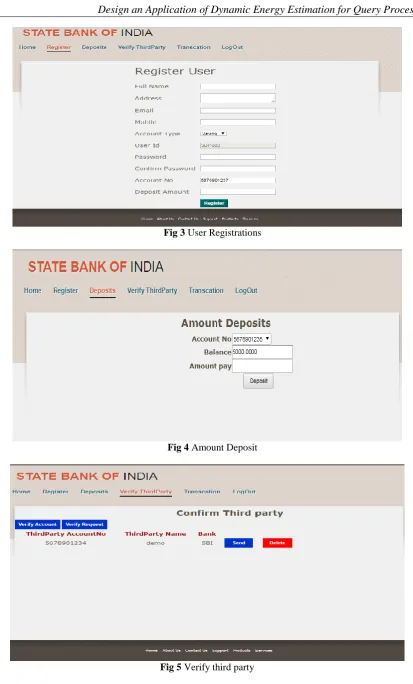
Fig 3 User Registrations
Fig 4 Amount Deposit
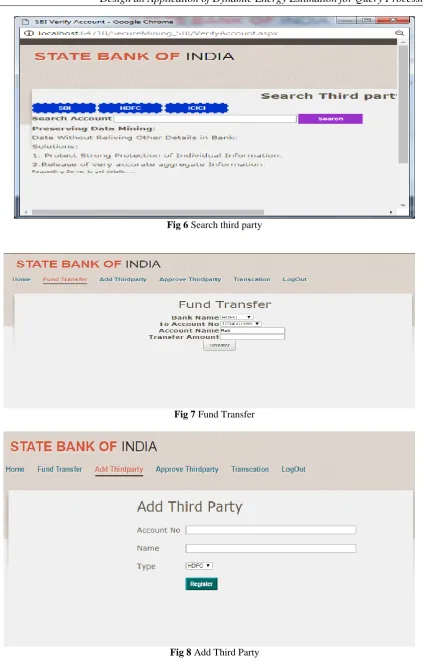
Fig 6 Search third party
Fig 7 Fund Transfer
Fig 9 User Transaction Details
Fig 10 Energy Estimation in Bank to Bank Transactions
VI. CONCLUSION
FUTURE ENHANCEMENT
Considering commonplace question improvement plans and exploring results of various improvement question plans. These directions would be necessary aspects of up relevance and usefulness of energy efficient question process. Modeling errors in each performance and energy prediction would even be a major downside to tackle. Notwithstanding variations from system surroundings and employment characteristics, models that capture dynamic info of the system and sporadically update corresponding parameters of our value and analysis models would be a major side of building sturdy inexperienced databases.
REFERENCES
[1]. Barroso, L.A., Hölzle, U., 2007. The case for energy-proportional computing. Computer 2007 (12), 33– 37.
[2]. Bausch, D., Petrov, I., Buchmann, A., 2012. Making cost-based query optimization asymmetry-aware. In: Proceedings of the Eighth International Workshop on Data Management on New Hardware. ACM: New York. pp. 24–32.
[3]. Beckmann, A., Meyer, U., Sanders, P., et al., 2011. Energy-efficient sorting using solid state disks. Sustain. Comput. Inform. Syst. 1 (2), 151–163.
[4]. Belady, C.L., 2007. In the data center, power and cooling costs more than the IT equipment it supports. Electron. Cool. 13 (1), 24.
[5]. Bin, L., Jiong, Y., Hua, S., et al., 2013. Energy-efficient algorithms for distributed storage system based on data storage structure reconfiguration. J. Netw. Comput. Appl. 48 (1), 71–86.
[6]. Binglei, G., Jiong, Y., et al., 2015a. 10, 202–207.
[7]. Binglei, G., Jiong, Y., et al., 2015b. SQL execution power profiling and modeling. J.Comput. Appl. 12, 33 62–3367.
[8]. Bjørling, M., Folgoc, L.L., Mseddi, A., et al., 2010. Performing sound flash device measurements: some lessons from uFLIP. In: Proceedings of the 2010 ACM SIGMOD International Conference on Management of data. ACM: New York. pp. 1219–1222.
[9]. Canim, M., Mihaila, G.A., Bhattacharjee, B., et al., 2010. SSD buffer pool extensions for database systems. Proc. VLDB Endow. 3 (1–2), 1435–1446.
[10]. Chen, J.J., Kuo, C.F., 2007. Energy-efficient scheduling for real-time systems on dynamic voltage scaling (DVS) platforms. IEEE Computer Society: Washington, D.C. pp. 28–38.
[11]. China IDC, 2012. Data center power will double in the next five years. [Online]. Available:〈http://tech. idcquan. com/pro/34910.shtml〉. (Accessed 2016).
[12]. Do, J., Kee, Y.S., Patel, J.M., et al., 2013. Query processing on smart SSDs: opportunities and challenges. In: Proceedings of the 2013 ACM SIGMOD International Conference on Management of Data. ACM: New York. pp. 1221–1230.
[13]. Dokeroglu, T., Bayir, M.A., Cosar, A., 2015. Robust heuristic algorithms for exploiting the common tasks of relational cloud database queries. Appl. Soft Comput. 30 (C), 72–82.
[14]. Global action plan, 2007. An inefficient truth. Global action plan report. [Online]. Available: http://www.global action plan.org.uk/〉. (Accessed 2016).
[15]. Graefe, G., 2008. Database servers tailored to improve energy efficiency. In: Proceedings of the 2008 EDBT workshop on Software engineering for tailor-made data management. New York: ACM. pp. 24– 28.
[16]. D. Meisner, C. M. Sadler, L. A. Barroso, W.-D. Weber, and T. F. Wenisch, “Power management of online data-intensive services,” in Proc. ISCA, 2011, pp. 319–330.
[17]. C. D. Manning, P. Raghavan, and H. Sch¨utze, Introduction to Information Retrieval. Cambridge University Press, 2008.
[18]. M. Catena, C. Macdonald, and I. Ounis, “On inverted index compression for search engine efficiency,” in Proc. ECIR, 2014, pp. 359–371.
[19]. J. Dean, “Challenges in building large-scale information retrieval systems: Invited talk,” in Proc. WSDM, 2009.
[20]. S. Robertson and H. Zaragoza, “The Probabilistic Relevance Framework: BM25 and Beyond,” Found. Trends Inf. Retr., vol. 3, no. 4, pp. 333–389, Apr. 2009.
[21]. A. Z. Broder, D. Carmel, M. Herscovici, A. Soffer, and J. Zien, “Efficient query evaluation using a two-level retrieval process,” in Proc. CIKM, 2003, pp. 426–434.
[22]. H. Turtle and J. Flood, “Query evaluation: Strategies and optimizations,” Inf. Process. Manage., vol. 31, no. 6, pp. 831–850,Nov. 1995.
[24]. A. Freire, C. Macdonald, N. Tonellotto, I. Ounis, and F. Cacheda, “Hybrid query scheduling for a replicated search engine,” in Proc. ECIR, 2013, pp. 435–446.
[25]. S. Albers, F. M¨uller, and S. Schmelzer, “Speed scaling on parallel processors,” in Proc. SPAA, 2007, pp. 289–298..