e- ISSN: 2278-067X, p-ISSN: 2278-800X, www.ijerd.com
Volume 14, Issue 9 (September Ver. I 2018), PP.34-42
Estimation Of Technical Performance Of Bioenergy Production
From Algae For Future Economic Analysis
Tsado, G.T
1,2., Adamu, M
1. And Alkali, A. A.
1 Department of Chemical Engineering, Federal polytechnic BidaDepartment of Chemical and Process Engineering, University of Surrey. Guildford, UK Corresponding Author:Tsado, G.T
ABSTRACT:
Integrated systems of algae cultivation and biofuels production is one of the technological strategies adopted in the area of algae biofuels Research and Development (R&D) in order to overcome feasibility and techno-economic barriers linked with large scale production of algae biofuels. Therefore this study seeks to assess the integrated process system in order to evaluate or estimate its technical performance, which will provide a solid basis for future economic analysis. In doing this, a study of system integrating biomethane production and biodiesel production using a harvested alga biomass was conducted. Four different scenarios were modelled: methane production, biodiesel production, biodiesel and methane (using residue from biodiesel production), and combined methane and biodiesel production, with each case generating electricity. These scenarios were analyzed and evaluated with respect to products output and energy performance. Microsoft Excel was used to aid in the analysis. The evaluation shows that in 100kg alga biomass the energy that can be generated is in surplus of 16.37 % - 76.69% after supply for on-site use in lipid extraction, transesterification process and anaerobic digestion (AD) system. However, the overall finding from this work is that the feasible technological path of integrated anaerobic digestion and algae cultivation for biofuel production is in the simultaneous combined production of methane and biodiesel and electricity; and this promises viable biorefinery with algae biofuels production.KEY WORDS:Algae, Methane, Biodiesel, Anaerobic Digestion, integrated systems, waste paper
--- --- Date of Submission: 01-10-2018 Date of acceptance: 13-10-2018 ---
---I.
INTRODUCTIONResources that are renewable are a vital area to look into in the quest for alternatives for fossil-based raw materials and energy. Increasing over dependence on fossil resources for the supply of energy to both domestic and manufacture purposes is broadly recognized to be unsustainable. In the world of biomass sources, algae have been recognised as a source of useful products and the most promising renewable resource and have long been under development. In certainty, algae holds great promise as a resource that, if properly developed, could become a sustainable biomass source for energy and fuels (Maczulak, 2010). Recognizing this fact and the need for developing renewable and sustainable energy resource a considerable research attention has been focused on algae aiming at its large-scale cultivation ecologically and economically (Khattar et al., 2009). Algae have been discovered to yield 15 to 300 times oil and 30 times more fuel than traditional soybean and cotton seed per hectare (Chisti, 2007; Ryan, 2009; Schenk et al., 2008). Based on the current available technology, commercial biofuels production from microalgae has not been economically feasible (Andersson et al., 2011 and DOE, 2007). Energy requirement for algae culture, Algal biomass drying and lipid extraction processes is high (Razon and Tan, 2011).
This work will find its usefulness in the following capacities:
1. Lay a background assessment for techno-economic analysis for algae cultivation and biofuels production. 2. Offer insight and valuable information necessary to guide a potential launch into commercial or advancement to integrated large scale production.
3. Provide foundation for technical performance and cost trade-offs among various technologies, processes and systems. For example product yield and energy balance for various routes are compared.
4. Find answer to the question: What algae cultivation and biofuel production technology should be adopted for its resultant biofuel to be cost competitive with other biofuels from alternative renewable resources?
This work is going to investigate the distribution of harvested algal biomass feed to AD and biodiesel production units in an interdependent integrated system and thereby assess the energy production output. In the over all, the study will do a technical assessment for potential integrated system ofbiodiesel and biogas production with a view of co-producing heat and electricity to the needed onsite and surplus be sold to grid. This is aimed to examine technological paths of integrated biofuels production using harvested alga biomass as feedstock, and then evaluate their potential for a realistic and sustainable future bio- refinery development.
The evaluation will be carried out using estimates from extrapolated data gotten from laboratory scale pilots systems and previous related work in the literature.
II.
METHODOLOGYFour scenarios, differentiated by how algal biomass is processed, are considered to evaluate and compare the potential of different configurations of the integrated algae-biofuel system. The evaluation is based on mass and energy balance modelling of the individual units of the system in the biomass processing phases.
2.1 Definition of Scenarios
The following four scenarios regarding the use of algal biomass were considered:
Scenario A (SA): Biodiesel production only (the base case) from the harvested Algal biomass without biogas production.
Scenario B (SB): Biodiesel production using all the harvested algal biomass while the lipid-extracted algae and glycerol sent to AD for biogas production.
Scenario C (SC): Algal biomass distributed between biogas and biodiesel production, with the same connections between biodiesel production and AD as in SB.
Scenario D (SD): Biogas production only from Algal biomass sent to AD without production of biodiesel.
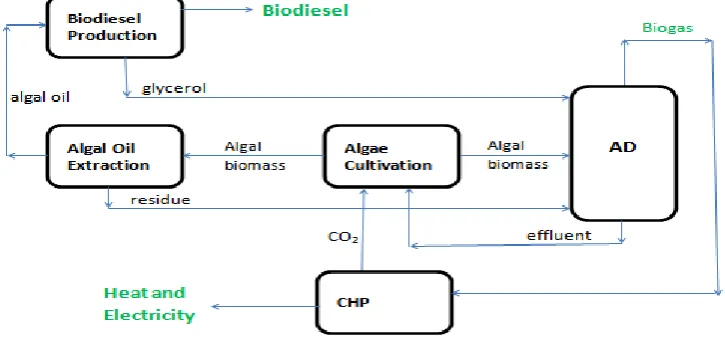
All the above scenarios are embedded in the total scheme of the integrated algae-biofuels system as illustrated in Figure 1. The biogas produced is utilized in CHP system to generate heat and electricity, which would be preferably used to meet the on-site demand.
Figure 1: Integrated Algae-biofuels Systems for Bioenergy Production
2.2 Modelling Assumptions
2.2.1 Algae Biomass
The typical algae solid concentration is less than 0.5 kg/m3 (Andersson et al., 2011) from cultivation. When flocculation and settlement mechanical means would be required to dewater the algae slurry to about 20% solid before further processing (Ron, 2007).In this work, the dewatered algae biomass is 100kg, which will be used for the productions of biodiesel and biogas. The lower heating value (LHV) of alga biomass is assumed to be 30MJ/kg (Razon and Tan, 2011).
2.2.3 Oil Extraction
This study assumes 30% oil content on dry weight algae. The feed to pre-treatment unit before lipid extraction is assumed to contain about 20 wt% solid biomass. A schematic process diagram for lipid extraction procedures is shown in Figure 3, starting with pretreatment of the algal biomass.
Pre-treatment, including drying, cell disruption and heating (Williams and Laurens, 2010; Andersson, 2011), can aid lipid extraction. To lessen cost of biodiesel production, drying option is not considered in this work, as in Chisti (2008). This study assumes mechanical cell distruption by means of milling, which is a popular option among the alternatives (Williams and Laurens, 2010). Specifically, algal biomass with a solid content of 20 wt-% goes into the cell disruption unit to be milled at 95% efficiency for 0.139kWh/kg (Xu et al., 2011) electrical power used. The slurry from the bead milling unit is heated up to about 95oC to further disrupt the cell wall. To estimate the energy required to heat-up the slurry from temperature of 25oC (within cultivation temperature range) to 95oC, the heat capacity of water (4.181kJ/kg/oC) is assumed since the slurry contains only 20wt% solid of algae. On the other hand, the undisrupted algae is assumed to appear in the cake after oil extraction and thus subsequently sent to anaerobic digestion.
Figure 2: Lipid Extraction Process from Harvested Algal Biomass
Solvent extraction of lipid from algae has been demonstrated with solvents such as butanol, ethanol, and 2-Propanol. In this work, the parameters presented by Frank et al. (2011) for wet hexane extraction at 95% extraction efficiency are adopted. The electric power required to separate lipid-rich-hexane and algae residue via disk stack centrifuge is 0.1 kWh/kg oil, while the heat energy required for vaporization of hexane is 1800kJ/kg oil.
2.2.4 Biodiesel Production
The lipid extracted are converted to biodiesel via transesterification, where lipid (tri-glyceride) reacts with alcohol to produce biodiesel (ester) and glycerol, with the presence of a catalyst.
For maximum conversion of triglyceride excess of alcohol is required after which the excess is recovered for reused (Drapcho et al., 2008; Demirbas and Demirbas, 2010). Thus optimal alcohol : oil ratio of 6:1 was assumed in order to achieve an approximately 98 wt% conversion to biodiesel, using a base catalyst, which yielded a product containing 10 wt% glycerol (Drapcho et al., 2008).
In this study, the free fatty acid in the oil is assumed to be 0.05% (Andersson et al., 2011), and thus pretreatment part of the oil is not modelled. Direct base catalysed transesterification route is adopted since the
Catalyst
Alkyl esters + Glycerol
(3mole) (1moles)
Triglyceride + Alcohol
concentration is assumed; with 99.8% conversion rate (Drapcho et al., 2008).
The mixture of biodiesel and glycerol are separated and glycerol sent to anaerobic digester while biodiesel is taken to purification unit, where 97% purity is assumed to be achieved. The biodiesel and alcohol content in glycerol is assumed to be negligible. It is also assumed in this study that biodiesel produced contains 76 wt% carbon (Schlagermann et al., 2012). The molecular weight of the algal oil is computed to be 267.93 g/mol (Drapcho et al., 2008).
To calculate the yield of biodiesel and glycerol, their theoretical yield was first determined from the stoichiometric and their molecular weight.
Energy consumption in biodiesel production is primarily by the purification unit and the transportation of materials within the plant. A study conducted by Janulis (2004) on energy consumption reduction in biodiesel fuel life cycle reported a total direct energy input to operate the biodiesel process to be 540 MJ/tonne biodiesel, which is adopted in this study.
2.2.5 Biogas Production
The biogas production model in this section considers the inflows into the digester from fraction of harvested algal biomass, algae oil extracted residues, and crude glycerol produced from the biodiesel production unit.
Organic Dry Matter (ODM) defines the quantity of convertible material into biogas. The amount of ODM of microalgae vary from species, as reported in Zhu and Lee (1997) study on dry weigh and ash free dry weight determination of selected marine microalgae. In this assessment study, 91 wt% ODM is adopted, which is a level cited for algae species with 31% oil content (Lee, 1997). The ODM for crude glycerol and methanol are set to 85.03 wt% and 99 wt% respectively, according to Andersson et al. (2011).
The techno-economic assessment of anaerobic digestion of microalgae conducted by Zamalloa et al. (2010) for three different scenarios reported the assumed value of 0.5m3/kgODM as the biogas yield, which is taken by this study, further the biogas composition assumed to be 70% methane and 30% CO2. Other impurities are ignored in the calculation of the yield of methane and CO2, which however are considered when estimating energy requirement for biogas clean up (see section 2.2.6).
The specific theoretical methane yield for glycerol and methanol are estimated from Equation 2 (Angelidaki et al., 2011).
1
The specific methane yield from algae residue is reduced by approximately 1/3rd of the “full” algal biomass methane yield (Brune et al., 2009)
Waste paper is used to boost the C/N ratio in the digester. The carbon content of waste paper is assumed to be 38% according to Jeon et al. (2007), with the specific methane yield of paper assumed to be 0.452m3/kg ODM and the content of ODM for paper to be 92%.
The electricity requirement for mixing in the digester is 0.108 kWh/kg TS, and the thermal energy demand for operating under a thermophilic condition (at 50oC to 55oC) is 0.68 kWh/kg TS (Collet et al. 2011). Besides, there is a need to further increase solid concentration from the digestate to 30%, and hence an added electric powerof 0.028 kWh/kg TS (Frank et al., 2011), in comparison to a disk stack centrifuge, was taken into account.
2.2.6 Biogas Clean Up
Crude biogas from anaerobic digestion contains components or impurities, such as CO2, H2S, NH3, H2, moisture, etc. These impurities have to be removed to avoid possible corrosion and deposits in the engine/turbine and other problems in the CHP system.
The technology considered for this clean up step in this study is scrubbing by water. The level of clean up depends on the requirement by the application of the purified biogas. According to Collet et al. (2011), power assumption of 0.301 kWh/m3 of clean CH4 is required to purify biogas to a purity of 96 vol%.For the sake of this study, 0.10 kWh/m3 of energy consumption is assumed for a lower purity requirement of biogas. The CO2-rich water is assumed to be supplied to algal pond to supplement the CO2 required in the algae cultivation.
n
x
n
m
x
y
16
8
12
4
.
22
4
8
2
2.2.7 Combine Heat and Power (CHP) System
The CHP system generates heat and electricity on-site which are utilized by various process units in the integrated bioenergy production system, to reduce or even eliminate the need for external supply. The overall conversion efficiency of the CHP system is defined as
2
Fuel Th E
Q
Q
Q
where η is the efficiency, QE is the useful electrical power output, QTh is the useful heat energy, and QFuel is the total fuel energy input in terms of lower heating value. In this work, 85% of CHP efficiency is assumed with 50% efficiency from heat and 35% electricity. The lower heating value of methane is 50 MJ/kg (Staffell, 2011).
2.3 Energy Balance and Efficiency
To evaluate the overall energy efficiency the integrated system, an energy balance analysis has been carried out against the boundary shown in Figure 3 (the dotted line). The oulet energy streams include biodiesel and biogas, with their energy content expressed in terms of lower heating value (LHV). The inlet energy streams include all the electricity and heat consumptions, as well as the material inputs that carry a LHV. These material inputs include MeOH that enters the biodiesel production, and waste paper consumed in the AD process, and harvested alga biomass. This study does not intend to consider the life cycle energy consumption; therefore energy required for producing any material input is not accounted.
Figure 3: Flow Diagram Showing Various Inputs into the System for Energy Balance Evaluation
The net energy output (ΔE) is given by ΔE = Eout – Ein 3 Where Eout is the total output energy, Ein is the total input energy
The energy ratio (ER) is expressed by
in out
E
E
ER
4The electrical energy input into the system is converted to equivalent thermal energy by assuming a heat-to-power conversion ratio of 0.4. This allows electricity, heat and energy content of materials to be made equivalent and all expressed in terms of thermal energy.
III.
RESULTS AND DISCUSSIONSBased on the assumptions and analyses given in section 2, the integrated system has been assessed in terms of the flows of material and energy, amount of bioenergy produced, and the overall energy performance.
6graphically represent the process energy performance of the integrated system.
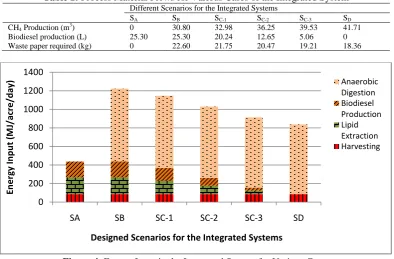
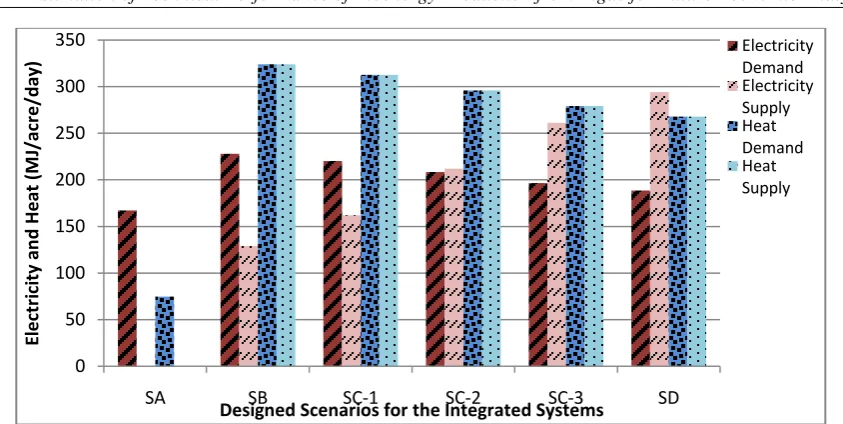
From the table and figures, it can be seen that the four scenarios presented in Section 2.1 give rise to different results. It should be noted here that scenario C is further divided into three cases in which algal biomass directed to AD is varied in the order of 20%, 50% and 80%, as in SC-1, SC-2 andSC-3 respectively. Figure 4 represents the energy input in the integrated system for different scenarios. Figure 5 represents the energy output through production of methane and biodiesel. Figure 6 represents the energy demand and supply for on-site use.
Table 1: Process Material Flows for Various Cases of the Integrated System Different Scenarios for the Integrated Systems
SA SB SC-1 SC-2 SC-3 SD
CH4 Production (m3) 0 30.80 32.98 36.25 39.53 41.71
Biodiesel production (L) 25.30 25.30 20.24 12.65 5.06 0 Waste paper required (kg) 0 22.60 21.75 20.47 19.21 18.36
Figure 4: Energy Input in the Integrated System for Various Cases
Figure 5: Energy Output from the Integrated System through Biodiesel and Methane Production 0
200 400 600 800 1000 1200 1400
SA SB SC-1 SC-2 SC-3 SD
En
e
rg
y In
p
u
t
(M
J/
ac
re
/d
ay
)
Designed Scenarios for the Integrated Systems
Figure 6: On-site Electricity and Heat Demand and Supply
Table 2: Process Energy Flow for Various Casesof Integrated Systems Different Scenarios for the Integrated Systems
SA SB SC-1 SC-2 SC-3 SD
Input Energy (MJ)
Alga Biomass (LHV) 300 300 300 300 300 300
Lipid Extraction 180.59 180.59 144.47 90.30 36.12 0
Biodiesel Production 171.65 171.65 137.32 85.82 34.33 0
Anaerobic Digestion 0 785.59 778.77 768.53 758.28 751.46
Input Total 652.24 1437.77 1360.56 1244.65 1128.73 1051.46 Output Energy (MJ)
Biodiesel 820.44 820.44 656.35 410.22 164.09 0
Methane 0 1016.52 1088.48 1196.42 1304.35 1376.31
Output Total 820.44 1836.97 1744.84 1606.64 1468.44 1376.31
Net Energy (MJ) 168.20 399.20 384.28 362.00 339.71 324.85
Energy Ratio 1.26 1.28 1.28 1.29 1.30 1.31
IV.
DISCUSSIONS OF RESULTSThe harvested algal biomass from the pond, after dewatering, is either sent wholly or in fractions to AD to produce biogas while some fractions is sent to lipid extraction unit to further process to biodiesel production. Here, the substrates to AD are sourced from the harvested algal biomass, algae oil extracted residues, glycerol (by-product in biodiesel production), and waste paper, as the case may be.
Table 1 represents the material flow in the process of transforming algae into biofuels, and feedstocks feed to the AD and the nutrient recovery. There are two extreme cases: Scenario A (SA) and Scenario D(SD) where the harvested algae is committed wholly to producing biodiesel only (SA) or producing methane only (SD). Generally in SA, the „base case‟ there is no CO2 recovery as the system is not integrated with AD through which the nutrients and CO2 are sourced and also, this scenario lacks the capacity to be self-sufficient in terms of energy demand onsite. On the other hand, SD, methane production only, is favourably disposed to in terms of electricity and CO2 savings, as shown in Figure 6.
A yet another case: mix co-production of methane and biodiesel as demonstrated in scenario B (SB) and scenario C (SC). In Figure 4, it is observed that (SB) offers the highest energy output, but with the least CO2 recovery as a result of smaller amount of methane produced in comparison with other scenarios. Also in SBbiodiesel production yields 22.25L (21.86kg biodiesel) which is higher than the other scenarios, but comes with the most energy input, owing to the fact that the entire biomass is processed to biodiesel; the higher the raw material to process, the more the energy requirement. Cell disruption and heating are form of algae pre-treatment which consumes quite a lot of energy, but this is helpful as it aids lipid extraction as well (Andersson, 2011; Lardon et al., 2009).
Scenario C is of three categories in which algal biomass distributed to AD is varied in the order of 20%, 50% and 80%. As the alga biomass to AD increase for these categories, energy input and output decreases. For SB and SC, the co-production of biodiesel and methane yield a higher net energy than when the algal biomass is to produce only either biodiesel or biogas (Figure 6), as in the case of SA and SD. This finding agrees with Harun et al. (2011) where energy output of various types of biofuels from a specie of microalgae
0 50 100 150 200 250 300 350
SA SB SC-1 SC-2 SC-3 SD
El
e
ctr
ic
ity an
d
Heat
(
M
J/
ac
re
/d
ay
)
Designed Scenarios for the Integrated Systems
energy output for producing either methane (14.04MJ/kgAlgae) or biodiesel (6.6MJ/kgAlgae).
Looking at the whole processing units, the highest energy demand in the entire integrated system comes fromAD unit (Figure 4); and this is translated from the thermal energy need. The reason is the thermophilic (50oC to 55oC) regimes of bioconversion assumed in the digester for biogas production (Vindis et al., 2009), and the energy input from the waste paper.The net energy ratio of one means a thermodynamic break-even (Razon and Tan, 2011). In Table 2, the energy ratio for the scenarios is greater than one, which translate to a positive net energy in the processes. For heat and electricity for onsite use (Figure 6), the surplus in observed to start from SB and increases to SD. The electricity surplus here is 21.13MJ, 62.03MJ, 123.5MJ, 184.73MJ, and 225.64MJ for SB, SC-1, SC-2, SC-3 and SD, and this corresponds to electricity surplus of 16.37%, 38.26%, 58.30%, 70.73% and 76.69% respectively.
V.
CONCLUSIONSA Technical assessment of systems integrating biofuels production from microalgae biomass has been carried out. The possible alternative technological paths were examined, and descriptive model developed to enable the estimation of material and energy flow in the system.
The energy generated is in surplus after supply for on-site use in, lipid extraction, transesterification process and AD system. The surplus electricity is an asset to the biorefinery; it can be sold to national grid. It is found from this study that the highest net energy output is achieved when the whole harvested algal biomass is taken to extraction unit to produce biodiesel while the algae oil extracted residues and glycerol are feeds to AD to produce methane. Finally, it can be stated here that the integrated system of processing path of combined production of methane and biodiesel, and electricity production promises a viable biorefinery algae biofuels production.
RECOMMENDATIONS
The economic features (capital investments, operating and maintenance costs) of the plant should be examined based on the values of the mass and energy balance already computed in this study. The financial feasibility, using different approaches (Net Present Value (NPV), Internal Rate of Return (IRR), and Pay Back Period (PBP)),and sensitivity analysis be carried out based on the technical analysis of this report.
REFERENCES
[1]. Andersson, V., Brogerg, S., and Hackl, R. (2011) Integrated Algea Cultivation for Biofuels Production in Industrial Clusters [online]. Program Energisystem. Available from:http://www.liu.se/energi/publikationer/tvarprojekt/1.465340/Arbetsnotat_47.pdf [Assessed: 25/5/2013].
[2]. Angelidaki, I., Karakashev, D., Batstone, D.J., Plugge, M.C. and Stams, A.J.M. (2011) Biomethanation and its Potential. Methods in Enzymology, 494, 327-351.
[3]. Brune, D., Lundguist, T. and Benemann, J. (2009) Microalgae Biomass for Greenhouse GasReductions: Potential for Replacement of Fossil Fuels and Animal Feeds. Journal ofEnvironmental Engineering, 135(11), 1136 – 1144.
[4]. Chisti, Y. (2007) Biodiesel from Microalgae. Biotechnology Advances, 25(3), 294-306.
[5]. Clarens , A.F., Eleazer P. R., Mark A. W. and Lisa M. C.(2010) Environmental Life Cycle Comparison of Algae to Other Bioenergy Feedstocks. Environmental Science &Technology, 44(5), 1813-1819.
[6]. Drapcho, M.C., Nhuan, N.P. and Walker, T.H. (2008) Biofuels Engineering Process Technology. McGraw-Hill, New York. pp 197– 260, 329 – 344.
[7]. Demirbas, A. (2010) Use of Algae as Biofuel Sources. Energy Conversion and Management, 51(12), 2738-2749.
[8]. Demirbas, A. and Demirbas, M.F. (2010) Algae Energy: Algae as a New Source of Biodiesel.Springer-Verlag London Limited, London. pp 75 – 86.
[9]. DOE, Department of Energy (2007) Biomass Program: Algae Biofuels. Growing America‟s Energy Future. US Department of Energy (DOE).
[10]. DOE, Department of Energy (2010) National Algal Biofuels Technology Roadmap. U.S. Department of Energy, Office of Energy Efficiency and Renewable Energy, Biomass Program. http://biomass.energy.gov
[11]. Dragone, G., Fernandes, B., Vicente, A.A. and Teixeira. J.A. (2010) Third generation biofuels from microalgae [online]. Institute for Biotechnology and Bioengineering, Centre of Biological Engineering, University of Minho. Available from: https://repositorium.sdum.uminho.pt/bitstream/1822/16807/1/3067.pdf [Assessed: 12/7/2013].
[12]. Ehimen, E.A., Connaughton, S., Sun, Z. and Carrington, G.C. (2009) Energy Recovery from Lipid Extracted, Transesterified and Glycerol Codigested Microalgae Biomass. Global Change Biology Bioenergy, 1(6), 371-381.
[13]. Ehimen, E.A., Sun, Z.F., Carrington, C.G., Birch, E.J. and Eaton-Rye, J.J. (2011) Anaerobic Digestion of Microalgae Residues Resulting from the Biodiesel Production Process. Applied Energy 88(10):3454–3463.
[14]. Frank, E.D., Han, J., Palou-Rivera, I., Elgowainy, A. and Wang, M.Q. (2011) Life-Cycle Analysis of Algae Lipid Fuels with the GREET Model. Report: ANL/ESD/11-5 for Argonne National Laboratory, Energy Systems Division. Available athttp:/www.osti.gov/bridge.
[15]. Frost, P. and Gilkinson, S. (2010) Performance Summary for Anaerobic Digestion of Dairy Cow Slurry [online]. Interim Technical Report for Agri-Food and Biosciences Institute. Available from:http://www.afbini.gov.uk/afbi-ad-18-months-v05.pdf[Accessed: 15/6/2013].
[16]. Harun, R., Davidson, M., Doyle, M., Gopiraj, R., Danquah, M. and Forde, G. (2011) Technoeconomic Analysis of an Integrated Microalgae Photobioreactor, Biodiesel and Biogas Production Facility. Biomass and Bioenergy, 35(1), 741-747.
[18]. Jeon, E.J., Bea, S.J., Lee, D.H., Seo, D.C., Chun, S.K., Lee, N.H. and Kim, J.Y. (2007) Methane Generation Potential and Biodegradability of MSW Components. Proceedings Sardinia 2007, Eleventh International Waste Management and Landfill Symposium [online]. Environmental Sanitary Engineering Centre, Italy. Available from: http://www.web-resol.org/textos/195.pdf[Accessed: 28/6/2013].
[19]. Khattar,J.I.S. , Singh, D. P. and Kaur, G. (2009) Algal Biology and Biotechnology. I. K International Publishing house. New Delhi.
[20]. Kofman, P.D. (2010) Units, conversion factors and formulae for wood for energy, COFORD 2010.http://www.woodenergy.ie/media/coford/content/publications/projectreports/cofordconnects/ht21.pdf
[21]. Lardon, L., H´elias, A., Sialve, B., Steyer, J.P. and Bernard, O. (2009) Life -Cycle Assessment of Biodiesel Production from Microalgae. Environmental Science and Technology, 43(17), 6475–6481.
[22]. Maczulak, A. (2010) Renewable Energy: Sources and Method. Fact on File, New York. Pp. 61 -63.
[23]. Marchetti, J.M., Miguel, V.U. and Errazu, A.F. (2008) Techno-economic Study of Different Alternatives for Biodiesel Production. Fuel Processing Technology, 89, 740–748
[24]. Morken, J., Sapci, Z. and Strømme, J.E.T. (2013) Modeling of Biodiesel Production in Algae Cultivation with Anaerobic Digestion (ACAD). Energy Policy, 60, 98–105.
[25]. Nigam, P.S. and Singh, A. (2011) Production of Liquid Biofuels from Renewable Resources. Progress in Energy and Combustion Science, 37(1), 52 – 68.
[26]. Pittman, J.K., Dean, A.P. and Osundeko, O. (2011) The Potential of Sustainable Algal Biofuel Production Using Wastewater Resources. Bioresource Technology, 102(1), 17-25.
[27]. Razon, L.F. and Tan R.R. (2011) Net energy Analysis of the Production of Biodiesel and Biogas from the Microalgae: Haematococcuspluvialis and Nannochloropsis. Jounals of Applied Energy, 88 (10), 3507–3514
[28]. Ron, P. (2007) Algae as a Biodiesel Feedstock: A Feasibility Assessment [online].Center for Microfibrous Materials Manufacturing (CM). Available from:http://www.ascension-publishing.com/BIZ/nrelalgae.pdf [Assessed: 20/5/2013]
[29]. Ryan, C. (2009) Cultivating Clean Energy. The Promise of Algae Biofuels. Report by the Natural Resources Defense Council (NRDC) and Terrapin Bright Green, LLC. Washington, DC: NRDC Publications,Schenk, P.M., Skye R. Thomas-Hall, S.R., Stephens, E., Marx, U.C., Mussgnug, J.H., Posten, C., Kruse, O. and Hankamer, B. (2008) Second Generation Biofuels: High-Efficiency Microalgae for Biodiesel Production. BioEnergy Research, 1, 20-43.
[30]. Schlagermann, P., Göttlicher, G., Dillschneider, R. Rosa, R. and Posten, C. (2012)Composition of Algal Oil and Its Potential as Biofuel. Journal of Combustion, 2012/285185, 44.
[31]. Staffell, I. (2011) The Energy and Fuel Data Sheet [online]. University of Birmingham, UK. Available from: http://www.claverton-energy.com/wp content/uploads/2012/08/the_energy_and_fuel_data_sheet.pdf[Assessed: 12/7/2013]
[32]. Vindis, P., Mursec, B., Janzekovic, M. and Cus, F. (2009) The Impact of Mesophilic and Thermophilic Anaerobic Digestion on Biogas Production. Journal of Achievements in Materials and Manufacturing Engineering, 36(2), 192 – 198.
[33]. Wiley, P.E., Campbell, J.E. and McKuin, B. (2011) Production of Biodiesel and Biogasfrom Algae: A Review of Process Train Options. Water Environment Research, 83, 326-338.
[34]. Xu L, Brilman D.W., Withag, J.A., Brem, G. and Kersten, S. (2011) Assessment of a Dry and a Wet Route for the Production of Biofuels from Microalgae: Energy balance analysis. Bioresource Technology,102(8), 5113-5122.
[35]. Yang, J., Xu, Ming., Zhang, X., Hu, Q., Sommerfeld, M. and Chen, Y. (2011) Life Cycle Analysis on Biodiesel Production from Microalgae: Water Footprint and Nutrients balance. Bioresource Technology, 102, 159 – 169.
[36]. Yen, H.W. (2004) Anaerobic Bioassay of Methane Potential of Microalgal Biomass, Ph.D. Dissertation, Biosystems Engineering, Clemson University, Clemson, NC. [unpublished]
[37]. Yen, H.W., and Brune, D.E. (2007) Anaerobic Co-digestion of Algal Sludge and Waste Paper to Produce Methane. Bioresource Technology, 98, 130-134.
[38]. Zamalloa, C., Vulsteke, E., Albrecht, J. and Verstraete, W. (2011) The Techno-Economic Potential of Renewable Energy through the Anaerobic Digestion of Microalgae.Bioresource Technology 102, 1149–1158.
[39]. Zhang, Y., White, M.A. and Colosi, L.M. (2013) Environmental and Economic Assessment of Integrated Systems for Dairy ManurTreatment Coupled with Algae Bioenergy Production.Bioresource Technology. 130, 486–494.
[40]. Zhu, C. J. and Lee, Y. K. (1997) Determination of Biomass Dry Weight of Marine Microalgae. Journal of Applied Phycology, 9, 189–194.