ORIGINAL ARTICLE
IJPHY
ABSTRACT
Background: Hamstring muscles involve a rate of intense musculoskeletal injuries. Hamstring flexibility, shorting, and exhaustion are hazard variables connected with hamstring strain. Enhanced flexibility has for quite some time been viewed as an imperative part in anticipation of musculotendinous strain. Expanding hamstring flexibility can assume a vital part in counteracting lower furthest point injuries. In any case, few research has been performed on the best tech-nique.This study was conducted to correlate the effect of different therapeutic techniques (active release, muscle energy and Mulligan) on increasing hamstring flexibility.
Methods: Fifty seven normal healthy male subjects with hamstring tightness were assigned randomly to one of the four study groups: Group (1)13subjects received active release technique. Group (2)15subjects received muscle energy tech-nique. Group (3) 12subjects received Mulligan’s techtech-nique. Group (4)17subjects did not get any intercession. Popliteal angle (active knee extension test) and sit-reach flexibility test were measured pre and post the intervention period. Results: MANOVA test for active knee extension test and sit-reach test among the four groups for post intervention values there was no significant difference between Group 1 and Group 2 in the post values of AKE with both groups showed significant increases than Group 3. Group 1 versus Group 3: p < 0.0001, CI: 3.5-11.8; Group 2 versus Group 3: p < 0.0001, CI: 4.6-12.8).
Conclusion: It can be reasoned that both active release and muscle energy techniques have similar impact in enhancing hamstring flexibility than Mulligan technique in normal male adults.
Keywords: Active release technique - Muscle energy technique – Mulligan technique - Hamstring flexibility - Active knee extension test – Sit and reach test.
Received 30th September 2016, revised 30th November 2016, accepted 03rd December 2016
www.ijphy.org
10.15621/ijphy/2016/v3i6/124729
CORRESPONDING AUTHOR
Int J Physiother. Vol 3(6), 680-686, December (2016) ISSN: 2348 - 8336
COMPARISON OF DIFFERENT THERAPUTIC TECHINQUES ON
HAMSTRING FLEXBILITY IN NORMAL ADULTS: RANDOMIZED
CONTROLLED TRIAL
*1Doaa I. Amin; PhD, PT
*1Doaa I. Amin; PhD, PT
Lecturer of Physical Therapy Basic Science Department, Faculty of Physical Therapy, Cairo University, Egypt.
INTRODUCTION
Strong flexibility is a part of human capacity; diminish flexibility has been appeared to incline a subject to a few musculoskeletal injuries [1]. Limited muscle flexibility is a typical issue that influences different patient populations and healthy ordinary individuals [2]. The capacity of a per-son to move unreservedly relies on upon his flexibility, a property that improves both wellbeing and ideal physical exercises. Flexibility is an imperative physiological seg-ment of physical wellness, and diminished flexibility can bring about wastefulness in the work put and is likewise a hazard calculated for low back pain [3].
Hamstring shorting has for quite some time been an issue for most living individuals. The more noteworthy domi-nant part of individuals are not extending as well as initi-ating their hamstrings in good way. The vast majority have work area occupations or employments where they are sit-ting for drawn out stretches of time, which causes the ham-strings to end up powerless and tight. At the point when the hamstrings are tight, there can be numerous results, which can bring about torment and injury [4]. Hamstring shorting has been accounted for to be the reason for back pelvic tilting, decreased ordinary lumbar lordosis bend, and declining the current pain in patients with low back pain [5].
A few specialists have analyzed the impact of muscle energy technique (MET) on hamstring flexibility, and found that it enhances muscle flexibility; its impact was credited to the inhibitory Golgi ligament reflex. This reflex is accepted to be initiated amid isometric compression of muscle, which is asserted to deliver extend on the Golgi ligament organs and a reflex relaxation of the muscle [6].
active Release Technique (ART) is the capacity to evacuate delicate tissue adhesions by diminishing tissue tension [7]. ART is utilized to reestablish unlimited movement of
del-icate tissues, discharge entangled nerves, and reestablish ordinary capacity of soft tissues [8].
Mulligan’s flexed leg raise technique has been explained as a means of improving range of straight leg raising (SLR) in subjects with back problems and hamstring shorting and/ or referred pain in the thigh [9].
Keeping up the flexibility of hamstring muscles is impera-tive for typical and athletic individuals and considered one of the need for medicinal services experts, to accomplish this objective subjects need to know the best and effective systems to expand hamstring flexibility [4].
There is an absence of understanding with respect to what are the best procedures to stretch the hamstring muscles [10]. Each of these intercessions has demonstrated clinical and exploratory achievement, no understanding has been come to on a standard convention for treatment. As needs be, the present study was directed to correlate the effect of different therapeutic techniques (active release, muscle en-ergy, mulligan straight leg rising) in expanding hamstring flexibility to avert future issues as low back pain.
METHODOLOGY
The current study was conducted in the Faculty of Physical Therapy, Cairo University, in the period from May 2015 to November 2015 to correlate the effect of different thera-peutic techniques (active release, muscle energy, mulligan straight leg raising) on hamstring flexibility of dominant leg in normal male adults.
Design of the Study
A pretest–posttest randomized controlled experimental design was used to compare the effect of different thera-peutic techniques (active release, muscle energy, mulligan’s straight leg raising) on hamstring flexibility of dominant leg in normal male adults as shown in diagram
Excluded: not meeting inclusion/exclusion
criteria (n=23). Assessed for eligibility
(n =80)
Randomized (n =57)
Group 1
(n =13) Group 2 (n =15)
Group 4 (n =17) Group 3
(n =12)
Active Release Technique
Muscle Energy
Technique No treatment
Treatment sessions was 3 times a week day after day for one month
Completion (n =57)
Mulligan’s Technique
Subjects
A sample of fifty-seven healthy normal male participants with hamstring tightness was assigned randomly using a random sequence generator to one of the four study groups. Subjects were recruited using publically distribut-ed posters, online social mdistribut-edia, and by verbal invitation. Subjects participated in the current study after approval of ethical committee of faculty of physical therapy, Cairo Uni-versity with number P.T.REC/012/001373 and all subjects provided written informed consent. Subjects were included if their age ranged from 18-26years [11], had 20-50 degrees active knee extension loss with hip and knee in 90 degree flexion (popliteal angle) [12], and if they had no history of lower extremities pathology, hamstring injuries and short-ing associated with muscle soreness, acute or chronic low back pain, history of fracture or surgery of back, pelvis, hip, knee and spinal deformities.
Instrumentation 1) Electrogeniometer
- Digital Egyptian made in the faculty of engineering Cairo University with number1719, used to measure the popli-teal angle (active knee extension test). Electrogeniometer consisted of the following:
- Two copper arms, their length were 20 cm and their widths were 5cm.
- A potentiometer (10-turn linear precision potentiome-ter) with panel mounting and stainless steel shaft.
- This potentiometer was wired to a battery as a variable resistor and fixed within the fulcrum of the two arms. - A digital display connected to the potentiometer through insulated electrical wires by sockets in digital display unit and metal jacks at the end of the electrical wire.
- This display convert each one degree of angular displace-ment to 10 electrical volt (lo = 10mV). In addition, it had the ability to read the fraction of one angular degree (0.0). - The Electrogeniometer was calibrated on well-known an-gle in three different anan-gles, which were (180º, 90º and 0 º). Both angles of 180º and 0ºwere calibrated on a straight line, while the 90º angle was calibrated on a right angle plas-tic tri angle. This method of calibration was repeated each time the device was used to allow accuracy of the measure-ment each time used. [13]
Electrogeniometer was valid instrument to measure ROM [14].
2) Weight and height scale:
It was used for measuring the participants’ weight (Kg) and height (Cm). Weight and height were measured to the nearest unit and calculated body mass index.
Procedures
The current study consists of three stages: Pretest measure-ments, treatment period, Posttest measurements:
Pretest measurements:
I. Active knee extension test (popliteal angle):
Active knee extension test is an objective test for measur-ing tightness of hamstrmeasur-ing muscles with electrogoniometer
while active knee extension. It has been showed excellent inter-rater and intra-rater reliability for assessing ham-string flexibility in normal healthy adults [15].
- Participants were evaluated for hamstring shorting uti-lizing the Active Knee Extension test (Popliteal angle) as-sessed for hamstring tightness using the Active Knee Ex-tension test (Popliteal angle) in the dominant leg. Every subject was set in recumbent position with hip and knee flexed in 90°.A wooden box was utilized to keep up the cor-rect position of hip and thigh.
- The pelvis was strapped down to the table for stabilization and controlling any accessory movement and the partici-pant’s head was kept in a neutral position to avoid any neu-ral tension that may occur which can cause a limitation in knee ROM and extensibility of the hamstring muscle[16]. - Bony landmarks were identified and marked with a cir-cular adhesive label to provide reference points to measure the degree of knee extension. The landmarks used are the greater trochanter of the femur, lateral femoral condyle and lateral malleolus.
- The support of the electrogoniometr was focused over the lateral condyle of the femur with the proximal arm secured along the femur utilizing greater trochanter as a kind of perspective. The distal arm was adjusted to the lower leg utilizing the lateral malleolus as a source of perspective. - The hip and knee of the extremity being exam were set into 90°flexion with the back part of thigh in contact with the box at all times to keep up hip in 90° flexion.
- The subject was requested that augment the right lower limb beyond what many would consider possible until a gentle extend sensation was felt. Electrogoniometer was utilized to quantify the angle of knee extension. Three re-iterations were performed and a normal of the three was taken as the last reading for Popliteal Angle [3].
II-Sit and reach flexibility test:
- This test included sitting on a plinth with legs extended straight ahead. The soles of the feet were set level against a wooden box. There was a ruler at the highest point of the box to gauge how far the individual has come to before them. A 40 cm ruler was situated parallel to the lower leg with a zero scale at the center of the ruler. The center of the toe toward the end of the foot spoke to a “zero “score. Achieves shy of the toes were recorded as short scores, and reaches past the toes were recorded as in addition to scores [17].
Treatment
- Group (1) - Active Release Technique Group (n=13) ART was connected 15 reiterations for 10 minutes, 3 times each week for 4 weeks. While the subject lying in prostrate position, the untreated limb was safely strapped down to the table to forestall exorbitant hip and pelvic rotation during technique.. There are 3 steps to perform ART: Step 1: Tender pressure was connected to the hamstring muscle along the whole length while extending the leg in various positions to better work the muscle [20].
Step 2: Tender pressure was applied at the origin and inser-tion of the hamstring muscle [20].
Step 3: Delicate pressure was connected around the adduc-tors and gluteus muscle since hamstring interfaces with these muscles and that could be the wellspring of ham-string shorting [20].
- Group (2) - Muscle Energy Technique Group (n=15) - Muscle energy procedure was connected utilizing post isometric relaxation. While the subject lying in recumbent position, the pelvis was strapped down to the table for ad-justment and controlling any adornment development and the untreated limb was safely strapped down to the table to counteract unnecessary hip and pelvic rotation during technique
- The subject’s hip was latently flexed and the leg reached out until pressure was detected and the subject reported a direct extending sensation. The subject gave a direct knee flexion isometric contraction (around half of maximal contraction), by squeezing his lower leg joint against the highest point of the specialist’s shoulder for 7–10 s.
- This was trailed by 2–3 s of relaxtion, and afterward the leg was inactively extended by the scientist to the palpated boundary as well as resilience to extend and held for 30 seconds. The leg was then brought down to the table for a short resting period (around 10 s). This strategy was re-peated two more times [21].
- Group (3) – Mulligan’s (SLR) Technique Group (n=12) - Subject was in recumbent lying, therapist remained along the edge of constrained SLR, therapist set subjects flexed knee behind him and subjects was requested that push therapist away with his leg and relax. Now therapist pushed subject’s bowed knee up similarly as shoulder on similar side gave there is no pain. The extend was managed for a few seconds and after that the leg was brought down to the bed [22].
- Group (4): the control group (n=17): They did not get any intercession.
Posttest measurements
Active knee extension test (popliteal angle) and Sit and reach flexibility test were repeated as discussed before in pretest measurements after the intervention period to de-termine its effect.
- The outcome measure for comparing the effect of dif-ferent therapeutic techinques on hamstring flexibility was increasing the hamstring flexibility in normal male adults
Statistical Analysis
All statistical analysis were carried out by using the statis-tical package for the social sciences (SPSS, version 20.0 for windows; SPSS Inc., Chicago, Illinois, USA). The normality of data distribution was tested through the Shapiro-Wilk test. Descriptive data for participants, characteristics and dependent variables was calculated as mean ± SD. In ad-dition, for each group, the percentage of change was calcu-lated using the following formula: Percentage of change = [(post-treatment score—pre-treatment score) / pre-treat-ment score] * 100. 2x4 mixed model MANOVA was car-ried out to compare the four groups (between-subject ef-fect) at each of the before and after test time periods and between the before and after test time periods (within-sub-ject effect) for each group for the two tested variables (AKE and sit and reach flexibility test). Furthermore, testing for the interaction effect between both independent variables was conducted. The alpha level of significance was adopted at 0.05.
Sample size
The sample size estimation was based on power analysis in a pilot study with 15 subjects (mean difference 26.87 and SD 5.64). G*power 3.1 software (University of Dussel-dorf, DusselDussel-dorf, Germany) was used in the present study. With power 80% and probability 0.05.
RESULTS
The general characteristics of the participants are shown in table (1). One-way ANOVAs revealed no significant differ-ences in the mean ages (p=0.74), heights (p=0.88), weights (p=0.78), and body mass indexes (p=0.54) between the four groups (p>0.05).
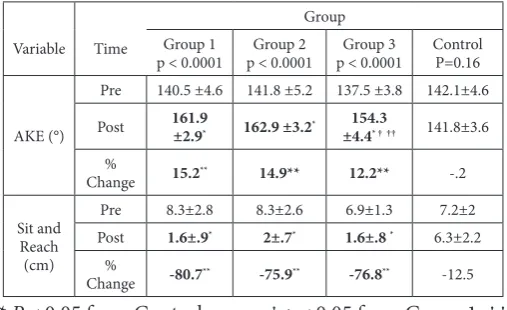
Results showed a time x treatment interaction (p < 0.05) for AKE and sit and reach test. Compared to the control group, Post hoc analyses using the Bonferroni correction revealed significant increases in the mean values of AKE after one month period for Group 1 (ART)(p < 0.0001, CI: -23.6- -16.3), Group 2 (MET)(p < 0.0001, CI: -24.8- -17.4) and Group 3(Mulligan)(p < 0.0001, CI:-16.4- -8.5). Fur-thermore, there was no significant difference (CI: -4.9- 2.9) between Group 1 and Group 2 in the post values of AKE with both groups showed significant increases than Group 3 (Group 1 versus Group 3: p < 0.0001, CI:3.5-11.8; Group 2 versus. Group 3: p < 0.0001,CI: 4.6-12.8), as shown in ta-ble (2).Regarding the sit and reach test, multiple pair wise comparisons showed significant decreases after one month period for Group 1 (p < 0.0001, CI: -9.4- -5.9), Group 2 (p < 0.0001, CI: -9.9- -6.6) and Group 3 (p < 0.0001, CI:-8.9- -5.3) in comparison to the control group. In addition, post hoc analyses revealed no significant differences in the post values between the treatment groups (Group 1 versus. Group 2: p >0.05, CI:-2.3-1.2 ; Group 1 versus. Group 3: p > 0.05, CI:-1.3-2.5; Group 2 versus. Group 3: p >0.05,CI: -.63-3), as shown in table (2) .
0.0001, CI: 14.5- 19), but not for the control group(p =.79, CI: -2.1- 1.6), as shown in table (2). Concerning the sit and reach test, the mean values decreased significantly after one month treatment period compared with pre-treatment in Group 1(p < 0.0001, CI: -8.2- -5.3) , Group 2(p < 0.0001, CI: -7.7- -4.9) and Group 3 (p < 0.0001, CI: -5.6- -2.4), but not for the control group(p =.16, CI: -2.2-.37), as shown in table (2).
Table 1: Descriptive Statistics on Age, Weight, Height and BMI
Variable Group 1 (N=13) Mean±SD
Group 2 (N=15) Mean±SD
Group 3 (N=12) Mean±SD
Control (N=17) Mean±SD Age (years)
p=0.74 Weight (Kg) P=0.78 Height (cm) P=0.88 BMI (Kg/cm2)
P=0.54
19.5±1.4
74.1±7.2
176.6±6.3
23.6±1.4
19.7±1.4
73.2±6.7
175.4±7.9
23.7±1.2
19.6±1.2
72.1±6.5
174.2±5.5
23.7±1.3
19.9±1.5
74.4±5.5
175.5±6.3
24.1±.77
SD: Standard Deviation; BMI: Body Mass Index; Group I: ART; Group II: MET; Group III: Mulligan.p: pvalue(prob-ability value)
Table 2: Comparison of Mean± SD of AKE and sit and reach of the four groups at pre and post treatment times
Variable Time
Group Group 1
p < 0.0001 p < 0.0001Group 2 p < 0.0001Group 3 ControlP=0.16
AKE (°)
Pre 140.5 ±4.6 141.8 ±5.2 137.5 ±3.8 142.1±4.6
Post 161.9 ±2.9* 162.9 ±3.2* ±4.4154.3 * † †† 141.8±3.6
%
Change 15.2** 14.9** 12.2** -.2 Sit and
Reach (cm)
Pre 8.3±2.8 8.3±2.6 6.9±1.3 7.2±2
Post 1.6±.9* 2±.7* 1.6±.8 * 6.3±2.2
%
Change -80.7** -75.9** -76.8** -12.5 * P < 0.05 from Control group; † p < 0.05 from Group 1; ††
p < 0.05 from Group 2; ** Significant change from pre to post; p < 0.05. AKE: Active Knee Extension. Group 1: ART; Group 2: MET; Group 3: Mulligan.p: p value(probability value)
DISCUSSION
Hamstring injuries as introduced in writing constitute an extensive rate of intense musculoskeletal injuries brought about amid wearing exercises at the secondary school, uni-versity, and expert levels. Hamstring flexibility, shorting, and weariness are all modifiable hazard variables connect-ed with hamstring strain [23].
Hamstring strain remains an essential sympathy toward restoration experts as they result in an incapacitating harm portrayed by intense loss of utilitarian execution, delayed times of recuperation, and resultant expanded occurrence of repeat. Enhanced flexibility has for some time been viewed as important part of preventive treatment of mus-culotendinous strain. Expanding hamstring flexibility can assume an essential part in averting lower limit overuse in-juries[24].
Analysts have executed an assortment of methods trying to
enhance hamstring flexibility, systems, for example, static exercise, warm, rub, proprioceptive neuromuscular facil-itation (PNF), active, muscle energy technique ,eccentric contraction ,mulligan techinque and consentric contrac-tion have already been appeared to enhance hamstring adaptability .However, most relative examinations were uncertain as which strategies work best [25].
Active release technique, muscle energy technique and mulligan technique have been proved separately to be effective in improving hamstring flexibility in previous studies. But there is limited study on comparing these three techniques. Subsequently, the point of present work is to correlate the effect of different therapeutic techin-ques in improving hamstring flexibility.
The results between the four groups showed significant increase in the mean value of active knee extension (AKE) after one month period. There was no significant difference between group active release (1) and group muscle energy (2) in the post values of AKE, with both group (1) and group(2) showed significant increase than group mulligan (3).
Regarding the sit and reach flexibility test showed sig-nificant decrease after one month period for group(1), group(2) and group (3) as table (2). There was no signif-icant difference in the post value between group active release (1) and group muscle energy (2).
All these findings revealed that ART group (1) and MET group (2) were more effective than mulligan group (3) in improving hamstring muscle flexibility. Additionally, both groups (1)&(2) showed significant improvement in post intervention values without statistical differences between them.
Firstly, the findings of ART agreed with Onkst (2011) who revealed that ART for the hamstrings is intended to lighten pain and shorting and help the hamstring to come back to its ordinary condition
These finding agreed with those obtained by Onkst et al. (2011) who reported that Active release technique and muscle energy technique discharges the scar tissue grips to permit full extending of the muscle and to recover flex-ibility for practical utilize.
Furthermore, Spina (2011) reported that the goal of ac-tive release technique is to evacuate the delicate soft tis-sue grips by diminishing tistis-sue pressure. The muscle is taken from an abbreviated position to an extended posi-tion while a contact hand is holding tissue pressure lon-gitudinally along the delicate tissue filaments
This concept was supported by Howitt et al. (2006) who stated that active release technique has three remarkable goals: Restoring free and unhampered development of delicate tissue, The arrival of entangled nerves, vascula-ture and lymphatic, and to re-set up ideal surface, versa-tility and capacity of delicate tissues.
The current results are in reliable with those reported by James et al. (2006) who proposed a component to clarify expanded tissue solidness or strain called the total harm cycle. In this cycle, redundant miniaturized scale damage in tight muscles prompts an expansion in the grinding and strain inside the myofascial structures.
Secondly, the results of Muscle Energy Technique in the present study are in assention with Waseem et al.(2010) who investigated the effect of muscle energy technique and eccentric training in increasing hamstring muscle flexibility in collegiate males and found that MET was more effective in enhancing hamstring flexibility. The im-pact of muscle energy technique and eccentric preparing in expanding hamstring muscle flexibility in university males and found that MET was more powerful in im-proving hamstring flexibility.
This concept was supported by Freyer (2006) who sug-gested that the likely mechanism of expanding muscle extensibility taking after MET includes both neurophysi-ological (counting changes to extend resilience) and me-chanical variables, (for example, viscoelastic and plastic changes in the connective tissue components of the mus-cle), which clarify the enhancing in hamstring muscle flexibility.
In addition to Ballantyne et al. (2003) who suggested that the adequacy MET was credited to the inhibitory Golgi tendon reflex. This reflex is accepted to be initiated amid isometric compression of muscle, which is guaranteed to deliver extend on the Golgi tendon organs and a reflex relaxation of the muscle. Also, Handel et al. (1997) re-ported that the utilization of post-isometric extending procedure, for example, MET, create more changes in scope of movement and hamstring muscle extensibility than static or ballistic extending.
Thirdly, the results of mulligan SLR in the present study are in concurrence with Kag et al.( 2014) who investigat-ed the effect of mulligan bent leg raise and active release technique in subjects with hamstring tightness and found that active release technique is more effective than mulli-gan technique in enhancing hamstring flexibility, as the techinque is a widely soft tissue treatment pointed specif-ically at easing tissue strain and reestablishing ordinary biomechanical work [7].
Active release technique and muscle energy technique could be used in improving hamstring muscles flexibil-ity in normal adults. Additionally, they could be used in diminishing lower limb musculoskeletal overuse injuries, fundamentally enhancing individual’s level of capacity, avoidance of future issues, for example, low back pain and patellofemoral pain disorder as a major aspect of the physical rehabilitation program and in the period of come back to the work for common people.
Further research should be conducted to investigate fur-ther whefur-ther active release technique, muscle energy technique and mulligan technique have similar effect be-tween genders, bebe-tween trained and untrained individu-als and between young and old individuindividu-als.
LIMITATION
Individuals differences in participants and their effects on measurement and results
CONCLUSION
Active release technique group (1) and muscle energy technique group (2) were more effective than mulligan group (3) in improving hamstring muscle flexibility in normal healthy male subjects. However, both groups (1) and (2) showed significant improvement in post interven-tion values of active knee extension test and sit-reach flex-ibility test without statistical differences between them. Acknowledgements
The authors express their sincere gratitude to all subjects who kindly participated in the study
Financial support and sponsorship Nil.
Conflicts of interest
There are no conflicts of interest. REFERENCES
[1] Bandy W.&Sanders B.Therapeutic Exercise: Tech-niques for Intervention. Philadelphia: Lippincott Wil-liams Wilkins. 2001;pp120-127.
[2] Leong B.Critical review of passive muscle stretch: im-plications for the treatment of children in vegetative and minimally conscious states. Journal of Brain Inju-ry. 2002;16(2):169–183.
[3] Waseem M., Nuhmani S.& Ram C. Efficacy of Muscle Energy Technique on hamstring muscles flexibility in normal Indian collegiate males.Calicut Medical Jour-nal. 2009;7 (2):180-186.
[4] Nagarwal A., Zutshi K., Ram C.& Zafar. R. Improve-ment of hamstring flexibility: a comparison between two PNF stretching techniques. International Journal of Sports Science and Engineering. 2010: 4(1): 25-33.
[5] Halbertsma J., Goeken L., Hof A., Groothoff W. &Eisma W. Extensibility and stiffness of the ham-strings in patients with on-specific low back pain. Ar-chives of Physical Medicine and Rehabilitation. 2001: 82(2):232–238.
[6] Ballantyne F., Freyer G. &McLaughlin P.The effect of muscle energy technique on hamstring extensibility: the mechanism of altered flexibility. Journal of Osteo-pathic Medicine.2003;6(2): 59-63.
[7] Spina, A. “Treatment of Proximal Hamstring Pain us-ing Active Release technique applied to the Myofascial Meridian: A Case Report. Sports Performance Cen-ters.< http://www. Sportsperformance centers. Com. 2011.
[8] Onkst T. the active release technique for the ham-strings: which muscle used when throwing a foot ball http:www.linkedin.com/in/timonkst. 2011.
[9] Hall T, Beyerlien C, Ulla and Hansson U. a mulligan traction straight leg raise: a polit study to investigate effect on range of motion in patients with low back pain. Journal of manual and manipulation thera-py.2006.14(2) 95-100.
&Cambier D. Muscleflexibility as a risk factor for de-veloping muscle injuries in maleprofessional soccer players. A prospective study. American Journal of Sports Medicine .2003;31(1):41–46.
[11] Ahmed A. A comparative study of Muscle Energy
Technique and Dynamic Stretching on Hamstring Flexibility in Healthy Adults.Bulletin of Faculty of Physical Therapy. 2011. 16 (1):1-6.
[12] Draper D., Castro J., Feland B., Schulthies S. &Eggett
D. Shortwave diathermy and prolonged stretching increase hamstring flexibility more than prolonged stretching alone. Journal of Orthopedic Sports Physi-cal Therapy.2004; 34(1): 13-20.
[13] Ibrahim A. Validation and reliability of a modified
electrogeniometer for measuring knee joint range of motion unpublished master thesis. Faculty of physcial therapy, cairo university. (2007).
[14] Goodwin J., Clark C., Deakes J., Burdon D. &
Law-rence C. Clinical methods of goniometry: a com-parative study.Journal of Disability & Rehabilita-tion.1992; 14(1): 10-15.
[15] Hamid M., Ali M. &Yusuf A. Interrater and Intrarater
Reliability of the Active Knee Extension Test among Healthy Adults. Journal of Physical Therapy Science. 2013;25(8):957-956.
[16] Kuilart K., Woollam M., Barling E. & Lucas N. The
active knee extension test and Slump test in subjects with perceived hamstring tightness.International journal of osteopathic medicine. 2005: 8(3): 89-97.
[17] Baltaci G., Un N., Tunay V., Besler A. &Gerceker S.
Comparison of three different sit and reach tests for measurement of hamstring flexibility in female uni-versity students. British Journal of Sports Medicine. 2003; 37(1): 59-61.
[18] Kage V. & Ratnam R. Immediate effect of Active
Re-lease Technique versus Mulligan bent leg raise in sub-jects with hamstring tightness: a randomized clinical trial. International Journal of Physiotherapy Research. 2014: 2(1): 301-04.
[19] Ayala, F., de Baranda P., Croix M. & Santonja F.
Repro-ducibility and criterion-related validity of the sit and reach test and toe touch test for estimating hamstring flexibility in recreationally active young adults. Physi-cal Therapy in Sport. 2012: 13(4), 219-226.
[20] James w., Andrew c.,Rodger e.& Tepe E. The effects
of active release technique onHamstring flexibility: A pilot study. Journal Ofmanipulative and physiological therapies. 2006; 29:224-227.
[21] Chaitow L. Muscle Energy Techniques, third ed.
Churchill Livingstone, Edinburg. 2006.pp 200-206.
[22] Kage V. & Ratnam R. Immediate effect of Active
Re-lease Technique versus Mulligan bent leg raise in sub-jects with hamstring tightness: a randomized clinical trial. International Journal of Physiotherapy Research. 2014: 2(1): 301-04.
[23] Heiderscheit B., Bryan C. Sherry M., Slider A.,
Chu-manov E.&Thelen D. “Hamstring Strain Injuries: Recommendations for Diagnosis, Rehabilitation, and Injury Prevention.” Journal of Orthopedic & Sports Physical Therapy. 2010: 40 (2), 67-81.
[24] George J., Tunstall A., Tepe R.&Skaggs C.The effects
of active releasetechnique on hamstring flexibility: a pilotstudy. Journal of Manipulative and Physiological-Therapeutics. 2006 ;29(3):224-227.
[25] Decoster L., Cleland J., Altieri C.& Russell P. The
ef-fects of hamstring stretching on range of motion: a systematic review. Journal of Orthopedic and Sports Physical Therapy. 2005;35(6): 377-387.
[26] Howitt S., Wong J. & Zabukovec S. The conservative
treatment of trigger thumb using Graston techniques and active release Techniques®. The Journal of the Ca-nadian Chiropractic Association. 2006: 50(4): 249.
[27] Waseem M., Nuhmani A., Ram C., Agarwal A., Begu
S., Ahmad F. & Ahmad S. A comparative study of the Impact of Muscle Energy Technique and Eccentric Training on Popliteal Angle: Hamstring Flexibility in Indian Collegiate Males. Serbian Journal of Sports Sciences. 2010; 4(1): 41-46.
[28] Fryer G. Muscle energy technique: research and
effi-cacy (Chapter 4).Muscle energy techniques. 3rd ed. Edinburgh: Churchill Livingstone. (2006); 109-132.
[29] Handel M.,Horstmann T.,DickhuthH. &Gulch R.
Effects of contract-relax stretching training on mus-cle performance in athletes. European Journal of Applied Physiology and Occupational Physiology. 1997;76(5):400-408.
Citation