Page 340
A WOMAN'S PLACE: A JOURNEY THROUGH MISOGYNY - AN EXPLORATION OF VIOLENCE AGAINST WOMEN AND THE EFFICACY OF DRAMATIC
MOVEMENT/PHYSICAL THEATRE AS A PEDAGOGICAL TOOL OF TRANSFORMATIVE LEARNING
Emilia Djiapouras, Christopher Herriot
De Montfort University, The Gateway, Leicester LE1 9BH, United Kingdom
Abstract
This paper conveys the effectiveness of expressive methodologies (dramatic movement/physical theatre) as a conduit for social learning. The audience/readers are encouraged to analyse the projected learning outcomes of a featured performance, achieving gender solidarity and an acute awareness of sexism/misogyny. The participants engaged in the performance personify the coercive conduct that the victim faces, holding her hostage to her emotional turmoil. This struggle ascends into an emotional climax as the young woman is empowered by interventions that give her a voice. She becomes powerful after being led to believe she is powerless. The audience observe an environment that allows them to discover the liberating effects of self-expression, identity and belonging. This paper outlines the effectiveness of physical theatre as a means to support, encourage and empower victims of domestic violence. It focuses on physical theatre as a tool for awareness-building, educating young people and professionals to develop a critical consciousness, promoting social change.
Key words: expressive methodologies, dramatic movement/physical theatre, social learning, gender solidarity, sexism/misogyny, empowered, powerlessness, liberating, self-expression, identity, belonging, educating, critical consciousness, social change
"The theatre is a weapon, and it is the people who should wield it."
Boal (2008:104)
This paper is based on a case study of a dramatic performance, created and delivered by students at De Montfort University as a tool to raise awareness of sexual and domestic violence (Djiapouras, 2017). The authors attempt to understand key features of this expressive methodology of theatrical practice. The development of the performance was itself a collaborative process, drawing on the imagination and creativity of the participants. It was inspired by a previous “skit”, the subject of a separate paper delivered at a conference in Hong Kong (Herriot & Djiapouras, 2016), performed by young participants, aged 14 to 17, at a “PeaceFest” multilateral youth exchange, hosted by DMU students in February 2016, engaging around 85 people from 8 different countries. The original skit was a representation of the journey of a young female refugee, navigating through various temptations, barriers, pitfalls and vices. Although a template for the performance featured here, the two examples of physical theatre are very different. The emotional impact on the audiences that view them also differ. The original skit provoked tears and immense empathy from the audience that viewed it (Herriot & Djiapouras, 2016) whereas the subject matter for this paper was marked by the description of “powerful” – the most common response in verbal and written feedback from each of the audiences.
Page 341
Brussels, to community workers and volunteers at the AIDS-Hilfe organisation in Berlin, to DMU youth work classes, to potential students at Open Days, and, to young people in various settings, with the same result. Audiences consider it “powerful” in its message delivery. Thus, the inference is that, as a transformative tool, the video has hit the mark, with the transportable potential to reach far more audiences than an intimate live performance of this nature could achieve.
The authors strive to unearth and (re)articulate modes of theatre history, which, as (Murray, 2016:5) states, have often been “hidden from view or subject to a strange amnesia”. This paper explains why physical theatre was appropriate to utilise for the performance, underlining its application and how it seeks to engage spectator and participant in the human body’s “limitations and possibilities, its social distortions” (Boal, 2008:108). Furthermore, the authors give explanation to the liberating effects of self-expression, both for the participants and the spectator alike, drawing emphasis towards the positive effects of participating in multiple expressive methodologies to “understand reality, [and] to transform it to our liking” (Boal, 2006:7). The physical theatre performance brings a sense of belonging and identity as it unfolds, reaching a climax built on the foundation of empowerment. The authors build on the experience of facilitating, writing and directing physical theatre, showing how transformative learning took place for all who engaged in creating the dramatic movement piece. This paper gives voice to victims of domestic and sexual violence as the performance centres its themes on these key social issues, with the authors calling for youth work practitioners, professionals and young people to engage in social action for social change through such media that create a positive social learning environment (Addams, 1993; Freire, 1996; Herriot, 2016).
1.WHAT IS PHYSICAL THEATRE?
In order to fully explain the efficacy of dramatic movement and physical theatre, a definition should be given. It is a form of theatre which emphasises the use of physical movement and motion, as in dance, storytelling and mime, for expression (Artaud, 1938; Callery, 2009; Bogart, 2014; Boal, 2008; Murray and Keefe, 2016). It is an art of embodied ideas, offering a social, philosophical and ideological context, making it a suitable expressive form to politically address how people (participants and spectators) are exposed to the “competitive, organised, coherent, and coercive world” (Boal, 2008:94) of the capitalistic society. With a focus on acting and musical influences playing their part, it can be argued that physical theatre is “the word made flesh” (Chekhov, 2002: xi) - it makes dance and theatre a tangible and relatable expressive form to engage in, “demoting the value of the spoken word” (Ibid, 2002: xi). Moreover, the origins of contemporary Physical Theatre can be traced back to the ancient times, in both the Greek Theatre of Antiquity (Wise, 1998) and in the Italian Commedia dell’arte. Within a context of folk culture and popular presentation (Tinaburri, 1987), this eventually developed Europe’s independently organised theatre companies, such as Theatre de Complicit, L’École Internationale de Théâtre Jacques Lecoq, The English Theatre Company (ETC) and The West End Theatre.
Page 342
themes into their work resonated within the passions and teaching of many theatre practitioners, such as Jacques Lecoq (1921-1999), Augusto Boal (1931-2009), and John McGrath (1935-2002), whom created the 7:84 left-wing theatre group in Scotland. These theatre practitioners have greatly influenced the world of theatre, by spending time to investigate the ‘”emotional dynamics’ of - and between - man and nature” (Murray, 2003:19; Murray & Keefe, 2016:7). These theatre practitioners, playwrights and politicians chose to “explore the power of movement and gesture as tools of communication on stage” (Murray, 2003:4). Lecoq professed that his whole practice was “giving voice to the people, giving expression to the people” (Bradley, 2000a in Murray, 2003:9). Boal considered theatre as having a relationship to all human beings, and stated that he is more concerned with “human beings as theatre” (Boal, 2000: ix). Bertolt Brecht (2014) had earlier sought to clarify concepts around theatre, revealing truths, exposing contradictions and promoting transformation (Boal, 2008; Brecht, 2014). It can be noted here, that physical theatre was rejuvenated by practitioners on the basis of raising awareness of the liberating effects of expressing one’s self through the radical lens of such theatre, which need not use words to make its message clear. This correlates with Boal’s notion of the Bourgeois Concretion, as he states that their methodical organisation of life further relegated the Arts as being a bourgeois pastime. They were conscious of their rise to power from the late 17th Century, and did not want this to change, However, Boal indicates
that the oppressed must rise; “determined by a new class” (Boal, 2008:60), which leads to a definitive purpose of action and reaction. This is depicted in much of his work, specifically The Theatre of the Oppressed (1979; 2000; 2008) as a tool for engaging the spectator and participant into “interpretive communities” (Bennett, 1990:44). Aristotle’s message of using art and literature as a tool for purification closely links here. He articulated that happiness is found in obeying the law (Aristotle, 322B.C; Butcher, 1951; Boal, 2008), and for those that make the law, this is satisfactory, but not for those that do not make the law. Understandably, they will rebel, not wishing to accept the criteria of inequality that are laid out before them. In these cases, says the philosopher, sometimes war is necessary (Boal, 2008). He does not stipulate that at all times this war must be violent, it can be noted that this ‘war’ can be abstractly found in theatre, such as forum theatre and other expressive methodologies, to make the ruling class aware that the voiceless are capable of having a voice (Freire, 1996). The piece of physical theatre considered in this paper aims to show the liberating effects of survivor self-expression, and, the recognition by youth work students of the inequality that exists within society. Of course, the theatre practitioners mentioned above all differed radically from each other in terms of their political standpoints and paradigms relating to the body, making their theatrical objectives often diametrically opposed. However, this does not dilute the fact that each of their pieces of work, move towards “spontaneity, creative freedom [and], the power of image as a spoken word” (Murray & Keefe, 2016) that resonates with the spectator(s).
2.THEATRE AS A PEDAGOGICAL TOOL
Physical theatre has become engrained in the teaching of educationalists (Murray, 2016), as the landscape of this art form is paved with aspiration, vocabulary, and the ‘rhetoric of physicality’ (Creak, 2015; Murray and Keefe, 2016). Thus, encapsulating how the cosmology of theatre and performance-making is so diverse, innovative, personal, and in a constant state of renewal as society remoulds itself (Stanton, 2015). Physical theatre does not separate theatre from politics, as the two are interconnected, interdependent, and both are elements of sovereign art and science (Boal, 2008).
If we do not go beyond our cultural norms, our state of oppression, the limits imposed on us, even the law itself (which should be transformed)-if we do not trespass in this we can never be free. To free ourselves is to trespass, and to transform. It is through a creation of the new that which has not yet existed begins to exist. To free yourself is to trespass. To trespass is to exist. To free ourselves is to exist. To free yourself is to exist.
Page 343
Theatre can be used as an instrument for transformative learning (Mezirow, 1991; Boal, 2008). We have already highlighted that part of the function of physical theatre is to resonate with the temper of the times. It grows under wider social and cultural forces, generating a personal biography (Murray, 2003; Lecoq, 2006; Brecht, 2014) of how the human body moves and is at the centre of everything in creative practice (Bradby, 2002). Like any other artistic practice, it has an intimate, though compound relationship with the wider socio-historical, political and cultural circumstances (Murray, 2003), as it picks up “tremors below the social surface, alerting audiences to dangers which may remain latent or actually erupt” (Shentsova, 1989:184). This specific videoed performance that the authors discuss and draw attention to accentuates the current space that we, as youth and community work practitioners, professionals, and theatre-makers, are operating in. Social and structural inequality continues to persist (Wilkinson & Pickett, 2009), with the rich getting richer and the poor getting poorer, even in today’s fast –paced, technologically advanced day and age. There has been a rise in the interest of the human body as an art form in a language of gesture, as we unconsciously or subconsciously express ourselves in a desire to communicate with those around us (Lecoq, 2006:6).
3.THE BODY AS A COMMODITY
Why, then, is there this profound interest in the body? Simon Murray (2003) points to two broad arguments that explain this. Firstly, it denotes the concept of human identity, and how there is an “elusive quest to discover the nature of personal identity…to help define selfhood” (Murray, 2003:38). That, the pre-eminence of the body within social thought is due to the fact that people want to define themselves, to sustain a sense of self and personal identity (Shilling, 1993). Individuals have an innate desire within them to achieve and maintain positive self-esteem (Abrams & Hogg, 1988). Secondly, Murray (2003) argues that in order for Capitalism to work and flourish, it needs to turn the body into a marketable commodity (Jameson, 1991), so that money-profits-can be made from it. Late Capitalism’s love affair with the body has to be rooted in ideas concerning commodification (Murray, 2003; Boal, 2008; White, 2013). The rise of various types of physical theatre, it can be argued, seeks to reflect and shadow this wider trend, showing how the body in the consumer culture (Berlinguer, 1994) becomes the main bearer of symbolic value for our identity and therefore, needs to be engaged in many ways (Murray, 2003). In its unquenchable thirst to make profits, Capitalism, is driven to find more things to sell, to make money from. Our identity can be interwoven in how society perceives our bodies to be. There is profit - there is a market - out of “altering those bodies and or the perceptions that surround them” (Jameson, 1991 in Murray, 2003:38-39). Concern for how the body looks becomes less innocent, and rather more tainted by the “potentially murky world of markets and finance capital” (Murray, 2003:39) and now the attention must be “given to issues of anti-establishment within the context of alienation…the body needs to be seen as arising from progressive devaluation of language and move towards a non-verbal idiom” (Sanchez-Colberg, 1996: 40) that is physical theatre/dramatic movement.
Capitalism may now require a public space that is characterized by either a deafening silence or a deafening noise. It is up to us to fight.
Inflammable Material (2013: unpublished)
Page 344
aim of tragedy and empathy is to create a learning environment that is free from discrimination for the spectator and the participant of the performance. Art needs to be symbolic, and Augusto Boal (2008) underlines how this symbolism can be understood through the process of ‘catharsis’- that is to release strong or even repressed emotions from within. This videoed performance aims to imitate this process of catharsis, through creating a sense of gender solidarity and empathy in the audience’s minds as they follow the tormented experience of the young woman throughout. Boal (2008) wanted his audience to engage in the performance, as did the student director of the video, with them becoming radical subjects of social change rather than just spectators of entertainment. He, along with other critically conscious theatre practitioners, want performance to be seen as a political art (Martin, 1990). There are four key stages that outline this message of revolutionary and radical theatre:
1. Knowing the body
2. Making the body expressive
3. The theatre as language
4. The theatre as discourse
Within these stages comes an emancipatory atmosphere that seeks to free the spectator “from his chains [as he] finally acts, and becomes a protagonist” (Boal, 2008:121) and their fictitious universe becomes real life. In knowing the body and its limitations, a creative atmosphere is utilised and maintained, leading further to the expressive nature of the body, and how it can be seen as a vessel that can carry a message. Boal (2008), as with many theatre practitioners of forum theatre, encourages people to not be passive recipients of theatre, as they ‘write’ the work the actors perform. He ascribes to the notion that the Bourgeois theatre is a ‘finished theatre’ (Hirokawa, 1996), and as it is the dominance of the ruling class that prevails within the arts and theatre, he encourages the proletariat classes (whom the spectator most likely is), to “ask questions, to dialogue, to participate” (Boal, 2008:120), and he effects this through all forms of theatrical expression in order to strive for his message of unity, revolution, and the love for life to shine through. This, is, essentially theatre as a language and discourse. He refashions performance, along with the likes of Bertolt Brecht, Jacques Lecoq, John McGrath etc, in order for it to weave into the cultural and political climate it is working within.
This physical theatre/dramatic movement performance conveys the turmoil victims face in a domestically violent relationship, and it is through this theatre form that these feelings, brought on by the coercive and controlling nature of the abuser, can be palpably and strongly felt. Furthermore, the authors wish to convey a message that raises awareness of the exploitation of the human body in highlighting the key concepts of gender solidarity, sexism and misogyny. Human trafficking is the worst it has been in the history of humanity, with over 45 million people enslaved worldwide in over 167 countries (Global Slavery Index.org, 2016). This needs to change. It is the responsibility of youth and community work practitioners, professionals and theatre practitioners to shed light on this crisis of dehumanising of vulnerable individuals (Freire, 1996), including men, women and children. This performance addresses only one small part of this issue.
4.IMPACT AND EFFICACY
Page 345
completely different manner. They could each draw differing conclusions on the message before them. This should certainly be the case between audiences from diverse backgrounds, each bringing their own perspective, their own world view to the table. Yet, the feedback received has indicated a remarkable unanimity of comprehension.
…..intelligence includes the ability to formulate and express our thoughts in coherent ways. We can do this using words and in numbers. We can also visualize, we can think in sound, in movement and in all the many ways in which these different modes interact. Musicians are not trying to express in sound ideas that would be better put into words. They are having musical ideas; ideas for which there may be no words. Visual artists think visually and have visual ideas.
Robinson (2011: 118)
Thus, the participating actors, guided by their student director/choreographer, have delivered a visual representation that has cut across individual perspective and encouraged a shared, collective appraisal of the performance and its message, its educative core. This may be a result of the commonalities of the audience, particularly the shared common purpose for their attendance at the performance in the first place. For instance, the initial audience for the piece was an academic conference on sexual and domestic violence. Presumably, attendees at such an event share a desire to challenge such violence and to find solutions or support for those who are victim to it. This commonality of purpose could have created the conditions, the environment, to facilitate a shared appreciation of the performance. A social learning system (Wenger, 2000) operates according to the same laws of behaviour and psychology as any other group system. Conformity to group behaviour could encourage the shared outcome experienced. Any group imposes standards of conduct and behaviour on its group members. Deviance can result in exclusion from the group or some form of marginalisation. Knowledge of the existence of this potential threat may be enough for group members to self-police, to embrace the dominant ideology or outlook of the group. However, this group conformity may explain the positive consensus in a group with a certain amount of homogeneity or unity of purpose but it does not explain adequately the development of a shared outlook in a brand new group with high levels of diversity (Hirokawa & Scott Poole, 1996).
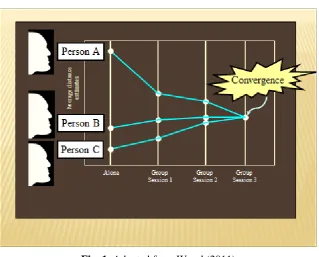
Generally, diverse groups come together over time, not immediately and not just around a single point of reference or a single, isolated experience. Ernest Bormann (in Hirokawa & Scott Poole, 1996: 90) argues…
Page 346
Fig. 1. Adapted from Wood (2011)
In the case of the sexual and domestic violence video, it is unlikely that each and every audience has arrived at the level of convergence, prior to viewing the film, that would engender such a common level of praise. It seems more likely that the skit is indeed a “powerful” mechanism for conveying a message.
There have been criticisms of this or that aspect of the performance, of course, but an overall appreciation of its message. One such criticism from an audience member at AIDS-Hilfe in Berlin on 14th June 2017 was that the video could potentially stereotype sexual/domestic violence as male on
female violence, suggesting improving the performance by the use of gender neutral “costumes” to mask the gender of participants. This would be worth exploring but it should be remembered that the video was not made by professional actors or mime artists and was made in a classroom setting with zero budget implications. Furthermore, without wishing to minimise nor downplay the impact of violence on any section of the population, the incidence of violence encountered in this arena is overwhelming male on female. Besides, the gender, race, class or sexual orientation of offenders or victims of violence in no way alters the basic format and development of the crime portrayed in the film. The skit is also only the first venture in a planned series of such initiatives, each building on the last, as the student director/choreographer seeks to develop and deepen her own understanding of the issues as well as that of participants and future audiences.
The motivation for making the film from a pedagogical perspective was, firstly, to encourage creative thinking and critical thinking amongst the students involved. Secondly, it was to encourage critical thinking among the audience as well as to raise awareness of how sexual/domestic violence can unfold.
Picasso once said that all children are born artists: the problem is to remain an artist as we grow up…..we don’t grow into creativity; we grow out of it. Often we are educated out of it.
Page 347
Many students arrive at De Montfort University (DMU), as with any other higher education establishment, believing themselves to be devoid of creative talent. Our task is to re-awaken the latent/dormant creativity that, according to Robinson (2011), a standard school education has suppressed. The introduction of Augusto Boal (2008) into the curriculum of the BA (Hons) in Youth Work & Community Development at DMU was undertaken precisely for this purpose. Students are encouraged to think through issues and to seek meaningful and symbolic methods of representation of aspects of these social issues to convey to an audience (generally of young people). The use of drama and role play are effective in visually communicating these concepts.
An illustration of the impact of dramatic representation can be seen in a classroom incident at De Montfort University on 10th December 2013. A student remarked that convicts (all convicts without
distinction) should be held in solitary confinement and fed only bread and water. This clearly is not an attitude one expects to be held by a youth or community worker, particularly as it does not differentiate between the wrongly convicted and those guilty of rape and murder, nor between those found guilty of petty theft and those of higher order crimes. The film, “Stuart – A life Backwards” was shown to the class. This is about a homeless person with a degenerative condition who experienced sexual and physical abuse, bullying and marginalisation as a child before embarking in later life on a trajectory of violence and imprisonment, and, an eventual (apparent) suicide. At one stage, he (Stuart) admits to attempting to cut someone’s head off! The student displayed the impact and efficacy of visual arts as a transformative tool by declaring, “It wasn’t his fault. He didn’t stand a chance”. This one lightbulb moment triggered a process of transformation in the student’s whole outlook towards crime and punishment and laid the basis for them developing an understanding of societal impact on individuals and the necessary empathy to work with the marginalised and oppressed.
The key characteristics of youth work include a commitment to anti-oppressive practice, to empowerment, to praxis and to encouraging social change. Each of these implies recognition of societal inequalities in power relations and of deep-rooted economic and social inequalities.
Herriot (2013)
5.POWER ANALYSIS
Chouhan (2015) advanced an adaptation of Thompson’s (2012:33) PCS model that helps us to understand the interrelationship of oppression at various levels:
Fig. 2. Chouhan (2015)
Personal
Cultural
Structural
Page 348
The “P” is the Personal Level and represents the individual’s beliefs, attitudes and behaviour; how people regard and treat others. The “C” is the Cultural Level and represents the assumed consensus about what is ‘true’, ‘right’, ‘good’ and ‘normal’; commonly accepted codes of conduct. The “S” is the Structural Level and represents the structures and institutions within society, which act to perpetuate divisions, prejudice and discrimination.
Chouhan (2015)
Chouhan (2015) introduced the additional “G” to reflect the growing importance of globalisation as new technology has ripped through time zones, as transportation and communication has advanced, and, as free trade agreements are put in place and world markets are increasingly opened up.
But, teaching anti-oppressive practice only goes so far in transforming student attitudes, unless traditional methods of lectures, seminars and group work are supplemented with eye-opening illustrations, images and physical representations, beyond PowerPoint graphics, to engender effective lightbulb moments. The use of physical theatre can be one such transformative tool.
…..a new idea is a light that illuminates things that simply had no form for us before the light fell on them and gave them meaning…
Susanne Langer in Robinson (2011: 89)
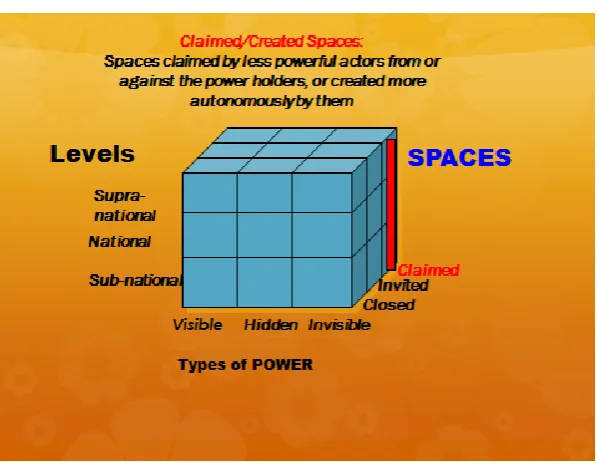
The curriculum is then brought to life and students begin to fully understand and assimilate the complex concepts that have been introduced in class and developed in directed reading. Thus, Thompson’s (2012) PCS model and the powercube (IDS 2013) cease to be mere words or diagrammatic expressions but can be used by youth work students to actually analyse power relations, oppressions and inequalities. The latter is a particularly useful tool for workers in the youth & community field. The powercube is a tool for analysing at what level power is wielded (globally, nationally or locally), what type of power is utilised (hidden, visible or invisible), and, what is the nature of the space in which power is exercised (closed, invited or claimed space). These concepts are crucial for understanding the power relations and interplays witnessed in social interactions and for understanding how to empower the oppressed.
Page 349
Fig. 3. Adapted from IDS (2013)
However, “invisible” power is also present in the “power within” or self-esteem (or lack thereof) of the main players. The victim may well be lacking in such power as they may have internalised the oppression that they face. In other words, they may take on board the view of them held by the oppressor – that they are worthless and deserve what they get. This internalisation can take place in other areas of discrimination and oppression such as may result from racism or bullying. Thus, to learn to apply the powercube in one arena is to open up the likelihood of its universal application. Using this power analysis to develop an awareness-raising skit or piece of physical theatre “teaches” the student to apply it, and how to apply it, in other spheres. Likewise, young people engaged in forum theatre or other forms of physical theatre, facilitated by youth workers, will also learn these skills.
It is inconceivable that youth and community workers should recognise these inequalities and oppressions yet seek to remain “neutral” in the face of them. Youth work should go beyond identifying oppression, or awareness-raising around it, but should facilitate the engagement of participants in activities and actions to challenge that oppression – social action for social change (Freire, 1996; Herriot, 2013)! Most of this social action will take place in “claimed” spaces through street demonstrations or through street theatre and so on.
On the other hand, it is also a key characteristic of youth & community work that the professional should not impose their own view of the world on participants as this, according to Freire (1996), would amount to “cultural invasion”. Rather, it is the purpose of youth work to facilitate learning, not to prescribe it. Participants, be they young people or student youth workers, are not “empty vessels” to be filled from the font of all wisdom and knowledge that some people regard academics to be. Every participant brings with them some form of knowledge and experience that can enrich the learning process. The task for youth workers is to unleash this potential by creating an environment conducive to democratic participation. This is where Freire’s (1996) “brick” comes into play.
Page 350
about it. They needed to campaign for security of tenure. Thus, the peasants had met Freire’s agenda of discussing the oppression they faced AND deciding on appropriate social action to effect necessary social change. In order to do this, they would need to produce pamphlets, leaflets, posters, press releases, make speeches and presentations, and, influence politicians. To do any of this, they would need to learn to read and write. Thus, the visual imagery of a simple tool, a “brick”, had met Freire’s agenda and, as a by-product, that of his employer. Freire had only asked one question. This is the essence of youth and community work. It is about empowering people to challenge the oppression they face. Physical theatre is another way to present the “brick”.
Whichever methodology is employed, challenging oppression and acting for social change requires development of critical consciousness. This is inherent in Freire’s “brick” above but also in physical theatre.
6.EDUCATING FOR CRITICAL CONSCIOUSNESS
The sexual violence and domestic violence video allowed audiences to view other people, performers, in social situations that occur in everyday life, whether open or hidden. It afforded the opportunity for some who may have been victims, or even perpetrators, of the violence depicted to contemplate it, to reflect on it and to study it from afar, from a safe vantage point, with some emotional detachment. For those who had never experienced the phenomenon, the crime, it afforded them the opportunity to put themselves in the shoes of those involved. It allowed emotional attachment but only on the basis of thinking through the issues involved, informing themselves of the issues from the symbolism of the performance. In short, the creativity of the piece encouraged critical thinking.
….critical thinking without creative and intuitive insights…is sterile and doomed…
Carl Sagan in Robinson (2011: 120)
Thinking through this particular form of violence, where it occurs, why it occurs and who or what is behind it can be the building blocks to critical consciousness. Deconstructing the issues and concepts around sexual and domestic violence and then re-constructing an understandable and communicable narrative that enlightens and moves the audience without a single spoken word, develops the capacity of individual performers to think critically about their own social world, to develop the critical consciousness that is vital to human development and empowerment. Audiences may escape the lasting effects of critical awareness, embracing the process only fleetingly as they experience the performance unfolding before them. However, the more “powerful” the message, the more likely they are to assimilate the learning and the critical thinking process.
Learning so defined is an interplay between social competence and personal experience. It is a dynamic, two way relationship between people and the social learning systems in which they participate.
Wenger (2000: 227)
Page 351
youth or community worker must then be the pursuit of education for critical consciousness. That is precisely what the video performance strives to achieve.
Film link: Djiapouras, E (2017) A Woman’s Place: A Journey Through Misogyny [online] De Montfort University. Available at: https://www.youtube.com/watch?v=FhNKBcsbZwg
REFERENCES
Addams, J. (1993). Philanthropy and social progress. Montclair: Patterson Smith. Allen, D. (2000). Performing Chekhov. London: Routledge.
Alston, A. (2016). Beyond immersive theatre. London: Palgrave Macmillan.
Aristotle (1983). Aristotle. 1st ed. Cambridge, Mass.: Harvard University Press, p.Quotes Aristotle, 322 B.C.
Artaud, A., Corti, V. and Artaud, A. (1938). The theatre and its double. 2nd ed. London: Alma Books Ltd.
Berlinguer, L. (1994). Universities today. The universities and the political power in Italy, from the Risorgimento to the fascist period. [Soveria Mannelli]: [Rubbettino].
Boal, A. (1995). The Rainbow of Desire The Boal Method of Theatre and Therapy. London: Routledge.
Boal, A. (2006). The aesthetics of the oppressed. London: Routledge.
Boal, A. and McBride, C. (2008). Theatre of the Oppressed. New York: Theatre Communications Group.
Bogart, A. and Landau, T. (2014). The viewpoints book. London: Nick Hern Books.
Brecht, B., Silberman, M., Giles, S., Kuhn, T. and Davis, J. (2014). Brecht on theatre. Berlin. Butcher, W. (1951). Mapping the Practice and Profession of Sculpture in Britain and Ireland. [online] gla.ac.uk. Available at: 'William Butcher', Mapping the Practice and Profession of Sculpture in Britain and Ireland 1851-1951, University of Glasgow History of Art and HATII, online database 2011 [http://sculpture.gla.ac.uk/view/organization.php?id=msib1_1220441024, accessed 03 Aug 2017] [Accessed 3 Aug. 2017].
Callery, D. (2009). Through the body. London: Hermes Chekhov, A. and Carson, P. (2002). Plays. London: Penguin.
Chouhan, J (2015) For the Love of Marx: Anti-oppressive Practice, a Youth & Community Work Approach, paper presented at a conference at Wuhan University, China on 10th November 2015
Creak, S. (2015). Embodied nation. Honolulu: Univ. of Hawaiʻi Press.
Djiapouras, E (2017) A Woman’s Place: A Journey Through Misogyny [online] De Montfort University. Available at: https://www.youtube.com/watch?v=FhNKBcsbZwg [Accessed: 2nd August
2017]
Freire, P. (1996). Pedagogy of the oppressed. London [u.a.]: Penguin Books. Freire, P (2005) Education for Critical Consciousness, London: Continuum
Gallagher-Bennett-S. (1990). Childhood dreams. Pittstown, N.J.: Main Street Press
Page 352
Goodman, L. and De Gay, J. (2003). The Routledge reader in politics and performance. London, UK: Routledg Gardner, L. (2015). Why children's theatre matters. [online] the Guardian. Available at: https://www.theguardian.com/stage/theatreblog/2013/oct/23/why-childrens-theatre-matters [Accessed 3 Aug. 2017].
Harvey, D. (2003). The ways of the world. 1st ed. London: Sage Publications. Hogg, M. and Abrams, D. (1988). Social identifications. London: Routledge.
Hardy, R. (2017). It's child's play: the performance that lets young people in care share their stories. [online] the Guardian. Available at: https://www.theguardian.com/social-care-network/2016/jan/21/its-childs-play-the-performance-that-lets-young-people-in-care-share-their-stories [Accessed 31 Jul. 2017].
Herriot, C & Djiapouras, E (2016) Peacefest: A Case Study in the Efficacy of International Youth Work as a Pedagogical Tool, paper presented to an international conference on “Youth & Inclusion” organised by and at Hong Kong Baptist University 16th to 18th June 2016
Herriot, C; Zammit, A; & Djiapouras, E (2016) PeaceFest: A Case Study of the Impact and Efficacy of Dramatic Movement & Role Play in International Youth Projects as a Conduit for Social Learning and as a Means of Building Solidarity Amongst Diverse Groups of Young People, paper presented to an interdisciplinary colloquium titled “Nurturing Solidarity in Diversity” organised by the University of Antwerp in Brussels 23rd to 24th November 2016
Herriot, C (2013) The Contribution of Marxist Theory to the Education & Training of Youth Workers, paper presented to a joint symposium of Wuhan University and De Montfort University held in Leicester on 10th June 2013
Hirokawa, R & Scott Poole, M (Eds)(1996) Communication and Group Decision-making, 2nd
Edition, London: Sage
IDS (2013) Powercube [www] Available from: https://www.powercube.net/ [Last Accessed: 30th July
2017]
Jameson, D. (1991). Last of the metal men. London: Penguin.
Keefe, J. and Murray, S. (2007). Physical theatres. London: Routledge.
Lecoq, J. and Bradby, D. (2006). Theatre of movement and gesture. London [etc.]: Routledge. Levitas, R. (2005). The inclusive society?. Houndmills, Basingstoke: Palgrave Macmillan.
Margaretthatcher.org. (1987). Interview for Woman's Own ("no such thing as society") | Margaret Thatcher Foundation. [online] Available at: http://www.margaretthatcher.org/document/106689 [Accessed 31st July. 2017]
Martin, R. (1990). Performance as political act. New York: Bergin and Garvey.
Mezirow, J. (1991). Transformative dimensions of adult learning. San Francisco: Jossey-Bass. Murray, S. (2003). Jacques Lecoq. London [etc.]: Routledge.
Preston-Dunlop, V. and Sanchez-Colberg, A. (2002). Dance and the performative. 2nd ed. London: Verve.
Robinson, K (2011) Out of Our Minds – Learning to be Creative, New Edition, Sussex: Capstone Shentsova, V. (1989). School of Physical Theatre. [online] Physicaltheatre.com. Available at: http://www.physicaltheatre.com/main/school.asp [Accessed 3 Aug. 2017].
Shilling, C. (1993). The body and social theory. 2nd ed. London: SAGE Publications. Stanton, N. (2015). Youth work and faith. 1st ed. London: YMCA George Williams College.
Page 353
Thompson, N. (2012). Anti-discriminatory practice. 5th ed. London: British Association of Social Workers (BASW) Practical Social Work) (Practical Social Work Series.
Tinaburri, M. (2010). Theatre school Berlin international physical movement Copeau Lecoq. [online] Apt-absurdacomica.com. Available at: http://www.apt-absurdacomica.com/about-us.html [Accessed 3 Aug. 2017].
Wenger, E (2000) Communities of Practice & Social Learning Systems, in Organization. London: Sage Volume 7(2): pp 225–246
White, G. (2013). Audience participation in theatre. Houndmills, Basingstoke, Hampshire: Palgrave Macmillan. Wood, J (2011), The Values of Youth Work, Lecture/Class, 21st January 2011, Leicester:
De Montfort University, unpublished.
Wilkinson, R., & Pickett,K. (2009), The Spirit Level: Why More Equal Societies Almost Always Do Better. London: Allen Lane.