WEB 2.0 USAGE PREFERENCES AND ATTITUDES AMONG THE UNDERGRADUATE
STUDENTS AND TEACHERS IN RUSSIAN AND UZBEK MEDICAL SCHOOLS
Nataliya V. Bukhanova, Sergey A. Chemezov, Elena V. Taptygina, Gavhar Zh. Zharylkasynova, Rano
U. Juldacheva, Larisa E. Petrova, Elena V. Pavlenko
Independent researcher, Edmonton, Canada
The Ural State Medical University, Ekaterinburg, Russia
Krasnoyarsk State Medical University, Krasnoyarsk, Russia
The Bukhara State Medical Institute, Bukhara, Uzbekistan
The Ural State Pedagogik University, Ekaterinburg, Russia
Abstract
Although usage of Web 2.0 has expanded dramatically among Russian and Uzbek postsecondary
students, little is known about medical students and teachers preferences and attitudes toward Web 2.0
use as a learning tool.
Objectives: To assess the usage of Web 2.0 applications by teachers and students in Russian and
Uzbek medical schools; to examine their perceptions toward use of these tools in curriculum.
Methods: A paper-based survey was administered among undergraduate medical students and
teachers at two Russian and one Uzbek medical schools. Responses were received from 184 students
and 69 teachers (response rate 92% for students and 69% for teachers) and analysed using
descriptive statistics.
Results and conclusion: medical students actively used Web 2.0 tools for personal purposes, preferred
to receive learning materials through the Internet, and were positive toward using those applications
in learning. Their teachers however used Web 2.0 tools seldom and preferred traditional teaching
format.
Key words: e-learning, medical education, Internet use, Web 2.0
BACKGROUND
Modern medical education is impossible without use of Internet resources and strong computer skills
of students and teachers. Essential to the modern medicine active student-centered learning requires
further development of the educational resources such as web 2.0 applications, simulators, virtual
patients and games. This will allow students actively participate in the learning process, increases their
motivation, and improves the quality of their study. Today Web 2.0 tools are widely used in many
medical schools around the world (Cheston C. C., Flickinger T. E., Chisolm M. S., 2013,
22
).
Until recently, face-to-face classroom format was considered the only appropriate way to teach
medicine in Russia and Uzbekistan. Last fifteen years, however, marked the fast development of
e-learning in the medical schools of those countries that has changed the whole concept of the medical
education.
The use of Web 2.0 application is Russian medical schools have not been researched. There are very
few publications on this topic describing the use of some electronic courses in curriculum (Sattarova
O.E., 2012).
The aim of this research was to investigate the use of Web 2.0 applications among medical students
and teachers in Russian and Uzbek medical schools, to research their attitudes toward e-learning and
preferences in use e-learning format in curricula.
CHARACTERISTICS OF THE PARTICIPATING INSTITUTIONS
The Bukhara State Medical Institute (BGMI)
The Republic of Uzbekistan uses 7 years system of the postsecondary medical education with two
years of residency afterwards. Although blended method is permitted in medical education, the
Institute uses face-to-face teaching format for all undergraduate students. Some continuous
professional learning (CPL) online courses are available for the Uzbek medical doctors through the
Tashkent’s (the capital of the country) and Russian educational web sites. No free wi-fi is provided at
the BGMI. Due to limited access to computers and the Internet, the access to the social networks in
unavailable from the institution.
The Krasnoyarsk State Medical University (KrasGMU)
Russian Federation uses 6 years system of the postsecondary medical education and two or three years
of residency. Distance learning and blended method are permitted at some courses and programs in
undergraduate and postgraduate education, as well as at residency and CPL.
The KrasGMU has used distance learning and blended method in its curricula since 2007. At the
present time, more than 200 online and blended courses on the Moodle platform are taught. Free wi-fi
is available on campus. The access to the social networks from the University’s computers is
prohibited.
The Urals State Medical University (USMU)
The USMU have used some distance learning and blended courses since 2004. For now 15 blended
courses for the CPL students, two distance courses and 120 blended courses for the undergraduate
students are taught. The locally developed platform SixSoft is used in teaching. The University
actively works on collaborative CPL projects together with the Bukhara State Medical Institute. No
free wi-fi is provided. The access to the social networks from the University’s computers is very
limited.
METHODS
A pilot study was conducted at the three participating institutions. To collect the data, a 24 multiple
choice questions survey was developed.
The necessary permissions to conduct the study was obtained from the administrative staff members
responsible for the ethic and research planning of all the participating institutions.
The survey was piloted and discussed with a small group of the students and teachers at each
institution, and needed modifications were made afterwards. Due to limited Internet access at the
Bukhara State Medical Institute, as well as due to possible lack of experience in the work with the
Internet among some students and teachers, the questionnaire was delivered in paper format.
RESULTS
Demographic information
Responses were obtained from 69 teachers (response rate 69%), and 184 students from first to sixth /
seventh years of study (response rate 92%).
Among the teachers, 42.2 % taught in clinical settings, and 57.8% worked only in classrooms (basic
sciences, social sciences, and other preclinical programs). All the teachers taught undergraduate
students, as well as the residents and CPL students. Most of teachers (30.7%) were from 31 to 35 years
old, however, in Bukhara 68% teachers were from 25 to 35 years old, in Ekaterinburg, 45% teachers
were younger than 36 years old, and in Krasnoyarsk, only 25% teachers were younger than 36 years
old. 35% of the teachers were men, 65% women,
The students were from first to sixth year of studying in Russia (19-23 years old), and from first to
sixth years of studying in Uzbekistan (19-25 years old). Among them, 43% were men, 57% women.
These data correspond to the general age and gender distribution in the participating medical schools.
Attitudes and preferences toward e-learning
In BGMI, neither teachers, nor students had any experience in teaching and learning online. In USMU,
21% of teachers taught online, and 79% did not. In KrasGMU, 43% teachers taught online, and 57%
did not. Most of teachers, regardless on that experience, had positive attitude toward e-learning in
general (BGMI – 84%, USMU - 75%, and KrasGMU - 87%). When asked if they wanted to teach
online, 98% of BGMI teachers, 81% of USMU teachers, and 69% of KrasGMU teachers gave a
positive answer. 96% of the BGMI students, but only 45% of the USMU and KrasGMU students
wanted to study online.
Web 2.0 applications’ use preferences
According to the report “Russian Internet” by OAO “NITs “Economika” (2012), the most popular
social networking platforms in Russia in 2012 were “V Kontakte,” “Moj Mir,” and “Odnoklassniki.”
According to Smonews.ru (2011), the first three places in this list belong to “V Kontakte,”
“Odnoklassniki,” and “Facebook.”
After literature search, four Uzbek social networks were found, but there were no data available on
their use and popularity. Preliminary discussion showed that medical students and teachers at BGMI
used only Russian social networks and there was no language barrier in networking communication.
The only specific Uzbek social network used in BGMI was Odnoklassniki.uz (a derivate from the
Russian network Odnoklassniki.ru) but neither students nor teachers separated those two platforms.
According to this, Odnoklassniki.uz was added to the Uzbek questionnaire, and two networks (.ru and
.uz) were combined.
Using these data, seven most popular social networks were listed in the questionnaire:
Russian based networks: “V Kontakte,” “Moj Mir,” “Odnoklassniki,” “Moy Krug,” “Mir Tesen.”
International networks: “Facebook,” “LinkedIn.”
An answer “Other networks” was also available.
In addition to it, the use of the microblogging site Twitter, video sharing site YouTube, applications
for videoconferencing, discussion groups, professional medical networks, Wikipedia, and the
application for the mobile devices were explored.
Graph 1. The knowledge of Web 2.0 application at the Bukhara State Medical Institute (three most
known social networks)
0% 10% 20% 30% 40% 50% 60% 70% 80% 90% 100%
Students Teachers
Odnoklassniki ru+uz
Facebook Moy Mir Skype Professional networks
Social networks
*Although most e-mail services provide video call tools, Skype is the most popular and often the only
known program for the videoconferences in Russia as well as in Uzbekistan.
Graph 3. The knowledge of Web 2.0 applications at the Krasnoyarsk State Medical University (three
most known social networks)
Social media tools were the most popular Web 2.0 applications among both students and teachers.
Other Web 2.0 applications, such as Wikipedia, YouTube, and professional networks were much less
known and used more seldom.
The graphs show better knowledge of Web 2.0 applications among Russian medical students and
teachers than among students and teachers at BGMI. Among all the participants, the students knew
more social networking sites and other Web 2.0 applications than teachers. Russian medical students
preferred the network “V Kontakte,” but their teachers knew “Odnoklassniki” more. Interestingly that
the network ‘Facebook” was the second well known among the Uzbek students but not very familiar
to the Russian medical students.
Medical teachers and students knew programs for the video calls (Skype) very well, excluding BGMI
where most students were unfamiliar with this application.
Table 1. Frequency of the Web 2.0 applications use at the Bukhara State Medical Institute (three most
known social networks)
Application More than once
a day Daily Weekly Monthly Rarely Never
Odnoklassniki (ru+uz) 0% 0% 24% 16% 60% 0%
Moy Mir 0% 0% 0% 4% 36% 60%
Facebook 0% 0% 0% 20% 76% 4%
Skype 0% 0% 4% 68% 20% 8%
Professional
networks 0% 0% 0% 0% 16% 84%
Application More than once
a day Daily Weekly Monthly Rarely Never
Odnoklassniki (ru+uz) 20% 52% 8% 4% 0% 16%
Moy Mir 12% 8% 8% 16% 12% 44%
Facebook 16% 8% 8% 12% 16% 40%
Skype 12% 12% 12% 12% 4% 48%
Professional
networks 12% 0% 4% 4% 4% 76%
Teachers
Students
Table 2. Frequency of the Web 2.0 applications use at the Ural State Medical University (three most
known social networks)
Application More than once
a day Daily Weekly Monthly Rarely Never
V Kontakte 14% 36% 14% 5% 0% 32%
YouTube 5% 30% 35% 5% 5% 20%
Odnoklassniki 13% 13% 21% 17% 17% 21%
Skype 14% 36% 14% 5% 0% 32%
Professional networks
5% 30% 35% 5% 5% 20%
Application More than once
a day Daily Weekly Monthly Rarely Never
V Kontakte 6% 41% 12% 6% 6% 29%
Odnoklassniki 18% 24% 12% 12% 12% 24%
Moy Mir 0% 19% 6% 13% 13% 50%
Skype 7% 0% 7% 29% 7% 50%
Professional
networks 0% 0% 7% 7% 0% 86%
Teachers
Table 3. Frequency of the Web 2.0 applications use at the Krasnoyarsk State Medical University
(three most known social networks)
Application More than once
a day Daily Weekly Monthly Rarely Never
V Kontakte 14% 7% 7% 7% 29% 36%
YouTube 8% 15% 0% 31% 23% 23%
Odnoklassniki 0% 7% 14% 7% 21% 50%
Skype 7% 20% 27% 7% 13% 27%
Professional networks
8% 8% 8% 33% 0% 42%
Application More than once
a day Daily Weekly Monthly Rarely Never
V Kontakte 50% 35% 6% 0% 1% 8%
YouTube 35% 13% 30% 10% 2% 10%
Odnoklassniki 10% 3% 23% 10% 10% 44%
Skype 14% 19% 52% 5% 5% 5%
Professional networks
5% 5% 16% 5% 16% 53%
Teachers
Students
The data on frequency of Web 2.0 applications usage revealed a big difference between students and
teachers. Most students visited their favourite social networks at least daily, but the teachers used the
networking sites mostly once a week or less. Students and teachers of BGMI used their preferable
web sites more seldom that in Russian medical schools.
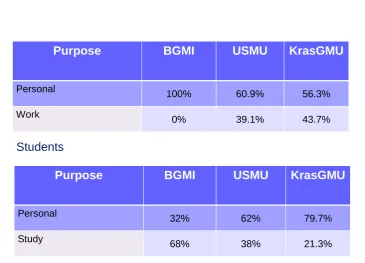
Due to absence of Web 2.0 applications in the curricula and the limited access to them from the
institutions’ computers, the terms “use for work” and “use for study” included all the activities
connected to work/study, such as information search, sharing, collaboration, and informal discussions
using the Web 2.0 tools in their spare time outside of their work places.
Table 4. Purpose of Web 2.0 use among teachers and students of the participating institutions
PURPOSE OF WEB 2.0 APPLICATIONS’ USE
Purpose
BGMI
USMU
KrasGMU
Personal 100% 60.9% 56.3%
Work 0% 39.1% 43.7%
Teachers
Students
Purpose
BGMI
USMU
KrasGMU
Personal
32% 62% 79.7%
Study 68% 38% 21.3%
Among the reasons not to use the social media for work/study most teachers named lack of time
(43.8%) and information protection concerns (24.5%). 33.3% of the USMU teachers and 42.8% of
KrasGMU teachers did not see a need to use the Web 2.0 tools in the curricula. None of the BGMI
teachers, however, responded that way, but 12% of them thought that personal networking would
distract them from their work.
Interestingly enough that both students and teachers did not mind discussing the work/study related
questions in social networks.
Knowing wide use of Internet resources for personal purposes, we checked the students’ preferences
and attitudes toward receiving course’s materials and announcements through the Internet (Graphs
4-9).
Graph 4. Students’ preferences for receiving course materials (BGMU)
Graph 5. Students’ preferences for receiving announcements and course information (BGMU)
In print Face to face
Phone E-mail
Social networks
Video-conference
How do you receive your courses information?
How do you prefer to receive your courses information?
0% 10% 20% 30% 40% 50% 60% 70% 80% 90% 100%
Mobile devices
Graph 6. Students’ preferences for receiving course materials (UGMU)
In print Face to face CD E-mail Social networks Video-conferenceHow do you receive your course materials?
How do you prefer to receive your course materials? Mobile devices 0 10 20 30 40 50 60 70 80 90 100 University website USB drive
Graph 7. Students’ preferences for receiving announcements and course information (UGMU)
In print Face to face Phone E-mail Social networks
How do you receive your courses information?
How do you prefer to receive your courses information? Mobile devices 0 10 20 30 40 50 60 70 80 90 100 University website
Graph 8. Students’ preferences for receiving course materials (KrasGMU)
In print Face to face CD E-mail Social networks Video-conference
How do you receive your course materials?
How do you prefer to receive your course materials? Mobile devices 0 10 20 30 40 50 60 70 80 90 100 University website
Graph 9. Students’ preferences for receiving announcements and course information (KrasGMU)
In print Face to face
Phone E-mail
Social networks
How do you receive your courses information?
How do you prefer to receive your courses information? Mobile devices Instant messages University website 0 10 20 30 40 50 60 70 80 90 100
purpose. Other formats, like video conferences, CDs, mobile applications, and social networks, were
used very seldom. The students’ preferences differed from the school to school but mostly coincided
with those of the teachers. At BGMU, on the other hand, students wanted their courses materials to be
delivered in different formats (online, mobile devices, video calls) but were given mostly face-to-face
and print choice.
In receiving the announcements and other information about their courses, the students inclined
toward web sites, e-mail, mobile devices, and video calls. In real settings, the announcements were
given mostly through the web sites, face-to-face, and in print.
CONCLUSION
The data show that medical students and teachers had positive attitude toward e-learning in general
and wanted to teach and study online. The students were familiar with many Web 2.0 applications and
actively used them, which can make the integration of new technology into curriculum easier.
On the other hand, medical teachers knew fewer social networking sites and used them less actively
than students, although they were much more familiar with the professional networks and video call
programs.
It corresponds with data that students are inclined toward using more technology in receiving course
materials and announcements, while teachers prefer traditional face-to-face and print formats.
Both students and teachers used social networks mostly for personal purposes and had very careful
attitude toward using them in study and teaching.
Future research with bigger audience is needed to address these issues and to make the integration of
technology into learning process easier.
Corresponding author: Nataliya Bukhanova, Edmonton, AB, Canada, [email protected]
Disclosure: The project was not financed by any benefactors.
REFERENCES
“A Rating of the social networks in Russia and in the world,” 2011. SMO News. Viewed Jan 2, 2012.
<http://smonews.ru/rejting-socialnyh-setej >[in Russian].
Cheston C. C., Flickinger T. E., Chisolm M. S., 2013. “Social Media Use in Medical Education: A
Systematic Review.” Acad. Med., N. 88, p. 893–901.
Chumakova E.V., 2011. “Educational space of the social networks of the Internet.” Professional
Education, N6, pp.39-40. [in Russian].
Pestrjakova I.A., 2012. “Internet-addiction of the youth to the social networks as a problem of the
modern age.” The International Journal of Science and Research. Viewed June 13, 2013.
<http://research-journal.org/featured/social/internet-zavisimost-molodezhi-ot-socialnyx-setej-kak-problema-sovremennosti/ > [in Russian].
Sattarova O.E., 2012. “Methodological approaches in the use of distance educational technology in the
professional education of the pharmacisits.” Perm. Viewed Jan 24, 2013.
<http://medical-diss.com/medicina/metodologicheskie-podhody-k-ispolzovaniyu-distantsionnyh-obrazovatelnyh-tehnologiy-v-professionalnoy-podgotovke-spetsiali#ixzz2h> [in Russian].