THE TRAINING NEEDS OF FAMILIES OF CHILDREN WITH CEREBRAL PARESIS
Antoaneta Z. Tersieva, Galina S. Tchaneva
Medical University of Sofia, Faculty of Public Health, Bulgaria
Abstract
One of the most important criteria for responsibility and culture of a society's attitude to children and people with disabilities. Child with mental or physical disabilities should enjoy a full life in conditions which ensure dignity, promote self-reliance and facilitate the child's active participation in society.
The purpose of this study is to identify the training needs of parents who agreed to care at home for their child who has been diagnosed with cerebral paresis. Results show that families of such children definitely have a need for training in the special care of the child, but such training is not offered by existing institutions concerned with these families.
Key words: Child with mental or physical disabilitie, training
Introduction
Almost 100-years experience is gained in Bulgaria in respect of training and growing up of children with special needs, particularly children with cerebral paresis (CP), but unfortunately as to published literature things are still in an early phase.
All rehabilitation activities are focused on control of the problems of the disabled child in the different periods of its development and in different spheres of brain activity - motion activity, speech, intellectual, sensory, in terms of the phases of socialization and improvement of the quality of life. The late diagnosis and therefore the late commencement of rehabilitation activities impair the prognosis for the best possible socialization of the child. Once diagnosed, CP may not be cured within the common meaning and this condition needs continuous care ensuring specific quality of life for the child.(Zafirova,1999)
In the recent years multiple regulatory document set the key operating principles and objectives, which require a complex approach to the disabled children focused on the development and offering appropriate individual health and social services and covering various activities for the best development of their abilities and based on each child's individual needs. This may be fully realized in a supportive family setting by development and multiplication of a model for integrated health and social service for disabled children and their families, which is to be provided by a multi-disciplionary team. The underlying idea is that children wuth development problems need both therapeutic measures and focused efforts for good quality of life and social adaptation of full value.
Such approach is widely spread in a number of EU countries but despite of the theoretical justifications and the understanding for its usefulness, it is insufficiently developed in Bulgaria, where the care is separated between the social and health system and therefore it is often uncoordinated and insufficiently efficient.
Cerebral paresis, being a heavy disease of social significance, is at the cross point of three major medical specialties - physical medicine and rehabilitation, nervous diseases and diseases of childhood and due to the wide range of brain dysfunctions it requires also that a number of non-medical specialists are involved, such as psychologist, speech therapist, special tutor, etc. It is necessary to make uniform the requirements to the family and institutional education, to create preconditions for easier integration to the social and labour environment of the healthy people. Disabled children should not be analysed beyond the context of their families and their relations with the people from their surrounding. Family is the first and main setting in which a child will grow up. The influence of the
family occurs by two interrelated ways: by the way of communication between the family members and by the way of the specially designed educational measures.( Boshkilova,2008)
The role and the influence of the family undoubtedly will increase more in terms of the development of a disabled child. This is stated by the modern concepts for rehabilitation that underline the need to educate the disabled child in its natural family setting. They emphasize the need to recede from the concept for rehabilitation in institutions on the account of comprehensive support to families raising disabled children. The implementation of such 'non-institutional' model of rehabilitation is a difficult task. By increasing the role of the family in the process of raising a disabled child, the difficulties for its overall implementation also increase. This is because the situation in a family raising a disabled child is much different from the situation in families raising healthy children.
Parents experience very strong negative emotions when they realize that their child is disabled. Very often this results in break (sometimes very serious) of the relations between the parents as well as between them and the disabled child.( Eneva,2000)
Undoubtedly an important influence on the emotions of the parents has the period of the child's development in which the disability occurs. Quite often the disease is identified yet in the first days of the child's life especially if disability is accompanied by visible defects (for example the Down syndrome, limbless by birth, infantile brain disorders). Then parents are informed about their child's condition immediately. In many cases, however, the disorder is found or appears later. In such cases parents need a long time to accept the situation and their emotions are very stormy.
Other factors influencing the experience of parents include: the type and degree of the permanent disability of the child. In the society dominates the understanding that some kinds of permanent disabilities are very severe (for example blindness, epilepsy, heavy mental disorders). The affected child and its family are treated as most unhappy and disadvantaged.
Those permanent disabilities, which strongly impair the health status of a child and hinder its development (for example heavy mental disorders, blindness, autism) usually make the parents experience the strongest emotions.
An important factor determining the experience of the parents is the extent to which the disability is visible. Parents of children, which with their behaviour and appearance differ significantly from the healthy children may suffer their disability very strongly. This is because they often face the segregating attitude of the society ensuing from the lack of approval for their child and for them as parents. Thus parents may decide to hide from the social environment the permanent disability of their child in order to avoid distress for their child or for them or because they feel ashamed.
The child’s behaviour also has a significant influence on the parents' feeling. This is because the child influences the feelings of its parents not only with its health status but also with its specific behaviour. This influence may be either negative or positive. The behaviour of autists and the children suffering from psycho-functional overexcitation is very frustrating for parents.
The child's disability disturbs the relations within the family but also the contacts of the family with their social environment. Therefore it is reasonable to state that the constructive adaptation to the new conditions is equally dependant on the adaptive abilities of the family and the specificities of the social environment in which it lives, the community's attitude to the disabled and their families, the professions of the parents, etc. Functioning of the family depends on these factors as well as the degree of adaptation to the different circles of the social environment - neighbours, local and wider community. (Manasieva,2004)
The purpose of the study is to reveal the major problems of families with children suffering from cerebral palsy.
Materials and methods. A survey was conducted among parents who raise children with infantile cerebral palsy in a family setting . The survey was conducted during the visits of parents to the consulting centres and specialized rehabilitation institutions in the city of Sofia. The survey covered
100 parents of children with CP who expressed willingness to take part. The survey was conducted in the period between June and December 2013.
Results. Studying the problems that face families that raise children with infantile cerebral palsy is very important for the establishment of organization for providing care and services to these children adequate to their needs. The problems of raising a child with CP refer to its sexual development too. According to data provided by the parents, the number of boys and girls with CP is quite the same.
47%
53%
boy girl
Fig.1. Distribution of children with cerebral paresis by gender
The received data show that boys are a little bet over 50% and the girls are a little bit below 50%. In 53,00% of the families the children with CP are boys and in 47,00% they are girls. We may conclude however that boys prevail. With a view to the pubescence of children with CP, the parents must be prepared and trained to render care to their children and for their adaptation to their body changes.
Table 1. Distribution of children according to their agent when the parents notices the changes in the development
Responses Relative share
Before 6 months 56,00
Before 1 year 34,00
Later 9,00
No answer 1,00
The data show that almost half of the children have shown deviations from the normal development before they reach the age of 6 months. For the other bigger group - 34,00%, the disorders are found before they reach the age of 1 year. Quite less - 9,00% are those children whose parents noticed deviations after the age of 1 year. There are clear and explicit indicators about the physical and mental development of children in the first year and therefore parents are able to notice the symptoms of the disease and to seek medical aid. Unfortunately making a diagnosis, in this case, does not relieve the parents but assigns a serious task to them - to learn how to care about their child who requires quite different and special care.
Table 2. Distribution of parents according to their abilities to work
Responses Relative share
Yes, as a personal assistant to my child 33,00
Yes, on a full-time basis 21,00
Yes, on a part-time basis 20,00
Yes, on a part-time basis from home 10,00
I don't work 17,00
Families, which have a child with infantile cerebral palsy need to make serious changes in the parents’ schedules and must ensure all day care for their sick child. The responses of the parents participating in the survey show that the highest relative share among them i.e. 33% are parents who work under a social benefit programme - as a personal assistant to their child. The parents who work on a full-time basis are almost 1/5 of the surveyed and the same percentage of parents work on a part-time basis. The lowest relative share is of parents who work on a part-time basis from their homes. It makes an impression that quite a lot of the respondents - 17.00% do not work and only take care of their children. Therefore it may be definitely concluded that the children with CP need a parent who takes much time to render care for them. One person however is unable to handle the problems of these children. The care shall be provided by a multi-disciplinary team, which shall plan the care depending on the health problems and the individual child’s opportunities for development.
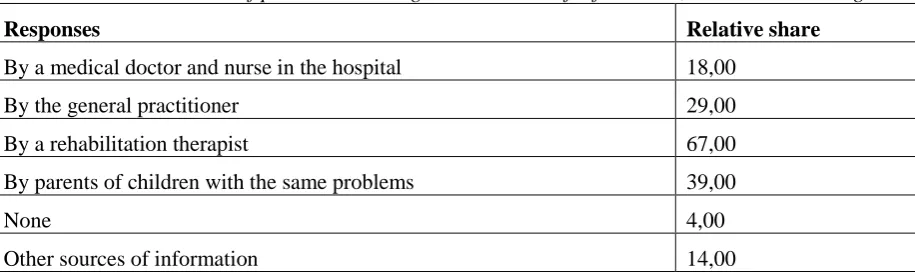
Table 3. Distribution of parents according to the sources of information, advice and training
Responses Relative share
By a medical doctor and nurse in the hospital 18,00
By the general practitioner 29,00
By a rehabilitation therapist 67,00
By parents of children with the same problems 39,00
None 4,00
Other sources of information 14,00
Sources of information for the parents and the reliability of the information are of material significance for the appropriate care for a child with CP. Obtained data show that the parents receive information mostly by the rehabilitation therapist who performs the therapeutic procedures for their child. In the second position are indicated the parents of children with the same problems. About 1/3 of the respondents refer for information to the general practitioner and the medical specialists from the inpatient units - medical doctors and nurses are involved least. A small part of them - 4,00% cope on their own without seeking information. To care properly for their children, parents must not only be well-informed but also they must have opportunity to be trained as well as to be advised regularly by qualified specialists.
Table 4 Psychological aid and support for parents of children with cerebral paresis
Responses Relative share
By friends of the family 38,00
By relatives and parents 61,00
Professional help from psychologists 21,00
Without help and support 13,00
Other methods of help and support 4,00
For most disabilities, parents need psychological help and support to overcome the negative feelings and emotions and to adapt to the new circumstances, which the family should cope with. The modern psychology develops and offers different methods and approaches for coping with and changing the psychological attitude but few families consider that they need that. Most of the respondents seek help and psychological support from their relatives and parents and the friends of the family are ranked in second position. This explicitly shows that the traditions in our country determine that the health problems in a family involve the commitment of the close friends and relatives and to a lesser extent of the professionals and institutions. 1/5 of the respondents have referred to professional help by psychologists, and 13.00% consider that they don't need help. A small part of the respondents i.e. 4% seek alternatives to overcome problems with psychological help and support.
34%
66%
0% 10% 20% 30% 40% 50% 60% 70%
1 2
yes no
Fig. 2. Distribution of parents according to their participation in patients' organizations
Although the parents of children with ICP seek information from other families with similar problems, the results show that a major part of the parents - respondents do not participate in patients' organizations. The patients' organizations aim to support families of patients, who have common health and social problems and their activities should refer to improvement of the quality of life of the patients. The reasons for which parents do not refer for help to the patients' organizations are not clear but obviously according to the traditions in our country usually the problems are resolved only within the family. The patients' organizations need to be more active in attracting parents of children with CP and developing better relations with the families to achieve better results in caring for these children.
53%
15%
32%
0% 10% 20% 30% 40% 50% 60%
1 2 3
yes no
I can not decide
Fig. 3. Need of professional nursing care for the families of children with cerebral paresis
To the question whether they need the help of a professionally trained nurse to care for their child with CP, more than half of the respondents answer positively. About 1/3 of the respondents are not certain and only 15,00% have answered negatively. These results show that the families of children with CP are well aware of the need to involve nurses in caring for their children. Nurses have the required professional skills and qualification to develop individual nursing care plan for a child with CP in accordance with its development and its individual needs. The disease causes disorders in the normal functions of individual organs and systems and therefore the parents shall be trained by nurses on how to control specific problems of pathological nature.
Conclusions
The birth of a disabled child changes completely the life of the family and the family functions. Following the period of distress and emotional crisis, the parents attempt to recover the broken balance by changing (sometimes to a great extent) the way of life of their family. They often have to abandon their plans, interests and preferences and to devote most of their time and care to their disabled child. The relations between the spouses change too. The professional life of the parents also changes. Contacts of the parents with their friends also change. They usually limit the circle and the frequency of their former contacts with friends, and they also limit their cultural life.
The child must be treated as an integral person with adequate respect and esteem. Disabled children are like all other children and have the same social needs as their coevals. They need friends and environment and they need to be esteemed. People surrounding them sometimes realize and sometimes don't realize that their attitude is incorrect however they don't know how to act. Disregard and excessive care are equally harmful.
It must be noted that CP is not just a disease but a state accompanying the affected in their whole life. In a family raising a disabled child, the care function gains special significance while the socializing and psychological functions go through considerable changes. A family raising a disabled child, for the purpose of realizing correctly its basic tasks and to preserve its balance and existence, must make considerable changes in its way of life. This is not a simple task and specialized professional help is required.
References
Boshkilova, S., Importance of parental attitude towards the child with CP for social development, Blagoevgrad, Trakia scieces. Serie biomed. sci.,6, 2008, N Suppl. 4, с.106-108
Eneva, I., Parents as partners in the therapeutic process children with special needs, Special Education, S,2000, стр.58-66.
Zafirova, S., The place for children with cerebral paresis in society, S., 1999 Karagesov, I. A. Grabcheva, Special Pedagogy, . „Abagar”
Manasieva, Т., Family in the system of preventive activity: Prevention of aggression among children, S. 2004
Marinova, P., Boltjes, Disk Development and prospects of people’s care in the social homes, „Asklepii”, 2000
Маslarov, D., Neurology , textbook for students, „Tempora“, S. 2010
Standards of Care Outcome Measures, for Children with Cerebral Palsy, Ohio Department of Health