IJIRT 147761
INTERNATIONAL JOURNAL OF INNOVATIVE RESEARCH IN TECHNOLOGY493
Smart Agriculture System Using IoT
Wale Anjali Devanand
1, Rokade Dipali Raghunath
2, Adsul Samadhan Baliram
3, Prof. Kazi K. S.
41,2,3
Student, BMIT, solapur.
4
Assitant Prof, BMIT, solapur.
Abstract— Internet of Things (IoT) plays a crucial role in smart agriculture.Smart farming is an emerging concept, because IoT sensors capable of providing information about their agriculture fields. Monitoring environmental factors is the major factor to improve the yield of the efficient crops. The feature of this paper includes monitoring temperature and humidity in agricultural field through sensors
I. INTRODUCTION
• Internet of Things (IoT) is widely used in connecting devices and collecting data information.
• Internet of Things is used with IoT frameworks to handle and interact with data and information.
• In the system users can register their sensors, create streams of data and process information.
• IoT are applicable in various methodologies of agriculture. Applications of IoT are Smart Cities, Smart Environment, Smart Water, Smart Metering, Security and Emergency, Industrial Control, Smart Agriculture, Home Automation, e-Health etc. ‘Internet of Things’ is based on device which is capable of analyzing the sensed information and then transmitting it to the user.
From the point of view of an agriculture farm owner the main requirements provided in our project are :
• Monitoring soil moisture
• Estimating crop water requirements
• Monitoring humidity and temperature
• Monitoring water level in the tank
• Detecting animal entry in the farm
II.LITERATURE SURVEY
The newer scenario of decreasing water tables, drying up of rivers and tanks, unpredictable environment present an urgent need of proper utilization of water.
To cope up with this use of temperature and moisture sensor at suitable locations for monitoring of crops is implemented in. An algorithm developed with threshold values of temperature and soil moisture can be programmed into a microcontroller-based gateway to control water quantity.
The system can be powered by photovoltaic panels and can have a duplex communication link based on a cellular Internet interface that allows data inspection and irrigation scheduling to be
programmed through a web page.
The technological development in Wireless Sensor Networks made it possible to use in
monitoring and control of agricultural parameter in precision agriculture.
The previous techniques made use of GSM system to alert the user; but the message was given in the format of text .Instead of using text if we use bars and gauge then it will be more effective . This is possible by using IoT
After the research in the agricultural field, researchers found that the yield of agriculture is decreasing day by day. However, use of technology in the field of agriculture. Many times animals enter in the farm and ruin out the crops and cause a major loss which the farmers cannot tolerate. To avoid this we are using PIR(Passive Infra-red) Sensor. By using this sensor we are monitoring animals entry in the farm and by using internet of things giving a alert message to the owner.
III. BLOCK DIAGRAM AND WORKING
IJIRT 147761
INTERNATIONAL JOURNAL OF INNOVATIVE RESEARCH IN TECHNOLOGY494
threshold value. It gives logic1 output. This output isgiven to arduino. When moisture sensor gives logic1 the relay turns on and turns on the DC water pump. The humidity sensor gives real time humidity as well as temperature reading. These values are displayed on the LCD display and also on the Blynk app by using IoT.
The PIR sensor is sensitive to the animal motion as soon as it detects motion ; the buzzer gives indication also one notification message is sent to the user that animal entry is detected.
The Ultrasonic sensor gives the indication of water level in the tank. This level is shown on the Blynk app of user .
Fig3.1 Block diagram of smart agriculture system
The Wi Fi module is used to give all real time data to the user by using internet.
A 12 volt Regulated power supply is used to drive DC water pump. 5volt power supply is necessary for the Wi Fi module and arduino.
The LCD display displays the values of humidity and temperature detected by the humidity module
IV. DISCRIPTION OF COMPONENT
4.1) Arduino Uno R3:-
It is a microcontroller board based on AT mega 328P. It has 14 digital input/ output pins, a 16 MHZ Quartz crystal, a USB connection, a power jack, an ICSP header and a reset button. It contains everything needed to microcontroller; simply connect it to a computer with USB cable or power it with a AC to DC adapter on battery to get started .
Fig4.1) Arduino Uno R3 Module
Features of the Arduino Uno: Microcontroller: ATmega324 Operating Voltage: 5V Input Voltage: 7- 12V Digital I/O pins:14 Analog input pins: 6 Flash Memory: 32KB Clock Speed: 16MHZ
Arduino
UNO
PIR SensorUltrasonic Sensor
Humidity & Temperature
Sensor
Moisture Sensor
DC Water pump Buzzer
Relay Circuit LCD Display
IJIRT 147761
INTERNATIONAL JOURNAL OF INNOVATIVE RESEARCH IN TECHNOLOGY495
4.2) Node MCU esp8266:-Fig 4.2) Wi-Fi Module
The ESP8266 is a low cost Wi-Fi microchip with full TCP/IP stack and microcontroller capability. This small module allows microcontrollers to connect to a Wi-Fi network and make simple TCP/IP connections using Hayes style commands.
The ESP8285 is an ESP8266 with 1MiB of built in flash, allowing for single chip devices capable of connecting to Wi-Fi.
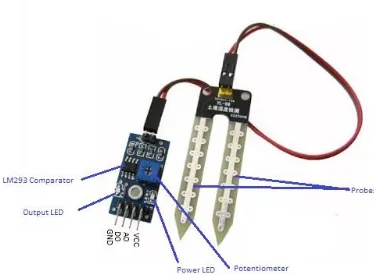
4.3) Moisture Sensor:-
Fig 4.3) Moisture Sensor
The soil moisture sensor consist of two probes which are used to measure volumetric content of water. The two probes allow the current to pass through the soil and then it gets the resistance value to measure the moisture value. When there is more water, the soil will conduct more electricity which means that there will be less resistance. Therefore, the moisture level will be higher. Dry soil conducts electricity poorly, so when there will be less water, then the soil will conduct less electricity which means that there will
be more resistance. Therefore, the moisture level will be lower.
This sensor can be connected in two modes that is Analog and Digital. In our project we are connecting the sensor in digital mode.
Specification:- Input voltage 3.3 -5V Output voltage 0-4.2V Input current 35mA
Output Signal Both Analog and Digital
4.4) PIR Sensor:
A passive infrared sensor is an electronic sensor that measures infrared light radiating from objects in its field of view. These are used to detect motion. The operating principle is that all objects with a temperature above absolute zero emit heat energy in the form of radiation. Usually this radiation isn’t visible to the human eye because it radiates at infrared wavelengths, but it can be detected by electronics devices designed for such purpose. The term passive in this instance refers to the fact that PIR devices do not radiate energy for detection purpose. They work entirely by detecting infrared radiation emitted by or reflected from objects.
Fig 4.4) PIR Sensor
Specifications:-
IJIRT 147761
INTERNATIONAL JOURNAL OF INNOVATIVE RESEARCH IN TECHNOLOGY496
4.5) LCD Display:-A liquid crystal display (LCD) is a thin, flat panel used for electronically displaying information such as text, images, and moving pictures. Its uses include monitors for computers, televisions, instrument panels, and other devices ranging from aircraft cockpit displays, to every-day consumer devices such as gaming devices, clocks, watches, calculators, and telephones Among its major features are its lightweight construction, its portability, and its ability to be produced in much larger screen sizes than are practical for the construction of cathode ray tube (CRT) display technology.
Fig 4.5) LCD Display
4.6) Humidity Sensor:-
Fig 4.6) Humidity Sensor
Humidity sensor is one of the most important devices that has been widely in consumer, industrial,
biomedical, and environmental etc. applications for
measuring and monitoring humidity. Humidity is defined as the amount of water present in the surrounding air. This water content in the air is key factor in the wellness of mankind. Irrigation
techniques like drip irrigation need accurate moisture content for plants.
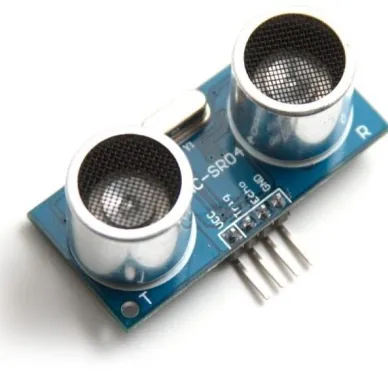
4.7) Ultrasonic Sensor:-
Fig 4.7) Ultrasonic Sensor
Ultrasonic sensors are a type of acoustic sensor. This contains one transmitter and one receiver.
Transmitters convert electrical signals into ultrasound receivers convert ultrasound into electrical signals. In similar way radar and sonar, ultrasonic sensors are used in systems which evaluate targets by
interpreting the reflected signals. For example, by measuring the time between sending a signal and receiving an echo the distance of an object can be calculated.
V. CONCLUSION.
The proposed system for agriculture is very good it checks the moisture level in the soil according to
which motor is turned ON or OFF. Also the information about water level in the water tank is given to the user on the LCD display as well as by using IoT also. The system gives information about humidity and atmospheric temperature. According to
which we can take action .Because of PIR sensor animals entry is also detected. . The advantages included low cost , low power consumption and less
IJIRT 147761
INTERNATIONAL JOURNAL OF INNOVATIVE RESEARCH IN TECHNOLOGY497
REFERENCES[1] Morais, Raul, A. Valente, and C. Serôdio. "A wireless sensor network for smart irrigation and environmental monitoring: A position article." In 5th European federation for information technology in agriculture, food and environment and 3rd world congress on computers in agriculture and natural resources (EFITA/WCCA), pp.45-850. 2005.
[2] Agrawal, Sarita, and Manik Lal Das. "Internet of Things—A paradigm shift of future Internet applications." In Engineering (NUiCONE), 2011
Nirma University International Conference on, pp.1-7. IEEE, 2011.
[3] Hu, Xiangyu, and Songrong Qian. "IoT application system with crop growth models in facility agriculture." In 2011 6th International Conference on Computer Sciences and Convergence Information Technology ICCIT. 2011.
[4] Li, Li, Hu Xiaoguang, Chen Ke, and He Ketai. "The applications of Wi-Fi-based wireless sensor network in internet of things and smart grid." In Industrial Electronics and Applications ICIEA, 2011 6th IEEE Conference on, pp. 789-793. IEEE, 2011. [5] Tuli, Anupriya, Nitasha Hasteer, Mukesh
Sharma, and Ankur Bansal. "Framework to leverage cloud for the modernization of the Indian agriculture system." In Electro/Information Technology (EIT), 2014 IEEE International Conference on, pp. 109-115. IEEE, 2014.
[6] Liu, Yuxi, and Guohui Zhou. "Key technologies and applications of internet of things." In Intelligent Computation Technology and Automation (ICICTA), 2012 Fifth International Conference on, pp. 197- 200. IEEE, 2012.
[7] Zhao, Ji-chun, Jun-feng Zhang, Yu Feng, and Jian-xin Guo. "The study and application of the IOT technology in agriculture." In Computer Science and Information Technology ICCSIT, 2010 3rd IEEE