e-ISSN: 2278-7461, p-ISSN: 2319-6491
Volume 6, Issue 9 [September. 2017] PP: 01-09
Pest Mitigation with Laser Identification System
*
Nicholle Hatton, Dr. Daniel Flippo
Corresponding Author: Nicholle Hatton
Abstract
: The daunting dilemma is how to feed nine billion people by 2050. Annual percentage crop yield increases are only half those required to meet projected food needs. The challenges are not just increasing population (doubled since 1970), but climate change, declining water resources, and competing demands for bioenergy crops. One major factor with crops are insects who have historically plagued human farmers with devastating results. As technology grows so does the understanding of pesticides and pest mitigation practices. Recent pushes for non-GMO and organic produce has forced new pest management practices to be developed. Crops still need to be protected against pests, but with the growing concern of pesticides, unconventional methods must be developed. Lasers can prove effective in pest mitigation without leaving lasting effects on the plant or the use of chemicals. Identification of the insect on the plant is key to the system. Identification occurs through image analysis based on the RGB index followed by binary conversion. Upon successful completion of image analysis each insect has a coordinate based on the pixel value of the center of mass of the insect. After identification, the insect must be mitigated with a servo tracking and coordination. The coordination occurs through conversions of coordinates and pulse width modulation (PWM). Two servos provide two degrees of freedom to the tracking system. The system in this study proves 44.4% accurate in insect identification and servo tracking and coordination accuracies of 94.27% in the X-direction and 89.06% in the Y-direction. The image identification and tracking system proves a conceptual mitigation system.--- --- Date of Submission: 29-08-2017 Date of acceptance: 13-09-2017 ---
I.
INTRODUCTION
The daunting dilemma is how to feed nine billion people by 2050. Annual percentage crop yield increases are only half those required to meet projected food needs. The challenges are not just increasing population (doubled since 1970), but climate change, declining water resources, and competing demands for bioenergy crops. One major factor with crops are insects who have historically plagued human farmers with devastating results. Insect identification and mitigation are paramount to world health for humans, livestock, and crops. Insects’mobility and adaptive-ness to human control methods makes this difficult. Today’s world lives with the realityof malaria and Zika with cases rising each week just to name a few (World Health Organization, 2016). Many researchers have begun to look into alternative methods of pest control in the hope that these diseasescan be eradicated. These methods for elimination of pests are environmentally friendly and safe (Foster et al., 2014; Hori, Shibuya, Sato, & Saito, 2014; Keller et al., 2016; M. Yao, M. Liu, J. Zhao, L. Huang, & Q. Zhou, 2009; Marx et al., 2013; Mullen et al., 2016). Not only are pests’ disease vectors, but they can decimate agricultural crops resulting in reduced yields. Pesticides, a mixture of chemicals commonly applied to fight pests have two major drawbacks. Efficacy can decline due to pest resistance to the active ingredients, which in turn demands greater concentrations of active ingredients for the pesticide to remain effective. Secondly, some of the active ingredients found in pesticides are harmful to humans, livestock, and the environment in large quantities and/or high concentrations. The organic market has grown as more people have been pushing toward eating and growing foods without herbicides and pesticides as well as avoiding genetically modified food because of the perceived health benefits. Crops still need to be protected against pests, but with the growing concern of pesticides, unconventional methods must be developed.
LASER EXTERMINATION
implemented boundary systems allowing insects within the boundary to be tracked by a laser system. The laser system shuts down if an object above a certain size threshold enters the area preventing any unwanted harm to non-target species or objects. This system was developed to be a stationary system that could be mounted in doorways or windows (Mullen et al., 2016). Marx et al. looked at a similar system but modified it to fit agriculture platforms and studied the laser effects on plants. Marx et al. used varying lasers to explore the effects on aphids, whiteflies and plants. He found that a 1064nm laser caused no lasting damage on the plants. Plants were observed for 40 days after laser treatment. However, it was never stated how long the plants and insects were exposed to the laser. Marx et al. found that the majority of the radiation from the 1064nm laser would be absorbed by the plant; high energy densities are needed to have lasting effects or mortality (Marx et al., 2013). Finally, Yao et al. looked at laser effects of locusts and plants. A laser placed at different distances and used for different amounts of time was used to determine the optimum distance and exposure time. Mortality was counted at intervals of 2 hours, 2days, and 3 days. Locusts are much thicker shelled insects than mosquitos or flies, and therefore require a greater exposure time to laser. Yao also found that the plants were not adversely affected by the laser even with 30s of exposure (M. Yao et al., 2009). Each of these experiments explores different aspects of determining the mortality of insects when exposed to lasers. However, most focus on very small insects with thin shells. These insects are much easier to kill and require a much shorter exposure time than locusts or other insects that cause damage to crops. More studies need to be done that investigate the minimum requirements exposure time, wavelengths, and power of lasers needed to exterminate crop pests. Further only a select few studies look at plant health and effects due to laser exposure. Plant effects need to be thoroughly understood before a laser system can be implemented. If the plant is killed in the process of killing the bug, nothing is gained from this method of extermination(Dix et al 2017).
OTHER METHODS
Others have explored light and photoacoustic detection to kill mosquitos (Foster et al., 2014; Hori et al., 2014). Irradiation is used to kill bacteria on food. It has recently been applied to larger complex organisms such as insects. Colored light irradiation would reduce or eliminate the safety considerations that associated with lasers because it has no known lasting effects on large organisms. Light of 440 and 467nm “have strong lethal effects” on insects causing pupae to die before adulthood (Hori et al., 2014). The blue light irradiation would eliminate adverse effects on humans, livestock, and the environment. One major question that arises using light irradiation as an extermination method is concerned with the influence of outside light sources and the effect it has on the mosquito extermination capacity of the system. Outside light could reduce the effects of the irradiation in an open system. The final question to be answered is the effectiveness on adult insects rather than simply pupae. More large-scale studies need be done in order to see if these options are realistic, applicable, and remains safe. Alternatively, Photoacoustic detection would also eliminate the adverse effects, as it would only target subjects that had a certain composition of nanoparticles (Foster et al., 2014). Photoacoustic is a specialized laser with an ultrasound transducer. The transducer is amplified to react long distances. The laser only interacts with nanoparticles. Thus, if no nanoparticles are present, then no harmful effects will be seen. However, this method is not practical on a large scale because the nanoparticles must be fed to the insect. One’s ability to feed these nanoparticles to the entire arthropod community across an entire crop field is relatively limited if not impossible.
AUTOMATED IDENTIFICATION
Automated identification of different species has been completed on a number of platforms from marine (Clement, Dunbabin, & Wyeth, 2005) to aerial (Gaston & O'Neill, 2004; Moore & Miller, 2002). The appropriate key characteristic for each species is used for identification. For example, mosquitos and small insects can be easily identified based on wing beat frequency (Moore & Miller, 2002) while marine invertebrates have to be visually identified based on shape and texture rather than color (Clement et al., 2005). Both Gaston and Clement describe the image processing aspects of their identification systems. For an effective image identification system, a good training set is required. Training sets consist of images of the species that display the ideal characteristics. The larger this training set is and the more variety within the training set, the greater chance of pest identification. Training sets take time to develop and can misidentify a subject if another object looks similar. It can also fail to identify a subject if the characteristics are not within the parameters of the training set (i.e. not an ideal specimen). However large training sets take time to complete and analyze. This method has also become outdated. New systems, such asNational Instruments MyRio vision processing software (National Instruments, Austin Texas), allow image processing to become much faster and simpler. The unique key characteristics must be understood before identification can take place.
alternative extermination method. The application to all insects rather than a specific species needs to be understood so that these methods can be applied to many platforms. Larger insects that have a thicker exoskeleton do not have the same requirements for mitigation as mosquitoes. The laser intensity, power, and exposure time needs to be understood for insects that are common pests in crop fields (i.e. grasshoppers, caterpillars, beetles, and worms to name a few).
For the purposes of this study, specific species identification of the insect is not necessary, the insects simply need to be identified from the surrounding environment (i.e. an insect cannot be mistaken for a brown spot on a plant). This study will focus on the tracking system. MyRIO will be used to process images and identify the target on a coordinate system. The laser will then move to the given coordinates to eliminate the pest. In future work, the laser tracking system will be mounted to an automatous robot to travel under crop canopy to control pests.
II.
METHODS
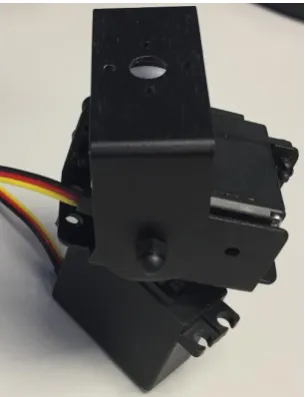
The camera used for this study in the methods and experiment is a Basler acA640-750uc, which has a pixel area of 640 X 480 pixels with a focal length of 8mm. The sensor with in the camera has an area of 3.07 mm X 2.30 mm. The camera coupled with two Deluxe HI Tec HS-422 servos is the platform for the mitigation system. Figure 1 below shows the servos used.
Figure 1 - Servo Configuration Used
SOFTWARE
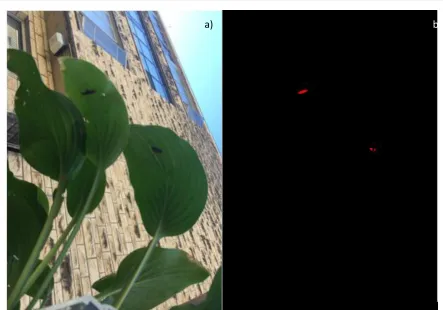
LabVIEW’s vision acquisition module was used to refine images and identify bugs based on set parameters. Images used to assess the acquisition system were taken in direct sunlight and shadow at different angles and plant positions. Figure 2a below shows an example of the image used for processing. The images were refined in the following process:
Images loaded to NI Vision Assistant
Brightness reduced to limit the light exposure of the plant and isolate the insect Converted to a binary image by isolating specific colors and regions
Boarder binary objects eliminated
The image is then refined to eliminate noise Center of mass (given in pixels) used to I.D. insect
Figure 2 - a) Sample Image Used for Processing b) Image after Processing with Insect Isolated
The pixel value given is transformed to a Cartesian coordinate system based on the camera parameters. In this case it was a matter of brining the (0, 0) point to the center of the image rather than the bottom left corner. By subtracting half the width or height from the X and Y pixel, respectively, accounts for the transformation. The pixel can then be multiplied by the conversion factor from a pixel to meters.
For simplicity it can be assumed that the image will be taken from a distance of 1m. This gives a projected image size of 38.38 cm X 28.75 cm, giving a conversion factor or .0006m/pixel. This factor will vary with assumed projection height, camera focal length, pixel area, and sensor size. For larger areas covered a smaller focal length or larger sensor should be used. The first object identified by the image processing is used as the “target”. The target is the object that the servo will respond to and coordinate movement to the center of the image. The target has a box created around it so that the user can ensure the accuracy of the image processing. The box is overlaid upon the original image from the camera, rather than the processed image.
INSERT IMAGE OF BOX AND OBJECT
The next step is to convert the Cartesian coordinate system to spherical coordinate systems. The following system of three equations can be used.
Eq. 1
Eq. 2
Eq. 3
The Z variable was assumed to be constant at 1m. X and Y are given from image processing and conversion as described above. The servos are connected so that one will move according to Eq. 2 and the other Eq. 3
LASER MOUNT
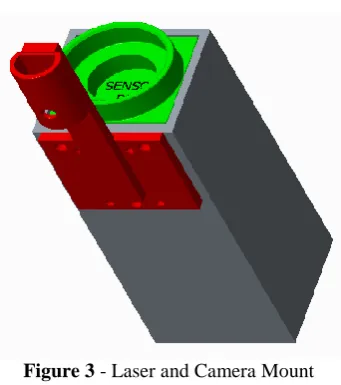
The laser is mounted directly to the camera. Figure 3 depicts the camera and laser mount combined system. The green represents the camera without the lens assembled. The gray is the camera mount that will be mounted to the servo. Finally, the red part is the laser mount. The top of the laser will be coincident with the lens once assembled.
Figure 3 - Laser and Camera Mount
Figure 4 shows the offset. Theta corrects the offset seen by the laser being mounted to the side of the camera. The mount has been designed so that theta is equal to one degree allowing the center of the laser point to meet the projected center of the camera. This eliminates any differentiation with the laser spot and the camera spot, allowing the laser to hit the identified insect.Figure 5 shows a close-up look at the laser mount; a slight angle in the positioning can be seen.
Figure 4 - Laser offset Diagram
Figure 5 - Close-Up of Laser Mount
This system is designed so that the laser only activates when an insect is identified. This prevents harm to the plant by limiting laser exposure to only when necessary for mitigation.
III.
EXPERIMENT
VISION ACQUISITION
Placing dead insects on a plant with a large leaf area tested the vision acquisition system. The selected plant was a Royal Standard Hosta. The hosta contained both green leaves and leaves with dead/brown ends and spots. This allowed the acquisition system to differentiate from an insect and the plant. The bugs used varied in color, size, and pattern. Three of the insects used were long-horned beetles of the Cerambycidae family. The forth insect used is a tiger beetle of the Carabidaefamily. The tiger beetle is dipected in Figure 5 as the second insect (from left to right), darkest in color. Figure 6also depicts the three long-horned beetles.
Figure 6 - Insects used in Experiment
The camera was placed at approximately one meter below the plant. When analyzing the results, incorrect identification of buildings and/or humans was not taken into consideration. This is because in practice these variables will not be in consideration. The test was run 12 times with the insects in varying numbers and locations on the plant.
SERVO COORDINATION
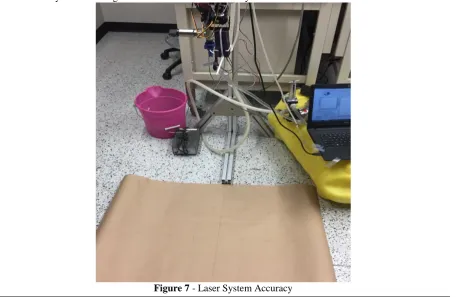
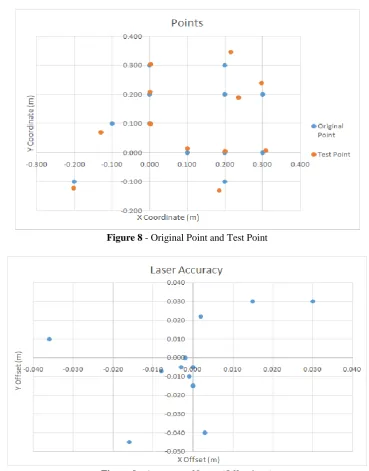
The servo movement was tested using LabVIEW. An X, Y coordinate was selected based upon the projected area covered by the camera. The coordinate is marked on a board placed 0.85 below the assembled laser system. The coordinate system marked in increments of 10 cm in each direction. The coordinate is then entered into LabVIEW as a control. Figure 7below shows the setup of the system. The laser is attached with the laser constantly on. Allowing accurate measurements of the system.
The accuracy of the laser system was recorded to the closest millimeter in the X and Y directions. The test was preformed 12times with different coordinates.
DISCUSSION AND APPLICATION
VISION ACQUISITION
The system proved accurate 44.5% of the time. Incorrect identification occurred 22.2% of the time while no identification occurred the remaining time.
Table 1 below shows the result from each test.
Table 1 - Vision Experiment Results
Test Insects Correctly Identified Incorrectly Identified
1 3 1 1
2 2 1 0
3 2 0 0
4 3 1 1
5 3 1 2
6 3 2 0
7 4 0 0
8 1 1 0
9 3 3 2
10 0 0 0
11 1 1 0
12 2 1 0
Adjustment to the RGB index allow for certain object to be identified when the image is converted to a binary image. Image color changes with shade and sun exposure and appear to have a different shade based on the surroundings. Insects with dark coloring were identified when located on the leaf face. When located on the stem insects were not identified, regardless of their coloring. When insects are on the stem there is little contrast with the surrounding and the insect. The leaf face provides more contrast and for colors to be identified easily. The light colored insect was not identified in any of the images. This indicates that the RBG index is not wide enough to accurately identify insects of light color. Increasing the index so that light color insects are identified could also allow brown spots in the plant to be falsely identified as an insect. Other identifiers will have to be explored to identify insects that are light brown in color.
Limitations for the image acquisition occur in applications for multiple insects of varying colors. The image analysis can be completed in a loop with different parameters for each loop allowing for all common insects to be identified.
SERVO COORDINATION
Figure 8 - Original Point and Test Point
Figure 9 - Accuracy of Laser (Offset in m)
The laser system tested above proves accurate. Limitations occur in applying the system outside of a laboratory environment. The height for image acquisition was assumed because of the simplicity of calculations, assurance of accuracy within the experiment, and a common distance for laser killing pests on the underside of corn plants. As plants have leaves at varying heights and growth points a calculated average will have to be used or a sensor, that can accurately access the height of the canopy, used in conjunction with the system.
IV. FUTURE WORK AND APPLICATION
V.
CONCLUSION
This study looked at the ability to identify insects on a plant medium and the coordination of servos in response to image analysis. The laser mitigation system discussed proves an adequate solution for pest control. The image analysis method identified insects on the canopy of a hosta plant. Coordination of the servos proved accurate to 94.3% in the X and 89% in the Y.The system proves accurate to conversion of coordinate systems, while providing acceptable recognition of insects with the vision acquisition system. Preliminary results of the control system prove promising and allow for flexible application of the systems to other platforms. The system proves a good alternative to conventional methods of pest mitigation. Additional studies will be needed before the system can be applied directly in the field. Studies include understanding plant limits to laser exposure and large insect laser mitigation limits. Understanding the two limits allow for mitigation in crop fields that is not harmful to the growing crop.
ACKNOWLEDGEMENTS
The author gratefully acknowledges the assistance of Tyler Hieber and Blake Walter. This study was supported by Dan Flippo of Kansas State University’s Biological and Agricultural Engineering Department.
REFERENCES
[1]. Clement, R., Dunbabin, M., & Wyeth, G. (2005). Toward robust image detection of crown-of-thorns starfish for autonomous population monitoring. Paper presented at the 2005 Australian Conference on Robotics and Automation, ACRA 2005, December 5, 2005 - December 7, Australian Robotics and Automation Association Inc.; The ARC Centre of Excellence for Autonomous Systems; The University of New South Wales.
[2]. Foster, S. R., Galanzha, E. I., Totten, D. C., Benes, H., Shmookler Reis, R. J., & Zharov, V. P. (2014). Photoacoustically-guided photothermal killing of mosquitoes targeted by nanoparticles. Journal of Biophotonics, 7(7), 465-73. doi:10.1002/jbio.201200199
[3]. Gaston, K. J., & O'Neill, M. A. (2004). Automated species identification: Why not? Philosophical Transactions:Biological Sciences, 359(1444), 655-667. Retrieved from http://www.jstor.org/stable/4142259
[4]. Hori, M., Shibuya, K., Sato, M., & Saito, Y. (2014). Lethal effects of short-wavelength visible light on insects. Scientific Reports, 4 doi:10.1038/srep07383
[5]. Keller, M. D., Leahy, D. J., Norton, B. J., Johanson, R., Mullen, E. R., Marvit, M., & Makagon, A. (2016). Laser induced mortality of anopheles stephensi mosquitoes. Scientific Reports, 6
doi:10.1038/srep20936
[6]. M. Yao, M. Liu, J. Zhao, L. Huang, & Q. Zhou. (2009). Effect on locusts and green bristle grass by 808nm laser irradiation. Paper presented at the Energy and Environment Technology, 2009. ICEET '09. International Conference on, , 3 298-301. doi:10.1109/ICEET.2009.537
[7]. Marx, C., Kiesow, T., Hustedt, M., Kaierle, S., Poehling, H. M., & Rath, T. (2013). Application of NIR-laser for the control of aphids and whiteflies. German Society of Horticultural Sciences, Berlin. , 3(12) 1-5. doi:10.5288/dgg - pr - 03 - 12 - cm - 2013
[8]. Moore, A., & Miller, R. H. (2002). Automated identification of optically sensed aphid (homoptera: Aphidae) wingbeat waveforms. Annals of the Entomological Society of America, 95(1), 6-8.
[9]. Mullen, E. R., Rutschman, P., Pegram, N., Patt, J. M., Adamczyk, J. J., Jr., & Johanson, E. (2016). Laser system for identification, tracking, and control of flying insects. Optics Express, 24(11), 11828-11838. doi:10.1364/OE.24.011828
[10]. ServoCity. (2016). How dose a servo work? Retrieved from https://www.servocity.com/how-does-a-servo-work
[11]. World Health Orginization. (2016). Zika virus and complications. Retrieved from http://www.who.int/emergencies/zika-virus/en/