E-ISSN 2308-9830 (Online) / ISSN 2410-0595 (Print)
Inter-Cluster Communication in Wireless Sensor Networks
SAIMA ZAFAR1 and ALI HAMMAD AKBAR2
1 Department of Electrical Engineering, National University of Computer & Emerging Sciences, Lahore,
Pakistan
2
Department of Computer Science, University of Engineering and Technology, Lahore, Pakistan
1
[email protected], [email protected]
ABSTRACT
Wireless Sensor Network (WSN) comprises of end devices or nodes equipped with sensors, microcontrollers and transceivers that communicate wirelessly to accomplish goals like surveillance, monitoring and control etc. Groups of nodes under the control of a single cluster head form clusters. Communication within WSN clusters is a widely researched area, however communication among multiple clusters located in close proximity is challenging due to clusters operating in distinct logical channels. Cluster merging and cluster diffusion are proposed for inter-cluster communication. In merging the two clusters combine to form a single network while in diffusion the two clusters are expected to retain their individuality while diffusing through edge nodes. This paper highlights the distinction between cluster merging and cluster diffusion, presents architecture for carrying out efficient diffusion and finally compares these two approaches under various network conditions. Simulations are carried out in Network Simulator (NS2) which shows that cluster diffusion can be rendered efficient when multiple edge nodes are used for inter-cluster communication.
Keywords:Sensor Networks, Network Cluster, Cluster Merging, Cluster Diffusion, Sensor Nodes.
1 INTRODUCTION
This IEEE802.15.4 [1] standard supports ubiquitous computing like wireless sensor networks. WSN are distinguished by features such as low cost, low power, low speed, short range, small memory and limited processing ability. Based on the diverse applications of WSN, it is certain that these networks would have to collaborate among themselves as well as with other networks. The association within a WSN is an extensively explored subject but little work exist that studies inter-WSN communication or communication among clusters of WSN.
In order to carry out communication between nodes located in two distinct clusters located in close proximity of each other, cluster merging has been suggested. In cluster merging, the cluster head of one of the networks is downgraded as a router and nodes in the networks communicate through a single cluster head such that the two networks combine to form a single network. On the other hand in applications where it is desirable to maintain network identity of the two networks, cluster diffusion is recommended such that communication between clusters takes place
through nodes located at the boundary of the two networks. However cluster diffusion is hampered by networks operating in distinct non-interfering logical channels. This minimizes interference at the physical layer but at the down side inhibits inter-cluster communication where clusters in the same operating space using different channels remain ignorant of each other‟s existence and develop isolated islands. This condition negatively impacts the possibility to implement cluster diffusion. Secondly there is a need to identify boundary nodes for carrying out inter-cluster communication and finally an efficient protocol is required for cluster diffusion which is comparable with cluster merging.
2 RELATED WORK
In WSNs cluster merging takes place after the formation of clusters, only considered necessary if it results in performance improvement. Cluster merging has been explored in many research activities, [2- 9] are some of the important work in this direction. In [5] a cluster merging algorithm is suggested that is a two-stage cluster-merge technique for computing minimum power broadcast trees. In [6] Wei, Z. et al. explain a cluster-merging algorithm with link optimization as the focus of their work. In [7] Ding, C., and He X. perform a thorough analysis of various methods for selecting the next cluster(s) in hierarchical clusters. It is observed that the primary motivation in cluster merging is performance gain within the network and not efficient inter-WSN communication. In [8] Campos, R. et al. explain a frame work for internetworking between heterogeneous WSNs using legacy technologies and the Ambient Network and Network Composition concepts. Their idea is to make existing technologies like Bluetooth and IEEE802.15 interoperable with each other.
In IEEE802.15.4 networks, the model of WSN merger is essential to the professed character of these networks because a single WSN is restrained in rendering substantial use and significance for practical applications. A strongly related work in this respect has been done by Misic, J. et al. [10-11] where IEEE802.15.4 network clusters are joined through a master-slave bridge. Although their claim is reasonable for some coverage and connectivity models in the real world, there are other scenarios not supported by their architecture or are totally unfeasible. They assume cluster merging as a process initiated after neighbor WSN detection is done, but they ignore the definition of the procedure needed to discover a neighboring WSN.
Khan, I. et al. [12] present a survey of boundary detection algorithms for sensor networks. They classify boundary detection algorithms into three categories; geometrical approaches, statistical approaches and topological approaches. The geometrical approaches assume that the sensor nodes are aware of their exact location within the network. This necessitates using special location hardware like GPS or scanning devices. The statistical approach classifies the nodes as interior and boundary nodes by supposing that the node distribution in the network adhere to certain statistical functions. These algorithms comprise of difficult statistical and mathematical computations. In topological approach, the algorithms utilize the topological information available at sensor nodes in the network.
3 DESIGN OF THE CONNECT PROTOCOL
3.1 Network Model
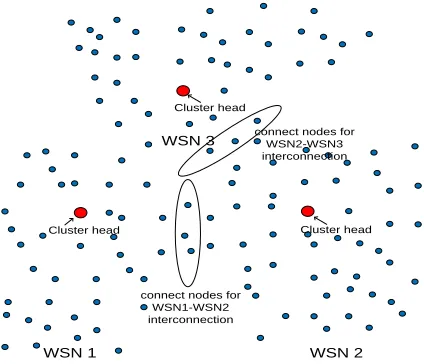
The network model for the CONNECT protocol is shown in Figure 1 which shows three sensor network clusters operating in distinct logical channels. The cluster heads and the boundary nodes which are in the radio range of both clusters and are potential candidates for „connect nodes‟ are also indicated.
Cluster head
Cluster head Cluster head
WSN 1 WSN 2
WSN 3
connect nodes for WSN1-WSN2 interconnection
connect nodes for WSN2-WSN3 interconnection
Fig. 1. Network Model for CONNECT Protocol
3.2 Protocol Design
There are five procedures in protocol explained in the following subsections. These stages are detection of possible „connect nodes‟, discovery of external cluster, duty cycle assignment to connect nodes for switching channels, dissemination of notification about external cluster(s) to network nodes and common interest based inter-WSN communication.
3.2.1 Procedure 1
The boundary nodes are detected and their Ids are stored at cluster head at the time of cluster initialization and sensor node Ids assignment [13-16]. The 16bit short address is obtained as
) 0
(
*AP N N MC MC
FC where FC is the
„first child address‟, MC is the „maximum allowed children‟, AP is „address of parent node‟ and N is „Nth child node‟.
nodes that have child nodes. This process continues for n-hop-count nodes from cluster head and boundary nodes list is updated till it contains Node IDs of all nodes at the boundary of the network.
3.2.2 Procedure 2
The swap command is sent from the cluster head to all boundary nodes to sense the presence of another logical channel in their operating space. In response to swap, the boundary nodes scan all 27 logical channels. If an external cluster is discovered, external cluster channel is stored and positive response to swap command is sent to cluster head. If there is no positive reply, cluster head exits the algorithm. The exit command may involve a mechanism whereby upper layers are reported of the nonexistence of neighboring clusters. When a cluster is discovered, positive response is sent to cluster head by boundary node(s) otherwise negative reply is sent and boundary node switches to home network logical channel. Cluster head stores boundary nodes Ids that positively respond and also retrieves external cluster information on the basis of external cluster, cluster Id. Those boundary nodes that positively respond to swap are termed as „connect nodes‟. At cluster head, when positive reply is received from a boundary node in response to swap command, swing command is executed.
3.2.3 Procedure 3
The cluster head issues swing command upon receiving the affirmative [resp(swap)=true] from a connect node or a group of connect nodes. The swing command is executed at the connect nodes. Through this command, the cluster head issues duty cycle to the connect nodes and resumes its normal operation.
Swing Command {Issued by the cluster head on Receiving Resp(swap)=true}
n N
Inform upper layers about WSNs
Save foreign cluster Id and recover External cluster Information
Save cluster-Ids of connect nodes
Convey swap between Local-Channel and Foreign-Channel command to connect nodes
Send duty-cycle to connect nodes Exit
The connect nodes then oscillate between the home-WSN logical channel and foreign-WSN logical channel based on the duty cycle and interconnects the two WSNs. While, a connect node
continues to relay information between two WSNs, in case it does not overhear the external cluster for a certain time, it sends a „drop‟ message to the cluster head. The cluster head waits for other connect nodes to send the same message. When all the connect nodes notify of the absence of a foreign network, the cluster head sends „terminate_swing‟ command to all connect nodes.
3.2.4 Procedure 4
The cluster head stores foreign cluster Id along with connect node Ids through which the external cluster can be reached. Cluster head has stored information about external clusters against their Ids, which it retrieves. Cluster head then broadcasts this information to all sensor nodes in WSN so that they are notified of the presence of a external cluster. It also broadcasts connect node Ids through which a particular external cluster is reachable. The sensor nodes can now initiate communication if there is an interest.
3.2.5 Procedure 5
When an external cluster is discovered in the personal operating space, the cluster head announces the existence of the external cluster to all sensor nodes. This way multiple external clusters (if discovered) are notified to all sensor nodes in WSN. On the basis of interest, sensor nodes can initiate communication. There are three possible ways or models for inter-WSN interest and data communication. In first model, an ordinary sensor node carries out inter-cluster communication through cluster heads of the two networks. In second model, a node carries out inter-cluster communication through connect nodes directly. Lastly an additional merged mode of data transfer can also be employed where both modes can be adopted based on the location of a node.
4 SIMULATION RESULTS
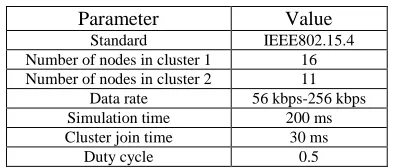
This section presents performance evaluation of
CONNECT protocol for inter-network
Table 1: Simulation Setup.
Parameter Value
Standard IEEE802.15.4 Number of nodes in cluster 1 16 Number of nodes in cluster 2 11
Data rate 56 kbps-256 kbps Simulation time 200 ms Cluster join time 30 ms
Duty cycle 0.5
It is observed that cluster diffusion through a single connect node does not compare well with cluster merging in terms of latency of data transfer. In model 1, a sending node in WSN „1‟ sends data to home-cluster-head that forwards it to the connect node to be sent to WSN „2‟, in model 2, sending node sends data directly to connect node while in model 3 sending node sends data to cluster head or connect code on the basis of proximity. In Figure 2 model 3 was expected to outperform first two models but owing to the overhead of route discovery messages, model 2 performs best. Since model 3 involves route discovery messages for deciding about the best path to the connect node and that contributes to latency therefore it is not the best model as far as latency is concerned.
0 50 100 150 200 250 300 350 400
5 10 15
La
ten
cy
(ms
)
Number of flows
Model 1
Model 2
Model 3
Fig. 2. Impact of data delivery models on latency of data transfer
Depending upon the location of sending node either of the first two models performs well. As number of flows increase, the single connect node tends to become the bottleneck of connection increasing latency while in cluster merging latency remains almost constant as number of flows increase. In cluster merging data transfer between two WSNs takes place as if it is a single WSN. Figure 3 shows comparison of our protocol with cluster merging. We observe that as number of connect nodes increases, cluster diffusion tends to approach cluster merging as there are more routes available for data transfer. In cluster merging, route discovery increases latency. When the number of flows across a single „connect node‟ increase, the latency increases multiple times, it almost doubles.
0 50 100 150 200 250 300 350 400
5 10 15 20
La
ten
cy
(ms
)
Number of flows
connect node=1
connect nodes=2
connect nodes=3
cluster-merge
Fig. 3. Impact of network size on latency due to flooding for a small network
But when number of connect nodes increase, latency increases less with number of flows as some of the flows are likely to be directed to the second connect node, similarly with 3 connect nodes, performance is even better. This effect is seen in Figure 3, with three connect nodes (CN=3) the slope of increase in latency is less when number of flows are increased from 5 to 20. Thus in situations where cluster diffusion is necessary, using more than one connect node for diffusion gives better performance. In model 3 and in cluster merging, route discovery messages increase latency. These messages are proportional to the number of nodes in the network. This means in small sized networks with less number of nodes, model 3 and cluster merging are very efficient but with network size, due to route discovery message flooding, their performance deteriorates as compared to model 1 and model 2 of CONNECT. This effect is shown for various network sizes in Figures 3 to 5.
0 50 100 150 200 250 300 350 400
5 10 15 20
La
ten
cy
(ms
)
Number of flows
connect node=1
connect nodes=2
connect nodes=3
cluster-merge
0 50 100 150 200 250 300 350 400
5 10 15 20
L
a
ten
c
y
(ms
)
Number of flows
connect node=1 connect nodes=2
connect nodes=3
cluster-merge
Fig. 5. Impact of network size on latency due to flooding for a large network
Model 2 is efficient when multiple connect nodes are available and when network size is large. Although latency of data transfer is affected by increased number of hops in large networks but this effect is uniform for all models as well as in cluster merging. In scenarios where cluster diffusion is mandatory model selection becomes a function of network size with model 1 and 2 preferable for large sized networks (more than 200 nodes) and model 3 preferable for small sized networks.
5 CONCLUSION
This paper presents an efficient cluster diffusion protocol for wireless sensor networks and compares its performance against cluster merging. Through NS2 simulations we show that by using multiple boundary nodes for diffusion, cluster diffusion can be made as efficient as cluster merging. Various alternate models of communication can be adopted such that communication can take place through cluster heads or directly through boundary nodes. This work is a milestone in improving inter-cluster communication which is an essential part of realizing the ubiquitous role of sensor networks. This way multiple sensor networks in the close proximity can detect each other and share information of interest or infrastructure network can be accessed hopping across multiple sensor networks.
6 REFERENCES
[1] IEEE802.15.4-standard Specifications. http://www.ieee802.org/15/pub/TG4.html. [2] S. Jung, A. Chang, and M. Gerla,
“Comparisons of ZigBee Personal Area Network (PAN) Interconnection Methods”, Proceedings of the IEEE International Symposium on Wireless Communication Systems (Norway) October 17-19, 2007, pp. 337-341.
[3] A. Willig, N. Karowski and J. Hauer, “Passive discovery of IEEE 802.15.4-based body sensor networks Ad Hoc Networks”, Ad Hoc Networks, Vol. 8, No. 7, 2010, pp. 742-754. [4] R. Jurdak, A. Nafaa, and A. Barbirato, “Large
Scale Environmental Monitoring through Integration of Sensor and Mesh Networks Sensors”, Special Issue on Wireless Sensor Technologies and Applications, Vol. 8, No. 11, 2008, pp. 7493-7517.
[5] K. Das, R. J. Marks, M. El-Sharkawi, P. Arabshahi and A. Gray, “A Cluster-Merge Algorithm for Solving the Minimum Power Broadcast Problem in Large Scale Wireless Networks”, Proceedings of the IEEE Military Communications Conference (USA) October 13-16, 2003, pp. 416-421.
[6] Z. Wei, C. Hui-Min and W. Hao, “Cluster Merging Algorithm with Link Optimization for Wireless Sensor Networks”, Proceedings of the International Conference on Wireless Communications, Networking and Mobile Computing (China) September 22-24, 2006, pp. 1-4.
[7] C. Ding and X. He, “Cluster merging and splitting in hierarchical clustering algorithms”, Proceedings of the Second IEEE International Conference on Data Mining (Japan) December 9-12, 2002, pp. 139-146.
[8] R. Campos, C. Pinho, M. Ricardo, J. Ruela, P. Poyhonen and C. Kappler, “Dynamic and Automatic Interworking between Personal
Area Networks using Composition”,
Proceedings of the IEEE International Symposium on Personal, Indoor and Mobile Radio Communications (Germany) September 11-14, 2005, pp. 947-951.
[9] S. M. Guru, M. Steinbrecher, S. K. Halgamuge and R. Kruse, “Multiple Cluster Merging and Multihop Transmission in Wireless Sensor Networks”, Proceedings of the Second International Conference on Advances in Grid and Pervasive Computing (France) May 2-4, 2007, pp. 89-99.
[10]J. Misic, J. Fung and V. B. Misic, “Interconnecting 802.15.4 clusters in master-slave mode: queueing theoretic analysis”, Proceedings of the 8th International Symposium on Parallel Architectures, Algorithms, and Networks (USA) December 7-9, 2005, pp. 7-9.
[11]J. Misic and C. J. Fung, “The impact of master-slave bridge access mode on the performance of multi-cluster 802.15.4 network”, Computer Networks: The International Journal of
Networking, Vol. 51, Issue 10, 2007, pp. 2411-2449.
[12]I. Khan, H. Mokhtar and M. Merabti, “A Survey of Boundary Detection Algorithms for Sensor Networks”, Proceedings of the 9th Annual Symposium on the Convergence of
Telecommunications, Networking and
Broadcasting (UK), June 23-24, 2008, pp. 1-5. [13]C. Nam, H. Jeong and D. Shin, D, “Extended
Hierarchical Routing over 6LoWPAN”, Proceedings of the Fourth International Conference on Networked Computing and Advanced Information Management (Korea) September 2-4, 2008, pp. 403-405.
[14]H. J. Lim and T. M. Chung, “The Bias Routing Tree Avoiding Technique for Hierarchical
Routing Protocol over 6LoWPAN”,
Proceedings of the Fifth International Joint Conference on INC, IMS and IDC (South Korea) August 25-27, 2009, pp. 232-235. [15]L. V. Chandra, K. Chai and S. Ramadass,
“Bias Child Node Association Avoidance Mechanism for Hierarchical Routing Protocol in 6LoWPAN”, Proceedings of the 3rd IEEE International Conference on Computer Science and Information Technology (China), July 9-11, 2010, pp. 332-335.