181305-9494-IJCEE-IJENS © October 2018 IJENS I J E N S
Existing and Parametric Study on Rainfall-Induced
Slope failure
Mohamed Ahmed Hafez1 , Lee Choon Yong2 , Ahmad Fadli Bin Mamat3, Rahsidi Sabri Muda4 ,Sivakumar Naganathan5, Zakaria Che Muda6, Zaher Almkahal7
1 Department of Civil Engineering, College of Engineering, Universiti Tenaga Nasional, Jalan IKRAM-UNITEN, 43000, Kajang,
Selangor, Malaysia. Email: [email protected].
2 Department of Civil Engineering, College of Engineering, Universiti Tenaga Nasional, Jalan IKRAM-UNITEN, 43000, Kajang,
Selangor, Malaysia. Email: [email protected].
3 TNB Research Sdn. Bhd., No. 1, Lorong Ayer Itam, Kawasan Institusi Penyelidikan
43000 Kajang, Selangor, Malaysia. Email: [email protected]. 4 TNB Research Sdn. Bhd., No. 1, Lorong Ayer Itam, Kawasan Institusi Penyelidikan
43000 Kajang, Selangor, Malaysia. Email: [email protected]@tnb.com.my.
5 Department of Civil Engineering, College of Engineering, Universiti Tenaga Nasional, Jalan IKRAM-UNITEN, 43000, Kajang,
Selangor, Malaysia. Email: [email protected].
6 Department of Civil Engineering, College of Engineering, Universiti Tenaga Nasional, Jalan IKRAM-UNITEN, 43000, Kajang,
Selangor, Malaysia. Email: [email protected].
7 Department of Civil Engineering, College of Engineering, Universiti Tenaga Nasional, Jalan IKRAM-UNITEN, 43000, Kajang,
Selangor, Malaysia. Email: [email protected].
Abstract--
The rehabilitation of the Cameron Highlands hydroelectric scheme which includes a process of removing a volume of about 2.8 million cubic meters sediments. The reservoir sediment has been excavated, as it is transported from the dredging site to the placement site or disposal area in government-owned Sg. Jasin/Jasik site. The dredged reservoir sediments are generally defined as sandy silts with moderate organic materials. Existing and parametric slope stability studying landfill embankment/slope has been conducted to assess the slope stability in the dumping area. Rainfall-induced slope failure has been incorporated in this study to explain why even engineered slope encountered failure when the depth of infiltration reaches the critical depth. In this study, the thickness of this wetted zone is assumed to increase subsequently while the factor of safety is determined.
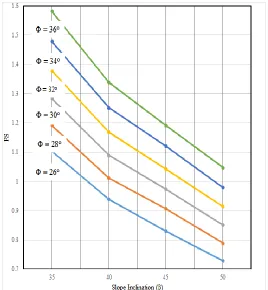
Moreover, the effect of the thickness of the wetted zone against stability has been checked to determine the maximum wetted thickness to install any types of slope remediation works such as a horizontal drain. The parametric study demonstrated that the slope factor of safety is decreased with increasing the thickness of infiltration, i.e., the advancement of the wetting front. However, the analysis of the existing conditions of slopes indicates that the slopes are in stable condition. The slopes with slope angles of 35° and less are stable independently to the material friction, while the slope angle of 50° is not stable for material friction angle of less than 36°. It is noted that the material in this study would not have a friction angle greater than 34°. On the other hand, the slope angle of 40° has a critical friction angle of 28°, while the slope angle of 45° has a critical material friction angle of 30°.
1. INTRODUCTION
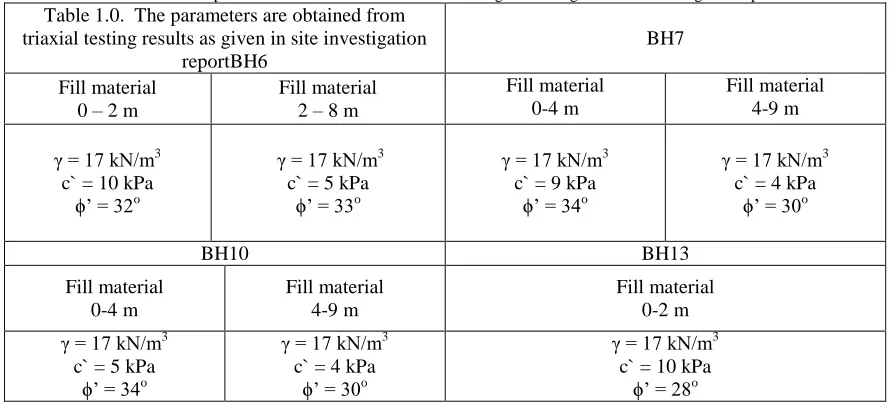
Table I
The parameters are obtained from Triaxial testing results as given in site investigation report Table 1.0. The parameters are obtained from
triaxial testing results as given in site investigation reportBH6
BH7
Fill material 0 – 2 m
Fill material 2 – 8 m
Fill material 0-4 m
Fill material 4-9 m
γ = 17 kN/m3 c` = 10 kPa
ϕ’ = 32o
γ = 17 kN/m3 c` = 5 kPa
ϕ’ = 33o
γ = 17 kN/m3 c` = 9 kPa
ϕ’ = 34o
γ = 17 kN/m3 c` = 4 kPa
ϕ’ = 30o
BH10 BH13
Fill material 0-4 m Fill material 4-9 m Fill material 0-2 m
γ = 17 kN/m3 c` = 5 kPa
ϕ’ = 34o
γ = 17 kN/m3 c` = 4 kPa
ϕ’ = 30o
γ = 17 kN/m3 c` = 10 kPa
ϕ’ = 28o
2. METHODOLOGY
The analysis through Slope/W was based on a Morgenstern-Price method that deals with both moment and force equilibrium equations. The factor of safety distribution was considered in constant, and no crack tension was allowed. Analysis of slope factor of safety was focused on boreholes 6, 7, 10 and 13 at Parcels 4, 5 and 5a. Meanwhile, some of those cross sections have been selected as critical slopes.
2.1 Estimation of infiltration through the soil:
The simulation of infiltration of water through the soil before the consolidation process (undrained), is unlikely. However, the previous literature and lab results obtained in the similar tropical region have been used as a reference to provide an approximated version of the effect
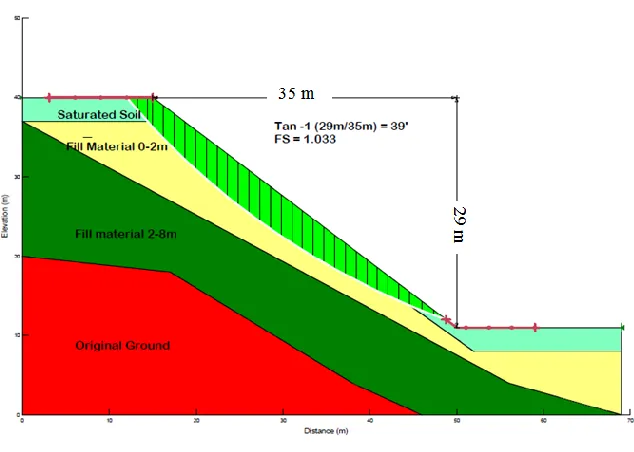
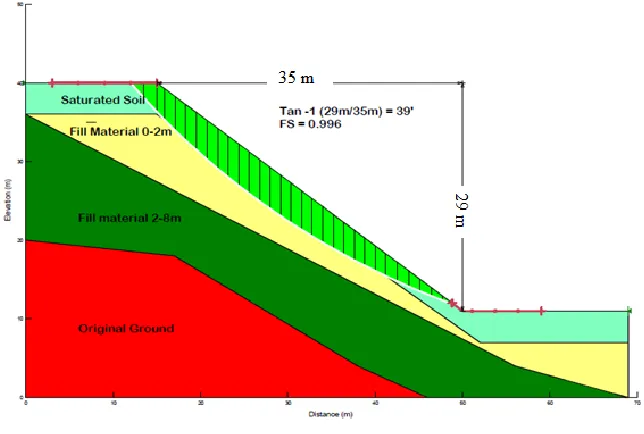
of infiltration in the stability of slopes. This approximated method allows the infiltration of water up to 1, 2 and 3m at the top of the slopes. The full saturation of water at the surface of the slope results in a reduction of a factor of safety. The new method proposed in this project is the usage of drained soil through the slope and allow the software to automatically reduce the shear parameters on the zones where water is flowing. This method generally generates results with higher credibility. As it is shown in Figure 1
2.2 Limitations.
181305-9494-IJCEE-IJENS © October 2018 IJENS I J E N S
3. RESULT AND DISCUSSION
a. Existing conditions.
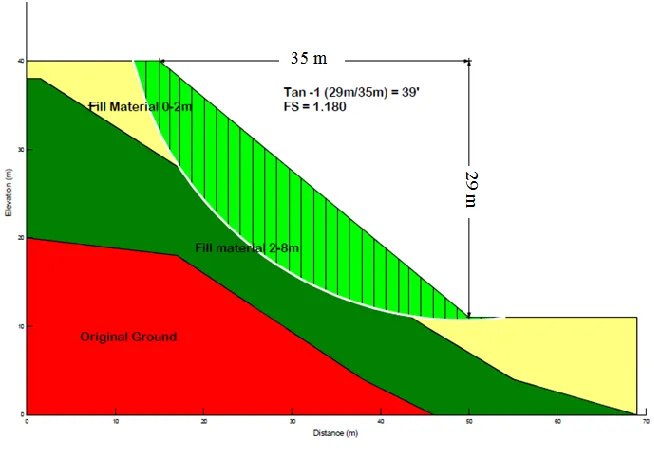
Figure 2 shows the slope stability analysis results for Chainage 80 in drained condition. The analysis results indicate that the slope is stable with a factor of safety of 1.180.
Fig. 2. Drained slope stability analysis at Chainage 80
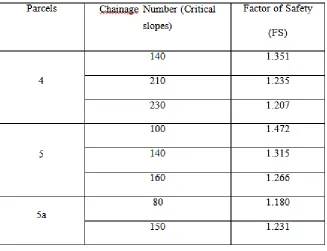
Table II
Summary of slope stability analysis results in an existing condition
Assessment of the stability of slopes with rainfall infiltration
The existing slopes in TNB Sg. Jasin/Jasik Site area is filled slopes, made of sand Silt or clay Silt, with intermediate permeability and friction angles. Figures 3 to 7 show the slope stability analysis for the thickness of infiltration of 1, 2, 3 and 4 m. and how the factor of safety was decreased.
181305-9494-IJCEE-IJENS © October 2018 IJENS I J E N S
Fig. 1. Slope stability analysis with rainfall infiltration depth of 2 m at Chainage 80
Fig. 3. Slope stability analysis with rainfall infiltration depth of 4 m at Chainage 80
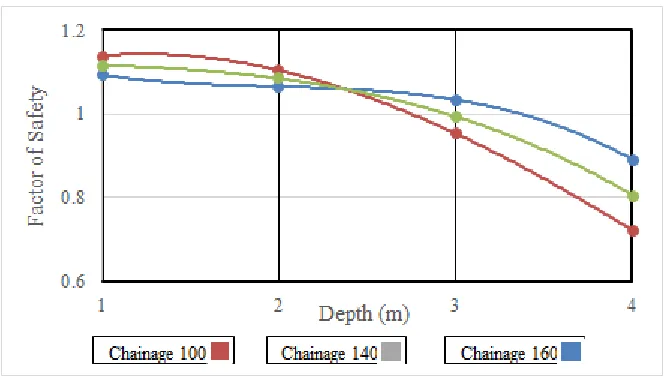
The variation of the slope factor of safety with the depth of infiltration is presented in Figure 8. Based on the interpolation of the results, the critical depth of infiltration is found to be around 3.5 m which correspond to the factor of safety equal one. Hence, it is necessary to determine the critical depths for infiltration to provide adequate slope stability analysis and design.
Fig. 7. Effect of rainfall infiltration depth against slope stability at Chainage 80
The results of the similar analysis for critical Chainages of Parcels 4, 5 and 5a are presented in Figures 9 and 10. It indicates that slope could be unstable when rainfall infiltration depth exceeds 3 m.
0.8
1
1.2
1
2
3
4
F
ac
tor
of
S
afe
ty
181305-9494-IJCEE-IJENS © October 2018 IJENS I J E N S
Fig. 9. Analysis of rainfall infiltration depth at critical slopes for Parcel 5a and 4
Fig. 10. Analysis of rainfall infiltration depth at critical slopes for Parcel 5
4. PARAMETRIC STUDY
A parametric study is to evaluate the stability of slopes regarding the variation of slope inclination (β) and drained shear strength parameters of soil (c’ and Φ’) was carried out. The range of parameters chosen for this study is limited to the existing conditions for selected critical slopes in studied Parcels. Figure 11 presents the results of the parametric study. The parametric study considered the slope angle to vary from
Fig. 11. Effect of slope inclination (β) and soil friction angle (Φ’) on the factor of safety under the drained condition for c’= 5kPa
5. CONCLUSION
The Slope/W analysis results demonstrated that the factor of safety was decreased gradually with increasing the depth of top infiltration. The friction angle has significant effects on the slope factor of safety. Increasing the friction angle will improve the safety factor of the landfill slope. The infiltration proved to cause slope instability when the factor of safety is decreased with the depth of infiltration. This has substantiated the adverse effect of infiltration on the stability of slopes.
ACKNOWLEDGMENT
The assistance and support from Tenaga Nasional Berhad (TNB), TNB Research Sdn. Bhd. (TNBR) And UNITEN R&D Sdn. Bhd. is gratefully acknowledged. The authors are indebted to the research assistants including Chin Zhou Hyn, Saman Kazemi, Zaher Almkahal and Sujendran Nair Chandran for carrying out the computer analysis work.
REFERENCES
[1] Arezoo Rahimi, Harianto Rahardjo, and Eng-Choon Leong, Effect of Antecedent Rainfall
[2] Patterns on Rainfall-Induced Slope Failure. Journal of Geotechnical and Geo-Environmental Engineering (2011). [3] Foley and Silburn, Hydraulic properties of rain impact surface
seals on three clay soils, Australian Journal of Soil Research CSIRO Publishing (2002)
[5] JKR Guidelines for slope design (2010)
[6] Md.Noor, M.J., Mahamood, A.R., Jamaludin, D. and Mohd. Jais (2006). “Modelling the mechanism of shallow slope failure due to rainfall infiltration.” International seminar on civil and infrastructure engineering (ISCIE06) University Technology MARA, Shah Alam, Malaysia.