A Study of Pupil Orientation and Detection of
Pupil using Circle Algorithm: A Review
A. F. M. Saifuddin Saif
1,Md. Shahadat Hossain
21Assistant Professor, Department of Computer Science, American International University-Bangladesh, Dhaka,
Bangladesh 2M Scholar, Department of Computer Science, American International University-Bangladesh, Dhaka, Bangladesh
Abstract: Determining a Pupil size, diameter and center are fundamental for pupil orientation. It is important features to detect eye and It is considered as a significant verification method for human computer interaction. In This paper, We investigated existing methods and presented the framework to detect pupil to calculate its distance. The existing methods of pupil orientation have classified in 4 section which are estimation and measurement, localization, detection, and tracking. We have shown the tabular study of an algorithm, detected feature and accuracy for each classification sector. There are several investigations that are running to classified all the sectors accurately. We have also proposed a framework to calculate pupil distance from images. We have described the algorithms to detect and straighten face, detect eyes. We have also proposed that a modified Circle Equation can be better to detect and exact pupils based on circle size, object polarity, and sensitivity. Although, we have discussed distance calculation.
Keywords: Pupil, Pupil Tracking, Size Estimation, Diameter Measurement, Pupil Detection, Pupil Localization , Eyes, Edge Detection, Algorithms
I. INTRODUCTION
Biometric information gives a unique identification to person. There are several biometric information such as Fingerprint Recognition, Voice Recognition, Signature Recognition, Face Recognition, Plan Scan, Irish Scan, Retina Scan, Hand Geometric, Key-Smoke Scan [1] [2] [3] [4].All these are used for increase security, identify a person, avoid false transaction, Predict the reliability of a person. There are many things which are not solved to make as biometrics such as: walking Geometric, Pupil distance, measurement to prove it as biometric information. we are analyzing computer vision to prove it unique.
The pupil is one of the important features for human and active research field in recent years. There are several problems to detect pupil from images . Although research has contributed many algorithms to detect it [3]. It is a continuous process to get to get a stable algorithms. There are many features which are used to
detect pupil, such as diameter, Center point, contour, size, blink. Moreover, ellipse fitting [5]and pupil orientation [6] is worked for pupil tracking.
Besides that, Algorithms are proposed to track down pupil from images and video.
Localization of an object is very important in computer vision application. Pupil localization plays an important role for face recognition, gaze estimation, and much more sector [7]. It is widely used in human computer interaction to assist disabled people to improve their life styles [8]. Especially, It is required to find out double pupil location for the pupil distance which is used for face normalization, for facial land marks the location, for noise removing [2]. The noise removing is another way to increase the accuracy. To getting high accuracy in the localization of pupil, we need high quality of images
[1].
The pupil is the core properties of an eye where we are trying to prove the pupillary distance as biometrics. The measurement of pupil diameter plays an important role. Pupil diameter has started measurement using Haar Classification Algorithm, Genetic algorithms, Color Characteristics Method [3]. The information of pupil diameter and the centre position of an image is required to measure the gaze direction. The image is captured by a near-infrared camera [4]. It is defined that the measurement of pupil diameter, center and size is needed for pupil distance measurement. In measurement purpose, Mid point and pupil diameter are going to use through geometric features, fitting algorithms, least square and Ellipse equation by Hough transformation.
monitoring system is more eligible that far field system to acquire accuracy of pupil size and blink endpoints and imaginary for a mobile computing usages [15]. Once pupil center and size can estimate, It is easy to detect pupil [12] and useful to improve the pupillary distance which can contribute in human machine interaction.
In recent years, Scientist is analysis eye movement data to detect fraud or false behavior where the pupil is used to tracking and getting the eye data [6] [16] [17] [18]. Time and resource have been wasted to search pupil in all regions of the image where it occupied only small rotation of the image [5]. Starburst model turned to advantage for shorten computing time and the possibility of false detection [19] [20]. Researcher concedes that there are many obstacles in front of pupil detection and tracking. Face Learning [21] [22], Eyes Point Occlude [22], Warning Glass [22],Illumination Variation [23] [22]and Face Rotating [22]decreased detection precision rate where viewers fast move and the sharply enhance of viewer number are taking responding speed [16]. On the other hand, Image Segmentation plays an effective role to acquire pupil geometric features, Such as area, Semi axis, centroid and orientation [17]. To detect pupil, It is required to obtain eye area in real-time video [18]. The contour of the pupil detection and fitted to an ellipse done by its geometric parameter [6]. So, Pupil area and contour can control the pupil detection and track with quite a high possibility of human computer interaction.
In this paper, A state survey has been presented on the pupil. Countour and Center detection are divided into several parts which are needed to identify the pupillary distance. Section 2 contains the current challenges of estimating, measuring, localizing, detecting and tracking pupil. Section 3 discusses Previous Research on Methods and Algorithms. Section 4 contains the Research methodology where discusses proposed frameworks, expected result. Finally, we conclude our paper in section 5.
II. ICURRENT CHALLENGES
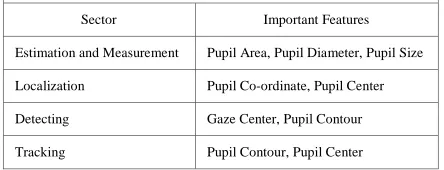
This paper discusses the main challenging factors to estimate and measure pupil area, diameter, and size, Localization of Pupil coordinate and center, Detection of Gaze center and contour, Tracking of pupil contour and center which are shown in Figure 1.
Area and size are important features to estimate an object. To estimate the pupil area and size, we need to find out the Location of the pupil. A pupil can be localized by its center and coordinate. It can be easy to estimate, if we measure the pupil diameter. But pupil contour can be given an effective result to localize pupil [1]. On the other hand, Color and Light Reflection can be good features to localize eyes. There are two types of
eyes in the world said by Amer Al-Rahayfeh and Maid Faezipour and Light Reflection has been used to estimate the gaze direction in many computer vision based eye trackers [24]. If we solve the estimation and measurement of a pupil, we can easily get the pupil area, size, and diameter.
In Eye tracking, It needs to build a geometric model to identify eye axis [6]. Some Geometric model has been present to detect and track the pupil [5] [18] [16] [6]. It can give an efficient result, once we can perfectly detect the gaze center and contour. According to geometric model, pupil center and size can not be selected genuinely. The Support Vector Machine(SVM) can detect the pupil co-ordinate [16] which
Current Challenges to estimate, measure, localize, detect and track pupil
Sector Important Features
Estimation and Measurement Pupil Area, Pupil Diameter, Pupil Size
Localization Pupil Co-ordinate, Pupil Center
Detecting Gaze Center, Pupil Contour
Tracking Pupil Contour, Pupil Center
Fig. 1: An overview of important features for Estimation and Measurement, Localization, Detecting and Tracking Pupil.
can determine the pupil contour. It is presented that Ellipse Fitting can determine the pupil boundary using contour [5]. Pupil boundary can formalize to detect pupil center which is exactly to detect and track pupil.
III. PREVIOUS RESEARCH ON METHODS AND ALGORITHMS
Prior Working Description of Pupil Estimation and Measurement
Algorithms Detected Features Accuracy Rate
Circle Area Equation [3], Ellipse Equation [3]
Pupil Diameter Low accuracy
Hough Transform [4] Pupil Diameter, Pupil Center
More Than Fan Shaped Separability Filter
Eye-link System [10] Gaze Position, Pupil Area
N/A
Dual Ellipse Fitting Method [11]
Pupil Size, Blink Rate 99.7%
Fig. 2: An overview of Prior working Algorithms, Detected Features and Accuracy Rate in Pupil Estimation and Measurement
Object localization could not find easily in prior time. Several Algorithms is used to identify pupil cor-ordinate, center and centroid point. Ada boosting eye classifier [2] is used to localize the pupil centroid and its coordinate. The accuracy of algorithms is 47% for eye region detection in face region where Face region detection precision is 92%. In Ensembles Regression Tree [8], 85.75% accuracy has been
Prior Working Description of Pupil Localization
Algorithms Detected Features Accuracy Rate
Ensembles Regression Tree [8]
Pupil Co-ordinate 85.7%
Adaptive Gradient Boosting Decision Tree(Adaptive GBDT) [7]
Pupil Co-ordinate 91.54%
StartBurst Model [1] Pupil Center 91.92%
Ada Boosting Eye Clas-sifier [2]
Pupil Centroid and Co-ordinate
More than 47%
Fig. 3: An overview of Prior working Algorithms, Detected Features and Accuracy Rate in Pupil Localization
measured in 5% error rate and 99.7% accuracy has been recorded at 25% error rate. On the other hand, Adaptive GBDT [7] is localizing pupil coordinate at 91.54% at 5% error rate and 99.89% accuracy has been recorded at 25% error rate. The Starburst model [1] has recorded 91.92% correct detecting pupil center where the average frame rate is 196.76(ms).
The detection of Pupil is required to measure the correct pupil distance. The curvature algorithm [9] has presented to detect pupil center. The Accuracy rate 40% to detect pupil boundary in an error of less 0.1 degree. The Modified Adaptive Resonance Theorem using NNs [12] estimate pupil size with accuracy of 91% where 90% correct differentiation between narcoleptic and
control subjects.The Canny Algorithm [25] [26] detect pupil contour and edge at 90% accurately. The Morphology algorithm [17] detected pupil contour. The accuracy is 90% on Left Pupil and 94% on Right Pupil. The Support Vector Machine(SVM) [16] is detecting eyes area coordinate with accuracy 98.2721%. But SVM and Correlation matching are time consuming [16].
Prior Working Description of Pupil Detection
Algorithms Detected Features Accuracy Rate
Curvature Algorithms [9]
Pupil Center 40%
Modified Adaptive Resonance Theorem using NN [12]
Pupil Size and EEG 91%
Canny [25] [26] Contour [25] [26], Edge [27]
High Accuracy [25] [26],
90% [27]
Morphology [17] Contour Left Pupil 90% and Right Pupil 94%
Support Vector Machine(SVM) [16]
Co-ordinates of Eyes Area
98.2721%
Fig. 4: An overview of Prior working Algorithms, Detected Features and Accuracy Rate in Pupil Detection
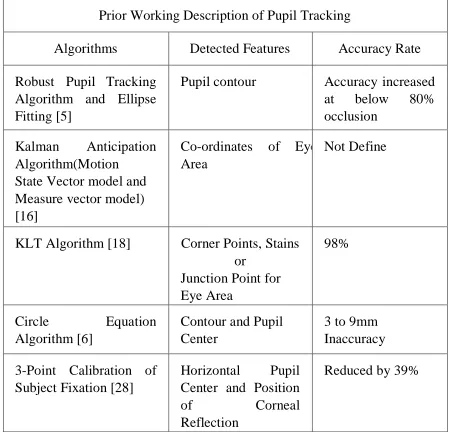
There are several methods to track the eyes. It is trying to use pupil contour, corner point, and pupil center to use pupil. Robust Pupil Tracking Algorithm and Ellipse Fitting [5] is used to contour detection where the accuracy increased at below 80% occlusion. Kalman Anticipation Algorithm [16] has two parts. Motion State Vector model and Measure vector model used to track the coordinates of eyes area in tracking a person. KLT Algorithm [18] has used to detect and track
Prior Working Description of Pupil Tracking
Algorithms Detected Features Accuracy Rate
Robust Pupil Tracking Algorithm and Ellipse Fitting [5]
Pupil contour Accuracy increased at below 80% occlusion
Kalman Anticipation Algorithm(Motion State Vector model and Measure vector model) [16]
Co-ordinates of Eyes Area
Not Define
KLT Algorithm [18] Corner Points, Stains or Junction Point for Eye Area
98%
Circle Equation Algorithm [6]
Contour and Pupil Center
3 to 9mm Inaccuracy
3-Point Calibration of Subject Fixation [28]
Horizontal Pupil Center and Position of Corneal Reflection
Reduced by 39%
corner points, stains or junction point for the eye area. Its accuracy is 98%. Circle Equation Algorithm [6] is used to estimate, measure and detect and track the contour and pupil center which is 3 to 9mm inaccurate. 3-Point Calibration of Subject Fixation [28] reduced 39% to track pupil center horizontally using corneal reflection location.
IV. IRESEARCH METHODOLOGY
The study presents the summarization of the pupil detection, pupil estimating, pupil measurement and pupil tracking Algorithms. There are several algorithms to detect pupil. But it does not detect properly with all algorithms. We are proposing a framework where we detect the pupil with all needed features. Based on pupil detection, we will calculate the distance of pupils. We set the task into 6 parts. It starts at Input image which is single image and ends with Distance Calculation.
A. Proposed framework
Fig. 6: A Block Diagram of Pupil Distance Measurement
B. Face Detection using SVM
There are several algorithms for face detection. Feature invariant and Template Matching plays an important role to detect face recognition where appearance based method gives the best output. Feature invariant worked with the grouping of edge, the mixture of Gaussian and Skin color, size and shape. The template matching worked with an object of shape. Appearance Based Method includes several popular algorithms which are eigenface using eigenvector, distributing based using Gaussian distribution and multilayer perception, Neural networks using Ensembles of neural networks, Support Vector Machine using the polynomial kernel and much more. We are going to use Support vector machine. It operates an induction principle which
derived to minimize an expected error. As it is a linearly constrained quadratic programming problem, The computational time and memory is extreme [29].
C. Face Straighten using SURF
There are three types of features in computer vision. Edge Feature is one of them. Edge features describe robustness to illumination change and rotation of the face image where it provides the structural character of an image. The Scale Invariant Feature Transform(SIFT) has used some local features that can apply in face recognition. But The features extraction is expensive. Therefore, Some researchers have proposed modifications to this method. The SURF Operator is of the local feature detector and descriptor. It has given invariance of scaling and rotation, strong robustness, and prominent separating capacity between different features [29]. We are using it to Straighten the Face.
D. Eyes Detection using Template Matching
Eye detection is a preprocessing stage before Irish and pupil detection said by Amer Al-Rahayfeh and Maid Faezipour [24]. Template Matching has used to detect the face with variation in scale, pose, and shape. It can locate the features of eyes, eyebrows, and lips [29]. At first, A Sobel filter is used to extract edges. We find several Algorithm which is going to detect eye using template matching. Although, Support vector machine is used to classify the images to eye/non-eye patterns [24]. we are going to use Template Matching and Support vector machine(SVM) to detect the eyes.
E. Pupils Detection
We have discussed several algorithms to detect pupil. Algorithms accuracy is too low and It cannot find appropriate features. We are using Circle Equation Algorithm to detect the pupil center and its contour. we need to modify the algorithm to get our exact output. The size of the pupil is 6 to 8 pixel. The object polarity is dark where the sensitivity is 0.93. Its accuracy is better than existing algorithms according to our need where we tested the algorithms using Matlab. Although, it has given low accuracy to detect pupil diameter [3].
F. Distance Calculation
Pupillary distance measurement is not easy to calculate uniquely. Once we completed up to the pupil detection part, we cannot measure the distance of pupils. None provides an equation to complete it uniquely. Although we are trying to propose some equation to make it unique. On the other hand, we will use Euclidean distance to calculate the millimeter scale Input Image
Face Detection using SVM [29]
Face Straighten using SURF [30]
Eyes Detection using Template Matching [24][29]
Pupils Detection using Circle Equation Algorithm
distance which is established as the pupillary distance in recent years.
V. CONCLUSION
We described an eye pupil orientation. the current challenges involve the measurement, estimating, localization, detection, and tracking of eyes data particularly the pupil. There are several pupil features which are used to identify pupil orientation. we have shown the tabular format of each sector algorithms, features and accuracy rate. The blink rate can be estimated using pupils features and it’s used to identify coordinate of eyes. There are several machine learning approach that has been presented to localize, estimate and measure the pupils. Besides that, some new and existing algorithms have been presented to detect and track pupils. we proposed a framework which uses a Circle Equation Algorithm to modify the object polarity, pupil size, and sensitivity. We hope that will give the better result than existing Circle algorithms. There is enough scope to study about pupillary distance. Because we did not find any equation to find pupillary distance uniquely. Although, we are observing our investigation on it.
REFERENCES
[1] Y. Zhao, Z. Qu, H. Han, and L. Yuan, “An effective and rapid
localization algorithm of pupil center based on starburst model,” in Advanced Information Management, Communicates, Electronic and Automation Control Conference (IMCEC). IEEE, 2016.
[2] G. Zhang, J. Chen, G. Su, and J. Liu, “Double-pupil location of
face images,” Pattern Recognition, vol. 46, pp. 642–648, 2013.
[3] J. N. Sari, H. A. N, L. E. N, P. I. Santosa, and R. Ferdiana, “A
study on algorithms of pupil diameter measurement,” in Science
and Technology Computer (ICST), International Conference on, 2016.
[4] Y. Morita, H. Takano, and K. Nakamura, “Pupil diameter
measurement in visible-light environment using separability
filter,” in Systems, Man, and Cybernetics (SMC), 2016 IEEE
International Conference on, 2016.
[5] T. Satriya, S. Wibirama, and I. Ardiyanto, “Robust pupil tracking
algorithm based on ellipse fitting,” in International Symposium on Electronics and Smart Devices (ISESD), 2016.
[6] A. Villanueva, R. Cabeza, and S. Porta, “Eye tracking: Pupil
orientation geometrical modeling,” Image and Vision
Computing, vol. 24, pp. 663– 679, 2006.
[7] D. Tian, G. He, J. Wu, H. Chen, and Y. Jiang, “An accurate eye
pupil localization approach based on adaptive gradient boosting
decision tree,” in Visual Communications and Image Processing
(VCIP). IEEE, 2016.
[8] N. Markus, M. Frljak, I. S. Pandˇ ziˇ c, J. Ahlberg, and R. Forchheimer,´ “Eye pupil localization with an ensemble of randomized trees,” Pattern Recognition, Elesevier, vol. 47, no. 2, pp. 578–587, 2014.
[9] D. Zhu, S. T. Moore, and T. Raphan, “Robust pupil center
detection using a curvature algorithm,” Computer Methods and
Programs in Biomedicine, vol. 59, pp. 145–157, 1999.
[10] K. W. Choe, R. Blake, and S.-H. Lee, “Pupil size dynamics
during fixation impact the accuracy and precision of video-based
gaze estimation,” Vision Research, 2015.
[11] S. Chen and J. Epps, “Efficient and robust pupil size and blink
estimation from near-field video sequences for human–machine
interaction,” IEEE Transactions on Cybernetics, vol. 44, no. 12,
pp. 2356–2367, 2014.
[12] D. Liu, Z. Pang, and S. R. Lloyd, “A neural network method for
detection of obstructive sleep apnea and narcolepsy based on
pupil size and eeg,” IEEE TRANSACTIONS ON NEURAL
NETWORKS, vol. 19, no. 2, pp. 308–318, 2008.
[13] P. Ivanov and T. Blanche, “Improving gaze accuracy and
predicting fixation in real time with video based eye trackers,”
Journal of Vision, vol. 11, no. 11, p. 505.
[14] E. A. Byrne and R. Parasuraman, “Psychophysiology and
adaptive automation,” Biological Psychol., vol. 42, no. 3, pp. 249–268, 1996.
[15] S. Chen and J. Epps, “Blinking: Toward wearable computing that
understands your current task,” IEEE Pervasive Computer, vol. 12, no. 3, pp. 56–65, 2013.
[16] C. Yan, Y. Wang, and Z. Zhang, “Robust real-time multi-user
pupil detection and tracking under various illumination and
large-scale head motion,” Computer Vision and Image
Understanding, vol. 115, pp. 1223–1238, 2011.
[17] A. B. Roiga, M. Moralesb, J. Espinosaa, J. Pereza, D. Masa, and
C. Illueca, “Pupil detection and tracking for analysis of fixational
eye micromovements,” Optik, vol. 123, pp. 11–15, 2012.
[18] M. K. ll o lu, M. T. k ran, and N. Kahraman, “Anti-spoofing in
face recognition with liveness detection using pupil tracking,” in
Symposium on Applied Machine Intelligence and Informatics, IEEE 15th International, 2017.
[19] D. Li and D. J. Parkhurst, “Starburst : A robust algorithm for
videobased eye tracking,” Image (Rochester, N.Y.), 2005.
[20] D. Li, D. Winfield, and D. J. Parkhurst, “Starburst: A hybrid algorithm for video-based eye tracking combining feature-based
and model-based approaches,” in IEEE Computer Society
Conference on Computer Vision and Pattern Recognition-Workshop, vol. 3, 2005, p. 79.
[21] Y. Li, S. Wang, and X. Ding, “Eye/eyes tracking based on a
unified deformable template and particle filtering,” Pattern
Recognition Letters, vol. 31, pp. 1377–1387, 2010.
[22] D. Torricelli, M. Goffredo, S. Conforto, and M. Schmid, “An
adaptive blink detector to initialize and update a view-based
remote eye gaze tracking system in a natural scenario,” Pattern
Recognition Letters, vol. 30, pp. 1144–1150, 2009.
[23] A. Santis and D. Iacoviello, “Robust real time eye tracking for
computer interface for disabled people,” Computer Methods and
Programs in Biomedicine, vol. 96, pp. 1–11, 2009.
[24] A. Al-Rahayfeh and M. Faezipour, “Eye tracking and head
movement detection: A state-of-art survey,” IEEE Journal of
Translational Engineering in Health and Medicine, 2013.
[25] G. Xin, C. Ke, and H. Xiaoguang, “An improved canny edge
detection algorithm for color image,” in Industrial Informatics (INDIN), 2012 10th IEEE International Conference on, 2012. [26] C. Jayachandra and H. Reddy, “Iris recognition based on pupil
using canny edge detection and kmeans algorithm,” in
International Journal Of Engineering And Computer Science, vol. 2, no. 1, 2013, pp. 221–225.
[27] M. Kassner, W. Patera, and A. Bulling, “Pupil: An open source platform for pervasive eye tracking and mobile gaze-based
interaction,” in Computer Vision and Pattern Recognition, 2014.
[28] H. J. Wyatt, “The human pupil and the use of video-based
eyetrackers,” Vision Research, vol. 50, pp. 1982–1988, 2010.
[29] M.-H. Yang, D. J. Kriegman, and N. Ahuja, “Detecting faces in
images: A survey,” IEEE Transactions on Pattern Analysis and
Machine Intelligence, vol. 24, no. 1, pp. 34–58, 2002.
[30] G. C. Oscos, T. M. Khoshgoftaar, and R. Wald, “Rotation