IJSRR, 7(4) Oct. – Dec., 2018 Page 2683
Research article Available online www.ijsrr.org
ISSN: 2279–0543
International Journal of Scientific Research and Reviews
Implementation of Secure Hash Algorithm1 for High Throughput and
Optimized Performance
PanduSagara*
1and A. Sindhura
2Dept. of Electronics and Communication Engineering, G. V. P College of Engineering (A), Visakhapatnam, AP-India. E-mail:[email protected], Email:[email protected].
ABSTRACT
Information security provides protection of information against unauthorized disclosure, data
collapse, and modification. Using virtual networks, the increase in demand for encryption of data is
major concern in computer systems and digital communication. Field Programmable Gate Arrays
(FPGAs) enter a significant growth due to their reprogrammable nature, flexibility and compatibility
in fabrication process. Generally, secure communication includes authentication, confidentiality,
non-repudiation, and integrity of the data. Cryptography is an essential part of secure
communication. Cryptographic algorithms are designed to provide strong bit authentication.
Compared to three classes of cryptography hash algorithms plays a major role. In this thesis, Secure
Hash Algorithm-1 (SHA-1) is implemented for achieving high throughput and optimized
performance using different modules in Xilinx FPGA devices. The entire architecture is coded using
Verilog HDL RTL constructs. All the modules of the architecture are been functionally synthesized
and simulated using Xilinx ISE Design tool 14.7. The proposed work is to provide security which is
the major challenge for FPGAs and SOCs (System on Chip).
KEYWORDS
: FPGA; Secure Communication; Hash Algorithms; SHA-1.*Corresponding author
Sri SagaraPandu
Assistant Professor of ECE Department,
G. V. P. College of Engineering (A),
Visakhapatnam, AP, India.
Email:[email protected]
IJSRR, 7(4) Oct. – Dec., 2018 Page 2684
INTRODUCTION
Information security is one of the real issues in this world. The prerequisites of information
security have experienced changes in the most recent couple of decades. Before the widespread use
of data handling equipment, the security of information must be profitable to an organization.
Network security measures the need to protect data during their transmission. It is significant to
decide the authenticity of the received information.
Cryptography is one of the most useful fields in the wireless communication area and personal
communication systems where information security has become important. A cryptographic hash
function is designed to ensure message integrity. Cryptographic hash functions are used to compress
and encrypt large messages into smaller message digest.
The authenticity of the confidential information like bank account number, passwords, credit
card numbers, FPGA bitstream and other personal data is mandatory in order to avoid fraud and false
representations. Various cryptographic algorithms look after confidentiality and data authentication
for the security of the information.
Any unplanned or intentional alteration to the data will result in a different hash value. A
good hash algorithm must make it impossible to either create an initial input that produces a specific
hash value or allow the original input to be intended from the hash value. A hash function is a
function that takes some message of any length as input and transforms it into a fixed-length output
called a hash value, a message digest, a checksum, or a digital fingerprint.
The paper is organized as follows: Section 2 describes cryptographic hash functions and
features of modern cryptography. Section 3 explains the Hash Functionsand properties of hash
functions. Section 4 determines Secure Hash Algorithm-1and processing steps of algorithm and
Section 5 describes the results and corresponding output. In section 6 provides conclusion and future
directions for improving work.
CRYPTOGRAPHIC
HASH
FUNCTIONS
Nowadays, a lot of applications make use of cryptographic hash functions to provide the
security for transmitted information. Cryptography stands for the study of techniques which deals
with numerous security matters similar to message authentication, confidentiality, integrity, and
non-repudiation. Most cryptographic hash capacities which are intended to take a string of any length as
information and deliver specified length hash string. Modern cryptography is mainly based on
numerical theory and computer science. The features of modern cryptography are authentication,
IJSRR, 7(4) Oct. – Dec., 2018 Page 2685
Confidentiality:
The purpose of confidentiality is to maintain information private, which must not be
disclosed to unauthorized parties. Confidentiality makes the effort for converting simple information
to an unreadable message, except by authorized parties. This conversion is known as encryption.
Decryption is applied for unreadable information to get original information. Encryption can be
provided by symmetric and asymmetric algorithms.
Data Integrity:
For every communication, integrity of the data is important. While sending the data it must
not be changed by unauthorized way. Maintenance of data integrity is done at creation, transmission,
and storage. Modification of data contains inserting false data, deleting original data. To overcome
these things cryptographic techniques like digital signatures and Message Authentication Codes
(MAC) are used, which are able to notice both accidental and intentional alterations.
Non-repudiation:
Non-repudiation is a security service that one cannot reject a transaction. This is regularly
used in digital signatures and email messages. For example, if non-repudiation service is applied in
the transaction, once the purchaser had placed an order, the purchaser cannot refuse the purchase
order.
Authentication:
Authentication is a method of identifying user‟s identity. Authentication has concern for
source and integrity services. Identifying an entity through username is source. Usually passwords
for username are kept unaltered and protected which provides authenticated integrity. Authentication
is a process of giving access to entity based on their identity.
HASH FUNCTIONS
The fundamental idea of hash function is to compress the any variable length of input to fixed
length output, comparatively smaller size than input 1. A hash function is one-way and irreversible,
which is computationally impossible to get the original input from hashed output. Each hash result is
unique and for a change in input the output must produce differently. The hash functions are having
following properties:
Pre-image resistance
An arbitrary length of message „M' is considered and hash „h' is calculated for the message.
Since it is easy to compute the hash from a message and difficult to get the message from the hashed
IJSRR, 7(4) Oct. – Dec., 2018 Page 2686
ℎ = 𝐻 (𝑀) (1)
Second pre-image resistance
Second pre-image resistance property is also known as weak collision resistance in hash
functions. It is hardly impossible to locate any second input that has same output as specified input.
M1 ≠ M2 where hash (M1) = hash (M2) (2) Collision resistance
It is computationally impossible to find two different pair of messages (M1, M2) with very
low probability having same hash H(M1) = H(M2). This is a strong collision resistance property.
These properties of cryptographic hash functions prevent different types of attacks. Due to this
secure authentication and efficiency the hash algorithms are used in Digital Signature Standards
(DSS).
SECURE HASH ALGORITHM-1
The Secure Hash Algorithm-1 popularly known as SHA-1 is a cryptographic hash algorithm.
This is one of the four algorithms in SHA family. This algorithm was developed by US National
Security Agency (NSA) and published by NIST (National Institute of Standards And Technology) in
the year 1995. 1 is derived from MD4 (Message Digest 4) algorithm. The first version is
SHA-0 which produces fixed length output of 16SHA-0-bits 2. Due to security threats in SHA-0, SHA-1 is
replaced. This is a one-way algorithm, once the message is hashed using this algorithm it produces a
message digest of fixed length and cannot get back the original message. The input is given in a
variable length which must be less than 264 bits. This is mainly used in Digital Signature Standard.
Hash algorithm does not have any key for encrypting the data like in symmetric and
Asymmetric algorithms. It produces a unique checksums for the given input3. Whenever sender
encrypts the message using hash algorithm, the same hash algorithm must be used by the receiver to
check the message integrity. Digital Signature Algorithm (DSA) takes the input as message digest
which verifies the signature of the message4. Since the message digest is smaller than the actual
message, signing the message improves efficiency. The change in single bit of input results in
completely different hash output. There will not be any similarity of digested value due to single bit
change5. The SHA-1 algorithm consists of following steps to process a message. They are:
Padding the message
Padding means nothing but expanding the message. Consider a message m having l bits, this
message is padded to make the length of 448 bits. Padding is made by adding 1 at least significant bit
IJSRR, 7(4) Oct. – Dec., 2018 Page 2687
Appending the length
In 512-bit block size the length of the 64-bits is appended at end of the padded message. This
represents the original length of the message where bytes of original message are converted to bit
format. If over flow occurs only lower order 64-bits are considered. This 64-bits are again divided
into 32-bit each, appending lower-order first followed by higher order word.
Processing functions preparation
SHA-1 has totally four processing functions which are used for 80 iterations. The first
processing function is applied for first 20 iterations. Here, second and fourth processing functions are
same. Same function is used twice.
a) f(t; B,C,D) = (B AND C) OR ((NOT B) AND D) (0<=t<=19)
b) f(t; B,C,D) = B XOR C XOR D (20<=t<=39)
c) f(t; B,C,D) = (B AND C) OR (B AND D) OR (C AND D) (40<=t<=59)
d) f(t; B,C,D) = B XOR C XOR D (60<=t<=79)
Processing constants preparation
SHA-1 consists of four processing constants which are repeatedly used for 80 iterations.
These constants are 32-bit each, first processing constant is applied for first 20 iterations and
followed by remaining constants.
a) K(t) = 0x5A827999 (0 <= t <= 19)
b) K(t) = 0x6ED9EBA1 (20 <= t <= 39)
c) K(t) = 0x8F1BBCDC (40 <= t <= 59)
d) K(t) = 0xCA62C1D6 (60 <= t <= 79) Initialization of buffers
SHA-1 initializes MD (Message Digest) buffers in order to calculate hash of the input values.
H0, H1, H2, H3, and H4 are five 32-bit buffers which are initialized with hexadecimal values called
fixed constants.
a) H0 = 67452301
b) H1 = EFCDAB89
c) H2 = 98BADCFE
d) H3 = 10325476
e) H4 = C3D2E1F0
Hash Calculation
The message is processed in 512-bit blocks, the message is scheduled in 512-bit blocks and
IJSRR, 7(4) Oct. – Dec., 2018 Page 2688 words are given for processing. After 16 rounds the process is repeated five times until (W79) last
round. The message schedule is done using the following expression.
𝑊𝑡 = 𝑀𝑡𝑖 0 ≤ 𝑡 ≤ 15 (3)
𝑊𝑡 = 𝑅𝑂𝑇𝐿1 𝑊
𝑡−3⊕ 𝑊𝑡−8 ⊕ 𝑊𝑡 −14 ⊕ 𝑊𝑡−16 16 ≤ 𝑡 ≤ 79 (4)
Where 𝑀𝑡𝑖 represents tth32-bit message of the ith 512-bit block in the message M. The five
32-bit words A, B, C, D, and E are defined at the beginning of the process of Mi. The algorithm process
one Mi at once, starting from M0 to Mi. Here, A = H0, B = H1, C = H2, D = H3, and E = H4 at
beginning of the process.
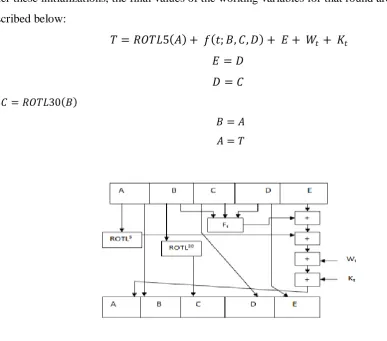
SHA-1 round function
Each round has 5 bit inputs; bit wise logical operations are performed and produces
32-bit output. This is the process for one round operation. The round operation is dependent on
non-linear function Ft. The rotate left shift operation is performed for mixing up input bits in different
positions completely. This operation is repeated 80 times with 20 rounds each.
After these initializations, the final values of the working variables for that round are calculated as
described below:
𝑇 = 𝑅𝑂𝑇𝐿5 𝐴 + 𝑓 𝑡; 𝐵, 𝐶, 𝐷 + 𝐸 + 𝑊𝑡 + 𝐾𝑡 𝐸 = 𝐷
𝐷 = 𝐶 𝐶 = 𝑅𝑂𝑇𝐿30 𝐵
𝐵 = 𝐴 𝐴 = 𝑇
Figure 1. SHA-1 round function
SHA-1 compression function
IJSRR, 7(4) Oct. – Dec., 2018 Page 2689 designed with different logic functions.
Figure 2. SHA-1 compression function
After the processing of compression function, the output of eightieth round is added to the
initial hash value through modulo addition which produces the 160-bit output. 𝐻0 ← 𝐻0 + 𝐴
𝐻1 ← 𝐻1 + 𝐵 𝐻2 ← 𝐻2 + 𝐶 𝐻3 ← 𝐻3 + 𝐷 𝐻4 ← 𝐻4 + 𝐸
RESULT
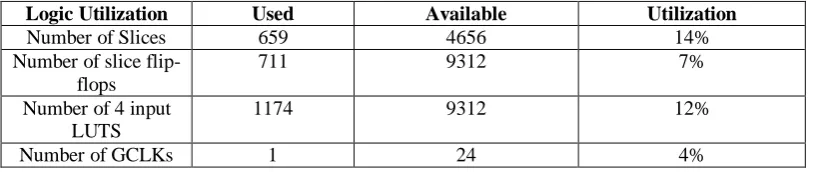
Synthesis report of Spartan-3E xc3s500e-4fg320 device specifies logic utilization of slices,
slice flip flops, LUTs, and GClKs.
Table 1. Device Utilization Summary of Spartan-3E
Simulation results are also specified. The throughput of the design is calculated using the
following notation:
Throughput = (Message block size * Clock frequency) / Clock cycles per block
Throughput of implemented design = 535.82 Mbps
Throughput per slices (TPS) = Throughput / Slices = 0.813Mbps / slice
Logic Utilization Used Available Utilization
Number of Slices 659 4656 14%
Number of slice flip-flops
711 9312 7%
Number of 4 input LUTS
1174 9312 12%
IJSRR, 7(4) Oct. – Dec., 2018 Page 2690
Table 2. Timing Report
Timing report Values obtained
Minimum Period 11.653 ns
Minimum input arrival time before clock 4.698 ns
Maximum output required time after clock 8.773 ns
Maximum combinational path delay 9.274 ns
Maximum Frequency 85.815MHz
The frequency and delay results after synthesis using Spartan-3E are shown in the table 2.
Figure 3. RTL Schematic
The RTL schematic of the design is shown in the figure 3, based on the input context output
context is generated. For any given message input the output generated is not identical. It generates a
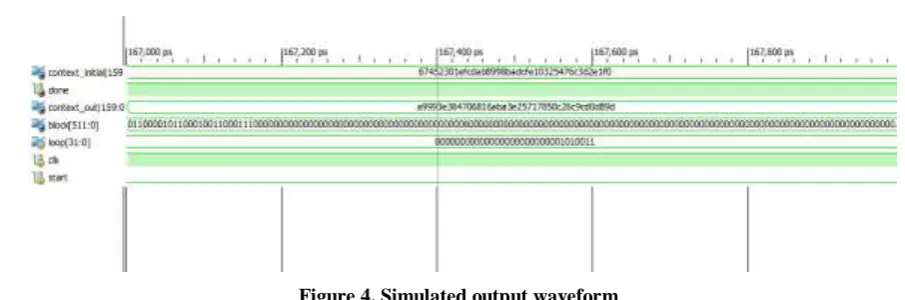
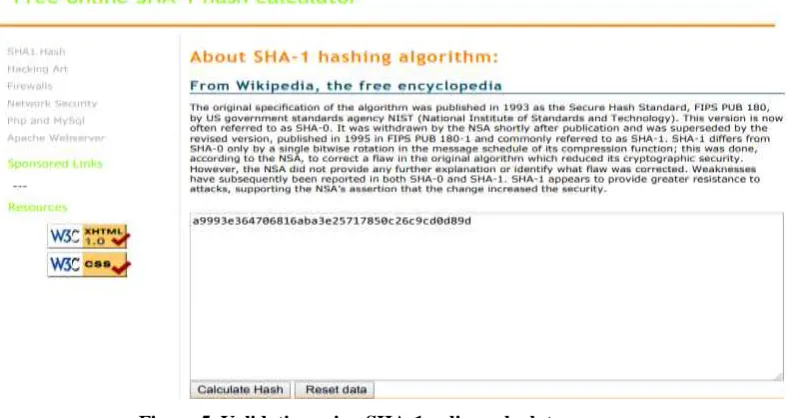
unique message digest. The simulated output shows the hash result which is exactly of SHA-1 online
hash calculator.
Figure 4. Simulated output waveform
For the given input message “abc”, generated an output of 40-digits value represented in
hexadecimal format which are located in H0, H1, H2, H3, and H4 buffers. The resulted hash output
is combined form of H0-H4 to produce 160-bits fixed length as shown in figure 4. The resulted
IJSRR, 7(4) Oct. – Dec., 2018 Page 2691 Figure 5. Validation using SHA-1 online calculator
For example, for a change in single character in the input message generates a completely different hash value. Instead of “abc” if “abe” is given as input text it is observed that different
message digest obtained.
Table 3. SHA-1 Output
Test Strings SHA-1
da39a3ee5e6b4b0d3255bfef95601890afd80709
abe c9a2a5540dcfc3ebad99e723223675d3f15edc54
message digest c12252ceda8be8994d5fa0290a47231c1d16aae3
abcdefghijklmnopqrstuvwxyzABCDEFGHIJKLM NOPQRSTUVWXYZ012
ed8b55273b7180b9a64b763ffd802939834d6d6c
The design is functionally tested and synthesized using Xilinx ISE Design tool 14.7. Overall
architecture is coded in Verilog HDL and test input is applied in test bench. When the output digest
is same with the online hash calculator value, the input message is known to be authenticated.
Considering the large input message is considered say 55 characters of the string. Although the input
message is large it generates fixed length 40 digit (160-bit) output.
The output is verified using online SHA-1 generator. The input is entered in online generator and selects the option “calculate hash”, hash value is generated that is exactly same hexadecimal
string generated using Xilinx ISE simulation.
By these observations it is said that irrespective of the input message using hash algorithm,
IJSRR, 7(4) Oct. – Dec., 2018 Page 2692
CONCLUSION
In this paper, the Secure Hash Algorithm-1 is implemented with high throughput of 535.82
Mbps. The same is simulated and synthesized in Xilinx ISE design tool using Spartan-3E. The
design summary specifies the optimized use of slices and slice flip flops, which achieves high speed
design with maximum frequency of 85.815MHz. Verilog code is written for the algorithm which
produces a fixed length output for any variable length input message. The implemented output is
validated using online SHA-1 hash calculator available in the internet which offers the hash values
for all the given inputs. The algorithm in this paper is designed for serial interfacing provides great
flexibility. Compared to previous implementations the proposed architecture occupies less area and
high speed. The hash algorithm in this paper can be used for verifying data and file integrity,
protecting passwords, IP information, FPGA bit stream encryption, and various applications.
FUTURE SCOPE
In the present work, the implementation of the SHA-1 algorithm is used to achieve an
optimized and high throughput by minimizing the delay. Presently the design is functionally tested
and synthesized using Spartan-3E FPGA board. There is a scope to reduce the number of bonded
IOBs, reduce the logic utilization further to increase the speed of the circuit. This can be further
modified to implement in any of the Xilinx FPGA devices. This algorithm can be implemented in
MATLAB software using HDL coder further achieving high throughput.
REFERENCES:
1. Ankit Anand and Pushkar Praveen, “Implementation of SHA on FPGA”, Int. J. Comput. Sci
(IJCSE)., E-ISSN: 2347- 2963, 2015; 3(5).
2. https://en.wikipedia.org/wiki/SHA-1.
3. Stallings, W. Cryptography and Network Security, 4/E. Pearson Education India.2006
4. A. P. Kakarountas, H. Michail, A. Milidonis, C. E. Goutis, and G. Theodoridis, “High-speed FPGA implementation of secure hash algorithm for IPSec and VPN applications,” J.
Supercomput., 2006; 37(2): 179–195,
5. Parelkar, M. M. FPGA security–bitstream authentication. Presentation Slides, available at