ISSN: 2306-9007 Alsamydai & Yousif (2018) 542
I
www.irmbrjournal.com June 2018I
nternationalR
eview ofM
anagement andB
usinessR
esearchVol. 7 Issue.2
R
M
B
R
The Impact of Advertising Campaigns on the Selection of
Candidates for Election
MAHMOOD JASIM ALSAMYDAI
The Faculty of Business, Al-Zaytoonah University, P.O box-130. Amman, Jordan.
E-mail: [email protected]
Tel: 0096265862982
RUDAINA OTHMAN YOUSIF
Department of marketing, Faculty of economic and administrative science, Al-Zarqa University of Jordan, Zarqa, Jordan,
E-mail: [email protected],
Tel: 962-6-586-2982
Abstract
The objective of this study is to identify the impact of advertising campaigns on the selection of candidate for election. An analytical descriptive style was used to achieve this goal. A questionnaire was designed as a tool to collect data. There were (32) questions in the questionnaire. The returned were (568) valid copies of the questionnaire, for a response rate of 87.38 %. The sample is derived from the population. A proper sample of (650) voters received the questionnaire. The study results indicate impact existence for advertisement campaigns on voters' elections for the electoral candidate. The study found that is advertisement campaigns through Television came in the first degree in impact on electing electoral candidate, with an average (4.470) which is greater than the average of the measurement unit (3) and the value of test-t (62.055) which is greater than the tabular value (1.96), and the value of Sig. is (0.0) which is less than (0.05). This indicates that there is an impact of advertising campaigns through Television on the choice of the electoral candidate.
Keywords: Advertising Campaigns, Candidate, Election, Television, Facebook.
Introduction
Political advertisements enable candidates to transfer, deliver and explain their thoughts and electoral
programs to the public through available communication media (Bon et al. 2012). Commercial
advertisements are considered an indirect and impersonal activity that aims to make the targeted population aware of the subject of the advertised issue and convince them to choose it (Shah 2016).
From another point of view, political advertisements target to define, inform and tell electors (voters) about electoral candidates and work to urge and convince them to election electoral candidate by concentrating on presenting candidates’ positive characteristics and advantages compared with other candidates, and explain their electoral programs (Van Steenburg, 2015).
ISSN: 2306-9007 Alsamydai & Yousif (2018) 543
I
www.irmbrjournal.com June 2018I
nternationalR
eview ofM
anagement andB
usinessR
esearchVol. 7 Issue.2
R
M
B
R
broadcasted by opposing candidates in order to carry out an appropriate election and that they must take responsibility for their election and be wary, cautious and note the guardianship nature of the election process. This is primarily because there are potential risks and threats when the wrong election result is obtained, and there can be dangerous consequences with respect to social, political and economic aspects (Al Sari and Al Aloosi 2013).
Political advertisements on Television have become the foremost means of communication by parties to persuade ambivalent voters, and to ensure that they turn up and vote for their side on Election Day. A significant turnover or unexpected shift in votes on election day ultimately ensures the success of advertising (Mamood 2000).
Those who work in advertising focus on designing advertising messages and selecting appropriate methods to reach targeted voters. In fact, advertisement campaigns for electoral candidates are organized processes that aim to impact decision-making, including electing the candidate. This process includes a series of advertisement campaigns through available communication methods or media such asocial media, short messages, newspapers, Television, radio circulation and broadcasting, printed advertising and public seminars (Yousif & ALSamydai 2012).
All these activities are processed to circulate and spread information about the candidate concerning their educational qualifications, past experiences and electoral program, in order to form a positive mental image about the electoral candidate among voters in order to motivate the voters to vote for them (ALsamydai et al. 2012).
Advertisement campaigns for electoral candidates aim to distinguish electoral candidates and work to show their good characters and explain their electoral program on a very wide range of issues, in order to gain support of those who agree with the candidate and their electoral program. Such campaigns also aim to create a good impression and urge the electorate to choose a particular candidate by spreading materials in
available media and arranging seminars and festival galas (Alsamydai & Al Khasawneh 2013).
Crispus (2015) noted that extensive use of mass media as an effective communication tool is evident during political campaigns worldwide. It stands out as a political mobilization medium in many countries. Its coverage, diversity and change within the social context have made mass media social mobilization tool. Television, radio, newspapers, and posters are among different forms of mass media used for political mobilization during elections.
Kotler and Armstrong (2013) indicated that marketing is highly suitable in this context because marketing commodities, services, individuals, organizations, places and others is highly effective. Thus, politicians rely on marketers' skills in marketing themselves through advertisement campaigns and by determining people’s needs, personal characters and the electoral program that meets those needs and promotes the candidate as well.
ISSN: 2306-9007 Alsamydai & Yousif (2018) 544
I
www.irmbrjournal.com June 2018I
nternationalR
eview ofM
anagement andB
usinessR
esearchVol. 7 Issue.2
R
M
B
R
Study Questions
The supervisors for the electoral campaigns of candidates concentrate on advertisement campaigns for influencing voters' decisions to choose electoral candidates; while these messages will reach the greatest possible number of voters, will those campaigns affect voters’ decisions to choose an electoral candidate? This study concentration to determine the impact of advertisement campaigns on electing electoral candidates. Such messages will most likely reach the maximum possible number of voters, but do such campaigns affect the choice of electoral candidates? The following sub-questions will attempt to answer this larger question:
What is the impact of electoral candidate Television advertising messages on voter decisions? Is there an impact of short messages, sent by electoral candidates, on voter election decisions?
Is there an impact of advertising messages, sent by electoral candidates through radio, on voter election decisions?
Is there any impact of electoral candidate street advertising on voter election decisions? Is there any impact of public seminars on voter election decisions?
What is the impact of Facebook on voter election decisions?
Objectives
The objectives of this study concern the determination of the impact of advertisement campaigns on election of electoral candidates, which was done by the following:
Determine the impact of electoral candidate Television advertisement messages on voter decisions. Determine the impact of electoral candidate short messages on voter decisions.
Determine the impact of electoral candidate advertisement messages, sent via radio, on voter decisions. Determine the impact of electoral candidate street advertising on voter decisions.
Determine the impact of advertisement campaigns, via electoral candidate public seminars, on voter decisions.
Determine the impact of electoral candidate advertisement campaigns, done via Facebook, on voter decisions.
Hypotheses
Based on the objectives and study questions, the main hypothesis of this study is that:
HO: There is no statistical significance (α ≤ 0.05) of the impact of advertisement campaigns on voter decisions for electing electoral candidates.
From the main hypothesis, we derive the following sub-hypotheses:
H1: There is no statistical significance (α ≤ 0.05) of the impact of electoral candidate advertisement campaigns, done through Television, on voter decisions.
H2: There is no statistical significance (α ≤ 0.05) of the impact of electoral candidate advertisement campaigns, done via short messages, on voter decisions.
H3: There is no statistical significance (α ≤ 0.05) of the impact of electoral candidate advertisement campaigns, done through radio, on voter decisions.
H4: There is no statistical significance (α ≤ 0.05) of the impact of electoral candidate advertisement campaigns, done through street advertising, on voter decisions.
ISSN: 2306-9007 Alsamydai & Yousif (2018) 545
I
www.irmbrjournal.com June 2018I
nternationalR
eview ofM
anagement andB
usinessR
esearchVol. 7 Issue.2
R
M
B
R
H6: There is no statistical significance (α ≤ 0.05) of the impact of electoral candidate advertisement campaigns, done via Facebook, on voter decisions.
Model
The following diagram (Figure 1) models the study problem, objectives and hypotheses, with reference to Alsamydai & Al Khasawneh (2013), Abdur-Rahman (2016), and Batta & Mboho (2015).
Figure 1: Study model the In-depended and depended factors
Literature Review
The process of choosing electoral candidates via methods involving publishing and broadcasting candidate information to impact voter decisions has been a primary focus of many studies, such as (Chudi Okwechim 2015), who focused on news paper advertisements’ role in the presidential elections in Nigeria in 2007. The author noted that news paper advertisements provided convincing information about candidates and enabled voters to know the candidates, thus facilitating the process of electing candidates. (Manasvi Maheshwari and Vineet Dahiya 2014) stated that advertisement campaigns launched by large corporations during India’s elections aimed at encouraging the electorate to vote. The advertisement campaigns succeeded in increasing the percentage of participants in the election from 48% to 66%, which was a record high outcome. Thus, advertisement campaigns positively impact electorates and drive them to vote. (Alsamydai & Al kasawneh 2013) determined the impact of personal characters, political background, credibility, communications, used communication media by candidates and campaign administration on the election of three electoral candidates. Their study showed that the ability of candidates to manage dialogue had the most effect on election decisions. Voter trust regarding promises made by the candidate and voter trust regarding the party the candidate belonged to were the next most influential factors affecting voter decisions. (Mohamed 2013) focused on candidate advertisement strategies and their effects on electing electoral candidates. The authors concluded that the team producing advertisement strategies did not focus sufficiently on the elector, with many other factors also being found to affect the success of these strategies. As a result of a tendency to not focus enough on electors, political parties and advertisers have not recognized the effective factors for strategy success prior to designing campaigns, and before developing advertisement campaigns. Thus, advertising messages are often not effective in persuading voters.
Yousif & ALsamydai (2012) determined the impact of Facebook on political promotion, including political promotion messages. They also determined the range of messages impact, through Facebook, on real world, current political events, and the changing political direction of users and political options. The results of the study showed that responders had interest in political subjects and political messages published through Facebook. They also found that Facebook has a significant role in political promotion of messages and in affecting politics in general.
In-depended factors Depended factors
Advertisement campaigns through TV
Advertisement campaigns through short messages
Advertisement campaigns through Radio
Advertisement campaigns through streets' posters
Advertisement campaigns through public seminars
Advertisement campaigns through Facebook
ISSN: 2306-9007 Alsamydai & Yousif (2018) 546
I
www.irmbrjournal.com June 2018I
nternationalR
eview ofM
anagement andB
usinessR
esearchVol. 7 Issue.2
R
M
B
R
Yousif (2012) aimed to identify the attention of Facebook users to published advertising messages on the site, and also attempted to identify the impact of these messages on the desire of users for purchasing, as well as the way that users evaluate Facebook as an advertising media. The study results showed that Facebook users were attentive to advertising messages and that these messages affected purchasing decisions for advertised products.
Al Saud (2011) mentioned that most voters did not have any information about the candidates. The most often-raised reason that pushed people to participate in elections was information from friends, relatives and leader opinions.
Election promotion campaigns through radio were the most effective broadcasting media in Saudi Arabia (Al Oaimri, 2013), but the role of Television and radio was limited in electoral political programs. Nevertheless, there was an important role for interviews and direct calls with voters. (Leo et al. 2013) concluded that Television advertisements convinced voters to prefer announced candidates and led to voters remembering those candidates, while also generating voter satisfaction and ultimate election of electoral candidates.
Brader (2005); Valentino et al. (2004): and Ansolaehere & Iyengar (1995) all noted that voters rush towards promotion campaigns, arranged by communication media and public seminars, as a result of the significant role played by these campaigns in terms of impacting voters to elect electoral candidates. In particular, today many advertising methods are available, and through them electoral candidates can publish and circulate texts, pictures, codes and words, and transmit talks, speeches, and interviews. It is important to bear in mind that by using social media, candidates are more likely to gain support from all individuals and groups that they belong to. Texts, whether written or verbal, are considered only as one part of the entire communication process (Kress 2010).Supporting this view is the fact that promotion campaigns for candidates do not typically depend today on publishing texts but rather on the range that transmitted information reaches. This shows the awareness of the candidates and their capability to understand the target for promotion campaigns.
Sanz (2013) showed that the interpretation of billboards depends on viewers’ access to background beliefs and an assumption forming a context in which new incoming information is processed. This was found to be the case for all billboards analyzed, where a background is needed in order to decode the meanings transmitted.
Forceville (2005) points out that billboard are easier to understand if they are seen during the election campaign period and considering the socio-political circumstances at the time of observation. Promotion campaigns targeting the marketing of electoral candidates are typically conducted for a specific period of time during an election campaign. They must begin prior to elections and before a reasonable and acceptable period in a form that achieves determined objectives to reach targeted voters and influence them to elect candidates, and stops promptly when elections are finished. Generally, the period of starting and finishing promotion campaigns for elections is regulated by the law in the state where elections are conducted. In some countries, promotion campaigns may last for several months, while in other countries they may be for a short period. There are countries that allow free hypocrisy upon promotion campaigns and others forbid it because they fear that the rich may take advantage of such campaigns.
ISSN: 2306-9007 Alsamydai & Yousif (2018) 547
I
www.irmbrjournal.com June 2018I
nternationalR
eview ofM
anagement andB
usinessR
esearchVol. 7 Issue.2
R
M
B
R
Candidates spend significant amounts of money to run their promotion campaigns. Of course, not all campaigns succeed, partly because not all are success filing reaching the voters. This may be due to many reasons, such as designing and running promotion campaigns in an ineffective manner, designing advertising messages that do not provide voters with information they wish to gain, or that the candidate did not determine their electoral program in a form that satisfies voters' emotions.
A successful advertisement is one that reaches the mind of voters and generates awareness in them about the important role that the electoral candidate will play to achieve voters' emotions (Cho 2015). At the same time, the success of promotion campaigns for electoral candidates depends on the availability of many factors, such as the personality and characters of candidates, political background, candidate credibility, communication types and communication media used by candidates in order to administrate their campaigns, which affects voter decisions (Alsamydai & Al kasawneh 2013).
Alsamydai (1997) notes that adapting the political product (the candidate) to the public depends on creating a positive image about them to put the candidate in harmony and consistency with the public. This important mission is one of the major responsibilities of operations administration in the field of electoral marketing; such marketing also includes campaign administration, collecting money, advertising, public relations, arranging public seminars, political marketing research to obtain specific information for planning, and organizing and implementation of promotion campaigns for the candidate. It is important to note that the main activities for political consultants aim to improve candidates’ image and build a positive mental image in the mind of the voters (Alsamydai, 2000).
The relation between politics and advertisements has led to the appearance of new ideas and strategies that aim to promote political parties and their electoral candidates, working to market them successfully as one package. Political advertisements aim to convince voters to accept candidates’ ideas with respect to their electoral program and the party they belong to (Yamamoto et al, 2015; Goodman, 2014; Jacobson et al, 2015; Eldin 2016).
With the use of radio, candidates can present their advertisement campaigns. There are no other communication media available for political advertisement in Nigeria. Political advertisements are still a significant tool for achieving victory in Nigerian elections. Politicians and political parties have to concentrate on publishing trusted messages for voters and take into consideration other factors affecting voter decisions such as family, friends and party members (Ngugi & Kinyua 2014).
The public and political media have typically depended on classical methods to communicate with people such as newspapers, magazines, radio and Television. However, since the appearance of social media, mobile phones, short messages, internet advertising and web sites for companies, parties and candidates have pushed sponsors of political promotion campaigns to use these methods preferentially.
Arulchelvan (2014) states that every major party in India has used all available electronic communication media, giving the capability to reach the maximum number of voters, and contributing to the success of their electoral campaign. Mobile phones, the Internet and Television have all played a significant role in candidates’success.
Freedman et al. (2004) state that there is a great deal of evidence that campaigns mobilize voters and disseminate information that allows voters to make “enlightened” choices. Many other authors are in accordance with this view (Campbell 2008; Finkel 1993; Gelman & King 1993; Holbrook et al 2001; Wlezien & Erikson 2002).
ISSN: 2306-9007 Alsamydai & Yousif (2018) 548
I
www.irmbrjournal.com June 2018I
nternationalR
eview ofM
anagement andB
usinessR
esearchVol. 7 Issue.2
R
M
B
R
message will be received, understood and explain its contents in a way that urges the receiver to accept the published information and be affected by it (Hovland 1953; Price & Zaller 1993).
Krasno & Green (2008) focused on evaluating Television advertising’s impact on electoral participation. The analysis of voting averages in media markets indicates that advertising volume bought by presidential campaigns, during the last weeks of the year 2000, was of insignificant impact on voter participation. According to classifications of presidential advertisements, whether information is positive or negative, no evidence was found to indicate that aggressive advertisements increase or decrease participation.
Importance
The election process is a major component of the democratic system, and competitive democratic elections can only be run within democratic regimes. It is a major principle of democracy and is not a target or objective by itself. Elections are considered a basic cornerstone in the building of a democratic system. Elections allow all individuals, who applied conditions of participation in elections, to vote for the electoral candidate who they believe will meet the targets they wish to achieve, and by their winning will play a significant role in developing the political process. Due to the increasing interest that people show in this vital issue, along with the involved parties in government and senate, the numbers of electoral candidates are also increasing, which has required from candidates to resort to advertisement campaigns to convey and deliver their ideas, electoral programs, arrange public seminars, and use social media to affect voter decisions.
Methodology
Tools
Two main resources were used to gather information for this study; they are presented below:
Secondary resources
These include data and information related to the abstract side, such as research, articles, books, scientific magazines, and foreign and Arabic theses related to the subject of the study.
Primary Resources
The primary resource was the study tool (questionnaire) and the data provided to the researcher from the research sample. The opinions of many specialists in the field, such as researchers, scholars, authors and university professors have been considered in finalizing the questionnaire and explaining its relation to the subject.
A five-point Likert scale was used for questionnaire answers: (5) strongly approve, (4) approve, (3) neutral, (2) do not approve, and (1) strongly do not approve.
Study Sample
A sample of (650) voters received the questionnaire. The returned were (568) valid copies of the questionnaire, for a response rate of 87.38%.
Validity and stability of the study tool
ISSN: 2306-9007 Alsamydai & Yousif (2018) 549
I
www.irmbrjournal.com June 2018I
nternationalR
eview ofM
anagement andB
usinessR
esearchVol. 7 Issue.2
R
M
B
R
The questionnaire, in its initial form, was presented by the researcher to a group of specialized university professors of the academic staff and marketing section to obtain the benefits of their scientific knowledge and experience and to take into consideration their notes, comments and modifications to make the tool more accurate.
Variance Inflation Factors (VIF)
These are used to investigate whether there is any multi-linear interaction problem between independent variables (advertisement campaigns through Television, street posters, radio, short advertising messages, public seminars, and Facebook) or not.
Table 1: Variance inflation factors
Study Variables Tolerance VIF Critical value
Advertisement campaigns through TV 0.568 1.760 5
Advertisement campaigns through short messages 0.869 1.247 5 Advertisement campaigns through Radio 0.725 1.380 5
Advertisement campaigns through streets' posters 0.802 1.151 5
Advertisement campaigns through public seminars 0.831 1.204 5 Advertisement campaigns through Facebook 0.845 1.183 5
From results found from Table 1, it is clear that there are no multi-linear interaction problems between independent variables, because all values for VIF are less than the critical value.
Natural Distribution Attribute Test
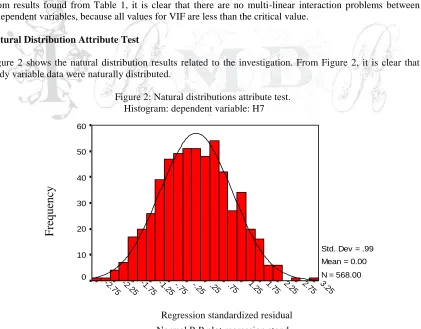
Figure 2 shows the natural distribution results related to the investigation. From Figure 2, it is clear that study variable data were naturally distributed.
Figure 2: Natural distributions attribute test. Histogram: dependent variable: H7
F
re
que
nc
y
Regression Standardized Residual
3.25
2.75
2.25
1.75
1.25
.75 .25
-.25
-.75
-1 .25 -1
.75 -2
.25 -2
.75
Histogram
Dependent Variable: H7
F
re
q
u
e
n
cy
60
50
40
30
20
10
0
Std. Dev = .99
Mean = 0.00
N = 568.00
Regression standardized residual
ISSN: 2306-9007 Alsamydai & Yousif (2018) 550
I
www.irmbrjournal.com June 2018I
nternationalR
eview ofM
anagement andB
usinessR
esearchVol. 7 Issue.2
R
M
B
R
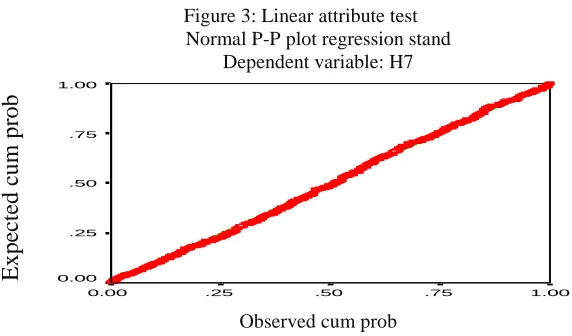
Figure 3: Linear attribute test Normal P-P plot regression stand
Dependent variable: H7
Expe
cted c
um p
rob
Normal P-P Plot of Regression Standardized Residual
Dependent Variable: H7
Observed Cum Prob
1.00 .75
.50 .25
0.00
Exp
ect
ed
Cu
m
Pro
b
1.00
.75
.50
.25
0.00
Observed cum prob
Figure 3illustratesthe results of the linear attribute test. Thus, it is clear that study variables were linear, and that therefore it is possible to test the study hypotheses.
Stability ofthe Study Tool
Cronbach's alpha test was used to measure the stability of the measurement tool (T).The (α) value reached (0.755) for the entire questionnaire. This is a good result, since it is higher than the accepted value (0.70).
The statistical treatment used in the study
The researcher relied on a number of statistical tests (Cronbach's alpha factor; Pearson correlation coefficient and multiple regression analysis) to support the study objectives and hypotheses using the (SPSS) program. A significance level of (0.05) was used throughout the study.
Results
Table 2 illustrates that Television advertisement campaigns were the most influential in terms of impacting electoral candidate success with an average (4.4701), which is greater than the average of the measurement unit (3), and the value of t-test (62.055), which is greater than the tabular value (1.96), with the p value being (<0.0001), which is less than (α=0.05).This indicates that there is an impact of advertising campaigns through Television on the choice of the electoral candidate.
Table 2: Impact of advertisement campaigns on electing electoral candidate.
Study Axis (Variables) t Mean Std. Deviation Sig
Impact of advertisement campaigns, through Television, on
electing electoral candidate 62.055 4.470 0.565 0.0
Impact of advertisement campaigns, through short
messages, on electing electoral candidate 8.507 3.261 0.730 0.0 Impact of advertisement campaigns, through Radio, on
electing electoral candidate 16.906 3.452 0.637 0.0
Impact of advertisement campaigns, through streets' posters,
on electing electoral candidate -8.374 2.716 0.807 0.0
Impact of advertisement campaigns, through public
seminars, on electing electoral candidate 46.969 4.023 0.520 0.0 Impact of advertisement campaigns, through Facebook, on
ISSN: 2306-9007 Alsamydai & Yousif (2018) 551
I
www.irmbrjournal.com June 2018I
nternationalR
eview ofM
anagement andB
usinessR
esearchVol. 7 Issue.2
R
M
B
R
It also shows that there is no impact for advertisement campaigns, through street posters, on electing electoral candidates, where the average is less than (3) and the value of the t-test is negative (-8.374).
Analysis of multiple regressions
The validity of the form of linear multiple regression is clear from Table2. The calculated value (F) (99.393), was greater than the table value (2.35), with the significance being acceptable to the alternative one. This indicates that all advertising activities, combined together, have an impact on electing electoral candidates.
a-Predictors: (Constant), H6, H2, H5, H4, H3, H1
b-Dependent Variable: H7
Table 3: Variations analysis table for linear multiple regression to check validity of the form of linear multiple regression
Std. Error of the Estimate
Adjusted R Square
R
Square R F df sig
0.42724 0.510 0.515 0.718 99.369
6 561 567
0.000(a)
Simple Linear Regression to Test Study Hypotheses
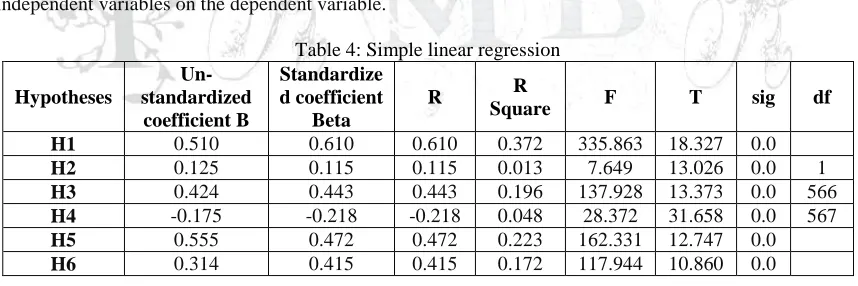
From Table 4, we find that the values of calculated F, for all dependent variables are greater than the tabular table that equals (3.9201), and the p value is (<0.0001) which is less than (0.05), and the value of F, for all independent variables is greater than (1.96); this indicates the existence of an impact for all independent variables on the dependent variable.
Table 4: Simple linear regression
Hypotheses
Un-standardized coefficient B
Standardize d coefficient
Beta
R R
Square F T sig df
H1 0.510 0.610 0.610 0.372 335.863 18.327 0.0
H2 0.125 0.115 0.115 0.013 7.649 13.026 0.0 1
H3 0.424 0.443 0.443 0.196 137.928 13.373 0.0 566 H4 -0.175 -0.218 -0.218 0.048 28.372 31.658 0.0 567 H5 0.555 0.472 0.472 0.223 162.331 12.747 0.0 H6 0.314 0.415 0.415 0.172 117.944 10.860 0.0
Stepwise
The results of Table5 indicate the approval of the statistical function for regression coefficients (B) for five variables. This indicates that there is statistical leading on associate level (0.05) for the five axes. This is suggested by the values of (t), where they are greater than (1.96) for five variables, and the associate level (0.0) for the five variables. The fourth variable, regarding the effect of advertisement campaigns, through street posters, on electing electoral candidateses, was excluded due to its weak impact.
ISSN: 2306-9007 Alsamydai & Yousif (2018) 552
I
www.irmbrjournal.com June 2018I
nternationalR
eview ofM
anagement andB
usinessR
esearchVol. 7 Issue.2
R
M
B
R
Table 5: analyze stepwise
Discussion
The study results indicate impact existence for advertisement campaigns on voters' elections for the electoral candidate. It agrees with the study of (Manasvi et al, 2014) that pointed to the success of advertisement campaigns in increasing participant numbers in elections. The study also coincides with the work of (Bader 2005; Valentino et al, 2004; and Ansolabehere & Iyengar 1995), which all indicated that rushing of candidates towards promotion campaigns, via information media and public seminars, is as a result of the significant role that these campaigns play in impacting voters and pushing them to elect electoral candidates.
The study noted that public seminars positively impacted voter decisions, which is compatible with
(Alsamydai & Alkaswneh 2013), who concluded that candidate capability to manage dialogue impacted their ability to become elected.
This study also agrees with (Al Saud 2011), who pointed out that there is an impact of advertisement campaigns, through radio, on encouraging voters to participate in elections. The reason behind that is that radio provides all information about the candidate and may be repeated often.
This study’s results, however, differ from those of (Al Aoumre (2013), who found a weak effect for advertisement campaigns, via Television and radio, on voters, but did agree that there is an effect of direct meeting or interviews of candidates with voters. This study also agrees with (Yousif 2012), who pointed to the effect of messages through Facebook on its users.
This study’s results and conclusions show that Television advertisement campaigns had the most impact on electoral candidates’ election, with street posters having the least impact. The latter method was excluded due to the use of stepwise (gradual) regression, which implies the acceptance of the null hypothesis, and which indicates that there is no impact for advertisement campaigns.
The questionnaire results show the impact of Television advertisement campaigns. The question: "advertisement campaigns transmitted by electoral candidate through Television have a significant role in explaining electoral program of the candidate" led to a result of (2.7130) which is less than the average of the standard unit (3), meaning that sample individual evaluations for the impact of this question was weak. Regarding advertisement campaigns in the streets via pictures and posters, the question: "Do you find pictures published on the streets impact decision of electing the candidate", gained an average of (2.7817) which is less than the average of the standard unit (3), indicating that sample individuals’ evaluation for the impact of this question was also weak.
Regarding the use of radio, the question: "Do you find advertisement campaigns through radio, is true (honest)", led to an average of (2.676) which is less than the standard unit average (3); thus, sample individuals’ evaluation for the impact of this paragraph is weak. The question concerning the impact of advertisement campaigns via Facebook: "Do you trust all information about the electoral candidate that are published on Facebook?"Gained an average less than (3), which indicates that sample individuals’ evaluation for the impact of this paragraph is also weak.
H B Beta F t sig
H1 0.510 0.610 333.863 18.327 0.0
H1,H5 0.328 0.279 220.737 8.164 0.0
H1, H5, H6 0.154 0.204 169.464 6.165 0.0
H1, H5, H6, H3 0.184 0.191 143.199 5.861 0.0
ISSN: 2306-9007 Alsamydai & Yousif (2018) 553
I
www.irmbrjournal.com June 2018I
nternationalR
eview ofM
anagement andB
usinessR
esearchVol. 7 Issue.2
R
M
B
R
The advertisement campaigns were shown in this study to have impacted electoral candidate elections. However, it can be further stated that candidates should show more interest in street advertisements by publishing pictures, signboards and posters, and they should find the weak points in it because sample individuals found that published information does not provide suitable candidate backgrounds, with issues such as the use of highly dated personal photos being one area that should be addressed.
Acknowledgements
We have to express our appreciation to Ali Mahmoud Jasim, Humam Mahmoud and Manar Al-Samraii for them comments on an earlier version of the manuscript.
Reference
Abdur-Rahman Olalekan Olayiwola (2016). Political Communication in the 2015 General Elections in
Nigeria: The Oyo State Experience- “The Wild, Wild West. Journal of Mass Communication &
Journalism. 6:5 .pp1-8.
Arulchelvan, S. (2014). New media communication strategies for election campaigns: Experiences of
Indian political parties. Online Journal of Communication and Media Technologies, 4(3), 124.
Alsamydai, M. J., & Al Khasawneh, M. H. (2013). Basic Criteria for the Success of the Electoral Candidates and their Influence on Voters' Selection Decision. Advances in Management and Applied Economics, 3(3), 105
Al-Sari Abdul-Karim Fahd and Al-Aloosi Fouad (2013). For Political and Political Marketing and
Marketing (first Edition). Osama Publishing House, Amman, Jordan, p.13.
Al-Omairi Walid Abdel Hadi (2013). The Role of Jordanian Radio and Television in Political Development (An Analytical Study). Jordanian Journal of Social Sciences. 1 (6).
ALsamydai, M. J., Yousif, R. O., & Al-Qirem, I. A. (2012). Measuring individual attitude towards
arabic-speaking Television channels and the impact of these channels on current events. International Journal
of Business and Management, 8(1), 73.
Al-Saud, Saad bin Saud Ali (2011). Political and popular participation and selection of candidates: A
survey of a sample of the electorate in the municipal council elections in Riyadh. Arabian Journal of
Media and Communication. 7 PP.10-50.
Ansolabehere, S., & Iyengar, S. (1997). Going negative: How political advertisements shrink and polarize
the electorate. The Free Press,
ALsamydai, Mahmod. Jasim (1997). Entrance in political marketing. Journal of Management and
Economics, 20 (2).75-84.
Ansolabehere, S., & Iyengar, S. (1995). Going negative: How attack ads shrink and polarize the electorate. Free PressSimon & Schuster. 9781439118757. Vol. 8.
Batta, N. M., Batta, H., & Mboho, M. (2015). Political advertising and electioneering in Nigeria: An
analysis of 2015 general election newspaper advertisements. European Journal of Business and
Management, 7(35), 81-89.
Bond, R. M., Fariss, C. J., Jones, J. J., Kramer, A. D., Marlow, C., Settle, J. E., & Fowler, J. H. (2012). A 61-million-person experiment in social influence and political mobilization. Nature, 489(7415), 295. Brader, T. (2005). Striking a responsive chord: How political ads motivate and persuade voters by
appealing to emotions. American Journal of Political Science, 49(2), 388-405.
Cho, J. (2015). Attack versus advocacy: Advertising tone that mobilizes. International Journal of
Communication, 9, 20.
Chudi Okwechim (2015) Political Advertising in Nigeria’s Emergent Democratic Process: An Overview of the 2007 Presidential Election. Journal on Media & Communications. 2 (2) p38.
Crispus Yankem, (2015). Radio as a tool of political mobilization in kenya during the 2013 general election: a case study of Nairobi county. Master thesis. University of Nairobi.
Campbell, J. E. (2008). The American campaign: US presidential campaigns and the national vote. Texas
ISSN: 2306-9007 Alsamydai & Yousif (2018) 554
I
www.irmbrjournal.com June 2018I
nternationalR
eview ofM
anagement andB
usinessR
esearchVol. 7 Issue.2
R
M
B
R
Eldin, A. K. (2016). Instagram role in influencing youth opinion in 2015 election campaign in Bahrain. European Scientific Journal, ESJ, 12(2).
Edegoh, L. O., Ezebuenyi, E. E., & Asemah, E. S. (2013). Television as a medium of political advertising during elections in Anambra State, Nigeria. Asian Journal of Social Sciences and Humanities, 2(3), 223-231.
Edegoh, L. O., Ezebuenyi, E. E., & Asemah, E. S. (2013). Television as a medium of political advertising during elections in Anambra State, Nigeria. Asian Journal of Social Sciences and Humanities, 2(3), 223-231.
Freedman, P., Franz, M., & Goldstein, K. (2004). Campaign advertising and democratic citizenship. American Journal of Political Science, 48(4), 723-741.
Franz, M. M., & Ridout, T. N. (2007). Does political advertising persuade?. Political Behavior, 29(4), 465-491.
Forceville, C. (2005). Addressing an audience: time, place, and genre in Peter Van Straaten’s calendar
cartoons. International Journal of Humour Research, 18, pp. 247-278.
Finkel, S. E. (1993). Reexamining the" minimal effects" model in recent presidential campaigns. The Journal of Politics, 55(1), 1-21.
Goodman, N. J. (2014). Internet voting in a local election in Canada. In The Internet and Democracy in Global Perspective(pp. 7-24). Springer, Cham.
Gelman, A., & King, G. (1993). Why are American presidential election campaign polls so variable when votes are so predictable?. British Journal of Political Science, 23(4), 409-451.
Holbrook, A. L., Krosnick, J. A., Visser, P. S., Gardner, W. L., & Cacioppo, J. T. (2001). Attitudes toward presidential candidates and political parties: Initial optimism, inertial first impressions, and a focus on flaws. American Journal of Political Science, 930-950.
Hovland, C. I., Janis, I. L., & Kelley, H. H. (1953). Communication and persuasion.* Yale University
Press. New Haven, Conn., 315p.
Jacobson, G. C., & Carson, J. L. (2015). The politics of congressional elections. Rowman & Littlefield. Kotler Philip & Armstrong Gary ( 2013) . Principal of marketing Prentice Hall; 15 edition.
Kress, G. (2010). A social semiotic multimodal approach to human communication: implications for speech, writing and applied linguistics. In Modos y formas de la comunicación humana (pp. 77-92). Servicio de Publicaciones
Krasno, J. S., & Green, D. P. (2008). Do televised presidential ads increase voter turnout? Evidence from a natural experiment. The Journal of Politics, 70(1), 245-261.
Livne, A., Simmons, M. P., Adar, E., & Adamic, L. A. (2011). The Party Is Over Here: Structure and Content in the 2010 Election. ICWSM, 11, 17-21.
Mohamed, N. S. P. (2013). Championing political campaigning towards first-time voters. Jurnal
Komunikasi, Malaysian Journal of Communication, 29(2).
Mahmood Jasim Alsamydai (2000). Political Marketing and Basics Strategies. Dar Zahran for publishing and distribution. P.63.
Mahmood Jasim Alsamydai. (1994). Introduction to Political Marketing. Jurnal of business and admistration University of Al-Mustansiriya, 7(4), 55-69.
Ngugi, P., & Kinyua, C. (2014). „The Concept and Philosophy of Community Radio Station in the Kenyan
Context‟. Journal of Mass Communication Journalism, 5, 233.
Price, V., & Zaller, J. (1993). Who gets the news? Alternative measures of news reception and their implications for research. Public opinion quarterly, 57(2), 133-164.
Shah, S. H. (2016). The Influence of Television Commercials on the Lifestyle of Youngsters. Bangladesh
e-Journal of Sociology, 13(2), 156.
Sanz, M. J. P. (2013). Relevance Theory and political advertising. A case study. The European Journal of
Humour Research, 1(2), 10-23.
Towner, T. L., & Dulio, D. A. (2012). New media and political marketing in the United States: 2012 and beyond. Journal of Political Marketing, 11(1-2), 95-119.
ISSN: 2306-9007 Alsamydai & Yousif (2018) 555
I
www.irmbrjournal.com June 2018I
nternationalR
eview ofM
anagement andB
usinessR
esearchVol. 7 Issue.2
R
M
B
R
Vonderschmitt, K. (2012). The Growing Use of Social Media in Political Campaigns: How to use Facebook, Twitter and YouTube to Create an Effective Social Media Campaign. Online.
Valentino, N. A., Hutchings, V. L., & Williams, D. (2004). The impact of political advertising on
knowledge, Internet information seeking, and candidate preference. Journal of Communication, 54(2),
337-354.
Wlezien, C., & Erikson, R. S. (2002). The timeline of presidential election campaigns. Journal of Politics, 64(4), 969-993.
Yamamoto, M., Kushin, M. J., & Dalisay, F. (2015). Social media and mobiles as political mobilization forces for young adults: Examining the moderating role of online political expression in political participation. New Media & Society, 17(6), 880-898.
Yousif, R. O., & ALsamydai, M. J. (2012). The impact of the political promotion via Facebook on individuals’ political orientations. International Journal of Business and Management, 7(10), 85. Yousif, R. O. (2012). The extent of Facebook users’ interest in the advertising messages. International