Neuropsychiatric Disease and Treatment
Dove
press
C A s e s e r i e s
open access to scientific and medical research
Open Access Full Text Article
Brief assessment of negative dysmorphic signs
Patrizia Fiori1
Antonio Monaco1
Maria Giannetti Luigi2
1Central Operative Unit of Neurology, 2infantile Neuropsychiatry and social
service, AsL AV, Civil Hospital of Ariano irpino, University of Naples, italy
Abstract: Body dysmorphic disorder is a body image dysperception, characterized either by an excessive preoccupation with a presumed or minimal flaw in appearance, or by unrecognition, denial, or even neglect regarding an obvious defect. These features are evaluated by a novel questionnaire, the Brief Assessment of Negative Dysmorphic Signs (BANDS). Moreover, the temperament and character background is examined. The relationship with addictive mentality/ behavior and schizoaffectivity is also highlighted. Lastly, the potential shift toward cognitive impairment and dementia is considered.
Keywords: body dysmorphic disorder, schizoaffectivity, addiction, behavioral-cognitive impairment
Introduction
Body dysmorphic disorder is a complex and multifactorial affliction, the clinical features of which vary from an excessive preoccupation with a presumed or minimal flaw in appearance to lack of recognition, denial, or even neglect of an obvious defect.1
The body image appears fragmented, with the “real body”, “perceived body”, “ideal body”, and “socially accepted body” in conflict. Egodystonic features, obsessive-compulsive reactions,2,3 and delusional aspects1,4 impair quality of life and daily
activities, with short- and long-term consequences, worsened by cultural and social factors,1 as well as addictive behaviors.5
Aims and methods
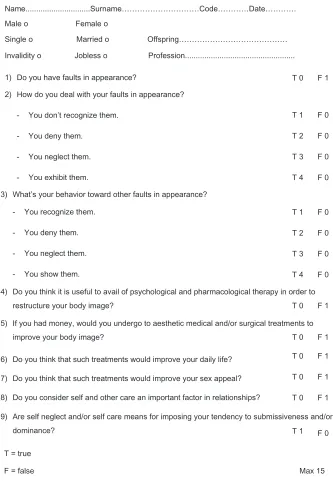
The aim of the present study was directed to identification and scoring of negative psychopathologic features of body dysmorphic disorder. We devised a novel question-naire, ie, the Brief Assessment of Negative Dysmorphic Signs (BANDS, see Figure 1), addressing the presence of faults in own and others’ appearance, the behavioral response toward these faults (lack of recognition, denial, negligence, exhibition), compliance with pharmacologic and aesthetic treatments, their putative success in improving daily life and sex appeal, concern for self-care as an important factor in relationships, and the association of self-care or self-neglect with a tendency to dominance or submissiveness. Moreover, we evaluated early aspects of temperament and character related to the devel-opment of body dysmorphic disorder and its worsening because of addictive mentality and/or behaviors. We referred to “Cloninger’s biosocial theory” and administered the Temperament and Character Inventory (TCI).6,7 We also used the Body Dysmorphic
Dis-order Examination (BDDE),8 the Hamilton Depression Rating Scale (HDRS),9 Michigan
Correspondence: Dr Patrizia Fiori Central Operative Unit of Neurology, AsL AV, Civil Hospital of Ariano irpino, University of Naples, italy
Tel +39 0825-877354 Fax +39 0825-828409 Email [email protected]
Neuropsychiatric Disease and Treatment downloaded from https://www.dovepress.com/ by 118.70.13.36 on 25-Aug-2020
For personal use only.
Number of times this article has been viewed
This article was published in the following Dove Press journal: Neuropsychiatric Disease and Treatment
Dovepress Fiori et al
Alcoholism Screening test (MAST),10 Munich Alcoholism
Test (MAT),11 and Dissociative Disorders Interview Schedule
(DDIS).12
Case 1
A 33-year-old craftswoman, with a precarious job and lonely, came to our observation for cranial trauma, followed by two episodes of loss of consciousness with tonic-clonic move-ments, over a three-day period. She used to drink 0.50–0.75 L of wine with meals and an unspecified quantity of beer during the day. Her physical appearance was neglected (thin, acne)
and with some abnormal features (facial down and a tendency to cyphotic posture). She suffered from episodes of migraine and epigastralgia. Glasgow Coma Scale (GCS) was 15. Neuro-logic examination was normal. TCI showed high self-transcen-dence (29, normal range 15.96 SD 6.14), high harm avoidance (27,18.36 ± 7.01), high persistence (7, 4.54 ± 1.8), low self-directiveness (17, 25.39 ± 7.6), normal novelty seeking (15, 20.58 ± 5.63), reward dependence (16, 16.01 ± 3.35), and cooperativeness (31, 31.43 ± 5). BDDE was 15 and BANDS was 14/15. HDRS score was 22/68 (moderate depression), MAST showed 9/45 positive answers and 2/8 negative answers
Name...Surname………Code…………Date………… Male o Female o
Single o Married o Offspring………
Invalidity o Jobless o Profession...
1) Do you have faults in appearance?
2) How do you deal with your faults in appearance?
- You don’t recognize them.
- You deny them.
- You neglect them.
- You exhibit them.
3) What’s your behavior toward other faults in appearance?
- You recognize them.
- You deny them.
- You neglect them.
- You show them.
4) Do you think it is useful to avail of psychological and pharmacological therapy in order to restructure your body image?
5) If you had money, would you undergo to aesthetic medical and/or surgical treatments to improve your body image?
6) Do you think that such treatments would improve your daily life?
7) Do you think that such treatments would improve your sex appeal?
8) Do you consider self and other care an important factor in relationships?
9) Are self neglect and/or self care means for imposing your tendency to submissiveness and/or dominance?
T = true
F = false
T 0 F 1
T 1 F 0
T 2 F 0
T 3 F 0
T 4 F 0
T 1 F 0
T 2 F 0
T 3 F 0
T 4 F 0
T 0 F 1
T 0 F 1
T 0 F 1
T 0 F 1
T 0 F 1
T 1
Max 15 F 0
Figure 1 Brief assessment of negative dysmorphic signs (BANDs).
Neuropsychiatric Disease and Treatment downloaded from https://www.dovepress.com/ by 118.70.13.36 on 25-Aug-2020
Dovepress Assessment of negative dysmorphic signs
(alcoholism), and MAT score was 24/52 (alcoholism). DDIS revealed a tendency to dissociative experiences (42 positive and 71 negative answers). Blood examination showed changes in mean corpuscular hemoglobin of 33.9 pg, leucocytes 3.2 × 10³, total bilirubin 1.12 mg/dL, direct bilirubin 0.37
mg/dL, aspartate transminase 286 U/L, alanine transaminase 231 U/L, alkaline phosphatase 113 U/L, and gamma-GT 563 U/L. The electroencephalogram (EEG) showed sporadic central and parietotemporal spikes during hyperventilation and photostimulation. Computed tomography and magnetic resonance imaging were negative. The patient was rehydrated and treated with gabapentin 300 mg, one tablet orally twice daily, vitamin B1 (cocarboxylase) 38 mg, B6 (pyridoxine) 200 mg, B12 (hydroxocobalamin) 1000 mg in 2 mL, metadoxine 500 mg, and omeprazole 40 mg.
Case 2
A 38-year-old unemployed bricklayer came under our care for transient left dystonia, followed by right paresthesia and hyposthenia. He reported that he was born by dystocic delivery. He was a current smoker. He suffered from early baldness, severe caries, and psoriasis, and visual acuity was reduced in the right eye as a result of accidental trauma. He was strongly attached to his family and was single. GCS was 15. Hematologic parameters were altered, ie, erythrocytes 6.71 × 10⁶, mean cell volume 65.5 dL, mean corpuscular
hemoglobin 20.9 pg, mean corpuscular hemoglobin con-centration 31.9 g/dL, leucocytes 11.8 × 10³, neutrophils
94.4%, lymphocytes 5%, monocytes 0.5%, eosinophils 0.1%, basophils, 0%, and glycemia 144 mg/dL. At urine examination, density was 1033, glucose 100 mg/dL, and proteins 20 mg/dL, with the presence of calcium oxalate. Sinus bradycardia was recorded on ECG. A nonspecific dys-regulation was also recorded at EEG. Computed tomography of the brain and encephalic magnetic resonance imaging were negative, with cervical magnetic resonance imaging showing a C3–C4 disc bulge. He was treated with betame-thasone 4 mg daily, pentoxiphyllin 400 mg orally, vitamin B1 (cocarboxylase) 38 mg, B6 (pyridoxine) 200 mg, B12 (hydroxocobalamin) 1000 mg in one 2 mL vial daily, and omeprazole 40 mg. Therapy with oral cyclosporine 100 mg, topical calcipotriol, and betamethasone were contin-ued. TCI showed high self-directiveness (36), low harm avoidance (7), and normal reward dependence (18), while scores related to self-transcendence (13), persistence (4), novelty seeking (20), and cooperativeness (27) were at the low limit of normal. BDDE was 11 and BANDS was 12/15.
Case 3
A 44-year-old woman came under our care for schizoaf-fective symptoms. She had married at the age of 16 as a result of pregnancy and had three children. Her husband had died from an unheralded myocardial infarction. Appar-ently, she appeared “full of beans”. She did not care about her physical aspect (hooked and deviated nose, slimness). Mitral insufficiency was detected on clinical examination and confirmed by echocardiography. TCI revealed a tendency to low scores for harm avoidance (17), novelty seeking (17), persistence (4), self-directiveness (23), cooperativeness (24), and reward dependence (11), with a high score for self-transcendence (22). BDDE was 3 and BANDS was 13/15. On DDIS, there were 36 positive and 77 negative answers. She was already being followed up by the regional mental health and social services, to which she was referred back with the suggestion to be more compliant with her existing therapeutic and social program, in order to safeguard herself and her children.
Discussion
The present study confirms our previous observations con-cerning the negative signs of body dysmorphic disorder that are often misdiagnosed, even though they interfere with daily activities and relationships, and can cause or worsen clinical conditions from young adulthood onwards. Social factors, substance abuse disorders (eg, alcoholism)5 and sexual
disturbances further worsen body dysmorphic disorder and quality of life. None of the available scales published assess the negative features of body dysmorphic disorder. The proposed novel scale, BANDS, is a useful tool to evaluate and monitor the course of body dysmorphic disorder and its possible shift toward behavioral-cognitive deterioration.
The psychopathologic process is related to the mode of attachment, and early emotional and cognitive experiences.13,14
The consequent development of abnormal aspects of tem-perament and character may even progress to borderline per-sonality disorder and dissociative experiences.1 The opposite
findings are revealed in unmarried females compared wıth males, with high harm avoidance, high self-transcendence, and low self-directiveness being peculiar to women compared with low harm avoidance, high self-directiveness, and a tendency to low levels of self-transcendence and coopera-tiveness in men.
Self-directiveness is a characteristic reflecting self esteem, discipline, and responsibility, and the capacity for strategic planning and reaching one’s personal goals in a social context. Dysfunction in self-directiveness is linked to
Neuropsychiatric Disease and Treatment downloaded from https://www.dovepress.com/ by 118.70.13.36 on 25-Aug-2020
Dovepress Fiori et al
irresponsibility, apathy, and a tendency to blame others for personal failure. Although negative experiences of rejection account for self-dysregulation,15 it should be considered
that the latter may predispose to them. Often, these negative aspects of personality precede submissiveness, dependency, rumination, and revenge motives. In our unmarried female patient, although high harm avoidance represents a defense mechanism, it may also have been an expression of limited insight. Indeed, addictive behavior was observed, character-ized by avoiding responsiveness, reward, and punishment, and abuse of alcohol as a means to cope with negative feelings. These characteristics were further suppressed by high self-transcendence together with a magical ideation on the future. In this case, high persistence may represent an abnormal perseverative responding, described as “obsessive drive” in substance use disorders.16
Smith et al reported that high harm avoidance, low self-directiveness, high self-transcendence, and poor executive functioning are related to schizophrenia endophenotypes.17 In
the male case, high self-directiveness, low harm avoidance, and a tendency to low self-transcendence and cooperative-ness may be the expression of a narcissistic trait, emotional repression, and internal conflict, which explains the relational closure and chronic activation of stress responses, with consequent somatizations that worsen the psychophysical state. In the third case, negative aspects of personality (low cooperativeness and reward dependence with high self-transcendence) interfered with mental health and social functioning.
In all the cases, body dysmorphic disorder assumed a regressive meaning. As suggested by Phillips et al, treat-ments should be aimed at improving functioning and quality of life in addition to relieving symptoms.18 In this
regard, a cognitive-behavioral approach prompts self-care and assumption of responsibility concerning one’s own life. It stimulates subjects affected by body dysmorphic disorder to rebuild their body image through a strategy that involves three fundamental steps, ie, compliance with therapy, control of risk factors and prevention of diseases and their complications, acceptance of universally shared norms, and behavioral models.
The early diagnosis and care of body image disorders is aimed at offering either short-term or long-term solutions for disorders in youth, which include neuropsychologic support and aesthetic treatment, which is important as an educational tool and as a guide to prevent conduct and behavioral disorders noxious to self and others. The spontaneous human fascination with “synchronicity”19 helps in recovering
behavioral harmony through the experience of interpersonal connectedness.20 According to the “circumplex model of
personality”, all social interactions are distributed along two orthogonal axes, ie, power/dominance and love/affiliation.21
The need to belong, considered to be a fundamental human motivation,22 is risky without consciousness of self and other
feelings and resources, and emotional and social competence, in order to avoid emotional reliance and/or incapacity to discriminate between one’s own and other emotions and sensations23 with loss of self directiveness.
On the other hand, while solitude represent emotional detachment/dissociation and ambivalence, mental and conduct disorders may develop in adolescence and are reported in teen-age pregnancy.24 Moreover, more vocal and prolific tendencies
are markers of a suboptimal reproductive social state25 and
of a pseudodemocracy.26 These factors reverse the meaning
of the individual and social “niche” in defeat and convert the latter into conflict, destabilizing civil society all over the world. In behavioral variants of frontotemporal dementia, a progressive loss of dominance and increased submissive behaviors are described in cases of predominant involvement of the frontal lobe, while cold-heartedness and lack of empathy are described in the temporal lobe.27 Neuropsychologic and
neuroradiologic studies are ongoing to assess whether body dysmorphic disorder represents a dysfunction of the mirror system and is predictive of cognitive diseases.
Disclosure
The authors report no conflict of interest in this work.
References
1. Fiori P, Giannetti LM. Body dysmorphic disorder: A complex and polimorphic affection. Neuropsychiatr Dis Treat. 2009;5:477–481. 2. Janet P. Les Obsessions et la Psychastenie. Parigi: Alcan; 1903. 3. Kraepelin E. Compendium der Psychiatrie. Leipzig: Barth; 1908. 4. Jaspers K. Allgemeine Psychopathologie. Berlin: Springer Verlag;
1959.
5. Grant JE, Menard W, Pagano ME, Fay C, Phillips K. Substance use dis-orders in individuals with body dysmorphic disorder. J Clin Psychiatry. 2005;66:309–405.
6. Cloninger CR. A systematic method for clinical description and clas-sification of personality variants. A proposal. Arch Gen Psychiatry. 1987;44:573–588.
7. Cloninger CR, Svrakic DM, Przybeck TR. A psychobiological model of temperament and character. Arch Gen Psychiatry. 1993;50: 975–990.
8. Rosen JC, Reiter JL. Development of the Body Dysmorphic Disorder Examination. Behav Res Ther. 1996;34;755–766.
9. Hamilton M. A rating scale for depression. J Neurol Neurosurg
Psychiatry. 1960;23:56–62.
10. Selzer ML. The Michigan Alcoholism Screening test: The quest for a new diagnostic instrument. Am J Psychiatry. 1971;127:1653–1658. 11. Feuerlein WF, Ringer CH, Kufner H, Antons K. Diagnose des the
Munich’s test on alcoholism. Munch Med Wschr. 1977;40:1275–1282.
Neuropsychiatric Disease and Treatment downloaded from https://www.dovepress.com/ by 118.70.13.36 on 25-Aug-2020
Neuropsychiatric Disease and Treatment
Publish your work in this journal
Submit your manuscript here: http://www.dovepress.com/neuropsychiatric-disease-and-treatment-journal
Neuropsychiatric Disease and Treatment is an international, peer-reviewed journal of clinical therapeutics and pharmacology focusing on concise rapid reporting of clinical or pre-clinical studies on a range of neuropsychiatric and neurological disorders. This journal is indexed on PubMed Central, the ‘PsycINFO’ database and CAS, and is the official
journal of The International Neuropsychiatric Association (INA). The manuscript management system is completely online and includes a very quick and fair peer-review system, which is all easy to use. Visit http://www.dovepress.com/testimonials.php to read real quotes from published authors.
Dovepress
Dove
press
Assessment of negative dysmorphic signs
12. Ross C, Heber S, Norton G. The Dissociative Disorders Interview Schedule: A structured interview. Dissociation. 1989;2:169–189. 13. Bowlby J. Attachment and Loss. Volume 1. Attachment. London: Hogarth
Press; 1969.
14. Giannetti LM, Nazzaro A, Balsamo M. Tecniche e Strategie
Cognitive-emotional-behavioral techniques and strategies. Agneli F, ed.
Rome; 2001.
15. Smart Richman L, Leary MR. Reactions to discrimination, stigmatiza-tion, ostracism and other forms of interpersonal rejection. Psychol Rev. 2009;116:365–383.
16. Adinoff B. Neurobiologic processes in drug reward and addiction. Harv
Rev Psychiatry. 2004;12:305–320.
17. Smith MJ, Cloninger CR, Harms MP, Csernansky JC. Temperament and character as schizophrenia endophenotypes in non-psychotic siblings.
Schizophr Res. 2008;104:198–205.
18. Phillips KA, Menard W, Fay C, Pagano ME. Psychosocial functioning and quality of life in body dysmorphic disorder. Compr Psychiatry. 2005;46:254–260.
19. Strogatz SH. Sync: The Emerging Science of Spontaneous Order. New York: Hyperion; 2003.
20. Pinel EC, Long AE, Landau MJ, Alexander K, Pyszczynski T. Seeing I to I: A pathway to interpersonal connectedness. J Pers Soc Psychol. 2006;90:243–257.
21. Wiggins JS. Interpersonal Adjectives Scale. Professional Manual. Odessa, FL: Psychological Assessment Resources; 1995.
22. Baumeister RF, Leary MR. The need to belong: Desire for interpersonal attachments as a fundamental human motivation. Psychol Bull. 1995; 117:497–529.
23. Decety J, Moriguchi Y. The empathic brain and its dysfunction in psychiatric populations: implications for intervention across different clinical conditions. BioPsychoSocial Med. 2007;1:1–21.
24. Dwyer JM, Jackson T. Unwanted pregnancy, mental health and abortion: Untangling the evidence. Aust New Zealand Health Policy. 2008;5:1–6.
25. Finer LB, Henshaw S. Disparities in rates of unintended pregnancy in the United States, 1994 and 2001. Perspect Sex Reprod Health. 2006;38: 90–96.
26. Raine TR, Gard JC, Boyer CB, et al. Contraceptive decision-making in sexual relationships: Young men’s experiences, attitudes and values.
Cult Health Sex. 2010;12:373–386.
27. Rankin KP, Kramer JH, Mychack P, Miller BL. Double dissociation of social functioning in fronto-temporal dementia. Neurology. 2003;60: 266–271.
Neuropsychiatric Disease and Treatment downloaded from https://www.dovepress.com/ by 118.70.13.36 on 25-Aug-2020