Space
Station Resistojets
THE COMPATIBILITY
OF DISPERSION-STRENGTHENED
PLATINUM WITH CANDIDATE PROPELLANTS
By
Margaret
V.
Whalen
National Aeronautics and Space Administration, Lewis Research Center, Cleveland, Ohio
Resistojets for space station auxiliary propulsion require both long lqe and multipropellant capability, and platinum dispersion strengthened with yttria and zirconia has been studied f o r possible use as a resistojet material. A series of propellant compatibility tests has been conducted, and the results are presented. Generally, on the basis of mass loss, there were no compatibility problems in any of the environments considered. Microscopy showed that the effect of the propellants on the surface of the platinum varied signijkantly; however material stability, a s measured by grain growth, did not appear to be a major problem.
A resistojet is an electrothermal thrust device which produces thrust by expanding a heated gas through a nozzle. The gas is heated as it flows through the resistojet heat exchanger, the temperature being varied by changing the power input to the heater. The resistojet designed for the space station is shown in Figure I.
To fulfil space station requirements a resisto- jet must be capable of long life and of operating with a variety of different propellants; however, the choice of materials to meet these re- quirements is limited. Therefore, the evalua- tion of potential materials will have a direct application to the development of multipropellant resistojets.
Two major considerations for candidate materials are the life-limiting problem of creep and the compatibility of these materials with potential space station propellants. Creep and grain growth can occur when a material is operated at high temperatures for extended periods of time, and can result in the formation of voids, physical distortions, and an unaccep- table reduction in the stress-rupture perfor- mance of the material.
Platinum and alloy-strengthened platinum were considered for biowaste resistojets during the Manned Orbital Research Laboratory pro-
gramme of the early 1970s ( I -3). Platinum was assumed to be compatible with candidate pro- pellants, and it was chosen for its excellent cor- rosion resistance and particularly for its oxidation resistance (4). Pure platinum, although corrosion resistant, was found to lack adequate high-temperature strength. Alloying platinum with rhodium improved the material strength; however, compatibility problems were encountered because the alloy was not as corrosion resistant as pure platinum.
Platinum-0.6 per cent thoria was also developed during this period as a high- temperature, high-strength material for biowaste resistojets. The compatibility of this material with carbon dioxide was verified, but no other data were available (5). This platinum- thoria alloy is no longer manufactured, but the experience gained during its production was used in developing improved dispersion- strengthened platinum materials. Two types of dispersion-strengthened platinum are currently available: one is strengthened with yttria and the other with zirconia. The addition of stabilis- ing oxides, less than I per cent by weight in
Fig. 1 Electrothermal thrusters are being actively considered a s auxiliary propulsion units on the NASA space station. The propulsive thrust is provided by a heated gas which is expanded through
a nozzle; the temperature and hence the thrust, being varied by changing the power input to an elec- tric resistance heating coil. Since it would be advantageous to use many of the on-board fluids as pro- pellants in these resistojeta-an engineering model of which is shown here-the constructional materials must be compatible with all these fluids under the conditions of use, for at least the design life of the thruster
Fig. 2 Constructional materials have been investigated under the operating conditions of a space station resistojet propulsion system, using a stainless steel or a quartz test cell. The compatibility of grain stabdised platinum with carbon dioxide, hydrogen, ammonia, nitrogen, steam, hydrazine and methane has been evaluated by resistively heating a coil of the metal while it is surrounded by gas
flowing through the cell, the flow rate being controlled by both upstream and downstream valves. Generally temperatures were measured using an optical pyrometer, but for the test in methane a
I
Mass-Loss Results for Dispersion-Strengthened Platinum Platinum-Yttria Carbon dioxide Hydrogen Ammonia Nitrogen Steam HydrazineMethane at 5OOOC
Hydrazine at 8OOOC
HydrogenIb’ Ammonia‘b’
Platinum-Zirconia Mass loss,
per cent
Estimated thruster
life, x 103,h
Mass loss, per cent
0.033 0.049 0.052 0.094 0.089 0.206 0.006 0.010 0.136 0.1 10
300 200 200 106 110 48 1500 970 148 182
0.01 2 0.023 0.050
0.221 0.1 55 0
-
-
- -
la1 All samples tested at 1400°C. except where noted otherwise
Ibl 2000 hour test
temperature strength, the creep resistance and the material stability, as indicated by limited grain growth (6,7).
Preliminary work showed promise for the use of dispersion-strengthened platinum for space station resistojets (8-10). The present report is a summary of the results of a series of com- patibility tests on dispersion-strengthened platinum. The results include 1000 hour com- patibility tests in carbon dioxide, methane, hydrogen, ammonia, nitrogen, steam and decomposed hydrazine; and 2000 hour tests in hydrogen and ammonia. The material evalua- tion included mass-loss measurements, the use of optical and scanning electron microscopy (SEM), grain-growth evaluation, and the use of Auger electron spectroscopy (AES). The mass- loss results were used to estimate thruster life in each propellant, the photomicrographs were us- ed to determine if any material deterioration had occurred and also to examine the materials for evidence of grain growth, while AES was used to examine the materials for contamina- tion by the various propellants.
Experimental Method
Material compatibility tests were conducted in six test cells. The test cells were of two basic configurations, the major difference being the
Estimated thruster
life, x 103.h
800 400 200 45 64 >1500 - - - -
technique used for maintaining cell pressure (9). Differences were the result of safety re- quirements and facility ventilation capabilities. One of the test cells is shown in Figure 2.
With the exception of the samples tested in hydrazine at 140ooC, all samples were coiled platinum-yttria or platinum-zirconia. The samples were coiled from tube with an external diameter of 0.203 cm and a wall thickness of
0.025 cm, a length of about 43.2 cm being re- quired for each coil. Samples for the 140oOC hydrazine tests were 15.2 cm lengths of this tubing. Prior to coiling, the platinum-yttria material required a 30 minute anneal in vacuum at 1000Oc. In the as-drawn condition the platinum-zirconia was ductile enough to coil without cracking.
The samples were resistively self-heated with a DC power supply, and their temperatures were measured using a two-colour optical pyrometer in all tests, except for those in methane. Since the methane tests were run at temperatures outside the pyrometer range, a calibrated chromel-alumel thermocouple at- tached to a centre coil was used for temperature measurement.
the operating pressure by closing the gas outlet valve and introducing gas into the chamber. When the desired pressure was reached, the outlet gas valve was opened and adjusted to maintain the required pressure. The gas flow in the decomposed hydrazine tests was about 300 standard cubic centimetres per minute (SCCM) to maintain stable operation of the thermal gas generator used for the decomposition, the resulting gas being a mixture of ammonia, hydrogen and nitrogen. In all other tests the gas flow was about 100 SCCM.
All
samples weretested at 140o0C, except for those tested in methane and a sample tested in hydrazine. The methane tests were run at 500OC so that solid carbon formation was minimised. A test in decomposed hydrazine was operated at 800OC to determine if the surface reaction was reduced.
Results
and
Discussion
Several techniques were used in the evalua- tion of the compatibility of these materials with the various candidate propellants. Sample mass losses over the period were used as a com- patibility indicator. The mass of each sample was measured before and after testing, the mass loss was used to extrapolate thruster life for each propellant environment, which was based on a failure criterion of 10 per cent gross mass
loss for a sample.
Photomicrographs of the test sample surfaces and cross-sections before and after testing were used to evaluate propellant interaction at the material surface and to determine changes in relative grain size. Auger electron spectroscopy was used to examine the samples for con- tamination.
Mass-Loss Results
A summary of the percentage mass losses and the estimated thruster lifetimes for both materials is given in the Table. The mass-loss values are for 1000 hours of exposure to the in-
dicated environment, except that the values for the last platinum-yttria tests in hydrogen and ammonia are for 2000 hours of exposure.
The platinum-yttria samples had mass losses
ranging from 0.006 per cent in methane to
0.206 per cent in hydrazine in the 1000 hour tests. The mass losses in the 2000 hour tests were 0. I 10 per cent in ammonia and 0.136 per
cent in hydrogen. Mass losses for the platinum- zirconia samples ranged from no measurable loss in methane to 0.221 per cent in the steam environment. The results of the platinum-yttria tests in hydrazine at 800 and 1400OC confirmed that the operating temperature was significant, because the mass loss of 0.010 per cent that oc- curred in the 8m0C test was more than an order of magnitude lower than the loss at 1400OC. Although these tests were run at gas pressures of 3.66 N/m2, the weight loss was consistent with vacuum evaporation of platinum (I I). This result indicates that evaporation may be the loss mechanism, rather than any corrosive attack by the propellants.
The mass-loss results were linearly ex- trapolated to give an estimate of thruster life. Based on the 1000 hour tests, the life estimates
were lowest in the hydrazine environment for platinum-yttria, and in the steam environment for platinum-zirconia. The 2000 hour tests of platinum-yttria in hydrogen and ammonia pro- duced life estimates of 148,000 and 182,000 hours, respectively. Straight tube samples were used in the 1400OC tests in hydrazine, and these exhibited the lowest life estimates. The mass loss of these samples may have been less if they had been tested in a coiled configuration, because of the possibility of metal being redeposited on facing sections and on cooler parts of the sample. Regardless of this possibili- ty, the life estimates of these and the other samples exceeded the anticipated 10,000 hour
life requirement for a space station resistojet by at least a factor of four.
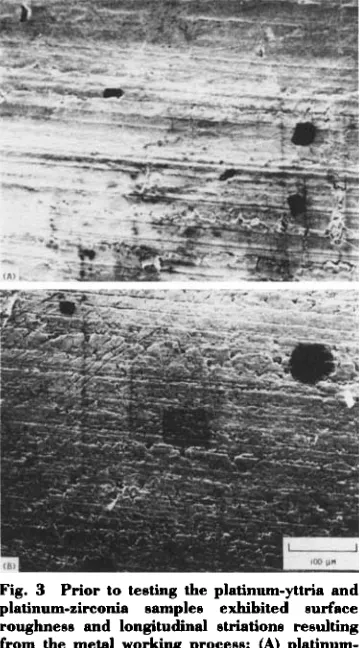
Fig. 3 Prior to testing the platinum-yttria and platinum-zirconia samples exhibited surface roughness and longitudinal etriations reeulting from the metal working process: (A) platinum- yttria atter annealing in vacuum for 30 minutes at 1000°C, (B) platinum-zirconin in the as-
drawn condition
These factors indicated that the life estimates based on mass loss were reasonable.
Surface-Analysis Results
Auger electron spectroscopy with depth pro- filing was used to examine surface contamina- tion in the 1000 hour tests only in carbon dioxide, hydrogen, ammonia and methane (9). This technique allowed elemental characterisa- tion of the surface of the sample. The con- taminants found on each sample included carbon, hydrogen, nitrogen and oxygen. For both platinum-yttria and platinum-zirconia AES with depth profiling indicated that the samples had surface layers of contamination which extended to depths of
-
moi.
Profiling to greater depths did not reveal any significantreaction. These results indicated that any reac- tions between platinum and the propellants tended to occur at the surface of the material.
Surface deterioration was also evaluated qualitatively by examining surfaces and cross- sections of the materials before and after testing, and photomicrographs were used to assess propellant interaction at the material sur- face, and to determine changes in relative grain size.
some slight grain growth. This was not con- sidered to be significant, and may have been due to sample variability. These results indicate that material stability is not a major concern.
The cross-sections of the platinum-yttria samples tested in ammonia and in hydrazine at 1400OC showed that the pitting, evident on the surface, extended well into the material. In each sample the corrosion was uniform across the tube thickness, with no evidence of ac- celerated attack at the grain boundaries. After 1000 hours at 1400OC in ammonia, the reaction zone, or the depth of pitting in the material, ex- tended through about one-third of the wall thickness. Exposing a similar sample to the same environment for 2000 hours resulted in a
reaction zone extending approximately halfway through the wall thickness. On the basis of a study of this reaction zone by M. V. Nathal,
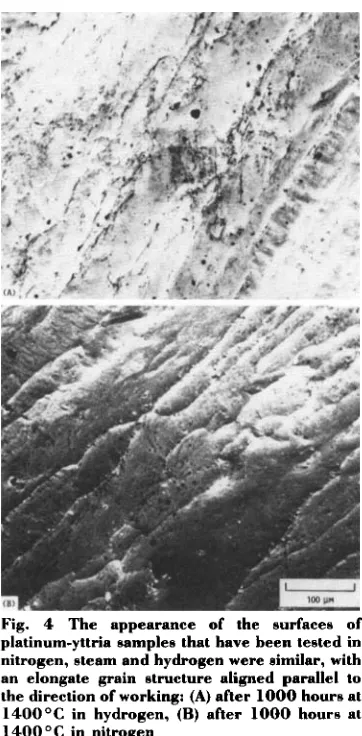
Fig. 4 The appearance of the surfaces of platinum-yttria samples that have been tested in nitrogen, steam and hydrogen were similar, with an elongate grain structure aligned parallel to the direction of working: (A) after 1 0 0 0 hours at 140OOC in hydrogen, (B) after 1000 hours at 140OOC in nitrogen
platinum-yttria sample tested in hydrazine, but run at only 80o0C, showed no evidence of the surface pitting that was so prominent after the 1400°C test.
Cross-sections of the platinum-yttria samples tested at 500, 800 and 140o0C exhibited similar grain size and very little difference from the an- nealed sample. This is illustrated by the photomicrographs, Figure 6. This grain size was greater than that of the untreated platinum- yttria sample, but approximately the same as the sample after the short anneal. The evidence implies that most of the grain growth occurred during the 3o minute vacuum at
IOoooc* The 2000 hour in hydrogen
showed no reaction, but there appeared to be
Fig. 6 Cross-sections of platinum-yttria tested at 500, 800 and 14OOOC for 1000 hours all showed similar grain sizes to annealed material, suggesting that most of the grain growth occurred during the 30 minute vacuum anneal at 1000°C: (A) afier annealing, (B) tested at 5OOOC in methane, (C) tested at 8OOOC in hydrazine, (D) tested at 14OOOC in hydrogen
M. V. Whalen and D. P. Pank at NASA Lewis Research Center, the estimated time for the attack to penetrate through the entire wall thickness was approximately 5000 hours at 1400OC; at 1300 and IOOOOC, sample lifetimes were estimated at about 15,000 and 40,000 hours, respectively. The condition of the 1400OC hydrazine sample was similar to that of the sample run in ammonia. The hydrazine sample run at 8 0 0 O C showed no evidence of corrosion on either the cross-section or the sur- face. This result indicates that platinum-yttria may be acceptable for operation in ammonia or hydrazine at the lower temperatures. The platinum-yttria samples exposed to carbon dioxide, hydrogen, nitrogen, steam and methane showed no evidence of corrosion or deterioration.
tested in carbon dioxide, hydrogen, steam and methane, as in the platinum-yttria samples, showed no corrosion or deterioration. The samples exposed to ammonia and hydrazine showed a reaction zone extending through about half the cross-section. The reaction zone of the platinum-yttria sample exposed to hydrazine was about the same thickness. The samples tested in ammonia showed a thicker zone for the platinum-zirconia sample. However, further testings by Nathal, Whalen and Pank indicated that these differences were due to experimental scatter, probably at- tributable to temperature control.
The results of the ammonia and hydrazine tests for both materials were interesting in that the mass loss measured in these tests was much lower than necessary to form the volume of voids seen in the platinum-yttria cross-section shown in Figure 7. Measurement of the tube diameter before and after testing indicated an increase in outside diameter of as much as 10 per cent. This evidence indicates that the void formation actually caused swelling of the material, rather than being indicative of a loss of material due to corrosion. A suspected mechanism for the void formation involves dif- fusion of hydrogen and nitrogen atoms into the platinum. The dissociation of ammonia into hydrogen and nitrogen occurs by a process with an intermediate step in which atomic hydrogen and nitrogen are formed (12-14). The dissocia- tion reaction occurs at the platinum surface, which is acting as a catalyst. Some of the atomic hydrogen and nitrogen may then diffuse into the platinum before combining to form molecular hydrogen and nitrogen. These can then coalesce into gas bubbles within the platinum and thus cause the swelling of the tubes. This type of reaction had been observed previously where ammonia gas was used for in- ternal nitridation of steels (13, 14). Additional-
ly, no void formation was observed in experiments run by Nathal, Whalen and Pank in hydrogen, nitrogen, or hydrogenfnitrogen mixtures, because the gas molecules do not dissociate at temperatures near 1400OC and because the molecules cannot diffuse into the
Fig. 7 After 1000 hours at 1 4 0 O O C in decom- posed hydrazine, this cross-section through the wall of a platinum-yttria tube shows a significant amount of porosity, which is not due to the loss of metal by corrosion. However it caused an iu- crease in the outer diameter of the tube
platinum to any significant extent. Again, the extent of this void formation can be reduced if operation at lower temperatures is acceptable, and this was confirmed by the tests at 800, 1000 and 1300OC. Further testing to determine the
influence of these voids on the mechanical pro- perties of platinum is recommended before the use of ammonia and hydrazine propellants at high temperatures.
Concluding
Remarks
however, the effects, if any, on the performance of a resistoiet should be evaluated.
The results indicated that platinum-yttria and platinum-zirconia are compatible with car- bon dioxide, hydrogen, nitrogen, steam and methane under the conditions presented here. The reaction found in both materials at 14m°C
when exposed to ammonia and decomposed
hydrazine can be reduced by lowering the operating temperature. Both dispersion- strengthened platinums should be acceptable for space station resistojets using carbon diox- ide, hydrogen, nitrogen, steam and methane. The propellants ammonia and hydrazine are also acceptable if the resistojet operating temperature is lowered.
References
I C. R. Halbach, “10 mlb Biowaste Resistojet Per- formance”, AIAA Paper 71-687, June, I971
z C. R. Halbach and R. Y. Yoshida, J . Spucecr. Rockets, 1971, 8 , 273
3 H. J. Albert and J . S. Hill, “Development of a Platinum-Thorium Oxide Alloy for Resistojet Thruster Use”, NASA CR-111959, 1971 4 J. R. Knight and B. Taylor, Powder Metall.,
1962, (IO), 108
5 E. E. Van Landingham and S. P. Willis, “In- tegrated Environmental Control/Life Support Resistojet Systems”, AIAA Paper 70-1 130, Aug.,
I970
6 G. L. Selman, J. G. Day and A. A. Bourne, “Dispersion Strengthened Platinum”, Platinum Metals Rev., 1974, 18, (z), 46
7 R. G. Stanley and F. G. Wilson, Met. Powder Rep., 1982, 37, 175
8 M. V. Whalen, S. P. Grisnik and J. S. h e y , “Compatibility Experiments of Facilities, Materials, and Propellants for Electrothermal Thrusters”, NASA TM-86956, 1985
9 M. V. Whalen and S. P. Grisnik, “Compatibility of Grain-Stabilized Platinum with Candidate Pro- pellants for Resistojets”, NASA TM-87118, 1985
10 M. V. Whalen and M. V. Nathal, “Compatibility of Dispersion-Strengthened Platinum with Resistojet Propellants”, NASA TP-2765, 1987
11 W. H. Kohl, “Handbook of Materials and
Techniques for Vacuum Devices”, Reinhold,
12 H. G. Nelson, D. P. Williams and A. S. Tetelman, Metall. Trans., 1971, 2, 953 13 L. S. Darken and R. W. Gurry, “Physical
Chemistry of Metals”, McGraw-Hill, 1953, 372 14 L. E. Kindlimann and G. S. Ansell, Metall.
Trans., 1970, I , 163
1967, P. 478
Fabricating Lithium Niobate
Optical
Wavelengths
One of the earliest uses of platinum was for the fabrication of crucibles to be used during chemical analysis, and over the years it has found application as a reliable containment material during many specialised processes, often under the most arduous conditions.
A recent communication from workers at the Universitat Dortmund, West Germany, describes a new diffusion technique which is regarded as an important step towards the reproducible fabrication of low-loss titanium- diffused
LiNbO,
waveguides (A. Neyer and T. Pohlmann, Electron. L e t t . , 1987, 2 3 , (22),I I 87- I 188).
During the fabrication of such waveguides precise control of substrate material stoichiometry, amount of deposited titanium and the diffusion conditions is required. The last are of paramount importance since the in- diffusion of titanium may be accompanied by an outdiffusion of LiO, from the LiNbO, crystal, resulting in an unwanted surface waveguide.
This
can now be avoided by con- taining the LiNbO, in a platinum box looselyclosed with a platinum lid, during diffusion at a temperature of 1050°C.
The partial pressure of Li 0 built up in the small enclosed container is thought to prevent strong outdiffusion of Li,O, but the main ad- vantages of the platinum box are that it does not have to be stabilised by LiNbO, powder, it is not affected by Li,O and it provides excellent temperature homogeneity.
Palladium Membrane
Reactor
Although a reversible reaction can never be complete under ordinary conditions, if the pro- ducts can be separated from the reacting mix- tures the reaction should finally go to completion, and N. Itoh of the National Chemical Laboratory, Japan, has recently con- sidered the decomposition of cyclohexane to benzene and hydrogen, using a platinum on alumina catalyst (AIChE J., 1987, 33, (9),
I 576-1578). The hydrogen produced diffused