A Collaborative Process Model In Managing
Kalrez Csr Program Of Clean Water Installation To
The Bula Community In East Seram Regency,
Maluku - Indonesia
Josep Antonius Ufi, Zainal Abidin Rengifurwarin, Jusuf Madubun, Haedar Akib, Basri Muhammad
Abstract: The issue of this study is a view on Oil & Gas’ CSR program and collaborative community development in KRZL Ltd. This study aims to analyze and discuss the collaborative process model applied to the clean water installation program to several villages in the Bula community, besides as a solution to the limitation of local government in East Part Seram Regency, Maluku Province. Primary data collection was conducted by using in-depth interview, FGD and field observation, while secondary data was conducted by using document study such as CSR program rules and reports and brochure of KLZR Ltd. Descriptive qualitative analysis technique was used for data analysis. The results showed that by optimizing participation and active involvement of the community with KLZR at each stage of the collaborative processes proved more successful in implementing the CSR program development of clean water installation to the Bula community.
Keywords: KRZL CSR Program, collaborative process model, community development.
—————————— ——————————
INTRODUCTION
Today's various collaborative models continue to be developed as an alternative solution to mismanagement problems of public policies and development programs (Sullivan & Skelcher, 2002: 1). There are various reasons, that drive the importance of using a collaborative approach (Husted, 2003; McDonald & Young, 2012; Dwiyanto, 2010). The collaborative pattern of Corporate Social Responsibility (hereinafter abbreviated CSR) program posses the potential as a source of development financing to sustain the government program (National Medium Term Development Plan (2015 – 2019). Collaboration in the context of community development (hereinafter abbreviated comdev) can lead to empowerment and strengthening the capacity of
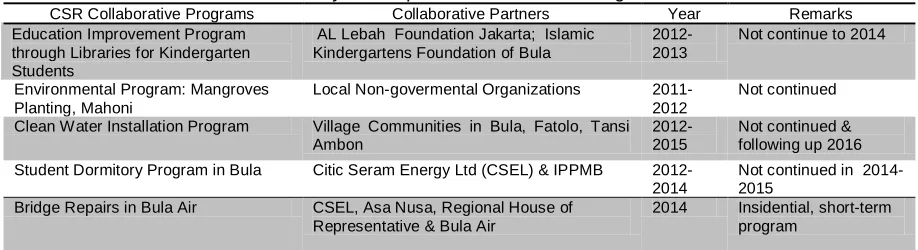
others (Guffey, 2006: 563), including contributing to community development (Cheever, 2006; Situmeang, 2016), and it needs to be guided by the community (Andrews, 2013; Eweje, 2007). The collaborative model of CSR program in oil and gas industry in Indonesia, in particular, is regulated in the Working Guidelines of the Implementing Body of Oil and Gas (BP Migas) 2005 on Guidelines for Community Development, which is also applied to Kalrez Petroleum Seram Ltd (hereinafter abbreviated as KRZL), one of the Contractor (K3S) or Bula Block Operators in Eastern Seram District in Maluku. An overview of various collaboratively managed CSR programs at KRZL 2012 - 2014 as presented in the table 1 below
.
Table 1
Collaborative Community Development of KRZL CSR Program in 2012 - 2014
CSR Collaborative Programs Collaborative Partners Year Remarks Education Improvement Program
through Libraries for Kindergarten Students
AL Lebah Foundation Jakarta; Islamic Kindergartens Foundation of Bula
2012-2013
Not continue to 2014
Environmental Program: Mangroves Planting, Mahoni
Local Non-govermental Organizations 2011-2012
Not continued Clean Water Installation Program Village Communities in Bula, Fatolo, Tansi
Ambon
2012-2015
Not continued & following up 2016 Student Dormitory Program in Bula Citic Seram Energy Ltd (CSEL) & IPPMB
2012-2014
Not continued in 2014-2015
Bridge Repairs in Bula Air CSEL, Asa Nusa, Regional House of Representative & Bula Air
2014 Insidential, short-term program
Source: Field data compilation in 2016-2017; Ufi, 2018 ____________________________
1Department of Administration Science Faculty of Social & Political Sciences - Pattimura UniversityEmail:
2Department of Administration ScienceFaculty of Social & Political Sciences – Pattimura UniversityEmail:
3Department of Administration ScienceFaculty of Social & Political Sciences - Pattimura University Email:
4Department of Administration ScienceState University of Makassar Email: [email protected]
While the management of those CSR programs indicated in the tabel 1 above were generally less than optimal, one of the KRZL’s collaborative CSR programs which is considered to be relatively optimal is the clean water installation program and its utilization to the Bula community. Based on the above description, the writer is encouraged to investigate further to explore the meaning behind the social phenomenon under the research questions, namely: (1) How is the collaborative model in managing CSR program of clean water installation to Bula Community? (2) To what extent is the significance of the collaborative process model between KRZL and the Bula community in managing the clean water installation program?
SIGNIFICANCE OF THE STUDY
This research actually has certain distinctive and significant characteristics compared to other research on the mode of CSR collaboration in oil & gas sector. Given the CSR initiatives are often in collaboration with NGOs (Peloza & Falkenberg, 2009), and with another stakeholders outside the local community that positioned merely as the CSR target, as mandated by Government (Frynas, 2008 in Cahyo Edi, 2014; Ufi, 2018), this research shows that the local community of Bula was determined discretionarily by the KRZL field Staffs as the main partner in managing the CSR program of clean water installation; and while a number of researches on CSR collaborative programs of CSEL, and of Pertamina (Persero) showed that such collaboration was based more on the written formal collaboration agreement (Fisip Unpatti, 2016; Ufi, 2018), but this research shows something different, in term of the characteristic of collaboration was based on verbal informal agreement.
LITERATURE REVIEW
Conceptualizing Collaboration
One of the studies on collaboration as a process that yields particular outcomes is done by Gray and Wood’s (1991). They propose three focused areas: antecedents to collaboration, the process of collaboration itself, and the outcomes of that process. Thomson et al (2007) indicate that many scholars tend to associate antecedents with collaboration processes and outcomes, and that process dimensions of collaboration are frequently presented as outcomes. Accordingly, research on problem-solving collaborative efforts conducted by Logsdon (1991 in Thomson et al. 2007), for example, suggest that solving concrete problems is as a successful outcome of the collaborative efforts; while Ostrom (1990; 1998 in Thomson et al. 2007), using an institutional perspectives, views self-governance as the positive outcome of a collaborative effort, and establishes some indicators such as : trust, reciprocity, and shared purpose making the potential for collaboration outcomes possible. According to Guffey (2006), 'collaboration is a process whereby participants engage in the issue of actively seeking a commonly defined solution'. Himmelman (in Guffey (2006), defines collaboration as an effort to exchange information, diversify activities, share resources, and willingness to increase the capacity of others for joint use and shared goals, based on
trust also in a relatively long time. Himmelman's definition by Kanter is considered an empowering action. Chrislip & Larson (1994), also stated that collaboration could lead to empowerment. Based on those studies that I propose in this research a working notion of collaboration: collaboration is a form of collective cooperation between two or more agencies, which builds mutual relationships and integrate shared resources, share responsibility and trust in order to achieve common goals, enjoy the benefits together also share the risks faced ".
Corporate Social Responsibility
There are various notions of corporate social responsibility (CSR), and its meanings vary across time and geographical space (Fairbrass, 2011 in Ufi, 2018). Although some writers and institutions, among others: The Trinidad and Tobaco Bureau of Standards (TTBS and The World Business Council for Sustainable Development contend that companies must assume responsibility for improving communities (Jenkins & Obara, 2006), pure altruistic criteria are rarely sufficient justification for the allocation of firm resources, and that normative arguments for CSR are typically accompanied by an argument for the business case (Porter & Kramer, 2002 in Peloza & Falkenberg, 2009). Here I adopt the notion of CSR by Barnett (2007), that is ‘a discretionary allocation of corporate resources toward improving social welfare that serves as a means of enhancing relationships with key stakeholders’. While Peloza & Falkenberg (2009), - by that notion- focuses on CSR programs that involve collaboration with NGOs, this research focuses on the discretionary allocation of resources directed towards local community for addressing the specific social and environmental issues the firm has targeted. It means that corporate CSR closely relates to community development, besides to the issues of corporate governance and environmental issues (Nasdian, 2015; Weber, 2008).
Collaborative Governance on CSR Program of Oil and Gas Sector
collaboration of oil and gas CSR programs involving local communities is important as local communities fall into the category of key stakeholders, besides others (Jenkins & Obara, 2008).
Community-Based CSR Collaborative Model
The collaborative model of a community-based CSR program is essentially a community empowerment perspective, meaning that it centers on community participation in the management of the CSR program itself, with active processes and initiatives from the community, guided in their own customary ways and using controlled means and processes effective and participatory. Here, communities are positioned not merely as the program targets (beneficiaries) but rather as key stakeholders actively involved in CSR programs. Participation includes, the involvement of citizens in all stages of CSR activities process, besides for capacity building process of the community to solve their problems both from the aspect of empowerment and of the environment (Nasdian, 2015: 238; Soplop et al, 2009 quoted by Cahyo Edi, 2014), including for the CSR program according to community needs and guaranteed sustainability (Jenkins & Obara, 2006), because it is realized that CSR program is a process oriented to the grassroots communities or vulnerable groups (Andrews, 2013), and prevents the creation of a community dependency pattern (Jenkins & Obara: 2006). Himmelman (1996), suggests that the process of collaboration is a set of strategies for how to transform society through a kind of 'empowerment collaboration.' The importance of inclusive interest and community stakeholder involvement is generally through 5 stages of CSR management process (Salam, Darmastuti, & Situmeang, 2017), namely: (1) engagement stagei.e. initial approach with the community to establish good communication and relation; (2) assessment phase, identification of problem and requirement of community as reference for formulation of
program plan; (3) action plans, planned programs to inculcate community aspirations; (4) stage of action and facilitation of mutually agreed programs; (5) evaluation and termination stage, assessing the extent of success of CSR program in the field. The five stages of stakeholder involvement are likely to be in tune with the phases of the collaborative process model: (1) pre-condition phase; (2) the problem-setting phase (the problem setting phase includes identifying key issues and identifying key stakeholders); (3) phase of direction determination (the application phase of directors or directions includes the establishment of common goals); (4) implementation phases (Gray, 1985; McCann, 1983; Jamal & Getz, 1995, in Situmeang, 2016); and (5) phase of follow-up and development (Waddell & Brown, 1997; Situmeang, 2016;). The community-based collaborative process model developed by Ring & Van de Ven (1994) cited by (Thomson & Perry, 2006; Thomson et al., 2007), is more informal, meaning that it is not based on an institutional structure that formal arrangements such as MoUs and SOPs, but are more informal and negotiation-based, develop commitments (psychological contracts), joint assessments based on reciprocity, then implement the program actions together with personal interaction. In this study, the framework of the collaborative process model of CSR program refers to the five stages of the collaborative process model proposed by Waddell & Brown (1997), because it is likely relevant to the empirical phenomena in the field, and can accommodate three stages of collaboration (Wood & Gray, 1991), also three stages of negotiation and assessment (at the pre-condition & problem-fixing stage) and implementation phase (proposed direction & implementation phase) proposed by Ring & Van de Ven (1994), as well as it is in line with the 5 stages of CSR management process proposed by Situmeang (2016: 40-41). The research framework is visualized in the conceptual diagram below.
Conceptual diagram of this research
Constructed by Ufi, 2019
Klrz’s Collaborative CSR Program of Clean Water Installation in Bula
C O L L A B O R A T I V E
P R O C E S S
Pre-condition Phase
Problem Setting Phase
Direction Determination Phase
Implementation Phase
Follow Up Phase
T H E
RESEARCH METHODOLOGY
This research employed the type of qualitative research located in Bula sub-district community, SBT Regency of Maluku. The key informants in this study were 7 people who were determined purposively, namely: KRZL PR Coordinator 1 person, Ex-KRZL PR staff 1 person, Communities Leaders: Head of Bula Village, Ex- Sub Village Chief of Air Suat Bula Village 1 person, sub-village chief of Galala – Bula 1 person, Ex- sub-village chief and village chief of Tangsi Ambon –Bula; 2 people.
Field data collection was conducted from October 2016 to February 2017. Primary data was collected by using in-depth interview techniques to gain knowledge, information and experience from key informants, supported by field observations to observe directly and systematically the various conditions of relevant objects in field, among others, the physical condition of clean water installations built and their utilization activities; Furthermore, secondary data was collected through documents study, for example, document on CSR program implementation Report, KRZL profile, and relevant regulations. While, data analysis used descriptive qualitative analysis technique (Miles, Huberman, & Saldana, 2014), consisting of, stages of data condensation, data presentation, and conclusion or verification.
RESULT AND DISCUSSION
1. A Collective Cooperation Form of CSR Program between KRZL and Bula Communities
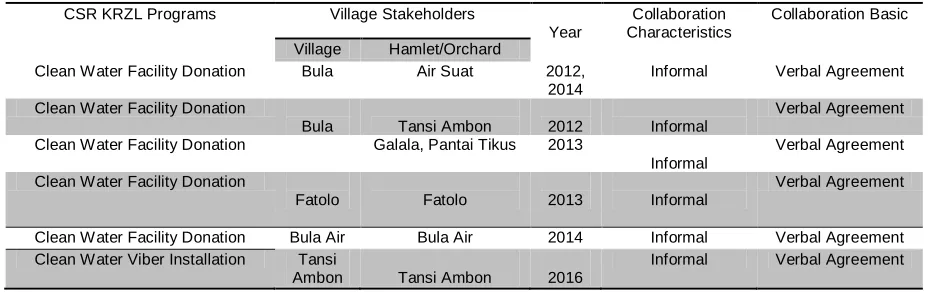
Based on the field data and information collected, it is indicated that the collaboration of clean water program is a collaborative management scheme of KRZL’s CSR program in the field of health (environmental sanitation) through the construction of clean water storage facility and its sustainable utilization for some (sub-) villages of Bula communities, namely pilot program in the hamlet of Air Suat and Tansi Ambon in 2012; continued in the sub-village of Galala and Wailia of Bula Village in 2013; as well as in the
village of Fatolo and Bula Air 2014. Related to the pattern of management, the field data showed that collaborative program management between KRZL and the local village community clusters coordinated by the (sub-) village chief. Recognized by UK, as Field General Affairs Supervisor KRZL (October, 2016) and J.R. as ex-KRZL PR staff (November 2016), that "... the program of provision of clean water facilities is one of the leading programs of KRZL which is collaborated with the residents of the Ring I target hamlet in Air Suat and Tangsi Ambon, and others coordinated by the hamlet head ..." ; this method is considered more appropriate than the contractor in addition to the limited budget is also more likely to gain profit and project orientation. Although the top management of KRZL wants the project to be handled by the contractor, but due to strong advice from the KRZL personnel in the field, it is agreed to work with local villagers. The KRZL is a Contractor of Cooperation Contract (K3S) engaged in petroleum exploitation enterprise which operates in Bula Block area, with an operating area of 35 Km2. On 22 May 2000 signed a Cooperation Contract for a period of 20 years between PT. Pertamina and Kalrez Petroleum (Seram) Ltd, with a depth of drilling permits up to 600 meters into the ground, and petroleum production in recent years has only reached approximately 400 barrels per day. The KRZL Cooperation Contract period will expire in 2020. Collective cooperation between KRZL and Community of Bula communities was more informal from the initial pilot program in Air Suat & Tangsi Ambon Bula hamlet in 2012 until the follow up program in other sub-villages of Bula and surrounding areas. The UK recognized (October, 2016), "... we began to approach the head of the hamlet and the villagers in Air Suat and Tansi Ambon to work together to carry out this work, and it was responded positively so that the work could go ... ", The same thing also recognized the key informant JR (December, 2016). The description of the collective cooperation form of the CSR program is presented in table 2 below.
Table 2. Collective Cooperation of KRZL and Village Communities
in the Construction of Clean Water Facilities at Bula Year 2012 - 2014/2015 CSR KRZL Programs Village Stakeholders
Year
Collaboration Characteristics
Collaboration Basic Village Hamlet/Orchard
Clean Water Facility Donation Bula Air Suat 2012, 2014
Informal Verbal Agreement Clean Water Facility Donation
Bula Tansi Ambon 2012 Informal
Verbal Agreement Clean Water Facility Donation Galala, Pantai Tikus 2013
Informal
Verbal Agreement Clean Water Facility Donation
Fatolo Fatolo 2013 Informal
Verbal Agreement
Clean Water Facility Donation Bula Air Bula Air 2014 Informal Verbal Agreement Clean Water Viber Installation Tansi
Ambon Tansi Ambon 2016
Informal Verbal Agreement
Data source: Compilation of field data 2016 – 2017 (Ufi, 2018). The actualization of collective cooperation between KRZL and villagers in the implementation of clean water program in Bula seems to be a direct action collaboration supported by stakeholders of the Government of SBT Regency, both
administrative and ceremonial support for the exposition of the event for the utilization.
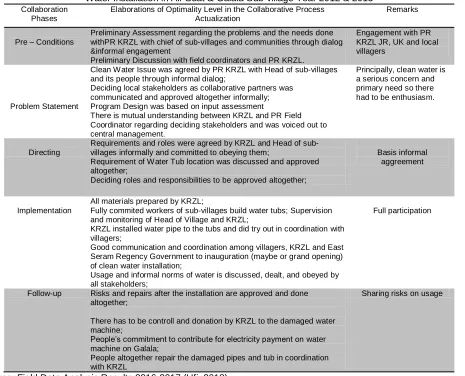
Furthermore, the data analysis related to the level of optimality of the actualization of each stage of the collaborative process between community & KRZL in the clean water installation program and its utilization,
especially in the clean water stub program in the hamlet of Air Suat and Galala, as well as various problems of its relative dis-optimality, can be summarized and presented in table 3 below.
Table 3. Optimality Level Analysis in the Collaborative Process of Clean
Water Installation in Air Suat & Galala Sub-village Year 2012 & 2013 Collaboration
Phases
Elaborations of Optimality Level in the Collaborative Process Actualization
Remarks
Pre – Conditions
Preliminary Assessment regarding the problems and the needs done withPR KRZL with chief of sub-villages and communities through dialog &informal engagement
Preliminary Discussion with field coordinators and PR KRZL.
Engagement with PR KRZL JR, UK and local villagers
Problem Statement
Clean Water Issue was agreed by PR KRZL with Head of sub-villages and its people through informal dialog;
Deciding local stakeholders as collaborative partners was communicated and approved altogether informally; Program Design was based on input assessment
There is mutual understanding between KRZL and PR Field Coordinator regarding deciding stakeholders and was voiced out to central management.
Principally, clean water is a serious concern and primary need so there had to be enthusiasm.
Directing
Requirements and roles were agreed by KRZL and Head of sub-villages informally and committed to obeying them;
Requirement of Water Tub location was discussed and approved altogether;
Deciding roles and responsibilities to be approved altogether;
Basis informal aggreement
Implementation
All materials prepared by KRZL;
Fully commited workers of sub-villages build water tubs; Supervision and monitoring of Head of Village and KRZL;
KRZL installed water pipe to the tubs and did try out in coordination with villagers;
Good communication and coordination among villagers, KRZL and East Seram Regency Government to inauguration (maybe or grand opening) of clean water installation;
Usage and informal norms of water is discussed, dealt, and obeyed by all stakeholders;
Full participation
Follow-up Risks and repairs after the installation are approved and done altogether;
There has to be controll and donation by KRZL to the damaged water machine;
People’s commitment to contribute for electricity payment on water machine on Galala;
People altogether repair the damaged pipes and tub in coordination with KRZL
Sharing risks on usage
Data Source: Field Data Analysis Results 2016-2017 (Ufi, 2018). Based on the data analysis in above table it is clearly known about the roles and responsibility portion of each partner at each stage of collaboration process of the clean water installation construction, from initial assessment in the pre-condition phase to implementation and follow-up. It is in line with Situmeang (2016: 40-41), which states the need for engagement or initial approach with the community and relevant stakeholders, in this case the stakeholders of the (sub-) village in Bula, so that communication can be established and good relationships that support the smoothness of the next stage such as assessment, planning and implementation of the program. With regard to the preparation of technical manpower for the construction
the installation of damaged water machines in Galala village, whereas, the commitment of the community partners to participate in financing the cost of electricity to start the water machine. This is in line with Krishna & Lovell (2007, cited by Nasdian, 2015: 238-39), that community participation in the implementation of CSR programs should
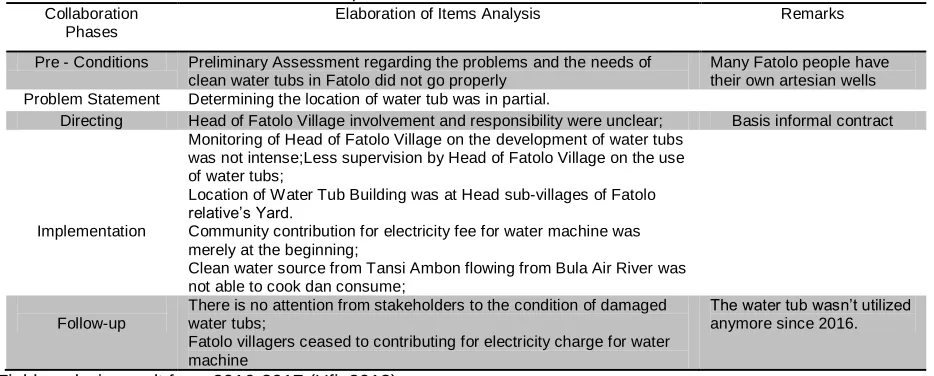
be in accordance with the needs of the community, and ensure the success and sustainability of the program. Accordingly, an analysis of the dis-optimality at the stages of collaborative process in the development of clean water installations in Tangsi Ambon and Fatolo, is presented in table 4 below.
Table 4. Analysis of Dis-optimality in the Program Collaboration Process Clean Water Development in Tansi Ambon and Fatolo 2013 – 2014
Collaboration Phases
Elaboration of Items Analysis Remarks
Pre - Conditions Preliminary Assessment regarding the problems and the needs of clean water tubs in Fatolo did not go properly
Many Fatolo people have their own artesian wells Problem Statement Determining the location of water tub was in partial.
Directing Head of Fatolo Village involvement and responsibility were unclear; Basis informal contract
Implementation
Monitoring of Head of Fatolo Village on the development of water tubs was not intense;Less supervision by Head of Fatolo Village on the use of water tubs;
Location of Water Tub Building was at Head sub-villages of Fatolo relative’s Yard.
Community contribution for electricity fee for water machine was merely at the beginning;
Clean water source from Tansi Ambon flowing from Bula Air River was not able to cook dan consume;
Follow-up
There is no attention from stakeholders to the condition of damaged water tubs;
Fatolo villagers ceased to contributing for electricity charge for water machine
The water tub wasn’t utilized anymore since 2016.
Source: Field analysis result from 2016-2017 (Ufi, 2018). Based on the analysis of data table 4 above, it is clear that the dis-optimality problem in the actualization of collaborative process between KRZL and the community of both Tangsi Ambon and Fatolo. And those problems seemly more related to the implementation phase and its utilization. In the Tangsi Ambon case, it turns out that the source of water flowed into the water reservoir that was built was directly from the river of Bula Air naturally without going through the processing first. As a result, the water is murky and is not qualified for drinking and cooking except for bathing and laundry needs only since 2012. Ex-Tangsi Ambon Chief (December 2016) confessed that the condition has been submitted to KRZL and it was promised to follow up. While UK-KRZL (December 2016) and The sitting Head of Tangsi Ambon Administrative Village (March 2017) found that there has been a phase of follow-up improvement through the collaboration of material resources and technology, owned by Tangsi Ambon community which providing 3 Stainless steel water tank where 2 of which have been filled with clean water directly sourced from the installation water supply from KRZL by 2016. Thus, the water needs of the community of Tangsi Ambon is continued in addition to Air Suat Sub-Village which according to the UK (October 2016), "unless the KRZL company closed down the the water will also stopped".Whereas, in the Fatolo case, the dis-optimality seems to have occurred since the pre-assessment phase of the condition which indicated a certain subjective and interested attitude in the process of determining the location
of the built-in water basin which was the location of the clean water basin within the yard of certain family homes that are still close relatives of community leaders (village heads). Similarly, it is known that the lack of commitment and the limitations of local community members to contribute the cost of purchasing electrical pulses. In determining the location of clean water basin built, for example, there was a tendency to control the clean water installation resources by the relatives of the village head. As argued by Guffey (2006: 566), and Ife & Tuserioero (2014: 234), for example, that in community empowerment programs, there is often uneven distribution of power and resources, which can hamper the continuation of its use. Finally, through field observation (February 2017), the condition of the dam of the clean water reservoir was detected without any concerted effort to follow up the improvement.
3. Empirical Collaborative Process Model of the Program of Clean Water Installation
Based on the result analysis and discussion above, I would like to construct an empirical model of the collaborative process within the CSR program of clean water installation in Bula communities, in the form of diagram and graphic below.
Graphic 2. Construction of an empirical collaborative process model
I
Constructed by Ufi, 2019 From the above picture of the empirical collaborative
process model of the CSR program, it can be explained each iconic symbol of the picture, as follows: first, the vertical line at the left side shows characteristic of the collaborative CSR program which ranging from informal one based more on oral agreement or consensus (at the bottom) to the formal one based on officially written agreement; second, the horizontal line at the bottom shows level of community based in term of participation, engagement & involvement at each stage of the collaborative process which ranging from the low level at the left side to the high level of participation at the right side. Accordingly, the five arrow boxes show each stage of the collaborative process of CSR program on clean water development. And I put the two cases of the process collaboration of clean water installation development program in Bula among KRZL and Bulla communities, which CSR case 1 shows the CSR case in Air Suat, Galala & Pantai Tikus; while the CSR case 2 shows the CSR case in Fatolo and Tangsi Ambon before 2016. In one side, both CSR cases shares the same characteristic of collaboration as they are positioned close to the bottom meaning that their characteristic is more informal (based on oral agreement); but in another side, they are different in term of the participation/involvement level, which the position of CSR case 1 is close to the right side meaning that the participation level is higher than the CSR case 2 that is close to the left side meaning that the participation level is low. Whereas, the vertical line at the right side shows certain benefits or outcomes reached by the CSR collaborative program. And based on the information showed above, it can be concluded that the CSR case 1 is better or more successful in term of reaching the certainly
positive benefits or outcomes if compared to the CSR case 2 that far from the better.
CONCLUSION AND SUGGESTION
Based on the analysis and discussion above, it can be summarized as follow: first, there is a good collective cooperation although it’s characteristic is more informal based on oral agreement between KRZL and community of Bula in CSR program of clean water installation and utilization (CSR case 1); Second, collaborative processes that involves contributions, participation, active involvement of Bula community leaders and community members with KRZL at each stage of the collaboration processes (from initial communication and need assessment to pre-condition phase, to implementation phase and follow up) made the CSR program of installation development clean water (especially in the Air Suat, Galala, Pantai Tikus, Wailia and Tangsi Ambon) more significant and successful to reach a sustainable water supply and utilization for the communities (if compared to the CSR case 2 which the participation level was very low). Therefore, it can be concluded generally that the collaborative process model of the community-based CSR program by optimizing the participation, contribution and active involvement of the community with KRZL at each stage of the CSR program collaboration process proved to bring better results in term of sustainable clean water supply & utilization and sense of ownership for the whole Bula communities. Based on the above conclusion , it is recommended that various strengthening and adjustment measures be applied to the community-based collaborative process model in the management of CSR programs in oil and gas Base Blocks and K3S in general, namely: first, the need for revision of the Working Guidelines (WGM) for the Special Unit for Oil and Gas (SKK Migas) no. 017 Year
C
h
ar
ac
te
ri
sti
c
of
C
ol
lab
o
r
ati
on
of
C
S
R
P
ogr
am
Level of Participation in the Collaborative Process stages of CSR Program Formal
Informal
Low High
CSR Case
2
COMM
KRZL
CSR Case
1
KRZL COM
M
Stage 1 Stage 2 Stage 3 Stage 4
Stage 5
C E R T A I N
O U T C O M E S
2005 by positioning the local community as the main stakeholder of K3S and not merely as the target (beneficiaries) of CSR program only; second, the need to establish SOPs at the management level of oil and gas K3S mandating the need to adopt community-based CSR (comdev) program management mechanisms; third, the need to strengthen coordination and collaboration among K3S Migas (KRZL) with public authority (local government) and local community to make optimal of the CSR programs of K3S Migas in order to support development programs in Bula Sub-district – SBT Regency. Finally, I would like to confess the limitation of this research that because it is more based in a small level of CSR program cases with strong social capital, commitment and community based fully in an informal contract so that it can reach successful. But still, we need also to explore the formally collaborative CSR cases based on official mandate (by law) as is reminded by Frynas (2008 in Cahyo edi, 2014).
REFERENCES
[1] Aas, C., Ladkin, A., & Fletcher, J. (2005). Stakeholder collaboration and heritage
management.Annals of Tourism Research, 32 (1), 28–48.
[2] Agranoff, R., & McGuire, M. (2004). Collaborative public management: New strategies for local governments. Georgetown University Press. [3] Ahmad, Khatmah, Gufran Dharma Dirawan,
Haedar Akib, Fakhri Kahar, dan T. M. (2015). Knowledge Problem Of Collaboration In Regional Development Planning (Case Inmamuju Regency). International Journal of Applied Business and Economic Research, 13 (4), 1721–1736.
[4] Andrews, N. 2013. Community Expectations from Ghana’s New Oil Find:Conceptualizing
[5] Corporate Social Responsibility as A Grassroots-Oriented Process. Africa Today: Indiana University Press, 60 (1), 55-75.
[6] Bappenas RI, 2015. National Medium Term Development Plan (2015 – 2019)
[7] BP Migas, 2005. Book II- Guidelines for Community Development.
[8] Cahyo Edi, A. 2014. Cross-Sector Partnership Models in CSR to Implement Poverty Reduction Initiatives in Indonesia. International Journal of Administrative Science & Organisation, Bisnis dan Birokrasi. Jurnal Ilmu Administrasi dan Organisasi. 21 (2) pp. 129-136.
[9] Cheever, K. A. L. 2006. Collaborations in Public Service: Memphis Experience. International Journal of Public Administration, 29, 533-555. [10]Chrislip, D. D., & Larson, C. E. (1994).
Collaborative leadership: How citizens and civic leaders can make a difference (Vol. 24). Jossey-Bass Inc Pub.
[11]Dwiyanto, A. 2010. Manajemen Pelayanan Publik: Peduli, Inklusif, dan Kolaboratif (cetakan pertama). Yokyakarta: Gadjah Madah University Press. [12]Eweje, G.2007.Multinational Oil Companies’ CSR
Initiatives in Nigeria.The Scepticism of Stakeholders in Host Communities. Managerial Law,49(6), 218-235.
[13]Fisip Unpatti, 2016. Report on CSR Implementation of DPPU Pattimura in Laha Village- Ambon, Unpublished.
[14]Guffey, M. K. 2006. Empowering Collaborations in the Hollow State. Intenational Journal of Public Administration, 29, 561-575.
[15]Himmelman, A. T. (1996). On the theory and practice of transformational collaboration: From social service to social justice. Creating Collaborative Advantage, 19–43.
[16]Husted, B. W. (2003). Governance choices for corporate social responsibility: to contribute, collaborate or internalize? Long Range Planning, 36 (5), 481–498.
[17]Ife, J. & Tesoriero, F. 2014.Community Development.AlternatifPengembanganMasyarakat di Era Globalisasi.Yokyakarta: Pustaka Pelajar. [18]Ismail, M. 2009. Corporate Social Responsibility
and Its Role in Community Development: An International Perspective. The Journal of International Social Research, 2 (9), 199-209. [19]Jenkins, H. & Obara, L. 2008. Corporate Social
Responsibility (CSR) in the Mining Industry – the Risk of Community Dependency. Paper presented in Center for Business Relationships, Accountability, Sustainability and Society(CRRC),1-23.
[20]Guffey, K. M. (2006). Empowering collaborations in the hollow state. Intl Journal of Public Administration, 29(8), 561–575.
[21]McDonald, S., & Young, S. (2012). Cross-sector collaboration is shaping corporate social responsibility best practice within the mining industry. Journal of Cleaner Production, 37, [22]54–67.
[23]Miles, M. B., Huberman, A. M., & Saldana, J. (2014). Qualitative data analysis: A method source book. CA, US: Sage Publications.
[24]Nasdian, F. T. 2015. Pengembangan Masyarakat (cetakan kedua). Jakarta: Yayasan Pustaka Obor Indonesia.
[25]Peloza, J. & Falkenberg, L. 2009. The Role of Collaboration in Achieving CSR Objectives. California Management Review, 51 (3) pp. 95 -114. [26]Reed, M. S. (2008). Stakeholder participation for environmental management: a literature review. Biological Conservation, 141(10), 2417–2431. [27]Salam, S., Darmastuti, S., & Situmeang, N. (2017).
Community Empowerment Program in Local Community During Transition Phase from Multinational Company to National Company [28]Sabaruddin, Abd., Dr. M.Si. 2015. Manajemen
Kolaborasi Dalam Pelayanan Publik.Teori, Konsep dan Aplikasi.Yokyakarta: GrahaIlmu.
[29]Situmeang, I.V.O., Dr. M.Si. 2016. Corporate Social Responsibility Di pandang dari
[30]Perspektif Komunikasi Organisasi.Yokyakarta: Ekuilibria;
[32]Sundaramurthy, C., & Lewis, M. (2003). Control and collaboration: Paradoxes of governance. Academy of Management Review, 28(3), 397–415. [33]Thomson, A. M., & Perry, J. L. (2006). Collaboration processes: Inside the black box. Public Administration Review, 66(s1), 20–32. [34]Thomson, A. M., Perry, J. L. & Miller, T. K. 2007.
Conseptualizing and Measuring Collaboration. Journal of Public Administration Research and Theory, 19, 23-56.
[35]Ufi, J.A. 2018. Manajemen Kolaboratif Program Corporate Social Responsibility pada Usaha Industri Migas di Kabupaten Seram Bagian Timur Provinsi Maluku (Studi Kasus pada Kalrez Petroleum Seram Ltd dan Citic Seram Energy Ltd), Disertasi. PPs UNM, Makassar.
[36]Vachon, S., & Klassen, R. D. (2008). Environmental management and manufacturing performance: The role of collaboration in the supply chain. International Journal of Production Economics, 111(2), 299–315.
[37]Waddell, S. & Brown, L.D. 1997. Fostering Intersectoral Partnering: A Guide to Promoting Cooperation Among Government, Business, and Civil Society Actors. IDR Reports, 3 (13).