Design and Implementation of an
Object-Oriented Functional Language
Lee Valentin Braine
A dissertation submitted in partial fulfillment of the requirements for the degree of
Doctor of Philosophy of the
University of London.
Department o f Computer Science University College London
ProQuest Number: 10608860
All rights reserved INFORMATION TO ALL USERS
The qu ality of this repro d u ctio n is d e p e n d e n t upon the q u ality of the copy subm itted. In the unlikely e v e n t that the a u th o r did not send a c o m p le te m anuscript and there are missing pages, these will be note d . Also, if m aterial had to be rem oved,
a n o te will in d ica te the deletion.
uest
ProQuest 10608860
Published by ProQuest LLC(2017). C op yrig ht of the Dissertation is held by the Author.
All rights reserved.
This work is protected against unauthorized copying under Title 17, United States C o d e M icroform Edition © ProQuest LLC.
ProQuest LLC.
789 East Eisenhower Parkway P.O. Box 1346
Abstract
A novel approach to the integration of object-oriented programming (OOP) and func tional programming (FP) is investigated. This is a well-researched area and we focus on several features that have, until now, proved resistant to integration.
The search for a language which combines both functional and object-oriented fea tures has a long and distinguished history. The aim is to integrate the formal methods benefits of FP with the software engineering benefits of both paradigms. However, we know of no language which can claim to be both purely functional and purely object- oriented (and retains complete type safety).
In this thesis, we explain some important issues concerning the integration of OOP and FP. We show why achieving this goal is difficult by identifying key differences between the two paradigms and discussing the seemingly-incompatible design issues raised by these differences. Achieving the goal thus becomes a problem of solving apparently-conflicting language design requirements.
We present a design for a new language, CLOVER, which meets almost all of these requirements by the careful integration of a number of different design criteria. The lan guage is purely functional and almost purely object-oriented, and is also completely type safe. The remaining object-oriented aspects are resolved by supplying a new interpre tation of object identity through a new visual notation.
Abstract 3
Acknowledgements
I would like to thank Chris Clack, my supervisor, for several reasons. Firstly, for providing a thought-provoking atmosphere during several years of research. Also, for much time spent improving my papers and this thesis. And finally, for the many pints of Fosters and Guinness over the years!
I would also like to thank friends and colleagues in the Department of Computer Science at University College London for providing a pleasant environment. Their support, feedback and suggestions were very much appreciated. My thanks also go to the anonymous reviewers of my papers, whose comments contributed to this thesis.
Contents
1 Introduction 10
1.1 Goals of the R esearch ... 11
1.2 Contributions of the Work ... 11
1.3 Overview of the T h e s is ... 12
1.4 P u b licatio n s... 12
2 Background 14 2.1 Overview of T e r m s ... 14
2.1.1 Overview of Object-Oriented Programming T e r m s ... 14
2.1.2 Overview of Functional Programming T e r m s ... 16
2.2 Related W o r k ... 17
2.2.1 Related Work on Object-Oriented Functional Programming . . 17
2.2.2 Related Work on Visual P rogram m ing... 21
2.2.3 Summary of Related W o r k ... 22
3 The Design of CLOVER: An OOFP Language 23 3.1 Design I s s u e s ...23
3.1.1 Type Safety versus Dynamic D espatch...24
3.1.2 Type Safety versus Overloading and Partial Applications . . . . 25
3.1.3 Curried and Partially-Applied M e th o d s ... 26
3.1.4 S ubtyping ... 26
3.1.5 Lazy Evaluation versus Discrete Messages and State Update . . 27
3.2 C L O V E R ...27
Contents 6
3.2.2 Language O v e r v ie w ... 30
3.2.3 Language P rim itiv e s ... 31
3.2.4 Abstract Expression S y n t a x ... 32
3.3 Type S y stem ... 32
3.3.1 Type Syntax ... 33
3.3.2 Overview of Type Sem antics...33
3.3.3 S u bty p in g... 33
3.3.4 O verloading...34
3.3.5 P o ly m o rp h is m ... 34
3.3.6 Typing R u l e s ... 35
3.3.7 Type S a f e ty ...36
3.4 Concrete S y n tax ...37
3.5 Abstract Expression S e m a n tic s...38
3.6 Referential T ran sp a ren c y ... 40
3.7 S u m m a r y ... 41
4 The Implementation of CLOVER: A Translation from OOFP to FP 42 4.1 Overview of the Transformation R u le s ... 42
4.1.1 Notation ... 44
4.2 Abstract Program Code ( A P C ) ... 45
4.2.1 Syntax of Abstract Program C o d e ...45
4.2.2 Translation of A PQ o into A P Q ...47
4.2.3 Translation of A P Q into A P C ... 48
4.3 Intermediate Data Structure ( I D S ) ...51
4.3.1 Syntax of Intermediate Data S tru c tu re ... 51
4.3.2 Translation of APC into I D S ... 52
4.4 Target Code ( T C ) ... 54
4.4.1 Syntax of Target C o d e ... 55
4.4.2 Translation of IDS into T C ... 56
Contents 7
5 Object-Flow 66
5.1 Inappropriateness of Traditional Object I d e n tity ...66
5.2 Object-Flow: a New Visual N o ta tio n ...68
5.3 Examples of Object-Flow N o ta tio n ...71
5.4 Development E n v iro n m e n t...73
5.5 S u m m a r y ...74
6 Conclusion 75 6.1 Critical A sse ssm e n t...75
6.2 Project S t a t u s ... 76
6.3 Further W o r k ... 76
6.4 S u m m a r y ... 77
6.5 C o nclu sio n s... 77
A I^pe Checking Algorithm 78 B Example Translation 83 B .l Concrete In s ta n c e ... 83
B.2 A PQ o I n s ta n c e ... 87
B.3 APC I n s ta n c e ...89
B.4 IDS Instance... 91
List of Figures
5.1 Standard Visual R ep rese n tatio n s...68
5.2 Application S i t e ... 69
5.3 Object-Flow Winder ...70
5.4 Object-Flow N o d e s ...70
5.5 Local Definition for i n c ...70
5.6 Method Definition for i n c L i s t ... 71
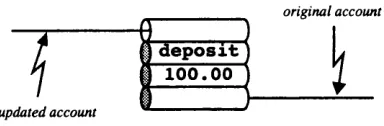
5.7 Using the Method d e p o s i t ... 71
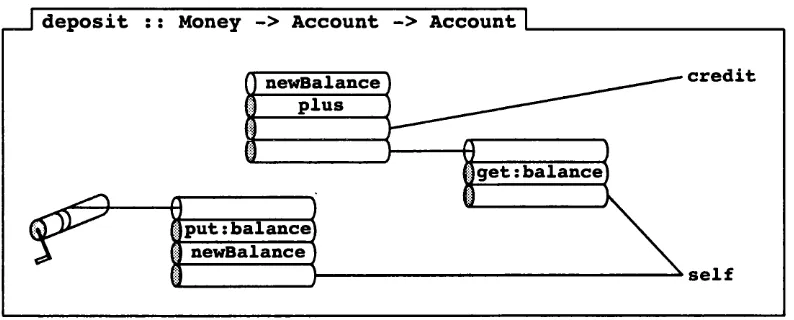
5.8 Method Definition for d e p o s i t ... 72
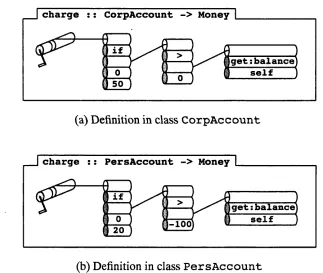
5.9 Using the Method c h a r g e ... 73
List of Tables
Chapter 1
Introduction
The object-oriented (OO) paradigm, together with an appropriate methodology, has successfully delivered many large projects. OO design (OOD) is used extensively in industry since it provides good control and componentisation characteristics for structuring the design of large applications. However, OO programming (OOP) has been rather disappointing: in particular, the expected level of code reuse has not been observed [McC97]. Furthermore, OOP languages have done little to reduce testing and debugging times: current OOP languages are not completely type safe and require extensive run-time testing and debugging.
By contrast, functional programming (FP) is not used extensively in industry, mainly due to perceived low performance, restricted programmer skill base, and poor support for large-scale applications programming (there is typically no methodology supporting analysis and design). However, FP languages can bring major benefits to program development. Complete type safety ensures that a high percentage of all errors are detected at compile time, thereby significantly reducing the time required for run time debugging. Furthermore, functional languages have simple syntax and semantics and the key property of referential transparency ensures that encapsulation cannot be breached and programmers can work securely at an appropriate level of abstraction.
1.1. Goals o f the Research 11
of a minimal subset that is common to most object-oriented languages and, we believe, captures the essence of object-oriented programming. We define the former as “refer- entially transparent with no side-effects and completely type safe, with lazy evaluation, parametric polymorphism, higher-order functions and partial applications” and the latter as “purely object-oriented (where everything is an object), using a class hierarchy with inheritance and pure encapsulation, subsumption through subtyping, method overload ing, method overriding and dynamic despatch”.
1.1 Goals of the Research
This thesis aims to investigate the following hypothesis:
The functional and object-oriented paradigms can be integrated, whilst retaining: • higher-order functions, curried partial applications, referential transparency,
laziness and complete type safety from the functional paradigm;
• subtyping, subsumption, inheritance, method overriding, method overloading and dynamic despatch from the object-oriented paradigm.
We will show that this hypothesis has not been demonstrated by previous research and also why achieving this goal is difficult by identifying the key research problems. We do not aim to prove complete type safety (in that the full construction of a type system including associated proofs is outside the scope of this thesis), but will provide a suffi ciently detailed design, typing rules and type checker to give a high degree of confidence that this is achievable.
1.2 Contributions of the Work
This work contributes to the understanding of the design space of object-oriented and functional programming languages. Specifically, the contributions of this thesis are:
• a new design for completely type-safe dynamic method despatch and overloading;
• a new object-oriented semantics for partially-applied, higher-order methods; • a new design for full overloading of methods in the presence of curried partial
applications and dynamic despatch;
1.3. Overview o f the Thesis 12
1.3 Overview of the Thesis
The thesis is structured as follows: after providing a background of relevant terms and related work in Chapter 2, we establish the problem by discussing the difficult design is sues in Chapter 3; we then present a new language CLOVER, its design features, syntax, type system and abstract expression semantics. In Chapter 4, we present an implemen tation of CLOVER as a translation from OOFP to FP. We then discuss the inappropri ateness of the traditional notion of object identity for OOFP in Chapter 5 and propose an alternative notion, together with a supporting new visual programming notation. In Chapter 6, we assess this work, summarise the project status, suggest directions for further work, and conclude. Finally, in the appendices, we present a type checking algorithm and an example translation from CLOVER concrete syntax to a target functional language.
1.4 Publications
This thesis is based on the following publications (repeated in the bibliography):
[BC96] L. Braine and C. Clack. Introducing CLOVER: an Object-Oriented Functional Language. In W. Kluge, editor, Implementation o f Functional Languages, 8th International Workshop (IFL’96), Selected Papers, Lecture Notes in Computer Science 1268, pages 1-20, Springer-Verlag, September 1996.
[BC97] L. Braine and C. Clack. An Object-Oriented Functional Approach to Information Systems Engineering. In Proceedings o f the CAiSE’97 4th Doctoral Consortium on Advanced Information Systems Engineering, 12 pages, June 1997.
[BC97a] L. Braine and C. Clack. Object-Flow. In Proceedings o f the 13th IEEE Symposium on Visual Languages (VL’97), pages 422-423, September
1997.
1.4. Publications 13
The following paper also provides a case study of the application of several of the OOFP techniques described in this thesis within a large commercial project:
Chapter 2
Background
In this chapter, we provide an overview of relevant object-oriented programming and functional programming terms. We also survey related work by focussing on relevant languages in the areas of object-oriented functional programming and visual program ming.
2.1 Overview of Terms
This section briefly summarises relevant OOP and FP terms as often used in the research communities.
2.1.1
Overview of Object-Oriented Programming Terms
Basic Concepts:
A class comprises both attributes (private data items) and methods (interface functions). Each class has a special constructor function which is used to define (instantiate) an instance of that class with specific values for its attributes. An object is the instantiation of a class. An object may be manipulated by sending it a message, which is the name of one of the object’s methods together with the actual parameters for that method.
Further Terms:
• Binary methods take a parameter (in addition to the distinguished object) which has the same type as the distinguished object.
2.1. Overview o f Terms 15
A distinguished object (DO) is used at run-time to resolve method overriding and determine which implementation should be used for a given method application (see overloading and overriding).
Dynamic binding associates a name with a value at run-time (and often a type, if this is not known statically — see dynamic typing).
Dynamic despatch is a run-time feature which invokes the implementation asso ciated with a method name according to the actual (run-time) type o f the distin guished object.
Dynamic typing associates a name with a type at run-time.
Inheritance is a relationship among classes, wherein a class shares the attributes or methods defined in one (single inheritance) or more (multiple inheritance) other classes (see also [Boo94]).
Multi-methods is a run-time feature which allows dynamic despatch to be based on more than one parameter.
Overloading provides multiple implementations for a method, each with a distinct type.
Overriding provides a replacement implementation for an inherited method or at tribute.
s e l f is an identifier, defined in every method, that is bound dynamically to the distinguished object.
Subsumption allows a function o f type oi ->> a2 to be provided with an argument of type (j3 iff <73 is a subtype of crx.
2.1. Overview o f Terms 16
2.1.2
Overview of Functional Programming Terms
Basic Concepts:
A functional program contains a number of function definitions, each comprising an ex pression definition and a type definition. If the language supports type inference, the
type definition may be optional. In an interpreted system, the user can choose to evalu ate an arbitrary expression which may include applications of any of these functions; in a compiled system, one of these functions (normally called m a in ) is chosen by the com piler as the primary expression to be evaluated. In both cases, the remaining functions provide the environment in which the primary expression is evaluated.
Further Terms:
• Referential transparency is the property ascribed to an expression if its evaluation always returns the same value, regardless of when it is evaluated, or how many times it is evaluated, and regardless of what may have been evaluated in the past or may be evaluated in the future.
• Polymorphism allows type expressions to include variable names which can be dynamically bound to any concrete type. A polymorphic function is one which contains a polymorphic type variable in its type definition.
• Higher-order functions either take a function as (or as part of) one of their argu ments or return a function as (or as part of) their result. A value that is passed as a parameter to a function is said to be a higher-order value if it is a function.
• Currying permits greater flexibility in the passing of arguments to functions. A function of more than one argument may be defined as either: (i) a single mapping from a tuple of all the input arguments to the result value, or as (ii) a sequence of mappings between the separate input arguments and the result value. The latter style is known as Currying and effectively defines a number of anonymous inter mediate functions in addition to the named function. A function that is defined using Currying is also known as a curried function.
2
.2
. Related Work 17that is, it may be applied just to its first argument, or its first two arguments, and so on including application to all of its arguments (in which case it is said to be fully applied). When a curried function is applied to its first argument, the result is another (anonymous) function which is waiting to be applied to the remain ing arguments. The result can be bound to a name, thereby supporting function specialisations.
• Laziness is an evaluation strategy adopted by many modern functional lan guages. There are two general mechanisms for evaluating functional languages: (i) applicative-order evaluation (where arguments to functions are evaluated be fore the function is executed — this corresponds to call-by-value parameter pass ing), and (ii) normal-order evaluation (where arguments to functions are only evaluated if and when they are needed by the function — this corresponds to call- by-name parameter passing). If the function body contains multiple copies of an argument name, normal-order evaluation runs the risk of multiple evaluation of the same term (which is inefficient); thus, an implementation technique is used which ensures that arguments are evaluated “at most once”. This implementation technique is called lazy evaluation — in practice, it also extends to include the lazy evaluation of data constructors, so that quasi-infinite data structures can be supported.
2.2
Related Work
Related work encompasses OOFP languages and the formalisation of OOP (such as a A-calculus of objects [FHM94] and an object calculus [AC96] — the reader is referred to [CW85] for foundational work in this area). In this section, we present an overview of the relevant work in these areas.
2.2.1 Related Work on Object-Oriented Functional Programming
2
.2
. Related Work 181980-1989
Early work such as Flavors [Can82, M0086] and CommonLOOPS [BKK+86] involved the extension of LISP [BB64] with object-oriented features. This work culminated in CLOS [BDG+88], a set of tools for developing object-oriented programs in Common LISP [Ste84]. Significant claims have been made [BGW91] that CLOS combines both OOP and FP as it supports the OOP features of classes, inheritance and method despatch, together with the FP features of Common LISP. However, because it is based on LISP (like Flavors and CommonLOOPS), it is not referentially transparent and therefore fails to satisfy one of the criteria stated in the hypothesis.
1990-1992
In the early 1990s, interest in OOP/FP integration increased, with several newly de veloped languages. However, five of these languages (Leda [Bud95], Quest [CL91], Rapide [MMM91], UFO [Sar93] and 0 2FDL [MCB90]) are not referentially transpar ent, FOOPS [Soc93] has no higher-order programming facilities, LIFE [AP93] only supports a simulation of FP, and G [HL91] and HOP [DV96] do not support full OOP. Kea [MHH91], Leda, Rapide, UFO, 02FDL, G and HOP are briefly outlined below:
• Kea is a higher-order, polymorphic, lazy functional language supporting multi methods and a type inference system. Unlike Smalltalk [GR83], Kea does not enforce certain aspects of OO encapsulation. In particular, Kea functions do not have to be associated with classes according to a distinguished object. Further more, Kea’s notion of polymorphism only admits the single type variable Any, and [MHH91] states that Kea “is currently being extended to include higher-order and (implicitly) polymorphic functions”, which implies that it does not have these features.
2
.2
. Related Work 19that are at odds with this technique”). Such a discipline requires the avoidance of many OOP features and Leda should, therefore, be viewed as providing either FP or OOP, but not integrating both simultaneously.
Rapide extends Standard ML (SML) [MTH90] with subtyping and inheritance. Objects are modelled as structures, and SML is extended so that structures may be passed to and from functions. Unfortunately, Rapide retains SML’s lack of ref erential transparency and, indeed, relies on it.
United Functions and Objects (UFO) is an implicitly-parallel language that “at tempts to bring [the functional and object-oriented] worlds together in a harmo nious fashion” [Sar93]. A functional subset of UFO provides OOP features such as classes and inheritance, but referential transparency is lost once any of the lan guage’s stateful features (stateful classes, instance variables, etc.) are used. It is interesting to note that even the functional subset is not lazy, on the grounds that it “conflicts with dynamic binding”.
0 2FDL is an interactive database programming language that combines inheri tance and encapsulation from OOP with an equational programming style and strong typing from FP. Although [MCB90] provides a denotational semantics based on an extended A-calculus, referential transparency is preserved only within a given database state, not across the database lifetime.
G is a language framework that aims to integrate algebraic, functional and object-oriented programming. The language design is closely related to Rapide [MMM91], but requires the programmer to define explicit conversion functions between types. G therefore lacks a key OOP feature of implicit subtyping.
2
.2
. Related Work 20no explanation of how dynamic despatch, inheritance, subsumption, overloading and overriding would be implemented.
1993-1995
In this period there were a number of notable attempts at integration, plus extensions of previous systems. OBJ [GWM+93] is a functional language that supports multiple inheritance, exception handling and overloading but has no higher-order programming facilities. ST&T [DK94] is an extension of Smalltalk’s type system bringing it closer to ML, though the result is first-order, strict, and still not referentially transparent. Uflow [SKA94] is an extension to UFO using a data-flow model for visualising execution, but is still not referentially transparent. Oz [MMR95] is a multiparadigm language which aims to encompass logical, functional and object-oriented styles; however, its use of “mutable binding of a name to a variable” results in referential transparency being main tained only “inside the objects”, not across objects nor the language in general. Finally, Caml Special Light [Ler95] (later re-named Objective Caml) laid the foundations for Objective ML (see next subsection), but unfortunately these foundations are not refer entially transparent.
1996-1998
2
.2
. Related Work 21casting operators and, importantly, does not consider the effects of assignment and state. Bla [Oor96] claims to unite functional and object-oriented programming through first class environments [GJL87]. However, none of these languages except CLOVER is ref erentially transparent.
ML< [BM97] is a decidable type system for higher-order object-oriented lan guages. It takes a polymorphic multi-methods approach (rather than the “standard” view of objects as extensible records with single-despatch methods) and can be applied directly only to multi-methods languages such as CLOS.
2.2.2
Related Work on Visual Programming
The functional paradigm is often chosen as the underlying computational model for VP because its simple semantics can be realised elegantly in standard data-flow notation. Examples of visual functional languages include:
• HI-VISUAL [MYH+84] is a visual data-flow programming language with an in teractive iconic programming environment;
• viz [Hol90] is an active data-flow visual language based on the A-calculus;
• VPL [LBF+91] is a demand-driven higher-order data-flow visual programming language for interactive image processing;
• Cantana [RW91] is a data-driven data-flow visual language component of Khoros (a general-purpose programming language);
• VISAVIS [PVM95] is a purely functional higher-order visual programming lan guage based on the Formal FP (FFP) model [Bac78].
2
.2
. Related Work 222.2.3
Summary o f Related Work
Chapter 3
The Design of CLOVER: An OOFP
Language
In this chapter, we present the new object-oriented functional language CLOVER, its design features and syntax. In addition, we present CLOVER’S type system, abstract expression semantics and also address referential transparency.
3.1 Design Issues
The most stringent criterion that we can devise for an object-oriented functional lan guage is that it must be purely functional — that is, it must be referentially transparent with no side effects — for without this property most of the formal-methods advantages of the functional paradigm are lost (e.g. most static analysis and program manipulation techniques for FP languages assume referential transparency). As discussed in Chap ter 2, attempts to create OOFP languages typically abandon referential transparency, despite its fundamental importance being emphasised repeatedly in the FP literature (e.g. “this property [referential transparency] is the hallmark of a functional language, and that under no circumstances should it be abandoned” [Sto85]).
Thus, our view is one of extending FP towards OOP rather than the other way around. Note that this requires us immediately to discard imperative notions of multiple assignment (see Chapter 5). We make two more design decisions at the outset:
3.1. Design Issues 24
ing explicit object delegation.
2. We choose dynamic despatch based on a single distinguished object to avoid the complexities of the multi-methods approach and to increase encapsulation.
In the remainder of this section we present five design issues which illustrate why the integration of OOP and FP is such a difficult task. Note that these issues are purely examples and are not a comprehensive analysis.
3.1.1
T^pe Safety versus Dynamic Despatch
A key feature of OO languages is dynamic typing (resolving the type of an object at run-time). In particular, subtyping permits conditional statements to return different subtypes of the declared return type. Thus, in general, it is not possible to resolve method despatch statically for dynamically-typed objects.
With dynamic method despatch, a run-time check is made on the actual type of the object receiving a message; the ambiguities arising from inheritance and method overriding are then resolved and the appropriate code is executed.
Many OO languages assume and accept that this implies type errors may occur at run-time. Having realised that this is undesirable, some OO language designers have created what they claim to be “type safe” OO languages: Eiffel [Mey91], for example, makes this claim. However, Eiffel actually provides an assignment attempt operator which handles run-time type errors in a controlled manner by assigning a v o i d value; it is assumed that the programmer will always check for the possibility o f a v o i d value and take appropriate action. This is not what functional programmers think of as “type safe” ! The FP world requires complete type safety, where the type system guarantees that it is impossible for a type error to occur at run-time.
3.1. Design Issues 25
3.1.2
Type
Safety versus Overloading and Partial Applications
Overloading is a common feature of 0 0 languages, allowing different definitions for the same method name. These overloadings can be distinguished by the types of the mes sage arguments and return value: each overloading must have a unique type signature. Overloading is certainly a desirable feature that we would wish to incorporate since it allows, for example, multiple ways to set a date:
d a t e ( 7 , " A u g u s t " , 1 9 9 6 ) d a t e ( 7 , 8 , 1 9 9 6 )
In the above example, the two overloaded versions o f d a t e take the same number of arguments. However, it is also important to support overloading with different numbers of arguments, for example:
t i m e (1 2,0,0) t i m e ( " n o o n ")
We wish to support fu ll overloading: that is, overloaded methods able to vary both in the type and number of arguments declared.
Unfortunately, it would appear to be impossible to combine dynamic despatch with curried partial applications and full overloading. With full overloading, the number of arguments in different overloadings may vary. With partial applications, a method may be applied to only some of its arguments. If the partial application uses the curried style (rather than, for example, a tuple with dummy values for the missing arguments), then there are ambiguities which are impossible to resolve at run-time. For example, given the following overloaded definitions (using the 24-hour and the 12-hour clock):
t i m e ( a : i n t ) ( b : i n t ) ( c : i n t )
t i m e ( a : i n t ) ( b : i n t ) ( c : i n t ) ( d : s t r i n g )
then is the application t i m e 6 0 0 a full application of the first overloading (mean ing 6 am) or a partial application of the second overloading (which could eventually be
3.1. Design Issues 26
3.1.3
Curried and Partially-Applied Methods
Currying, higher-order functions and partial applications are key features of the func tional programming style, yet are absent from OOP. This is not unreasonable, since OO programmers normally perceive messages to be indivisible and it is not clear what a par tially applied message would mean. For example, if the method f takes distinguished object o and normally takes three arguments a, b and c , then what does the message f a b denote? Can it be given a name? What does it mean operationally? Can it be sent as it is to the object o or must it be delayed until the final argument is ready? If it is sent to the object, what does the object do with it? Must it store it and wait for the final argument to arrive? The denotational and operational semantics of partial applications have not been fully addressed in the OO world.
Furthermore, as we have already seen, it is difficult to reconcile curried partial ap plications with dynamic despatch and full overloading.
3.1.4
Subtyping
Subtyping is central to OOP but absent from current “production” FP languages. Haskell [PHA+97] has at various times been the subject of claims that its type classes mechanism [WB89] facilitates OO programming [Ber92]; this has promulgated the mistaken assumption that Haskell’s type classes provide subtyping. Unfortunately type classes do not provide the subtype relationship that we require; rather, they support a structured form of overloading.
If we are to support dynamic despatch, then the run-time method despatcher must accept an argument of many different types (the method’s distinguished object); this requires either subtyping or flattening the entire type system into what is essentially a monotyped language. Similarly, subsumption requires subtyping to be applied to method arguments.
3.2. CLOVER 27
Whereas polymorphic type inference used to be considered undecidable for inclusion types, recent work [BM96] has demonstrated that decidable systems can be implemented.
3.1.5 Lazy Evaluation versus Discrete Messages and State Update
We wish to retain the powerful FP feature of lazy evaluation, yet this does not seem to have a natural meaning within the message-passing view of OOP. For example:
1. Multiple assignment semantics require strict state update;
2. State update is driven by the arrival of a message (data-driven);
3. Messages are discrete, finite and pre-evaluated;
4. Sending a message is an atomic action.
The above views seem to preclude the incorporation of any notion of lazy evaluation into OOP. However, we will show in the next section that it is in fact possible to employ lazy evaluation in a language that supports object-oriented features.
3.2
CLOVER
We now present the design for a higher-order, lazy, object-oriented, completely type- safe functional language; we call this language CLOVER. CLOVER provides:
1. a new design for completely type safe dynamic method despatch and overloading;1
2. a new object-oriented semantics for partially applied messages and higher-order functions;
3. a new design for full overloading of methods in the presence o f curried partial applications and dynamic despatch;
4. a new programming notation and semantics for object state, object identity and object-oriented lazy evaluation.
^ o t e that Eiffel claims type-safe dynamic despatch but at the cost of losing overloading, whereas
3
.2
. CLOVER 28CLOVER is intended to be used for application development, not low-level systems programming. We support programming at the specification level, much as functional languages can be used to write executable specifications [Tur85a].
CLOVER supports the traditional OOP features of a class hierarchy, subtyp ing, subsumption, inheritance, method overloading, method overriding and dynamic despatch. It also incorporates the FP features of referential transparency, single assignment attributes, polymorphism, curried partial applications, higher-order func tions and lazy evaluation. Methods are defined as expressions — they are pure functions with no side effects.
The language is completely type safe, there are no pointers and memory allocation is automatic; thus, CLOVER is a secure language which could be used, for example, to produce totally secure applets for the World-Wide Web. However, a secure CLOVER run-time system as a browser plug-in is left for future work!
In our prototype, a lazy functional programming language is used as an interme diate language: CLOVER code is first type-checked using a bespoke type-checker (see Appendix A) and then translated into a standard functional language. This allows the use of a standard compiler for final code generation.
3.2.1
Design Features
The key to CLOVER’S successful support of both OOP and FP is in the careful integra tion o f a number of different design criteria. Since there are so many design parameters (subtyping, subsumption, inheritance, overloading, overriding, genericity, partial appli cations, Currying, laziness, etc.), the design space is extremely large and our goal has proven to be remarkably elusive. However, as is so often the case, the solution appears quite natural in retrospect.
3
.2
. CLOVER 29Bounded universal quantification:
It is clear that dynamic typing is incompatible with knowledge of actual types at compile time, yet we require a language which has dynamic typing and is also completely type safe.
The first step to solving this apparent conflict is to ensure that upper bounds on types are always known statically. This allows dynamic typing (in that the actual type of an expression can be any subtype of the known upper bound), whilst ensuring that all type errors (in terms of the upper bounds) can be detected at compile time. We cur rently require the programmer to give explicit upper bound types in all method type sig natures and for all method arguments, though in future we hope to implement a subtype inference system. Inclusion polymorphism is thus implemented as bounded universal quantification [CW85].
Monotonic inheritance:
For completely safe method despatch, statically resolvable upper bounds are only part of the solution. When a message is passed to an object, the required method must also actually be defined for that object. The static knowledge of the upperbound type of the object must therefore be coupled with the restriction that inheritance be monotonic; that is, if a method or attribute exists for a given class then it will also exist (with identical type signature) for all of its subclasses.
Shallow subtyping:
In order to achieve complete type safety, it is essential that full method overloading can be resolved statically. Since only upper bound types are available at compile-time, we must therefore restrict CLOVER to shallow subtyping— that is, an inherited or reimple mented method must have the same type as its ancestor. We provide full method over loading (with different types and numbers of arguments) but insist that all overloadings are declared in the class where the method name is first defined. Thus, if an overloaded method application is valid for a given type then it will be valid for all subtypes.
Implementation of message application:
3.2. CLOVER 30
For CLOVER, we wish to support curried partial applications and so it would seem that the above application could naturally be implemented as f o a b c. How ever, this causes problems for partial applications of messages. As previously dis cussed, there is a problem with the semantics of partial applications in an object-oriented context. Considering the above implementation technique, what would f o a mean, both denotationally and operationally?
We define a partially-applied, message as a method that has not yet been applied to all its arguments and that has not yet been applied to its distinguished object. We allow a partial application to be named, to be passed as an argument to a method, and to be returned as a result from a method. However, only a fully-applied message can be sent to a distinguished object.
To implement these semantics precisely, we adopt the unusual procedure of placing the distinguished object as the last in the sequence of curried arguments: f a b c o.
Laziness:
The key to the incorporation of laziness in CLOVER is our new concept of object identity, as explained in Chapter 5.
3.2.2
Language Overview
A CLOVER program consists of three components:
1. an invocation (an expression);
2. a class hierarchy (a tree with at least one class);
3. for each class, an unordered set of attribute declarations and method definitions.
3.2. CLOVER 31
methods may be objects or messages (including partial messages). Thus, CLOVER is higher-order, treating messages as first-class citizens.
The class hierarchy represents the subtype structure (see Section 3.3.1). Subclasses may inherit methods and attributes through shallow subtyping only — that is, an in herited or reimplemented method must have the same type as its ancestor. Overloaded method declaration is allowed, but only in the greatest superclass where the method is first defined; thereafter, the separate overloaded instances may be inherited and reimple mented through shallow subtyping as described above. Thus, CLOVER supports both overloading and overriding.
Each class is a subtype of its parent and subsumption allows a formal method parameter of type a to be bound to an actual parameter of type r as long as t is a subtype of a (and using the contravariant rule to establish subtypes of higher-order arguments). Method overloading is resolved at compile-time, whereas method overriding is resolved at run-time by dynamic despatch on the type of the distinguished object (if the distinguished object’s class does not define or override the method, the despatcher (conceptually) searches up the inheritance hierarchy to find the least superclass which has a definition for the method — note that this cannot fail at run-time). CLOVER provides completely type-safe subsumption and dynamic despatch using bounded universal quantification of type names.
3.2.3
Language Primitives
3.3. Type System 32
3.2.4 Abstract Expression Syntax
The following abstract syntax for an expression is based on the typed A-calculus (extended with let and case constructs) and with objects as constants:
In the above syntax, a denotes a type. Methods, bound variables and object attributes are
the implementation. A-abstractions are only used at the top level of a method binding. Support is provided for bindings with local scope using let. However, these bindings may only be local constant applicative form s [Pey87]; that is, they may not be parameterised A-abstractions but they may be any other expression which returns either an object or a (partial) message. The restriction which outlaws the A-abstraction in let bindings prevents the undesirable creation o f new methods as local definitions, since all methods should formally be specified as part of a class interface.
The typechecker’s (static) overloading resolution and the implementation of (dy namic) method despatch are illustrated in the abstract expression semantics (see later).
In this section we briefly sketch the design of the CLOVER type system. Our proto type currently supports simple type checking rather than full type inference (see A p pendix A). For an introduction and review of types in object-oriented programming, see [FM95],
value :: x*1 . . . x ann
I Xxax . eae
n > 0 (object c o ns tr u ct or)
(■cu rri ed m e th o d d e f i n i t i o n )
(built — in m e t h o d)
( i m m e d i a t e d a t a)
l i teral°
expr :: value
I ea^~^a'2 x ° x
(value)
<*x Si (cur ri ed appli cati on,
S is d e f i n e d in Sect ion 3.3.3)
( name)
let (xi = e\ x) . . . ( xn = e£n) in eae n > 0 (local d e f i n i t i o n )
j = 1 . . . m , m > 0, nj > 0 Vj
referenced through identifiers (“x ”) and key primitive methods are built-in to facilitate
3.3. Type System 33
3.3.1
T^pe Syntax
A type is either an object, a message (which has function type), a bracketed message or a primitive (which is required within class definitions for primitive types). The explicit bracketing is necessary to denote a function type being returned from a method — this facilitates identification of the distinguished object (the last argument to a method). Each class has a distinct type constructor name k (we define a one-to-one correspondence between the class name and the type constructor name). Thus, the syntax for types in CLOVER is given by:
r :: k
I ti —y r2 I (r i —> t2)
I 'b o o l' | 'c h a r' | 'num'
3.3.2
Overview of T^pe Semantics
We define an object’s type as the set of the names and types of all its attributes and methods:
TQk;]] = { x z} U {rrii},Xi £ A t t r i b u t e s ^ ) , rrii £ M e t h o d s (k)
T \ct\ —»• <72] = T [<7i] —y T [< t2]
T[(<7i — y < j 2 ) J = (T[criJ — ► 7 ” | o ’2 J)
3.3.3
Subtyping
Although we would rather have the intermediate FP language compiler do the type checking, our preferred languages (Miranda [Tur85] and Haskell [PHA+97]) do not yet provide subtyping and are therefore unable to check inclusion polymorphism. We there fore currently implement a simple subtype matching algorithm (see Appendix A).
3.3. Type System 34
We define the subtype relation operator X as follows:
«i «2 iff T [[«2]] c T[[«i]]
( 7 i (72 ^ Ti -> r 2 iff (ri ^ <7i) A (cr2 ^ r 2) (<7i or2) ^ (ri —>• r 2) iff (ti ^ (7i) A (cr2 ^ r 2)
«* 2^ n ^2 «* 2^ ( n -> t-2 ) (72 2^
<7-1
(<7i cr2) ^ Ki (ai —>■ cr2) 2^ r i r 2
<Ji —>■ cr2 ^ (ti —» r 2)
3.3.4
Overloading
A method may be defined at many different types, where the types are completely unre lated. However, we require each overloaded definition to have a unique type signature that is statically-resolvable from the other overloaded definitions. Thus, given two over loaded method definitions of type <j\ —> crdist -> 02 and t\ -* crdist —y r 2 (where crdist
is the type of the distinguished object), we require that either (<ti n ) A (ti <ti) or (<72 2^ t-2 ) A (r2 2^ 02)* This generalises to multiple arguments and overloadings with different numbers of arguments. Note that this style of overloading permits some covariant specialisation.
3.3.5
Polymorphism
3.3. Type System 35
Our type matcher (see Appendix A) checks declared return types against declared argument types, for every application, to ensure that the subset relationship holds. We do not attempt type inference; type inference for inclusion polymorphism has long been considered problematic and, though we are encouraged by recent work [AW93, BM96], dynamic despatch causes problems for CLOVER type inference.
In this section, we provide a set of typing rules for the CLOVER type system. We use x : a to denote an assumption (an association of type a with variable x), T b x : a to mean “from the set of assumptions V we can deduce that x has type a”,
not already contain a typing for x%and y to mean “from X we can infer V ”. Note that the Let rule does not handle recursive functions — this is left for further work.
3.3.6 Taping Rules
r U { x : cr} to denote the set of assumptions formed by adding x : cr to T (which does
r \ j { x : a } h x : a [Var]
T U { l i t e r a l : cr} h l i ter al : cr [Lit]
[Builtin]
T \~ C <7i — y crn —)■ cr f h (x\ : t~i) . . . (x n : Tn
T h ( C X\ . . . x n) : cr Ti X <ji [C o n s t r]
[App]
T U { x : a } \ ~ e : r
T h (Xx.e) <7—y r [Abstr]
r U {xj : 0-j} h e : cr Vh e, : r
t-, Ti ^ (7j-, 1 < i < n [Let]
T h (let (z i = e i ) . . . ( xn = en) i n e) : cr
r h e : cr Tj l~ ( C Xjx ■.. Xjn) : aj Tj h ej : ctj
3.3. Type System 36
3.3.7 Type Safety
We distinguish between languages that check types at compile-time and those that check type tags at runtime. CLOVER checks all types at compile-time and catches all type errors statically, yet still supports dynamic despatch. Thus, no type errors can occur at run-time — this is our definition of type safety. However, our system does not, of course, catch all possible errors (e.g. division by zero and non-termination).
In particular, we contend that our system will never send a message to an object that does not have a corresponding method implementation for that message. Briefly, this property can be argued for CLOVER as follows:
• if a method exists for a class, it is defined to exist for all subclasses (due to the property of monotonic inheritance introduced previously);
• an object supports exactly those methods that are defined for its class;
• each method application is statically type-checked using the explicitly-annotated upper bound types of the arguments and the distinguished object;
• if the type-checker proves the existence of the method for the upper bound type of the distinguished object, and if at runtime the distinguished object must be either of that upper bound type or of a subclass, then the method must exist for the actual object present at runtime.
3.4. Concrete Syntax 37
3.4 Concrete Syntax
The complete concrete syntax for CLOVER is specified below. This includes constructs for defining a hierarchy with classes containing attributes and methods, constructors, type declarations and all language keywords.
Program ::= Node Invocation
Invocation : : = 'in vocation ' Expression
Node ::= Class Subclasses
Class 'c la s s ' I dentif ier Attributes Methods
Attributes 'a ttr ib u te s ' '{7 Attribute* '};
Attribute I dentif ier Typing
Methods 'methods' '{' Method* '}/
Method I dentif ier Typing '{ ; Me th o dD ef M e th o dD e f ::= I d e nt i f i e r+ '= ' Expression
Subclasses 'su b c la sses' '{' Node* '}'
Expression Ident if ier Typing
Expression Expression Typing
' ( Expression ') ' Typing
'le t ' '{' Binding* 'in' Expression Typing
'new' I dentif ier Constrs Typing
Literal Typing
Binding ::= I dentif ier '= ' Expression ';'
Constrs '()r | ' ( ConstrArgs ')'
Cons tr Args ::= Expression | Expression ';' ConstrArgs Literal ::= 'True' I 'False' I CHARACTER I NUMBER
Typing
Type
:= Type := Identif ier
| Type ' - > ' Type
3.5. Abstract Expression Semantics 38
3.5
Abstract Expression Semantics
In this section, we provide a full definition of CLOVER’S abstract expression semantics. This includes the key issues of subsumption, (static) overloading resolution and (dynamic) method despatch. Note that the complete translation of CLOVER into a standard functional language is defined in Chapter 4. We use the semantic functions £ and /C to map from syntactic to semantic domains:
£ :: E x p r e s s i o n s —> E n v i r o n m e n t s —> S e m a n t i c Val ues
)C :: C o n s t a n t s —> S e m a n t i c Values
K is pre-loaded with the semantic definitions of the primitive methods, literals and constructors. Similarly, the syntactic definitions of the user-defined methods are pre-loaded into the syntactic function select:
select :: E x p r e s s i o n s —> M e t h od s —» E x p r e s s i o n s
In the following equations, (select e°e dynamically
despatches (returns the lambda abstraction associated with) method m from class a e at overloaded type a Xl -» aX2 —» a Xn —>• k. In essence, the equation containing select illustrates how the last argument of a method application is given special status as the distinguished object and the method definition is determined by reference to the type of that distinguished object. Note that the special bracketing syntax for types is required so that we may detect the distinguished object for a method which returns a message. Also, subtype constraints are checked statically based on upper bound types.
3.5. Abstract Expression Semantics 39
S \ C ° ^ x l 1 . . . p = (1C \ C° ^ e x . . . en
where e t = S [xf'J p
S l * t \ p = £ [ * ? !
S \ l ite r a la\ p = K [ilite r a la]
5 [x a] p = S { p { x a )}
S ^rn<Txi ^ <7x'2~*"'^>'(Txn^'T e[ei e ^ 2 . . . e^en]] p
= £ e ^ 1 e ^ 2 . . . e£e"] p,
n > 1, r = (« or (a-! —>■ <r2))
where ( Xx . e ) = select eanen m ax^ <Jx^ - ^ CJxn^"r
S [(Ax . e Y x^ ax^ ^ ' " ^ axn~^T e[ei e ^ 2 . . . e£en] p
= S [e<7*2-)---)‘cr*n->-T e^62 . . . e£eri] ^(x := e i),
n > 1, (7ei r< <Txi •> (k or (<Ti <72))
£ [m <T,_K"_*°r"-,,T] p = Axi . . . x n . (£ [m CTl_K"_^ n_*'r x i .. . x j p),
n > 1, r = (k or (<7X —»■ cry))
£ [(Aar.e)'71^ 2] p = Ax . (£ [e*2]/?)
£ [eai“^ 2 x CTl] p = (£ [e'71^ 2]] />) (5 [x a*] p), a x < o x
5 [/e * (x i = e l 1) . . . (x„ = < n) in eae] p = £ [e*6] p (x i := e*1, . . . , x n := ej")
£ \case ea o f ( C f1 x jj1 .. a \nj
• ®im PCTl •el >
(^a3 aJnj
• x;n; ->■ ( J , e • ■ cj » pom
"ml • •• < , " T -+ O I p =
where ^ — C j3 ej}1e ■a]Tl.jnj
''c
£
II
3.6. Referential Transparency 40
3.6 Referential Transparency
The term “referential transparency” was first used in [WR13] to describe an aspect of syllogistic logic when only the content of a statement is required, not its circumstances. The term was subsequently introduced into computing in [Lan64] and has become an important property of functional languages.
We adopt the following definition, taken from [Dil88], where a language is referentially transparent if it satisfies the following two conditions:
• Different occurrences of the same expression in a single scope have the same meaning;
• Two different expressions which have the same meaning anywhere in a single scope have the same meaning throughout that scope and, hence, can be substituted for each other anywhere in that scope.
We argue informally about CLOVER’S property of referential transparency by referring to the abstract expression semantics in the previous section. The above concept of a “single scope” is defined for our purposes as a constant value for the environment p.
Values of base-case expressions are computed by applying either: (i) the semantic function 1C (to literals or primitives), or (ii) the semantic function S (to variables and the environment p). In the former case, 1C is pre-loaded with bindings that never change, whereas in the latter case selection of a binding from the environment is achieved using a LIFO search and therefore, for a given environment and name, will always return the same value. Furthermore, the environment p is only modified as the result of a let or A expression, and in these two situations the environment is extended.', existing bindings in the environment are not modified.
Some care must be taken with the operation of the select function, which deter mines the value of a method name for a fully-saturated application. It suffices to note that selectalways returns the same result when passed the same arguments.
3
.7
. Summary 413.7 Summary
Chapter 4
The Implementation of CLOVER: A
Translation from OOFP to FP
In this chapter, we present the key stages of an implementation of CLOVER as a set of rewrite rules. Many implementation routes are possible, but we choose a functional language as our target code. This permits the exploitation of automatic memory man agement, lazy evaluation and Currying (all of which become available at zero imple mentation cost). Furthermore, we can generate concise understandable code (which is more important than execution speed for our prototype implementation).
In order to provide a focussed discussion, we ignore all issues related to type check ing and assume that this has already been performed (see Appendix A for type checker). We similarly assume that the straightforward translation from CLOVER’S visual nota tion, Object-Flow, to a textual code has already been performed. The goal is to describe the translation from an abstract form of this code, Abstract Program Code (APQo), into an abstract form of a simple functional code, Target Code (TC). We give detailed al gorithms, to provide a basis for others to explore and further develop these ideas. We also provide the first demonstration of how to support completely type-safe dynamic despatch in the presence of (partially-applied) higher-order methods.
4.1 Overview of the Transformation Rules
4.1. Overview o f the Transformation Rules 43
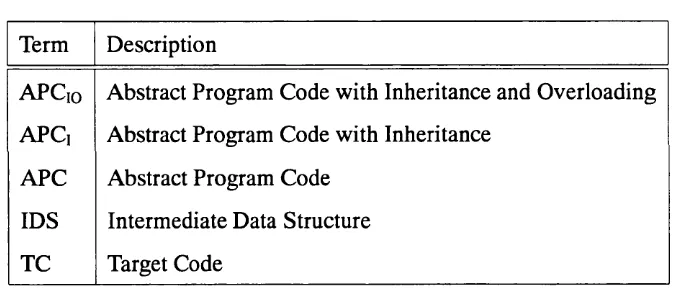
of high-level translations, as illustrated in Table 4.1 (the terms are expanded in Table 4.2 and explained fully in subsequent sections).
Table 4.1: Summary of Main CLOVER Translations
Translation Source Target Description
V
Object-Flow A PQ o Parses visual language into abstract coden
A PQ o A PQ Resolves overloaded methodsi
A P Q APC Expands inherited attributes and methodsT
APC IDS Flattens and inverts program structureQ
IDS TC Generates target codeTable 4.2: Terms Used During Translations Term Description
APQo APC, APC IDS TC
Abstract Program Code with Inheritance and Overloading Abstract Program Code with Inheritance
Abstract Program Code Intermediate Data Structure Target Code
We define the translation T of Object-Flow into TC as the complete transformation, composing the other translations as shown below:
Translation of Object-Flow into TC
I--- 1 T :: ProgramoF -+ P r o g r a m r c
T[ o f ] = G o P o I o 7 Z o P [ o f ]
4.1. Overview o f the Transformation Rules 44
transforming A P Q into APC. The fourth translation, T , flattens and inverts the code to create an intermediate data structure (that is more amenable to later functional code generation) by transforming APC into IDS. Finally, the translation Q generates target code in a simple abstract functional language.
4.1.1
Notation
We use two main notations within this chapter: one to define the abstract syntax of our languages and data structures, and the other to define the transformation rules which operate on them.
We define abstract syntax by induction on syntactic structure, using Extended-BNF notation. We use to define syntactic categories, () for grouping, [ ] to indicate zero- or-one, * to indicate zero-or-more, + to indicate one-or-more, | to separate alternatives and ' ' for terminals.
We define transformation rules to manipulate syntactic categories directly. The rules are higher-order and exploit curried notation, with rule names not italicised so that curried rule applications, e.g. “(expAttrs ns a s l n h ) ”,can be differentiated from se quences of syntactic categories, e.g. “(c l d a t t r s m s ) ”.There is no special bracketing notation for lists; instead, we define the following operators and rules for direct manip ulation of syntactic categories.
Operators and transformation rules for list functionality
x © (y i... yn)
(zi ... xn) ® (yi ... yn)
hd (xx ... xn)
tl (xi x2 ... xn)
map f () map f (x 0 xs)
concat () concat (x © xs)
(f x) © (map f xs)
o
x ® (concat xs)
4
.2
. Abstract Program Code (APC) 454.2
Abstract Program Code (APC)
We use “Abstract Program Code” to describe three language forms that are syntactically very similar: (i) Abstract Program Code with Inheritance and Overloading (A PQ 0), (ii) Abstract Program Code with Inheritance (A PQ ), and (iii) Abstract Program Code (APC).
A PQ o provides all the object-oriented features discussed in Chapter 1. After an Object-Flow program has been parsed into A PQ o, it is first translated into A PQ (which has no method overloading) and then into APC (which has explicit, rather than implicit, inherited attributes and methods). The syntax o f A PQ o and A P Q are identical, and are almost identical to APC. The semantics of these language forms are, however, consid erably different and the translations must, of course, preserve the original program se mantics.
4.2.1 Syntax of Abstract Program Code
APC is a pair consisting of a class hierarchy and a program invocation definition (see below). The class hierarchy is a recursively-defined tree structure with each node con sisting of a class definition and its subclasses. A class definition contains the class name, a list of attributes and a list of methods. An attribute consists simply of an attribute name and its type, and a method consists of a method name, its type and an expression repre senting the method implementation. Similarly, the program invocation definition is an expression (except that the semantics prohibit it from containing A-abstractions).
The expression syntax is based on the typed A-calculus, with the addition of object constructors which require the type (i.e. the class name) o f the object to be constructed together with a list of arguments. The constructor definitions themselves have the same syntax as method definitions, although the semantics are somewhat different (see Sec tion 4.4.2). Note that all expressions are annotated with an explicit type tag.
4
.2
. Abstract Program Code (APC) 46Syntax of APCio and APC|
P r o g r a m m e " = Node P r l n v D e f P r l n v D e f ::= Expr
Node C l a s s D e f Node*
C l a s s D e f C la s sN ame Attribute* Method*
Attribute AttributeName Type
Method ::= MethodName Type Expr
'Object' C l a s s N ame Expr* Type
'V ariable' VariableName Type
'V ariable' MethodName Type
'B u iltin ' PrimFunction Type
'Apply' Expr Expr Type
'Lambda' VariableName Expr Type
'Let' Binding* Expr Type
'L ite r a l' Pr imVal ue Type
VariableName Expr
'BoolVal' bool | 'CharVal' char | 'NumVal' num
'Plus' | 'Minus' | 'M ultiply7 | 'Divide' | ...
| 'If' | 'And' | 'Or' | 'Not' | ...
| 'Equal' | 'GreaterThan' | 'LessThan' | ...
Type 'ClassType' C l a s s N ame
| 'FunctionType' Type Type
| 'BrFunctionType' Type Type
| 'Prim itiveType' Pr imType
Binding
PrimValue
PrimFunction
P r i m Ty pe 'b o o l' | 'c h a r' num
C l a s s N ame, Attribute Name, MethodName, VariableName E { I d e n t i f i e r s }
trans-4
.2
. Abstract Program Code (APC) 47lation) and indicate explicitly that the implementation is inherited (but not overridden) and should be reused from a superclass.
Syntax of APC
i I
As for A PQ o and APQ, except Expr is extended as follows:
Expr ::= ... | 'Reused' C l a s s N ame
4.2.2
Translation of APCI0 into A P Q
We translate A PQ o into A PQ by resolving method overloading. This involves gen erating new names for each separate type-instance of a method definition: these new method names must be used appropriately wherever the overloaded method name is ap plied, so the entire program must be transformed and the type of every application must be checked.
Overloading resolution proceeds in two phases:
1. Scan all classes and, where overloaded method definitions are found, generate new names and add them to a translation table. Each entry in the table is a triple comprising the overloaded method name, the type, and the resolved method name.
2. Use the translation table from the first phase to tranform the program (i.e. both the left-hand-side and right-hand-side of all method definitions, together with the invocation), so that all occurrences of overloaded method names are translated according to the types at which the methods are applied.