Licensed under Creative Common Page 186
http://ijecm.co.uk/
ISSN 2348 0386
DEVELOPING MODELS OF MANAGERIAL
COMPETENCIES OF MANAGERS: A REVIEW
Mimoza Manxhari
Department of Management, Faculty of Economics, University of Tirana, Albania [email protected]
Liridon Veliu
Department of Management and Informatics, Faculty of Economics, University of Prishtina “HasanPrishtina”, Kosovo
Jetullah Jashari
Akademisches Lehrkrankenhaus Klinikum Aschaffenburg, Germany [email protected]
Abstract
The purpose of this paper is to analyze the managerial competencies models. The literature
review comprises peer-reviewed journal articles, white papers, conference proceedings and the
topic of managerial competencies and models. This study aims to present models of managerial
competencies from many authors. Managerial competencies are becoming one of the key
building blocks of success of the company to achieve both the mission and vision in creating
added value and improve business performance and especially the development of their own
people. Managerial competencies play a pivotal role in organizational effectiveness. The
competency model is a tool for detection and identification of needs for its development. The
models managerial competences in many organizations have become an important part of
human resources management. In the professional literature we can read about the different
competency models that are designed for managerial competencies. Research into
competencies which in this study is the underlying attributes of a manager, started mainly in the
USA, followed by the UK and later the interest for this topic spread to the rest of Europe.
Licensed under Creative Common Page 187 INTRODUCTION
According to Armstrong (2001), a competence is a work-related concept that defines the areas of work in which a person needs to be competent. Managers are required to ensure that organizations achieve their objectives. Managerial competencies are defined as sets of knowledge, skills, behaviors and attitudes that a person needs in order to be effective in a wide range of managerial jobs and various types of organizations (Hellriegel, Jackson, Slocum, Staude, Amos, Klopper, Louw and Oosthuizen, 2004). Organizations applying several managerial competencies which drowse attention to the need to understand how different these competencies are working in organizations, this require to highlight the most effective competency in order to enhance it for a good performance.
Competency is an important concept in organization management since it is closely related to excellent work performance (Levenson, Van der Stede& Cohen 2006). Individual competencies, according to Hoge, Tondora and Marrellu (2005), are one of the factors which determine the effectiveness of organization performance. Managerial competency models located in the literature capture business skills, intra–personal skills, interpersonal skills, and
leadership skills as important competencies for effective performance.
Managerial competence is the ability for managers and leaders, to direct work streams and define outcomes clearly. Identifying the requisite of competencies for achieving an occupational field is a critical process in management, where the task of identifying qualities defines the efficiency of managers. Competency often means “a fairly deep and enduring part of a person‟s personality” (Alec Levenson, 2011). Competent managers have been required by the organizations from the early 1950‟s Boyatzis (1982). Managers are required to ensure that
organizations achieve their objectives. Many researchers over a period of time have tried to identify and establish competencies which are required for managerial effectiveness leading to superior performance. Managers may thus be seen as seeking to give, take, and manage meaning through work and the organization. Boyatzis (1982) defines managerial competencies as characteristics that are causally related to effective and/or superior job performance. Organizations applying several managerial competencies which drowse attention to the need to understand how different these competencies are working in organizations, this require to highlight the most effective competency in order to enhance it for a good performance. Boyatzis (2008) also analyzed managerial competencies and defined competencies as an underlying characteristic of a person that could be a motive, trait, skill, aspect of one‟s self-image, social
Licensed under Creative Common Page 188 In another definition, competencies are specified as a mean of „being able to perform a work role to a defined standard with reference to real working environments‟. A competency model is “a list of competencies which are derived from observing satisfactory or exceptional employee performance for a specific occupation” (Draganidis and Menzsaz, 2006) and used to categorize competencies for common use. Hellreigel et al (2005), define manager as “a person who plans,
organizes, directs and controls material, financial, information and human resources in order to achieve organizational goals.”
Each company wishes to have the most capable managers. The road to success with these people is much easier. More and more businesses are beginning to realize the value of their workers. Shirazi and Mortazavi (2009) found that responsiveness, pro-activeness, effective communication, team building, negotiation and decisiveness are the main characteristics of an effective manager.
LITERATURE REVIEW
Set of managerial competencies creates so-called competency model. Today is a very important basis for effective management of managers in organizations. Major organizations are seeking to form these models for all employees, particularly managers. According to F. Hroník, the main problem of competency models is their insensitivity to context. A competence model in a managerial context, describes the performance criteria or the description of the characteristics of a competence performance against which a managers‟ performance is measured, reviewed
and evaluated. It identifies and describes the knowledge, skills and behaviours needed to perform a role effectively in an organisation to achieve the organisation‟s goals. Building on McClelland‟s (1973) view, Competency term that was defined by Boyatzis (1982) as underlying
characteristics that the person possess lead to achieve outstanding performance. It is basically a mix of knowledge and skills that are needed for an effective performance, (Bhardwaj, 2013). Commission of the European Communities (2005) competence includes: a). cognitive competence involving the use of theory and concepts, as well as informal tacit knowledge gained experientially; b). functional competence (skills or know-how), those things that a person should be able to do when they are functioning in a given area of work, learning or social activity; c). personal competence involving knowing how to conduct oneself in a specific situation; d).ethical competence involving the possession of certain personal and professional values.
Licensed under Creative Common Page 189 for good work performance; c). all personal traits related to the work, knowledge, skills and values which encourage people to doing their job well. Asumeng, (2014) showed skills and knowledge are behavioral attitudes that mostly predict success, and considered these behaviors are important for any organization thinking strategically and seeking prosperity. Managerial competencies have been used and are recommended regularly by several authors constructed initially on the basis of (Boyatzis and Goleman 2007; Boyatzis 1982) work. It is as follows.
Table 1: Contents of managerial competencies
No. Blocks of Managerial
Competencies
Managerial Competencies
1. Professional competencies
Planning, problem solving, information gathering, analytical thinking, abstract thinking, strategic thinking, learning from one‟s own and others‟ experience, striving for results, initiative, business-like orientation, generation of ideas, diligence, resolution, global perspective, organizational skills, team-work, negotiation skills, leadership, conflict handling, communication, organizational awareness, systemic logics, written communication, creativeness and ability to implement innovations, modern knowledge, time management, risk assessment, risk-taking, defining the circle of personal interests.
2. Social competencies
Communication and influencing others, verbal communication, convincing communication, effective relations, orientation to customer, goal-setting, delegation of authorities, change management, performance management, fairness, responsibility, flexibility, cultural awareness, qualification, group-building and development skills.
3. Personal competencies
Self-confidence, stress management, personal reliability, loyalty, self-control, self-confidence, self-management, listening skills, system of personal values, personal goals, continuous personal self-development, personal responsibility for taken decisions, awareness of ethics relevance in business.
Source: D. Goleman and R. E. Boyatzis (2008); M. Woodcock and D. Francis (1982); A. Baležentis (2006)
Licensed under Creative Common Page 190 Table 2: Managerial Competencies
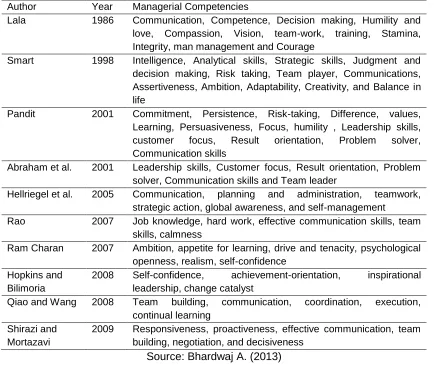
Author Year Managerial Competencies
Lala 1986 Communication, Competence, Decision making, Humility and love, Compassion, Vision, team-work, training, Stamina, Integrity, man management and Courage
Smart 1998 Intelligence, Analytical skills, Strategic skills, Judgment and decision making, Risk taking, Team player, Communications, Assertiveness, Ambition, Adaptability, Creativity, and Balance in life
Pandit 2001 Commitment, Persistence, Risk-taking, Difference, values, Learning, Persuasiveness, Focus, humility , Leadership skills, customer focus, Result orientation, Problem solver, Communication skills
Abraham et al. 2001 Leadership skills, Customer focus, Result orientation, Problem solver, Communication skills and Team leader
Hellriegel et al. 2005 Communication, planning and administration, teamwork, strategic action, global awareness, and self-management
Rao 2007 Job knowledge, hard work, effective communication skills, team skills, calmness
Ram Charan 2007 Ambition, appetite for learning, drive and tenacity, psychological openness, realism, self-confidence
Hopkins and Bilimoria
2008 Self-confidence, achievement-orientation, inspirational leadership, change catalyst
Qiao and Wang 2008 Team building, communication, coordination, execution, continual learning
Shirazi and Mortazavi
2009 Responsiveness, proactiveness, effective communication, team building, negotiation, and decisiveness
Source: Bhardwaj A. (2013)
In his paper on “Managerial Competencies and Organizations Performance”, Hawi et al., (2015)
provided a model on Managerial Competencies.
Figure 1. Managerial Competencies Model
Source: Hawi et al., (2015)
Licensed under Creative Common Page 191 Figure 2. Holistic-Domain Model of Managerial Competencies
Source: Asumeng (2014)
In his paper on “The Influence of the Factors of Managerial Competencies”, Yahya et al., (2012)
provided a model on this line.
Figure 3. The Influence of the Factors of Managerial Competencies
Source: Temtime et al., (2005) and Chye et al. (2010)
Olan et al., (2012) presented in the paper “An Empirical Testing of Managerial Competencies of Industrial Managers in Sichuan Province of China”, two Managerial Competencies models, as
Licensed under Creative Common Page 192 Figure 4. Iceberg Model of Managerial Competencies
Source: Tucker et al., (1994)
Competence iceberg model, on the other hand, divide competencies into two main categories, one upside water surface such as knowledge and skills and the other is below the surface that includes mainly viewpoint of value, self-image, character/personality, self-force/social motivation and so on (Liu, et. al, 2005).
Hellriegel et. al. (2005) recommended that to be a successful manager one needs to develop six core managerial competencies namely: Communication Competency, Planning and Administration Competency, Teamwork Competency, Strategic Action Competency, Global Awareness Competency, and Self-Management Competency. Current study primarily focuses on Planning and Administration Competency of Working managers.
Figure 5. A Model of Managerial Competencies
Source: Hellriegel et al., (2008)
Licensed under Creative Common Page 193 Table 3: Perspectives on managerial competencies model
Source: Mbokazi et al., (2004)
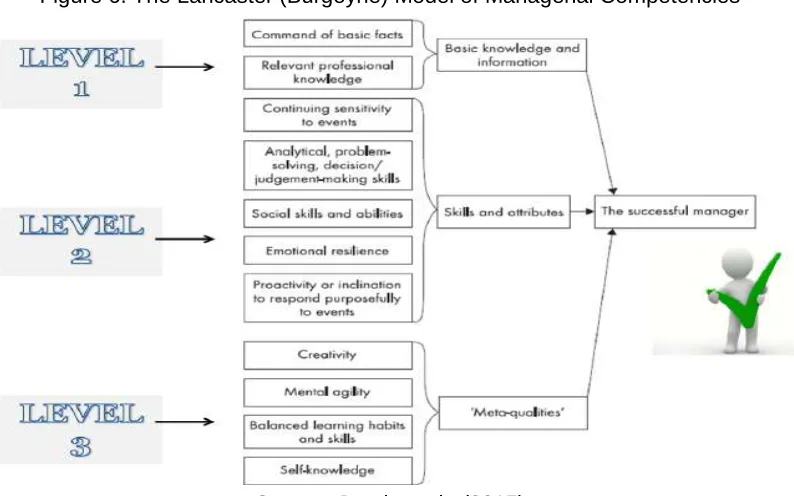
According to Jacob et al., (2015), paper “Competency mapping: a multidimensional competency based performance analysis framework”, presented: The Lancaster (Burgoyne) Model of
Managerial Competencies (Burgoyne and Stuart, 1976)
Figure 6. The Lancaster (Burgoyne) Model of Managerial Competencies
Licensed under Creative Common Page 194 McCarthy et al. (1999) in his paper “The grand model of managerial competence”, stated
competences are common for all the managers, who is responsible for resources of organization.
Table 4: The grand model of managerial competence
Source: McCarthy, M.A., Thomas, N.G. (1999)
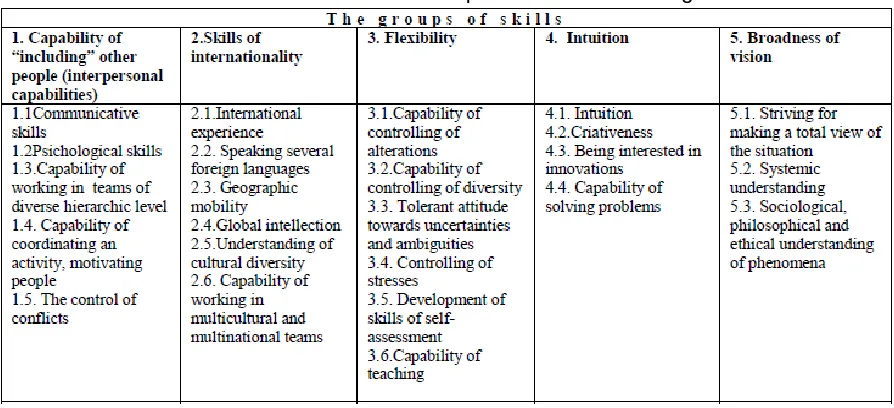
According to Kurschus et al., (2012), in the paper “The conception and models of managerial competence in modern theories of management”, propos two models (table 5 and figure 7) of
managerial competencies.
Table 5: The model of the competence of euro-manager
Licensed under Creative Common Page 195 Figure 7. The model of managerial competence
Source: Lindsay et al., (1997)
According to Collins et al. (1994), Dale (1990) available models of managerial competence being in their contemporary shape are still able to elucidate and define the manager‟s behavior
and skills, which are useful nowadays, whereas little attention is given to encouraging organizations to invest their resources in a rising, dynamic, flexible and conformist manager, who is capable to accept future challenges. Having summarized the attitudes of such authors as (Burgoyne, 1990; Spencer et al. 1993; Doyle, 1995; Siriwaiprapan, 1996; Lindsay et al. 1997; Nyhan, 1998; Clarke, 1998; McCarthy et al. 1999; Seige, 1999; Woodruffe, 2000; Cheetham et al. 2005; Ruth, 2006; Rappe et al. 2007; Brinckmann, 2008; Qiao et al. 2009; Heilmann et al. 2011) towards the models of managerial competence it is possible to maintain that the structure of managerial competence depends on a concrete situation, however, anyways it must include the following items: Common managerial and technical knowledge; Communicative skills; Psychological and behavioral abilities; Cognitive skills. Managerial competency has been studied from many perspectives in academic research, including: the impact of competency-based methodologies on HRD (Rothwell, Lindholm 1999); the role which competencies play in education and training field (Camuffo, Gerli 2004; Hansson 2001; Kersh Evans 2005; Tovey 2006); individual and contextual factors influence competency levels (Wickramasinghe, De Zoyza 2008; Agut et al. 2003); the competency approach to study entrepreneurial and leadership characteristics (Wickramaratne et al. 2014; Jena, Sahoo 2014; Quintana et al. 2014; Jantti, Greenhalgh 2012; Man et al. 2002; Schmitt-Rodermund 2004); the specific character of managerial competencies depending on the type of company, industry or market which the company operates in. (Cappellen, Janssens 2008; Suh et al. 2012; Trivellas, Drimoussis 2013; Chong 2013; Kożuch, Szczepańska-Woszczyna 2014; Vila et al. 2014), evaluation of behavior,
Licensed under Creative Common Page 196 CONCLUSION
The literature on managerial competencies is a wide area and it has been more actualized in recent years. This can especially be attributed to globalization, which has put strong pressure on management skills. Therefore, management competences have been put firmly on the research agenda. Some managers use the advantages that globalization offers with great success and others are not able to handle this situation. The interesting question is what makes some managers successful while others fail. Most progressive organizations today are using managerial competencies models to outline the key skills and behaviors they want to see in their supervisors, managers, and executives. Managerial competencies models can provide a structured framework for defining and developing those behaviors that have the biggest impact on an organization‟s performance. Managerial competencies identification and development
are important tools of human resources management that is aimed at achieving strategic organizational goals. The value of the managerial competencies model consists in its application and may be identified in particular.
A competency model describes a specific combination of knowledge, skills and other personality characteristics. They are necessary for the efficient execution of tasks in the organization. The competencies in a model may be organized in a variety of formats. Managerial competencies are not fixed and should correspond to the needs of the organization. Despite the variety of models of managerial competence they do not avoid being criticized. Nyhan (1998), Seige (1999), Ruth (2006) express the opinion that any set of managerial competence does not exhibit the role of a manager completely, because every activity needs the whole range of specific competences, which influence effectiveness of a concrete role. Besides, they noticed, that the generalities, which exist in managerial competences, are still sophistic improvements on the works written by Fayol (1949), where the work of manager and the skills connected with it are described while using four categories: planning, organization, coordination, and control. Competencies are different for the manager at the operational, tactical or strategic level. Therefore is necessary to shape managerial competence in varying degrees and quality. A successful organization is an organization where human resources have the required competencies to achieve business success and the strategic objectives of the organization. A competency model describes a specific combination of knowledge, skills and other personality characteristics. They are necessary for the efficient execution of tasks in the organization. The competencies in a model may be organized in a variety of formats.
Licensed under Creative Common Page 197 empirical on managerial competencies. Furthermore, it would be interesting to compare managerial competencies of private SME‟s managers between the public sector managers.
REFERENCES
Agut, S.; Grau, R.; Peiro, J. M. (2003). Competency needs among managers from Spanish hotels and restaurants and their trainings demands, Hospitality Management 22: 281–295. http://dx.doi.org/10.1016/S0278-4319(03)00045-8
Alec L. (2011). Measuring the Impact of A Managerial Competency System: Does Identifying And Rewarding Potential Leaders Improve Organizational Performance? Center for Effective Organizations Armstrong M. (2001).Handbook of Human Resource Practice (8th edn). London: Kogan Page.
Armstrong, M. (2006).A Hand Book of Human Resource Management Practices. London: Kogan Page Ltd. Ary, D., L.C. Jacons and A. Razavieh, 2002. Instruction to Research in Education. USA: Wadsworth/Thomson Learning Hopkins
Armstrong, M. and T. Stephens, (2008).Management a Leadership.Praha: Grada Publishing. ISBN 978-80-247-2177-4.
Asumeng M. (2014). Managerial Competency Models: A Critical Review and Proposed Holistic-Domain Model, Journal of Management Research ISSN 1941-899X, 2014, Vol. 6, No. 4
Asumeng M.A. (2014). What it means to work hard for career progression: a qualitative study among managers in Ghana. Journal of Management
Bhardwaj A. (2013). Managerial Competencies and their influence on managerial performance: A Literature review. International Journal of Advanced Research in Management and Social Sciences Vol. 2 | No. 5 | May 2013 www.garph.co.uk IJARMSS | 70 ISSN: 2278- 6236 http://www.academia.edu/5450517/Managerial_Competencies_And_Their_Influence_O
n_Managerial_Performance_A_Literature_Review_Introduction
Bongani M., Deléne V., Linda F. (2004). Management perceptions of competencies essential for middle managers, SA Journal of Industrial Psychology, 2004, 30 (1), 1-9
Boyatzis R.E. (2008). “Competencies in the 21st century”, Journal of Management Development, 25(7), 5–12
Boyatzis R.E., Goleman D., Acquisition H. ( 2007). Emotional and Social Competency Inventory, The Hay Group, Boston.
Boyatzis R.E., Saatcioglu (2008). “A twenty year view of trying to develop emotional, social and cognitive intelligence competencies in graduate management education”, Journal of Management Development, 27(3), 92–108.
Boyatzis RE, (1982). The Competent Manager: A model for Effective Performance, John Wiley & Sons, New York. Boyatzis RE.,;1; 2008. Competencies in the 21st century, J. Management Development, 27,1,5-12.
Boyatzis, R. E. (2009). Competencies as a behavioural approach to emotional intelligence.Journal of Management Development, 28(9), 749-770. http://dx.doi.org/10.1108/02621710910987647
Brinckmann, J. (2008). Competence of top management teams and the success of new technology based firms: a theoretical and empirical analysis concerning competencies of entrepreneurial teams and the development of their ventures. Wiesbaden: Gabler Publishing.
Burgoyne, D.G. (1990). An introduction to business decision-making. Toronto: Methuen.
Licensed under Creative Common Page 198 Cappellen, T.; Janssens, M. (2008). Global managers‟ career competencies, Career Development International 13(6): 514–537. http://dx.doi.org/10.1108/13620430810901679
Cheetham, G., Chivers, G. (2005). Professions, competence and informal learning. Cheltenham: Edward Elgar Publishing.
Clarke, J., Newman, J. (1997). The managerial state. London: Stage.
Collins, J., Porras, J. (1994). Built to last: successful habits of visionary companies. New York: Harper Business.
Dale, G. (1990). Management proven in the marketplace.Conference on Identifying and Applying Competencies within your Organization. London: Resources Ltd.
Doyle, M. (1995). Organizational transformation and renewal: a case for reframing management development. Personnel Review, 24(6), 36-45.
Draganidis, F., &Mentzas, G. (2006). Competency based management: a review of systems and approaches. Information Management &Computer Security, 14(1), 51-64.
Fayol, H. (1949). General and industrial management.In C. Storrs (Eds.). London: Pitman & Sons.
Hansson, B. (2001). Competency models: are self-perceptions accurate enough?, Journal of European Industrial Training 25(9): 428–441. http://dx.doi.org/10.1108/03090590110410205
Hawi R., Alkhodary D., Hashem T., (2015). International Journal of Management Sciences Vol. 5, No. 11, 2015, 723-735
Heilmann, P., Heilmann, J. (2011). Competence management in maintenance: case - Finnish forest company. Management Research Review, 35(1), 4-13.
Hellriegel, D., Jackson, S. E. & Slocum, J. W. (2002).Management.9th Edition.Cincinatti: South Western College Publishing
Hellriegel, D., Jackson, S. E., Slocum, J. W., Staude, G., Amos T., Klopper, H. B., Louw, I. &Oosthuizen, T. (2004).Management2nd South African Edition. Cape Town: Oxford University Press.
Hellriegel, D., Jackson, S.E. & Slocum, J.J. (2005). Management: A Competence-Based Approach. Singapore: Thomson South Western
Holtzman, D.M. and E.M. Kraft (2010). “Skills Required of Business Graduates: Evidence from Undergraduate Alumni and Employers,” Business Education & Accreditation, vol. 2(1), p. 49-76.
Hroník, F. (2007).Rozvoj a vzdělávánípracovníků, Grada Publishing, ISBN: 80-247-1457-4, Praha
Jantti, M.; Greenhalgh, N. (2012). Leadership competencies: a reference point for development and evaluation, Library Management 33(6/7): 421–428. http://dx.doi.org/10.1108/01435121211266249
Jena, S.; Sahoo, Ch. K. (2014). Improving managerial performance: a study on entrepreneurial and leadership competencies, Industrial and Commercial Training 46(3): 143–149. http://dx.doi.org/10.1108/ICT-10-2013-0066
Keerthy T. R., Nisha A. Jacob (2015). Competency mapping: a multidimensional competency based performance analysis framework, International Journal in Management and Social Science, Vol.03 Issue-02, ISSN: 2321-1784
Kersh, N.; Evans, K. (2005). Self-evaluation of tacit skills and competences of adult learners facilitating learning success and work re-entry, European Education 37(2): 87–98.
Kożuch, B.; Sienkiewicz-Małyjurek, K. (2014). New requirements for managers of public safety systems, Procedia – Social and Behavioral Sciences 149: 472–478.
Lala, R.M. (1986). In search of leadership, Vision books, New Delhi
Licensed under Creative Common Page 199 Lindsay, Ph. R., Stuart, R. (1997). Reconstruing competence. Journal of European Industrial Training, Vol. 21, No. 8-9, p. 32-38.
Liu Y. Olan, Bhawana S., Ilham S., Chee W. Ming (2012). An Empirical Testing of Managerial Competencies of Industrial Managers in Sichuan Province of China, International Journal of Independent Research and Studies Vol. 1, No.1; www.aiars.org/ijirs
Liu, X., Ruan, D., &Xu, Y. (2005).A study of enterprise human resource competence appraisement. Journal of Enterprise Information Management, 18(3), 289-315.
Luthans, F. (1998), “Successful vs. effective real managers”, Academy of Management Executive, Vol. 10, No. 2, pp. 127-132.
Man, T. W. Y.; Lau, T.; Chan, K. F. (2002). The competitiveness of small and medium enterprises: a conceptualization with focus on entrepreneurial competencies, Journal of Business Venturing 17(2): 123– 142. http://dx.doi.org/10.1016/S0883-9026(00)00058-6
Martina K. Hana U. Jirl F.(2012). Identification of Managerial Competencies in Knowledge-based Organizations.Journal of Competitiveness.Vol. 4, Issue 1, pp. 129-142, March 2012
McCarthy, M.A., Thomas, N.G. (1999). Developing self-awareness in the managerial career development process: the value of 360-degree feedback and the MBTI.Journal of European Industrial Training, Vol 23, Issue 9.
McClelland, D. C. (1975). Power: the inner experience. New York, NY: Irvington Publishers.
Moradi, F.; Jajarmizadeh, M.; Nikkar, M.; Abbasi, N. (2011). Evaluation of behavior, skills and commitment, management, Advances in Management & Applied Economics 1(2): 169–183.
Nyhan, B. (1998). Competence Development as a Key Organizational Strategy – Experiences of European Companies. Industrial & Commercial Training, 30(7), 59-68.
Qiao, J.X, Wang, W. (2009). Managerial competencies for middle managers: some empirical findings from China. Journal of European Industrial Training, 33(1), 69-81.
Quintana, C. D. D.; Ruiz, J.-G.M.; Vila, L. E. (2014). Competencies which shape leadership, International Journal of Manpower 35(4): 514–535. http://dx.doi.org/10.1108/IJM-05-2013-0107
Rajadhyaksha U., Managerial Competence (2005). Do Technical Capabilities Matter?,Vikalpa, Vol.30., No.2
Ralph-JörnKurschus, VaidaPilinkienė (2012). The conception and models of managerial competence in modern theories of management, Journal of Management, ISSN 1648-7974
Rappe, Ch., Zwick, T. (2007).Developing leadership competence of production unit managers. Journal of Management Development, 26(4), 312-330.
Rothwell, W. J. &Lindholm, J. E. (1999).Competency Identification Modelling and Assessment in the yUSA. International Journal of Training and Development, 3 (2), 90-105.
Ruth, D. (2006). Frameworks of managerial competence: limits, problems and suggestions. Journal of European Industrial Training, 30(3), 206-226.
Schmitt-Rodermund, E. (2004). Pathways to successful entrepreneurship: parenting, personality, early entrepreneurial competence, and interests, Journal of Vocational Behavior 65(3): 498–518. http://dx.doi.org/10.1016/j.jvb.2003.10.007
Seige, G. (1999). Clarifying The Use of Competence and Competency Models in Recruitment, Assessment and Staff Development. Industrial & Commercial Training, 27(11), 5-12.
Shirazi Ali and MortazviSaeed (2009). “Effective management performance a competency based perspective”, International Review of Business Research Papers, Vol. 5, No. 1, pp. 1-10.
Licensed under Creative Common Page 200 Smart, Bradfort D. (1999). Top grading: how leading companies win by hiring, coaching and keeping the best people, Englewood Cliffs: Prentice Hall, New York
Spencer L.M.Jr., Spencer S.M. (1993). Competence at Work: Models for Superior Performance, John Wiley & Sons, New York.
Talukder, D., & Hawkins, B. (2014). Managerial skills and competencies in New Zealand organisations: a cause for concern. International Journal of Economics and Business Research, 8(2), 125-142.
Tovey, L. (2006). Meeting business and management training and development needs through competency assessment, Strategic Change 3(2): 71–86. http://dx.doi.org/10.1002/jsc.4240030204
Tripathi K., Agrawal M.(2014).Competency Based Management In Organizational Global Journal of Finance and Management. ISSN 0975-6477 Volume 6, Number 4 (2014), pp. 349-356 Research India Publications http://www.ripublication.com
Trivellas, P.; Drimoussis, Ch. (2013).Investigating leadership styles, behavioural and managerial competency profiles of successful project managers in Greece, Procedia – Social and Behavioral Sciences 73: 692–700.
Tucker, S. A. &Cofsky, K. M. (1994).Competency-Based Pay on a Banding Platform. ACA Journal, 3(1), pp. 30-45.
Wickramaratne, A.; Kiminami, A.; Yagi, H. (2014). Entrepreneurial competencies and entrepreneurial orientation of tea manufacturing firms in Sri Lanka, Asian Social Science 10(18): 50–62. http://dx.doi.org/10.5539/ass.v10n18p50
Wickramaratne, A.; Kiminami, A.; Yagi, H. (2014). Entrepreneurial competencies and entrepreneurial orientation of tea manufacturing firms in Sri Lanka, Asian Social Science 10(18): 50–62. http://dx.doi.org/10.5539/ass.v10n18p50
Woodruffe, Ch. (2000). Development and assessment centres: identifying and assessing competence, 3rd ed. London: Institute of Personnel and Development.
Wu, W., W., Lee, Y., T., &Tzeng, G., H., (2005). Simplifying Managerial Competency Model by using Rough Set, in Rough Sets, Fuzzy sets, Data Mining & Granular Computing, Springer Berling
Yahya H., Khaled E. (2012). The Influence of the Factors of Managerial Competencies among SMEs inSelangor, Malaysia A Preliminary Study of Human Resources, Australian Journal of Basic and Applied Sciences, 6(13): 123-134, ISSN 1991-8178