Impulsivity,
“
Advergames,
”
and Food Intake
WHAT’S KNOWN ON THIS SUBJECT: Previous studies have shown that food advertisements influence caloric intake among children. However, individual susceptibility to food advertisements has not been examined thoroughly.
WHAT THIS STUDY ADDS: This study examines the role of impulsivity in the effect of food advertisements. An advergame promoting snacks overruled refraining from eating, especially among impulsive children. Thefindings suggest that impulsivity plays an important role in susceptibility to food advertisements.
abstract
BACKGROUND AND OBJECTIVES:Previous studies have focused on the effect of food advertisements on the caloric intake of children. However, the role of individual susceptibility in this effect is unclear. The aim of this study was to examine the role of impulsivity in the effect of advergames that promote energy-dense snacks on children’s snack intake.
METHODS: First, impulsivity scores were assessed with a computer task. Then a randomized between-subject design was conducted with 261 children aged 7 to 10 years who played an advergame promoting either energy-dense snacks or nonfood products. As an extra manipulation, half of the children in each condition were rewarded for refraining from eating, the other half were not. Children could eat freely while playing the game. Food intake was measured. The children then completed questionnaire measures, and were weighed and measured.
RESULTS: Overall, playing an advergame containing food cues in-creased general caloric intake. Furthermore, rewarding children to refrain from eating decreased their caloric intake. Finally, rewarding impulsive children to refrain from eating had no influence when they were playing an advergame promoting energy-dense snacks, whereas it did lead to reduced intake among low impulsive children and children who played nonfood advergames.
CONCLUSIONS:Playing an advergame promoting energy-dense snacks contributes to increased caloric intake in children. The advergame promoting energy-dense snacks overruled the inhibition task to refrain from eating among impulsive children, making it more difficult for them to refrain from eating. Thefindings suggest that impulsivity plays an important role in susceptibility to food advertisements. Pediatrics 2014;133:1007–1012
AUTHORS:Frans Folkvord, MD,aDoeschka J. Anschütz, PhD,aChantal Nederkoorn, PhD,bHenk Westerik, PhD,aand Moniek Buijzen, PhDa
aBehavioural Science Institute, Radboud University, Nijmegen,
Netherlands; andbDepartment of Psychology and Neuroscience,
Maastricht University, Maastricht, Netherlands
KEY WORDS
food advertisements, advergames, impulsivity, caloric intake, children, obesity
ABBREVIATIONS
kcal—kilocalories VAS—visual analogue scale
Mr Folkvord conceptualized and designed the study, collected the data, carried out the analyses, and drafted the initial manuscript; Drs Anschütz, Nederkoorn, and Westerik, and Prof Dr Buijzen conceptualized and designed the study and critically reviewed the manuscript; and all authors approved the
final manuscript as submitted.
This trial has been registered with the Australian New Zealand Clinical Trials Registry (identifier ACTRN12613000035729). www.pediatrics.org/cgi/doi/10.1542/peds.2013-3384 doi:10.1542/peds.2013-3384
Accepted for publication Feb 27, 2014
Address correspondence to Frans Folkvord, MD, Behavioural Science Institute, Radboud University Nijmegen, Thomas van Aquinostraat 2, 6526 GD Nijmegen, Netherlands. E-mail: [email protected]
PEDIATRICS (ISSN Numbers: Print, 0031-4005; Online, 1098-4275). Copyright © 2014 by the American Academy of Pediatrics
FINANCIAL DISCLOSURE:The authors have indicated they have nofinancial relationships relevant to this article to disclose.
FUNDING:This research was granted by the Behavioural Science Institute, Radboud University Nijmegen.
POTENTIAL CONFLICT OF INTEREST:The authors have indicated they have no potential conflicts of interest to disclose.
Although the causes of this trend are multifaceted, there is growing evidence that food commercials are a major contributor.2Food consumption can be
activated by salient environmental cues in an automatic and difficult to control way.3 Content analyses reveal that the
majority of food products promoted are energy-dense and high in fat, sugar, and/or salt, which is in sharp contrast to (inter)national dietary guidelines.2
Cue reactivity theory states that food cues induce craving for food and actual eating behavior owing to the presence of sensory inputs associated with past consumption.4,5The sight, smell, or
thought of tasty food induces appetite, and insuffcient inhibitory control causes failure in inhibition, leading to increased food intake.6,7 Impaired behavioral
in-hibition (ie, impulsivity) might make it more difficult for children to resist the temptation of energy-dense food.8,9
Im-pulsivity is generally defined as the tendency to control, think, and plan in-sufficiently.10Two aspects of impulsivity
can be distinguished: insufficient in-hibitory behavioral control and re-ward sensitivity or the inability to delay reward.11Being able to control
impul-sive behaviors can be an important explanation for the individual suscep-tibility to food advertisements, but this has not been examined before.
The objective of this study is to examine the role of impulsivity in the effect of adver-games promoting energy-dense snacks on children’s snack consumption. Adver-games are online electronic Adver-games that are used to advertise a product or a brand.12–14Online games provide a highly
involving, interactive, and entertaining brand experience.12We hypothesize that
(H1) playing advergames promoting energy-dense snacks increases caloric intake, (H2a) stimulating response in-hibition by rewarding refraining from eating decreases caloric intake, and (H2b)
intake when they play a nonfood adver-game than when they play a food advergame. We also expect that (H3) impulsive children eat more. Specifi -cally, we expect (H4) that rewarding refraining will have less influence on high impulsive children, especially when they are playing a food advergame.
METHODS
Study Design
We used a factorial between-subject de-sign: 2 (type of advergame: energy-dense
snacks versus nonfood products)32
(inhibition task: reward to refrain from
eating versus no reward) 3 2
(im-pulsivity: high versus low). The depen-dent variable was caloric intake. While playing, 2 bowls of energy-dense snacks were presented: (1) jelly candy (cola bottles) and (2) milk chocolate candy shells. The jelly candy were identical to 1 of the food products shown in the advergame promoting energy-dense snacks.
We counterbalanced and randomly as-signed children to 1 of 4 conditions, which involved playing1the energy-dense
snacks advergame (ie, promoting a pop-ular candy brand and 8 different sweets from this candy brand) without the in-hibition task2; the energy-dense snacks
advergame with the inhibition task3; the
nonfood advergame (ie, promoting a popular Dutch toy brand and 8 in-dividual toys from this brand) without the inhibition task4; and the nonfood
advergame with the inhibition task. All games were identical, except for the advertised brands and products. The game involved an online memory game with 16 cards, whereby brand name and logos appeared on the back of the cards, and the individual products appeared on the front. These products clearly displayed the brand logos. For the candy products we used high-quality images of gummy cola bottles, bananas,
used images of a trampoline, keyboard, basketball, teddy bear, drum kit, and other toys from this brand. Cards were laid out in a grid face down. On each turn, the child turned 1 card over, then a second. If the 2 cards matched, they remained open. If they did not match, the cards were turned back over and the child got another turn. The goal was to match the pairs of cards. When cards were turned over, it was important to remember where they were for when the matching card turned up later in the game. To enhance awareness of the brand, we showed it on the right side of the screen. To immerse the children into the game by exerting time pressure with a digital timer top-left of the screen and a time bar top-center of the screen. Furthermore, the game played an un-pleasant sound when a child selected a false pair and a pleasant sound with a correct pair. The experimenter left the room every time the children played the advergame.
Measures
Impulsivity
Impulsivity is a multifaceted construct, in which roughly 2 aspects can be dis-tinguished: reward sensitivity and in-sufficient inhibitory behavioral control.15
To measure impulsivity we used the door-opening task, which has been specially developed to measure reward sensitivity in young individuals, differ-entiating between normal children and children who have impulsive disorders like attention deficit hyperactivity dis-order and conduct disdis-order.16–19 The
chance of winning, which decreased with 10% after every 10 doors. The chance was therefore 50% after 40 doors, being the most profitable moment to stop the game. Children who opened more than 40 doors were considered as highly im-pulsive. Because the child’s aim was to earn as many points as possible, he or she should quit opening doors once the probability of a winning door dropped below 50%. When children continued the game, the chances of losing increased and winning decreased. If the child keeps opening doors in search for reward de-spite punishment, the reward system is considered dominant.19
BMI
We calculated BMI, measured as weight (kg)/height2(m). We measured weight to
the nearest 0.1 kg and height to the nearest 0.5 cm while the children were wearing clothing but no shoes. We calculated whether the children were underweight, normal weight, overweight, or obese using international cut-off scores.20
Caloric Intake
We weighed the amount of snack food that a child ate before each child en-tered the room and again after eating. We used a professional balance scale to estimate to the nearest 0.1 g. We cal-culated the number of grams that a child ate in kilocalories (kcal) for use as a dependent measure. The amount of energy-dense snack food that a child ate was the sum of the caloric intake of jelly candy and milk chocolate candy.
Hunger
We controlled for individual differences in hunger by presenting the children with a visual analog scale (VAS; 14 cm) measuring the extent to which they felt hungry before the experiment began. The anchors were “not hungry at all” and“very hungry.”VAS’s have been used successfully and extensively to assess
subjective appetite sensations, like hun-ger, prospective food consumption, and fullness in children.14,21–23Furthermore,
VAS was compared with Likert scale measurements among children and found to be of comparable reliability.24
Attitude toward brand and foods shown in the advergames was assessed with 6 items (nice, stupid, tasteful, untasteful, cool, boring) on a VAS scale. This measurement has been established by Holbrook and Batra,25and tested extensively among
(young) children14,26At the end of the
experiment, we asked the children to indicate the goal of the research, but no child gave the correct answer.
Subjects
Subjects were 266 children (grades
2–3) from 5 primary schools in the
Netherlands. We obtained approval from the institute’s ethical committee for social sciences and obtained in-formed consent from the schools and parents. More than 93% of the children were allowed to participate. Data col-lection occurred between January 2013 and March 2013. The experimenter brought 1 child to a separate classroom containing a computer where they started with an online questionnaire to assess gender, age, and pre-experimental hunger. Subsequently the child conducted the door-opening task and after this task played 1 version of the advergames. The child was instructed that (s)he would be playing a memory game for 5 minutes and should attempt tofinish as many games as possible, which were unlimited. Then the experimenter placed the bowls with food and a glass of water at the same table as the computer. The experimenter told the children without the inhibition task that (s)he could eat as much as (s)he wanted, and the children with the inhibition task that (s)he could eat as much as (s)he wanted but that if (s)he would eat nothing (s)he would get a reward afterward. Further instructions stated that after each game, the time bar
would stop, and the score would appear; then the time would continue when the new game started. The child signaled the experimenter when the game stopped after 5 minutes. To give the children an opportunity to snack, the children had a small break of 30 seconds after 2fi n-ished games before they could start the next game. Subsequently, the second part of the questionnaire wasfilled out and length and height were measured. The experimenter asked all children to refrain from discussing the experiment with their classmates. After all children had finished participation, they were allowed to choose a pencil as reward. The chil-dren did not receive the reward imme-diately after the experiment and all children got the reward. After each ses-sion, the experimenter weighed the bowls to calculate caloric intake and refilled them before the next child entered.
Statistical Analysis
Randomization checks using a 1-factor ANOVA were conducted for gender, hun-ger, age, BMI, impulsivity, and kcal energy intake (Table 1). Outlying scores on ca-loric intake were examined by comput-ing residual scores and testcomput-ing them for Mahal’s distance, Cook’s distance, and leverage scores, showing no indications for outlying scores. The main effects of type of advergame, impulsivity, and in-hibition task were tested with analysis of covariance. An additional analysis of co-variance tested the interaction effects be-tween type of advergame, inhibition task, and impulsivity. Bonferroni-corrected post hoc test was used to examine the differences between the experimental conditions. We calculated effect sizes for Cohen’sfand Cohen’sd.
RESULTS
Descriptives
Thefinal sample consisted of 261 dren, 50.2% boys. We excluded 5 chil-dren from the analyses because they had notfinished the session (n= 3) or
teachers had interrupted (n= 2). In our sample, 3.8% of children were un-derweight, 71.3% normal weight, 18.4% overweight, and 6.5% obese.
We found no differences between the experimental conditions for gender, hunger, BMI, age, and impulsivity. Brand recognition and attitudes toward the game, striving for the reward, and how much they wanted the reward did not differ between the type of advergame.
Main Analyses
Results confirmed ourfirst hypothesis
1H showing a significant effect of type
of advergame on caloric intake (P, 0.01) (Table 2). Children who played an advergame promoting energy-dense snacks ate significantly more (P , 0.01) than children who played an advergame promoting nonfood prod-ucts. Children who were hungrier ate
more (P,0.05). Hypothesis H2a was
also confirmed, showing a significant effect of the inhibition task on caloric intake (P,.01). Children who played 1 of the advergames without the in-hibition task ate more than the chil-dren who played an advergame with the inhibition task. The post hoc results confirmed H2b, showing that children who played the advergame promoting energy-dense snacks with the in-hibition task ate significantly more
(P , 0.01) than the children who
played the nonfood advergame with the inhibition task. Furthermore, we found that children who played the adver-game promoting energy-dense snacks with the inhibition task had a lower
caloric intake (P , 0.01) compared
with children who played the adver-game promoting energy-dense snacks without the inhibition task. Children who played the advergame promoting nonfood products with the inhibition task ate less (P,0.01) than children who played the nonfood advergame without the inhibition task. In contrast with H3, which stated that impulsive children would eat more, we found no effect for impulsivity (P.0.05).
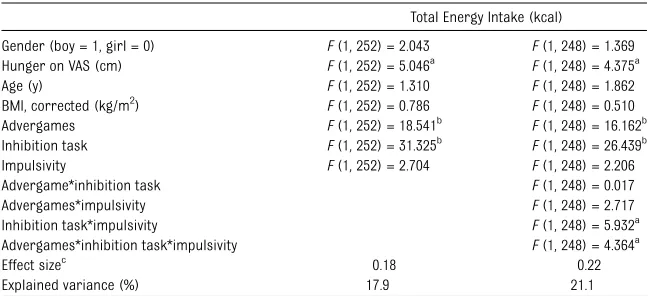
Finally, we expected (H4) that rewarding refraining would have less influence on high impulsive children, particularly when they were playing an advergame promoting energy-dense snacks. Results showed that the 3-way interaction was significant (P,0.05), shown in Table 2. Bonferroni corrected post hoc test (Ta-ble 3) showed that there was no differ-ence for general caloric intake (P..05) between the high impulsive children who played the advergame promoting energy-dense snacks with the inhibition task
compared with the children without the inhibition task. In contrast, results showed that impulsive children who played the advergame promoting non-food products with the inhibition task had a significantly lower caloric intake (P, 0.05) than those without the in-hibition task. Low impulsive children who played the advergame promoting energy-dense snacks with the inhibition task had a significantly lower caloric intake (P,.01) than those without the inhibition task. Finally, low impulsive children who played the advergame promoting nonfood products with the inhibition task had a lower caloric in-take (P,.01) than the children who did not have this inhibition task.
DISCUSSION
This is thefirst study examining the role of impulsivity in the effect of food advertisements on actual snack intake
Inhibition Task (n= 69) Inhibition Task (n= 65) Task (n= 62) Task (n= 65) Gender (boy = 1, girl = 0) 0.55 (0.5) 0.43 (0.5) 0.47 (0.5) 0.54 (0.5)
Hunger on VAS (cm) 2.8 (3.6) 3.7 (3.9) 3.6 (4.5) 3.2 (4.0)
Age (y) 7.8 (0.8) 7.8 (0.7) 7.7 (0.7) 7.6 (0.7)
BMI, corrected (kg/m2) 1.25 (0.4) 1.29 (0.5) 1.16 (0.4) 1.29 (0.5)
Impulsivity 39.3 (28.9) 38.8 (26.2) 36.9 (28.5) 36.9 (25.5)
Total energy intake (kcal) 156.3 (135.2) 87.3 (114.3) 101.3 (74.1) 33.2 (74.4)
TABLE 2 Results From 2 Univariate Analyses of Covariance With Total Energy Intake as a Dependent Variable (n= 261)
Total Energy Intake (kcal)
Gender (boy = 1, girl = 0) F(1, 252) = 2.043 F(1, 248) = 1.369 Hunger on VAS (cm) F(1, 252) = 5.046a
F(1, 248) = 4.375a
Age (y) F(1, 252) = 1.310 F(1, 248) = 1.862 BMI, corrected (kg/m2) F(1, 252) = 0.786 F(1, 248) = 0.510 Advergames F(1, 252) = 18.541b F(1, 248) = 16.162b Inhibition task F(1, 252) = 31.325b F(1, 248) = 26.439b Impulsivity F(1, 252) = 2.704 F(1, 248) = 2.206 Advergame*inhibition task F(1, 248) = 0.017
Advergames*impulsivity F(1, 248) = 2.717
Inhibition task*impulsivity F(1, 248) = 5.932a Advergames*inhibition task*impulsivity F(1, 248) = 4.364a Effect sizec
0.18 0.22
Explained variance (%) 17.9 21.1
among young children. We found that food cues in advergames triggered eating behavior and that rewarding children to refrain from eating decreased caloric intake in both types of advergames, thereby supporting hypotheses 1 and 2a. From the children who were rewarded, children who played the food advergame ate more than the children who played the nonfood advergame, confirming hypoth-esis 2b. Impulsive children did not eat more than less impulsive children, which refutes hypothesis 3. Finally, we found that rewarding children to refrain from eating had less influence on high impul-sive children than on low impulimpul-sive chil-dren, especially when they were playing an advergame promoting energy-dense snacks, supporting hypothesis 4. These findings imply that impulsive children have difficulties self-regulating their caloric intake during a food advertise-ment when they are rewarded to refrain from eating, but not when they are facing a nonfood advertisement. Furthermore, we found that less impulsive children had a lower caloric intake when they were rewarded to refrain from eating in both type of advergames. These latter findings mark the individual suscepti-bility to food advertising, which is a very interesting insight.
Cue reactivity theory states that food-related cues (eg, the sight or smell of food) act as conditioned stimuli that trigger conditioned responses, like craving and actual eating behavior.4
This may mean that exposure to food-related cues results in cephalic phase responses and strong desires to eat, preparing children for food intake.
In-creased impulsivity might make it more difficult for children to resist the temptation of energy-dense food when craving for food is elicited by food commercials. This reasoning is in line with our hypotheses and earlier fi nd-ings.8,27,28 A remarkable finding was
that low impulsive children playing the energy-dense advergame ate more than high impulsive children playing the same game when they were not asked to refrain from eating. A possible explanation is that conducting sub-sequent tasks may have led to a state of ego depletion. The high impulsive chil-dren did not inhibit their responses during the impulsivity task to the same extent as the low impulsive children. The latter were more successful in inhibiting their responses during the impulsivity task. Consequently, after successfully controlling reward sensi-tivity during the impulsivity task, a de-crease in self-control could have occurred among the low impulsive children.29
Besides the large sample size, a strength of this study is its high external validity, as the advergames used are identical or comparable to advergames used by many (food) companies. Advergames are interactive entertainment, which makes it more difficult for children to recognize commercial message in the game. Be-cause cognitive capacity is directed to playing the game, there is not enough capacity to think critically about the pur-pose of the game.30Moreover, we were
able to test a large number of children and we successfully manipulated re-sponse inhibition so that we could con-duct adequate analyses to examine
the role of self-regulation when stimulated to inhibit responses dur-ing a food commercial.
CONCLUSIONS
This study showed that exposure to food cues in advergames influences caloric intake and that these food cues hamper self-regulation when young children are rewarded to refrain from eating. Children who played the advergame promoting energy-dense snacks did not report less motivation to self-regulate response in-hibition, so an explanation could be that the food cues in the advergame signaled food intake, which led to failures in self-regulation of snack intake. Furthermore, impulsive children showed more diffi -culties in refraining from eating while playing an advergame promoting energy-dense snacks, supporting concerns from scholars that food commercials con-tribute to vulnerable children’s snack-ing.13 Future research should focus on
whether children can be tutored by their parents to self-regulate their snack intake during or after advertising ex-posure. Active advertising-related par-enting training children to cope with persuasive intentions of food adver-tisements can reduce undesired ad-vertising effects.31Studies have shown
that training self-regulation to control impulses for food is successful in learn-ing adolescents and adults to control their food intake after temptations and tempting snacks,32,33so we might expect
that children can also be trained to self-regulate their snack intake. Afinal rec-ommendation to parents is reducing the availability of snack foods at home.
TABLE 3 Adjusted Means and SDs of Food Intake (in kcal) Controlled for Gender, Hunger, and Age, By Condition and Impulsivity (n= 261)
Low Impulsivitya High Impulsivityb
No Inhibition Task With Inhibition Task No Inhibition Task With Inhibition Task
Advergame promoting energy-dense snack 203.0*616.4 (n= 37) 76.7†616.0 (n= 39) P,.001 104.6*618.1 (n= 31) 94.6†619.9 (n= 26) P..05 Advergame promoting nonfood products 101.9‡615.9 (n= 40) 32.4x615.5 (n= 42) P,.001 99.4‡621.4 (n= 23) 39.2x621.0 (n= 23) P,.05
aANOVA post hoc pairwise comparisons (Bonferroni) with food intake as the dependent variable showed significant differences between * and†(P,.001, Cohen’sd= 0.97), and between‡and
x(P,.001, Cohen’sd= 0.91).
bANOVA post hoc pairwise comparisons (Bonferroni) with food intake as the dependent variable showed no significant differences between * and†(P..05), and showed a significant
difference between‡andx(P,.05, Cohen’sd= 0.81).
obesity.Lancet. 2010;375(9727):1737–1748
2. World Health Organization.WHO Report on Diet, Nutrition and the Prevention of Chronic Disease. Joint WHO/FAO Expert Consulta-tion WHO Technical Report Series. Geneva, Switzerland: World Health Organization; 2003
3. Cohen DA. Neurophysiological pathways to obesity: below awareness and beyond in-dividual control.Diabetes. 2008;57(7):1768– 1773
4. Coelho JS, Jansen A, Roefs A, Nederkoorn C. Eating behavior in response to food-cue exposure: examining the cue-reactivity and counteractive-control models. Psychol Ad-dict Behav. 2009;23(1):131–139
5. Jansen A. A learning model of binge eating: cue reactivity and cue exposure.Behav Res Ther. 1998;36(3):257–272
6. Jansen A, Nederkoorn C, van Baak L, Keirse C, Guerrieri R, Havermans R. High-restrained eaters only overeat when they are also im-pulsive.Behav Res Ther. 2009;47(2):105–110
7. Hofmann W, Malte F, Roefs A. Three ways to resist temptation: the independent con-tributions of executive attention, inhibitory control, and affect regulation to the im-pulse control of eating behavior.J Exp Soc Psychol. 2009;45:431–435
8. Nederkoorn C, Guerrieri R, Havermans RC, Roefs A, Jansen A. The interactive effect of hunger and impulsivity on food intake and purchase in a virtual supermarket. Int J Obes (Lond). 2009;33(8):905–912
9. Lawrence NS, Hinton EC, Parkinson JA, Lawrence AD. Nucleus accumbens response to food cues predicts subsequent snack consumption in women and increased body mass index in those with reduced self-control.
Neuroimage. 2012;63(1):415–422
10. Solanto MV, Abikoff H, Sonuga-Barke E, et al. The ecological validity of delay aver-sion and response inhibition as measures of impulsivity in AD/HD: a supplement to the NIMH multimodal treatment study of AD/HD.J Abnorm Child Psychol. 2001;29(3): 215–228
11. Dougherty DM, Mathias CW, Marsh DM, Jagar AA. Laboratory behavioral measures of impulsivity.Behav Res Methods. 2005;37 (1):82–90
12. Culp J, Bell RA, Cassady D. Characteristics of food industry web sites and “
adver-”
Behav. 2010;42(3):197–201
13. Nairn A, Hang H. Advergames: it’s not child’s play. A review of research. Family and parenting institute 2012. Available at: www. agnesnairn.co.uk/policy_reports/advergames-its-not-childs-play.pdf. Accessed June 28, 2013
14. Folkvord F, Anschütz DJ, Buijzen M, Valkenburg PM. The effect of playing advergames that promote energy-dense snacks or fruit on actual food intake among children.Am J Clin Nutr. 2013;97(2):239–245
15. Guerrieri R, Nederkoorn C, Jansen A. The interaction between impulsivity and a var-ied food environment: its influence on food intake and overweight.Int J Obes. 2008;32 (4):708–714
16. Daugherty TK, Quay HC. Response persev-eration and delayed responding in child-hood behavior disorders. J Child Psychol Psychiatry. 1991;32(3):453–461
17. Matthys W, van Goozen SHM, de Vries H, Cohen-Kettenis PT, van Engeland H. The dominance of behavioural activation over behavioural inhibition in conduct disor-dered boys with or without attention deficit hyperactivity disorder. J Child Psychol Psychiatry. 1998;39(5):643–651
18. Shapiro SK, Quay HC, Hogan AE, Schwartz KP. Response perseveration and delayed responding in undersocialized aggressive conduct disorder.J Abnorm Psychol. 1988; 97(3):371–373
19. Nederkoorn C, Braet C, Van Eijs Y, Tanghe A, Jansen A. Why obese children cannot resist food: the role of impulsivity. Eat Behav. 2006;7(4):315–322
20. Cole TJ, Bellizzi MC, Flegal KM, Dietz WH. Establishing a standard definition for child overweight and obesity worldwide: in-ternational survey. BMJ. 2000;320(7244): 1240–1243
21. Dodd CJ, Welsman JR, Armstrong N. Energy intake and appetite following exercise in lean and overweight girls.Appetite. 2008;51 (3):482–488
22. Moore MS, Dodd CJ, Welsman JR, Armstrong N. Short-term appetite and energy intake following imposed exercise in 9- to 10-year-old girls.Appetite. 2004;43(2):127–134
23. Rumbold PLS, Dodd-Reynolds CJ, Stevenson E. Agreement between paper and pen
vi-based electronic appetite rating system (PRO-Diary©), for continuous monitoring of free-living subjective appetite sensations in 7-10 year old children. Appetite. 2013;69: 180–185
24. van Laerhoven H, van der Zaag-Loonen HJ, Derkx BH. A comparison of Likert scale and visual analogue scales as response options in children’s questionnaires.Acta Paediatr. 2004;93(6):830–835
25. Holbrook MB, Batra R. Assessing the role of emotions as mediators of consumer re-sponses to advertising.J Consum Res. 1987; 14(3):404–420
26. Panic K, Cauberghe V, de Pelsmacker P. Comparing TV ads and advergames tar-geting children: the impact of persuasion knowledge on behavioral responses.J Ad-vert. 2013;42(2–3):264–273
27. Jasinska AJ, Yasuda M, Burant CF, et al. Impulsivity and inhibitory control deficits are associated with unhealthy eating in young adults. Appetite. 2012;59(3):738– 747
28. Francis LA, Susman EJ. Self-regulation and rapid weight gain in children from age 3 to 12 years.Arch Pediatr Adolesc Med. 2009; 163(4):297–302
29. Baumeister RF. Yielding to temptation: self-control failure, impulsive purchasing, and consumer behavior.J Consum Res. 2002;28 (4):670–676
30. Rozendaal E, Lapierre MA, van Reijmersdal EA, Buijzen M. Reconsidering advertising literacy as a defense against advertising effects. Media Psychol. 2011;14(4):333– 354
31. Buijzen M. The effectiveness of parental communication in modifying the relation between food advertising and children’s consumption behaviour.Br J Dev Psychol. 2009;27(Pt 1):105–121
32. Kroese FM, Adriaanse MA, Evers C, De Ridder DTD.“Instant success”: turning temp-tations into cues for goal-directed behavior.
Pers Soc Psychol Bull. 2011;37(10):1389– 1397
DOI: 10.1542/peds.2013-3384 originally published online May 5, 2014;
2014;133;1007
Pediatrics
Moniek Buijzen
Frans Folkvord, Doeschka J. Anschütz, Chantal Nederkoorn, Henk Westerik and
Impulsivity, ''Advergames,'' and Food Intake
Services
Updated Information &
http://pediatrics.aappublications.org/content/133/6/1007
including high resolution figures, can be found at:
References
http://pediatrics.aappublications.org/content/133/6/1007#BIBL
This article cites 31 articles, 3 of which you can access for free at:
Subspecialty Collections
http://www.aappublications.org/cgi/collection/obesity_new_sub
Obesity
http://www.aappublications.org/cgi/collection/nutrition_sub
Nutrition
http://www.aappublications.org/cgi/collection/media_sub
Media
following collection(s):
This article, along with others on similar topics, appears in the
Permissions & Licensing
http://www.aappublications.org/site/misc/Permissions.xhtml
in its entirety can be found online at:
Information about reproducing this article in parts (figures, tables) or
Reprints
http://www.aappublications.org/site/misc/reprints.xhtml
DOI: 10.1542/peds.2013-3384 originally published online May 5, 2014;
2014;133;1007
Pediatrics
Moniek Buijzen
http://pediatrics.aappublications.org/content/133/6/1007
located on the World Wide Web at:
The online version of this article, along with updated information and services, is
by the American Academy of Pediatrics. All rights reserved. Print ISSN: 1073-0397.